CBS LATE MOVIE: Are You In the House Alone? (1978)

EDITOR’S NOTE: Are You In the House Alone? was on the CBS Late Movie on September 25, 1981, December 9, 1983 and August 10, 1984.

Any time people wonder why women keep pushing harder and harder for their inalienable rights, you should force them to watch this movie, which shows how far our society has come since 1978. There’s a scene in here that literally made us start yelling at the TV set because of how insane it is. Yet forty years ago, this type of thinking was commonplace.

Originally airing on CBS on September 20, 1978, Are You In the House Alone? It is based on the 1976 novel of the same name by Richard Peck.

Gail Osborne (Kathleen Beller, Dynasty) is a high school student dealing with all the pressures of being sixteen, such as discovering her skills as a photographer and dealing with boys who only want sex. Her family has moved away from San Francisco to a new town to escape the dangers of the big city.

She starts dating a guy named Steve (Scott Colomby, Tony from Caddyshack), despite her overprotective parents (Blythe Danner and Tony Bill). Despite this young love blossoming, Gail continues to receive threatening letters and calls from a man who laughs at her. She asks her principal for help and is basically told that it’s probably all her fault for the way she’s treated one of her male classmates.

Gail’s life is pretty much falling apart. Her parents constantly fight, her dad gets back on the wagon, and he gets fired from his job without telling anyone. The letters and calls start to increase, and we have a red herring dangled in our snooping noses in the person of way too involved photography teacher Chris Elden (played by the incredibly named Alan Fudge, who was in Galaxis, My Demon Lover, and Brainstorm).

Surprise — it ends up being her best friend Allison’s (Robin Mattson, who was in Candy Stripe Nurses and a film remarkably similar to this, Secret Night Caller) boyfriend, Phil (Dennis Quaid, who is so young it’ll blow your mind). He attacks her while she’s babysitting the children of Jessica Hirsch (Tricia O’Neil, Piranha II: The Spawning), a lawyer who just happens to be dating the aforementioned Mr. Elden.

The shocking part we mentioned above is that when Jessica becomes Gail’s lawyer, she tells her that there’s a chance no one will put Phil in jail because she’s not a virgin anymore. The world may be a mess these days, but man, in 1978, it was a real mess.

While not technically a slasher — there’s no body count to speak of — the hallmarks of the genre, such as a babysitter being stalked and constantly threatened by a maniac, are all here.

Also, what was it with 1970s made-for-TV movie houses and plants? Every single home in this movie is abundantly lush with vegetation. Every plant is green and thriving, despite the absence of sunlight in any of these homes. How did they do it?

CBS LATE MOVIE: Someone’s Watching Me! (1978)

EDITOR’S NOTE: Someone’s Watching Me! was on the CBS Late Movie on January 21 and June 12, 1981.

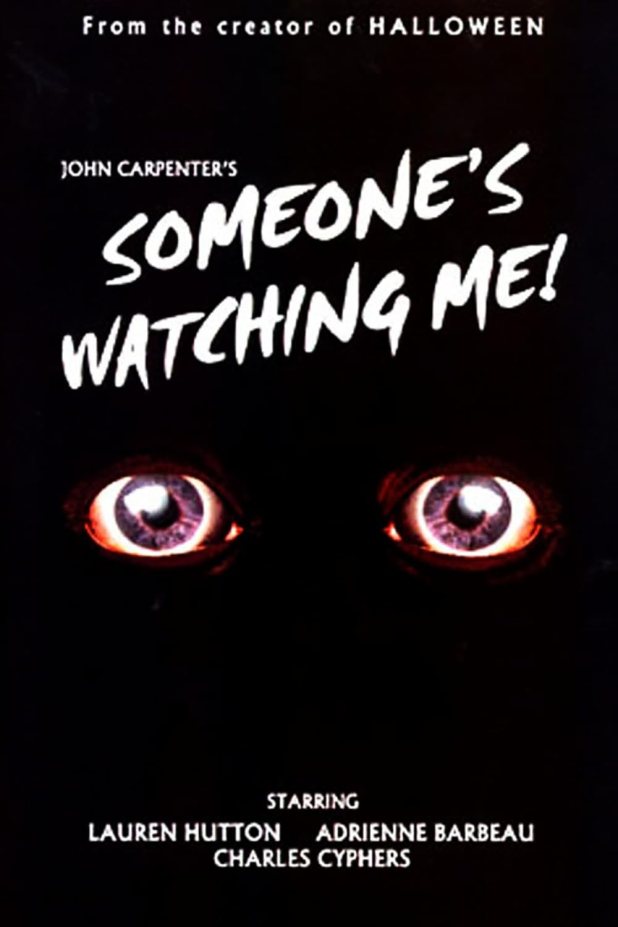
John Carpenter was hired by Warner Bros in 1976 to write a script based on the true story of a woman who had been spied on inside her Chicago apartment. The script, High Rise, ultimately became a TV movie that Carpenter was also given the opportunity to direct.

“I thought it was a really, really good idea,” said Carpenter. “So I had my first experience with television. And my first union experience. I got into the Director’s Guild through that. I had a really good time on it, I have to tell you. I met my wife.”

This eighteen-day shoot allowed Carpenter to test many of the techniques that he’d use weeks later when he started work on Halloween.

Originally airing on November 29, 1978 on NBC, this movie concerns Leigh Michaels (Lauren Hutton), who has moved to Los Angeles to escape New York City. As she begins her new career at television station KJHC with new friend Sophie (Barbeau) and a relationship with college professor Paul Winkless (David Birney, who went on to be quite the reader of audiobooks).

However, she’s soon dealing with phone calls and starts receiving unlimited calls. She calls the police, but there’s nothing she can do except wait for the voyeur to come to her.

Fans of Halloween take note: Charlie Cyphers shows up as a cop.

WEIRD WEDNESDAY: The Bees (1978)

Alfredo Zacarías made Demonoid, and we should thank him for that. He also took advantage of the sheer terror that ensued when the Africanized honey bee was on its way to America. Initially used in Brazil to increase honey production, 26 swarms escaped quarantine in 1957 and spread throughout South America, incredibly defensive and angry bees that supposedly can chase a person for a mile. These bees have killed a thousand people, with many of their victims being stung over and over again. Just imagine six-year-old me watching this on the news every night as we were told repeatedly how close these bees were to us and how doomed we all were.

I also blame the exploitation film industry, which seized upon this and made so many killer bee movies, as they had all the news doing their advertising work for them. There was the 1974 TV movie Killer BeesThe Swarm and this movie, ads filled with just bee after bee, and I’d watch when I was outside, sure today was the day I’d be stung to death.

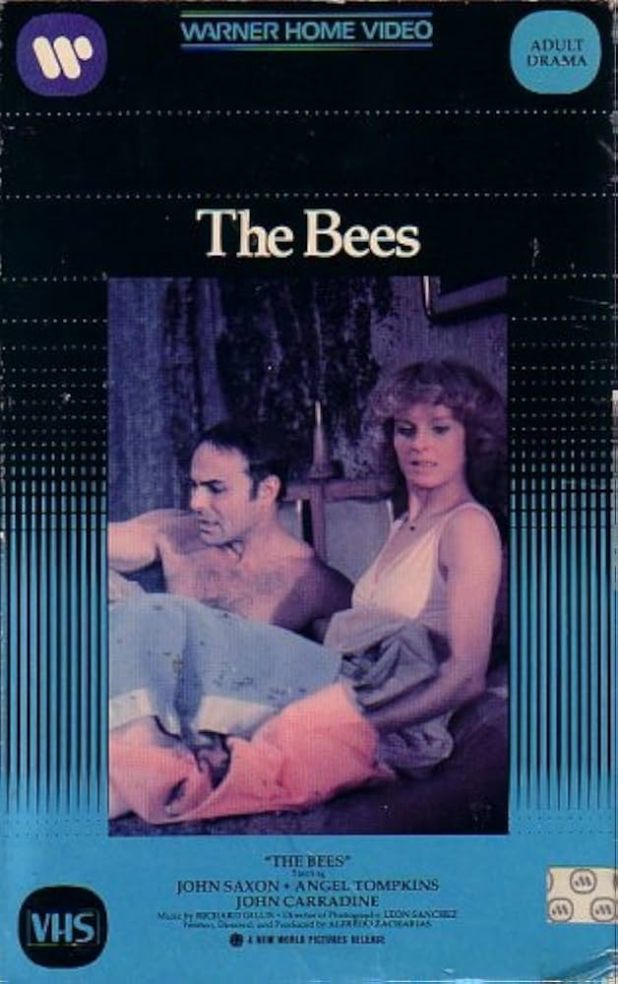
Jack Hill went uncredited on this as a writer, as he was supposed to direct it, but life didn’t work out that way. It’s the story of South American killer bees who haven’t just been smuggled into the country for experiments, but have also mutated into even smarter than your average bee and use that to kill humans.

It all happens when Dr. Miller (Claudio Brook) is trying to crossbreed the aggressive bees with a much calmer species to make more honey. A local tries to break in and steal the bees, which leads to his angry family and friends burning down Miller’s house, and the bees escaping. Meanwhile, Miller’s wife Sandra (Angel Tompkins) takes the queen to her uncle Dr. Sigmund Hummel (John Carradine, of course) and Dr. John Norman (John Saxon), who have the same goals as her husband, except there’s a honey spy ring trying to make more money off the bees and that means murder.

There’s a scene where Carradine falls to his doom, and I won’t lie—I watched it nine times, and with each rewatch, I loved this movie even more. Also, John Saxon speaks to stock footage of the UN.

You can watch this on Tubi.

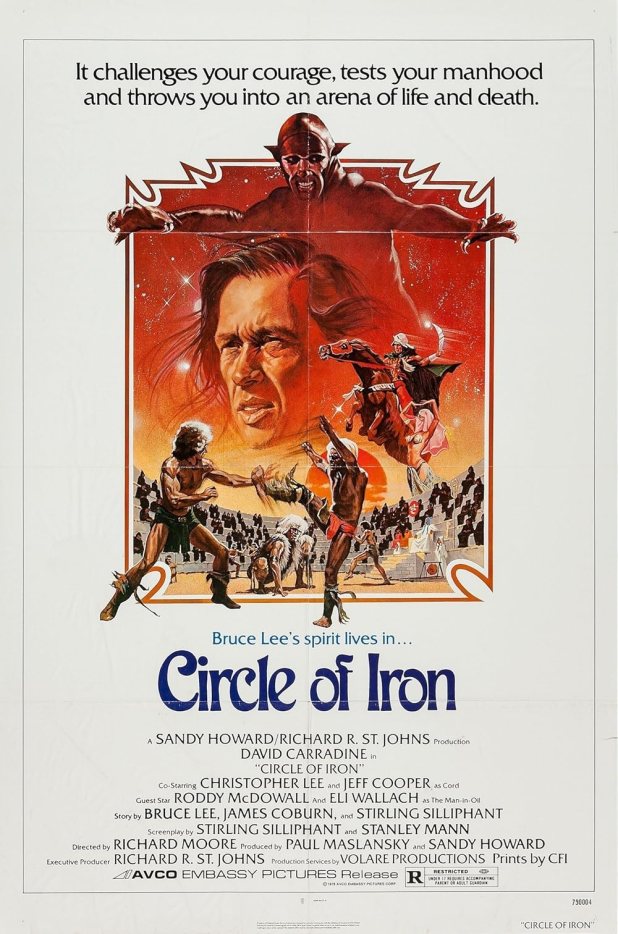
JUNESPLOITATION: Circle of Iron (1978)

June 3: Junesploitation’s topic of the day — as suggested by F This Movie— is David Carradine!

This movie is fantastic bullshit.

Bruce Lee originally was to write and appear in this, saying in the intro he wrote, “The story illustrates a great difference between Oriental and Western thinking. This average Westerner would be intrigued by someone’s ability to catch flies with chopsticks, and would probably say that has nothing to do with how good he is in combat. But the Oriental would realize that a man who has attained such complete mastery of an art reveals his presence of mind in every action…True mastery transcends any particular art.”

Working with James Coburn and screenwriter Stirling Silliphant, Lee didn’t just want to make the first Western movie about martial arts. He tried to make a movie that would introduce audiences to the philosophy behind martial arts; more than fighting, more about mastering the self.

Coburn and Lee eventually got frustrated by one another—small stuff, like Coburn getting a better hotel room and treatment than Lee, be like water indeed, or Lee nonstop humming pop songs until Coburn screamed at him—and Lee went to Hong Kong to make Fist of Fury, become a star and die.

Lee had intended his movie — you know, the same one that would teach Eastern theories of the martial world — to have  Thai, Cantonese, Arabic and Japanese dialogue, explicit Tantric sex and scenes of genital destruction.

A few years later, Stanley Mann rewrote it, added comedy and brought on board a bunch of the finest all-white actors—some of whom could do martial arts. And that’s how we got this movie, which is ridiculous in all the best ways.

Cord (Jeff Cooper, who played Kaliman in a few Mexican movies) is a fighter who is undisciplined and kicked out of the temple by Roddy McDowall. Yet he still wants to find The Book of Knowledge, which is held by Zetan (Christopher Lee). The man sent on the quest instead of him, Morthond (Anthony De Longis, Blade from Masters of the Universe), has been nearly killed — and demands help to die with honor — and it seems like a fool’s errand. Then Cord meets the mysterious Blind Man (David Carradine) and starts his own quest.

Carradine also plays Death, a Monkey Man and Chang Sha, who uses his wife Tara (Erica Creer) to seduce our protagonist before leaving him behind and her crucified. Cord also runs into Eli Wallach, who has been sitting in a pot of boiling oil for a decade in the hopes that his penis falls off. I did not make that up.

Also known as The Silent Flute, this has director Richard Moore (his only full-length, but he shot the underwater footage for Thunderball and was the cinematographer on The Wild AngelsDevil’s AngelsMyra BreckinridgeThe Stone Killer and Annie) making a mix of a king fu movie and a Zen koan that feels more Holy Mountain than Enter the Dragon.

The flute Carradine plays in this is the same one from Kill Bill: Volume 2.

So yes, this movie is complete bullshit but it’s wonderful bullshit. None of the people other than Carradine seem to know how to do martial arts, and I couldn’t care less. With Lee, this would have been a classic, perhaps, but as it stands, it’s this majestic attempt at something, a movie with dialogue like this:

Blind Man: A fish saved my life once.

Cord: How?

Blind Man: I ate him.

The sound of one hand clapping? You’re watching it.

You can watch this on Tubi.

APRIL MOVIE THON 4: Team-Mates (1978)

April 6: Independent-International: Write about a movie from Sam Sherman. Here’s a list.

Vicki Mason (Karen Corrado) is trying to change the world — or at least her small town — by trying out as a kicker on the football team. Her boyfriend Brian Caldwell (Max Goff, Cheerleaders Beach Party) isn’t impressed, but she’s sick of him cheating on her, so she dumps him and goes all in on the team even if they don’t want her.

Director Steven Jacobson edited Nurse Sherri and shot the extra footage in Naked Evil, but otherwise, that was it for his career. The script comes from Jennifer Lawson, who went on to be the CEO of a public broadcasting station, and Sam Sherman, the man who brought so much to us through Independent-International.

This feels as much like a Corman nurse cycle movie as it does an Animal House cash-in. It’s worth watching for James Spader’s and Estelle Getty’s first roles. He was 18, and she was just a spry 55.

Four years later, this was re-released as Young Gangs at Wildwood High — Sam Sherman knew how to cash-in on stuff like Fast Times at Ridgemont High — and you have to admire the balls to do that. Thanks, Temple of Schlock, for always having facts like this. It’s worth noting that this film had two campaigns as Team-Mates and another in 1980 as Young Gangs, hoping that people looking for The Warriors at the drive-in could be confused into seeing this movie that has nothing to do with gangs and so much more to do with football.

You can watch this on YouTube.

SYNAPSE FILMS 4K UHD/BLU-RAY RELEASE: Blue Sunshine (1978)

Do you know why I’ve never done acid? This movie right here. After all, it has an “inspired by true events” square up in the end credits.

After a series of seemingly unconnected murders in Los Angeles, only one link keeps coming up: every single person took the same strain of LSD called Blue Sunshine. The sins of the past decade are ready to come back and destroy the “Me” decade.

Zalman King — yes, the same man who got your mom all tingly after you were put in bed and she watched Showtime’s Red Shoe Diaries — plays Jerry Zipkin, a man accused of the murders who — in true giallo-style — must clear his name. That’s because he was at a party where the murders may have started, complete with a screaming Brion James and Billy Crystal’s brother singing Frank Sinatra songs before he starts throwing women into the fireplace.

If it turns out that you took Blue Sunshine, chances are that you’re about to lose all your hair, go crazy, and start killing everyone in your path. Of course, no one knew this ten years ago when they were all dosing on it back in college. Chromosomal damage can be a real b, you know?

How can you not love a movie whose title is spoken by a parrot? One that has a climactic disco shootout? Or is it so 1970s that it ends up speaking for pretty much the entire decade?

The self-medicating Dr. David Blume, the hard-drinking and hair losing John O’Malley, and Ed Flemming (Mark Goddard, Major Don West from Lost In Space) are all caught up in the grip of the bad trip. The effects sum up Flemming’s political campaign: “In the 1960s, Ed Flemming and his generation shook up the system. Now he’s working within it.” He has become the system. It’s as if the children in Manson’s famous quote- “These children that come at you with knives- they are your children. You taught them. I didn’t teach them. I just tried to help them stand up.” — are even more dangerous when fully grown.

Goddard isn’t the only TV star that shows up, as Alice Ghostly (Esmerelda from Bewitched) makes an appearance.

Writer and director Berman would lend his strange style to other films such as Squirm, Remote Control, Just Before Dawn, and the odd true crime TV show Love You to Death, which starred John Waters as a Grim Reaper attending weddings of partners who would soon kill one another.

The director claims that two major TV networks expressed interest in purchasing the film as a “movie of the week.” The opportunity to get double the budget was appealing. Still, after seeing the edits that the movie would need to be able to play on network TV, Lieberman decided to produce this for theaters.

The Synapse release of this movie comes in a gorgeous box, overstuffed with extras. It starts with a 4K restoration of the original 35mm camera negative mastered in Dolby Vision that has a new surround sound mix supervised by director Jeff Lieberman; two audio commentaries with Lieberman, who also contributes an introduction; an archival 2003 interview with director Lieberman; “Lieberman on Lieberman” video interview; Channel Z “Fantasy Film Festival” interview with “Master of Horror” Mick Garris and Jeff Lieberman; Fantasia Film Festival 4K Premiere Q&A with moderator Michael Gingold and director Jeff Lieberman; two anti-drug scare films, LSD-25 and LSD: Insight or Insanity?, courtesy of the American Genre Film Archive; Jeff Lieberman’s first film The Ringer (remastered in 4K by Synapse Films from the original camera negative); trailers; a stills gallery; liner notes booklet by Lieberman, featuring a chapter on the making of Blue Sunshine from his book Day of the Living Me: Adventures of a Subversive Cult Filmmaker from the Golden Age; a limited edition fold-out poster and limited edition remastered CD soundtrack.

Order it ASAP from MVD.

Metal Messiah (1978)

Tibor Takács made some wild movies, but before that, he was part of the Toronto-area punk and metal scene as the manager and producer for The Viletones and The Cardboard Brains, some of whom end up in this 1978 rock opera. Sure, he makes streaming Christmas movies now, but he once made The Gate and the insane I, Madman.

Written by Stephen Zoller, this feels like The Man Who Fell to Earth meeting The Rocky Horror Picture Show as well as Phantom of the Paradise and The Foreigner, but that’s just me trying to put some handle on this.

Max the Promoter (John-Paul Young, lead singer of The Cardboard Brains) has hired private detective Philip Chandler (Richard Ward Allen) to find The Messiah (David Jensen of the band Kickback), who is preaching to the teens of Anywhere City that rock and roll is filled with sin. Max either wants him to be a star or dead or both, while Violet (Liane Hogan) and the Children of Truth want him hooked on drugs.

The music in this feels early 70s glam rock but that just helps this seem even weirder, as does the Third Reich crowd noises in the final concert, as the Metal Messiah — spoiler warning — because a religious rock star and gets crucified to the cheers of the assembled crowd.

This was a stage play and that makes sense. What doesn’t is how much this movie seems to hate rock and roll while being a rock opera. The evils of music would stay with Takács, as the album The Dark Book would open quite literally The Gate once he learned how to hone his filmmaking.

You can watch this on YouTube.

VIDEO ARCHIVES SEASON 2: The Big Sleep (1978)

VIDEO ARCHIVES NOTES: This movie was discussed on the December 10, 2024 episode of the Video Archives podcast. 

Following up his turn as Phillip Marlow in Farewell, My Lovely, Mitchum is back and he’s got Michael Winner directing and writing for him. Sure, Mitchum is twice the age he should be and this is in London instead of Los Angeles, but it’s got a mean edge that I love.

General Sternwood (Jimmy Stewart) is near death, but still wants to know who is blackmailing him. He hires Marlowe, who meets the military man’s daughters, Charlotte (Sarah Miles) and Camilla (Candy Clark). The case leads the detective to pornographer Arthur Geiger (John Justin), his employee Agnes Lozelle (Joan Collins) and finally to Joe Brody (Edward Fox), who Agnes is in love with. As for Camilla, she’s found at the scene of Geiger’s murder after posing for nudes, which would shock her dying father.

As for Charlotte, she is tied up with Eddie Mars (Oliver Reed), a gambler whose wife Mona (Diana Quick) ran off with Charlotte’s husband Rusty and who has several bills due thanks to Charlotte’s gambling debts. Meanwhile, Brody steals Charlotte’s nude photos and pays with his life.

Marlow tangles with a hitman named Lash (Richard Boone) and several red herrings to figure out exactly what the General wants him to look into. He actually never wants the old man to learn the truth about his daughters, particularly when he puts his own life on the line to draw one of them out.

Jimmy Stewart was having issues saying his lines on time due to hearing issues and possibly memory problems. Mitchum may have said, “The picture was all about corpses, but Jimmy looked deader than any of them,” but Stewart outlived him by one day.

Oliver Reed was only in this so he could work with Mitchum and was impressed that the actor could drink a bottle of gin in just 55 minutes. Meanwhile, Mitchum and Boone seemed to be having a drinking contest at all times and even fired live rounds close to one another in a gun fight scene.

As you can imagine, this was a set full of maniacs. When meetings some folks of Arabic nationality, Mitchum warned them that Winner was a Mossad agent, while Winner set up a porn photo shoot to ensure that “copyright issues” didn’t come up for the magazine in the film, which ended up with Mitchum hooking up with the model that was in that shoot, Lindy Benson. He was also being stalked by two women, who had a battle in his apartment at one point during filming.

Winner hated that Joan Collins wore wigs, so he demanded she use her real hair. When they wrapped,  Collins gave Winner a friendly kiss and as she walked away, she took off her wig, fooling him for teh entire production.

When that car blows up at the end, the effects crew had soaked rags in gasoline. Winner decided it would be a good idea to light a cigar around this — he had only been on film sets his entire life — and ignited a gas line, which set the crew tent on fire and nearly a house.

You can watch this on Tubi.

VIDEO ARCHIVES SEASON 2: Ice Castles (1978)

VIDEO ARCHIVES NOTES: This movie was discussed on the December 10, 2024 episode of the Video Archives podcast. 

I think it’s hilarious that Tarantino and Avery got people to watch Ice Castles that otherwise would never endure it. They got me!

Former skater Lynn-Holly Johnson is Lexie Winston, a figure skater on the way to the Olympics when she’s blinded in a freak accident. Withdrawing into depression, only her boyfriend Nick Peterson (Robby Benson) can coach her back onto the ice, getting her back into skates even if she can’t see.

Will she be able to skate again? Will he forgive her for leaving him for a sportscaster? Will she try the triple jump that nearly killed her?

Roger Ebert said, “Call me Scrooge; stories like this make me cringe.”

Director Donald Wrye made this movie twice, as there’s a 2009 remake with Taylor Firth and Rob Mayes in the lead parts. Lynn-Holly Johnson ‘s cameo? It got cut. Wrye also directed Born Innocent, so I can never be mad at him. As for Lynn-Holly Johnson, she would skate again in the Bond movie For Your Eyes Only.

For some reason, I have watched several ice skating movies and hate the sport. Why do I keep putting myself through this?

SEVERIN BLU RAY RELEASE: Scala!!! shorts disc one (1968. 1971, 1978, 1984, 1986, 1989, 1991)

On the bonus discs of Severin’s new Scala!!! Or, the Incredibly Strange Rise and Fall of the World’s Wildest Cinema and How It Influenced a Mixed-up Generation of Weirdos and Misfits release, you’ll find examples of several shorts that played at the theater. You can buy this from Severin.

Divide and Rule – Never! (1978): Made for and by young people, this forty-minute or so film looks at race and how it is viewed in school, at work and by the law. There are also some historic sequences of British imperialism and a discussion of how Germany got to the point that it was pre-World War II, plus plenty of punk rock and reggae. This has many sides represented, from Black and Asian immigrants to ex-National Front members.

Divide and Rule — Never! was distributed by The Other Cinema, a non-profit-making, independent film distribution company in London.

Sadly, so much of this movie — made 45 years ago — are just as relevant today in America. This is movie that doesn’t shy away from incendiary material, but that’s what makes it so powerful. In addition to the interviews, it has some interesting animation and a soundtrack with Steel Pulse, TRB, X-Ray Specs and The Clash.

Dead Cat (1989): Directed and written by Davis Lewis, this has Genesis P-Orridge in the cast and a soundtrack by Psychic TV, which has been released as Kondole/Dead Cat.

A boy (Nick Patrick) has a cat that dies and his grief deposits him into a psychosexual nightmare, including a medicine man (Derek Jarman) and several unhoused people (P-Orridge, Andrew Tiernan).

This was shown at only a few theaters the year it was release — including Scala Cinema — before fading away and almost being lost before Lewis found it. In the program for this film, Scala said “The torture that occurs at the transition of sexuality.” If you liked videos for bands liek Skinny Puppy and Nine Inch Nails, this feels like the inspiration.

The Mark of Lilith (1986): Directed by Bruna Fionda, Polly Gladwin and Zachary Nataf as a project at The London College of Printing, this is all about Zena (Pamela Lofton), who is researching monstrous women. She meets Lillia (Susan Franklyn) a vampire, at a horror movie and the two start a relationship. 

Liliana, trapped with an abusive male partner by the name of Luke (Jeremy Peters) who is what vampires probably would be, scavengers who feed on the weak, dreams of movies in which she is the victim of just such a vampire. She’s often fed on human beings, but has been careful not to be caught or make a mess, unlike her partner. As for Zena, she’s been studying how female gods were once worshipped but now only appear in horror fiction as monstrous creatures.

So much of this movie is as right on now as when it was made, like the speech that Zena gives when Liliana tracks her down: “Have you noticed that horror can be the most progressive popular genre? It brings up everything that our society represses, how the oppressed are turned into a source of fear and anxiety. The horror genre dramatizes the repressed as “the other” in the figure of the monster and normal life is threatened by the monster, by the return of the repressed consciously perceived as ugly, terrible, obscene.”

Her argument is that we can subvert the very notions of horror, making the monsters into heroes that destroy the rules that hold us down.

However, this being a student film, it’s very overly earnest and instead of working these ideas into the narrative as subtext, they take over the entire movie. If you’re willing to overlook this, it’s a pretty fascinating effort.

Relax (1991):  Steve (Philip Rosch) lives with his lover Ned (Grant Oatley), but as he starts to engage in a more domestic relationship, he starts to worry about all of the partners he’s had. After all, the AIDS crisis is happening and he’s never been tested. Ned tells him to relax, but there’s no way that he can.

The wait for the test is just five days but it may as well be forever. This also makes a tie between sex and death, as Steve strips for both Ned and his doctor. And in the middle of this endless period of limbo, he dreams of death and fights with Ned, who just smiles and keeps telling him to relax. But how could anyone during the time of AIDS?

I remember my first blood test and the doctor lecturing me after he gave it, telling me that I should have been a virgin until I married and whatever happened, I brought it on myself. The funny thing was, I had been a virgin, I thought I was getting married and I had no knowledge that my fiance was unfaithful to a level you only see in films. That night, my parents came to visit, leaving their small town to come to the big city and my mother asked, “What is that bandage on your arm?” I could have lied, but I told her it was for a blood test, and I dealt with yet someone else upset with me. My problems were miniscule in the face of the recriminations that gay people had to deal with, a time of Silence=Death, a place seemingly forgotten today other than by the ones who fought the war.

Directed and written by Chris Newby, this is a stark reminder of that time.

Boobs a Lot (1968): Directed by Aggy Read, this is quite simple: many shots of female breasts, all set to The Fugs’ song of the same name. Banned in Australia, this has around three thousand sets of mammaries all in three minutes, the male gaze presented over and over and, yes, over again until it goes past just being sophomoric and becomes mesmerizing in the way that breasts are when you’re starting puberty. I’m ascribing artistic meaning to this but really, at the end of the day, it’s just a lot of sweater meat. Fun bags. Cans, dirty pillows, babylons, what have you. My wife is always amazed at how many dumb names I can come up with for anatomy and I blame years of John Waters and reading Hustler as a kid and yeah, I’m not as proud of the latter than the former. That said, there are a lot of headlights in this one.

Kama Sutra Rides Again (1971): Stanley (Bob Godfrey, who also directed and write this) and Ethel are a married couple looking to keep their love life interesting, so they have been trying out new positions. Things start somewhat simple, but by the end, Ethel is being dropped through trap doors and out of an airplane onto her husband. A trapeze love making attempt ends in injury, leading Ethel to chase Stanley while all wrapped up.

Stanley Kubrick personally selected this film to play before A Clockwork Orange in theaters in the UK. I wonder if this played at Scala before the screening that shut down the theater. More than just a dirty cartoon, this was nominated for an Oscar. Despite being about lovemaking, it’s all rather innocent and remains funny years after it was made.

Coping With Cupid (1991): Directed and co-written by former Slits guitarist Viv Albertine, this finds three blonde alien women — played by Yolande Brener, Fiona Dennison and Melissa Milo — who have come to Earth to learn what love is, under the command of Captain Trulove (the voice of Lorelei King). They meet a man named Peter (Sean Pertwee), who hasn’t found anyone, as well as interview people on the street to try and learn exactly how one person can become enamored of another.

Richard Jobson from Skids and Don Letts from Big Audio Dynamite appear, as does feminist sexologist Shere Hite, at least on a TV set. I love that the three aliens are the ideal of male perfection yet they are lonely, trying to figure out what it takes to make the heart beat. It’s kind of like so many other films that I adore where space women try to understand men, a genre that really needs a better title. See Cat-Women of the Moon, Missile to the Moon, Queen of Outer Space, Fire Maidens from Outer SpaceAmazon Women On the Moon, Abbott and Costello Go to Mars, El Planeta De Las Mujeres Invasoras and Uçan Daireler Istanbulda.

On Guard (1984): Sydney: Four women — Diana (Jan Cornall), Amelia (Liddy Clark),  Adrienne (Kerry Dwyer) and Georgia (Mystery Carnage) — juggle their lives, careers and even families to destroy the research of the company Utero, who are creating new ways of reproductive engineering. Or, as the sales material says, “Not only are the protagonists politically active women, but the frank depiction of their sexual and emotional lives and the complexity of their domestic responsibilities add new dimensions to the thriller format. The film also raises as a central issue the ethical debate over biotechnology as a potential threat to women and their rights to self-determination.”

One of the women loses the diary that has all of the information on their mission, which leads to everyone getting tense over what they’re about to do. Directed by Susan Lambert, who wrote it with Sarah Gibson, this allows the women to be heroes and not someone to be saved. I like that the advertising promised that this was “A Girls’ Own Adventure” and a heist film, hiding the fact that it has plenty of big ideas inside it.

Today, in vitro fertilisation (IVF) is an accepted way of having children, yet here, it’s presented as something that will take away one of the primary roles of women. Juxtapose that with IVF being one of the women-centric voting topics of the last U.S. election.