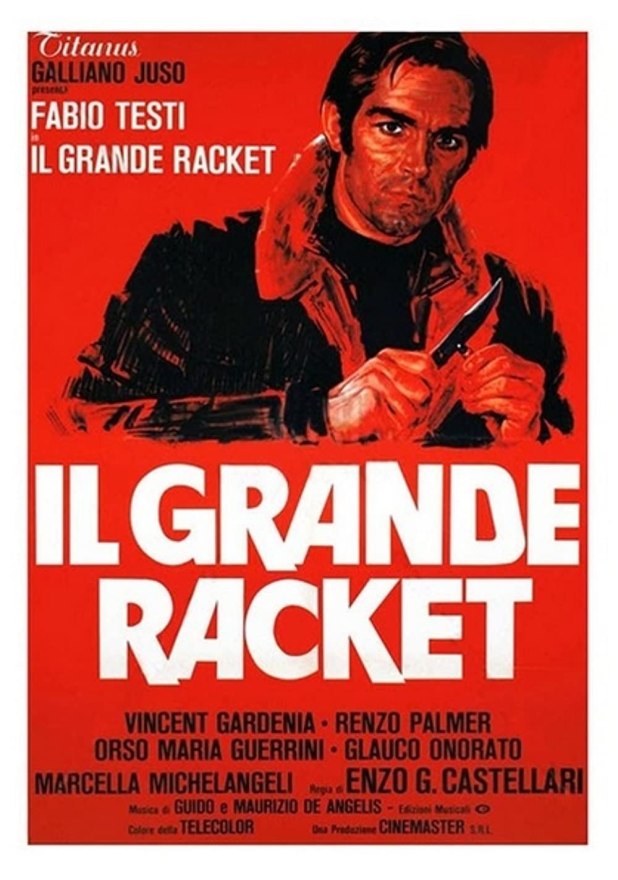
Rogue Cops and Racketeers: Two Crime Thrillers: The Big Racket (1976)

Both of the Enzo G. Castellari movies on Rogue Cops and Racketeers: Two Crime Thrillers push action further than anything we’ll see on screens this year, both films backed with brutality and danger both in the film and in making it, as there are no computers to make these stunts look like they’re spitting in death’s face. They’re all real, all true, pure guts and balls and power.

Nico Palmieri (Fabio Testi) is one man against a crime syndicate that starts with robbing a small town and charging them protection money, but has aims much higher. Nico’s hands are tied by the system so he forms his own squad of vigilantes who have each been damaged by the mob: a criminal named Pepe (Vincent Gardenia); Piero Mazzarelli (Glauco Onorato), who has been crippled by the gang; Luigi Giulti (Renzo Palmer), whose daughter was raped by the gang and who then committed suicide (this scene is Death Wish brutal and it’s even worse when you realize that it’s Castellari’s daughter Stefania playing the role), Gianna Rossetti (Orso Maria Guerrini), an Olympic marksman whose wife Anna was assaulted and killed by the mob — after they urinate all over her and set his house on fire, making them beyond Death Wish 3 goons — and the mercenary Doringo (Romano Puppo).

Nico’s lost his badge to take down crime. Will his gang be able to stop the crimewave?

There’s a scene where Testi is in a car that goes down a hill. We watch it slowly fall apart and glass flies directly at the actor and it looks truly harrowing because, well, it was. When you don’t have budgets and you don’t have time and all you have is guts, you shoot the movie.

The end of this movie is apocalyptic. Bullets fly, cars explode, fire is everywhere and by the end, even the shotgun that Testi grips can’t solve everything. His rage closes the movie, as crime doesn’t go away just because you’re a good man trying to save the world.
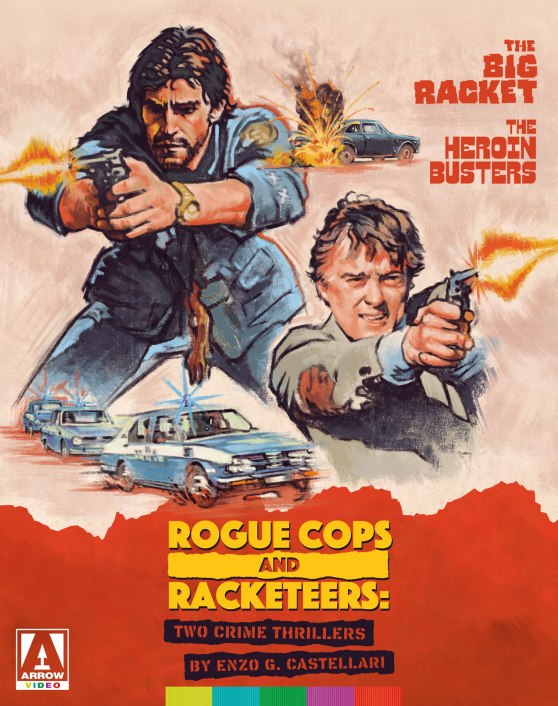
The Arrow Video limited edition of Rogue Cops and Racketeers: Two Crime Thrillers has this movie and The Heroin Busters. Both films have brand new 2K restorations from the original 35mm camera negatives by Arrow Films, with restored original lossless mono Italian and English soundtracks and newly translated English subtitles for the Italian soundtracks. Both movies aso have new audio commentaries on both films by critics Adrian J. Smith and David Flint and the limited edition packaging has reversible sleeves featuring original and newly commissioned artwork by Colin Murdoch, as well as an illustrated collector’s booklet featuring new writing on the films by Roberto Curti and Barry Forshaw. If that’s not enough, you also get twelve double-sided, postcard-sized lobby card reproduction artcards.

The Big Racket also has new video interviews with co-writer/director Enzo G. Castellari, Fabio Testi, Massimo Vanni and editor Gianfranco Amicucci. There’s also a new appreciation and career retrospective of composers Guido and Maurizio De Angelis by musician and disc collector Lovely Jon, a trailer and image gallery.

You can get Rogue Cops and Racketeers: Two Crime Thrillers from MVD and Diabolik DVD.
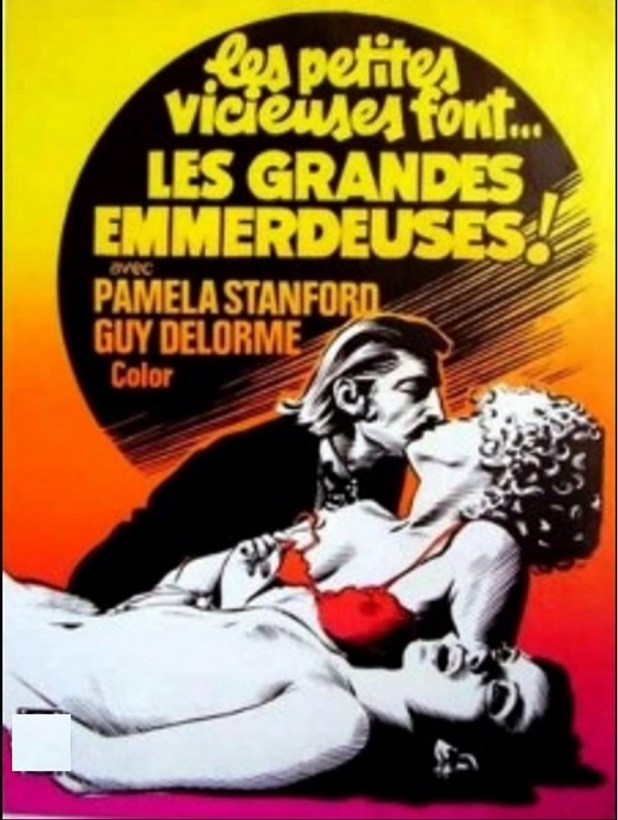
JESS FRANCO MONTH: Les Emmerdeuses (1976)

This movie has so many Jess Franco picadillos.

Pina and Tina (Lina Romay and Pamela Standford) are two nightclub dancers who would rather be spies. If you say, hmm, have I seen this before, I ask you to remember that you are now within the Jess Franco Cinematic Universe, a place where all exotic dancers are either spies, possessed or possessed spies.

Most of the movie is them talking directly to us, when they’re not having sex, or being attacked by Duran the monster man or dressing up in a catsuit. Yes, it’s another Red Lips movie, if not in name, because these girls go by Golden Panther.

What it does have is the most valuable prize in all of the JFCU. No, not Ms. Romay’s quim, but diamonds. Yes, diamonds have been stolen from a millionaire with the cursed Franco name of Radeck. So they do what anyone would when it comes to steal them back. They conceal them inside their sex or within Monica Swinn’s fake penis that she’s packing to dress like a man.

The name translates to Pain in the Ass but this movie is anything but. It’s a truly joyous find within the multitudes of Franco films and one woven into so many of the films he made before this. How did Dr. Orloff not show up?

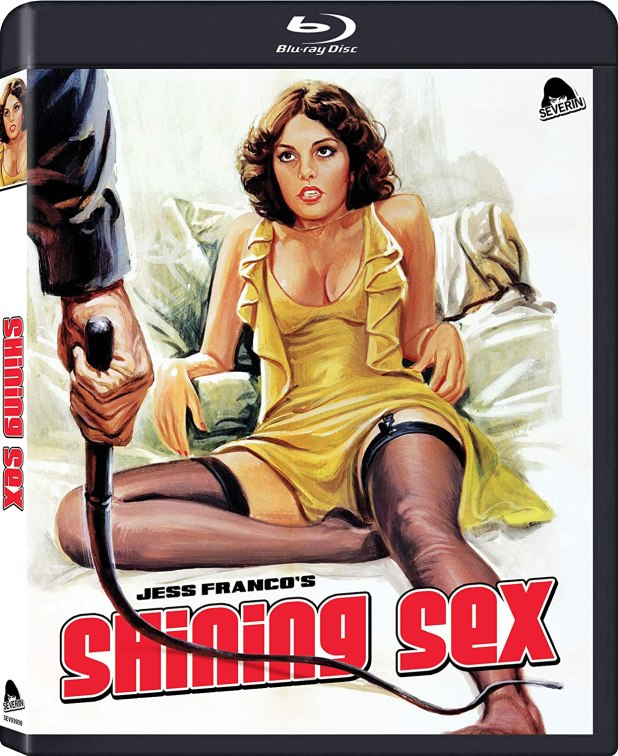
JESS FRANCO MONTH: Shining Sex (1976)

Lina Romay was once married to actor Ramon Ardid, who had introduced her to Jess Franco, who was using him as a still photographer on his movies, and having his wife increasingly appear in the role Soledad Miranda once had, that of the central focus of his camera, mind and crotch’s obsession.

After the death of Miranda, Franco was still grieving. Sure, he was married to Nicole Guettard — and would be until 1980 — who worked as a script consultant on his movies and even was in a few of them, the team of Franco and Romay would slowly grow from professional to something more after her marriage to Ardid broke up in 1975 and ended in divorce in 1978, even though Ardid continued working with Franco until 1980.

Franco and Romay would form a team for four decades of work, living together from 1980 until her death and finally getting married in 2008. She’d appear in more of his movies than anyone else and even as she ages, Franco never ceases to find her beauty and explore it, sometimes with zoom lenses that feel gynecological. But who are we to put our hangups on their love? How rare is it to find someone that you share like-minded feelings about art and sex and stay with that person nearly forever?

This time around, Lina is Las Vegas showgirl Cynthia, whose routine has impressed Alpha (Evelyne Scott) and her slave Andros (Guettard). Of course, this leads her into their bed, except for all the epithets that you can throw at Jess Franco, he’s no mere pornographer.

That’s because Alpha is from far beyond our pitiful planet and the lovemaking closes with Cynthia being covered with a sparkly lotion that forces her to do the bidding of Alpha and Andros, which goes from carnal acts to killing those that know too much about them, which includes Dr. Elmos Kallman (Olivier Mathot), Dr. Seware (Franco) and spiritualist Madame Pécame (Monica Swinn).

I can’t even imagine that this movie was once intended to play movie screens, places that would become altars for the worship of what Franco found most holy, Lina Romay’s sex displayed big, bold and covered in glitter up there on the silver screen, plot and normalcy be damned.

Franco’s obsession — beyond Romay — is always women who have the power to kill through physical, vampiric or sexual means. Empowered by this alien substance, Lina/Cynthia has become biblical verse writ large — “I am come a light into the world, that whosoever believeth on me should not abide in darkness” as well as the words of the Bhagavad Gita, as recited by Oppenheimer, as he watched the death cloud he has created take physical form — “Now I am become Death, the destroyer of worlds.” Sex can kill and it can take a talkative young woman freely giving of her body and transform it into the literal angel of death, using the lifegiving power between her thighs to snuff out anyone that must be destroyed.

The nuclear frisson of the lust and love and obsession and eventual lifelong partnership of Franco and Romay would knock both of their marriages apart and probably wasn’t easy for anyone in either of their families, but when you discover that kind of love that the Bible only ascribes to the Lord — “If the radiance of a thousand suns were to burst into the sky that would be like the splendor of the Mighty One.” — woe be to anyone who was in their way.

Unlike some cultists, Franco wanted the entire world to worship with him, to partake from what he saw as perfection. Shining Sex indeed.

You can get this from Severin.

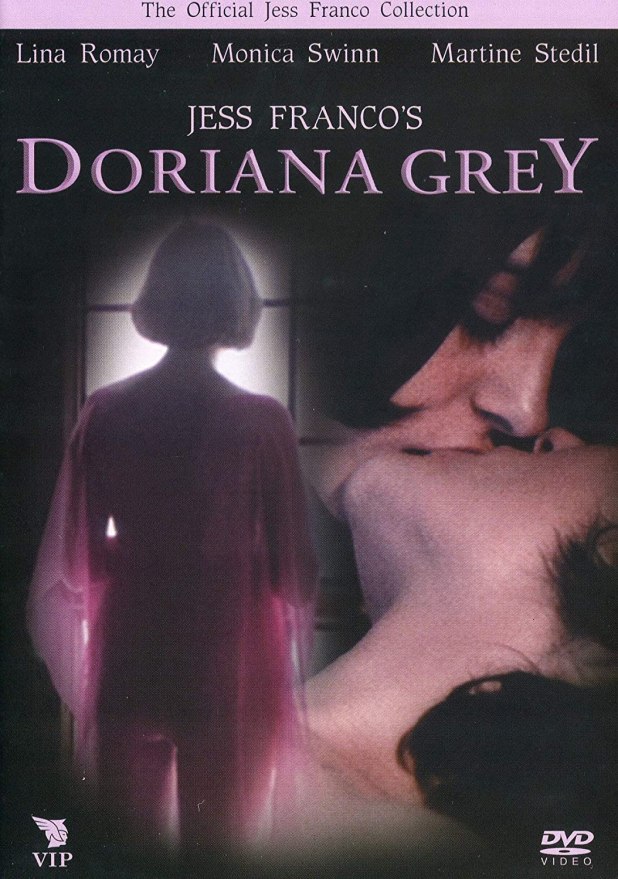
JESS FRANCO MONTH: Die Marquise von Sade (1976)

Lady Doriana Grey (Lina Romay, who else?) haunts a castle while her twin sister has been under the care of Dr. Orloff in his asylum, but we never see him. And we do know they have a strange psychic connection beyond their similar looks.

That’s not the only problem Doriana has.

It turns out that she can’t properly experience le petite mort, as they say, and her lovers end up taking the big sleep as a result of making love to her. That’s what keeps both of the sisters young, but it’s the bliss — and feelings of life running out — that are making the other sister even more unhinged.

Also known as Die Marquise von Sade, this has Monica Swinn as the reporter who figures this out and Raymond Hardy is also in it. He was Romay’s husband at the time and let that walk around your brain because this entire movie feels like Jess making love to his muse — and future wife — with his camera, every zoom being a thrust, every long look at her body a longing sigh either in his heart or probably loins, a union of just the two of them making tender love through the glass lens, rainbow in the skyline behind her, dead woman in the bathtub, multiple Linas into infinity.

Also — it’s pretty much Female Vampire, but you’re either going to love this or think Franco is a hack.

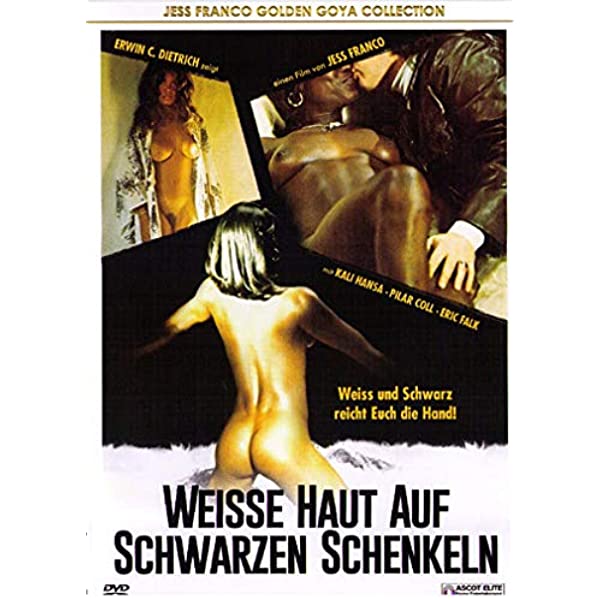
JESS FRANCO MONTH: Weiße Haut und schwarze Schenkel (1976)

Look, when you have a movie called White Skin, Black Thighs and Jess Franco directs it, you may know what to expect.

What I did not expect was to see a love making scene where people are horizontally dancing on what appears to be dry ice, as smoke pours out all over the place.

One of the movies that Franco made with Erwin C. Dietrich, this is pretty much a remake of Le Journal d’une Nymphomane — thanks Adrian from Letterboxd — this is mostly a series of couplings with only the slightest of connecting story, but hey — there’s an alien that lives in the basement and he gets to make love to one of the actresses, which is pretty wild, when you get your mind around it.

There’s are some great production values, but someone must have yelled at Franco to keep his hands off the camera, because there are no zooms in and out. In fact, I felt kind of strange watching one of his movies without the constant camera moves.

The main story is about Marga (Diotta Fatou, who is also in Franco’s uncredited Girls in the Night Traffic and Swedish Nympho Slaves) trying to kill herself after catching her girlfriend Lena (Kali Hansa, Night of the SorcerersDemon Witch Child) making love to Victor Kühn (Erik Falk) on stage.

Franco said in a commentary track that Hansa disappeared after this movie, possibly back to her native Cuba “because she was against Fidel Castro…she wanted to be there to fight him because she was a very strong woman. I never heard about her again.”

Victor is married to Lola (Pilar Coll, Around the World In 80 Beds) and when she finds out that her man has led a woman to her suicide attempt, she’s not mad. She is upset that he slept with a black woman, however, and then ends up exploring her other more sapphic side with Lena, so man, that rich Kühn couple just can’t resist that lady, huh?

All in all, this wasn’t as good as the film it’s remaking, which is true nearly all of the time but always definitely true when it comes to the many, many times Franco tried to make his movies again.

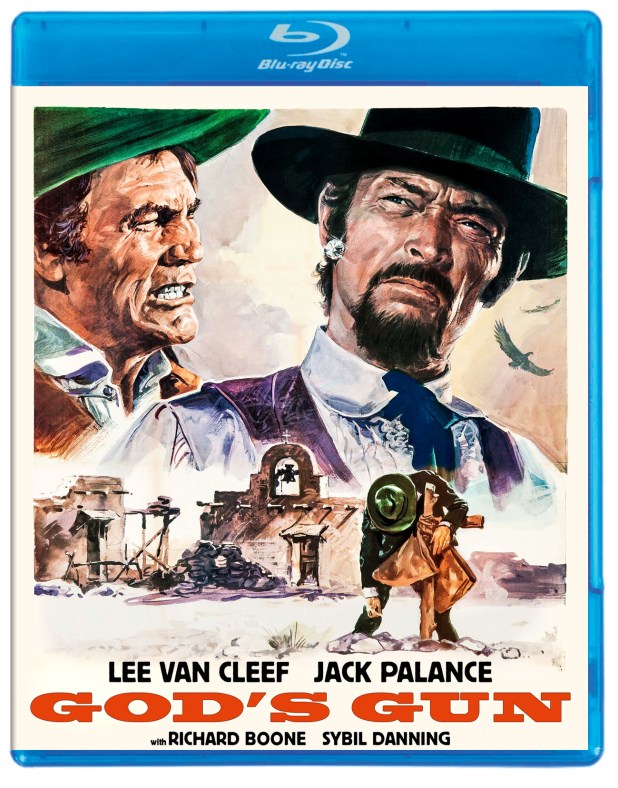
KINO LORBER BLU RAY RELEASE: God’s Gun (1976)

I had no idea that this Italian Western was an Israeli co-production and just a few years before they’d make it to the USA, Menahem Golan and Yoram Globus would work with The Irwin Yablans Company and Cannon Film Distributors to bring this movie to screens all over the world.

Sam Clayton (Jack Palance, as always, a grinning force of complete menace) and his gang have taken over Juno City, stabbing men and assaulting women before leaving the town in the bloody dust. No man will ride out to stop them, except Father John (Lee Van Cleef), a holy man who rides out unarmed and takes the guilty gang members to jail.

The gang breaks them out of jail and kills the priest, sending a young boy named Johnny (Leif Garrett!) to Mexico to bring Lewis, the twin brother of the dead man of the cloth, and he comes back with vengeance on his mind, even if it turns out that Clayton ends up being Johnny’s father.

Also known as Diamante Lobo and A Bullet From God, this is Lee Van Cleef’s last filmed Western (and second movie with Garrett). It was a rough film for Richard Boone, who had started having health problems, then got drunk and walked off the set, leaving the Israeli location before he even dubbed his dialogue. He’d say in an interview, “I’m starring in the worst picture ever made. The producer is an Israeli and the director is Italian, and they don’t speak. Fortunately it doesn’t matter, because the director is deaf in both ears.”

That deaf director was Gianfranco Parolini, better known in America as Frank Kramer, and the maker of some wild stuff like SabataYeti: Giant of the 20th CenturyKiss Kiss, Kill KillThe Three Fantastic Supermen and writing If You Meet Sartana… Pray for Your Death. It was written by John Fonseca, whose career is all over the place, acting in The Uranium Conspiracy (also produced by Golan), serving as a dialogue coach and even shooting stills on the sets of Don’t Open Till Christmas and Slaughter High.

How did I get this far without telling you Sybil Danning is in this movie? Am I slipping?

This may not be the best Italian Western you’ve ever seen, but honestly, the end with Palance rambling in a cemetery and alternating between being paternal and horrifying, well, that’s worth the price of this blu ray. And Lee Van Cleef? Always just right.

The Kino Lorber blu ray release of God’s Gun — I’ve never seen it look this good, as I own it on multiple Italian Western public domain sets — has a brand new 2K Master, audio commentary by Repo Man filmmaker Alex Cox (!), a trailer, subtitles and a great reversible cover. Here’s to more movies like this coming out on blu ray! You can get this from Kino Lorber.

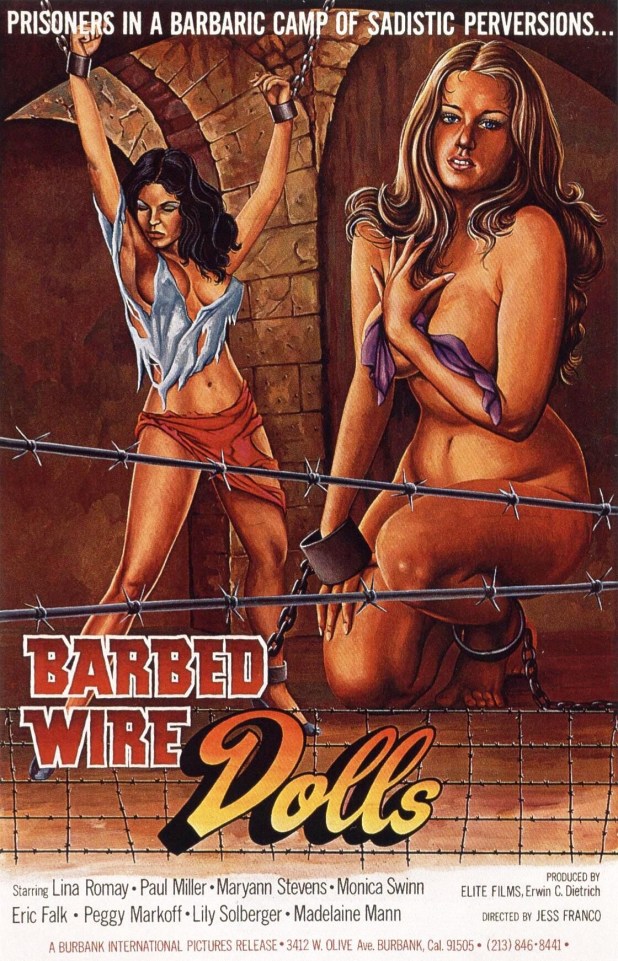
JESS FRANCO MONTH: Barbed Wire Dolls (1976)

You know how you know this is a Jess Franco movie? Because he plays the father of Maria (Lina Romay), a man that has been trying to assault her, so she kills him and ends up in the prison that forms the setting for this film, a place where The Wardress (Monica Swinn, Female VampireHitler’s Last Train and a woman who said of Franco’s movies, “I’d mull over the previous scenes and think to myself, “This can’t be the same character. How many films am I really making here?”) rules with a velvet glove cast in iron, a woman who reads Third Reich books for fun.

The real boss is Dr. Carlos Costa (Paul Muller) who is not really a doctor and just a man trying to make a living by creating a living hell on earth for his female inmates. He’s an innovator, a man who creates metal beds that electrically shock prisoners, so I guess he’d do well in today’s America where 0.7% of our population is behind the wall.

Look, this is pretty much a scumfest, so you’re either going to get offended or learn how to wallow. It’s also the kind of movie that has a budget so low that a slow motion scene has to be acted out at actual speed, meaning that everyone has to pretend that it’s in slow motion and if you don’t love that, why are you even watching movies like this?

At one point, audiences had to pay to see Mom and Dad in a tent or a four-walled theater just so they could see a woman’s lady business, albeit one with a baby coming out of it. Thirty years later and there’s Jess Franco repeatedly zooming his camera and jump cutting right to mossy clefts like it’s nothing and I guess that’s progress.

Look for Martine Stedil (who Franco put in prison once before in Women Behind Bars), Peggy Markoff (who went to the big house twice for Franco in Ilsa the Wicked Warden and Wicked Women), Beni Cardoso (whose career took her from Franco’s The Girl from Rio to the krimi Der Todesrächer von Soho, the Conan ripoff The Throne of Fire, the double Bruno Mattei Western madness of White Apache and Scalps and then the Umberto Lenzi TV movie House of Lost Souls) and a few other ladies who had one Franco movie and then never did a film again.

If you want to watch it for yourself, it’s on the Internet Archive.

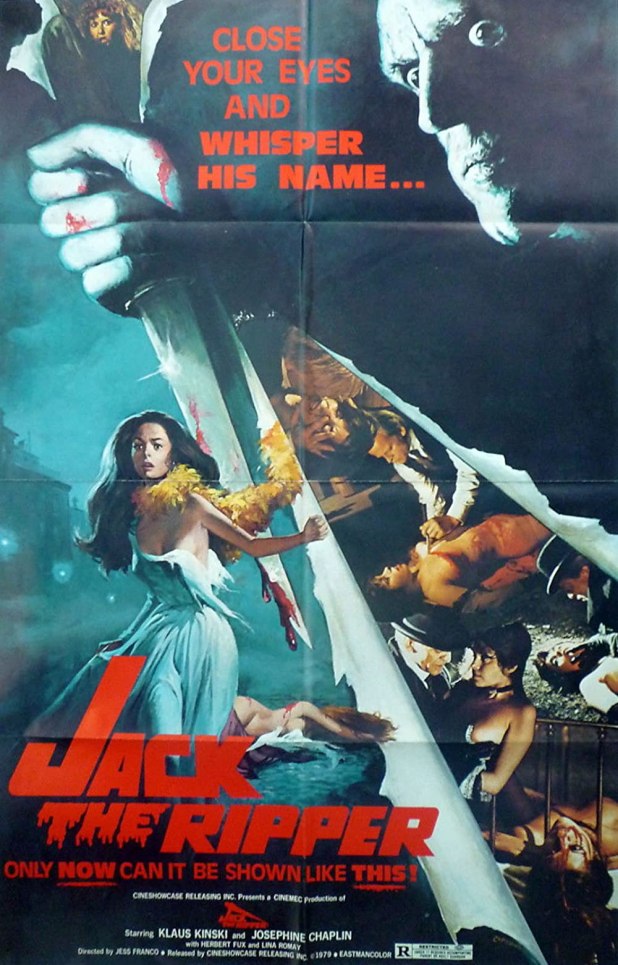
JESS FRANCO MONTH: Jack the Ripper (1976)

EDITOR’S NOTE: When this was written back on March 2, 2019, I had not yet embraced the evil world of Jess Franco. That has seemingly changed. I mean, we’re doing an entire month of his movies.

I’ve made it through plenty of Jack the Ripper movies by now and I can point out all of their cliches: a foggy dark night, a man in a cape and a hat, ladies of ill repute singing and screaming “Want some love, guv’nor” and a flash of the blade. Then Jess Franco shows up and makes a movie that has absolutely nothing to do with reality but hey — Klaus Kinski!

At the time I watched this, I hadn’t liked any of Francos’s movies other than Vampyros Lesbos. But I still found some nice things to say:

The color is particularly nice here, that rich 1970’s European kind of color that movies just don’t have anymore. Klaus Kinski is as creepy as ever as Jack the Ripper. And hey — it’s the first Ripper movie I’ve watched all week where he cut off a woman’s breast in full view, much less Franco’s muse, Lina Romay.

This was, at the time, the most professional looking of Franco’s films that I’ve seen*. The scene of the fishermen finding the severed hand has a poetic grace to them that is usually lacking from his work. But if you’re looking for a historic Jack the Ripper film, know that this ends up with him arrested and the reason for his killing spree being that he’s murdering women who look like his mother, who was a prostitute.

The important thing about loving movies is giving more than one chance. While I don’t love everything Franco made, I’ve learned which products are great and which ones have, well, acquired taste.

*I’d say Venus in Furs is much better, if asked.

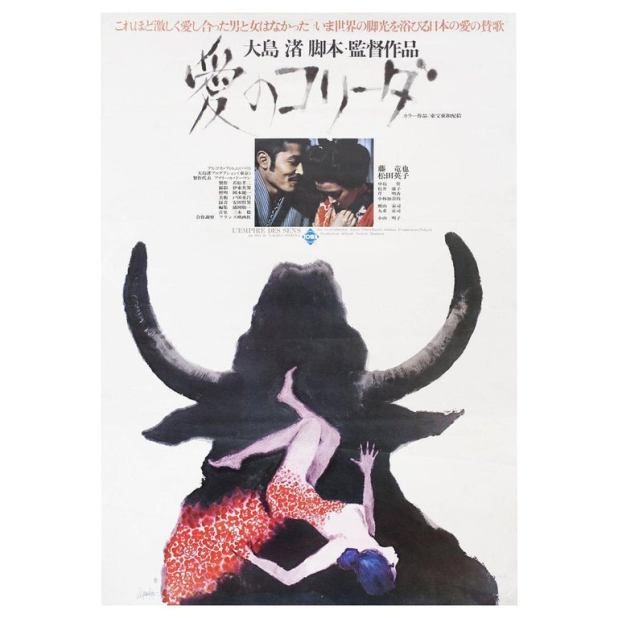
In the Realm of the Senses (1976)

Sada Abe (Eiko Matsuda) is a former prostitute who now works as a maid in a hotel, where she falls for the owner, Kichizo Ishida (Tatsuya Fuji), an affair that starts simply with non-stop sex and continues to become an obsession, as she doesn’t want to share him even with his wife. Soon, their love games include strangling one another during sex and her holding a knife to his manhood, saying that she’s going to take it with her. Well, that’s exactly what happens, as she accidentally kills him while they make love and takes his member with her, walking with it inside her before she’s arrested.

Directed and written by Nagisa Ōshima, who also made Merry Christmas, Mr. Lawrence, this is a rare mainstream film that doesn’t shy from unsimulated sex, made in a culture that even hides the mere glance at female genitals. It was made in France, while in Japan, it was fogged and blurred so that it could appear in theaters.

Eiko Matsuda had worked in sexploitation films but was never treated as harshly by the public as she was when this film was made, finally moving to France and ending her acting career. Society remains unfair, as her male partner in the movie, Tatsuya Fuji, regained his career after two years.

This was based on a true story and Sada Abe did not fade from the world after serving five years of her six-year sentence even though she asked for the death penalty. The police record of her interrogation and confession became a best-selling book. Over the next few years, the public perception of her moved from a pervert to someone who murdered for love. She acted in a traveling show and worked in a bar in downtown Tokyo for twenty years before appearing in Teruo Ishii’s documentary History of Bizarre Crimes by Women in the Meiji, Taishō, and Shōwa Eras. When  Oshima tried to find her before making this movie, he learned that she was in a nunnery, yet most reports claim that she disappeared.

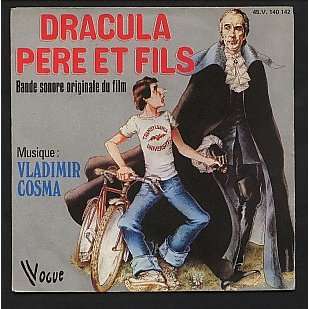
Dracula Pere Et Fils (1976)

This French movie — whose title means Dracula and Son — brings Christopher Lee back to the role he may be most famous for in his tenth* and final screen appearance as Dracula. It was directed and written by Édouard Molinaro, who made the original La Cage aux Folles.

That arch nemesis of all Universal and Hammer villains, villagers with torches, have finally pushed Dracula and his son Ferdinand out of their home and to England. Actually, they’re torch bearing villagers who have found that they prefer Communism to living under a vampiric dictator.

With all the monster movies being made, the Count finds work playing himself and his son becomes a night watchman. But when they both fall for the same woman, played by Marie-Helene Breillat. Her sister Catherine plays Ferdinand in the beginning.

The American version has lots of reshoots and different jokes. It didn’t come out until 1979 in the U.S., but I don’t remember it causing much noise. Then again, they got a vocieover for Ferdinand that sounds like Don Adams on Get Smart, so go figure.

*The other Lee Dracula films are:

  1. The Horror of Dracula
  2. Dracula Prince of Darkness
  3. Dracula Has Risen From His Grave
  4. Taste the Blood of Dracula
  5. Scars of Dracula
  6. Dracula A.D. 1972
  7. Satanic Rites of Dracula
  8. Jess Franco’s Count Dracula
  9. In Search of Dracula