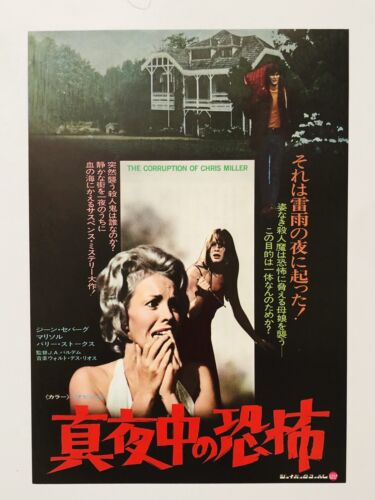
Cinematic Void January Giallo 2023: The Corruption of Chris Miller (1973)

EDITOR’S NOTE: Cinematic Void will be playing this on Saturday, Jan. 7 at 7:30 PM at the Sie Film Center in Denver, CO (tickets here) with Four Flies On Grey VelvetFor more information, visit Cinematic Void

Chris Miller (former Spanish child star Marisol; when she married dancer Antonio Gades, Fidel Castro acted as their godfather) lives with her stepmother Ruth (Jean Seberg, the haunted and doomed beauty who was also in Breathless and Saint Joan). The loss of Chris’ father has damaged both of them, so when a drifter named Barney (Barry Stokes, Prey) shows up, it changes their lives. Maybe not for the better, what with a killer slicing his way through the village…

This Spanish giallo was directed by Juan Antonio Bardem (yes, the uncle of Javier) who also made Death of a Cyclist and wrote A Bell From Hell. It was written by Santiago Moncada, who was also the pen behind Hatchet for the HoneymoonRicco and The Fourth Victim.

Ruth blames Chris for her husband leaving, so she uses Barney to seduce her stepdaughter, who is recovering from the dual loss of her father and being assaulted at school. Her plan? When daddy comes home, he won’t love his daughter much any longer because she’s no longer a virgin. Meanwhile, the killer keeps on killing, including a scene where he dresses like Charlie Chaplin.

Also released as Behind the Shutters Sisters of Corruption and , this movie is also a proto-slasher, rife with bloody murders, including a moment when the rain slicker-covered villain kills an entire family in slow motion.

This is a film that deals as much with trauma as murder, that has the sound of running water causing horrifying flashbacks and has no easy ending for anyone in the film, as the guilt of the killings won’t disappear with the death of any suspect.
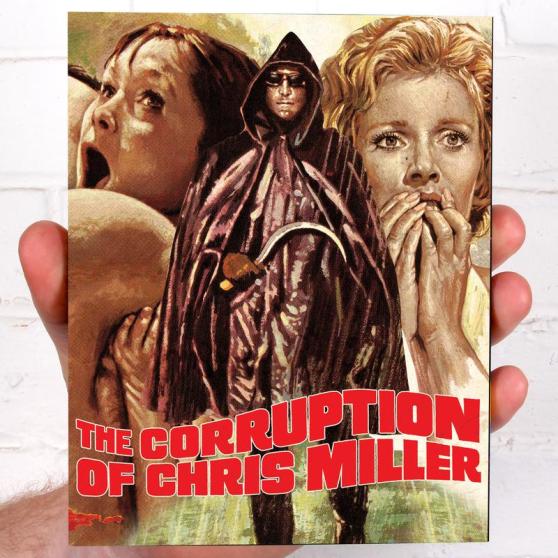
Vinegar Syndrome recently released this on blu ray, complete with a newly scanned 4K capture from the original 35mm negative.
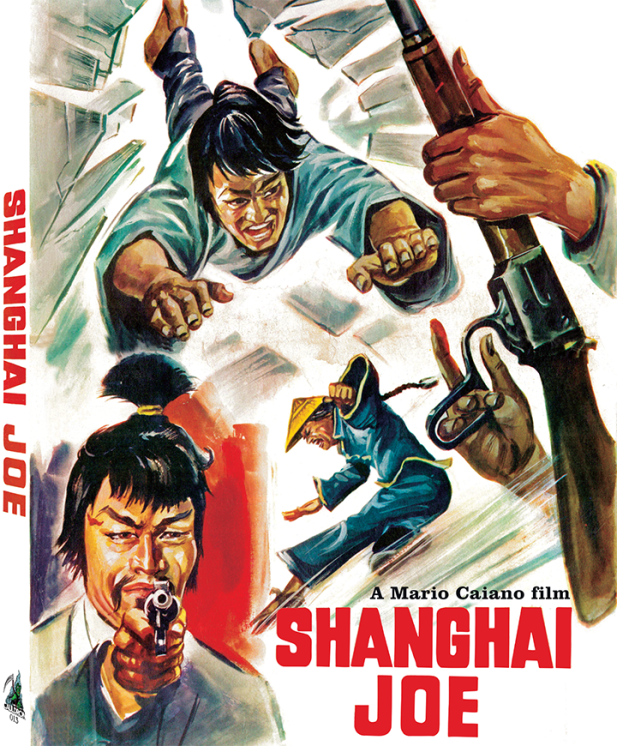
CAULDRON FILMS BLU RAY RELEASE: Shanghai Joe (1973)

EDITOR’S NOTE: This was originally on the site on August 20, 2020.  It’s back because Cauldron has released an absolutely stunning version of it on blu ray featuring a 2K restoration from the negative, both English and Italian audio options, CD soundtrack with music from Bruno Nicolai, and brand new extras including an interview with Master Katsutoshi Mikuriya, a visual essay by film historian Eric Zaldivar, commentary with film historian Mike Hauss from The Spaghetti Western Digest, a trailer, poster and high-quality slipcase. You get buy it from Cauldron.

According to the Spaghetti Western Database, lead actor Chen Lee may have been a Japanese karate instructor, but according to director Mario Caiano (Eye In the Labyrinth), he worked in a laundry, not in a dojo, and was picked because he looked like a young Dustin Hoffman. Some think his real name was Mioshini Hayakawa, which is Japanese, not Chinese. That said, if that being racist — not knowing the difference between two countries nearly 1,900 miles away from one another — then this movie is not for you.

Seriously, nearly every race gets denigrated in this movie audibly and physically. Luckily, Shanghai Joe ends up killing every single offender.

Also — the Bruno Nicolai music — recycled from Have a Good Funeral, My Friend… Sartana Will Pay — is so good you’ll want to stick around for the whole movie.

Shanghai — or Chin Hao — has come to this country and instead of finding whatever it is he’s looking for — he has tattoos much like Kwai Chang Caine — he’s found that aforementioned racism and a love interest in Cristina (Carla Romanelli, Fenomenal and the Treasure of TutankamenThe Lonely Lady).

Our hero’s skills as a fighting man make their way to cattle rancher Stanley Spencer (Piero Lulli, Kill, Baby…Kill!), who is really enslaving Mexicans to do his work. That means that the bad guys decide to kill him, but none of them can get it done.

Spencer ends up hiring four different killers, much like video game bosses, to do his work for him. There’s Tricky the Gambler (Giacomo Rossi Stuart, The Night Evelyn Came Out of the Grave), Pedro the Cannibal (Robert Hundar, Sabata), Buryin’ Sam (Gordon Mitchell, who improvised and sang the song “Chin-Chin Chinaman” while carrying a shovel to try to kill Shanghai) and Scalper Jack (an astonishing Klaus Kinski, who is obsessed with hair and you genuinely fear for the life of Romanelli in their scene).

Finally, Mikuja, the only person who has the same martial arts technique and tattoo as our hero, is hired to kill him. Their battle may not be a fight on the order of a Shaw Brothers technical battle, but it’s still fun.

This movie is incredibly strange, because every time I thought it was going to be normal, it would go from slapstick to our hero plucking out a bad guy’s eye and blood spraying all over the place. It’s closer to a horror film set in the West with martial arts than a straight-up Italian Western, but it’s better for that difference.

Totally recommended.

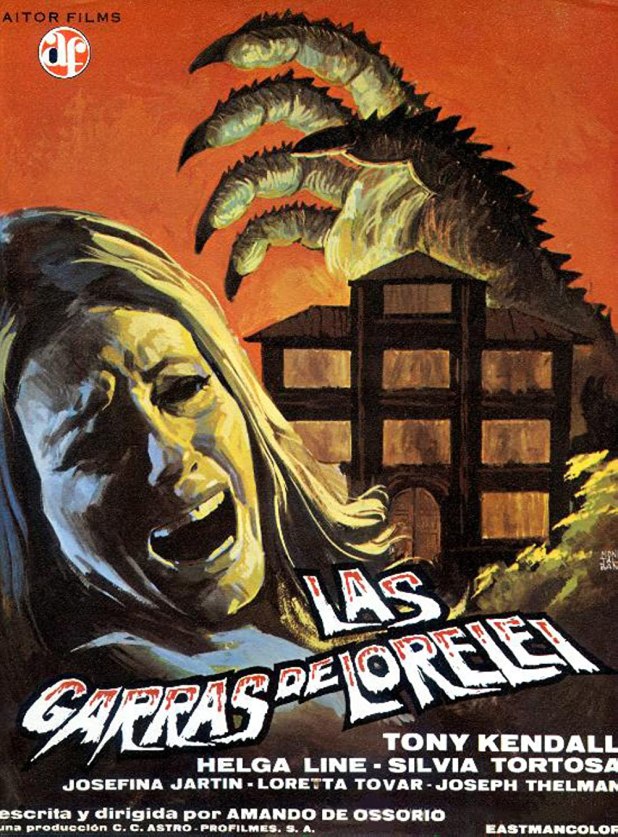
AMANDO DE OSSORIO WEEK: The Loreley’s Grasp (1973)

As you know, I do love alternate titles. This was known in the U.S. as When the Screaming Stops and even better, The Swinging Monster, both titles that make no sense, what with this being set in an indeterminate time and the only swinging coming from how many gorgeous women are in it. That said, the first other title got a gimmick from distributor Independent Artists, who added Shock Notice, turning the screen red with flashing lights before each murder.

Directed and written by Amando de Ossorio, this is about a German boarding school for girls — parents, don’t send your babies to German boarding schools — where the young ladies are getting murdered in such bloody and horrifying ways during every full moon. This leads to the teacher, Elke Ackerman (Silvia Tortosa, Horror Express) to hire a hunter named Sigurd (Tony Kendall, The Whip and the Body) to protect her pupils.

Each night, Sigurd patrols the school grounds — noticing the many gorgeous students under his protection, naturally — before he meets Sigurd a cloaked woman (Helga Liné) that he keeps missing despite chasing her. He also meets Professor Von Lander (Ángel Menéndez) who has made a dagger that can transform the creature — the Loreley — back to her human form. And as you can imagine, he’s already fallen for her, despite his job and the fact that she’s killed numerous people.

Sigurd is also in love with Elke — maybe he’s The Swinging Monster — and Loreley has already gone after her while restraining him in the undersea cave where she lives with an army of feral women. It’s an entire world removed from our own, like another time and place, which our somewhat modern man destroys with bombs before leaving behind the monstrous world and embracing a love of reason. I’m not so sure I’d make the same choice.

I’ve read a lot of reviews that make fun of this movie, that say it has bad effects, that it’s kind of stupid. Those people are small minded sad folks who can’t embrace the world of Eurohorror, where every man looks like a superhero and every young girl’s bodice is practically either ripped open or covered in blood. A world where gorgeous women lie in wait inside lagoon caves, ready to transform and destroy.

MILL CREEK NIGHTMARE WORLDS: The Fury of the Wolfman (1973)

EDITOR’S NOTE: This was first on the site on August 23, 2020.

La Furia del Hombre Lobo is a 1970 Spanish horror film that is the fourth in the saga of werewolf Count Waldemar Daninsky, played as always by Paul Naschy. It was not theatrically released in Europe until 1975, yet an edited U.S. version played on television as early as 1974 as part of the Avco-Embassy’s “Nightmare Theater” package, along with Naschy’s Horror from the Tomb and The Mummy’s Revenge.

For those that care about these things — like me — the other films were MartaDeath Smiles on a MurdererNight of the Sorcerers, Hatchet for the HoneymoonDear Dead DelilahDoomwatchBell from HellWitches MountainManiac Mansion and The Witch.

This time, Daninsky is a professor who travels to Tibet, only to be bitten by a yeti which seems like not the werewolf origin that you’d expect. He then catches his wife cheating on him, so in a fit of passion, he murders them both before being killed himself. But this being a Spanish horror movie, that’s just the start of the trials that El Hombre Lobo must struggle through.

Daninsky is revived by Dr. Ilona Ellmann (Perla Cristal, The Corruption of Chris Miller), who wants to use him for mind control experiments. Soon, however, our hero learns that she has a basement filled with the corpses of her failed experiments. To make matters even worse, she brings back his ex-wife from the dead and turns her into a werewolf too!

There’s a great alternate title to this movie: Wolfman Never Sleeps. How evocative! That’s the Swedish version that has all of the sex that Franco’s Spain would never allow.

Naschy claimed that director José María Zabalza was a drunk, which may explain how this movie wound up padded with repeat footage from Frankenstein’s Bloody Terror and some stunt double continuity antics that nearly derail this furry film.

You can watch this on Amazon Prime. It’s also coming out on blu ray from Ronin Flix.

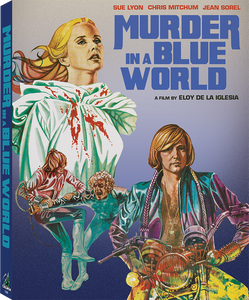
CAULDRON FILMS BLU RAY RELEASE: Murder In a Blue World (1973)

In Spain, this was known as Una gota de sangre para morir amando (A Drop of Blood to Die Loving), in France as Le bal du vaudou (The Voodoo Ball), in the U.S. as To Love, Perhaps to Die and in the UK as Clockwork Terror and Murder In a Blue World.

It’s director and co-screenwriter Eloy de la Iglesia’s take on a future world that at times may feel very 1973 but also feels way more 2022 than we may want to admit.

The director was a member of the Spanish Communist Party and his films reflect his beliefs, bravely work in his feelings on his homosexuality and often feature violent forms of social protest, all of which caused him massive issues as he battled the censors of Spanish dictator Francisco Franco.

Anna Vernia (Sue Lyon) is a dedicated nurse, dating Dr. Victor Sender (Victor Sorel), a doctor who uses electro-shock therapy on violent criminals to make them better citizens. This is necessary, so he believes, as they live in a city constantly dealing with crime, including what the police believe is a sadistic homosexual man killing gorgeous young men.

As a family settles in for the evening and plans to watch A Clockwork Orange — look, if you’re going to be ripping off or making your own version of a movie, go all in! — they’re soon attacked by a motorcycle gang who assault the mother and father, finally killing them before leaving their son alive. One member of the gang, David (Chris Mitchum), disagrees with the other members, so they attack him and expel him.

Meanwhile, Anna is collecting pop art — Alex Raymond original art, a copy of Lolita which is ironic as Lyon played the lead in Kubrick’s film — when she isn’t acting as that serial killer everyone is looking for, using a scalpel to murder men after sex, becoming inspired to murder by their post-coital heartbeats. David sees her disposing of one of her bodies and begins following her as she disguises herself and wipes out an underwear model and a young gay man.

David has befriended her guard dog and makes his way into her home, blackmailing her and using the money to buy a motorcycle. His old gang attacks him and leaves him for dead, which takes him to the hospital, where Victor plans on using his techniques to redeem him. Anna decides that this can’t happen — she feels something for him — so she kills him after reading Poe to him as her would-be lover Victor’s patients lose their minds.

I love how this movie somehow combines the ancient future of the 70s with the trapping of giallo. This is a strange and wonderful film that I plan on going back to several times.

The Cauldron Films release of Murder In a Blue World has a 2K restoration of the Spanish producer’s cut from the negative in a 1080p presentation. It has a newly edited interview with Mitchum, a dubbing feature, a video essay by Dr. Xavier Aldana Reyes and commentary by Kat Ellinger. You can get this from MVD.

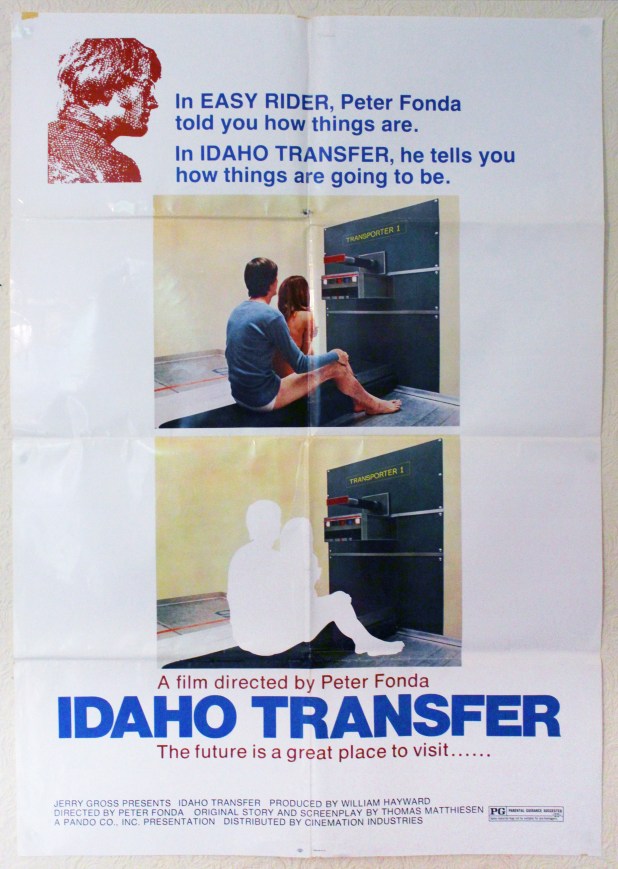
MILL CREEK NIGHTMARE WORLDS: Idaho Transfer (1973)

EDITOR’S NOTE: This was originally on the site on November 23, 2017.

Karen Braden just got out of a mental hospital. Now, her father and sister, Isa, have taken her to a secret government facility in Idaho where they’re working on matter transference. However, they’ve learned how to travel through time instead, which has taught them a sad fact: an ecological event will soon wipe out civilization.

idaho_transfer

Only those twenty and younger can handle time travel, due to the damage it does to the kidneys. The scientists start sending teenagers fifty-six years ahead to rebuild the human race. It turns out that the project was secret and once discovered, the government turns off the machines, trapping everyone in the future, where they are killed when one of them, Leslie, goes nuts. Oh yeah — and everyone is now sterile, despite Karen’s assertions that she is pregnant.

No one even cares that they are about to die. One of the teens, Ronald says: “I don’t think you have to leave anything behind. Just have a beautiful time like all the other junk litter in the universe, then say goodbye. I don’t know what else to tell you. Perpetuation and all the crap that goes with it is a big hoax anyway.”

The last survivor, Karen, tries to change the settings on the machine and go back to prevent everything. But she screws up and goes too far forward. A futuristic car pulls up and a man takes her, placing her in the trunk to be used as fuel. A future girl asks her family what will happen when they run out of fuel and will they have to stop driving cars? The film ends with the words “Esto Perpetua,” meaning “It is forever.”

Other than Keith Carradine, the cast is filled with unknowns. Peter Fonda produced and directed it, but eventually, he let the film disappear into the public domain. I discovered it on a Mill Creek Entertainment 50 pack and it’s…weird.

It’s the only movie I’ve ever seen where an 8-track player is a time machine and you need to get into your underwear (or nude) and have someone sit behind you to activate it. That seems like some kind of weird pick-up trick, but somehow it works. Except the future is incredibly shitty and you’ll be turned to gasoline. So there’s that.

This seems like the coming down of 60’s hope, the understanding that the world would soon end. But then, the 80’s would arrive and everyone would start caring about only one thing: themselves. Perhaps the dead world of Idaho Transfer is preferable to selling out and becoming a lie.

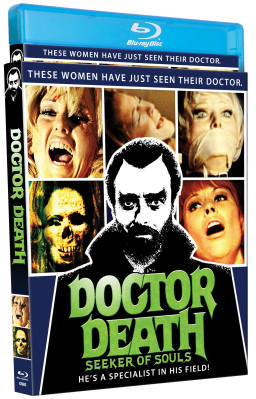
KINO LORBER BLU RAY RELEASE: Doctor Death (1973)

Dr. Death (John Considine) is a thousand-year-old magician who can transfer souls from one body to another. He keeps himself alive by jumping from one body to the next and oh yeah — he has acid blood. I mean, sure, I’m down with that.

Sadly, this never got a sequel, as that was the plan. The main story is about Fred Saunders (Barry Coe), whose wife has just died and promised to return from the other side. After finding that spiritualist after spiritualist are all carny liars, he meets Doctor Death who really can bring the dead back from the grave. Of course, he’s also an absolute maniac.

One of the film’s financiers was Barry Gordy, who got to direct a scene. It’s also the last screen appearance of Moe Howard and has horror host Larry “Seymour” Vincent as a killer.

Consider this a 1973 TV movie that played theaters and drive-ins. It’s low budget, but groovy as it gets. I want to live in the world of this movie so badly. I really wish they’d made ten of these movies. “Enter that body!” says Doctor Death. Sure, whatever you want.

The Kino Lorber blu ray release of Doctor Death has commentary by John Considine, who also contributed an intro and an interview. It also has an interview with the director’s son Steve Saeta and a trailer. You can get it from Kino Lorber.

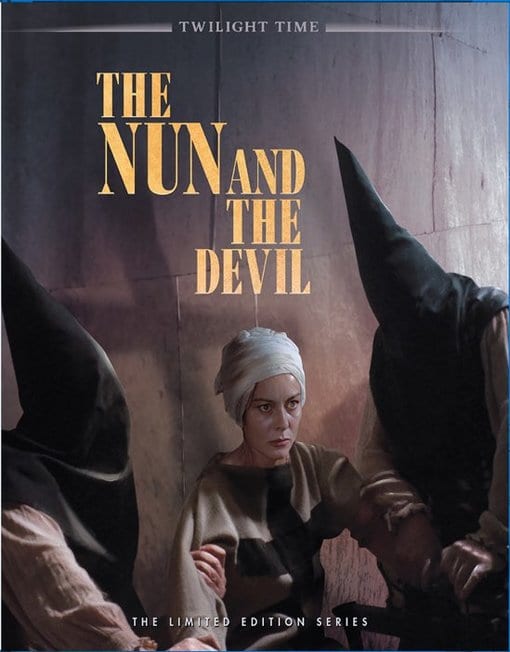
TWILIGHT TIME BLU RAY RELEASE: The Nun and the Devil (1973)

Le Monache di Sant’Arcangel, Sisters of Satan and The Nuns of Saint Archangel are the other names for this film by Domenico Paolella who started his career all the way back in 1939 and also directed Stunt SquadWomen of Devil’s Island and Story of a Cloistered Nun.

Based on authentic 16th Century records and a story by Stendhal — sure, whatever you say — this film really hits all the expected sleazy beats of nunsploitation but it invented it, coming early in the cycle that really got going between The Lady of Monza and The Devils.

The Sant Arcangelo Convent is where Sister Julia (former Miss Great Britain Anne Heywood, who was also in The Fox and The Killer Is on the Phone) is doing everything she can to become Mother Superior.  This all happens as the nuns may take on celibate vows yet make love to one another and invite men inside the walls of their holy place. Of course, this just means that we get a square up reel after holy men come in and torture these sinning women, all before Julai is forced to drink poison.

Shot in a real convent — Fossanova Abbey in Priverno, Latina — that has to be a Jess Franco-like trick, as somehow they were never told exactly the movie that was getting made. I can’t even imagine the condemnation that followed.

Look, I don’t want to be some kind of drooling leering fanboy, but if you make a movie with Ornella Muti as a nun, well…it’s going to be something I’m going to watch.

Twilight Time’s new release of The Nun and the Devil has an audio commentary with critic Kim Newman and Italian cinema expert Barry Forshaw, interviews with Luc Merenda and Martine Brochard, a profile of Domenico Paolella, a nunsploitation interview with Marcus Stiglegger and a trailer. You can get it from MVD.

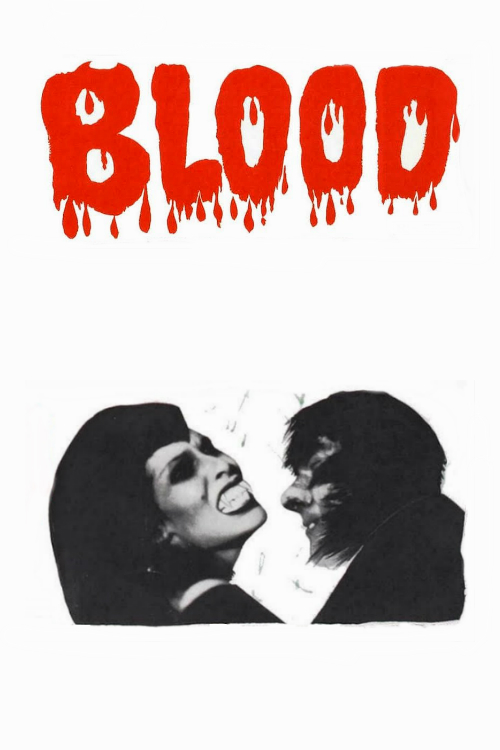
2022 Scarecrow Psychotronic Challenge Day 8: Blood (1973)

8. THE MONSTER MASH: Multiple monsters in one movie? That’s a graveyard smash!

Dr. Lawrence Orlofski (Allan Berendt) has just bought a new house and moved his wife Regina (Hope Stansbury, who wrote Vapors and also appears in Milligans’s Depraved!The Degenerates and The Rats Are Coming! The Werewolves Are Here!) — “My wife doesn’t like the daylight hours. Rather, I should say daylight doesn’t agree with her.” — in along with their three servants, Orlando (Michael Fischetti), Carrie (Patricia Gaul) and Carlotta (Pichulina Hempi).

If this is your first Milligan movie, you may be wondering why everyone is screaming at one another. If you’re a fan of his work, you instantly get excited as soon as people start raising their voices.

Regina is a corpse but as soon as she’s injected with blood, she becomes young again. She’s angry that she can no longer be in the sunlight, all while the servants hold umbrellas over her and prepare her meals. She and the doctor seem to despise one another with her saying, “Go to hell,” and him answering, “We’re there already.”

Meanwhile, there are carniverous plants in the basement that need to be fed with blood from Carlotta’s brain. Also, the doctor’s name is really Lawrence Talbot, but this movie doesn’t need to explain that to you and you better get the reference yourself. Also also, Carrie’s brother visits, which allows her to give the audience at least some background: “There is an abnormal distribution of tissue and blood cells which makes up her physical structure. These plants which Dr. Orlofski and I have found are the only things that will bring a normal balance.” Then she makes a move on her brother, who runs right into Regina’s room and immediately gets a meat cleaver to the brain and acid poured all over himself. Also also also — this movie has a lot going on while also seeming glacial which is a totally Milligan balance — Dr. Orlofski is having an affair with Prudence (Pamela Adams), the secretary of Carl Root (John Wallowitch), the lawyer in charge of his father’s estate who is stealing money and oh I forgot to tell you, the doctor is also a werewolf.

Regina eats a mouse in one cut, I mean, literally chopping it in half and gulping it down as if this was made in Italy. And then there’s Petra, Keeper of Graves (Eve Crosby), an old woman who watches the doctor rut around with that secretary in her cemetery and fills in Regina on that secret; she’s was also the mistress of Orlofski’s father. Well, now she’s dealing with the daughter of Dracula.

Shot in Milligan’s St. George mansion located in Staten Island — I wonder how much that inspired the TV series version of What We Do In the Shadows — this movie is a period film and under seventy minutes and an abrupt marital fight into a flaming finale, capped by Dr. Frankenstein moving in next.

This movie is not of our world. It’s not of our reality. It did, however, play double features with Legacy of Blood and with Chinese Hercules under the alternate title Black Nightmare in Blood.

You can watch this on Tubi.

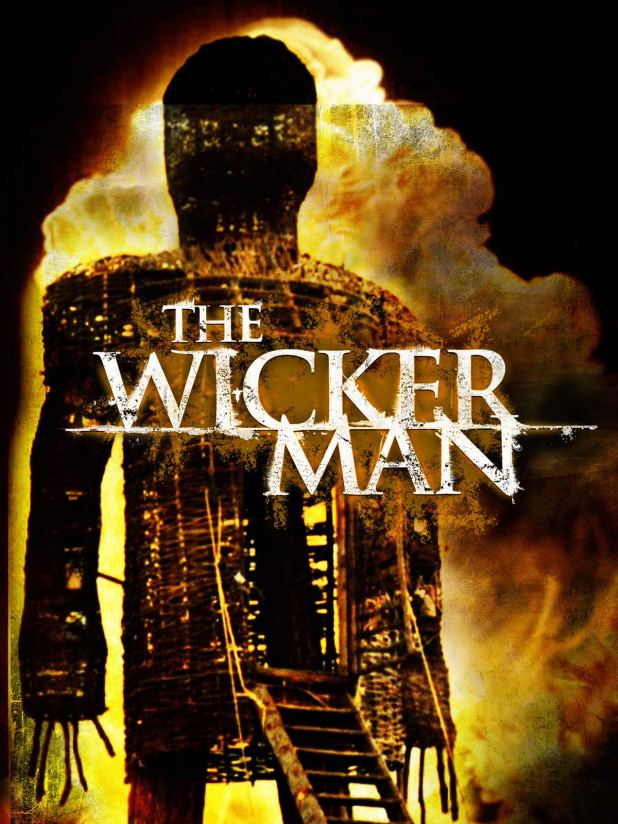
THE CHRISTOPHER LEE CENTENARY CELEBRATION PRIMER: The Wicker Man (1973)

EDITOR’S NOTE: You can watch this movie this weekend at the Drive-In Super Monster-Rama! Get more info at the official Drive-In Super Monster-Rama Facebook page and get your tickets at the Riverside Drive-In’s webpage.

The Wicker Man begins with Christopher Lee, a Hammer star, talking to writer Anthony Shaffer about more interesting roles. Shaffer had read the David Pinner novel Ritual — which had first been written as a script for Michael Winner, and I can’t even imagine what he would have done — and turned that inspiration into his own story.

Shaffer’s vision for the film was unique. The story delves into the intersection of modern religion and ancient pagan practices. It departs from the typical blood and gore of horror, opting instead for a creeping, unknown terror that lurks in the shadows. This unique approach is what we now refer to as folk horror.

The Wicker Man stands at the crossroads of art and horror, somewhere between movies like Performance and The Devil Rides Out, but with a twist, as the traditional rules of horror no longer apply. The concepts of good and evil, as defined by Judeo-Christian beliefs, are absent in this story. Instead, it’s a journey into the unknown, exploring ancient ways that have existed long before the modern era.

Christian Sergeant Neil Howie (Edward Woodward) is initially presented as the virtuous hero. He is on the island of Summerisle investigating Rowan Morrison’s disappearance, yet the villagers refuse to admit that she ever existed.

He’s shocked at these people’s ways, which include putting frogs in their mouths to cure illness and dancing around phallic maypoles. He finds images of past May Queens. He meets Lord Summerisle (Lee), who leads this village. And he sees the answers that he seeks, despite perhaps not liking them.

There’s also tempted by Willow MacGregor (Britt Ekland, who was three months pregnant; she was dubbed by Annie Ross, and her body double was dancer Rachel Verney), and there’s a scene where she dances with a wall between her and Howie that is volcanic. It has no nudity, but it’s filled with sensual energy.

Director Robin Hardy also made The Fantasist and The Wicker Tree, a very loose sequel to the original movie. Hardy first published the sequel as a novel, Cowboys for Christ, about American Christian evangelists who travel to Scotland and end up in a similar situation. Lee plays the Old Gentleman, who is either Summerisle or not.

Shaffer also wrote The Loathsome Lambton Worm, a direct sequel that begins immediately after the ending of The Wicker Man. In it, Howie is saved by his fellow police officers. The movie features a fire-breathing dragon and is much more fantastic than the first one.