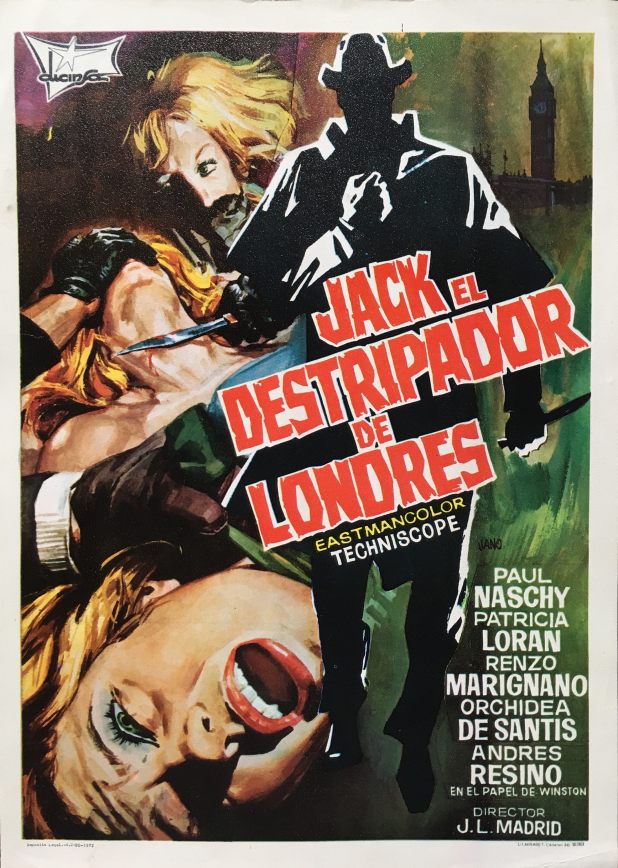
Pedro (Paul Naschy!) used to be an acrobat, but he had an accident and now all he does is limp around rainy London and get into fights. Meanwhile, a murderer starts redoing the crimes of Jack the Ripper. Could it be Pedro? Once his second wife is killed, he becomes a target for both the police and the mob that controls prostitution.
Basically, this is a Spanish movie trying to be an Italian giallo shot in England starring Paul Naschy, who doesn’t become a werewolf. A true multicultural affair if there ever was one!
The thing is, despite having a limp and supposedly being unable to work, Naschy’s character routinely dishes out beatings to criminals.
That said, a man calling himself Jack is killing all manner of girls of ill repute and then calling the inept police and sending them heads in hat boxes 24 years before Seven. This is a giallo in name only, as there’s rarely any high fashion, other than lothario teenager and Ripper suspect Winston’s wife. This lady serves her guests cakes via a hostess cart, all while holding a poodle under one arm and wearing a dress that looks like it was Carol Burnett-style made out of the curtains. This is one lady that knows how to party! Too bad her husband is more interested in blackmailing the students that he’s sleeping with. That said, one of them, Sandy, wears quite the fetching black furry jacket.
There’s also an amazing moment where one of the hookers, Belinda, screams about all of the men that have screwed her over. So there’s that.
But if you were expecting something out of the Argento, Martino or even Lenzi giallo camp, you may wish to look elsewhere. It also may try hard to be sleazy, but it doesn’t feel like a real maniac is in the director’s chair. Maybe I’ve been spoiled by the Italian maestros, who so artfully make everything look like a neon red dream.
There are, however, numerous b roll travelogue shots of 1971 London with people either mugging for the camera or doing their best to avoid it with a stiff upper lip.
Hammer hit all the monster cues before 1971: vampires, mummies, werewolves, lesbian vampires, you name it. By 1971, it was time for something different. Something that mixed the Hammer sophistication audiences had come to expect with plenty of the gore they now wanted. Peter Sasdy was tapped to direct — you may know him from films like Taste the Blood of Dracula and Countess Dracula. To me, he’ll always be the guy behind the criminally unknown Welcome to Blood City and the criminally awesome The Lonely Lady.
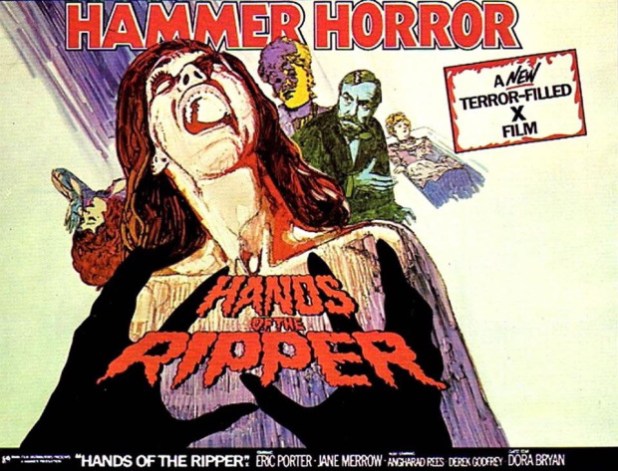
The infant daughter of Jack the Ripper witnesses his last murder, as the killer murders his wife (and her mother, of course) when she catches on to the fact that her husband has blood all over himself and that he’s just returned in the middle of the night from Whitechapel.
Strangely, while we see Jack the Ripper’s face clearly — it’s a mess of syphilis scars — and hear his voice and people recognize him, no one ever says who he is. Ever stranger, the actor who played him has gone uncredited and all Hammer records as to who played him have vanished. Even director Peter Sasdy wouldn’t reveal who it was!
Fifteen years later, his daughter is fully grown and possessed by the spirit of her father, entering into trances where she’ll kill people and not remember what happened afterward. That’s a career danger, as she’s now the adopted daughter of a phony spirit medium and that kind of job requires one to go into said trances. To top it off, the old phony then tries to sell her adopted daughter’s virginity!
But it all works out. After all, a psychiatrist wants to help her and is convinced that he has the cure. Dude, this is a Hammer movie. This isn’t going to end well for anyone!
The second Hammer film about Jack the Ripper (after 1950’s Room to Let), this was paired in America with the superior Twins of Evil, which is probably my favorite vampire movie ever. This is a combination Gothic horror/proto-slasher/giallo/possession film that is pretty much ahead of its time. And hey! Someone gets their eyes put out with knitting needles. So there’s that.
You can watch this with an Amazon Prime subscription.
Argento’s The Bird with the Crystal Plumage has scores of imitators that rose in the wake of its success. There were scores of gorgeous women being murdered, jazzy soundtracks blaring and movies with animals in their titles. And then, every once in a while, there’s a giallo that rises beyond the pack and asserts itself as a true work of art.
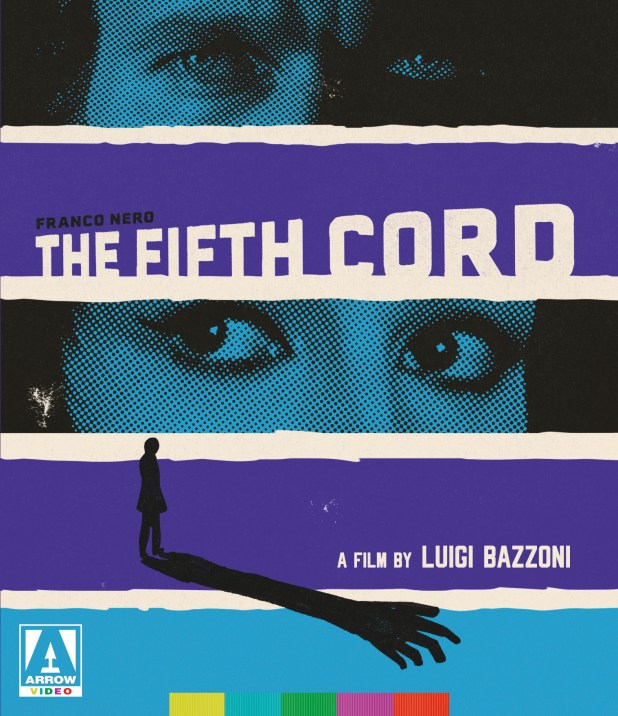
Giornata Nera per L’Ariete, or Black Day for the Ram, may appear to be an animal title, but it really refers to astrology (which kind of gives away some of the film). It’s better known as The Fifth Cord.
Director Luigi Bazzoni doesn’t have a huge list of films to his credit, but between this film, The Possessed and Footprints on the Moon, his take on the giallo form is unlike anyone else’s. This is more than a murder mystery. It’s a complex take on alienation and isolation at the end of the last century.
Based on David McDonald Devine’s novel — but based in Italy, not Scotland as in the book — The Fifth Cord starts with a man barely surviving a vicious attack on the way home from a New Year’s Eve party. We even get to hear the words of the killer:
“I am going to commit murder. I am going to kill another human being. How easy it is to say, already I feel like a criminal. I’ve been thinking it over for weeks, but now that I’ve giving voice to my evil intention I feel comfortably relaxed. Perhaps the deed itself will be an anti-climax, but I think not.”
Writer Andrea Bild (Franco Nero!) is assigned to report on the case and to put it bluntly, he’s a mess. Ever since his separation, he’s been drowning his life in whiskey and women.
Soon, the attacker strikes again and this time, whomever it is succeeds and leaves behind a black glove with a finger missing (Evil FIngers is an alternate title). That one finger missing turns into two, then three and comes with evil phone calls. Andrea has to take on the giallo role of the investigator before he becomes either the fifth victim or is arrested by the police — it turns out that he was at that very same New Year’s party, as was every single one of the victims.
The story itself is rather basic, but the way that it’s told is anything but. Vittorio Storaro’s cinematography places The Fifth Cord in an industrialized Rome that’s rarely seen in giallo, eschewing the historic architecture we’re used to seeing. I’d compare it to a less flashy Tenebre, but this was made a decade before that movie.
If you come to these movies for the fashions, well, you may be slightly disappointed. But if you love the decor, look out. I’ve never seen more spiral staircases in one movie ever before. The house with the giant fireplace was also used for Argento’s Four Flies on Grey Velvet, but looks so much more impressive here. And I loved how the modern architecture gives little room to run in the closing moments.
This movie has never looked better than on its recent Arrow Video release. It’s jaw-dropping how gorgeous the film appears and the Ennio Morricone soundtrack positively emerges from the speakers. I expect great things from this company, but they continually surprise and delight me at every turn.
This release includes a brand new 2K restoration from the original camera negative with the film in both English and Italian with optional subtitles. There’s also a commentary track by critic Travis Crawford; Lines and Shadows, an incredibly informative video essay on the film’s use of architecture and space by critic Rachael Nisbet; interview with author Michael Mackenzie and film editor Eugenio Alabiso; and even a brand new interview with Franco Nero, who looks amazing at 77 years old. They even found a previously unseen deleted sequence!
This is one of my favorite releases so far this year and has my highest recommendation. You can get it directly from Arrow Video or from Diabolik DVD.
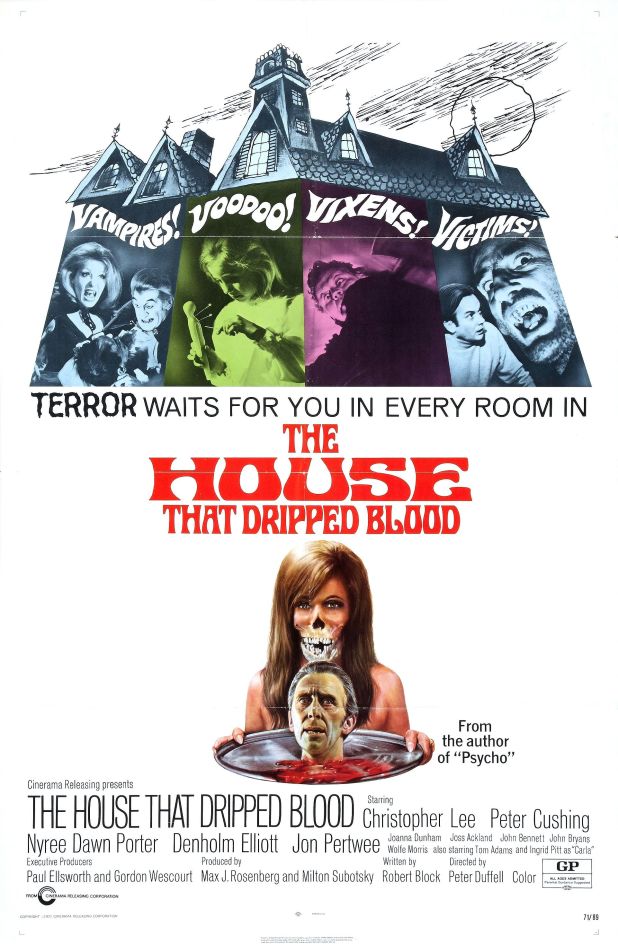
I’ve said it before and I’ll say it again, but no one ever will do portmanteau movies quite like Amicus. This 1971 offering claims that “TERROR waits for you in every room in The House That Dripped Blood” and it’s directed by Peter Duffell, who mainly worked in British TV. All four stories are based on the words of Psycho author Robert Bloch.
Movie star Paul Henderson bought a country estate where every previous tenant has died or disappeared mysteriously. Now, a Scotland Yard inspect is here to get to the bottom of things.
In Method for Murder, a horror writer (Denholm Elliott, Marcus Brody from the Indiana Jones films) and his wife are haunted by the villain of the novel he’s currently writing.
Then, in Waxworks, Peter Cushing and Joss Acklund (the bad guy from Bill & Ted’s Bogus Journey) all in love with a mannequin.
Sweets to the Sweet is all about a widower (Christopher Lee!) battling a governess over how to best raise his daughter, who may or may not have evil powers.
Finally, in The Cloak, we learn that Paul Henderson (Jon Pertwee, the third Doctor Who) found an evil cloak that transformed him into a vampire. Ingrid Pitt shows up, which delights me more than words can say.
Despite its title, there’s no blood in this one. There is, however, plenty of fun. If you’re bored by a story, just hang out for a bit. And if you like what you’re seeing, there are plenty more Amicus films we can recommend.
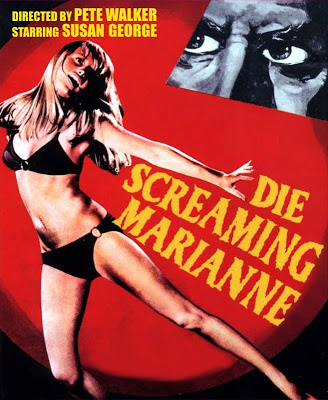
Marianne (Susan George, Tintorera…Tiger Shark) has been on the run from her family and the criminals they’ve hired, because on her 21st birthday, she inherits millions of dollars from her mother and the legal papers that will incriminate her father, the Judge (Leo Genn, A Lizard in a Woman’s Skin).
After being chased by those criminals away from her go-go dancing job, Marianne meets up with Sebastian, who takes her to London and tries to marry her. She’s not all that into it, so she plays with him and writes the name of his best man Eli on the wedding certificate. She starts to fall for Eli at the same time that she learns that her father had hired Sebastian to bring his daughter back to him.
Meanwhile, Marianne’s sister Hildegard has been in love with her father — and I mean in love in the most sexual of sense — and wants to kill her sister. Of course, she also gets with Sebastian and tries to put the moves on Eli.
Your enjoyment will depend on how much you like 1970’s kitsch and the directorial style of Peter Walker (Schizo, The Comeback).
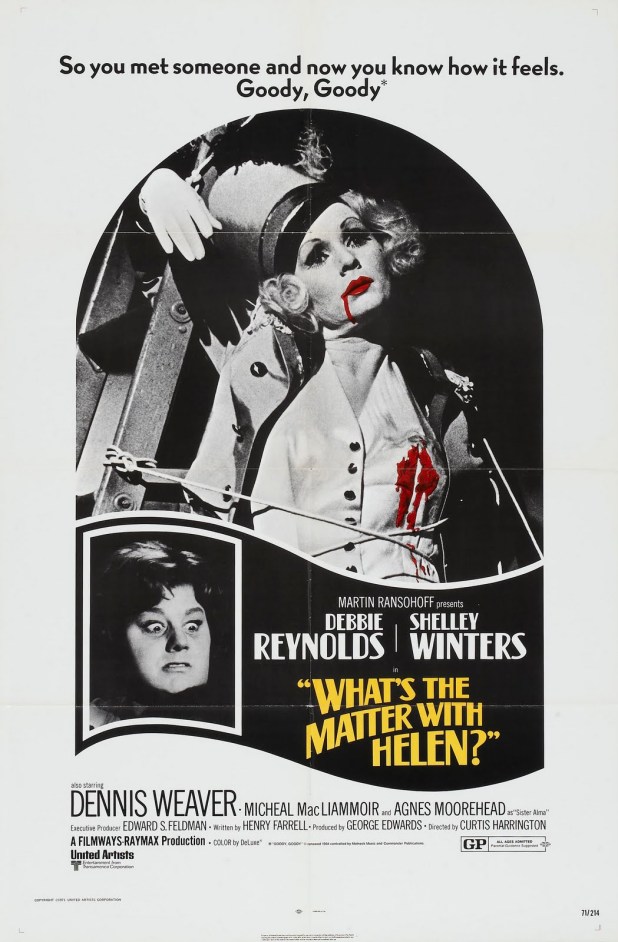
I like to play this game where any time the title of the movie is mentioned, I scream and cheer like I’m Pee Wee sitting on Chairy. Good news for me — What’s the Matter with Helen? says it’s title more than once, leading to me wondering if I should invest in the paper bags full of confetti that Rip Taylor always seems to have to throw around.
Two young men are going to jail for life after murdering an older woman. Then, we see their mothers — played by Shelley Winters and Debbie Reynolds — as they bravely face an angry mob and drive away. As they make their way home, an anonymous phone call takes credit for the attack which bloodied up Winters’ character Helen. Reynolds character Adelle then reveals her plan to pack up her cardboard standup of herself and move to California to start a dance studio. Soon, the two ladies have changed their last names and gone west.
This is a movie packed with odd situations and even odder characters, like elocution teacher Hamilton Starr and a tramp who continually bothers Adelle. And oh yeah — Helen is madly in love with her friend and becomes insanely jealous to the point that she often sticks her fingers into metal fans when she isn’t listening to Sister Alma (Agnes Moorehead) on the radio. Alma is obviously Aimee Semple McPherson, the 1920’s and 30’s celebrity whose Foursquare Church’s faith healing radio broadcasts were the forerunner of modern televangelism and charismatic Christianity.
Adelle falls for Lincoln Palmer (Dennis Weaver), the father of one of her students. He’s rich as it gets, rich enough to pay for gigolos to dance with her while he watches in yet another one of those moments that would get explored in a modern movie and are just another creepy aside in this one.
Between Helen murdering people who break into their house, then trying to be forgiven by Sister Alma all while having flashbacks to her husband being run over by a plow, her madness soon overtakes the film and things proceed to a rather sudden and shocking conclusion. There’s also an extended miniature golf sequence and numerous rabbit murders, as well as the reveal that Helen may have been right to kill at least one of the intruders.
This movie happened when director Curtis Harrington (Night Tide, Whoever Slew Auntie Roo?) and producer George Edwards approached writer Henry Farrell (What Ever Happened to Baby Jane?) became a hit. was a hit, hoping to get a screenplay. Hagsploitation was in, baby, and these dudes wanted in on the action!
According to Debbie Reynolds, Shelley Winters’s psychiatrist had warned her not to take this movie, as she was about to play a woman having a nervous breakdown while she was actually having one. She claims that Winters became her character to the point that the studio considered replacing her with Geraldine Page, who had plenty of hagsploitation cred after starring in Robert Aldrich’s What Ever Happened to Aunt Alice?
Winters also totally caught the lesbian undercurrents — well, they’re not so well hidden, so let’s say overcurrents — in the movie, but the scenes where she really played it up were left on the cutting room floor.
It’s worth noting that this was an Oscar-nominated film — for Reynolds outfits, that is. If you have a Debbie Reynolds crush, good news. This is the movie for you. This is also the movie for you if you love musical numbers about animal crackers.
Every single person in this one is disreputable, even the children, who are forced to dress as showgirls and purr songs like “Oh, You Nasty Man.” This posits What’s the Matter with Helen? as a forerunner of calling out the blatant sexuality of child beauty pageants years before Jon Benet was murdered.
I’ve always wanted to see this movie, despite its trailer and poster giving away the ending. What were they thinking? That said, there’s enough weirdness here to sustain my interest, even if I knew how it was all going to turn out.
Want to see it? Shout! Factory has recently released it on blu ray.
When I was really young, I loved to visit the high school library that my uncle ran. Today, it would probably seem small, but in my ten-year-old mind, it was huge. That said — now that I’m a grown-up, I realize just how many cool books my uncle would hide in his library for kids to find. There were collections of EC Comics and stuff like The Fifty Worst Films of All Time (And How They Got That Way) by Harry Medved, Randy Dreyfuss and Michael Medved.
When I first read that book, back when I was twelve, I thought it was the greatest thing I’d ever laid my eyes upon. I got all of their Golden Turkey Awards books and loved the quasi-documentary It Came from Hollywood But as I grew older, I began to realize that many of the movies that were decried by these books — such as the work of Ed Wood, for example — held artistic merit that superseded anyone making light of them.
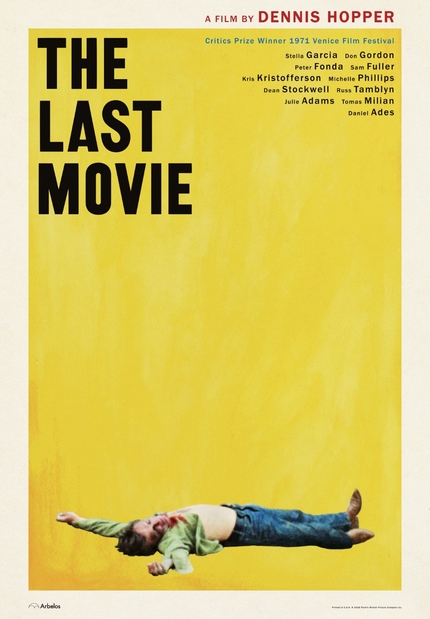
Reviewing some of The Fifty Worst Films today, I realize how many of them I actually enjoy, like Airport ’75, the Matt Helm movie The Ambushers, Bring Me the Head of Alfredo Garcia, Godzilla vs. Hedorah and Valley of the Dolls. One of the films on this list really fascinated me, though: Dennis Hopper’s The Last Movie.
After Easy Rider became a surprise success, Dennis Hopper could do anything he wanted. And sure, maybe what he wanted to do was take near inhuman levels of drugs. But let’s be serious — he had the soul of an artist and $1 million dollars from Universal bankrolling him, as well as the understanding that he had free rein with little to no intervention from the studio. After all, that had paid off with Easy Rider, right? And Hopper had been trying to get this movie made since he was in Rebel Without a Cause.
For most of 1970, Hopper and his crew shot hours upon hours of footage. And then Hopper went to New Mexico and started editing. And drinking. And doing drugs. And editing. And doing more drugs. I’m not exaggerating — just watch Lawrence Schiller and L.M. Kit Carson’s (yes, the same person who wrote The Texas Chainsaw Massacre 2) The American Dreamer.
Hopper had a cut that was pretty conventional. In the Alex Cox documentary Scene Missing, Alejandro Jodorowsky watched this cut and mocked Hopper, telling him that he had the opportunity to create true art. The visionary director would give Hopper a cut of the film, which he didn’t use, but inspired him to craft the disjointed film that exists today. Another interesting fact: when this was first screened, the projectionist loudly said, “This movie has the right title, because it’s going to be the last movie Universal ever makes.” An enraged Hopper attacked the man, ending the screening. Hopper’s career would take a long time to recover — which we covered way back when we discussed Chainsaw 2.
After being a lost film for decades — it had a short two week New York run and ran in some drive-ins as Chinchero — Arbelos, a new boutique distributor focusing on the release of both new and restored classic art house titles, has re-released a 4K restoration of The Last Movie as their first official product.
The main premise of The Last Movie is that films are dangerous. You can interpret that metamorphically or physically, as the indigenous natives of Peru keep making a movie as a ritual long after the camera have stopped rolling. Hopper based this story on things he saw as he filmed the movie that would be the first of his many comebacks, The Sons of Katie Elder, where he saw locals do the very same thing.
Kansas (Hopper) has stayed behind in Peru after a movie ends shooting after an actor is killed in a stunt. A stuntman by trade, Kansas decides to quit making movies and stay behind with a Maria, local prostitute, in what feels like paradise.
There’s a subplot with a couple who wants to buy a mine that doesn’t have much to do with what happens next, but the woman in the couple is Julie Adams from Creature from the Black Lagoon. It really feels like it gets in the way of what the movie should be about. It also feels like Hopper shot so much footage that he could have edited twenty different movies out of the results.
Yet the real narrative of the film is that the natives have turned sticks into cameras and are filming a movie that will never exist filled with real violence. That’s when The Last Movie begins to touch on the issues of reality versus fiction and how we perceive storytelling, as well as using behind the camera terminology as a storytelling tool.
Despite its downbeat theme, there’s a true beauty to this film, made even more gorgeous by the painstaking restoration process the film has gone through. The final scenes of the wooden false cameras attempting in vain to film Kansas’s sacrifice are breathtaking.
“It ends in fire. All my movies end in fire.” Hopper may have said that about Easy Rider, but it’s true about nearly everything he touched. This comes from Some Kind of Genius, a 30-minute one on one talk with Hopper that’s also on the blu ray release. It’s exactly the kind of extra I was hoping for — a rambling discussion of career and art by Hopper. I wish I’d have the opportunity to speak to the man, someone I feel was a true icon of American art, but never will get the chance to. This doc gets me close.
You need to see this for yourself. You can grab it on the Arbelos store now.
DISCLAIMER: I was lucky to get a copy of this from Arbelos, but that didn’t impact my review. I was already enthusiastic about buying a copy of this and was happy they sent it my way.
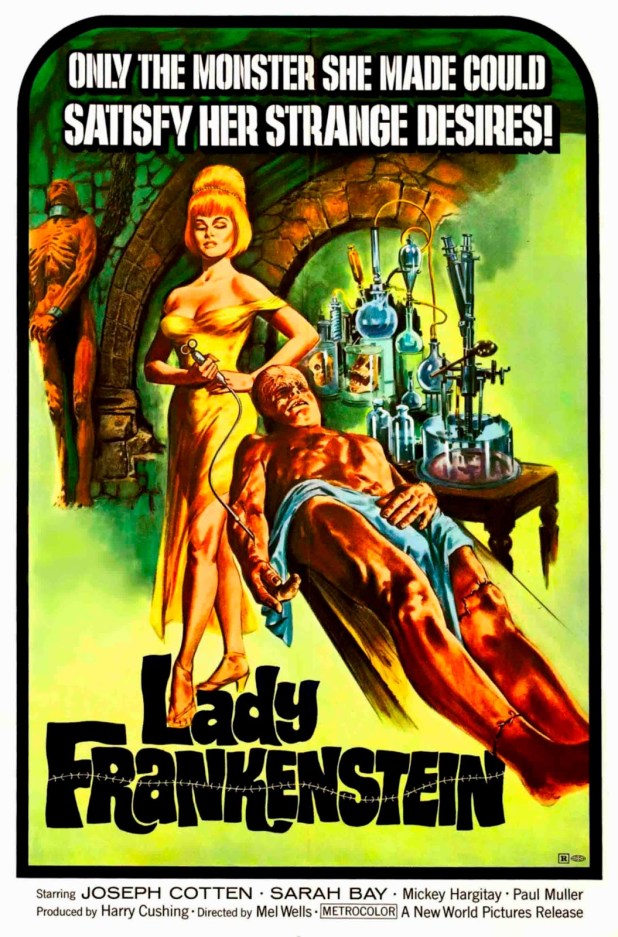
Imagine a Hammer movie where instead of implied nudity and strange sexuality, everything is laid, well, bare. It’s not hardcore, but compared to where horror was pre-1971, Lady Frankenstein is a somewhat audacious concept: the man is no longer in charge and it turns out that the heroine (or villain, there’s no real hero in this movie though) is even more warped and insatiable than those that have come before. If you listen to Rob Zombie, you may know the sample from the trailer for this film: “Who is this irresistible creature who has an insatiable love for the dead?”
Three graverobbers deliver a body to Baron Frankenstein (Joseph Cotten!) and his assistant Dr. Marshall (Paul Muller, Barbed Wire Dolls) to bring back to life. The twist is that Tania Frankenstein (Rosalba Neri, Lucifera: Demon Lover, Amuck!) has completed her studies in medicine and is eager to help her father with his secret work.
The next day, the Frankensteins and Marshall watch a criminal be hung and run into Captain Harris (Mickey Hargitay, the former husband of Jayne Mansfield and father of actress Mariska Hargitay, who was played by Arnold Schwarzenegger in the 1980 made for TV movie The Jayne Mansfield Story), who already suspects them of graverobbing.
That night, Frankenstein brings the man back to life — a scarred, weird headed, giant-eyed beast — who pretty much instantly hugs the Baron to death. Tania and Marshall report the murder as a burglar, but Harris calls their facts into question.
If you thought that killers going after people as they have sex was something that was invented in 1980’s slashers, the creature in Lady Frankenstein is here to show you the error of your ways as he comes upon (no, not like that, get your mind out of the gutter) numerous frolicking couples and eviscerates them.
Meanwhile, Tania makes Marshall confess that he’s always loved her, but his old body can’t satisfy her. This is a polite way to say that the dude has erectile dysfunction and if Viagra had existed in the 1800’s, there would be no need for the movie to continue the way that it does. Tania does find the mildly mentally challenged servant Thomas (Marino Masé, The Red Queen Kills Seven Times) attractive, so she has sex with him while Marshall watches. Thus cuckolded, he snuffs the young man out with a pillow.
Things get better for him, as she puts his brain in the young man’s body, making him superhumanly strong for some reason. While all that’s going on, the creature keeps on terrorizing people until they remember that they’re supposed to pick up pitchforks and torches and take him out.
The monster makes its way back to the castle, where it attacks Marshall, who rips off its arm, allowing Tania to stab it before he smashes its head open. As the castle burns down around them, Marshall and Tania make love as Harris and Thomas’ sister Julia (Renate Kasché, Devil in the Flesh) watch. The flames consume them as Marshall begins to choke out Tania.
Lady Frankenstein isn’t a great movie, but has a great lead who can do anything a man can do, if a man wants to bring the dead back to life and have sex with their reanimated corpses. It’s progress. And if you want, you can watch it on Amazon Prime.
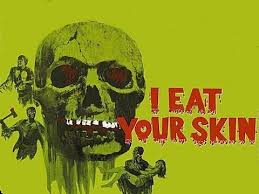
The only reason anyone knows this movie is because of Jerry Gross. He bought it, paired it on a double feature with I Drink Your Blood and renamed it from Zombies to I Eat Your Skin and made this amazing trailer and double poster.
These two movies have nothing in common. I Drink Your Skin is a certified classic of the drive-in while this is a messy black and white film where a writer heads to a Carribean island looking to research voodoo for his next book. Then he meets a mad scientist who is trying to stop aging and hijinks ensue.
This sat on the shelf for six years and you can see why when watching it. Director Del Tenney is also responsible for The Horror of Party Beach, so that should explain so much about this one.
I can only wonder what order these two films played in. Would this be a good comedown from the acid lunacy of its tag partner? Or would the boredom of this one serve as absolutely no preparation for the bloodlust that was to soon follow? One wonders.
This is yet another in the unending stack of evidence that I continually present to Becca as reasons that I will never take a cruise or an island vacation. No one is taking me to the Green Inferno!
While patently ridiculous, the end of this film does pick up some steam, with a lengthy twerking exhibition/voodoo ritual. There’s also a great moment where a zombie carries a box labelled explosives into the prop of the escape plane, grounding our remaining heroes. And I kind of love that the writer hero of this one starts and ends the movie reading love scenes passages from the purple prose he writes to an enraptured audience of bikini clad women. And this is the guy I’m supposed to be rooting for?
Day 21 of the Scarecrow Psychotronic Challenge is 21. Opiate of the Masses. The power of the Scarecrow compels you to watch a religious film! I’ve been dying to watch this movie, as I’ve known parts of it from Negativland’s song “Christianity Is Stupid.” Once Nicolas Winding Refn added it to his site www.bynwr.com, I knew this would be my pick.
The title of this film references Jeremiah 12:5: “If you have run with footmen and they have tired you out, then how can you compete with horses? If you fall down in a land of peace, how will you do in the thicket of the Jordan?”
The director, Ron Ormond, started his career in vaudeville doing magic, before making B picture Westerns and exploitation films such as Mesa of Lost Women, Untamed Mistress, Teenage Bride/Please Don’t Touch Me and films such as 40 Acre Feud, which starred country star George Jones. After that, he spent much of the 1950’s writing books with Ormond McGill about magic and psychic belief, such as Religious Mysteries of the Orient/Into the Strange Unknown, The Art of Meditation and The Magical Pendulum of the Orient.
It gets stranger. By the 60’s, Ormond moved on to producing roller derby for Leo Seltzer and making films like The Girl from Tobacco Road with cowboy star Tex Ritter and The Monster and the Stripper, an inordinately bonkers film that plays like a variety show packed with exotic dancers, contortionists, rockabilly and a swamp monster played by musician Sleepy LaBeef that was filmed in the studio of a Methodist Church with exteriors shot on location in the Okefenokee Swamp.
Then, well, Ormond crashed his single-engine plane near Nashville and had a Paul on the road to Damascus moment. Soon, instead of making movies that’d play in drive-ins for horny teens, he’d be converting them to the will of God. Yet this movie proves that he lost none of his exploitation edge. After all, his son’s godfather was Bela Lugosi. Now, Ormond was woke to the teachings of one Estus Pirkle, who was convinced that America faced its greatest danger from Communism.
In their follow-up to this film, The Burning Hell, Pirkle would speak to the horrors of the afterlife while Ormond matched him with the kind of imagery that could only come from a junk movie pioneer who nearly smashed a plane into the unforgiving Earth. Actually, he crashed another plane in 1970, after finishing The Monster and the Stripper, so two signs from God were enough to get Ormond on board. Because after all, Pirkle would preach hellfire and brimstone like this: “Hell is forever. 10,000 years from now, every sinner will still be in Hell. 100,000 years from now, every sinner will still be in Hell. 1,000,000 years from now, every sinner will still be in Hell. 100,000,000 years from now, every sinner will still be in Hell. 1,000,000,000 years from now, the inhabitants of Hell will still be sinning, cursing, crying, swearing, and in a pain that no mortal man has to experience now.”
But let’s discuss this movie because it truly boggles the mind.
As Pirkle reads a sermon, we see an America that is made up of Southern accents and good Christian folks getting decimated by Communists with the worst accents you’ve ever heard. They force people to renounce their faith, accept Castro as their personal savior and shoot their own mothers when they’re not shoving bamboo sticks into children’s brains through their ears, making those kids puke all over the place. This entire sequence is shown up close and in person. Christians are shot, stabbed, hung, tortured and murdered. Their children are made to hang them and drop them onto spikes. It’d be frightening if it wasn’t so over the top. I’ve always had the belief that Christians have way better Satanic imagery than most Satanists, as this movie and the Jack Chick tract The Beasthave both shown me. But look — don’t take it from me. See it for yourself!
This film was often played in churches and in tent revivals, where at the end, there would be an altar call. Supposedly, this movie achieved its goal of saving a million souls, which was now the box office that Ormond was now really concerned with.
Pirkle promised that hundreds of dead bodies would litter the streets of our towns and tens of millions of Americans would be killed by Communists within the next 24 months. He also found the time to shame a good Christian girl who witnessed but had the temerity to wear a mini-skirt while doing so. And he also drops bon mots like “Are you aware that less than sixty years ago there was not one Communist in the world, whereas today Communism controls one billion, one hundred million people?”
I know that I grew up Catholic and that warped me beyond belief, but I really am glad that I never attended any tent revivals growing up. I would have ended up speaking in tongues, handling snakes, drinking poison and saving people with psychic surgery.
Seriously, this movie messed with my mind on a level that Alejandro Jodorowsky could only dream of. This is a movie where Communists machine gun Baptists into a giant unmarked grave as the camera luridly moves amongst the carnage and a small boy says, “Where’s my mommy? Where’s my daddy?” before another Communist monster with an accent like Dracula demands that the kid step all over a painting of Jesus, which leads to that cherubic child getting beheaded rather than turn his back on Christ and his head tumbles into the ground in dramatic slow motion while a member of the audience within the audience screams and gives up her hippie ways and finds her way back to the Lord while the ghost of her mother cries from an open casket.
This isn’t just the best religious movie I’ve ever seen. It may be the best movie ever made.
Want to see the whole thing? Fuck yes you do. I posted a YouTube link above and if you join the ByNWR site, you can see the best quality version of this film that exists.


 B&S About Movies
You must be logged in to post a comment.