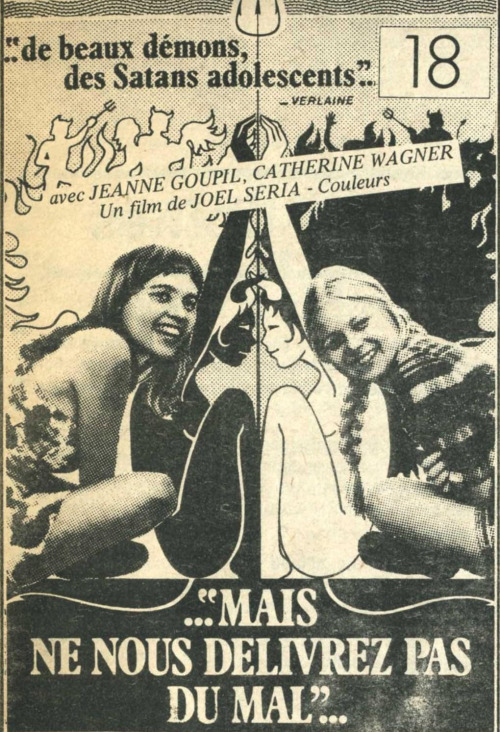
Loosely based on the Parker–Hulme murder case of 1954 (which also inspired Heavenly Creatures), Don’t Deliver Us from Evil is about Anne de Boissy and Lore Fournier, two post-pubescent Catholic schoolgirls that come from rich, conservative families. They’re both growing up to be maniacs, thanks to a love of death poetry, mocking people, pranks, petty theft and one another.
They believe that when they are together, they are special and beyond the law, which allows them to escape punishment. Anne’s parents go on vacation and leave her at home, which allows Lore to move in and their love affair to grow. Their pranks also grow, including setting fire to a perverted farmer’s house, killing all of the birds of the school’s groundskeeper and stealing the Eucharist and performing a Black Mass where they marry themselves to Satan.
There’s a really off juxtaposition in the film where the girls use their sexuality to be adults and when men take it too far, they instantly appear to be what they are — really young girls. It’s disquieting and upsetting in a way that no movie I’ve ever seen has pictured — before or since.
For example, when the girls attempt to seduce a motorist, he takes it as an invitation to rape Lore. Anna saves her and murders the man, who they dump in the river. A detective begins asking questions and the girls are sure they will be discovered, so they enter into a suicide pact. They know that when they go to Hell, Satan will reward them for their service.
In front of their entire school, they read a Baudelaire poem to a cheering crowd before lighting themselves on fire.
This film was known as “the French movie banned in France.” It lives up to its controversial reputation — one assumes that the film was near incendiary when it was originally released. Yet it’s not strictly an exploitation film. It’s quite beautifully shot and has a definite message against the censorship of the Catholic Church and unfairness of the French class system.
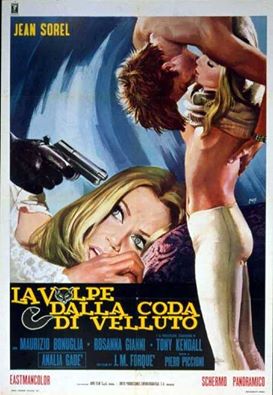
Whether you call it In the Eye of the Hurricane, Lusty Lover or Suspicion, this film starts with plenty of style and 70’s morality.
Ruth and Paul are a new couple, but Ruth is still married to Michael, who thinks their trial separation will get them back on the same page. Ruth obviously has no interest in that — she instantly runs away with Paul to a seductive Mediterranean beach.
Their love is shot in crazy colors, upside down kisses, swans in the hot tub being given as gifts, discotheques for two, making pottery together, a stone swan filled with caviar and champagne…yeah, Ruth isn’t going back home.
This is a film of bad memories, strange moments of a new relationship, not getting introduced to people and it feeling weird, swirling camera shots around a dancing couple ala DePalma’s Body Double (but 13 years early), bearskin rugs in front of the fire (it is 1971) and suspicion.
Soon, Ruth is involved in a couple of accidents; her brakes fail while driving and her oxygen tank runs out while diving for an octopus (while Paul drinks wine on the boat with his dog and pours wine all over the coral!). Ruth gets paranoid and believes that Paul may be trying to kill her. Or is it his war buddy Roland, who seems to care about Paul a little too much (and the dude has scars from a lion on his chest!)?
Oh yeah — Paul even goes underwater to get her some coral, where we reveal Danielle, a redhead who is a rival for Paul’s affections. And Michael, Ruth’s husband, comes back to visit.
Oh hey! There’s Paul and Roland, just randomly shooting things in the yard. Nothing strange there! There’s a great ending where Michael challenges Paul to show him how good he is. He holds up a magazine as the camera goes from the model’s face to his to Ruth’s. A shot rings out and it goes right between the model’s eyes…and the hole reveals Ruth! What a great shot!
Oh wait — Paul, Michael and Danielle are all in it together, as they are working together to kill Ruth, who tearfully listens to their plans. Ruth runs back to the house, debating calling the police, before deciding on grabbing a gun. From there on out, it’s all big zooms in on the eyes and ominous music!
Ruth writes a note to Paul that says that she knows he is coming back to kill her and she won’t stop him. He was the man she was looking for all her life and she put all of her faith, trust and love into him. He represented her whole being, but now, she knows why he approached her. She never imagined anyone could be capable of such hatred and it all makes her exhausted. Now, she feels that she has to pay the price for her mistakes, as she has lost all of her faith and willpower. She sees this act as suicide and begs him to hurry.
What follows is a selection of quick cuts — a black gloved hand with a gun, swans, red faces, worried faces and then Paul appears behind her, telling her that he was going to curl up with her. A phone call breaks the silence and the police call to say that Michael has been killed.
But wait — does Ruth have a plan of her own? The dog has died and the ice cubes she made earlier are the culprit. Paul moves Danielle into their home and they begin bullying her, trying to make her confess to the fact that she murdered Michael to protect Paul. They even force themselves on her in bed in a scene that’s shot more like a horror film than a romance. Ruth just lies here, mouth wide open in terror, trying to fight them off. She finally runs and hides in a corner before her ex-husband and his new love consummate their relationship.
Ruth calls the police, who come with the news that Michael was killed with a chemical from Ruth’s pottery supplies that she had just asked Paul to get for her. She set everyone else up to survive and walks down the beach with Michael’s friend Roland as the film closes.
I’ve read that this film steals a lot from Umberto Lenzi’s Orgasmo and A Quiet Place to Kill, which I need to find and watch. That said — there are some moments of interest here and once you get past the slow opening, it all gets rather exciting. If you’re looking for a copy for yourself, Mondo Macabro has released a new DVD that’s available right here.
I promised to get to another Sergio Martino movie this week and I hope that I have not betrayed your trust, dear reader.
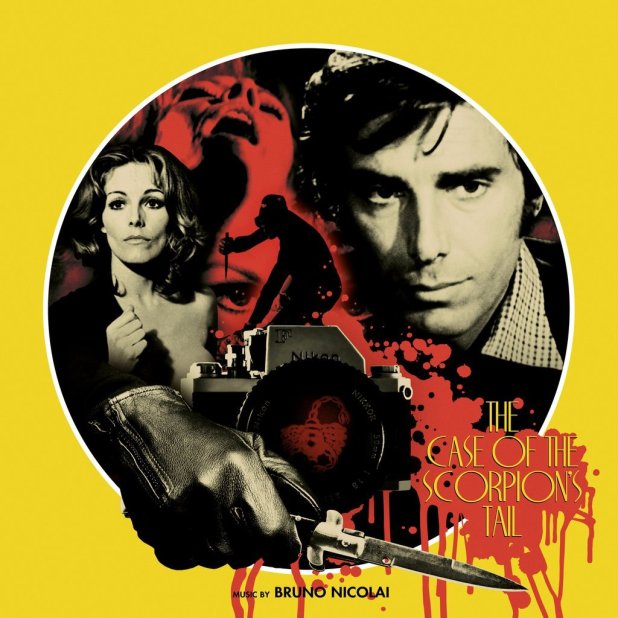
While she makes love to someone else, Lisa’s husband dies in a jet crash. She stands to inherit all of his money, despite them being basically separated. An ex-lover has a confrontation with her, threatening her with blackmail. She pays up — some money now, then some when she gets the letter where she wished that her husband was dead. But a gloved hand finds the letter and kills the ex-lover!
Lisa has to go to Athens to collect the money, but runs into one of her husband’s ex-lovers, Lara Florakis (Janine Reynaud, Succubus) and a knife wielding maniac. Peter Lynch (George Hilton from All the Colors of the Dark) saves her and takes her to the hotel. She asks for all of the money in cash, despite warnings to how dangerous that is.
That same maniac tries to kill Peter, then comes back to kill Lisa, sharp jazz wails staccato punctuating each stab of the knife, each rip across her body. Jump cuts and flashes and the room is covered by the police, who question him.
An INTERPOL agent, Inspector Stavros (Luigi Pistilli, The Good, the Bad and The Ugly, Your Vice is a Locked Door and Only I Have the Key), offers to help Peter with the case and the moment he goes to talk to Lara, he’s attacked by the gloved man.
That brings in Cléo Dupont(Anita Strindberg, Who Saw Her Die?), a journalist who pretty much instantly falls in love with our hero. They go up to his room, but it’s been turned over by the police, with even the bed sliced open looking for the million dollars that went missing when Lisa was killed.
Turns out the gloved man wasn’t on Lara’s side — he or she slits her throat, then runs up a spiral staircase as a guard gives chase. This reveals a room full of one eyed baby dolls and a strange oil painting. Between the woman’s face against the glass with blood spraying everywhere and these reveals, this film is really tipping its hat toward Argento.
The bodyguard chases after the killer, but is knocked off the roof. One slash across the fingers and we have another dead body. It’s 45 minutes in…and most of the IMDB cast is already dead!
That said — there’s a stewardess that gets the gift of scorpion earrings from an unseen lover. So there’s that.
Meanwhile, Peter and Cléo make love on an orange shag couch while a peeping tom watches from the window. You know how Bruce Banner always has on purple slacks and you wonder, “Who wears purple slacks?” Peter does.
The peeping tom wants him to move his car, which is blocking the garage. That said — he’s awfully creepy about it. Peter moves the car and then gets back to business time. PS — if you’re into late 60’s/early 70’s patterns and fashions, you may fall in love with this movie.
While George was out, the killer snuck in. Good thing he forgot his keys! He stumbles in at the last second, but Cléo has already been sliced up. The cops suspect Peter — but they also find a scorpion cufflink that looks just like the earrings we saw earlier.
Oh yeah — about that stewartress’s boyfriend? Yeah fights the killer, only to get his eye hacked out. Somewhere, Fulci was smiling.
Cléo is out swimming off Peter’s yacht and finds the money buried in a cave. Like a Republic serial villain, he reveals his entire plot. He worked for years to make money and saw rich people just throw it away. He put everyone against one another and even had a partner who would do the killings while he was in the room. It’s all rather simple as the police find and kill him before he can hurt her.
I’m rather glad this wasn’t the first of Martino’s giallo movies that I watched. It’s very by the numbers where his other fims seemed to try new stylistic touches. It’s not a waste of your time, but in a world where we get so little of it, you may be better off watching something else.
Sergio Martino’s directorial efforts have run the gamut — from straight exploitation (Mondo Sex and Mountain of the Cannibal God, which features Stacy Keach and Ursula Andress, as well as real animal mutilation which we’d never endorse) to horror (Island of the Fishmen, which in addition to starring Barbara Bach and Joseph Cotten, was re-edited by Jim Wynorski and re-entitled Screamers), post-apocalyptic action (2019: After the Fall of New York and Hands of Steel, which is more Terminator rip off than Road Warrior), spaghetti westerns, crime dramas, war films, comedies and even Italian TV, where he’s worked for the last several decades. But this week we’re here to discuss his contributions to the world of giallo.
This is his first effort and the start of the ensemble case in which he’d use in his films. George Hilton would appear in four of his films, Ivan Rassimov in three and one of the queens of the giallo, Edwige Fenech, would star in three (in fact, she was married to Sergio’s brother, the late producer Luciano Martino, at one time).
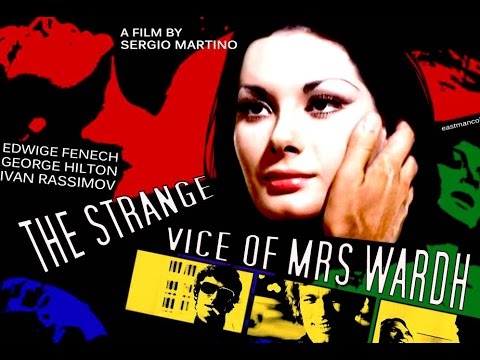
Wondering why this film isn’t just titled The Strange Vice of Mrs. Ward? Turns out a woman named Mrs. Ward sued before the release, claiming that the film would ruin her good reputation, so they changed the title. Yes, Italy, the country where you can make a movie called Zombi 2and have nothing to do with the original film still has legal settlements such as this. You can also find this movie under the titles Blade of the Ripper, Next! and The Next Victim.
Julie Wardh (Fenech) is the wealthy heir to a retailing company. But she’s also a fragile flower, back in Vienna, a city packed with memories and former lovers. She’s married to Neil (Alberto de Mendoza from Horror Express and A Lizard in a Woman’s Skin), a man so wealthy and powerful that he leaves for business the moment they land.
As Julie rides alone in the rain, her car is stopped by the police who are on the hunt for a killer. The sound of the wiper blades reminds her of the last time she was here, recalling a vicious fight between her and a lover who repeatedly slapped her around before they made love in the rain. There’s a gorgeous shot here at the end, where the lovers are to the left of the camera while rain descends on them, almost illuminating them and a sports card pushes into the right foreground. Compared to other giallo which seem content to merely ape Argento or seem like boring police procedurals, Martino aspires to art within his direction (which honestly is why this site is planning on a week of his films).
A green light and honking horns snap Julie from her reverie and she returns to her apartment, where she takes strange notice of a car. Her apartment has been left exactly as it was the last time she was here — it’s a white pop art explosion of metallic, green and blue lines contrasted with oval windows — and just as she’s getting ready to take a bath, the buzzer rings. A dozen roses with a note attached: The worst part of you is the best thing you have and will always be mine – Jean.
We cut to a party, where Caroll (Conchita Airoldi, who would go on to produce Cemetery Man) is trying to hook Julie up with her cousin George (George Hilton, All the Colors of the Dark, The Case of the Bloody Iris) as a catfight between two girls in paper dresses goes down. Tell you what — if I am to learn anything from giallo, it’s that every party in 1970’s Italy was packed with drugs, crazy music and the chance that anything from a fistfight to an orgy could happen at any minute. People had to be exhausted all the time. Jean (Ivan Rassimov from Planet of the Vampires, Your Vice is a Locked Door and Only I Have the Key, Eaten Alive!), the guy who sent the roses and was the man she remembered in the earlier flashback, is there extending a salute. This enrages Julie, who leaves the party, but he follows her into the street. He reminds her that she belongs to him, but she counters that she married Neil to escape him, which is cemented when Neil shows up and punches the dude. Jean just laughs, looking at both of them, knowing that he owns Julie body and soul.
This leads to a flashback where Jean pours champagne all over her, soaking her dress, then smashes the bottle of champagne, showering her in glass shards. He uses what’s left of the bottle to slice up her dress and skin before he takes her. Their coupling is a mix of pleasure and pain, covered in blood, that she had to escape. But did she want to?
So what then is Mrs. Wardh’s strange vice? Is it for men that are bad for her? Is it for pain and dominance? Or some combination of both? As we learn, she’s caught between three men — her husband, whose cool indifference and emotional (and physical) unavailability is just as cruel as her former lover Jean, who owns her to the point that she is nearly his again before Neil showed up to hit him. And the third side of this love rectangle (is there such a thing?) is George, who is the porridge to her Goldilocks — the just right combination of both. Yet there is a fifth side to this — making it a love pentagon (!?!) — with Julie wanting to be a good woman, true to her vows and not to her need to be beaten, bloodied and forced. She is torn between her desire and her need to fit into the moral code of the world. So much of giallo is based on this — created in a country where the Holy Seat of a religious empire sits smack dab in the middle of Rome. Religion and morality nearly shook hands with the sexual revolution and excesses of the pre-AIDS 1970s.
Ah, but let’s not forget that a proper giallo needs a murder, which this film delivers with a quick slash in the shower. That said — what strikes me about Martino is that unlike Argento, he cares more about the story and the characters than creating murder art set pieces. The conversation between Carol and Julie isn’t just words on a page, they’re vital clues into her mental state. Whereas Carol’s casual amorality is revealed, saying that the killer — who we just saw attack the showering girl — is taking out her competition, Julie worries about her values. She married Neil for security and protection, but not the monetary or physical kind. She wanted protection from herself, as she feels that her loss of control and willingness to submit to the violent impulses of men makes her a sinner.
George shows up to meet Julie and get to know her better. He even tells her that he loves to court women when their husbands are around, cuckolding them. Julie claims that that leaves her cold, while Carol claims that she’d bed him, family or not. They decide to go to lunch together, which seems to be more about George staring at Julie than sustenance. Julie demands that George take her to the bus station, but instead he takes her all over the countryside on his motorcycle (What is it with Fenech’s character and dudes that ride bikes? Is it the freedom that it represents?) while he wears white leather fringe, a look that is very 1971. He calls her the moment that she enters the house and she tells him that she likes him way too much, so she can never see him again. Of course, he’s already there and enters the front door before kissing her. She tries to get away, but he keeps telling her that he is in love with her. She begs him to not complicate her life, that she is not the girl he thinks she is. Their kiss is artfully compressed into a second kiss that occurs much later that same day — an intriguing way to show the passage of time and the growth of their relationship.
As they kiss in the dark, a car nearly hits them, which Julie is sure is Jean. She tells him to take her anywhere, which ends up being his apartment. The car returns and its driver watches from the window as Julie and George make love (or, more to the point, she knees him in the crotch while laying upon him, but whatever works for them, I guess).
Later, Julie gets more flowers from an anonymous admirer. Her husband asks who they are from and she wishes aloud that they came from him. There’s another note attached — “Your vice is a locked door and only I have the key.” She tells him that she realizes that diplomats only love other diplomats. He replies that she feels that he has always failed and wronged her. He asks if she is content. “I’m more than content,” comes her reply.
The black gloved killer is watching her and calls her to blackmail her, saying that he will tell her husband. She goes to talk to Carol and claims that it’s Jean. Carol responds that the killer’s last victim was “that whore at the party” and Jean couldn’t be the killer, as he doesn’t go after women like that. Carol embraces free love and says that if Julie is into George, then why should she have to hide it? Also: Carol just walks around her apartment naked (and also has a crazy cover up that is all black with red feathers) and Julie is just fine with it. Carol offers to go to where the blackmailer/killer wants her to drop off the money.
Julie nervously chainsmokes while watching a motorcycle race, a scene intercut with Carol going to meet the killer. To show the escalation of worry, Martino piles on the jump cuts and quick switches between the two women. Whereas Julie is trapped within her worry and the walls of her apartment, the carefree Carol is all alone within a huge park. Alone until the killer reveals himself, slashing her with a straight razor. Again — the killings are rather matter of fact in contrast to the set-ups in this film.
The police get involved, finally investigating Jean. They go to his apartment, which is covered with photos of naked women and exotic animals. Then, they interrogate him with her in attendance. It’s just an excuse for him to keep trying to seduce her and inform the police that Julie has a blood fetish, so she could be the killer, too. George has also been brought in for questioning, to which Jean says, “Now I know why my flowers have no effect on you.”
Neil arrives to take Julie home, but later George says that he wants to speak to her husband and take her away from the city. She says that she has to see this out, she has to discover who killed her best friend when it should have been her.
As Julie returns home, she finds herself in a dark parking garage. The headlines of a car cut into the inky blackness before she is nearly run over. She runs for the elevator, watching for the killer and the numbers of her floor to get closer. Yet the doors open to reveal the killer! Julie runs from him, even attempting to hit him with her car. She barely makes it inside the apartment, screaming at the door. Her husband lets her in but she’s in hysterics. There’s a lot of this scene that feels like it influenced Halloween 2‘s elevator scene. I’m not alone in feeling like that sequel is a giallo. Check out this awesome article from Bill at Groovy Doom to see what I mean.
Neil has had enough and decides to go to Jean’s house and confront him. He tells Julie that he will go alone, but she is afraid and rushes to be with him. They explore his dark house, finally finding Jean’s body in the tub. Julie is overcome and passes out in her husband’s arms. When they get outside, Jean’s car is gone and flowers have been left in the backseat with another poem. Neil throws the flowers down in disgust.
We cut to a dream sequence of George, a laughing Carol and Jean covered in blood, slapping her around. Her husband wakes her up and shows her the photo of the killer. She asks her husband to protect her, but he leaves. She calls and begs George to come get her. He promises to take her to Spain, a place that will make her forget the rest of the world (people continually promise this to Julie, such as Carol’s offer that a place will make her forget she’s on a diet or that an affair will make her forget her sadness).
Neil comes back home to learn that Julie has left. Meanwhile, the killer tries to attack another woman, who unmasks, disarms and stabs him. He makes one last attempt to kill her, but passes out from blood loss.
Meanwhile (!), George and Julie are spearfishing. The camera work here slows down, turning around our lovers (You can’t tell me that DePalma didn’t watch at least a few giallo, even though he claims to have only seen The Bird with the Crystal Plumage and has been dismissive of Argento’s work. Sure, all of his films and giallo betray the and of Hitchcock, but some of these films seem way too close). They discover that the killer has died, but George disappears and someone starts following Julie. She arrives back at their apartment to hear the sound of dripping water. We follow the sound to the bloody curtains of the tub as water and blood spill out. The camera begins to spin back and forth before she sees Jean’s dead body, screams and passes out. George arrives and tries to wake her up, but she’s catatonic. George finds the cause of Julie’s worry — rust had been dripping onto the floor, looking like blood.
Julie awakens and her mood gives way to madness. She’s sure someone is there and yet there is no one. As she realizes this, she attacks a wall and is chloroformed from behind by…Jean! George is rushing a doctor to see her, explaining her vice for blood that excites and repels her at the same time. But Jean is too busy dragging her to the kitchen, where he duct tapes the window shut. He opens a gas line and locks the door (using an ice cube?), leaving her to die. We hear her heart beating out as it’s cut with shots of the doctor and George rushing to her. She makes an attempt to stand but cannot. And it’s too late — Julie is dead.
Neil comes to see the police and blames George for what the police are classifying as a suicide. Jean waits in a secluded area for George, who greets him with a smile. He asks him for the money — turns out that they were in this together. Even after explaining that they both have an alibi, Jean asks again for the money. George shoots him and leaves a gun in his hand, making it look like a suicide.
Turns out that Neil and George were in on this too — Neil has paid off his debts and with Carol gone, George is the only heir to a fortune — much like Hitchcock’s Strangers on a Train. As they drive away laughing, Neil sees Julie on the side of the road and demands that Neil turn around. To their surprise, it is her — followed by the police. A chase leads them off the side of the road to their death. The doctor has saved her life and it seems like he’s fallen for her.
Wow. The Strange Vice of Mrs. Wardh was but the first of Martino’s giallo films, but it’s great. It kept me guessing until the end with none of the b roll travelogue footage and red herrings that plague so many other films in the genre. What a movie to spend the middle of the night into the morning with!
Here’s a drink recipe.
The Strange Cola of Mrs. Wardh (tweaked from this recipe)
1 1/2 oz. J&B Scotch
5 oz. cola
4 dashes Angostura Orange Bitters
An orange wedge
Put on your black leather gloves and use a switchblade to slice an orange wedge.
Fill a tall glass with ice and pour in the J&B and cola.
Add the bitters, then squeeze in the orange juice and use the rest of the wedge for a garnish.
Sometimes, when you watch a horror film, you’re lied to by a title which promises you something that the film cannot or will not deliver. Not so with Jess Franco’s Vampyros Lesbos. Franco promises you lesbians and vampires and he delivers.
He also delivers plenty of late 60’s style and a space age jazz soundtrack that threatens to take over your mind. In fact, I had the soundtrack way before I had the movie, as it was re-released in the 1990’s.
Countess Nadine Carody (the sublime and sadly departed Soledad Miranda) lives on a remote island where she puts on a seductive burlesque act every night that entices unwary women. Now, she has her eyes set on Linda, who starts dreaming of her.
Somehow, somewhere in all these lesbionic dreams, Linda finds Memmet torturing a young woman. It’s probably of worth to note that the director of the film, Franco, plays the torturer.
Then, Linda finds Nadine’s home, the former residence of Count Dracula. Linda gets dizzy off wine, the two women have sex and Nadine drinks from Linda’s neck. Upon awakening, Linda finds Nadine floating motionless in a pool and awakens screaming in a mental asylum.
That said — Nadine is alive and explains to her familiar, Morpho, how Dracula turned her. Now, she feels that she must turn Linda. Nadine keeps coming back to her, then reappearing in the mental hospital, so Dr. Seward (Dennis Price, Twins of Evil, Theater of Blood) explains that if she wants to defeat the curse, she must split a vampire’s head with an axe or pierce it with a pole.
Let me see if I can sum up the insanity of the next few minutes: Linda is kidnapped by Memmet. Dr. Seward wants to become a vampire, Nadine refuses and Morpho kills him. Memmet explains that all women who meet Nadine become insane, including his wife, so he must kill them all. Linda kills him with a saw, then returns to Nadine. Instead of giving her the blood she needs to survive, she stabs her in the eye, wanting to belong to no one. Morpho kills himself. And finally, Linda’s boyfriend tries to convince her that this was all a dream.
If you’re seeking a film that makes narrative sense, you should just leave this one on the shelf. If you’re seeking an erotic, psychedelic freak out with some amazing music, then you’ve found the right film. While some compare Franco to Ed Wood, in this film, he’s hit his high water mark.
This is one of those films where you kind of have to put your own reading into it. Mine’s that Linda is bored by her life, by feeling that she needs a man to be complete and believes that Nadine’s free life could be her escape. However, she finds that she would still be a possession, so she destroys her to make her final escape, deciding that a life of boredom could be better than a life of constant feeding on others.
But who can say. Watch it for yourself. Or just listen to the music — this song as also featured in Tarantino’s Jackie Brown.
If you were a well-to-do woman in Italy in the 1970s, chances are — based on the movies that I have seen — that you are about to killed, have killed someone, are having a lesbian affair, are on drugs or all of the above.
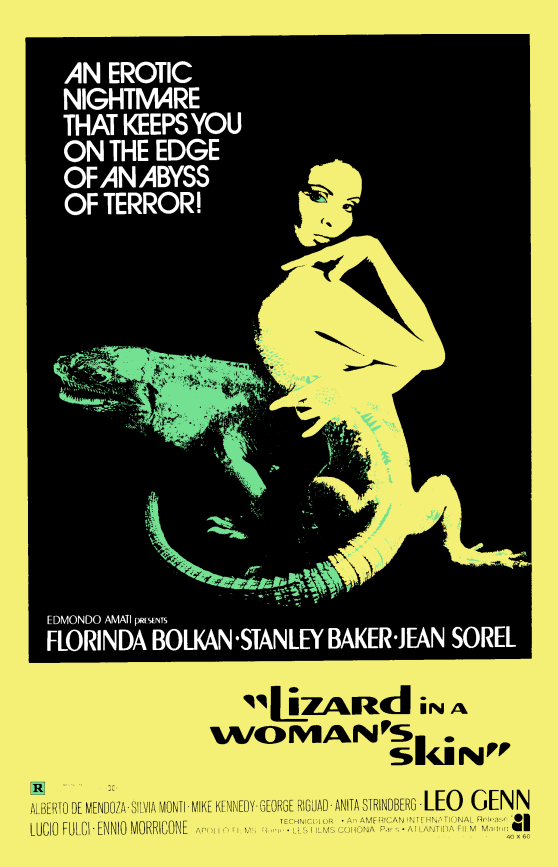
Carol (Florinda Bolkan, Don’t Torture a Duckling) is one of those wealthy women. She lives with her father, rich lawyer and politician Edmund Brighton, husband Frank and step-daughter Joan (Edy Gall, Baba Yaga, The Devil is a Woman). Carol’s been having dreams that cause her to see a doctor. It seems next door neighbor, Julia (Anita Strindberg, Your Vice Is a Locked Room and Only I Have the Key, The Antichrist) is having all-night sex and drug orgies that at once repulse and excite Carol.
All sorts of rich people shenanigans are going on — Frank is having an affair with his secretary. And Carol may or may not be having a lesbian affair with her neighbor. Her dreams have become so intense, she can’t tell fact from fiction. What worries her the most is that her latest dream ends with her stabbing Julia in vivid Fulci splendor while two hippies watch. That dream turns out to perhaps be true, as Julia is dead and Scotland Yard is on the case. The room and condition of the dead body match Carol’s dream.
The hippies that she remembers from her dream don’t remember seeing her kill Julia. But Carol’s prints are on the murder weapon. As she waits for her trial in a sanitorium, one of the hippies breaks in and chases her. What follows is an infamous scene where she happens upon a room full of vivisected, still alive dogs. It’s a dream sequence unconnected to the rest of the film, but it landed Fulci in prison. Carlo Rambaldi, the amazing special effects artist of E.T., Alien and more, saved the director from a two-year jail sentence by bringing the fake dog props to the courtroom.
Ready for some of those giallo red herrings? Turns out that Julia had discovered Frank’s affair with his secretary and had been blackmailing him. Carol gets released, but upon meeting a hippy woman at Alexandra Palace, she’s attacked, first by bats (this is Fulci, after all) and then by a hippy man who graphically stabs her before the police save her.
Then, stepdaughter Joan meets with the hippy woman witness but ends up with her throat cut. The hippie witnesses admit to stalking Carol and murdering the stepdaughter, but they know nothing of the night that Julia was killed, only recalling “a woman in a lizard’s skin.” At this point, everyone should scream and jump up and down, as the name of the movie has been said in the body of the film.
Another giallo moment — an action that happens off-screen with a main character. Brighton, Carol’s father, has killed himself, leaving a note that he had killed Julia. At his gravesite, the police ask how Carol knew about Julia calling to blackmail the family when it had never been revealed. Turns out Carol and Julia were in bed together when that call was made, but Julia had also threatened to go public with their lesbian affair.
But what about the hippies? Turns out they were so high on LSD, they remembered nothing. Carol decided that if she combined her crazy dreams with images of the murder, she’d get off because of temporary insanity. So wait — her father didn’t kill the girl? Did she kill her father? Why would she be having such crazy dreams about the neighbor if she’d already indulged in the affair?
If you’re confused by a giallo, sometimes I think it’s doing its job. And after all, this film is all about the visuals, as Fulci does a great job with the hippie sequences and throws some split screens in, pre-DePalma. It may drag in parts, but there are also bravura sequences to make up for that fact.
Over the next few weeks, we’ll be reviewing several of George Romero’s most well-known — and in this case, least known — works. As a filmmaker that came from Sam’s hometown, as well as one of most interesting voices in American genre filmmaking, there’s plenty to celebrate. Rather than focus on a film like Night of the Living Dead or Dawn, we’d rather speak about the films that feel more personal. Perhaps even lost. So it’s appropriate that we start with a film that was his attempt to escape the fate of being known only for horror.
Edgar Wright wrote a touching tribute to Romero the day after his death. There’s a line that struck me here: “We had coffee in a Toronto hotel with him and he asked me and Simon what we were doing next. I replied that we were making a police action comedy. ‘Oh, not a horror, then?’ he replied, ‘So you’re getting out.’ This was a telling statement, as there was always the sense that George had interests in film that stretched beyond the realm of horror. But even if he was pigeonholed somewhat in the genre realm, one of the reasons that his work resonates still is because of fierce intelligence and humour behind it.”
When I was 14 or so, I read and re-read and then read again Paul R. Gagne’s The Zombies That Ate Pittsburgh: The Films of George A. Romero. This was in the dark days when there was no internet, no way to instantly stream a film. Sure, I could rent Night, Dawn or Day, but hunting down Martin, Knightriders or The Crazies was hard. And finding Season of the Witch was pretty impossible. What struck me was that Romero chose There’s Always Vanilla — a movie that even the book told me that I’d probably never see — was that as his second effort he was already avoiding being typecast as a horror director. He obviously failed — but for years, I struggled to find this movie. Anchor Bay and Something Weird released it awhile back and thanks to The Carneige Library’s Oakland branch, I’ve found a copy (if you live in Pittsburgh, you owe it to yourself to visit this huge treasure trove of media, yours for the taking).
It’s the only film he created that has no otherworldly elements. Instead, it’s very much a view of America — and Pittsburgh, Romero’s adoptive hometown — at the start of the 1970s. While Vietnam and the looming Watergate scandal would erode the nation’s trust that the world would remain bright and cheerful and expected, Western Pennsylvania always had certainty in the face of uncertainty — surely the mills and mines of our region would constantly offer work, so even after the military was done with you or college didn’t fulfill you, you could always come back home, always find a job that paid more than well. I personally remember tales in grade school of the holiday parties for the kids of mill workers — every boy got a train set, every girl an Easy-Bake oven. My grandfather put forty plus years into the blast furnace; his friends all worked there or in other mills, gathered around the bar drinking Pabst or Iron City, telling tale of dealing with foremen or how much they could make off a double or triple shift.
There’s more of this erosion to come in Romero’s work as the 1970s go on in Season of the Witch and particularly Martin, which is a grisly reminder of how it only took eight years to make the Steel City look like the end of the world.
Also known as The Affair, Romero would say that this film was a “total mess” and that the budget hampered what could have been a better film. He’s also claimed that the writer was lazy and left halfway through the process of making the movie. Much like the aforementioned Witch, it concerns how women’s roles are changing in society, from providing emotional and monetary support to finally realizing — again in Witch — that their predestined roles are fading away, perhaps never to return.
Vanilla opens on some art that likens America to a machine, as well as the comments of local citizens as they walk past. The gray, dark skies of Pittsburgh — a marked contrast to the post-industrial age clean skies we enjoy now — is noticeable. We meet Chris Bradley, a soldier who’s had a variety of jobs, from pimp to guitar player. He feels like he’s lost the ability to think from all the noise of rock and roll music, so he’s going back home to Pittsburgh.
Then, for some reason, we’re on a commercial shoot. It’s disjointed and feels like b roll from one of the commercials that The Latent Image, Romero’s production company, was working on in between movies.
Chris’ dad owns a baby food factory and always wanted his son to be part of the family business; another big issue as the generation gap widened in Pittsburgh, a place rife with Catholicism and ingrained family values, where multiple generations would toil in the same mine or mill or operate the butcher shop or furniture store. Chris has been a drifter and avoiding the fate of his father — day after day of the same work, again and again. Chris remarks that he’s been gone for three years and his dad is still in the same bar, drinking a shot and a beer, the same way he was when he left. Pittsburgh was — and remains — a hard drinking town, where a boilermaker (slang for a shot of whiskey dropped in a beer) is served at lunch.
Chris meets up with an old girlfriend, Terri Terrific, at a bar that pretty much could be the Edison Hotel (note for anyone not from Pittsburgh, the Edison is a noted strip club that was, shall we say, rather rough — not as rough as the long since demolished Chez Kimberly or Roman V — and is now a cleaned up gentlemen’s club known as Blush) . Terri’s friend refers to Chris as a “jag off,” reminding anyone in town that this movie was definitely shot in Pittsburgh and confusing anyone from any other town in the world.
Oh yeah — Terri may or may not be have had a kid with Chris. His dad may hold true to family values, wondering why Chris doesn’t pay for child support, but he’s also hooked up with a blonde friend of Terri’s. Men and women of the 70s had weird relationships, where guys really did do whatever they wanted and kept their wives in the dark. He asks Chris how much he needs to pay the girl he slept with, showing again that cultural divide. A woman who has sex with an older man she doesn’t know has to be a prostitute in dad’s world. In Chris’ world, this is de rigueur behavior.
The film keeps cutting back to Chris, who directly addresses the camera in a way where we’re supposed to identify with him. Maybe I’m too far past the hippy days of the 60s, but I find nothing of value or kinship.
Chris meets Lynn (Judith Ridley, or Judith Streiner, who played Judy in Night of the Living Dead), a model who he moves in with. We’ve already seen her on that commercial shoot and how she wasn’t happy with another man, Michael. She starts to resent Chris after initially enjoying the escape he initially offered her. She keeps pushing him to get a steady job and after learning that she’s pregnant, she schedules an abortion without telling him (in 1970s Pittsburgh, an abortion was the scandal of scandals, again due to the city’s large Catholic contingent).
The romance in these scenes feels contrived — Chris basically negs on her, saying she isn’t that attractive and that she has a fat ass, which wins her over for some reason. They drive in his Jeep, shop for clothes, have a picnic and talk a whole bunch — in a scene that’s chopped up and edited ala a montage, but ends up feeling really confusing, like a romance version of Laugh-In. Franky, its fucking intolerable. Not really Romero’s fault, I guess, as this feels like plenty of films from the end of the age of Aquarius.
NOTE: One of these dates brings Chris and Lynn to the old Pittsburgh Zoo, where they get to walk up to baby lions and pick them up. They are carrying baby lions around like it’s no big deal, because in 1970 and in Pittsburgh life was fucking cheap and you’d probably die in a mine collapse or by tripping into the blast furnace anyway, so why not pick up a baby lion like it’s no big deal. After all, mother lions aren’t protective. At all.
ALSO: One of their dates, shown in montage, shows them going to the newly opened Monroeville Mall. Foreshadowing?
The search for a job brings Chris into advertising — an occupation that Romero knew only too well (and your author does, too. Why else would he be awake at 4:15 AM but to write script treatments, then be unable to sleep and watching a Romero rarity). Chris is going to be a copywriter and thinks he can do it with no education — again, in my experience, he’s in way over his head.Turns out that he can’t do it, finding that he hates his military past and can’t sell the promises that it offers to anyone else.
Chris also plays in the park with Terri and his maybe or maybe not son. Terri is so Pittsburgh it hurts; she eventually ended up with big claw hair after this, has old episodes of Evening Magazine videotaped so she can show everyone that time that Patti Burns came to Dormont and knows all the words to “Ah! Leah!”
Lynn discovers that she can’t bring herself to get the abortion, so she moves in with a high school boyfriend who says he’ll raise the child as his own. Chris moves in with his dad and finds that he must embrace the old values — and the drudgery of it — that his father has. At a Howard Johnson’s — fancy dining in Pittsburgh circa 1970 — dad tells him that while life is like an ice cream parlor, packed with exotic flavors, there’s always vanilla to fall back on.
Note: Any time that the title of a movie comes up in the dialogue of the film, everyone should scream as loudly as possible, as if Pee Wee has just said the secret word.
There’s Always Vanilla closes by showing a very pregnant Lynn living in the suburbs (Mount Lebo, right, yinz guys?). A large package from Chris arrives, filled with helium balloons that she allows to drift away, his memory of the carefree time they shared that he will always remember. You know, the times when he called her a bitch and argued with her all the time and told her that she had a fat ass. Those carefree times.
Vanilla is about as night and day — sorry for the pun — from Night of the Living Dead as it gets. However, there were numerous times during it’s running time that I wished that a Venus probe would come back to earth and graves would cough up their dead.
Romero wouldn’t make another movie until 1973, which would find him creating two films, Season of the Witch and The Crazies, which will be getting to this week. I wouldn’t recommend you watch this unless you’re a completist or want to see how awesome downtown Pittsburgh looked in 1970.
Special thanks to Bill DeJoseph for catching a typo!



 B&S About Movies
You must be logged in to post a comment.