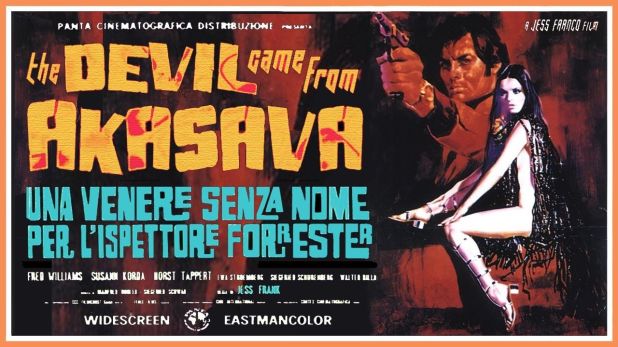
Jess Franco made another Edgar Wallace movie, Sangre en mis zapatos, which was based on Sanders of the River. This is based on the story Keeper of the Stone, which is from the same book.
Prof. Walter Forrester (Ángel Menéndez) is a British scientist working in the Akasava jungle in South America who has disappeared and may have stolen a mysterious stone. His nephew Rex Forrester (Fred Williams) is looking for his uncle. But the real reason to watch this is British agent Jane Morgan (Soledad Miranda), who has a secret identity as the stripper wife of the British consul Irving Lambert (Alberto Dalbés), which seems pretty wild when you wrap your mind around it.
The sinister Dr. Andrew Thorrsen (Horst Tappert) and his perhaps even more nefarious wife (Ewa Strömberg) also get involved, Franco plays an evil agent and Howard Vernon gets blown up real good when he tries to steal the stone, which can turn people into zombies and metal to gold because, well, who knows. It’s all a device to get us to see just how wonderful Soledad could be as a spy.
Sadly, she’d die in an auto accident at the too soon age of 27 soon after this movie wrapped. I wasn’t even born yet and it still breaks my heart.
So yes, this is the same cast and crew as Vampyros Lesbos and pretty much the same story as Venus In Furs and Ms. Muerte, but look, if Soledad Miranda made a movie where all she did was eat soup, I’d watch it.
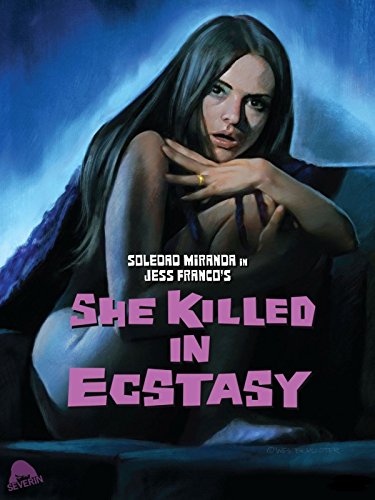
This time around, she’s Mrs. Johnson, the widow of a scientist who was doing some, well, perhaps unethical experiments with human embryos that led to a medical committee rejecting his work and leading to his depression and suicide. So she does what any of us would: she hunts and kills everyone that caused this to happen.
Yes, one by one, Prof. Jonathan Walker (Howard Vernon), Dr. Franklin Houston (Paul Muller), Dr. Doneen (director Jess Franco) and Dr. Crawford (Ewa Stromberg) are all part of her revenge, with a side of a love scene between Johnson and Crawford because there’s no way that Franco would have Miranda and Stromberg in the same movie and miss that.
Before this movie was even released, Miranda died as a result of major head and back trauma from a car crash. She left behind a son, a husband and thirty movies in ten years, as well as a hole in the life of Franco, as she’d been the muse behind some of his best films.
In this movie, she is the center of the world, a dark-eyed shadow of a woman destroyed yet willing to take that pain and give blow for blow, scorn for scorn, doom for doom — with interest compounded liberally.
At just 80 minutes and with some incredibly arty angles and a great soundtrack — something else this has in common with Vampyros Lesbos — this is prime Franco.
EDITOR’S NOTE: Nearly five years ago — August 22, 2017 — we talked about this movie on our site. Let’s bring it back from the grave as we unearth all this Franco all month long.
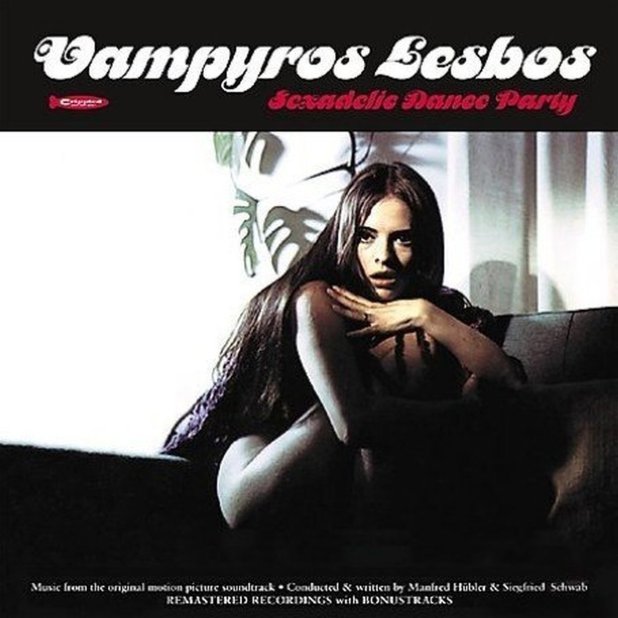
Sometimes, when you watch a horror film, you’re lied to by a title that promises you something that the film cannot or will not deliver. Not so with Jess Franco’s Vampyros Lesbos. Franco promises you lesbians and vampires and he delivers.
He also delivers plenty of late 60’s style and a space age jazz soundtrack that threatens to take over your mind. In fact, I had the soundtrack way before I had the movie, as it was re-released in the 1990s.
Countess Nadine Carody (the sublime and sadly departed Soledad Miranda) lives on a remote island where she puts on a seductive burlesque act every night that entices unwary women. Now, she has her eyes set on Linda, who starts dreaming of her.
Somehow, somewhere in all these lesbionic dreams, Linda finds Memmet torturing a young woman. It’s probably of worth to note that the director of the film, Franco, plays the torturer.
Then, Linda finds Nadine’s home, the former residence of Count Dracula. Linda gets dizzy off wine, the two women have sex and Nadine drinks from Linda’s neck. Upon awakening, Linda finds Nadine floating motionless in a pool and awakens screaming in a mental asylum.
That said — Nadine is alive and explains to her familiar, Morpho, how Dracula turned her. Now, she feels that she must turn Linda. Nadine keeps coming back to her, then reappearing in the mental hospital, so Dr. Seward (Dennis Price, Twins of Evil, Theater of Blood) explains that if she wants to defeat the curse, she must split a vampire’s head with an axe or pierce it with a pole.
Let me see if I can sum up the insanity of the next few minutes: Linda is kidnapped by Memmet. Dr. Seward wants to become a vampire, Nadine refuses and Morpho kills him. Memmet explains that all women who meet Nadine become insane, including his wife, so he must kill them all. Linda kills him with a saw, then returns to Nadine. Instead of giving her the blood she needs to survive, she stabs her in the eye, wanting to belong to no one. Morpho kills himself. And finally, Linda’s boyfriend tries to convince her that this was all a dream.
If you’re seeking a film that makes narrative sense, you should just leave this one on the shelf. If you’re seeking an erotic, psychedelic freak out with some amazing music, then you’ve found the right film. While some compare Franco to Ed Wood, in this film, he hit his high watermark with this one.
This is one of those films where you kind of have to put your own reading into it. Mine’s that Linda is bored by her life, by feeling that she needs a man to be complete and believes that Nadine’s free life could be her escape. However, she finds that she would still be a possession, so she destroys her to make her final escape, deciding that a life of boredom could be better than a life of constant feeding on others.
But who can say? Watch it for yourself. Or just listen to the music — this song is also featured in Tarantino’s Jackie Brown.
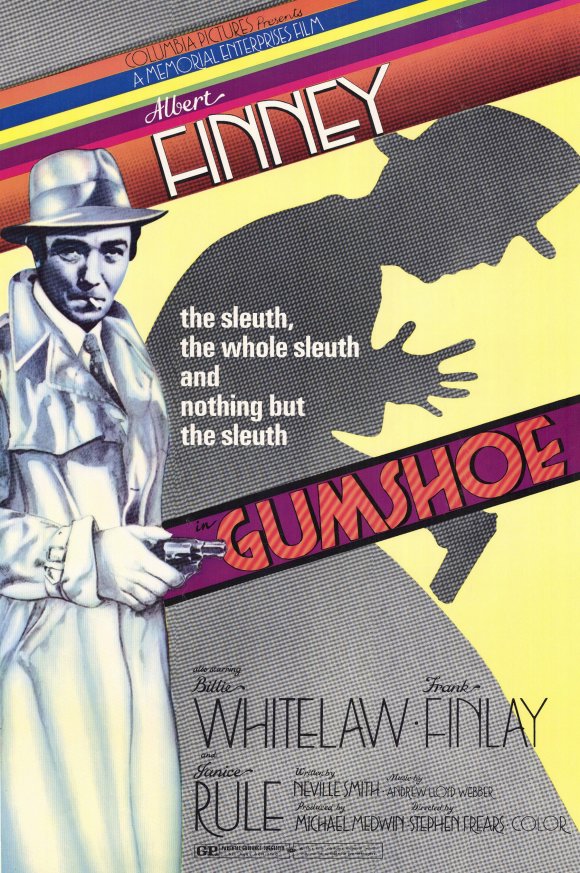
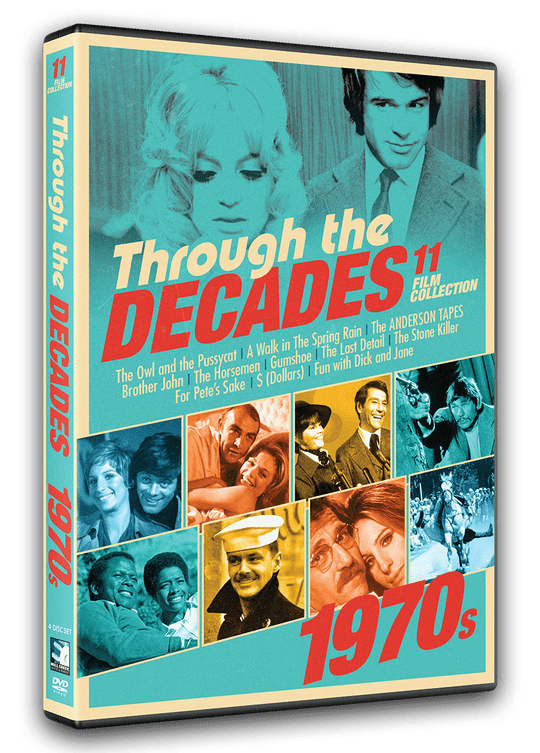
The Atlantis Bookshop is an esoteric bookshop that’s been the center of London’s occult scene since it opened in 1921. It’s where the “Father of Wicca” Gerald Gardner attended meetings of The Order of the Hidden Masters and the shop even published his first book. It continues to be a nexus point for magic users and is featured prominently in Gumshoe, a movie that has some magic of its own as Eddie Ginley (Albert Finney) dreams of escaping his bingo hall reality and becoming a detective like in the books he reads. When he places an ad for his detective services as a birthday joke, he discovers himself in the middle of an actual case that may involve his family.
Featuring the first music score for a film by Andrew Lloyd Webber, Gumshoe‘s drug scenes kept it from being released on video until 2009. It was the debut film of director Stephen Frears (The Grifters, Dangerous Liaisons, High Fidelity) and was written by Neville Smith, who also plays Arthur in this movie.
There was a big revival of hard boiled detective films and film noir at the start of the 70s and this film does a great job of showing how one man can become lost in the dream of what it would be like to live in their world.
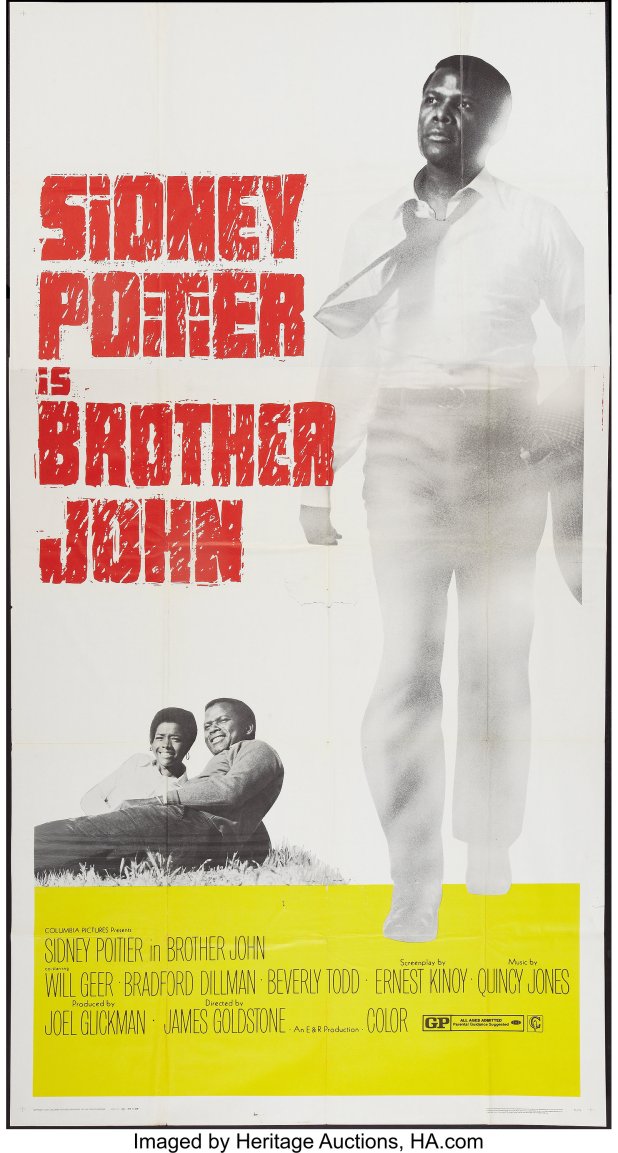
If racist white audiences were upset when Sidney Poitier retaliated and slapped back the plantation owner in In the Heat of the Night, they had to have had a meltdown when this time, a cop challenges him and he proceeds to complete emasculate the man without breaking a sweat.
Seriously, I was not prepared for this movie, a film in which Poitier plays a man of mystery who just may be the literal angel of death returning every time a family member dies in his small southern hometown when he isn’t showing up for moments of death and destruction all over the world.
This movie wasn’t well-considered when it came out and you know, I completely believe those critics were fools. Author Scott Woods wrote an essay, “Brother John: Reclaiming the Blackest Movie Ever,” in which he said, “In 1971 black people were fresh off several assassinations of people who stood firm in their interests and were starting to resign themselves to the reality that desegregation without enforceability was still segregation. Brother John did not beat what audiences it was able to muster over the head with its wisdom, but it was too much for people to transpose themselves into. Poitier perhaps did his job too well. Poitier wanted to do Brother John but America needed him to do Brother John . And then no one went to see it. Brother John has it all, and does all things well: civil rights, racism, classism, toxic masculinity, black love, house parties, homecooked funeral rites. You haven’t celebrated Black History Month properly until you’ve seen this film. Brother John is a perfect black film, both for its time and now, generating even more resonance as we walk every day in a world aflame with hate and neglect.”
It was written by Ernest Kinoy, who was a POW in World War II in the slave labor camp at Berga before making it back to America and becoming a writer for the radio shows Dimension X and X Minus One, eventually making his way to movies and TV, with Roots and the TV series The Defenders being his best-known scripts. Brother John was directed by James Goldstone, who was the director for episodes of Star Trek and The Outer Limits before working on movies like They Only Kill Their Masters, Rollercoaster and Jigsaw.
Uraz (Omar Sharif) is the son of Tursen (Jack Palance), a stable master and retired buzkashi player, a sport in which horse-mounted players attempt to place a goat or calf carcass in a goal. He has lost his honor when he breaks his leg in a game that his father has bet all of the family’s money on, which means he has to learn how to ride and play again, despite most of his leg.
Based on Joseph Kessel’s Les cavaliers, this was scripted by Dalton Trumbo and directed by John Frankenheimer, who loved the movie even if it wasn’t a financial success.
There’s a lot of animal violence in this, so be warned. I mean, it’s a game played with a dead animal, after all. The same game is played in Rambo III, in case you wondered. Like that movie, the Afghanistan of this film is long gone.
It’s a big Hollywood film about a sport and a place that I can imagine very few people were interested in, which makes me interested in it.
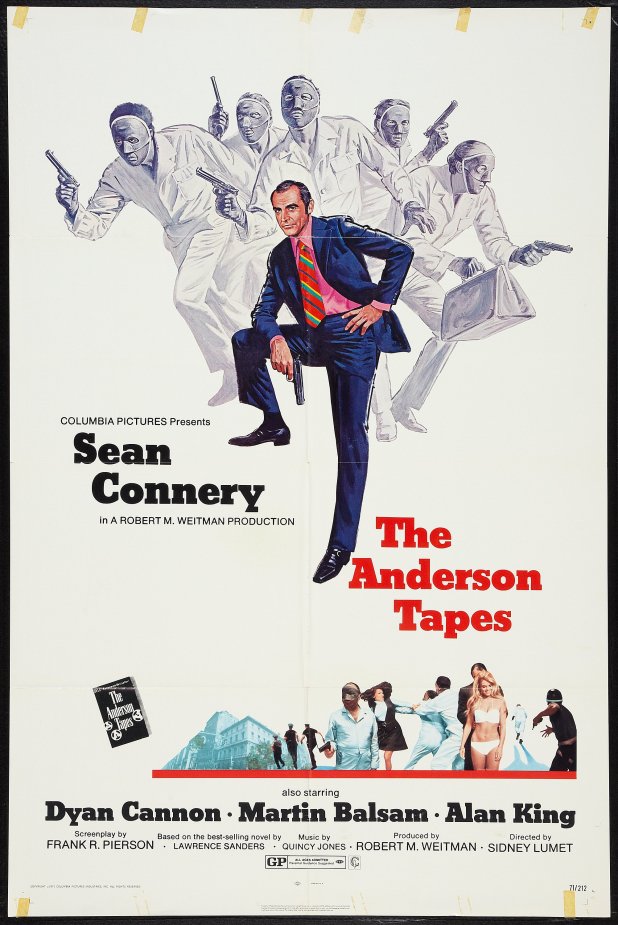
A few days out of jail and John “Duke” Anderson (Sean Connery) is back with his lover Ingrid (Dyan Cannon) and already planning his next job: robbing every single apartment in her building with the help of a furniture van.
To do the job right, he needs the right crew. So he gathers a team that includes antiques dealer Haskins (Martin Balsam), the safecracker known as The Kid (an incredibly young Christopher Walken) and Pop (Stan Gottlieb), an old-timer who is finally out of jail. However, Angelo (Alan King), the mob boss who funds this operation, forces him to bring along — and kill — “Socks” Parelli (Val Avery) as part of the job, making things even more complicated.
This movie has a great cast, with Conrad Bain, Garrett Morris, Ralph Meeker*, Scott Jacoby and Margaret Hamilton in her last role. It’s beyond prophetic in how overly watched we would be, as every step of the crew is watched, listened to and recorded by a number of government agencies, as well as a team of amateur radio operators. It was released one year to the day before Watergate, which announced just how watched we all are.
Based on the book by Lawrence Sanders, the screenplay was written by Frank Pierso (Cool Hand Luke, Dog Day Afternoon) and diected by Sidney Lumet (Network, Serpico). It brought back Connery’s career and stopped his typecasting as James Bond.
*Meeker plays Edward X. Delaney, a continuing character of Sanders, who would be played by Frank Sinatra in The First Deadly Sin.
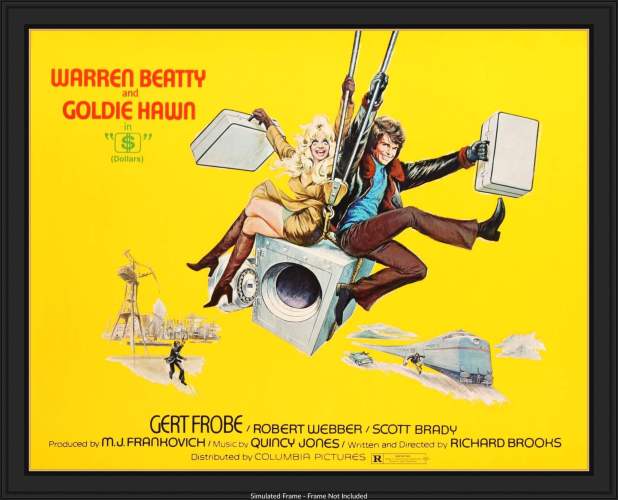
A Hamburg, West Germany bank has privacy laws that are quite favorable to an entire rogue’s gallery of criminals who need a place to keep their money safe from the government. Meanwhile, bank security consultant Joe Collins (Beatty) has been planning on stealing all of their cash along with sex worker Dawn Divine (Goldie Hawn).
From there, the criminals — like Las Vegas mobsters, military men who’ve just made money off an illicit drug deal and a brutal killer known only as the Candy Man — start hunting Joe and Dawn for their money across nearly all of Europe.
This was directed and written by Richard Brooks, who also wrote Key Largo and directed and wrote Blackboard Jungle, In Cold Blood and Waiting for Mr. Goodbar. This isn’t as successful as those, but Beatty and Hawn have a fun chemistry and are both filled with such charm that I couldn’t dislike this movie.
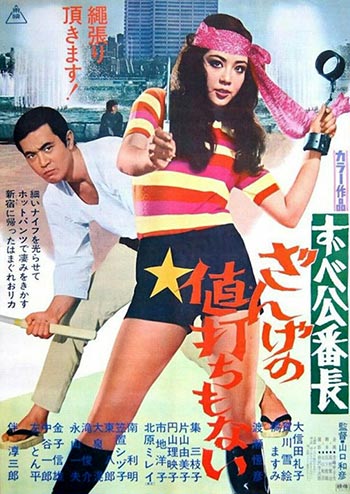
The fourth film in this series has a similar set-up to Delinquent Girl Boss: Blossoming Girl Dreams, with Reiko Oshida’s Rika getting out of reform school and working for the mechanic father of one of her classmates, who is of course being muscled in on by the Yakuza. Have they learned nothing from the other movies?
The end of this film, where the five female leads wear red overcoats and literally walk in high fashion to the mob boss’ lair with the soundtrack blaring was taken and used by Assassination Nation, but trust me, this movie is a billion times cooler than that film can ever dream of being.
Obviously, reform school has only made Rika tougher, but also more concerned about her friends, her community and others, while the Yakuza only wants to take everything they can. That’s why she’s a hero, even if the world only sees her as a girl that needs tamed.
These films in no way get close to the excesses of this genre, but are certainly worthy of your time.
EDITOR’S NOTE: I love this movie and that was apparent when it was originally on the site on November 19, 2018. As Curtis Harrington week continues, let’s go back and watch it all over again.
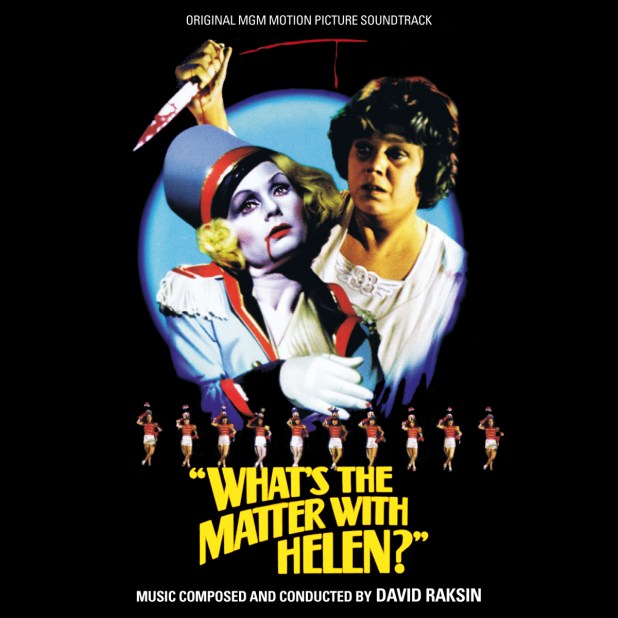
I like to play this game where any time the title of the movie is mentioned, I scream and cheer like I’m Pee Wee sitting on Chairy. Good news for me — What’s the Matter with Helen? says it’s title more than once, leading to me wondering if I should invest in the paper bags full of confetti that Rip Taylor always seems to have to throw around.
Two young men are going to jail for life after murdering an older woman. Then, we see their mothers — played by Shelley Winters and Debbie Reynolds — as they bravely face an angry mob and drive away. As they make their way home, an anonymous phone call takes credit for the attack which bloodied up Winters’ character Helen. Reynolds character Adelle then reveals her plan to pack up her cardboard standup of herself and move to California to start a dance studio. Soon, the two ladies have changed their last names and gone west.
This is a movie packed with odd situations and even odder characters, like elocution teacher Hamilton Starr and a tramp who continually bothers Adelle. And oh yeah — Helen is madly in love with her friend and becomes insanely jealous to the point that she often sticks her fingers into metal fans when she isn’t listening to Sister Alma (Agnes Moorehead) on the radio. Alma is obviously Aimee Semple McPherson, the 1920’s and 30’s celebrity whose Foursquare Church’s faith healing radio broadcasts were the forerunner of modern televangelism and charismatic Christianity.
Adelle falls for Lincoln Palmer (Dennis Weaver), the father of one of her students. He’s rich as it gets, rich enough to pay for gigolos to dance with her while he watches in yet another one of those moments that would get explored in a modern movie and are just another creepy aside in this one.
Between Helen murdering people who break into their house, then trying to be forgiven by Sister Alma all while having flashbacks to her husband being run over by a plow, her madness soon overtakes the film and things proceed to a rather sudden and shocking conclusion. There’s also an extended miniature golf sequence and numerous rabbit murders, as well as the reveal that Helen may have been right to kill at least one of the intruders.
This movie happened when director Curtis Harrington (Night Tide, Whoever Slew Auntie Roo?) and producer George Edwards approached writer Henry Farrell (What Ever Happened to Baby Jane?) hoping to get a screenplay. Hagsploitation was in, baby, and these dudes wanted in on the action!
According to Debbie Reynolds, Shelley Winters’s psychiatrist had warned her not to take this movie, as she was about to play a woman having a nervous breakdown while she was actually having one. She claims that Winters became her character to the point that the studio considered replacing her with Geraldine Page, who had plenty of hagsploitation cred after starring in Robert Aldrich’s What Ever Happened to Aunt Alice?
Winters also totally caught the lesbian undercurrents — well, they’re not so well hidden, so let’s say overcurrents — in the movie, but the scenes where she really played it up were left on the cutting room floor.
It’s worth noting that this was an Oscar-nominated film — for Reynolds outfits, that is. If you have a Debbie Reynolds crush, good news. This is the movie for you. This is also the movie for you if you love musical numbers about animal crackers.
Every single person in this one is disreputable, even the children, who are forced to dress as showgirls and purr songs like “Oh, You Nasty Man.” This posits What’s the Matter with Helen? as a forerunner of calling out the blatant sexuality of child beauty pageants years before Jon Benet was murdered.
I’ve always wanted to see this movie, despite its trailer and poster giving away the ending. What were they thinking? That said, there’s enough weirdness here to sustain my interest, even if I knew how it was all going to turn out.
Want to see it? Shout! Factory has recently released it on blu ray.


 B&S About Movies
You must be logged in to post a comment.