Ritual of Evil (1970)

The sequel to 1969’s Fear No Evil, this made for TV movie brings back Louis Jordan as psychiatrist Dr. David Sorrell. Now, he has to help Jolene Wiley (Anne Baxter), who has been targeted by a witch coven led by Leila Barton (Diana Hyland). Jolene’s parents have already been killed and her sister Aline (Carla Borelli) has just overdosed on sleeping pills. Could she be next?

This was supposed to be a series, Bedeviled, but NBC ran Night Gallery instead. They still bought another pilot and this was it.

Along with. his mentor Harry Snowden (Wilfrid Hyde-White), Dr. Sorrell investigates, meeting a friend of Aline, Larry Richmond (Georg Stanford Brown), a Vietnam vet hippie blues singer who may have seen way too much of the cult. As for Leila Barton, she’s working on bewitching Dr. Sorrell and using that to get away with her crimes. This movie sets her up as a potential long-term enemy/lover if the show was ever bought.

Director Robert Day started his career in the UK but made some popular TV movies in the U.S., such as ScruplesThe Initiation of Sarah and Death Stalk. This was written by the team of Robert Presnell Jr. (The Secret Night Caller) and Richard Alan Simmons (who developed Mrs. Columbo).

It’s rare that a potential show had two pilots air and the series was never picked up. I can only imagine if this had become a series, not all of the episodes would have aired and it would later be released on a box set after numerous airings on the CBS Late Movie.

The Projectionist (1970)

Chuck McCann (Chuck McCann, The Girl Most Likely to… and the co-creator of Far Out Space Nuts with Bob Denver) is a projectionist at the Midtown Theater, which is run by the always angry Renaldi (this is Rodney Dangerfield’s first movie). Stuck in the booth with no one else for hours at a time, McCann watches movies all day and dreams of being a superhero, Captain Flash, with Renaldi as The Bat.

McCann was a gifted voice actor, so he does tons of impressions in this, including Humphrey Bogart, Sydney Greenstreet, Jimmy Stewart, John Wayne, Clark Gable, Butterfly McQueen and Laurel and Hardy. He was a big fan of the comedy duo, hosting the New York City kid show Laurel and Hardy and Chuck. He often played Oliver Hardy in commercials with Jim MacGeorge as Stan Laurel. He was one of the five founding members of The Sons of the Desert, a Laurel and Hardy appreciation group, along with their official biographer Jim McCabe, Orson Bean, cartoonist Al Kilgore and John Municino. And then he dreams of The Girl (Ina Balin) and rescuing her from The Bat.

Director and writer Harry Hurwitz also made the adult Fairy TalesNocturna: Granddaughter of Dracula and Auditions as Harry Tampa, as well as Safari 3000That’s Adequate, Buster Krabb’s last movie The Comback TrailSafari 3000 and he wrote Under the Rainbow.

You can spot several interesting people in this: David Holliday (the voice of Virgil Tracy on Thunderbirds), cinematographer João Fernandes (who shot Deep ThroatThe Devil In Ms. JonesBloodrageInvasion U.S.A.The ProwlerChildren of the CornHuman ExperimentsThe NestingThe Kirlian Witness, Let Me Die a WomanThe Taking of ChristinaLegacy of BloodDeadly Weapons and directed three episodes of Walker, Texas Ranger, as he worked with Chuck Norris many times), Lucky Kargo (who is also in Cauliflower Cupids and Barry Mahon’s Sex Club International as Lucky Bang Bang), Sam Stewart (Bad Girls Go to HellThe Girl from S.I.N.), Alex Stevens (a werewolf from 23 episodes of Dark Shadows), bellydancer Morocco, Robert Staats (Night Call NursesMr. Billion), Robert King (who is in tons of late period Jess Franco movies such as Lust for FrankensteinDr. Wong’s Virtual Hell and Blind Target), Rita Bennett (who played a strippeer in Raging BullAll That Jazz and Danny Steinmann’s High Rise using the stage name Elizabeth Sunburst) and it’s all shot by Victor Petrashevic, who also was the cinematographer on Behind Locked DoorsMassage Parlot Murders!The MinxGathering of Evil and the director of Love Me…Please!

I have no idea how this was able to just take scenes from Casablanca, Gunga Din, Sergeant YorkGone with the Wind, Citizen Kane, Fort Apache, The Birth of a Nation, The Maltese Falcon and Barbarella, but there you go. There are even some fake trailers, but the best part of all of this is getting to see the theaters of Times Square all the way back in 1970.

You can watch this on YouTube.

VCI ENTERTAINMENT/MVD BLU RAY RELEASE: Quackser Fortune Has a Cousin in the Bronx (1970)

Aloysius “Quackser” Fortune (Gene Wilder) takes road apples and sells them to people with gardens. His family keeps telling him that horses will be banned for cars soon, but he loves his work. And he’s in love with an American, Zazel Pierce (Margot Kidder) who is studying abroad. I mean, this movie has to be science fiction. 1970 Margot Kidder is in love with a guy who scoops manure.

Director Waris Hussein would eventually make TV movies like The Henderson Monster and Copacabana. This film strains my credibility meter as there’s no reason for these characters to be in love, and at the end, where Fortune inherits a fortune from that cousin in the Bronx and becomes a tour bus driver—spoiler—it seems too easy.

Nonetheless, 21st Century re-released this as Fun Loving after Wilder’s successful films with Richard Pryor as a new movie, not one with years of dust on it.

I love seeing Gene Wilder and Margot Kidder in movies, even if what emerges isn’t necessarily their best work. I’m also excited that this is out on Blu-ray, as it will allow me to go back and watch it again in the hopes that it will find me in a better frame of mind.

This Blu-ray has a commentary track by Robert Kelly, artist, reviewer and film buff extraordinaire. It also has a photo gallery and trailer. You can get it from MVD.

Cinematic Void January Giallo 2025: The Bird with the Crystal Plumage (1970)

EDITOR’S NOTE: Cinematic Void will be playing this on Saturday, Jan. 11 at midnight at the Coolidge Theater in Brookline, MA (tickets here) and Monday, Jan. 13 at 7:00 p.m. at Los Feliz 3 in Los Angeles, CA (tickets here). For more information, visit Cinematic Void

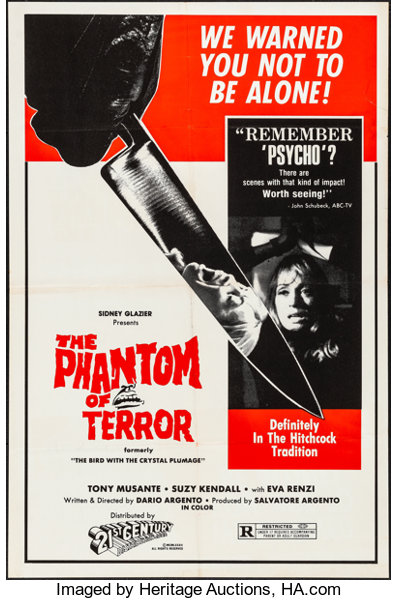
Aside from Mario Bava’s influential films, such as Blood and Black LaceThe Girl Who Knew Too Much, no other movie has left as indelible a mark on the Giallo genre as Dario Argento’s 1970 directorial debut. Before this, Argento was a journalist who contributed to the screenplay of Sergio Leone’s Once Upon a Time in the West.

The title of the film, The Bird with the Crystal Plumage, is a metaphor for the protagonist’s predicament. Just as the bird is trapped by the beauty of the crystal plumage, Sam is trapped by the beauty of the art gallery and the mystery it holds. This metaphorical title sets the tone for the film and its exploration of the relationship between art and violence. In the film, Sam Dalmas (played by Tony Musante) is an American writer struggling with writer’s block. He travels to Rome for a change of scenery, accompanied by his British model girlfriend, played by Suzy Kendall. Just as he decides to return home, he witnesses a black-gloved man attacking a woman inside an art gallery. Desperate to save her, he finds himself helpless, trapped between two mechanical doors as the woman silently pleads for help.

The woman, Monica Ranier, is the gallery owner’s wife. Although she survives the attack, the police suspect Sam may be involved in the crime and confiscate his passport to prevent him from leaving the country. Unbeknownst to them, a serial killer has been targeting young women for weeks, and Sam is the only witness. Haunted by the attack, Sam’s memory is unreliable, leaving him without a crucial clue that could solve the case, adding a layer of suspense to the narrative.

This film introduces several tropes that would become hallmarks of the genre: the foreign stranger turned detective, the gaps in memory, and the black-clad killer—elements that later Giallo films would pay homage to. These elements, along with Argento’s unique visual style and use of suspense, would go on to influence a generation of filmmakers and shape the Giallo genre as we know it today.

Another recurring theme in Argento’s work appears for the first time here: the notion that art can incite violence. In this instance, a painting depicting a raincoat-clad man murdering a woman plays a significant role.

As the story unfolds, Sam receives menacing phone calls from the killer, and the masked assailant attacks Julia. The police manage to isolate a sound in the background of the killer’s conversations—the call of a rare Siberian bird. This bird, a Grey Crowned Crane, plays a significant role in the film’s narrative, serving as a clue that brings the police closer to unraveling the mystery. The film’s use of this rare bird as a plot device is a testament to Argento’s skill as a storyteller and his ability to create tension and suspense.

Alberto, Monica’s husband and the owner of the art gallery, ultimately attempts to kill her, revealing that he orchestrated the attacks. However, in true giallo fashion, mistaken identity is a crucial plot twist. Even though this film was made nearly fifty years ago, I won’t spoil the reveal of the real killer.

I recall my parents seeing this movie before I was born and disliking it so much that they would mention “that weird movie with the bird that makes the noises” whenever they encountered a confusing film. Ironically, I grew to love Argento’s work. My fascination with Giallo and difficult-to-understand films is a form of rebellion against their opinions.

This film, an uncredited adaptation of Fredric Brown’s novel *The Screaming Mimi*, was initially considered a career misstep by actress Eva Renzi. The film’s producer even wanted to replace Argento as director. However, when Argento’s father, Salvatore, spoke with the producer, he noticed that the executive’s secretary appeared shaken. When he asked her what was wrong, she revealed she was still terrified from watching the film. Salvatore convinced her to explain her fear to her boss, ultimately leading to Argento staying as director.

The outcome of this struggle? It is a film that played in one theater in Milan for three and a half years, leading to countless imitators—and inspired many elements in films featuring lizards, spiders, flies, ducklings, butterflies, and more—for decades to come. Argento would later continue his so-called Animal Trilogy with The Cat O’Nine Tails and Four Flies on Grey Velvet, then Deep Red before moving into more supernatural films like Suspiria and Inferno.

SEVERIN BOX SET RELEASE: Fear In the Philippines: The Complete Blood Island Films

From 1959 to 1971, Filipino filmmakers Eddie Romero and Gerry de León —along with Hemisphere Pictures marketing consultant Samuel M. Sherman—booked flights for drive-in audiences to Blood Island. This dark den of zombies, medical experiments, wanton women and terror would last four movies that fans of exploitation films have obsessed over ever since.

I’ve loved these movies ever since I first discovered them when Severin’s first re-releases came out a few years ago. I was so lucky to see many of them at the drive-in.

Now, Severin is re-releasing all of them – scanned uncut in 4K with improved color and audio plus over 8 combined hours of special features – in a new box set that you can get directly from the Severin Films Webstore.

Terror Is a Man (1959): Call it Blood Creature, Creature from Blood Island, The Gory Creatures, Island of TerrorGore Creature, or its most well-known title, Terror Is a Man, but what you should really call it is the first of the Blood Island films. These movies, produced by Eddie Romero and Kane W. Lynn, include Brides of Blood, The Mad Doctor of Blood Island and Beast of Blood.  You can also consider The Blood Drinkers a Blood Island movie.

This movie was in theaters for nearly ten years—until 1969, when distributor Sam Sherman re-released it as Blood Creature with a warning bell that alerted the audience to impending gore.

William Fitzgerald (Richard Derr, who was almost The Shadow in a TV pilot that was turned into a movie called The Invisible Avenger) is the lone survivor of a ship that has crashed on Blood Island. Also, there are Dr. Girard (Francis Lederer, whose Simi Hills home is considered a landmark residence), his frustrated wife Frances (Greta Thyssen, who was in three of the Three Stooges shorts and Cottonpickin’ Chickenpickers) and his assistant Walter Perrera.

Much like The Island of Dr. Moreau, Girard is making half-man, half-animals like the panther he’s been experimenting on that tends to attack villagers. Of course, the doctor’s wife falls in love with the protagonist, and the beast gets loose and kills all sorts of people, including his creator. But hey — that mummy-like cat-eyed fiend seems to survive at the end, as a small island boy sends him away on a rowboat.

Gorgeous natives. Strong men. Crazy doctors. Werecats in bandages. Blood Island. Indeed, this one has it all.

The Severin release includes extras such as interviews with Samuel M. Sherman, co-director Eddie Romero, Pete Tombs (co-author of Of Immoral Tales), and critic Mark Holcomb, a trailer, and a poster and still gallery.

Brides of Blood (1968): This movie, which was originally known as Island of Living Horror, was rereleased with Count Dracula’s Great Love. The former was retitled Cemetery Girls and the latter was renamed Grave Desires.

Much like all of these Filipino horror films, it’s completely bonkers.

The tropics are the place for three Americans to find, well, complete insanity.

Dr. Paul Henderson, a nuclear scientist investigating nuclear bomb tests, is played by Kent Taylor. He was once a major star, playing the title role in fifty-eight Boston Blackie movies. His name is also half the inspiration for Superman’s alter ego (the other star is Clark Gable).

He’s married to the gorgeous but always ready-to-cuckold Carla, Beverly Powers. Beverly was once the highest-paid exotic dancer in the world before becoming an actress and starring with Elvis in SpeedwayKissin’ Cousins and Viva Las Vegas. She also pretty much played herself in Breakfast at Tiffany’s. After all that acting, she became a minister with The Living Ministry in Maui, Hawaii.

Then there’s Jim Farrell, a young Peace Corps member played by John Ashley. Ashley was an AIP star who appeared in Dragstrip Girl and sang his song “Let Yourself Go Go Go” in Zero Hour! He was also a regular in their beach movies, appearing at Beach PartyMuscle Beach PartyBikini BeachBeach Blanket Bingo, and How to Stuff a Wild Bikini.

After living in Oklahoma for a while, Ashley produced these movies with Hemisphere Pictures, living in the Philippines for part of the year and helping to create these little bits of madness.

Our protagonists soon learn that Blood Island is cursed. It’s now a place that has been irradiated by nuclear fallout from those bomb tests, with vines that attack people and butterflies that bite. There’s also a beast in the jungle that tears women apart to get off because, hey, why not?

Carla learns that the beast is one of the villagers, Esteban, but it comes at the price of her own life. She’s an early “sex and people who want sex must be destroyed” casualty decades before this type of destruction de rigeur.

Between carnivorous trees eating Carla’s remains and the movie ending in a vast orgy, this is probably unlike any other film you’ve seen before. You can say that about every single film from this studio.

The press book for the movie suggested that all female theatergoers would get the chance to become Brides of Blood and receive a free engagement ring. There was even the idea of giving away fake marriage certificates, but legal concerns prevented that.

Extras on the Severin release include commentary from  Samuel M. Sherman; interviews with co-director Eddie Romero, Sherman and Beverly Powers; the alternate Brides of Blood Island title sequence and a Jungle Fury title card; a teaser; a trailer and a poster and still gallery.

Mad Doctor of Blood Island (1969): We’re back ten years after we first got to Blood Island. Eddie Romero and Gerardo de Leon have returned in the directing chair, and this time, they’ve brought even more blood, beasts and boobs than they did in their last effort, Brides of Blood.

This film was syndicated to TV as Tomb of the Living Dead and is also known as The Mad Doctor of Crimson Island because, in some states, like Rhode Island, the word “blood” wasn’t allowed in movie advertising.

After Brides of Blood, John Ashley discovered that the film was so well-received that distributors asked him to make more. He moved to the Philippines and got to work.

The film starts with an initiation, as at some theaters, you are given a packet of green liquid and asked to recite the oath of green blood so that you can watch the unnatural green-blooded ones without fear of contamination. Years later, Sam Sherman said that he came up with this idea, and he got incredibly sick when he drank one of the packets. The film’s other gimmick is rapidly zoomed in and out, like Fulci on speed, whenever a monster appears. That was to cover the harmful special effects, but it made plenty of theatergoers sick. Man — destructive green liquid and frequent pans and zooms. It’s as if they wanted kids to puke!

A woman runs naked through a jungle before a green-skinned monster kills her. Yes, that’s how you start a movie!

Then we meet our heroes, like pathologist Dr. Bill Foster (Ashley), Sheila Willard (Angelique Pettyjohn, who was famously in the Star Trek episode “The Gamesters of Triskelion” and early 80s hardcore films like Titillation, Stalag 69 and Body Talk) and Carlos Lopez (Ronaldo Valdez, who would become the first Filipino Kentucky Fried Chicken Colonel).

The ship’s captain, who got them there, tells them how the island is cursed and how its people bleed green blood. Everything falls apart — Sheila’s dad, who she hoped to take home, is now a drunk. And Carlos’ mother refuses to leave, even after the mysterious death of her husband.

It turns out that Dr. Lorca has been experimenting on the natives, who just want to be healthy. Instead, they’re becoming green beasts that murder everything they can. Look out, everyone! I hope you’ve drunk your green blood before this all began!

Angelique Pettyjohn claimed that the love scene with John Ashley was not simulated. Seeing how Severin finally found the uncut film, and I haven’t seen any penetration, I think she’s full of it. But who am I to doubt her?

To make this even better, the American trailer of this is narrated by Brother Theodore!

Extras on the Severin release include commentary by Nathaniel Thompson and Howard S. Berger and a second commentary with Samuel M. Sherman; interviews with Pete Tombs, Mark Holcomb and Eddie Romero; a trailer and a poster and still gallery.

Beast of Blood (1970): All good things must end. This is the final of the Blood Island films and the last movie that Eddie Romero would make for Hemisphere Pictures.

As Dr. Bill Foster (John Ashley), Sheila Willard, her father and Carlos Lopez escape from Blood Island, this movie’s Beast gets on board and goes buck wild, killing everyone he can and blowing up the ship. He survives and heads back to the jungle while Dr. Foster spends months recovering. Everyone he knew or loved is now dead.

Of course, he’s going back to Blood Island.

Dr. Lorca (Eddie Garcia), who apparently died at the end of the last movie, is still alive but horribly scarred. He controls the beast, which can live without its head and even talk and control its own body from afar.

This is less of a narrative movie for me and more a collection of magical images, as bodies squirt blood and beasts have swampy faces and make strange noises while their heads rot inside beakers and lab equipment.

To promote this one, which played a double bill with Curse of the Vampires, the producers printed counterfeit 10 bills that folded in half, with the other side revealing a poster for the film. Those fake sawbucks were scattered all around the neighborhoods where this movie played.

Extras on the Severin release include commentary by Samuel M. Sherman, interviews with Celeste Yarnall and Eddie Garcia; a Super 8 digest version; a trailer; a radio spot and a poster and a still gallery.

MOVIES THAT PLAYED SCALA: Dougal and the Blue Cat (1970)

Thanks to the British Film Institute, there’s a list of films that played Scala. To celebrate the release of Severin’s new documentary, I’ll share a few of these movies every day. You can see the whole list on Letterboxd.

Based on the TV series The Magic Roundabout, this has Dougal the dog remembering a dream or a memory of walking past an abandoned factory and hearing a voice that says “Blue is beautiful, blue is best. I’m blue, I’m beautiful, I’m best!” That voice belongs to Madam Blue (Fenella Fielding), who sends Buxton, a blue cat, to distract everyone from her plans to assume control of the garden where Dougal and his friends live and turn the world blue.

Just like the TV show, this movie uses the footage of the French stop motion animation show Le Manège enchanté — created by Serge Danot with the help of Ivor and Josiane Wood — which was totally rewritten and told by Eric Thompson. The show was broadcast in 441 five-minute episodes between 1965 and 1977. It wasn’t just enjoyed by kids; adults made it a cult show. In 1975, comedian Jasper Carrott released “The Magic Roundabout,” a live comedy routine about the show that went to #5 on the UK singles chart.

MOVIES THAT PLAYED SCALA: Performance (1970)

Thanks to the British Film Institute, there’s a list of films that played Scala. To celebrate the release of Severin’s new documentary, I’ll share a few of these movies every day. You can see the whole list on Letterboxd.

Donald Cammell was raised in a home “filled with magicians, metaphysicians, spiritualists and demons” and spent his childhood bouncing on the knee of “the wickedest man in the world” Aleister Crowley. Originally a painter, he became a screenwriter before meeting the Rolling Stones through Anita Pallenberg.

Performance was supposed to be a light-hearted swinging ’60s romp, but it ended up being what John Simon of New York Magazine called “the most vile film ever made.” It’s the story of two men*, Chas (James Fox), a brutal street thug, and Turner (Mick Jagger), a rock star who has gone into hiding.

Chas was a member of an East London gang, a man of violence who is prized for his ability to get money for his employer Harry Flowers. However, his complicated past with another gangster and that man’s murder has ostracized him from the gang and put him on the run and into the orbit of Turner and his two women, Pherber (Pallenberg) and Lucy (Michèle Breton).

By the end of the film, fuelled by drugs, cross-cutting techniques, a disjointed narrative and no small amount of magic, the two men have switched identities, with Chas displaying Turner’s face and Turner, well, not having a face any longer.

Warner Brothers thought that with Jagger in the movie they getting a Rolling Stones movie that young people could go see. Instead, they got a movie filled with drugs, sex, violence and ideas about cross-dressing and sex transforming identity that would still be dangerous half a century later.

The behind the scenes events — the house in Lowndes Square used in the film was investigated for drugs, Keith Richards was outside in a car fuming because Jagger and Anita were really having sex, Fox stopped acting for fifteen years to become an evangelical Christian — are just as interesting as the film, but the movie itself is astounding.

It was almost unreleased, as a Warner exec would complain, “Even the bathwater was dirty” and the wife of one of them would throw up at the premiere. Ken Hyman, the leader of Warner Brothers, decided that “no amount of editing, re-looping or re-scheduling would cover up the fact that the picture ultimately made no sense.” The film was shelved for two years until Hyman left and even then, the movie was re-edited and the Cockney accents were redubbed.

Time has been kind to Performance, a movie that points out the juxtaposition between the violent lives of East End with the rock and roll world of London. “A Memo to Turner” predates music videos. Bands from Coil to Big Audio Dynamite and Happy Mondays all referenced or sampled the movie while it’s been an influence on so many directors.

As for Cammell, he struggled against the mainstream after this movie — and with Marlon Brando, who kept asking him to write films and then deciding not to make them — before making Demon Seed, a film that deals with transformative sexuality, just like Performance. He’d make White of the Eye and Wild Side before killing himself with a shotgun. Kevin Macdonald (co-director of the story of his life, Donald Cammell: The Ultimate Performance), said “He didn’t kill himself because of years of failure. He killed himself because he had always wanted to kill himself.”

I held back watching this for years, because I wanted to make sure that I was ready for it. I needed to be prepared for this film, to not use it as wallpaper or background noise. It deserved more than that. And I’m glad I waited. It was worth it.

*It’s directed by two men as well, Cammell and Nicolas Roeg, who would go on to make Don’t Look NowThe Man Who Fell to Earth and The Witches.

MOVIES THAT PLAYED SCALA: Beyond the Valley of the Dolls (1970)

Thanks to the British Film Institute, there’s a list of films that played Scala. To celebrate the release of Severin’s new documentary, I’ll share a few of these movies every day. You can see the whole list on Letterboxd.

A few things amaze me about this movie:

  1. That it was intended as a sequel to 1967’s Valley of the Dolls, a veritable smorgasbord of sleaze and stupidity that I adore with all my heart, but which was a sizeable mainstream success.
  2. That 20th Century Fox would hire Russ Meyer and Roger Ebert to make it. Ebert himself says that it wasn’t until after making the film that he realized how unusual it all was: “…in hindsight, I can recognize that the conditions of its making were almost miraculous. An independent X-rated filmmaker and an inexperienced screenwriter were brought into a major studio and given carte blanche to turn out a satire of one of the studio’s own hits.” When Fox producer Richard Zanuck greenlit the script, Meyer said, “I felt like I had pulled off the biggest caper in the world.”
  3. That anybody has ever made a movie afterward, because this is the literal ultimate film of all ultimate films, a movie awash in overwrought pathos, exploitation and you can’t believe they went there insanity, blows my mind.

Neither Meyer nor Ebert read the novel Valley of the Dolls, but they knew what the film was all about — young innocent girls get chewed up and spit out by the hard and violent world of Hollywood and not all of them find redemption.

Ebert said that the duo wanted to take that ever further: “We would include some of the sensational elements of the original story- homosexuality, crippling diseases, characters based on “real” people, events out of recent headlines…heavily overlaid with such shocking violence that some critics didn’t know whether the movie knew it was a comedy.”

Meyer wanted to appeal to all audiences under thirty with something for everyone: mod fashion, hip music, soap opera romance, amazing set design, lesbians, orgies, drugs, transgender characters, Nazis, comedy, serious drama, plenty of skin, violent exploitation and an ending that had a moral — the so-called square-up reel.

They changed some characters — Susan Lake and Baxter Wolfe are really Anne Welles and Lyon Burke from Valley of the Dolls — but some are real people, like Ronnie “Z-Man” Barzell being based on Phil Spector decades before he became a killer. Randy Black is Muhammed Ali. And the end of the movie was based on the Tate-LaBianca Murders, claiming the life of Valleystar Sharon Tate at the hands of the Manson Family.

Complicating the movie — for the actors — is that Meyer wouldn’t let on if the movie was really serious or comedic. Some decisions — SPOILER WARNING like Z-Man being Z-Woman SPOILER WARNING — were made on the spot, despite it having nothing to do with the rest of the film.

Roger Ebert said, “It’s an anthology of stock situations, characters, dialogue, clichés and stereotypes, set to music and manipulated to work as exposition and satire at the same time; it’s cause and effect, a wind-up machine to generate emotions, pure movie without message.”

While Zanuck had asked for an R rated to pushed the boundaries toward X, the film did receive an X rating. So Meyer responded by deciding that he wanted to insert even more sex and nudity into the film.

So what’s it all about? Glad you asked.

Kelly MacNamara (Dolly Martin, Playboy Playmate of the Month for May 1966), Casey Anderson (Cynthia Myers, Playboy Playmate of the Month for December 1968, and a woman whose nude photo was taken to the moon by the crew of Apollo 12) and Petronella “Pet” Danforth are The Kelly Affair. Kelly’s man, Harris Allsworth manages them and they decide to travel to Hollywood to meet up with Kelly’s aunt Susan Lake, who stands to inherit a big fortune.

Her financial advisor Porter Hall thinks they’re just hippies out to get her money, but she doesn’t care what that old man thinks. Instead, she introduces them to Ronnie “Z-Man” Barzell. He’s played by John LaZar, who is also in Deathstalker II, so it’s kind of ironic that he’s in the sequel to a movie that stars Lana Clarkson, the woman killed by the person he’s really playing here, Phil Spector. Woah.

To top it off, Kelly is wearing one of Sharon Tate’s outfits from the original in this scene. Dolly Read nearly couldn’t do the scene as she was in tears when she learned that the outfit had belonged to the dead actress. The publicity for the film — the famous three on a bed shot of the band — also has them wearing clothes from that movie.

He becomes their manager, enraging Harris, and renames them The Carrie Nations. Kelly soon falls for Lance Rocke (Michael Blodgett, who after acting in movies like Disco Fever and The Velvet Vampire, would write Rent-A-Cop and Hero and the Terror) while her ex-boyfriend ends up in bed with pornstar Ashley St. Ives (Meyer’s wife, Edy Williams). But soon, Harris can’t perform because he’s all tied into the booze and the dolls, baby. The dolls! The one time he can get it up, he knocks up Casey, his ex-girl’s best girlfriend who then has a lesbian affair with Roxanne (Erica Gavin, the star of Meyer’s Vixen), who asks her to get an abortion. Whew! So much happens so fast in this movie you really gotta keep up.

Meanwhile, Petronella has a storybook romance with Emerson Thorne (Harrison Page, Carnosaur) that ends in a brutal fistfight and near vehicular homicide when he catches her in bed with champion boxer Randy Black (James Iglehart, Angels Hard As They Come). Susan gets back with her old fiancee Baxter Wolfe (Charles Napier!) while drugs and touring beat up The Carrie Nations, until one show Harris leaps to his, well, not death, but he loses the use of his legs. Kelly falls back in love for him after his stupid fall. Emerson and Petronella get back together. Casey and Roxanne have lots of sex. If it seems like it’s all going to end up fine, Meyer is here to play with your mind.

Z-Man invites Lance, Casey and Roxanne (the latter two wearing real outfits from the 1960’s Batman TV show) to another of his drug-fuelled parties. After Lance turns him down, he reveals that he’s been a woman all along before going off — beheading Lance to the 20th Century Fox theme before stabbing his servant and getting Casey to fellate his gun before murdering her and her lover (this is teased in the film’s opening). Kelly, Harris, Pet, and Emerson arrive too late to save them, but they kill Z-Man and Harris starts to move his feet again.

While an overly preachy voiceover squares us all up, like we’re watching Mom and Dad or something, we watch Kelly and Harris, who is limping on crutches, enjoy nature before all three surviving couples get married at the courthouse.

Between this movie and Myra Breckinridge, Zanuck lost his job at Fox. That said — despite an X rating and a meager $900,000 budget (Meyer came in $100,000 under) — it ended up earning more than $40 million dollars. Of course, they also had to pay out Valley author Jacqueline Susann’s estate for damages, which meant that the movie starts with this disclaimer:

THE FILM YOU ARE ABOUT TO SEE IS NOT A SEQUEL TO “VALLEY OF THE DOLLS.” IT IS WHOLLY ORIGINAL AND BEARS NO RELATIONSHIP TO REAL PERSONS, LIVING OR DEAD. IT DOES, LIKE “VALLEY OF THE DOLLS” DEAL WITH THE OFT-TIMES NIGHTMARE WORLD OF SHOW BUSINESS BUT IN A DIFFERENT TIME AND CONTEXT.

Needless to say, this is in my top films ever. If you ever visit and you’d like to watch while I scream the songs at the screen and jump up and down, you’re invited.

MOVIES THAT PLAYED SCALA: El Topo (1970)

Thanks to the British Film Institute, there’s a list of films that played Scala. To celebrate the release of Severin’s new documentary, I’ll share a few of these movies every day. You can see the whole list on Letterboxd

A combination of exploitation film, spaghetti (well, maybe chili con carne given its origins), art film and quest for enlightenment, El Topo is either the greatest movie you’ve ever seen (me) or complete bullshit that seems to go on forever and ever (my wife).

El Topo and his son are traveling the desert when he instructs his son that he is now a man and must bury his first toy and a photo of his mother. The naked child — either symbolizing purity or just a lack of wardrobe budget — rides with our protagonist as he walks through a town that has been decimated.

The black-clad gunfighter finds those responsible and destroys them, including castrating their leader, the Colonel. Rescuing that man’s woman, who he calls Mara, El Topo learns of four gunfighters that cannot be defeated. He abandons his son and goes with her on a quest.

From here on out, it’s a mix of religious and sexual interplay as well as gunfights that grow more and more mystical. There’s also a no legged man riding a no arms having man, a master who can catch bullets in a butterfly net, a dude who can stop bullets with his body, a woman who sounds like birds when she screams, hundreds of dead rabbits, people spontaneously going up in flames and their graves secreting honey and bees, and so much more. Throughout each gun battle, El Topo grows weaker as he must rely on trickery instead of skill. Each win feels more like a loss, particularly as Mara becomes more demanding and grows fonder of the unnamed woman with the voice of a man who has been riding with them.

El Topo visits the sites of each of his four battles and is shot numerous times by the woman as he crosses a bridge. His body is taken by dwarves and mutants as the first part of the film ends. Becca was sure this was the end of the movie and I didn’t have the heart to tell her that there was much, much, much more to come.

Our protagonist has been born again as a Christ-like figure who has meditated for at least 20 years in the caves of an inbred group of mutants. He is now cleaned and shaved as he promises to return them to the light (the mole, who El Topo is named for, constantly claws its way to the sun, but is then blinded). To get there, he and his new bride, a dwarf woman, must beg and be part of a series of skits that take advantage of them, climaxing with them being forced to make love in a room full of the town’s men.

And this town — it’s covered with Illuminati imagery, worships guns, takes slaves and destroys them to the cheers of an adoring crowd. It also feels a lot like America.

Of course, El Topo’s son is now a monk in this town and when he and his bride attempt to marry, he tries to kill his father for leaving him behind. He agrees to spare the old man’s life until he frees his people.

Finally free, the mutated cavepeople run to the town, thinking it is their salvation. Instead, they are massacred and El Topo is shot numerous times. Remembering what he learned from the gun battles, he rises and kills every single one of them. Then, he sets himself on fire (“I kind of figured this would happen sooner or later,” said my wife) as his child is born. His grave also releases honey and bees as his sons and wife ride on into the distance (there was once hope of a Sons of El Topo movie with Marilyn Manson as the star, but it has not happened. There was, however, a comic book, which will be released in the US in December of 2018).

El Topo has inspired legions of fans, from John Lennon (who championed the film and had Allen Klein, manager of The Beatles, buy it and show it nationwide at midnight screenings, then produced the follow-up The Holy Mountain) to David Lynch, Dennis Hopper, Gore Verbinski (citing that debt in his animated film Ringo), Nicolas Winding Refn and Suda 51, whose video game No More Heroes has a similar plot about finding and destroying the best assassins in the world.

A midnight movie staple for years, El Topo disappeared in the 1980’s and 90’s, as Allen Klein would not give up his rights to the film. I searched for years, as Heads Together (a long lost and lamented rental store in Pittsburgh) had the only copy in town, one that was constantly checked out. This was 1994 — nearly pre-internet and not the time when you could easily stream or order and film. It wasn’t until another sadly lost shop, Incredibly Strange, opened in Dormont that I was able to get a copy of the Japanese laser disc release. Since then, I’ve acquired the blu ray of the film, which makes it totally convenient to view at any time.

You can imagine my excitement when the movie was playing a midnight show at Row House, a theater in Pittsburgh’s Lawrenceville neighborhood. Before the film, the owners and programmers of the theater sat on stage and apologized for showing it, as they had just learned of the rape scene in the film and that Jodorowsky had claimed in past interviews that it was real (to be fair, he’s also said that it was consensual and that he penetrated her). This scene lasts around 30 seconds or less of screen time and shows no actual sex. I’ve read tons of books on the film and watched it so many times over the years and never really dealt with this controversy myself.

They said that they debated not showing the film — keep in mind before this talk, they did a trivia contest to give away tickets, which is kind of darkly humorous that they would put something that was quite literally trivial before such a big discussion and announcement — then said that they decided to show the film and donate its proceeds to a charity that they literally could not remember the name of. Then, they talked about future movies coming to the theater and couldn’t remember much of next month’s schedules other than Tokyo Tribes, which was described with the world rap more than five times.

At the risk of sounding like an asshole, this whole affair came off as handwringing and hand washing at the same time. If the theater had an issue with this, they should have not shown the film. Upon further research, no one is sure whether or not this scene is an actual rape. In interviews, Jodorowsky has been given to mania, saying things that any normal person would think is insane, such as using his proposed Dune to create a prophet and actual drugs on celluloid. I’m not giving the man a pass in the interest of hero worship (full disclosure, I am a fan of several of his movies), but the actress that played Mara (Mara Lorenzio) supposedly couldn’t be found to be paid and was on LSD for most of the production (this doesn’t suggest consent, just setting up that the film was shot during very different times). She did, however, make an appearance in the documentary Midnight Movies: From the Margin to the Mainstream where this was not discussed.

I will share that years after making the movie, Jodorowsky felt that he stole of some son’s childhood by making him take part in such a violent film. He flipped the opening of the film and had him dig up the teddy bear and a photo of his mother and told him, “Now you are 8 years old, and you have the right to be a kid”.

I don’t think this absolves him of whatever happened in this film. But the whole incident with the theater has left a bad taste in my mouth. I feel like they should have offered refunds (I wouldn’t take one), but instead by giving proceeds to charity, they took that choice away. They still advertised the movie up until hours before it went on with no mention of this controversy. And I overheard one of the people on stage mention that he’d never seen the film, only having seen The Holy Mountain and was interested to see what it was all about.

Again — I’d have more respect for them if they took an actual stand and didn’t show the film. It just felt like they were absolving themselves of it and almost challenging the audience to witness an actual rape if we wanted to stay and watch it. I realize that we’re evolving and changing as a society and I feel that it’s a great thing. And I can’t really collect my thoughts and properly express them here — I’ve tried — but it just all felt messy. And I guess that’s how these things are. The whole way that the affair was conducted didn’t give me any faith or trust in Row House as a theater, to be perfectly honest.

Sorry for the soapbox, but I had a lot to get off my chest. So what can we learn from this film? Well, “too much perfection is a mistake,” is a good start. I also learned “moderation in everything, even in moderation” from a fortune cookie last week. So there’s that.

I’ve also learned that the more I try and go out and experience film with others, I’m reminded that thanks to blu ray and my high def TV, I often feel a lot better just watching them at home. That’s what dooms most second run and boutique theaters, the apathy, along with the fact that I can spend money on a blu that’s equal to my ticket and get a better experience at home. Theaters should be selling that something extra and giving you more — again, a soapbox and I want to see these places succeed.

PS – The group they claim to have donated to was PAAR, Pennsylvania Action Against Rape. It’s one of the oldest rape crisis centers in the country and a totally worthwhile charity. It’d have felt a lot more genuine and honest if they could have remembered their name and told us something about them then stumbled through a speech that certainly needed nuance and actual notes.

I also understand that men have traditionally been horrible to women and this behavior could certainly have happened. The truth isn’t completely sure here and it’s a very difficult issue to maneuver. I just wanted to call out that I felt it was handled in a ham-fisted way and that there are better ways to handle such topics. I’m not justifying the actions of the filmmaker or the words he’s said (or changed over the years).

CHILLER THEATER MONTH: The Horror of Frankenstein (1970)

EDITOR’S NOTE: The Horror of Frankenstein was on Chiller Theater on Saturday, November 30, 1974 at 11:30 p.m., Saturday, July 10, 1976 at 11:30 p.m. and Saturday, December 9, 1978 at 11:30 p.m.

Directed by Jimmy Sangster, written by Jeremy Burnham and Sangster and starring Ralph Bates as Baron Victor Frankenstein, this started as a remake of Curse of Frankenstein before Hammer allowed Sangster to write it as a parody. This was an attempt to make Bates into the new Hammer star.

Shot on the sets of Taste the Blood of Dracula and The Vampire Lovers and playing double features with Scars of Dracula, this also has David Prowse as the monster. He’s the only actor to play the role twice for Hammer, as he’s also in Frankenstein and the Monster from Hell (and wore Universal Frankenstein’s Monster makeup in Casino Royale).

Victor Frankenstein isn’t sympathetic at all in this. He kills his father to get the title of Baron von Frankenstein, goes to medical school in Vienna until he’s caught knocking out the dean’s daughter and then he comes home to assemble the dead into his creation.

Dennis Price and Joan Rice are good as the graverobbers, but despite the idea of starting a new series with a younger Dr. Frankenstein, this feels less special than the past of Hammer. Even the ending, where the monster gets covered by acid, is a let down. But still, it’s a Hammer movie and even a bad one has some reasons to watch.