Joe Sarno week (June 16 – 22) Joe Sarno was called the Bergman of 42nd St, but don’t let that stop you from watching his movies! He was able to shape dramatic stories that were entertaining and of-the-moment while working with tight budgets and inexperienced performers but he never lost sight of why people were buying the tickets – HOT SEX!
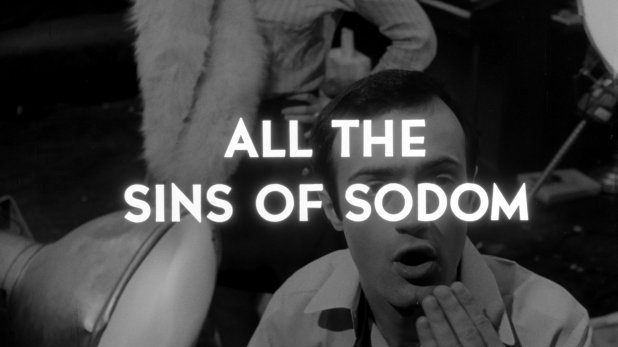
The title of this movie is awesome and then I found out that it’s also called All The Evils Of Satan and I don’t know if I could be more enthusiastic about a film.
New York City shutterbug Henning (Dan Machuen) is supposed to shoot some nudes for his agent Paula (Peggy Sarno) but is obsessed with shooting the evil that lives inside all women. To capture this, he takes images of Leslie (Maria Lease, who would go on to be a director of adult films as well as Dolly Dearestand being the script supervisor on Better Off Dead) as she hangs from the ceiling of his studio. After, they make love, and while Henning usually never sees another of his conquests again, she feels different. She’s also mindblowingly gorgeous, which helps.
He also meets another model named Joyce (Marianne Prevost) who he feels sorry for. She’s homeless and needs a hand up. He invites her to stay in his studio and assist him, but when he grows angry that he can’t capture with his camera what he sees with his eyes, he learns that she’s the perfect muse for his images of base morality. Paula even tells him that she sent Joyce his way, claiming “”I sent her to you because she is what you’re looking for. If I ever I saw it, she’s the daughter of Satan.”
That means that things aren’t going to end well for anyone. Again, this is in stark black and white and while the lovemaking scenes are quite erotic, they’re mostly clothed. Then again, when they were made by Sarno, this burned the celluloid.
As the Godfather of Gore states in that intro to this film in its Arrow Video release, this is the one movie that rivals Blood Feast for box office and was his answer to the question, “Why don’t you stop cutting up all those girls and kill some men?”
This time through, I watched the film with commentary by H.G. Lewis and Something Weird’s Mike Vraney. This commentary track is a real joy, with Lewis quite honest about his faults as a filmmaker while giving tips for would be exploitation creations for how to film things properly. I wasn’t sure how much more I could love this movie, but this release exponentially increased my ardor.
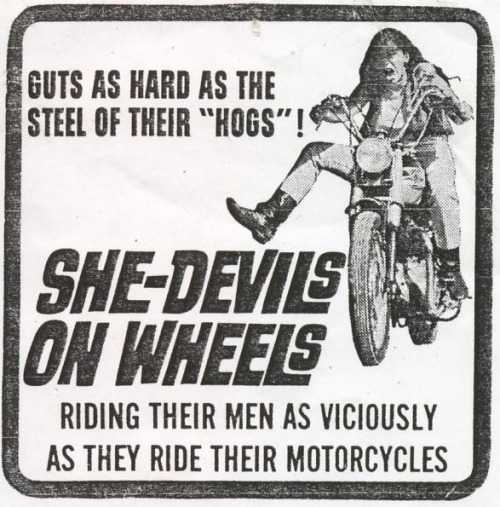
Filmed with a legitimate cast of biker riding women, this movie is years ahead of its time. Heck, it’s years ahead of its time now. These women outride, outfight and dominate every man they meet with no apologies whatsoever. Even Karen, our would-be protagonist, after being forced to kill a lover by dragging him behind her hog, still stays with the Maneaters. They terrorize Florida and every human being they meet because they’re outside of the scope of humanity. They’re superheroes — well, supervillains — who can’t be stopped.
I love that Lewis realizes that adding on a post-credits scene in 1968 was a mistake. It was often trimmed or audiences left before they saw it. The film can’t end with the Maneaters in jail. They speak almost directly to the camera, promising more chaos. It’s as if they’re the biker gang Avengers years before anyone would think to film such a sequence.
I also love that Karen rejects the straight world and her ex-boyfriend Joe, who wants things to be the way they always were. The women in this movie reject the roles their gender has enforced upon them and instead have no issues slicing, dicing, tearing and maiming their way through their rival gang, led by Joe Boy. The fact that he’s a slice of mom and pop Americana, with bleached blonde good looks and it’s astounding — not to be a broken record — that the film ends with her rejecting white picket fences and a certain future.
H.G. Lewis made 33 films between 1962 and 1972. Those films would run in drive-ins for years before the adventure of the VCR and Something Weird would bring them back to viewers. Most of these movies had lower budgets than this and less time ($60,000 spent over two weeks), but they all exhibit a zeal and love for shock and showing you something different than you’ve ever seen before. Lewis remains affable and happy throughout the commentary, the kind of uncle you wish you had who’d done some crazy things in his past and wasn’t shy about sharing them with you. The loss of both he and Mike Vraney are palpable.
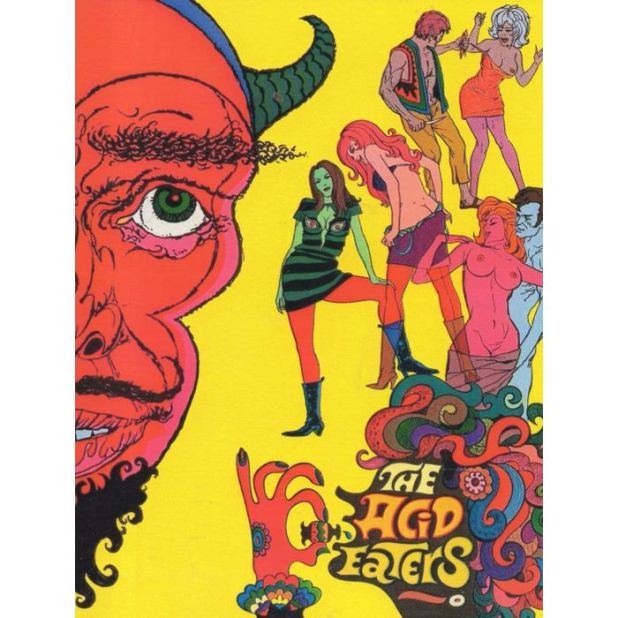
The poster for The Acid Eaters is, of course, a billion times better than the movie it’s selling, but how many films have a bunch of people climbing a fifty-foot tower of LSD cubes? One that I can think of.
Under the name B. Ron Elliott, this film’s director, Byron Mabe, made a nudie cutie with perhaps the best title ever, A Smell of Honey, a Swallow of Brine. He also directed She Freak, The Lustful Turk, Nude Django, Mystic Mountain Massacre and Space Thing amongst others. In between making these berserk movies, he was an actor in Hollywood.
Writer Carl Monson would direct a few movies too, like A Scream in the Streets, Please Don’t Eat My Mother!, Will to Die (AKA Legacy of Blood), The Takers and the x-rated Tarz and Jane and Cheeta, which had Devil In Ms. Jones star Georgina Spelvin, Talia Cochrane (Wham! Bam! Thank You Spaceman!, Devil’s Ecstasy) and Patrick Wright (The Seven Minutes, Track of the Moon Beast) in it.
Pat Harrington, who was in plenty of Harry Novak movies and Mantis In Lace, is in this, billed as Camille Grant and dancing to bongo drums. So are former pro wrestler Buck Kartalian, who you may know as The Khan from Gymkata, and Sharon Carr, who was in the aforementioned A Smell of Honey is on hand.
There’s a drone soundtrack, David F. Friedman serving as the cinematographer and the devil poking people in the butt while they’re all trying to kiss in the nude. Look, I’ve never done LSD, but I would hope that it is not as boring as this movie and totally as sensational as the poster for this one.
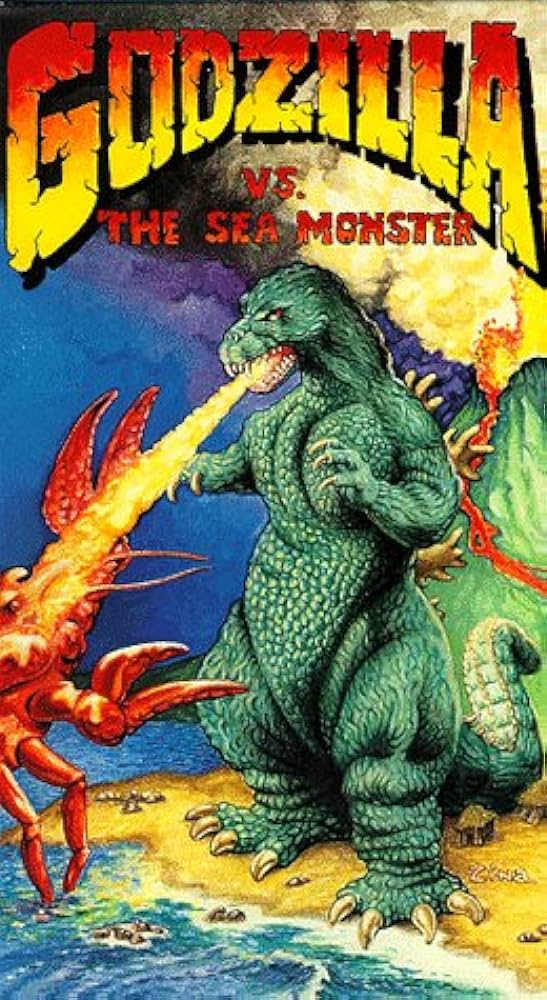
This movie started as a vehicle for the Japanese version of King Kong, with the title Operation Robinson Crusoe: King Kong vs. Ebirah. It was rejected by Rankin/Bass Productions, the folks who created all your favorite holiday specials and who had the rights to Kong, producing a licensed TV show — The King Kong Show — which was amongst the first original cartoons to be produced in Japan for Americans.
King Kong’s role was replaced with Godzilla under the title Ebirah, Horror of the Deep*. It’s the first of two Godzilla films — Son of Godzilla is the other — set on a South Pacific island instead of Japan.
What most filmmakers have never realized is that no one cares at all about the humans in these stories. As a child and an adult, I do not care if people find their brothers that have been lost or if the Red Bamboo terrorist group sells heavy water weapons. I only care to see the monster crab named Ebirah and our friend Godzilla fight.
Yet as an old man, I also feel for Godzilla, who just wants to hide in a cave and sleep after defeating the menace of Ghidorah. Instead, these kids make a lightning rod** and zap him to awareness before he has to kill a giant condo (which is totally a Rodan costume), knock down some jets and then set that big crustacean*** straight by ripping his claws off.
Bonus points to Godzilla to remembering that just because Mothra**** is the friend of humanity, she and he are not on speaking terms. The movie ends with another big battle, an island getting blown up real good and Godzilla going back into the murky depths. Soon, he would meet his son, but that’s a story for another day.
This one has a really lower budget and reused the Daisenso-Goji suit. At some point during filming, the head of this suit was combined with the Mosu-Goji suit for episode ten of Ultraman to create the monster Jirass. That head was replaced with a different head that shows up after Godzilla fights the Red Bamboo and is noticeable for the bug eyes and raised eyebrows.
A lizard with eyebrows. This is why I love Godzilla.
*It’s known by so many names around the world, but my favorites are Germany’s Frankenstein and the Monster from the Ocean, Poland’s Ebirah: The Monster of Magic and Holland’s Mothra the Flying Dracula Monster.
**Godzilla being powered by electricity is totally because the script was written for the Japanese King Kong, who is powered that way. It’s also why he’s so protective of Dayo, as falling for human females is a Kong characteristic.
***Ebirah’s name comes from the Japanese word ebi. That means shrimp, so he’s really one of those and not a crab, but he has crab claws, so…
****This is the last Showa-era Godzilla film where Mothra’s twin helpers the Shobijin, appear. They’re played by the same actress, Pair Bambi, instead of The Peanuts (Emi and Yumi Itô).
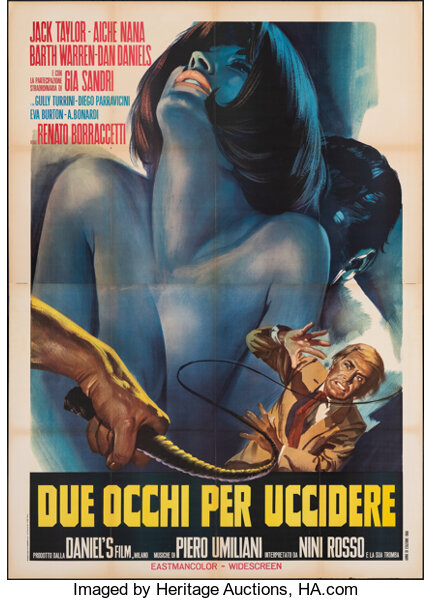
Directed by Renato Borraccetti, who wrote the script with Fernando Luciani, Two Eyes to Kill disappeared after playing theaters and never was released on video. It was sold on eBay in 2014 and was restored as part of a crowd funding mission. The reason why the version online is so short is that one of the reels is missing.
Jean (Fabio Testi) is sentenced to death but keeps his trumpet, playing jazz on the night before he’s taken to the guillotine. He claims he’s innocent until his head comes off his shoulders. The real story, however, is about nightclub owner Max (Jack Taylor), who is being sold out by one of his girls, Rosy (Gia Sandri) and her friend Pierre (Barth Warren). She’s recording everything that happens in the club using her gigantic glasses, which is pretty crazy. They’re playing a game to destroy him, even cluing his girlfriend Nadia (Aichè Nanà) into the fact that he’s assaulting young women.
Why? Well, they were friends with Jean, so we didn’t meet him for no reason. They’re trying to drive Max insane by tormenting him with the sad trumpet song Jean played before he died.
This movie has Eurospy gadgets that may be made from thick paper, lunatic women dancing on stage — Aichè Nanà has a shirtless man appear and start whipping her! — and a jazzy soundtrack by Piero Umiliano and trumpet player Nini Rosso. I wonder if we will ever see a completed cut of this or this is the best we get. Regardless, it’s pretty interesting to check out. I mean, the entire movie seems to be set in a few rooms and curtains take the place of walls.
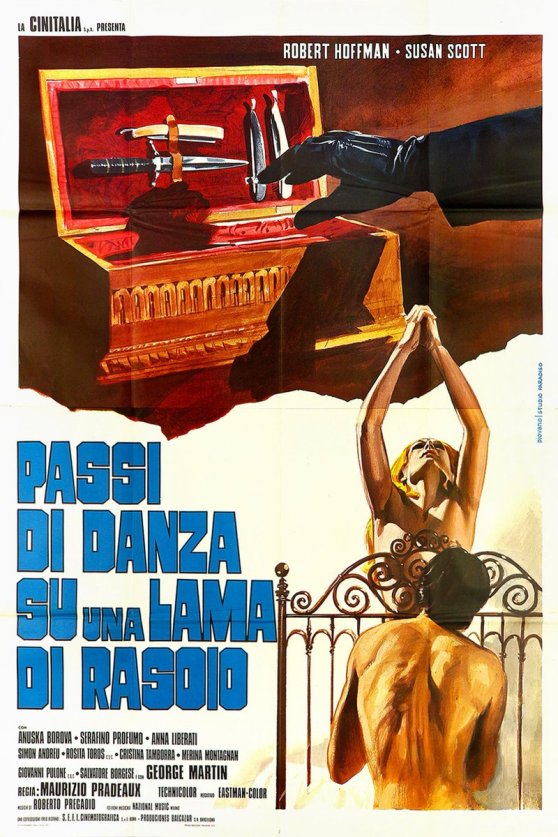
Death Carries a Cane (1973): If death carries a cane, isn’t it weak? With that thinking, aren’t the alternate titles — Dance Steps on the Edge of a Razor, Maniac At Large, The Night of the Rolling Heads and Devil Blade — so much cooler?
Well, that’s because whoever the killer is, he or she has a limp. That’s what Kitty (Nieves Navarro, billed here under her boring Americanized nom de plume Susan Scott) sees when she watches a murder through a coin-operated telescope. That’s just the first of many killings and it just might be her boyfriend Alberto, who has the misfortune of having a limp and a cane when that’s what’s being profiled. I’ve said it before and I’ve said it again, defund the giallo police.
Director Maurizio Pradeaux also made another Grim Reaper referencing giallo, Death Steps in the Dark, which has a scene where the protagonist has to wear drag to escape the police.
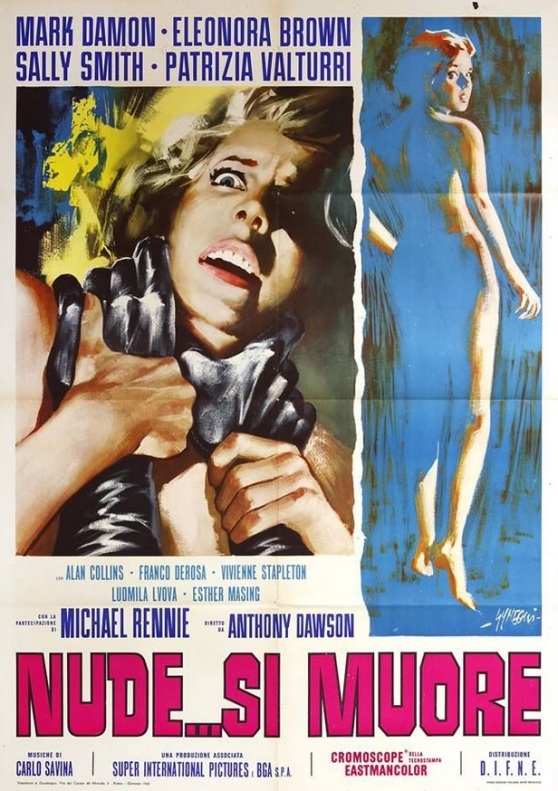
Naked You Die (1968): Naked…You Die (AKA The Young, the Evil and the Savage) is a pretty fun early giallo with good direction by Antonio Margheriti.
Yet it was very nearly was a Mario Bava movie.
According to Tim Lucas’ Mario Bava: All the Colors of the Dark, Bava was hired by Lawrence Woolner — the distributor of Hercules in the Haunted World and Blood and Black Lace in America — to direct a movie about a killer stalking a school. Cry Nightmare was going to be the title and Bava wrote the script with Brian Degas and Tudor Gates (Barbarella, Danger: Diabolik).
Lamberto Bava told Lucas that “Just a short time before the filming was to begin, Mario Bava had an argument with the producers and he abandoned the film.” As for Margheriti, who met Woolner when he distributed Castle of Blood, he said “I think Mario was busy at that time, working on Diabolik or something.”
Either way, locations were already secured, cast and crew had been hired and a theme song had already been recorded.
The drowned body of a woman is placed in a truck going to St. Hilda College. There, only seven students, two teachers — Mrs. Clay (Ludmilla Lvova) and Mr. Barrett (Mark Damon — Headmistress Transfield (Vivian Stapleton) and gardener La Foret (Luciano Pigozzi) are present.
Soon, the killing begins with Betty Ann being strangled and found by Lucille (Eleonora Brown in her last film until coming out of retirement in 2018), who is having an affair with Barrett. When she tells him to come see the body, it’s already gone, so they decide to leave the school.
The killings kick into gear with Cynthia (Malisa Longo, Ricco the Mean Machine) being killed in front of the gardener, who is soon killed as well and Denise (Patrizia Valturri) too. There’s also amateur detective Gillie (Sally Smith) on the case and Inspector Durand (Michael Renne from The Day the Earth Stood Still) trying to stop the killings.
All the girls wear similar uniforms — and outfits that change scene by scene — and nobody wonders why an older teacher can play Big Bad Wolf with Little Red Riding Hood and get away with it.
The aforementioned theme song “Nightmare” by Powell and Savina (Don Powell, who played Emanuelle’s father in Black Emanuelle 2 and did that film’s soundtrack, along with Carlo Savina, who composed the music for The Killer Reserved Nine Seats, Lisa and the Devil, Fangs of the Living Dead and so many more) and performed by Rose Brennan owes royalties to Neal Hefti.
Perhaps even wilder is the fact that the movie informs us that Gillie may be the daughter of James Bond.
Giallo would change in a few years to be bloody, sleazier and stranger. That said, this is a great example of an early version of this style of movie.
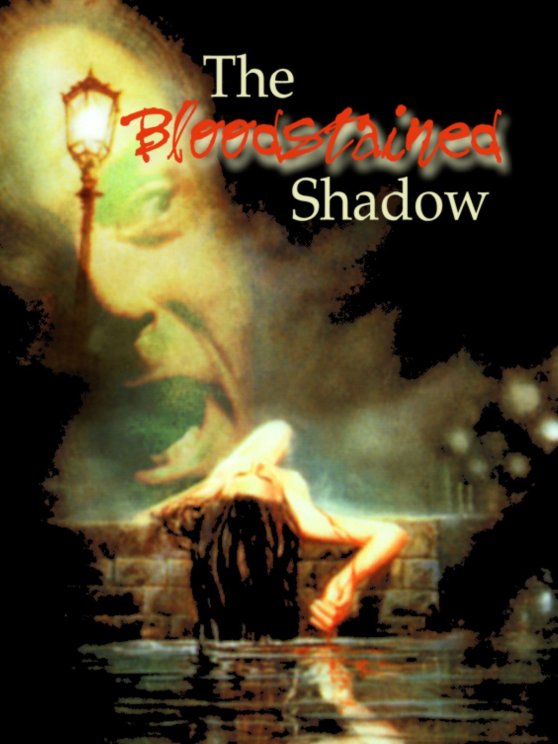
The Bloodstained Shadow (1978): One of my favorite things about giallo are the alternate titles. As if The Bloodstained Shadow isn’t a great name, this movie also goes by Solamente Nero (Only Blackness), which is a way better title. The other thing I love about this genre is that just when I think I’ve seen every good one, I find another to enjoy.
This is the kind of movie that tells you exactly where it stands in the first minutes, as a killer strangles a girl in a field before the credits even start. That murder has never been solved. Years later, a college professor named Stefano has a nervous breakdown. To recover, he comes home to visit his brother Don Paolo, who has become a priest that hates all of the immorality in their small town.
Oh what immorality — there’s a gambler, a psychic, a combination atheist/pedophile and an illegal abortionist with a mentally challenged son who lives in a shack top the list, along with your typical sex and drinking that happens in any town.
Meanwhile, murders have been piling up and whoever is behind it, they’re leaving notes to the priest, warning him that if he reveals who the killer is, he’ll be next. That’s because on Stefano’s first night back home, Don Paolo saw the killer murder the town psychic in the courtyard.
Stefania Casini (Suspiria) also appears as the love interest, Sandra, who helps Stefano come back to normalcy. Well, as normal as a town filled with murder can be. I’m kind of amazed that she wears a belly chain all day. When you get to the love scene, you’ll know what I mean.
There’s also some amazing religious imagery in this one, like a skinned and bloody animal that has been placed in the sacristy to warn the priest that he’s getting too close, or the communion scene that reveals who the real killer is.
Finally, Goblin plays some great music in here, created by composer Stelvio Cipriani. It’s really a great package, thanks to director Antonio Bido, who directed one other giallo, Watch Me When I Kill. I love how the past childhood trauma that the brothers endured continues to permeate their lives as they try to grow up. This is a very adult giallo and by that, I mean that it doesn’t need nudity and gore to tell its tale.
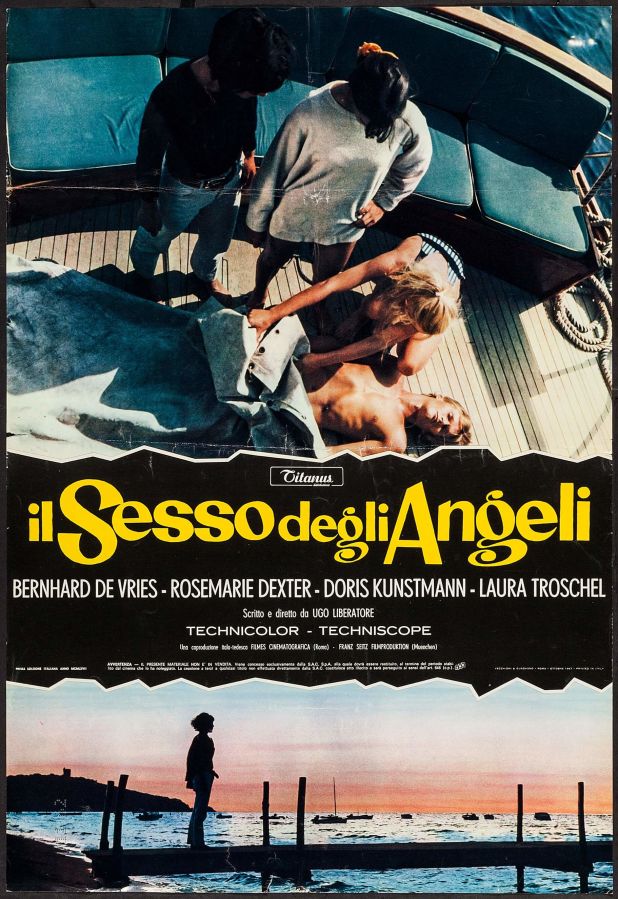
Directed by Ugo Liberatore (Damned In Venice), wrote it with Frank Seitz, this is all about three women — Nora (Doris Kunstmann, Seven Deaths in the Cat’s Eye), Nancy (Rosemary Dexter, Casanova 70) and Carla (Laura Troschel, Four Flies on Grey Velvet) leaving Nora’s lover Luca (Giovanni Petrucci) behind and taking her father’s boat on a voyage. Stealing Marco (Bernard De Vries) from his lover, they sail out for the Dalmatian coast of Croatia.
Of course, he’s going to be with each of the women, one after the other, but because they also plan on having LSD trips, you can imagine that none of this will work out well for him. Maybe if he had waited until Queens of Evil came out in 1970, Marco would be better armed for this trip. Or trips, right? Or a year for Top Sensation. They take a tape recorder with them to see what happens when they all get dosed, but when Marco wakes up with a bullet hole in his stomach — and no one knows why — things get dark. Should the girls get him help? Or will they try to care for him all on their own?
Despite its title — The Sex of Angels — this promise of carnal freedom comes with a horrible price, which means that it does so much of what exploitation always has: revel in sin yet condemn it at the same time. As Marco slowly and horribly dies from his painful injury, he’s further destroyed as his manhood is withered by being forced to dress in women’s robes and a fur coat, all while they sail past gorgeous coastlines.
Amazingly, The Sex of Angels was released in the U.S. by United Artists. It’s a great lesson in that old, “If it seems too good to be true, it is” moral. If three gorgeous women kidnap you, you’re probably going to die. Not everyone makes it in this and it does have the strange idea that acid will unlock the latent lesbian urge in women. I would say, “Only in Italy,” but I’ve seen it happen in enough films all around the world.
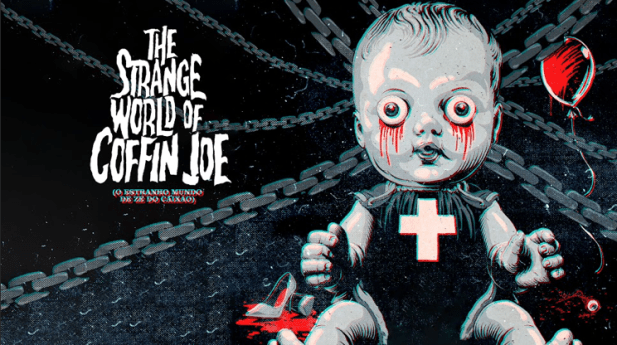
Sure, Coffin Joe was dragged into a pond by the skeletons of his victims and had accepted God, but now he’s back and seemingly as filled with hate for the human race as ever before. Instead of his search for the perfect woman, he’s here to tell you three stories, as if he’s an EC Comics character. Well, a year after this movie, he would have his own comic book series with the same title. It was also the name of his much later TV talk show.
In “The Doll Maker,” a man and his four gorgeous daughters make the most realistic and sought after dolls. Criminals rob them when they learn that they don’t keep their money in the bank. After the doll maker faints, the robbers assault the daughters, who actually start to accept and encourage their advances after remarking about their eyes. And soon enough, we learn how the dolls have such human-looking eyeballs.
“Obsession” is about a poor balloon seller with a foot fetish and a love for a beautiful woman well above his station. After her wedding, which he watches from afar, he learns that she has been murdered. Too poor to attend her funeral, he comes to her body in the mausoleum where, well, he makes love to her and her feet before returning the shoes he saw her lose when she was still alive.
Finally, “Theory” has Professor Oãxiac Odéz (José Mojica Marins, also Coffin Joe and this film’s creator) bring a rival professor and his wife to his home. Soon, he has imprisoned them and forces them to go through a series of sadistic experiments to prove if instinct can overcome reason and love.
So yes, Coffin Joe is in this for about three minutes. But his fingerprints — and long fingernails — are all over every frame.
Arrow Video’s limited edition collection of the movies of Coffin Joe is haunting my shelves and I can see Zé do Caixão in the shadows of my basement. The Strange World of Coffin Joe has commentary with Marins, Paulo Duarte and Carlos Primati in Portuguese with English subtitles. There’s also an alternative ending with commentary by Marins. You can get this set from MVD.
EDITOR’S NOTE: Today’s movie is brought to you by AC Nicholas, who has graciously become a Big B&S’er, a monthly supporter of the site and got to pick an entire week of movies. His idea this time was for a series on movies that started as one film and were dubbed into something else.
Would you like to have me write about the movies of your choice? It’s simple!
Go to our Ko-Fi site and donate. There’s no set amount and I won’t tell you what to do. In fact, if you just keep reading for free, we can still be friends.
Join as a monthly member for just $1. That makes you a Little B&S’er.
As a Medium B&S’er at just $3 a month, if you pick a movie or a director, I’ll write about them for you. In fact, I’ll do one for each month you subscribe and even dedicate the post to you.
For $5 a month, you basically get some major power. As a Big B&S’er, I’ll write an entire week on any subject you’d like. How awesome would that be? In fact, I’ll do it for every month you’re a member. Do you think any of your other movie sites will do that for you?
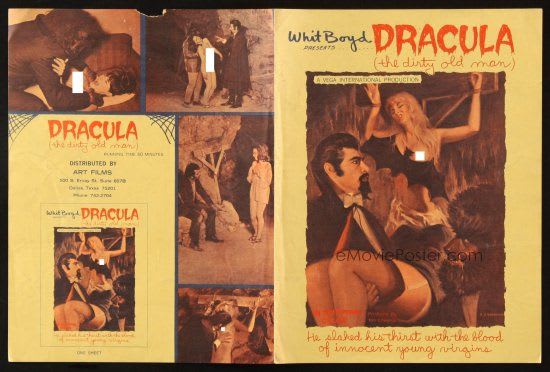
Directed, written and produced by William Edwards, this movie starts with this line: “I saw a panorama of beautiful hills. However, as beautiful as it may seem, death lurked behind those beautiful hills and beautiful women. I don’t know which came first.”
Count Alucard (Vince Kelly) has brought a reporter named Mike (Billy Whitton) to his cave and turned him into Irving Jackalman, a werewolf henchman who brings him women to both feed on and make love to. The jackal or werewolf mask is from another movie that Edwards wrote, The Mummy and the Curse of the Jackals, which has five minutes of John Carradine in it.
The problem is that Mike’s girlfriend Ann (Ann Hollis, who was also in The Ravager) is so attractive that the vampire must have her even after a whole movie of him tying up women, making out with them and then drinking their hemoglobin.
Producer Whit Boyd also was behind 60s sleaze like Spiked Heels and Black Nylons, Hot Blooded Woman, The Sex Shuffle, Scarlet Negilee, The Office Party, Party Girls and Eat, Drink and Make Merrie. In April 1970, sheriff’s deputies in Pensacola, FL seized prints of this movie and I Am Curious (Yellow) from the Ritz Theatre and charged the manager with two counts of unlawful showing of an obscene film and maintaining a public nuisance.
Where this gets even better is that the original sound shot with the movie was so bad and didn’t match the footage that the entire thing was dubbed in the studio. As well as additional footage shot in Dallas, using local talent, there are only two voices in this movie and both sound like old vaudeville comedians talking over some jazz instead of any dialogue for most of the film.
It makes this roughie feel almost cute, I almost said, then I looked up and a werewolf was strangling a naked women, who was covered with blood, and still raw dogging — I guess, right? — her.
One of the few actresses in this to do anything else is Sue Allen. She plays Carol in this and is also in the X-rated 1970 movie Cindy and Donna. She would go on to sing in several cartoons, including Yogi’s First Christmas.
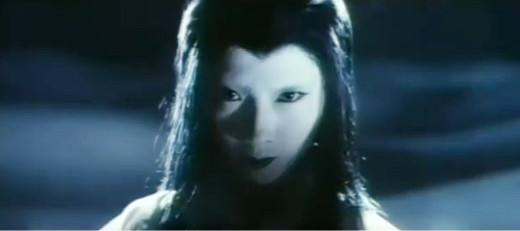
An expanded adaptation of the Yuki-onna short story from the 1904 collection Kwaidan: Stories and Studies of Strange Things by Lafcadio Hearn, The Snow Woman was released in the U.S. — with subtitles — in 1969 under the title Snow Ghost. A similar story also is in the movie Kwaidan.
Director Tokuzo Tanaka directed many of Zatochi movies for Daiei, as well as the films Bad Reputation, The Haunted Castle and the incredible Killer Whale. The script was by Fuji Yahiro.
An old sculptor and his student Yosaku (Akira Ishihama) are carving a statue of a goddess and looking for the perfect tree. As they shelter themselves from the snow, they meet a woman in white who freezes the master but allows his apprentice to live, as long as he never reveals that he saw her. If he does tell anyone about her, she will return to kill him.
Later, Yuki (Shiho Fujimura) comes to live near the apprentice, who waits five years for the tree to dry so that he may sculpt it. He’s dealing with a bailiff who kills the wife of the master sculptor, who reveals that her dying wish is that Yuki marries the young sculptor. The bailiff tries to make Yuki his concubine but she freezes him and all of his men, revealing herself, as the sculptor speaks of the night he met her. She leaves, rather than fulfill her oath to kill him, as she can’t leave their son an orphan.
This story had to have inspired the final story in Tales from the Darkside: The Movie. My favorite part of this movie is how any time the snow woman appears, the movie make an obvious removal from reality in color and brightness. What a gorgeous story.

 B&S About Movies
You must be logged in to post a comment.