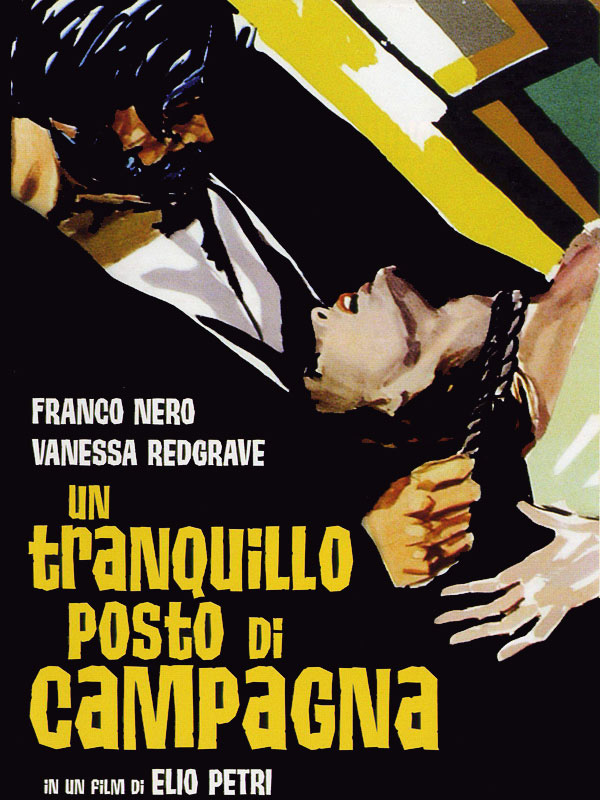
A Quiet Place in the Country (1968)

The 10th VictimWe Still Kill the Old Way. Property Is No Longer a Theft. Todo Modo. Investigation of a Citizen Above Suspicion. Elio Petri made movies that challenged viewers and sadly, he died at 53, an age well too young and one that should have left many years to continue pushing cinema.

Based on The Beckoning Fair One” by Oliver Onions — where do you think the soundtrack team got their name? — A Quiet Place In the Country stands between and yet above so many genre. Is it giallo? Gothic horror? An art film? Comic book trash, as The Boston Globe wrote? Can it be all of those?

Leonardo Ferri (Franco Nero) hasn’t been able to paint for a long time. His girlfriend Flavia (Vanessa Redgrave) keeps pushing him to get back to painting so she can sell his work at her gallery. She rents him a mansion out in the countryside, but he feels lost. Then he notices an abandoned property and moves in, a place once taken care of by Attilio (Georges Géret). He hires a housekeeper, Egle (Rita Calderoni in her first world, not yet entering the psychosexual world of Renato Polselli’s films) and begins to make the place new again.

Yet there are noises everywhere and strange feelings. A shopkeeper tells him that a girl, Wanda (Gabriella Boccardo), died there during World War II, shot by a plane. He keeps seeing a man leave flowers on his property every day. Flavia leaves when the house itself seems to attack her, as a hole opens under her feet and a bookshelf nearly falls on her.

Without her, Leonardo becomes obsessed with Wanda, learning how every man in town was in love with her and every woman hated her. Was she a nymphomanic using everyone? Was she looking for love that she didn’t have anywhere else? Was she using everyone or were they using her? He finally tracks down her mother (Madeleine Damien) to Venice where she lives in a small apartment. Telling her that he’s a journalist, he takes photos of her back to the house.

The person leaving the flowers ends up being Attillo. He tells her that he never cared that she loved anyone else, that they had a secret room where her mother watched them make love through a mirror, that the only time he ever grew jealous was when he watched her be mounted by a German soldier who he killed. She helped him bury the body on that day, the same one she died in the air strike.

Flavia comes back and learns that Leonardo has given up on everything. Even his attempts at romance are too rough and between an electric current that strikes her and being strangled by unseen fingers during a seance, she knows she can no longer stay. As the guests department, Leonardo follows her, stabbing her before tearing her to pieces with a shovel. He also attacks his maid and her boyfriend, using them as part of his art before his mind goes a series of visions in which soldiers force people to paint on the grounds and Atillo reveals that Wanda survived the air attack and he was the one who killed her. As the police come to arrest him, he realizes that Flavia stands in the crowd with the onlookers.

Months — or years? — later, he is confined to a mental institution. All he does is work, finally being able to paint sexualized artwork, living off pornography and chocolate. The orderly takes his work, telling him he needs even more and delivers them to Flavia, who hides from his window. She remarks that she wishes that she had his life, as it looks so relaxing.

This movie made me cry more than once and sometimes from joy and other times from the abject nature of my sadness. Perhaps also the Ennio Morricone score. It’s emotional when a movie works so well, when you realize that this is the only first-time watch that you will ever get. And it strikes a nerve that Franco is looking for someone who was never there, a woman who is perfect because he only sees her in his mind, but every man, even the ones who touched her before, cannot forget her, as her ghost — memories and not supernatural, mind you — will remain burning hot in their memories as they settle for their wives and lives. Is Franco’s character any different than them? Is Flavia not attacked at all by the supernatural but perhaps the one who engineered all of this, a non-horror ending that turns this into the giallo? Did anyone die? Did anyone live?
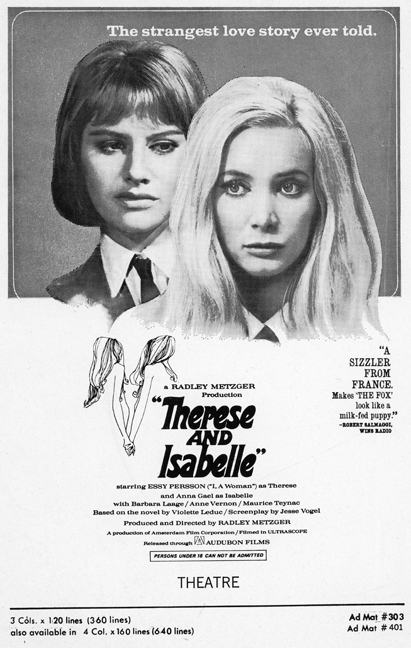
SUPPORTER DAY: Therese and Isabelle (1968)

EDITOR’S NOTE: Today’s movie is brought to you by AC Nicholas, who has graciously become a Big B&S’er, a monthly supporter of the site and got to pick an entire week of movies. Would you like to have me write about the movies of your choice? It’s simple!

  1. Go to our Ko-Fi site and donate. There’s no set amount and I won’t tell you what to do. In fact, if you just keep reading for free, we can still be friends.
  2. Join as a monthly member for just $1. That makes you a Little B&S’er.
  3. As a Medium B&S’er at just $3 a month, if you pick a movie or a director, I’ll write about them for you. In fact, I’ll do one for each month you subscribe and even dedicate the post to you.
  4. For $5 a month, you basically get some major power. As a Big B&S’er, I’ll write an entire week on any subject you’d like. How awesome would that be? In fact, I’ll do it for every month you’re a member. Do you think any of your other movie sites will do that for you?

Radley Metzger made this movie in black and white to, as he told The Rialto Report, “to deliberately align it more closely to classic cinematic love stories of yesteryear rather than the often gaudy sexploitation movies that were de rigueur in the late 1960s.”

Thérèse (Essy Persson, who is also in Metzger’s I, A WomanMission Stardust and Cry of the Banshee) and Isabelle (Anna Gaël, also known as Anna Abigail Thynn, Marchioness of Bath; Ceawlin Thynn, 8th Marquess of Bath; Viscountess Weymouth; the Dowager Marchioness; the Honorable Lady Thynn; as you can tell by her title, Gaël’s life was fascinating, beyond acting in movies like Dracula and Son and Zeta One. According to the introduction to her incredible Rialto Report interview, she spent the 70s married to a “…wealthy British aristocrat, a controversial and scandalous union that started when Anna was just 15, and involved salacious stories of hundreds of lovers, erotic paintings of the Kama Sutra that police deemed to be obscene, one of the most famous English stately homes, and allegations of racism that caused the break-up of a noble family.”) are two young women who fall in love after Thérèse is taken to a boarding school by her remarried mother. The entire story is told in flashback; as it was shot without sound in the style of Italian movies, the dubbed nature of the film adds a dreamlike quality.

Roger Ebert called it “the worst movie of the year” and “another of his traveling stupidity exhibitions, which masquerade as “art films” to get into respectable theaters.”

I don’t know if he saw the same movie that I did, to be honest. I was touched by the loss that Thérèse feels as she walks the halls of her abandoned school, remembering when love was young and the feelings of being with the first person that you love. That’s my than smut or a so-called dirty movie in my eyes.

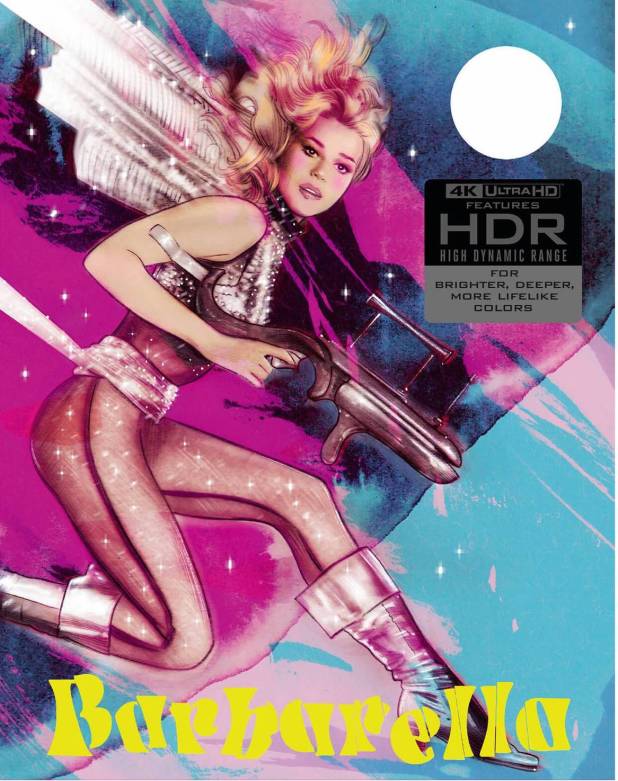
ARROW 4K UHD AND BLU RAY RELEASE: Barbarella (1968)

Shot directly after Mario Bava’s Danger: Diabolik, this Roger Vadim-directed movie is based on the comic book of the same name by Jean-Claude Forest. The film stars Vadim’s then-wife Jane Fonda as Barbarella, a United Earth agent sent to find scientist Durand Durand, who has created a weapon that could destroy humanity.

Vadim was hired to direct this film after producer Dino De Laurentiis purchased the rights. This led to Vadim looking to cast several actresses in the title role, including Virna Lisi, Brigitte Bardot (that’s who the character was originally based on) and Sophia Loren before ending up picking his wife.

In case you’re wondering why this movie is such a mess, Charles B. Griffith was the last writer to work on it, saying that he had done uncredited work on the script after fifteen other writers — including Terry Southern — worked on the movie.

This film is packed with fashion, amazing sets — you can credit Bava’s film for some of that, and great characters, like John Phillip Law (who used the break in shooting to be in the aforementioned Danger: Diabolik) as Pygar the angel, Anita Pallenberg (Performance) as the Black Queen, Milo O’Shea as Durand-Durand, Marcel Marceau in a rare speaking role as Professor Ping, David Hemmings (Deep Red) as Dildano and even cameos from Fabio Testi and Antonio Sabato (who was originally to play the role that Hemmings ended up doing).

So yeah. This is a gorgeous film that makes no sense whatsoever. Is that such a bad thing? I first watched this as a child on HBO and I think when the part came in which the birds tear apart Barbarella’s clothes, my parents decided that it was time for me to go to bed. I was hooked on movies that were seen as being wrong for me to watch and Italian-shot films.

A sequel was planned with producer Robert Evans called Barbarella Goes Down, but it never happened. Nor did a 1990 remake, a Robert Rodriguez idea or a potential project with Nicolas Winding Refn, who moved on to other projects, saying, “…certain things are better left untouched. You don’t need to remake everything.”

The Arrow Video release of Barbarella is, as you always expect, overflowing with features. It starts with a brand new 4K restoration from the original negative by Arrow Films, all inside a reversible sleeve featuring original and newly commissioned artwork by Tula Lotay. It comes with a double-sided fold-out poster featuring the same artwork, six double-sided postcards and an illustrated book with new writing on the movie by Anne Billson, Paul Gravett, Véronique Bergen and Elizabeth Castaldo Lundén, and select archival material.

There’s audio commentary by film critic Tim Lucas, as well as alternative opening and closing credits in 4K with Dolby Vision and the isolated score.

Extras include an appreciation by film critic Glenn Kenny, a two-hour in-depth discussion between film and cultural historians Tim Lucas and Steve Bissette, a feature on the costume designs, an interview with camera operator Roberto Girometti, actor/director Ricky Tognazzi discussing the life and work of his father Ugo Tognazzi, an interview with Fabio Testi, a video essay by Eugenio Ercolani on producer Dino De Laurentiis, a trailer, U.S. TV and radio commercials and an image gallery.

You can get it on 4K UHD or blu ray from MVD.

Spagvemberfest 2023: A Pistol for 100 Coffins (1968)

Also known as El sabor del odio (The Taste of Hate), A Gun for One Hundred Graves and Vengeance, this Italian-Spanish Western was directed by Umberto Lenzi and written by Marco Leto, Vittorio Salerno and Eduardo Manzanos.

Jim Slade (Peter Lee Lawrence) had it rough in the Civil War. He’s a Jehovah’s Witness, so he refused to shoot other soldiers. He’s locked up in a labor camp for cowardice before being pardoned. When he gets home, he finds that his parents are dead.

Jim gets over that whole thing about not killing people pretty quick, taking out three of the four suspects quickly. That’s when he goes after their leader, Texas Corbett (Piero Lulli), which brings him to Galveston. Seconds after he shows up, he meets a preacher by the name of Douglas (John Ireland) and witnesses a bank robbery. He soon learns that Corbett was behind that robbery, so he gets the job of sheriff so he can legally hunt down and kill him.

This feels like an Italian Western mixtape with a weird undertaker (A Fistful of Dollars) and an end battle in a cemetery (Django). Then again, if you get upset with every Italian movie that rips something off, you’re going to be angry your entire life.

My favorite thing about this is that even though Jim is now able to kill people, he only drinks water. Never whiskey.

You can watch this on Tubi.

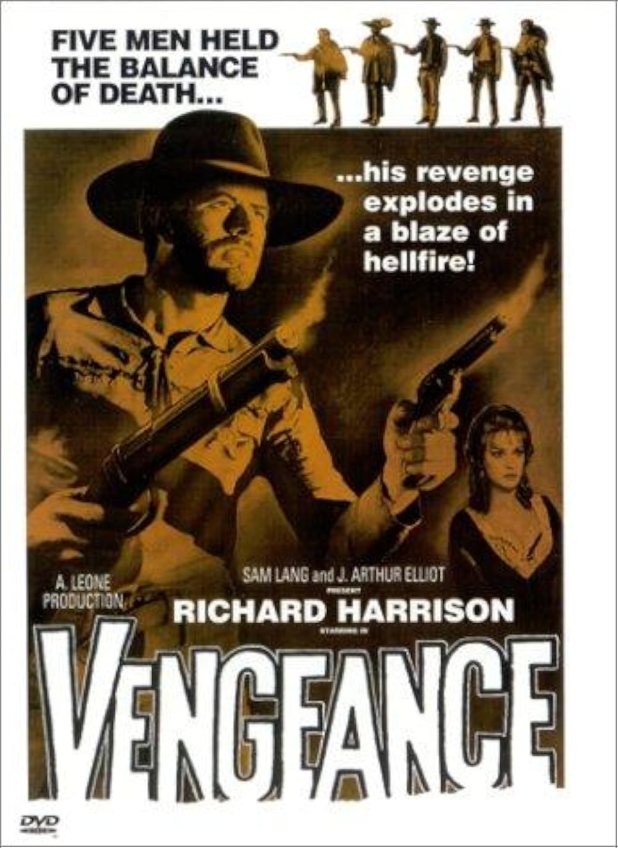
Spagvemberfest 2023: Vengeance (1968)

Jokko Barrat (Richard Harrison, years before he would appear in so many Godfrey Ho movies), Richie (Alberto Dell’Acqua, one of the many undead in Zombi), Domingo (Luciano Pigozzi, who appears in so many movies and always gives me so much joy when he shows up) and Mendoza (Claudio Camaso, the brother of Gian Maria Volonté. Unlike his leftist brother, Claudio was ultra-fascist to the point that he may have planted a bomb at an entrance to Vatican City. He was exonerated, but years later was arrested for strangling a friend to death and then killed himself in jail) have a plan to steal gold from some bandits, but are betrayed by Domingo. Mendoza dies and Ricky is tortured before between torn apart by horses.

Jokko follows the five men and Mendoza, killing them one by one and leaving part of a bloody rope — the same that was used to kill Ricky — all while being followed by a detective (Paolo Gozlino).

As much a gothic horror film as a Western, this was directed and written by Antonio Margheriti. The end even takes place in a mine and feels like its more Italian horror than cowboy epic. I’ve seen some reviews that say that this is a typical Western, but I wonder what movie they were watching.

You can watch this on YouTube.

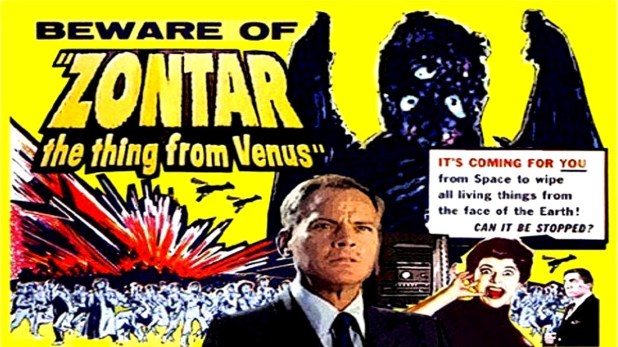
MILL CREEK SCI-FI CLASSICS: Zontar, the Thing from Venus (1967)

Zontar, the Thing from Venus is one of the many remakes of Roger Corman movies — this one is It Conquered the World — directed by Larry Buchanan.

This starts at a dinner party. That’s where NASA scientist Dr. Keith Ritchie (Anthony Huston) reveals to Dr. Curt Taylor (John Agar) that he’s been secretly meeting with an alien from Venus named Zontar who is coming to solve all of Earth’s issues. A dinner party would not seem to be the time to do this.

Zontar ends up being a three-eyed, bat-winged, skeletal black creature and I don’t want to be one of those people that judges people by their outside appearances, but I don’t think Zontar has any intention of making the world a better place.

Not even when Zontar starts possessing people with lobster injecto-pods does Ritchie think this friend is a horrific alien monster. No, it takes his wife Martha (Patricia De Laney) dying before he does something about it. Scientists are really smart and also so dumb.

Don’t have the box set? You can watch this on Tubi.

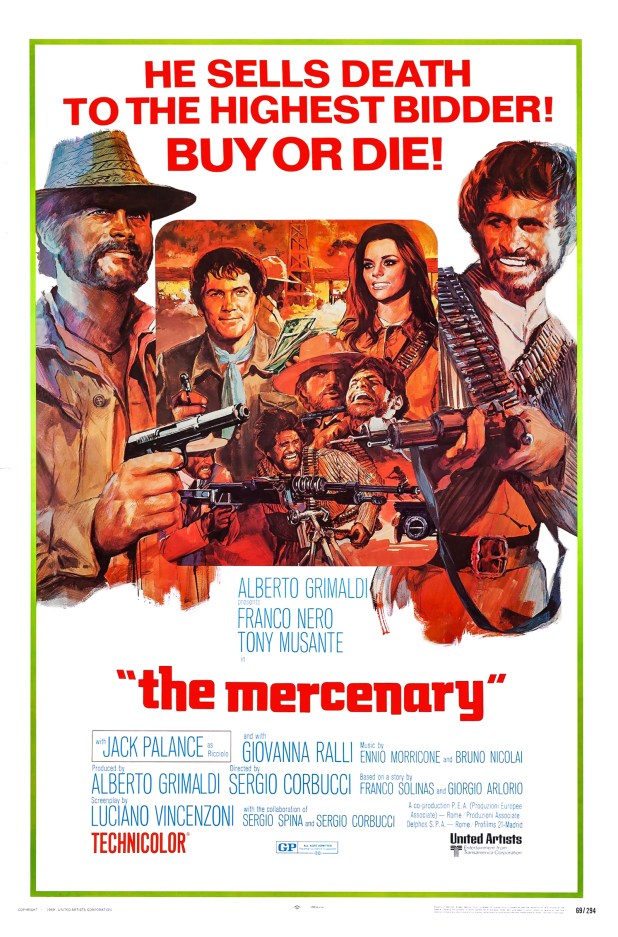
Spagvemberfest 2023: The Mercenary (1968)

As he watches the circus, Sergei “Polack” Kowalski (Franco Nero) thinks that one of the performers is Paco Roman (Tony Musante), which makes him think back to when they were revolutionaries and battled against another mercenary named Curly (Jack Palance).

Much like another Nero character, Django, Kowalski has a gun that gives him a big advantage, a Hotchkiss M1914 machine gun. Paco hires him to teach him how to lead a revolution. They go from town to town, stealing money, horses and weapons, even adding another member to their group, Columbia (Giovanna Ralli, What Have They Done to Your Daughters?).

Yet Paco and Kowalski soon start fighting over how much it costs to have him be part of the revolution. Finally, Paco imprisons him and marries Colombia, but then Curly and his men attack. He tries to free Kowalski, who turns the tables on him and he has to be saved by his wife.

Back to the circus, where Curly and his men attack. Kowalski kills them all and gives each man a bullet for their final duel. Then, he takes Paco to collect the reward only for Colombia to betray them both or so it seems before she and the circus performers create a diversion big enough for our two heroes to use machine guns to kill every one of their enemies. Kowalski suggests to Paco that they should be mercenaries, not understanding the dream of the revolution.

Director Sergio Corbucci set the standard for violence in Italian Westerns in movies like Django and The Great Silence before making comedies. Yes, somehow, the same man who made Super Fuzz made the most depressing Western ever, one that leaves its hero and his lover dead in the snow.

You can watch this on Tubi.

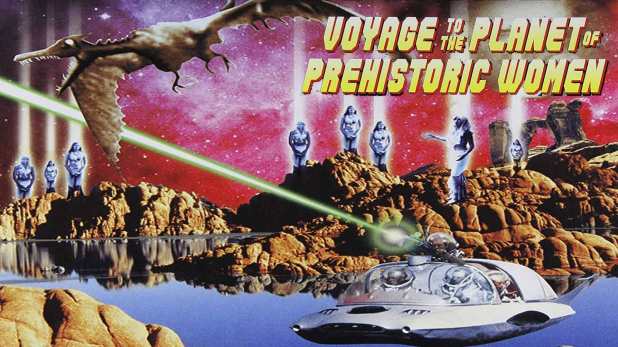
MILL CREEK SCI-FI CLASSICS: Voyage to the Planet of Prehistoric Women (1968)

Roger Corman knows how to get the most out of a movie. He turned the Russian Planeta Bur into both Voyage to the Prehistoric Planet and this movie. The former* has new scenes with Basil Rathbone and Faith Domergue, but the latter has one major reason to watch: Mamie Van Doren.

The pedigree of this movie is pretty wild, because it was adapted by Peter Bogdanovich, who chose not to have his name credited on the final film. And let’s not forget that this all ties back — since Corman loved to recycle what he recycled — into the early Francis Ford Coppola cheapy and Mill Creek box set favorite, Battle Beyond the Sun.

Five male astronauts and their robot John land on Venus and are attacked by a pterodactyl and then an entire culture of women, including Van Doren. Amongst their number are Verba (Mary Marr, who would go on to edit Rolfe Kanefsky’s softcore movies), Twyla (Paige Lee), Meriama (Irene Orton), Wearie (Pam Helton) and Mayaway (Margot Hartman, who in addition to being in this movie, would go on to be the chairman of the board of the First Stamford Corporation, one of the largest privately held commercial real estate companies in the State of Connecticut; she also wrote and starred in Violent MidnightDescendant and The Curse of the Living Corpse).

Bogdonovich was asked by Corman to work on the film, as American-International Pictures wanted some girls in it, so he hired Mamie Van Doren and an entire cast of blondes, then went and filmed them for five days and did the narration.

Despite the fact that this had to be remixed together, you have to love the ending, where the robot left behind becomes the new god of Venus. Spoiler warning for a 52-year-old film…

*Curtis Harrington adapted that movie.

You can watch this on YouTube.

MILL CREEK SCI-FI CLASSICS: King of Kong Island (1968)

I love this movie because I know that it upset people so much. It was titled King of Kong Island and there’s no King Kong, there’s barely an island and it’s so Italian that you know that I was yelling things in pure joy throughout the entire movie. Eva, la Venere selvaggia didn’t even know that in America people expected it to be something it couldn’t be.

Albert Muller (Marc Lawrence, the man who would make Pigs) is putting radios into the heads of gorillas to control them. These apes kidnap Diana (Ursula Davis, An Angel for SatanCrypt of the Vampire) and Burt Dawson (Brad Harris) attempts to save her before being abducted by natives who are led by a white girl because that’s how movies work.

She’s Eva (Esmeralda Barros, God Is My Colt 45) and she doesn’t fall in love with Burt. No, she’s just kind of there. He’s into Diana. I’m also making this sound way more action-filled than it is because it’s packed with long moments of talking yet the beat up print and fuzzy noises that approximate a soundtrack on the Mill Creek box set that I viewed this on made me feel like I was lying in a sleeping bag with my feet under a warm old Zenith TV as a kid and I had no responsibility or anywhere to be.

Director Roberto Mauri also made He Was Called Holy Ghost.

Spagvemberfest 2023 and Arrow Video Savage Guns box set: The Four of the Apocalypse (1975)

Salt Flats, Utah. 1873. Professional gambler Stubby Preston (Fabio Testi, Contraband) is arrested the moment he steps off the stagecoach, thwarting his plans to win money from the town’s casino. It turns out that he’s actually lucky, because the town has become a vigilante mob that burns that den of iniquity to the ground, leaving only Stubby and three other criminals alive: Bunny (Lynne Frederick, Phase IV), a pregnant prostitute, a black man named Bud and the alcoholic Clem (Michael J. Pollard, Bonnie and Clyde).

The four are given safe passage out of town by the sheriff, who gives them a wagon and horses for all of their remaining money and possessions. Soon, they are traveling with a Mexican gunman named Chaco (Tomas Milian, Don’t Torture a Duckling) who saves the group from lawmen, only to torture one of the remaining lawmen in front of the group.

Nevertheless, everyone agrees to take peyote together. The four wake up tied up as Chaco (Milian claims he based his performance on Manson) taunts and beats them, shooting Clem and raping Bunny in front of the entire group.

There have been rumors for decades that Frederick and Testi were having an affair during this film. Testi was dating Ursula Andress at the time, who was incredibly jealous. Some evidence is that even when Frederick’s scenes were all wrapped, the two actors improvised scenes that would include the two of them, including a love scene that has been lost. During the aforementioned rape scene, Milian was so into character and so rough that Testi’s reaction in that scene is real.

The four manage to get the gravely injured Clem onto a makeshift stretcher and follow Chaco and his gang as they kill everything in their path. Finally, they find a ghost town where Clem dies, Bud loses his mind and Stubby and Bunny admit that they love one another — just in time for her to die in childbirth and Stubby to leave her son to a town made up of only men.

Stubby hunts down Chaco, learning that the sheriff set up the events of the entire movie. Enraged, he murders every single person there, leaving Cacho alive so that he can torture him. When Chaco reminds him that he raped Bunny, Stubby shoots him without a word, as he walks into the sunset with only a stray dog as a companion.

Four of the Apocalypse… is influenced by Easy Rider and attempts to offer up a journey of redemption, but you have to understand that Fulci is at the helm. That means that as soon as you have a tender, feel-good moment, you’re going to be given moments of pure gore, like people skinned alive or used for food. Yet there’s also art to be found, thanks to Fulci’s first of ten collaborations with cinematographer Sergio Salvati. It’s also the first time Fulci would work with Fabio Frizzi on the soundtrack. The result is unlike anything you’ve heard in a spaghetti western.

Arrow Video’s Savage Guns box set has high definition 2K restorations of all four films from the original 35mm camera negatives, with El Puro newly restored by Arrow Films. Plus, you get brand new introductions to each film by journalist and critic Fabio Melelli, an illustrated collector’s booklet featuring new writing on the films by author and critic Howard Hughes, a fold-out double-sided poster featuring newly commissioned artwork by Gilles Vranckx and limited edition packaging with reversible sleeves featuring original artwork and a slipcover featuring newly commissioned artwork by Gilles Vranckx.

Four of the Apocalypse has new audio commentary by author and producer Kat Ellinger, an appreciation of the movie by Stephen Thrower, a deep dive into the soundtrack with Lovely Jon Newly, a trailer and an image gallery.

You can get this set from MVD.