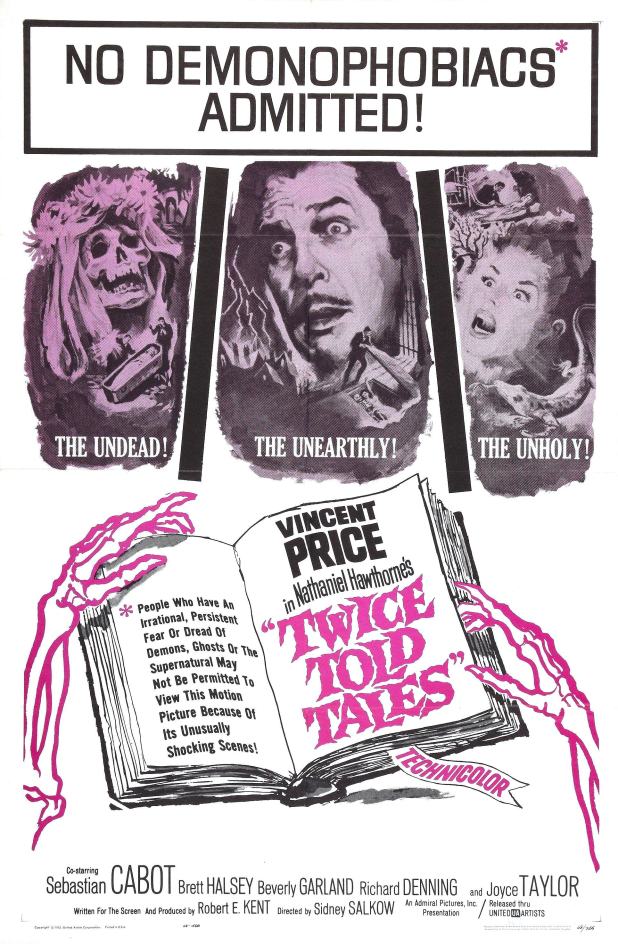
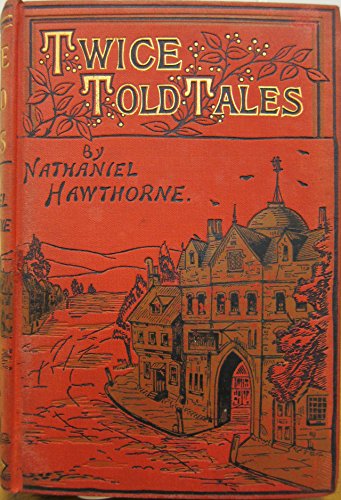
Of the three stories featured in Twice-Told Tales, only one of them — “Dr. Heidegger’s Experiment” — is actually from the Nathaniel Hawthorne book. The other two — “Rappaccini’s Daughter” and The House of the Seven Gables — come from another story and a book the author wrote.
Much like Tales of Terror, all three of these stories feature Vincent Price as narrator and star. It was written and produced by Robert E. Kent, the man who brought Roy Orbison to the screen in The Fastest Guitar Alive. This was directed by Sidney Salkow, who also worked with Price on The Last Man Alive.
In “Dr. Heidegger’s Experiment,” Carl Heidegger (Sebastian Cabot, The Time Machine) and Alex (Price) meet to celebrate Heidegger’s 79th birthday. As they look back on their lives, they learn that Carl has never gotten over the death of his fiancee Sylvia. In a drunken depression, he wanders down to her grave, only to find her perfectly preserved. As he drinks the water that rains down on her coffin, the old man — and then his friend — become young again.
Both of them decide to inject the dead woman with the water and she returns, only to inform Carl that Alex was her lover. The two men clash, only for Alex to die and Sylvia to wither to a skeleton. Alex wanders the crypt, unable to find any more of the water.
While dramatic, this story doesn’t match Hawthrone’s, during which four older people use water that they’ve found from the legendary Fountain of Youth, near Lake Macaco in Florida. It doesn’t end on such a down note either.
“Rappaccini’s Daughter” is the story of a man (Price) who has kept his daughter like a plant in a garden, treating her with the extract of an exotic plant that makes her very touch deadly. Yet what happens when she falls in love with a young man (Brett Halsey!)?
This story inspired the DC Comics character Poison Ivy, while the story itself was based on Indian fairy tales of poisoned maidens. The pop culture life of this story also extends to the Fleetwood Mac song Running through the Garden.”
The last story is “House of the Seven Gables,” which finds a cursed family, reincarnation, an inheritance and skeletal hands emerging to attack Price. The same story had been previously filmed in 1940 and also featured Price (he plays Gerald Pyncheon here; he played Clifford in the original).
The Hawthorne novel was a major inspiration for H. P. Lovecraft, who claimed that it was “New England’s greatest contribution to weird literature.” You can detect the novel’s shadow cast over his stories “The Picture in the House”, “The Shunned House” and The Case of Charles Dexter Ward.
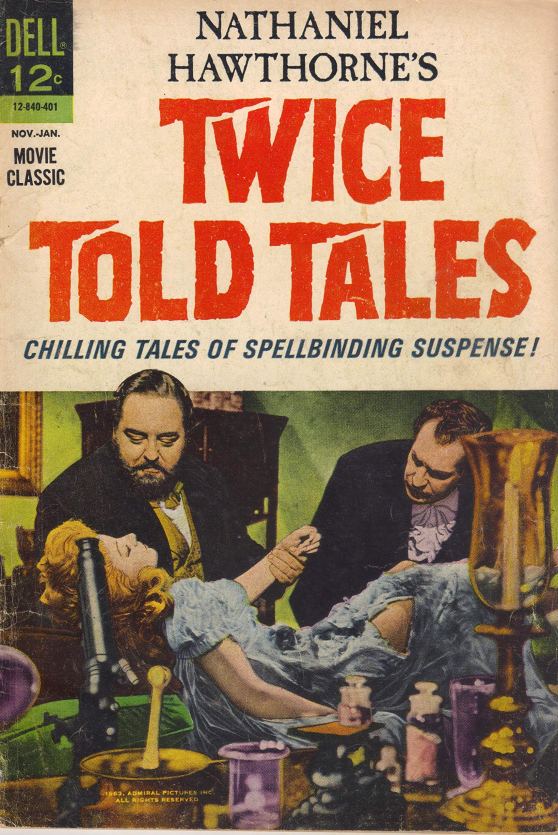
They even made this into a Dell comic book!
If you enjoy anthology horror and Vincent Price, this one’s for you. If you don’t, never speak to me again.
Right before Ron Ormond’s road to Damascus moment, he was making movies like this, which feel like a mondo crossed with a sex ed movie and yet have all of the best things of both genres.
Using his real name Vittorio Di Naro, Ormond directed this film (and wrote it, too). It starts with Vicky (Vicki Caron, her only role; she’s a buxom redhead who seems like someone I would have pined over in my twenties. Who am I lying, if I were single, I’d be putting her through trade school) being assaulted as a teen.
Before we can reflect on what has happened, the movie goes into mondo territory and begins showing us the history of hypnotism, which is really an excuses to show us primitive cultures who still do things like rolling in glass and walking across fire. Yes, this film will have the theme of hypnosis in it, but there’s no reason for this footage and by that, I mean that I love that this footage is in this film.
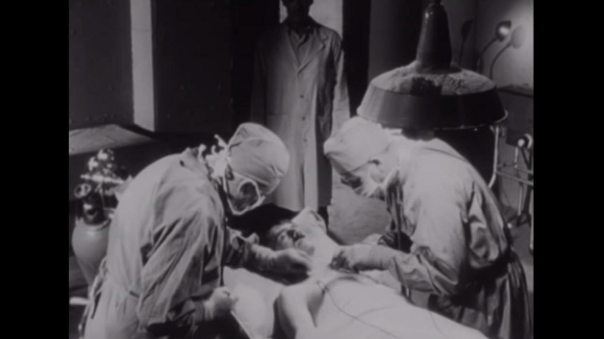
Then, without any warning, we go from a drawing of a man with a one hundred pound plus tumor in his scrotum to watch an actual open heart surgery procedure. Some horror films use Val Lewton’s blueprint for suspense. Ron Ormond just lures you in with the promise that this is a sex movie and then punches you in the stomach with some of the sickest surgical footage possible.
Now, the movie can really begin.
Vicky is supposedly a real person and this story really happened, which is also the kind of thing that I demand in nearly everything I watch. She has some hang-ups because of the aforementioned assault which lead to her never allowing her new husband to touch her. Or maybe it’s because her mother (Ruth Blair, who unfortunately only did this movie) wants her daughter to keep on being her wingwoman.
This all leads Vicky to a therapist named Bill, who is played by Lash La Rue of all people. Yes, the very same cowboy actor who starred in eleven films from 1948 to 1951 in which he dressed all in black and used a bullwhip to stop bad guys. In 1952, Lash’s comic book adventures sold nearly 12 million copies, but a decade later and we have our hero appearing as a kindly doctor instead of a man in black battling bad guys.
La Rue is the perfect person for the Ron Ormond orbit, as he became born again and did church ministry after being a movie star. He also disappeared for most of the 70s, as he took the role of teh villain in the movie Hard on the Trail without realizing that it was an adult movie. To repent, he was a missionary for ten years before showing up in movies like The Dark Power and Alien Outlaw.
Lash appears on the back cover of the Johnny Cash and Waylon Jennings album “Heroes.”
In order to determine exactly why Vickie won’t let her husband near her, he brings in real-life hypnotist Ormond McGill to figure out the answers. At some point in the 50s, Ormond had spent in Asia with McGill in Asia researching and writing the book Religious Mysteries of the Orient/Into the Strange Unknown. They also wrote The Master Method of Hypnosis, The Art of Meditation and The Magical Pendulum of the Orient together; one wonders whether Ron gave it all up once he found God. McGill was such a mentor to Ron that he took his stage name from the man.
Despite the title, this film really does care about its subjects and how Vickie is damaged because of how she feels for her husband but can’t bring herself to care for him sexually. It’s a surprisingly deep topic for when this movie was made (shot in 1959, released in 1963).
There are also musical numbers by the Mulcay Brothers.
This movie plays like a mixtape for the mentally disturbed. I loved every single moment of it.
There’s so much fog in this movie, Lucio Fulci got jealous.
So much fog that the Elizabeth Dane wrecked.
So much fog…
You get it, right?
A bunch of lizard people emerge from under Los Angeles and use their fog machine to invade the city because, well, we nuked them out of their homes. Luckily, Tom Gregory (Robert Hutton, who also directed the movie) joins with a group of survivors to battle the slimy reptiles, who can’t deal with salt or their own spears.
Susan Hart — who would one day marry American-International Pictures president James H. Nicholson and appear in their beach movies — is one of the humans battling the mucky scaly heels.
This entire movie was filmed in the studios of KTLA but ran out of money after nine days. The slime creatures cost most of the money and none of the stuntmen or Hutton got paid. There was also the wild thought to use small people as giant voles who would lead the invasion, but when they watched the footage, it was too silly to use. Just think of that, as this movie is one of the goofiest films ever made. I wish I could watch that footage.
Hutton would go on to write Persecution, which was one of Lana Turner’s last films. It’s just as goofy — maybe more — than this one.
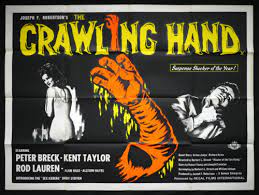
If an astronaut crash lands and says things like, “My hand… makes me do things…. kill…. kill!” At this point, you may say, perhaps this is not lack of oxygen in the astronaut’s helmet but he may really have something wrong with him.
There’s also a medical student named Paul (Rod Lauren was a singer who released the song “If I Had a Girl” before acting; he moved to the Philippines where he married actress Nida Blanca. He became the lead suspect in her death when she was stabbed in a parking garage, then fought extradition back to the country for years before jumping off a hotel room balcony; sorry to bring everyone down with who Paul really was) who finds the astronaut’s hand and well, keeps it. Because that’s what doctors do: keep desiccated hands that they find from space crashes.
Paul starts to use the power of the hand to attack people he dislikes and becomes obsessed with it. The police — led by The Skipper Alan Hale Jr. — try to catch him and the space agency starts to realize that the fingerprints of the dead astronaut are all over the place. So Paul takes the hand to the beach and tries to destroy it and some cats try to eat it, because that’s the kind of movie The Crawling Hand is.
Somehow, writer Rick Moody used this film as inspiration for his novel Four Fingers of Death, the tale of writer Montese Crandall, who attempts to get over the death of his wife by throwing himself into his work and writing a remake of The Crawling Hand.
Director Herbert L. Strock also made Gog and The Devil’s Messenger and one of the co-writers was Joe Cranston, the father of Bryan. None of them noticed that at times, the crawling hand is a left hand a right hand at other times.
ABOUT THE AUTHOR: Mark Rochester’s bio says, “Librarian. Mad about movies, traveling, books and film soundtracks. Perfect night – Watching The Private Life of Sherlock Holmes with Ornella Muti.”
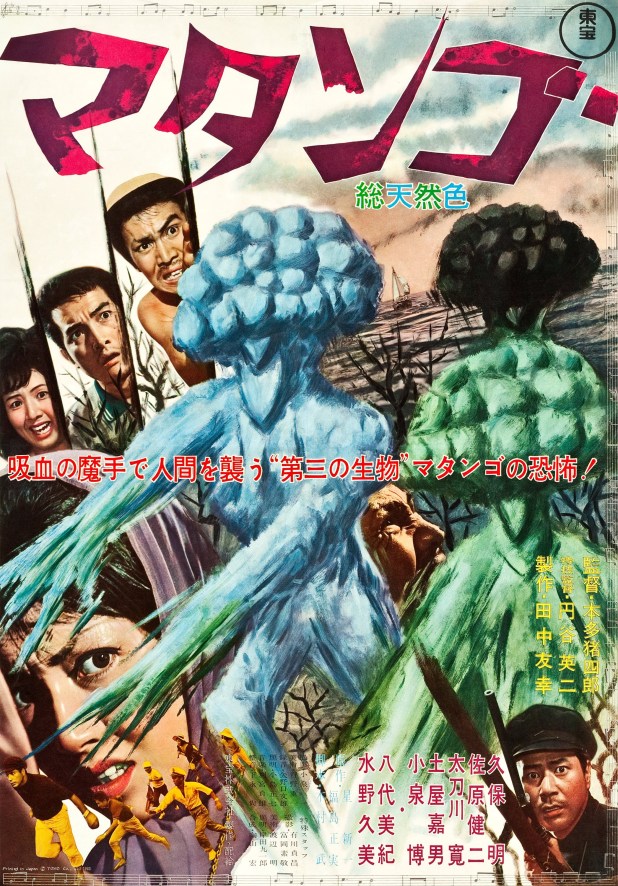
Matango is a Japanese horror flick from Ishiro Honda, director of Godzilla, based on the short story The Voice in the Night by English writer and bodybuilder William Hope Hodgson.
Rumored to be the inspiration for the American sit-com Gilligan’s Island that ran from 1964-67, Matango, also known as Attack of the Mushroom People has people turning into mushrooms on a mysterious island. Sounds great, doesn’t it?
Well, it did to me, anyway, and I was buzzing with anticipation when I settled down to watch it, late at night, with, for effect, a cup of Heinz Mushroom Soup with double croutons. However, twenty minutes into the film and I was having second thoughts – about the film, that is, not those extra croutons. Our small cast, led by Akira Kubo (Son of Godzilla), have not yet got their yacht wrecked on the eerie, deserted island, the setting for most of the film, we have had a strange musical number on board the yacht, and it is all a bit slow and… dull. Even after Kubo and co start exploring the island it is another twenty minutes before we see a mushroom man, creeping about the boat at night, attacking the crew, in what is one of the best moments in the film. Bafflingly, the next morning almost everyone is in denial over seeing anything, and carry on as if nothing has happened. Maybe it was all a dream? Too much sake – or mushrooms?
Much of the rest of the film is spent watching the shipwrecked group struggling to survive on the island, fighting one another, mostly for the attractive Mami, played by Kumi Mizuno (Invasion of Astro-Monster), and slowly starving to death, unable to eat the dangerous mutative Matango mushrooms that seem to grow everywhere on the island lest they morph into “mushroom people.” There are a couple of clunky flashback sequences that pop up as the group looks for food – one is used to squeeze in another musical number, and the other a “risque” dance sequence.
The film is colorful, but rarely atmospheric. The mushroom people effects, though good for the time, are now hopelessly amusing – not a good thing for “horror” movie. But there are some unforgettable moments – like the scenes in the jungle with the exotic-looking mushrooms blooming and mushroom people wobbling about, and the ominous sequence near the start when the crew find another wrecked boat completely covered in fungus. Although this all sounds a bit wacky, and “creature-feature” tacky, Ishiro Honda intended Matango as a serious movie warning of the way the Japanese people were changing after the war, and striving for things that would ultimately change and destroy them. Unfortunately, it is now easy to overlook this subtle message today and see it as a cheap monster movie.
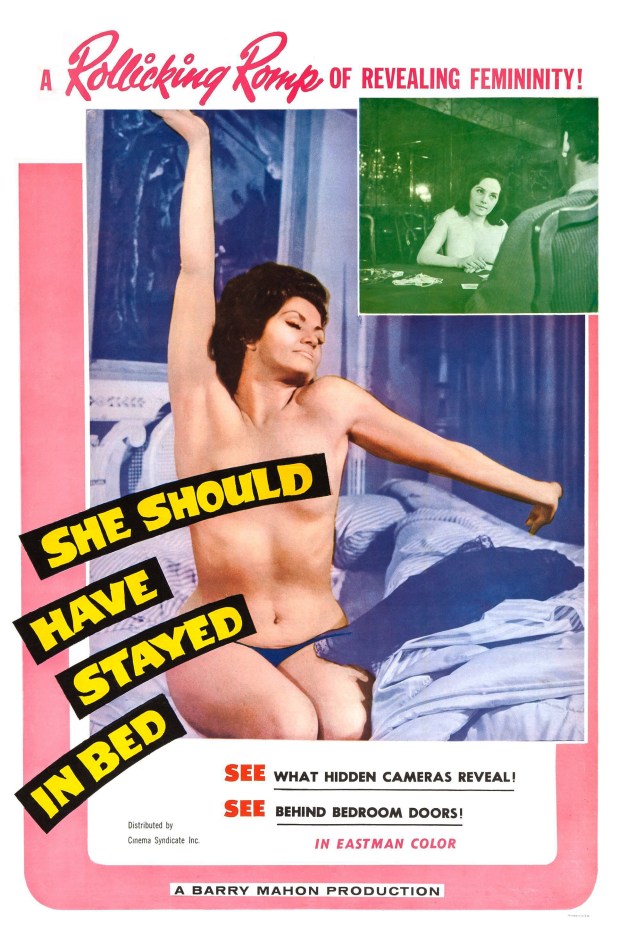
Barry Mahon must have been looking for any story he could shape into a narrative to get nude women into a story by 1963. He made so many movies like this, but this installment has some charm, as some of the guys will do anything to appear to be artists and get the attention of a girl willing to doff her duds.
Monica Davis (Rocket Attack U.S.A.), Jane Day (She Shoulda Stayed In Bed), Davee Decker (It’s All for Sale), Audrey Campbell (Olga herself!) and the Bennett sisters play the ladies in this, a movie that attempts to be a documentary while also making any opportunity to show off these girls.
I saw a modern picture of Chesty Morgan the other day. She looked like someone’s grandmother, a lady you’d see shopping at Walmart. I wonder about so many of the ladies in Mahon’s films who owned their beauty and appeared in these movies. Did their kids ever know? Their husbands? Were their lives better because of the experience?
You gotta give it to Barry Mahon. Not only did he make movies with gorgeous women, he did it alongside his wife, Clelle. She often worked in his script and continuity department, which is pretty funny if you’ve ever seen one of her husband’s movies.
The story itself is pretty simple: a New York-based shutterbug takes nudes of the tenants of an apartment building while waiting for a pin-up model to show up. That photographer is played by Michael Baron, who would go on to produce I, Robot.
This movie had censorship problems in New York and wasn’t released in theaters there. There’s a wild reason why: nudity was allowed if it showed up in everyday activities, which is why so many nudist movies had people playing sports and doing things. This movie just had a guy shooting pictures of women, which isn’t the kind of life most people are used to.
Mahon’s women in this movie were Jane Day, Faith Gilbert and Irene Charles, who all are also in Mahon’s 1,000 Shapes of a Female, which leads me to believe that both films were shot at the same time. Gigi Darlene (Bad Girls Go to Hell) , and Alice Denham (Susie from the Olga series) are also in this.
Can sixty-five minutes of scantily clad women be boring? Watch this movie and find out.
I’m echoing what nearly every article about this movie says, if only because it’s true. The first two minutes of this movie are better than anything that will follow.
We start in a ghost town, where a laughing hooded figure buries a young boy alive. When the kid asks, “Who are you?” the reply is chilling: “You know me, Joey!” and then laughter, as the boy’s shocked face is shown and we see gigantic eyes fill the screen.
Seriously, if that’s all Terrified! was, people would still be talking about it and not just manaics like me.
The titles are so classy — just check out the whole opening at Art of the Title — that even the Crown International Pictures title card comes up as part of the animation and not just thrown out at the start of the movie.
Lew Landers’ last movie — he made The Raven at Universal before a long career that went from film to television — Terrified! is all about a college psychology student studying just how much terror a man can take. Once a killer starts hunting him, he gets first-hand knowledge.
Denver Pyle — years before he was Uncle Jessie — is in this as a lawman. Speaking of lawmen, Ben Frank, who was Inspector Lt. Mankiewicz in Death Wish 2, is in this. So is Barbara Luddy, who was one of the Disney players from 1955 to 1973, with her voice showing up as Lady in Lady and the Tramp, Merryweather in Sleeping Beauty and Rover in One Hundred and One Dalmatians. And oh wow — Robert Towers is here too, someday to be in Masters of the Universe as the strange-looking Skeletor minion Karg!
It’s not horrible, but man, that opening makes you hope for so much more.
Editor’s Note: Thanks to Dustin Fallon from Horror and Sons for this entry. He’s always been a big promoter of our site and has been instrumental when it comes to getting writers for our Mill Creek box set review projects. Dustin wrote this back on November 3, 2019, as part of our Mill Creek Pure Terror Month tribute of reviews. Well, in addition to that 50-film box set, this crazy film is also part of Mill Creek’s Gorehouse Greats 12-pack. This is a great review of seriously goofy film. No way we can re-review it any better than Dustin’s take.
They Saved Hitler’s Brain is a 1968 film directed by David Bradley, who also directed 2 well-known films starring Burt Lancaster, “Peer Gynt” and “Julius Caesar”.
You know what? Strike that last sentence.
The Madmen of Mandoras is a 1963 film from director David Bradley, who also directed 2 well-known films starring Burt Lancaster, “Peer Gynt” and “Julius Caesar”. They Saved Hitler’s Brain is really just the same damned movie, re-titled for television distribution in 1968 and featuring new footage shot specifically for its broadcast re-release.
The new footage, which is essentially an entirely new opening for the film, is a bunch of muddled nonsense that attempts to expand upon the original film’s plot, but in truth adds nothing of value or importance to the film, and actually slows down the film’s pacing. The film opens with a scientist who has been working on a secret government project to create a serum for the deadly chemical weapon known as “G-gas” (which the government fears may be used as a weapon by hostile countries) being blown to bits when he triggers a bomb connected to his car. A government agent, who looks suspiciously like Hall of Fame closer Dennis Eckersley, is assigned to the case.
The opening moments of The Madmen of Mandoras are edited into this new footage through the use of some rather abrupt and jarring transitions, with the difference in film quality immediately apparent. These scenes highlight a military briefing on the lethal “G-Gas”, where it is stated that the antidote must remain well guarded, as its falling into the wrong hands could have dire consequences for the entire world. Of course, this just means that a scientist working on the antidote is soon captured by agents of the surviving Third Reich!
They Saved Hitler’s Brain attempts to add some additional action to its runtime by meshing footage from the original film with the newly created scenes so that it appears that Eckersley and his new female partner are trying to thwart the abduction. However, both agents fail to do so and are killed for their efforts, saving viewers the nightmare of dealing with them any longer. This, in essence, wraps up the “Hilter’s Brain” portion of this review, as well as the newly created portions of the film. Now, forget they ever happened because they are total shit!
As for the real film, The Madmen of Mandoras….
Near the end of WWII, Nazi scientists discover a means of preserving the life of Adolph Hitler into perpetuity, allowing the man to continue his plans for world domination for years to come. Well, at least his severed head is preserved, severed from his body and placed into a small glass tank filled with various “life-sustaining” fluids. A decoy of the Fuhrer is left behind to deceive the Allied forces into believing that the madman had been killed and his plans for domination thwarted. The surviving officers of the Reich, with Hitler’s head in tow, flee to the fictional South American island nation of Mandoras, where they secretly plan their next steps.
Years pass and with the creation of the G-gas weapon, the Nazis have found the key to their resurgence. The only thing standing in their way is the antidote, which counters the gas’s effects, should it ever be released. As such, Nazi agents are sent to America with orders to abduct a certain Professor John Coleman, one of the scientists working on the serum. However, the government of Mandoras is not without knowledge of the Nazi’s schemes and have sent their own agent to prevent the plan from succeeding.
The Mandorian (Is that the correct terminology for the natives of this tiny fictional country?) agent fails and Coleman is taken despite his interference. Also captured are Coleman’s youngest daughter, Suzanne, and her boyfriend, David. The next intended target is Coleman’s son-in-law, Phil Day, who works for US intelligence. Granted, they weren’t intelligent enough to predict an incident such as this, or Coleman would have had some sort of security detail. The Mandorian agent prevents Phil and his wife’s abduction, but is shot and killed in the process. However, as this is a movie, the man is able to disclose the entire elaborate conspiracy to Phil before he expires.
Phil and his wife, Kathy, soon board a flight to Mandoras. Upon landing, the couple are “greeted” by the island nation’s police force, which in this case is just Creature From the Black Lagoon co-star Nestor Paiva and his seemingly slow-witted assistant. The couple are treated as “special guests” of the nation, even though no one should have known that they were visiting, and are shown to the island’s finest hotel. Okay, so it’s the only hotel.
Not long after settling into the hotel room, the Days’ are shocked to find a man sneaking into their room, despite their still being in it at the time. After a brief scuffle, the man is introduced as “Camino”, the twin brother of the Mandorian agent killed in America. Camino discloses that he, like his late brother, are working to stop the Nazi resurgence. He warns the couple that many nefarious eyes are now watching them and that danger can wait around any corner.
Essentially ignoring this warning, Phil and Kathy head out to a small local bar. There, they find Suzanne dancing away to the brass band that is playing. Suzanne informs her sister that the men that kidnapped her were quite friendly, which really doesn’t seem like the actions and behavior of a group known for their acts of genocide. Suzanne is also not aware of David’s whereabouts, but she also doesn’t seem overly concerned either. The good nature of the Nazis is proven untrue when a failed attempt on Phil’s life leaves another man dead and a dancer with a bullet in her side. After the dust has settled, Phil notices that Kathy and Suzanne are no longer in the bar. Making matters worse, Phil is arrested before he can even begin to search for the women.
Phil is escorted to the Mandoras’ presidential palace, which the Nazis have overtaken to use as their new base of operations. Phil is placed into a jail cell, where not only Kathy and Suzanne await, but Professor Coleman as well. David resurfaces, revealing himself to be a Nazi officer who has been involved in the plot for quite some time, brutally bitch-slapping Suzanne when she confronts him. However, the incarceration proves to be brief when Paiva and the nation’s president appear to release the captives, disclosing that they’ve secretly been fighting against the Nazi insurgence.
Hitler’s severed head finally makes its grand entrance, leading his forces as they prepare their bombers for a worldwide G-gas attack. This plan doesn’t get very far though, as Phil, Camino, and the rest of the men launch an all-out assault on the small, single-engine plane that is actually shown. I did mention that this was a low-budget film, right? You won’t be seeing much more than stock footage of bombers. Here, you’ll just get a Cessna.
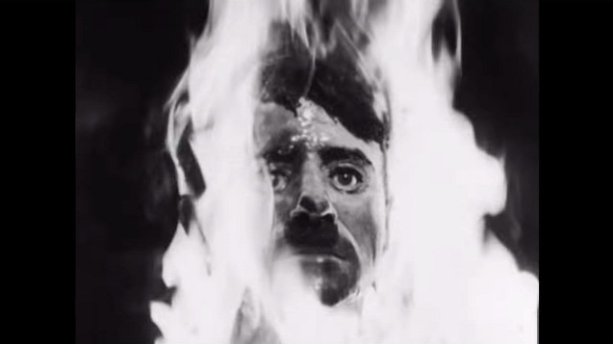
As one might expect, the heroes win, preventing the world from falling into the hands of the Third Reich. What you might not expect, especially from a film of this age, is the grisly closing image of Hitler’s disembodied head, here portrayed by a wax mold, gruesomely melted away by flames. While it is quite evident that the head is indeed wax, it’s still fairly gnarly watching the wax melt away like layers of skin and flesh from the skull-shaped creation. In fact, the scene was deemed disturbing enough to viewers that it had to be (marginally) edited down for the television re-issue.
The Madmen of Mandoras, or They Saved Hitler’s Brain, or whatever you choose to call it is a fun slice of pro-American/anti-Nazi propaganda* layered in a healthy dose of 1940’s/50’s era comics “pulp”, and sprinkled with a pinch of early 60’s pop culture sensibility. It doesn’t require a lot of thought and generally moves at a steady pace, although the footage added to the television re-release does make the first half of the film drag noticeably. The film feels more than a little dated by today’s standards, but still provides some solid entertainment for a rainy weekend afternoon or one of those nights when you’re just not sure why you are even still awake.
Editor’s Note: This review ran back on March 12, 2020, as part of our Explosive Cinema 12-Film Pack blowout. Now, we are having a B-Movie Blast as part of that Mill Creek 50-Film Pack of reviews (Amazon).
I came here to see Jimmy Bryant and the Night Jumpers do the “Tobacco Worm” and the “Stratosphere Boogie” . . . and eat popcorn . . . and drink coffee. Lots of coffee. (They’re sort of a redneck, twaggy bluegrass version of Booker T. and the M.G’s; please telll me that you know the iconic instrumental “Green Onions” and get that reference. Don’t make me feel like the old dude that I am.)
“Yeah, I call B.S on the pseudo-intellectual B&S About Movies writer,” you say. “You never heard of them or the movie, R.D, until Sam bought the Mill Creek “Explosive Cinema” 12-pack.”
Sorry, ye mighty Internet Warrior. You’d be wrong.
Because of my longstanding love of rock ‘n’ roll and movies; slumming, collecting, and working in the vintage vinyl marketplace, doing road work, and working on the radio, I thrive, THRIVE on rock ‘n’ roll movie oddities and obscurities. If a flick has even the slightest cameo by a rock band in it, I’ve tracked down that movie and seen it. Even more so with today’s public domain catchall disc sets. Back before the digital realm, I taped ’em off UHF-TV and have shelves of 6-hour mode recorded VHS tapes packed with these flicks.
The Skydivers is the second of three films written and directed by Coleman Francis, primarily a TV and Drive-In flick bit actor who appeared on episodes of Dragnet who turned up in Russ Meyers’s Motorpsycho! and Beyond the Valley of the Dolls, and had a somewhat larger part in the juvenile deliquent rock ‘n’ roll flick, 1959’s T-Bird Gang, which is just one of the many made in the backwash of 1955’s Rebel Withouta Cause and Blackboard Jungle. (Now I am really missing the old AMC Network’s “American Pop” film series. Tears.) While I have never seen the riffed version, MST3K took The Skydivers to task in the ’80s; perhaps you’ve seen that version.
Skydivers is not, however, a rock ‘n’ roll or juvenile deliquent flick: it’s a bargain basement film noir of the Double Indemity (1944) and The Postman Always Rings Twice (1946) variety. It does not, however, qualify as “explosive cinema” and it is as out-of-place alongside Tony Tulleners’s Scorpion (1986) on the Mill Creek “Explosive Cinema” set as it is seeing me sitting in front of a plate of sushi or inside a Starbucks. So don’t be fooled by the movie’s tagline: “The first feature length motion picture showing the daredevils of the sky who free fall from heights of 20,000 feet with only a ripcord between life and death!” (Insert yawn, here.) “Thrill jumping guys, thrill seeking girls, and daring death with every leap,” indeed.
Anyway, Anthony Cardoza . . . wait, where do I know that name from . . . holy B&S About Movies, BatSam! Tony starred in Ed Wood’s Night of the Ghouls and directed Alvy Moore (The Witchmaker) from TV’s Green Acres in Smokey and the Hotwire Gang. He’s produced, as Sam has called out, “interesting films” (aka, turkeys), such as The Beast of Yucca Flats (directed by Coleman Francis) and Bigfoot. (Coleman’s other directing efffort was 1966’s Night Train to Mundo Five, produced by, you guessed it. . . .)
Anyway, Tony-boy is the producer behind this vanity project as part of a unhappily married couple who owns a decrepit airfield-skydiving school in the middle of nowhere New Mexico. Of course, Harry is the loser-dickhead who dragged his wife Beth (don’t be confused; actress Kevin Casey, in her only role, is a “she”) out into the desert—and he’s the one who’s restless and cheats on her. And the woman, Suzy, he’s cheating with is a femme fatale (Marcia Knight, Mako: The Jaws of Death) who’s had enough, so she seduces another guy to kill him. But wait, the wife is restless as well and she’s having an affair with her husband’s army buddy.
And they plot against each other. And they jump out of planes. And they sit in coffee houses and listen to a couple tunes from Jimmy Bryant and the Night Jumpers—who are the only reason to check out this mess.
And they’re the only reason I know this movie exists. And now: you know it exists. Email your disdain to the fine folks at Eide’s Entertainment in Pittsburgh for carrying that cursed copy of the Mill Creek “Explosive Cinema” set and selling it to Sam (we love you, guys!).
You can watch TV-taped VHS rips on You Tube without the riffing, but I think you’ll need the MST3K riffed version to make it thought.
That, and a nice, strong pot of coffee. Stratosphere Boogie, babydoll!







 B&S About Movies
You must be logged in to post a comment.