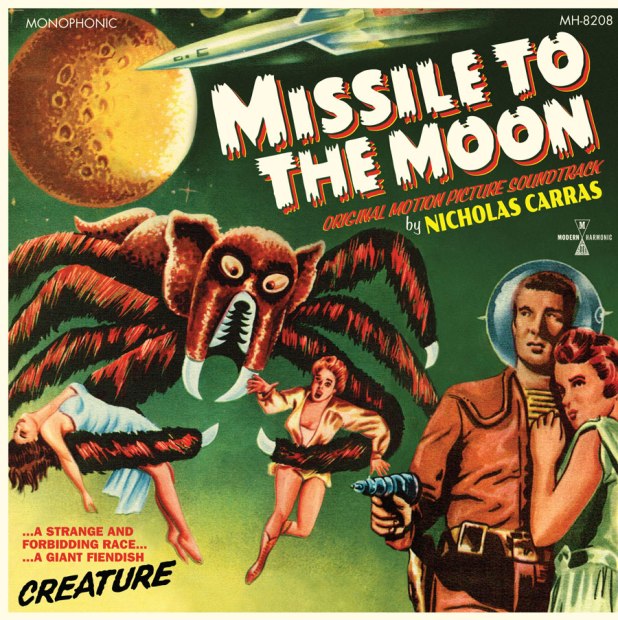
REPOST: Missile to the Moon (1958)

EDITOR’S NOTE: We already posted this one, way back on March 3, 2020. That said, if you’re going to do a week of movies all about evil women taking over the Earth, you have to include this one, right?

Have you already watched this movie? Well, maybe.

Missile to the Moon is an even lower-budget remake — is that possible? — of the low-budget film 1953 film Cat-Women of the Moon.

That movie had 3D going for it, but this one has much younger men in the heroic roles and an army of international beauty contest winners playing the moon maidens. But the dreaded moon spider? Yep. That’s the very same prop from the original film. It was originally built for the movie Tarantula, so here’s to Hollywood for being green years before anyone knew what recycling was.

This film was shot in the Vasquez Rocks, where all cheap films decide to show what the moon or an alien planet looks like. A red gel over the lens of the camera was the attempt to make the sky look different, yet no science was given to the script. How do people explode into flames when there’s no oxygen, after all?

Anyways, two escaped convicts named Gary (Tommy Cook, who is also in High School Hellcats and would go on to write and produce Rollercoaster) and Lon (Gary Clarke, TV’s The Virginian) stowaway on a rocketship that Dirk Green is piloting back to his home satellite, the moon. He’s soon killed by a meteor storm, of course.

Also on board are hunky Steve Dayton and his fiancee June (Cathy Downs, The Amazing Colossal Man), who obviously had no idea what they were getting into. They all soon find themselves up against an underground empire of gorgeous moon women and their evil ruler, Lido (K. T. Stevens, who also shows up in They’re Playing With Fire).

Rock men. Giant spiders. Nina Bara, who was on TV’s Space Patrol. Leslie Parrish, who would go on to pretty much invent C-SPAN and remains an environmental activist. Laurie Mitchell, who plays a very similar role in Queen of Outer Space opposite Zsa Zsa Gabor. Marianne Gaba, the Playboy Playmate of the Month for September 1959, who also plays a robot in Dr. Goldfoot and the Bikini Machine. These are the menaces and maidens that our convicts must face on…the moon!

This was directed by Richard E. Cunha, whose Frankenstein’s Daughter made the other half of the double bill that this movie appeared on. It was written by H.E. Barrie, who was also behind She Demons and Girl in Room 13 (two other Cunha films), and Vincent Fotre, who wrote Baron Blood.

I have a weakness for movies where female societies have taken over the moon. I blame, of course, Amazon Women on the Moon.

You can watch this on Amazon Prime and Tubi. There’s also two different Rifftrax versions: One has Mike Nelson and Fred Willard (Amazon Prime and Tubi) and the other has the original crew (Tubi).
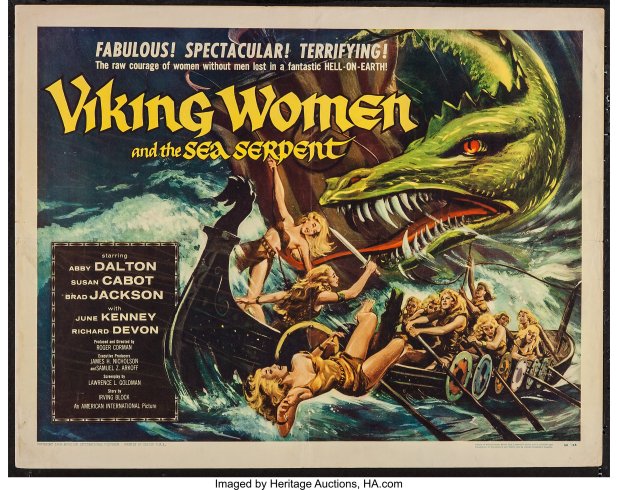
The Saga of the Viking Women and Their Voyage to the Waters of the Great Sea Serpent (1958)

Released on a double bill with The Astonishing She-Monster, this Roger Corman-directed epic was the result of a pitch by a special effects company, believe it or not.

Corman was approached by special effects experts Irving Block (who wrote Forbidden Planet) and Jack Rabin (whose credits include everything from the effects for The Night of the Hunter to Humanoids from the DeepThe NorsemanDeathsport and the TV pilot for The Adventures of Superpup), with the duo making an oral presentation that won him over. Block and Rabin agreed to work for a small fee in exchange for a cut of the profits, with American-International Pictures putting up the financing.

With 1958’s The Vikings in theaters, Corman wanted to get this one out fast and cash in. That said, it was a lot of work, with nearly seventy camera set-ups a day. And the shooting was dangerous, too, with actors nearly drowning, almost riding horses off the cliffs of Bronson’s Canyon and getting hurt.

In the article “Wasps! Vikings! Sea Serpents!” in Fangoria 52, actor Richard Devon said that Viking Women was “a disastrous film to work on. It was as if Roger was really trying to shorten his skimpy shooting schedules even more than before. He didn’t waste a frame. Nor did he spare anyone’s feelings on the set. He was an absolute demon.”

It’s the tale of the Viking women — of course — who head out to rescue their missing men, led by Desir (Abby Dalton, Rock All Night; she replaced Kipp Hamilton*, who held out for more money).

Their husbands, brothers and sons have been taken by Stark (Devon) of the Grimaults and made to work in the mines. There’s also the matter of dealing with a sea serpent, which is dealt with thanks to the heroic sacrifice of Vedric (Brad Jackson, once billed as “The World’s Youngest Magician” whose career faded due to his obsession with reincarnation and the occult).

Also appearing are Susan Cabot (who was in plenty of Corman’s films, such as The Wasp Woman and War of the Satellites), June Kenney (the good girl gone bad in movies such as Sorority Girl and Teenage Doll), Betsy Jones-Moreland (who in one Corman movie literally played the Last Woman on Earth), Pittsburgh native Jonathan Haze (The Little Shop of Horrors), Playboy February 1957 Playmate of the Month Sally Todd (Frankenstein’s Daughter) and Gary Conway (who was on TV’s Lands of the Giants). Also, if you liked the dogs in Teenage Cave Man, they’re in this movie too.

In his book, How I Made a Hundred Movies in Hollywood and Never Lost a Dime, Corman would confess that he learned “an important lesson from this movie: don’t fall for a sophisticated sales job about elaborate special effects.”

He went on to say, “I realized I had been had. (Block and Rabin) had simply promised something they could not deliver. A great sales pitch had distorted my judgment and AIPs.”

*Kipp is, of course, the singer who performs “The Words Get Stuck in My Throat” in War of the Gargantuas, a former Miss Optometry and the sister-in-law of Carol Burnett.

You can watch this on Tubi.

The Wild Women of Wongo (1958)

One of only two movies that James L. Wolcott would direct — the other is a compilation film called The Best of Laurel and Hardy — this is one odd duck. It also features scenes that were, believe it or not, directed by his friend Tennessee Williams, who was on set and thought it’d be fun to try.

It’s shot inside Coral Castle, an oolite limestone structure that was built by one man, Edward Leedskalnin, who either used ley lines or reverse magnetism to move and carve numerous stones — all by himself — with several weighing multiple tons. Other movies shot there include Nude on the Moon and La Furia de Los Karatecas.

Mother Nature herself explains to us an experiment that she created with Father Time. On the island of Wongo, they made two tribes, the ugly and violent men and the gorgeous women. On the island of Goona, they did the exact opposite.

Now, the four tribes have come into contact with one another, as the brutish apes of Wongo have attacked the attractive men of Goona. That tribe sends their king’s son to seek help and he discovers the attractive women, who suddenly realize that they no longer have to settle for the grotesque men that their mothers and grandmothers once did.

Going against tradition has its downside, as the crocodile god of the people — played by stock footage — grows angry and demands their deaths. They rebel, defeat their opressors and make their way to Goona, just as the good looking men of the tribe are engaging in the ritual where they must survive weaponless in the jungle. The women easily defeat them and take them for husbands while the less good looking races find one another too.

The women of Wongo are played by Marie Goodhart, Michelle Lamarck, Val Phillips, Jo Elaine Wagner, Adrienne Bourbeau (not Adrienne Barbeau, who would have been 12 when this was filmed), Joyce Nizzari (Playboy Playmate of the Month for December 1958, who was photographed by Bunny Yeager and would serve as one of Hugh Hefner’s personal assistants in the 1990’s), Jean Hawkshaw, Mary Ane Webb and Candé Gerrard.

The women of Goona were played by Barbara Lee Babbitt, Bernadette, Elaine Krasher, Lillian Melek (Pagan Island), Iris Rautenberg and Roberta Wagner.

If you want to learn more about them — and this slice of strangeness — I recommend the Women of Wongo page.

I’m trying to think of what message that this is all trying to send and how it ties into our week of female-based societies when it really seems that this movie is all about outward appearance. It does have a talking parrot and lots of alligator wrestling, so it has that going for it.

You can watch this on YouTube.

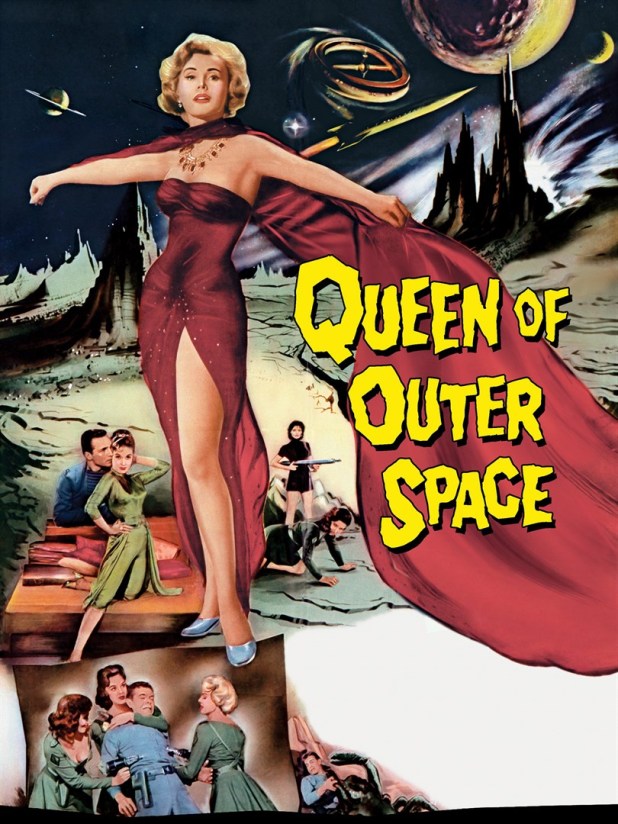
Queen of Outer Space (1958)

It’s amazing just how much Amazon Women on the Moon got the parody of this movie right, all the way down to the uniforms.

What’s even more astounding is that this movie was written by Charles Beaumont, who wrote “Number Twelve Looks a Lot Like You” for the Twilight Zone, as well as 7 Faces of Dr. Lao, The Intruder and one of my favorite movies of all time, The Masque of the Red Death.

Oh man, this movie.

Edward Bernds is mostly known for Three Stooges and Bowery Boys shorts, but he also made Return of the FlyHigh School Hellcats and Reform School Girl, which are three movies that I absolutely love. He was hired by producer Walter Wanger, who had just got out of prison for shooting agent Jennings Lang when he caught him making time with his wife Joan Bennett.

Exiled to Allied Artists, he bought this movie, which wasn’t made for a decade and by which time others at the studio were looking for properties that had already been paid for. Throw in some recycling of Abbott and Costello Go to Mars, Cat-Women of the Moon and Fire Maidens from Outer Space, as well as actual recycling — Queen of Outer Space uses sets and ships from World Without End, footage from Flight to Mars, another ship from the Bowery Boys movie Paris Playboy and costumes from Forbidden Planet— and you have a movie.

The far-flung future world of 1985 is when Captain Patterson (Eric Fleming, Rawhide) and his crew of Lt. Mike Cruze (Dave Willock, What Ever Happened to Baby Jane?), Lt. Larry Turner (Patrick Waltz, The Silencers) and Professor Konrad (Paul Birch, Day the World Ended) are attacked by a laser beam that crashes their ship on Venus, where they run afoul of Queen Yllana (Laurie Mitchell, who is also in the very similar Missile to the Moon). This masked matriarch presides over a society of all women, having killed all men after her face was scarred ten years ago. Well, not all the men — some of the scientists have been kept on a prison colony on one of the planet’s moons*.

Luckily, the all-white crew of JR “Bob” Dobbs lookalikes is helped by Talleah (Zsa Zsa Gabor, perfectly cast as the only Hungarian beauty queen in space) and her female comrades Motiya (Lisa Davis, the voice of Anita, the female owner of the 101 Dalmatians), Kaeel (The Monster That Challenged The World) and Odeena (Marilyn Buferd, the only actress I can think of who was in Les Belles de nuit and won Miss America and was also in The Unearthly).

For all my attempts at assembling a week of movies about matriarchies, Talleah and her friends long for the love of men, which means that this women-run planet cannot survive. It all falls apart when the queen decides to destroy Earth and the disintegrator backfires, killing her and putting Talleah in power.

Even though their ship is fixed, Earth’s leaders demand that they remain on Venus for a year, which is exactly what they wanted anyway. Everyone begins to embrace and hug one another and…well, let’s leave it up to your imagination.

You know who wasn’t happy? One of the crew left behind his girlfriend, who was played by Joi Lansing (Hillbillys in a Haunted House, Bigfoot).

The strangest thing about this movie, however, is that it predates Star Trek by eight years and the uniforms that the queen’s guard wear are in the same red, blue and gold colors.

*Strange, because Venus has no moon.

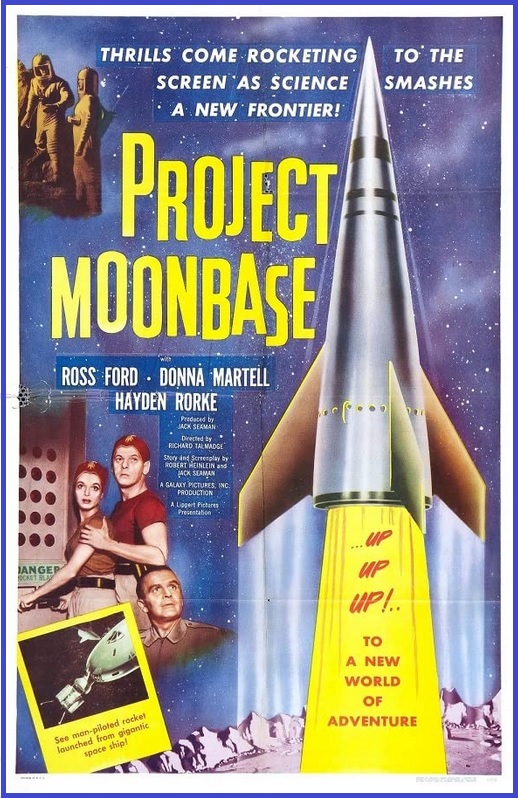
Project Moonbase (1958)

“In 1948, the Secretary of Defense proposed that the United States build a space station as a military guardian of the sky.”
— From the film, according to the words of James Forrestal, the First Secretary of Defense, under President Harry Truman

“Today, I’m thrilled to sign a new order taking the next step to create the United States Space Force.”
— President Donald J. Trump, February 2019

Yep, that’s Hayden “Dr. Bellows” Rorke from I Dream of Jeannie.

Robert A. Heinlein, the “dean of science fiction writers,” may have penned the short story and adapted-to-screenplay, and ex-Douglas Fairbanks stuntman-turned actor Richard Talmadge may have come to second-unit direct on the classics Casino Royale, How the West Was Won, and The Greatest Story Ever Told, but they’re either two of Hollywood’s most blatant sexists or producer (on his final film) Jack Seaman creatively-overruled the production. Or studio chief Robert Lippert — whose Lippert Pictures gave us the superior Rocketship X-M (1950) (that Hollywood has been trying to remake for years) — saw Heinlein’s future world of women running space stations and moon bases as poppycock. The Bechtel Test scene-failures of Generals threatening over-the-knee spankings to female officers, mansplaining spaceflight to a female gossip columnist (instead of Hedda Hopper, we get the offensive Polly Prattles . . . women “prattle,” ha-ha), and offhand commenting on Ms. Praddle’s wide girth, that “it costs the government $300-a-pound to send anything into space and everything must weigh under 150 pounds” must be heard to believed. And the insulted women just role their eyes and chuckle at the “jokes.”

Women in space as pilots is bad enough, but running the mission! Why . . THIS IS AN OUTRAGE!

Yeah, Dalton Trumbo didn’t write this . . . and Colonel Briteis is more Wilma Deering than Ripley. And when you see the Col. (called “a nice kid” as her last name is mispronounced as “bright eyes” by superiors) clad in those shorty-short camping cargos, tights, and ballet flats — and a space tee-shirt cut to accentuate the breasts — you’ll know what I mean by more “Deering than Ripley.” And dig those headpieces: is this where Alfonzo Brescia got his costuming ideas for his Italian “Pasta Wars” oeuvre? (Shameless plugging of our “Drive-In Friday: Pasta Wars with Alfonzo Brescia” featurette.)

So goes the future-history of 1970: a world where the era of #MeToo was not yet foretold; a future were the “Enemies of Freedom” plot their the moon base mission foil with an Ed Woodian oscillator, a short-wave radio, and an office intercom plopped on a wooden desk à la Plan Nine from Outer Space.

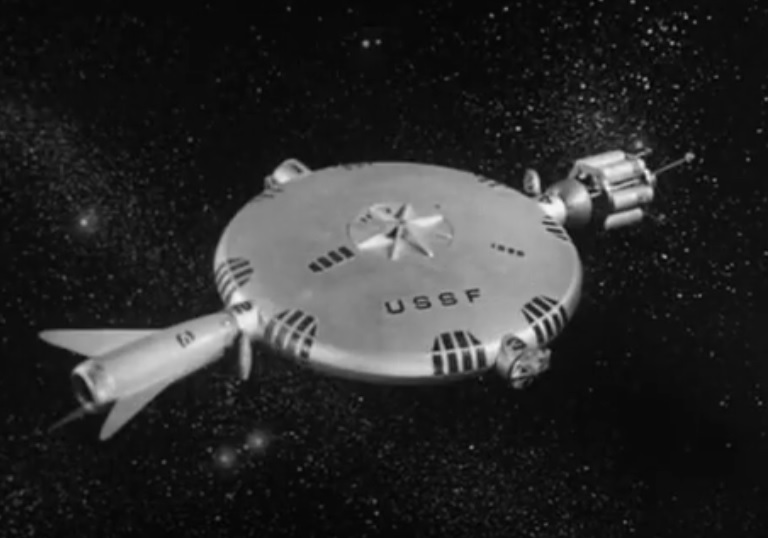
It helps when the U.S Air Force — who ran space before NASA — lends you their concept models.

“You need any help?”
“Can I strap you in?”

— Maj. Bill Moore exhibiting more chauvinistic chivalry to the female Colonel “Bright Eyes” ready to climb aboard and strap into the rocket

While Heinlein’s pen changes up the space opera tomfoolery from the usual intelligent-but-weak female Bechtel Test boondoggles of The Angry Red Planet, Gog, and King Dinosaur — by giving us a female U.S. President and moon base commander — the “women are equal” subtext is lost in space against all of the condescending male-nationalism. Oh, did we mention the orders for Maj. Bill Moore to propose marriage to Colonel Briteis — and be the first marriage on the moon — are preformed by our Madame President of the United States? And while that flip of the script gives Project Moonbase the distinction as the first onscreen portrayal of a female president, Madame is also a female president complicit in matrimonial servitude.

Ad astra per aspera, my dear galactic concubine. May your hardships and adversity, be light.

However, even with its sexist dialog faux pas and the MST3K ribbings, aside: Once we get into space, Project Moonbase is a fascinating watch, with those official U.S. Air Force models, along with split-screen photography of astronauts walking upside down in corridors and sitting in chairs on walls, and shuffling along in magnetic boots (more like Robin “The Boy Wonder” rejects) — all before Kubrick came up with the idea. And, if you’re a junk cinema fan, you’ll notice the set and costume similarities with the also-slagged Cat-Women of the Moon (also released in 1953; but a day apart from each other via different distributors). And bash that alien-women-rule-the-moon romp as you may, but, courtesy of decent against-the-budget set designs, its a not-as-bad-as your MST3K-led to believe.

You can watch Project Moonbase — unriffed — on You Tube.

About the Author: You can learn more about the writings of R.D Francis on Facebook. He also writes for B&S About Movies.

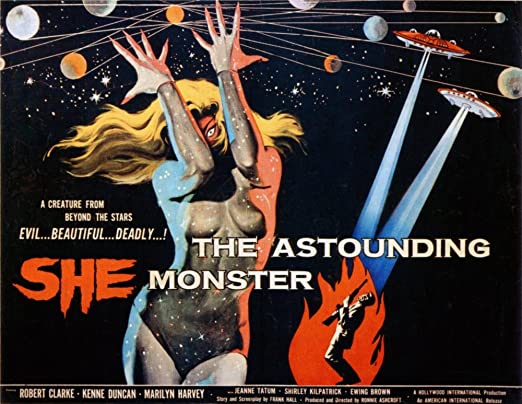
The Astounding She-Monster (1958)

Released as part of a double feature with Roger Corman’s The Saga of the Viking Women and Their Voyage to the Waters of the Great Sea Serpent — also covered this week — American-International Pictures’ The Astonishing She-Monster is all about what happens when a gang kidnaps a rich heiress and just happens to run into an alien woman who emerges from a meteorite. You know, everyday stuff.

Nat Burdell (Kenne Duncan, the “Meanest Man In the Movies”), Esther Malone (Jeanne Tatum, The Ghost of Dragstrip Hollow) and Brad Conley (Ewing Miles Brown, who produced Blood From Dracula’s Castle) kidnap wealthy society girl Margaret Chaffee (Marilyn Harvey, who appears as Dr. Sapirstein’s receptionist in Rosemary’s Baby) and hide out to wait for the ransom to come rolling in.

Meanwhile, a geologist named Dick Cutler (Robert Clarke, The Hideous Sun Demon) watches a meteor land in the forest. He misses the fact that a glowing blonde in a skintight leotard — that ripped during filming — which is why she backs out of every room instead of turning around — has emerged and that she can kill with just a touch.

So, in an amazing coincidence, the gangsters end up in Cutler’s cabin. One of them chases after the alien woman, who quickly dispatches him with radiation before taking out the other gangsters one by one.

Only Cutler and Chafee remain, but he’s one of those 1950’s scientists that can come up with a solution no matter what. He someone deduces that the alien’s body is made up of radium and platinum, which he uses to come up with the perfect acid solution that instantly disintegrates her.

The jokes on him, as she was holding an invitation from the Master of the Council of Planets of the Galaxy for Earth to join the Council. Only now do they realize that she only killed in self-defense and their actions may have doomed our world.

Ronnie Ashcroft directed this, but he had help. Yes, he brought along Edward D. Wood, Jr. who wanted to title this movie Naked Invader. While it was originally planned as a $50,000 production with a seven-day shooting schedule, the final product only cost $18,000 to make and was sold to AIP for $60,000. Most of the actors were paid $500 a week and several actually made decent residuals as it played for at least four years in theaters and drive-ins. So it’s not a great movie, but it is a happy story, right?

As for how it ties in to our week, it promises you an alien femme fatale, but really only delivers a mute alien in high heels and a skintight outfit killing men. Actually, I’m all for that, when you put it that way.

You can watch this on Tubi.

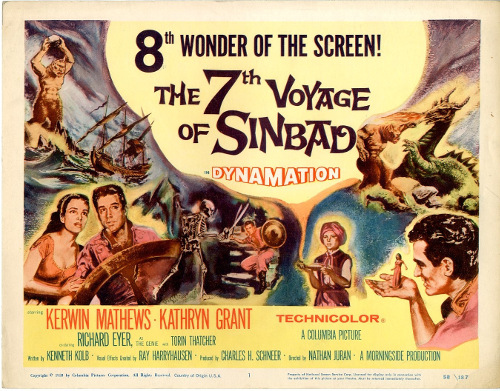
The 7th Voyage of Sinbad (1958)

Have movies ever been as good before or since this one?

Nope. They haven’t.

The first of three Columbia Sinbad films, all boast the genius of Ray Harryhausen and his Dynamation stop-motion magic.

As we meet Sinbad and his crew, they’re helping a magician escape a towering cyclops. Things don’t get any easier — or less exciting — for them for the next 88 minutes.

Our hero (Kerwin Matthews) has the goal of marrying Princess Parisa (Kathryn Crosby) to bring peace between her father’s kingdom of Chandra and his homeland of Baghdad. But during the festivities, the sorcerer Sinbad saved portends of dark times to come and a war between Baghdad and Chandra. Unless he returns to Colossa, all is doomed. No one listens, so he shrinks Parisa, which means that Sinbad must go to Colossa to find the egg of a Roc, the only thing that can restore her.

What follows is an adventure packed with a dragon, a mutinous crew of criminals, a sword battle with a skeleton and a second and even more vicious cyclops.

Director Nathan Juran had already worked with Harryhausen on 20 Million Miles to Earth. The creature in that movie, the Ymir, had its model reused to create the cyclops in this film.

This is the kind of movie that’s ideal for a lazy and rainy Saturday. It’s filled with imagination and moves so quickly that you nearly want to watch it again the moment it wraps up.


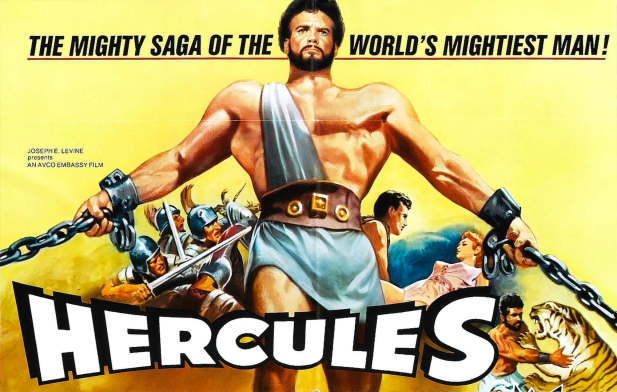
Hercules (1958)

Joseph E. Levine was a genius. At the time of his death, he’s produced nearly 500 films. He did some pretty amazing things, like introduce the U.S. to Sophia Loren and Godzilla, while bringing foreign movies like Jack the Ripper and Attila: Scourge of God to America, renaming The Second Best Secret Agent in the Whole Wide World to Licensed to Kill and producing and executive producing everything from Santa Claus Conquers the Martians and The Graduate to Mad Monster PartyThey Call Me TrinityMagicThe Carpetbaggers and The Producers. He started the Embassy in AVCO Embassy.

But for the purposes of this story, he was the man who spent $1 million dollars* to make Steve Reeves a star all over the world with this movie. And by the time he did it, Reeves had already made four more movies ready to follow this one.

Unlike many actors who go to Italy to make a film, the former chiropractor and Mr. America of 1947, Mr. World of 1948 and Mr. Universe of 1950 became a huge deal over in Italy, ending his career on his own terms in 1968 after the western A Long Ride from Hell, which has the incredible alternate title I Live For Your Death!**

Funny enough, this is more the story of Jason and the Argonauts, yet with Hercules taking center stage. And from this movie, an entire industry of peblum movies was born.

Hercules joins the crew of Jason, along with Ulysses and his father Laertes, Argos, the twins Castor and Pollux, Orpheus and Aesculapius when Pelias, the King of Iolcus, sends Jason on a fool’s errand to take the Golden Fleece. That’s because Pelias has been warned that someday, Jason would take his throne. Meanwhile, Hercules is in love with the king’s daughter Princess Iole. Who can blame him? She’s played by Sylvia Koscina, who is also in Deadlier Than the Male and So Sweet, So Dead***.

Hercules battles ape men and Amazons when he isn’t fulfilling his labors, like fighting the Nemean Lion and the Cretan Bull. There’s even a dragon with the voice of Godzilla, which makes sense, as Levine owned the rights to that sound effect.

By the mid-60’s, 10% of all Italian films were sword and sandal movies. That’s how influential this one is. And speaking of importance to Italian film, the cinematographer for this movie suggested that Reeves grow a beard. His name? Mario Bava.

*Levine spent more money promoting this movie than it cost to make. He was ahead of his time, if today’s movies are any indication. He also introduced the concept of saturation booking by using over 600 prints of this film, which at the time was a huge number of prints to be struck, as most theaters only had one screen.

**Reeves had turned down A Fistful of Dollars because he felt that Italians couldn’t make a western out of a Japanese samurai film. He also turned down Dr. No — this could be apocryphal — because they could not afford his salary demands.

***Her maid is played by Luciana Paluzzi, who was Fiona Volpe in Thunderball, as well as appearing in The Green Slime, Jess Franco’s 99 Women and A Black Veil for Lisa.

You can watch this on YouTube.

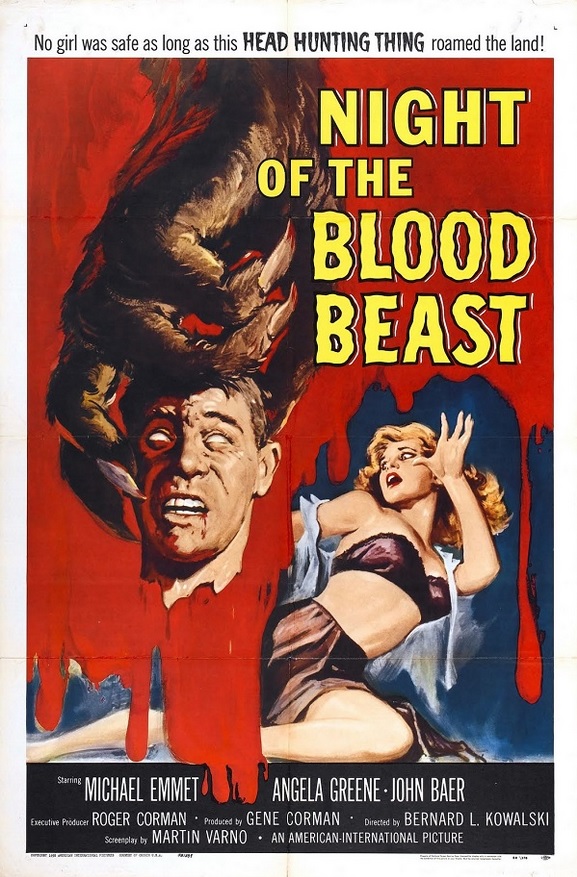
Mill Creek Sci-Fi Invasion: Night of the Blood Beast (1958)

Editor’s Note: This review previously ran as part of our Mill Creek Pure Terror tribute month on November, 25 2019.

It’s hard to believe this forgotten—and to be honest, not very good—62-minute Roger Corman quickie shot in 1958 for a mere $68,000 over the course of seven days wound up in WGA arbitration, but it did: Writer Martin Varno disputed the writing credit given to Roger’s brother, Gene. Even harder to believe: Harold Jacob Smith, who worked on the film’s rewrites/dialogue doctoring, won an Academy Award for Best Original Screenplay for The Defiant Ones (1958). But, hey, look at what happened to James Cameron (Galaxy of Terror) and Ron Howard (Grand Theft Auto). (By the way: Don’t forget to read my “October 2019 Scarecrow Challenge” review of Ice Cream Man starring Ron’s brother, Clint.)

Damn this 27th galaxy to hell!

Starting out as a screenplay “Creature from Galaxy 27” and influenced by the Howard Hawks box-office smash, The Thing from Another World (1951), Night of the Blood Beast tells the story of the return of the first deep space astronaut—implanted with an alien embryo. Although astronaut John Corcoran’s body seems “dead,” it maintains a blood pressure and harbors strange, alien seahorse-like cells his blood stream that grow into a lizard-like fetus. Then the film goes off into a weird, homosexual subtext with the alien and Corcoran “protecting” each other.

Ah, a human male as a walking alien-baby incubator? I’ve seen this before. Well, besides the homosexual subtext, it does sound familiar, doesn’t it? Well, doesn’t it Dan O’Bannon?

Sadly, while Night of the Blood Beast is clearly an Alien antecedent, the film—because of its low-budget quality further stymied by the amateurish acting of TV series bit-players—goes unmentioned alongside the more formidable Alien precursors of Forbidden Planet, It! The Terror of Beyond Space, Queen of Blood, and, especially, Mario Bava’s Planet of Vampires. Well, doesn’t it, Dan O’ Bannon?

During its initial success, literary critics noted Alien’s similarities to the Agatha Christie tale, And Then There Were None (1939), and the short stories “Discord in Scarlet” and “The Black Destroyer” in A.E van Vogt’s collection, The Voyage of the Space Beagle (1950), which could have possibly influenced Martin Varno’s storytelling. It certainly did influence—although he flat out denied it—O’ Bannon’s storytelling: so much so that 20th Century Fox settled with van Vogt out of court.

Speaking of familiar: B&S readers are familiar with Corman’s house of recycling: Stunt footage from Eat My Dust and Grand Theft Auto turned up in several of his ‘70s hicksploitation films . . . and how many times did we see Battle Beyond the Stars SFX shots reused? Thus, you’ve seen Night of the Blood Beast’s alien costume before: In Teenage Caveman (1958), which wrapped two weeks before Blood Beast began shooting. Some film reviewers describe it as “a bear crossed with a moldy parrot”—and they’re right! Is the costume as bad as Richard “Jaws” Kiel’s The Solarite—with the light bulb eyes—in Phantom Planet (1961)? Yep. And since when does an alien, only by monitoring Earth’s radio broadcasts, develop a dialect worthy of a Royal Shakespearean Company actor? Book this parrot for the CBS Evening News. He should be holding a skull and crying out for Desdemona. “The parrot is ready for his close-up, Mr. DeMille!”

If you need more fun-filled, Roger Corman sci-fi tomfoolery, check out Night of the Blood Beast’s John Baer in Attack of the Giant Leeches (1959) and Ed Nelson in Attack of the Crab Monster (1957).

If you want to go deep into the Alien cottage “homage” industry with B&S Movies, then surf on over to Ten Movies that Rip-off Alien and A Whole Bunch of Alien Rip-offs All at Once.

It freaks me out that I’ve seen all these movies. I don’t know if that makes me cool or just a very sad excuse for a human being.

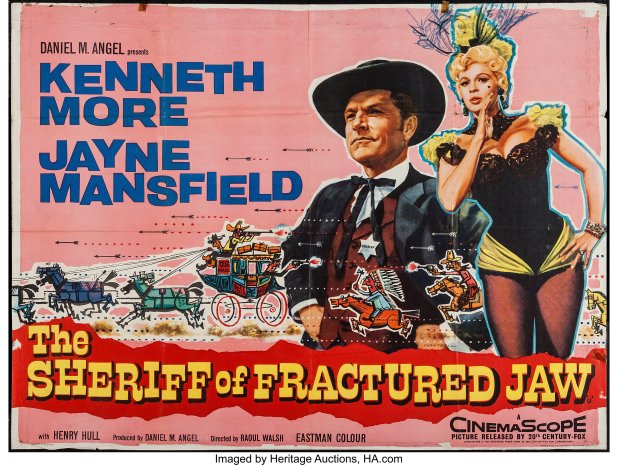
The Sheriff of Fractured Jaw (1958)

Raoul Walsh had an interesting career, going from acting as John Wilkes Booth in D.W. Griffith’s The Birth of a Nation to directing High Sierra, They Died With Their Boots On and The Naked and the Dead. Here, he travels to Spain — and Pinewood Studios — to shoot a comedy western with Kenneth More and Jayne Mansfield.

Originally intended to be a movie with Clifton Webb and Marilyn Monroe, this ended up being part of a three-movie deal 20th Century Fox made to film three movies in England. The studio was pushing Mansfield to take over for the temperamental Marilyn Monroe, but she upset execs by getting pregnant with her second child and missed days of work.

There’s a decent supporting cast — Willaim Campbell (Hush… Hush, Sweet Charlotte), Robert Morley (Theater of Blood) and Bruce Cabot (King Kong) — and some great CinemaScope visuals. It’s a trifle about More playing a British man who ends up becoming a sheriff and Mansfield as a tough saloon owner.

Mansfield sings a few songs here, but that’s really the voice of Connie Francis.

You can watch this on YouTube.