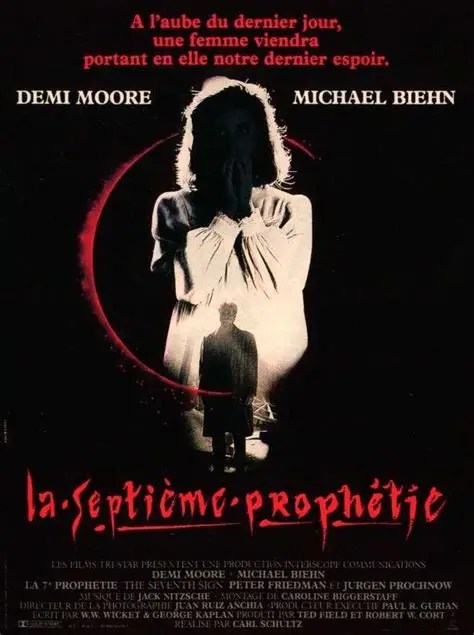
UNSUNG HORRORS HORROR GIVES BACK 2025: The Seventh Sign (1988)

Each October, the Unsung Horrors podcast does a month of themed movies. This year, they will once again be setting up a fundraiser to benefit Best Friends, which works to save the lives of cats and dogs across America, giving pets second chances and providing them with happy homes.

Today’s theme: 1980s

ABOUT THE AUTHOR: Adam Hursey is a pharmacist specializing in health informatics by day, but his true passion is cinema. His current favorite films are Back to the Future, Stop Making Sense, and In the Mood for Love. He has written articles for Film East and The Physical Media Advocate, primarily examining older films through the lens of contemporary perspectives. He is usually found on Letterboxd, where he mainly writes about horror and exploitation films. You can follow him on Letterboxd or Instagram at ashursey.

The characters of The Bible have been a fount of inspiration for horror movies since the days of silent film. Many of these films focus on the exploits of demons and the Devil, supernatural beings out to possess, corrupt, and destroy. The Seventh Sign takes a different approach, turning to the back of the Book to see how God’s judgment might be poured out onto the Earth.

If the title had not already been taken by Ingmar Bergman, perhaps The Seventh Seal might have been a more appropriate title. A mysterious man named David (Jurgen Prochnow) is globetrotting, breaking the seal on various parchments. With each break, another disaster occurs, from the fish in the ocean in Haiti dying to the discovery of a frozen desert in the Middle East. Eventually, David finds his way to Abby (Demi Moore), a pregnant woman who is due to give birth on Leap Day. Abby’s lawyer husband Russell (Michael Biehn) is busy trying to get a young man with Down’s Syndrome clemency from the gas chamber for killing his parents (who were also brother and sister), a strange B story that eventually does become more important in the final act.

David rents a room above the garage and tells the couple a story over dinner involving sparrows and their song. According to David, all souls are stored in a place called the Guf. As a soul comes to inhabit the body of a newborn baby, the sparrow sings its song. While the story sounds charming on the surface, Abby soon finds herself face-to-face with the realization that David is actually the second coming of Jesus Christ. And the Guf is all out of souls, starting with her baby. God is ready to judge the world, and only Abby can stop it.

The Seventh Sign takes an interesting approach to its storytelling by melding Jewish folklore with the New Testament. The Guf is not mentioned in the Bible, but it is mentioned in the Jewish text, the Talmud, which is sort of an interpretation by rabbis of the Torah, the oral history of the Jewish people that also incorporates the first five books of the Bible (confused yet?). If nothing else, it was a bold move by the makers of The Seventh Sign to take Jewish folklore and apply it to the apocalypse. In comparison to horror films that tap into Christianity for inspiration, there have not been too many films inspired by Jewish folklore.

Perhaps the most famous being from Jewish folklore featured in films is the Golem, a protector made from clay who comes to life to save and serve the Jewish people. Another figure in Jewish folklore is the dybbuk, a spirit who clings to its host, possessing that person, causing mental anguish. One recent film that explores a dybbuk is Demon (2015), a Polish film featured in the All the Haunts Be Ours: Volume 2 set from Severin Films. Also featuring a dybbuk was The Unborn, a film from 2009 starring Gary Oldman as a rabbi who is consulted to get rid of the spirit. Oh how I love all of the different forms of folk horror! I learn so much about different cultures from these stories, even if I do not care for the film itself sometimes.

But fortunately, I really enjoyed The Seventh Sign, more than others it seems (currently only a 2.7 star rating on Letterboxd). It is a film that I never got around to watching for whatever reason (perhaps due to the lack of champions for the film). But I found it to be very thought-provoking. Demi Moore in the lead role helps for sure. And although the film seems too scared to go for an unhinged ending it could have, there is some comfort in thinking that the prayers and actions of one woman could change God’s mind, a consistent thread throughout the Bible.

I watched this one as God intended—on a VHS cassette tape I bought from Goodwill years ago but before now never cracked the seal so to speak.
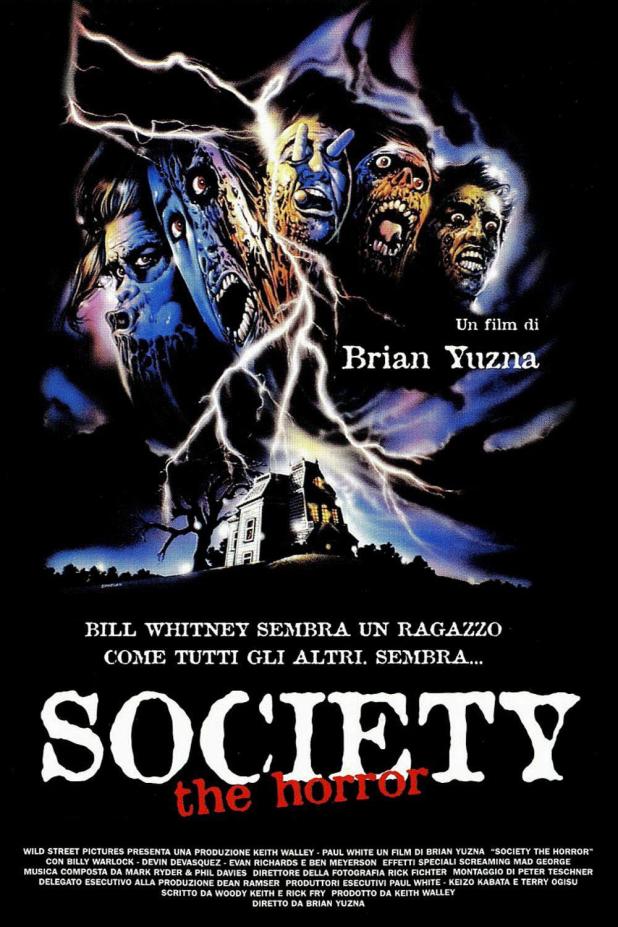
UNSUNG HORRORS HORROR GIVES BACK 2025: Society (1992)

Each October, the Unsung Horrors podcast does a month of themed movies. This year, they will once again be setting up a fundraiser to benefit Best Friends, which works to save the lives of cats and dogs across America, giving pets second chances and providing them with happy homes.

Today’s theme: 80s!

About the Author: Parker Simpson is a writer and podcaster focusing on cult films and their social impacts. They currently cohost Where Is My Mind, a podcast focusing on underappreciated films from a variety of genres and countries. They have also held panels, chartered local organizations, and written articles to their blog. When not writing or studying, they like to spend time with their pets and go outside. Check out the podcast Linktree and blog.

Note: I wrote this in early September. This has been edited accordingly to make it seem like I watched it recently.

It’s not every day you see a mass walk out of a film over one scene. Or seeing those who stay have their jaws permanently agape. Or those same people become increasingly sweaty and anxiety ridden as time passes. It’s rather funny, really. I would highly recommend the experience.

This is an accurate summary of my local drive-in’s screening of Society, which they decided to double-bill with Killer Klowns from Outer Space. I don’t know how they keep getting copies of cult horror films to show in small town America, but I respect it and will keep forking over my money to them (you should, too). Seriously, last weekend they screened Lamberto Bava’s Demons with Return of the Living Dead, and next week is a two-night event including Girls Nite Out, Madman, Re-Animator, Spider Baby, and Children Shouldn’t Play With Dead Things. What is in the water here?

Society is a film known more for its ending (I will try to not spoil too much) than what precedes it. Its timely imagery of the rich literally eating the poor has aged just as well as the special effects Brian Yuzna got the plot from. Despite the continual citing of his and collaborator Stuart Gordon’s influence in recent efforts (see: The Substance), his directorial career is rather bumpy, ranging from extremely amusing (Faust: Love of the Damned) to awful (Beyond Re-Animator). This is his high point: if you ask me, he hit it out of the park with Society and should have done more with social commentaries instead of basing his career on getting ideas from Screaming Mad George. Then again, I shouldn’t curse the man who holds the rights to my favorite franchise.

What makes this stand out from the rest of Yuzna’s filmography is not the melding of naked bodies and human beings turned inside out – it’s the elaborate pacing and making the most of its surroundings. By the time the late 80s rolled around, the popular landscape was more interested in making money than engaging the general public. Culture had shifted away from the organic roots of the 60s and 70s, being redirected to malls and television. It may have been a sign of economic prosperity, but it signaled a cultural downfall we are still feeling the effects of. Setting Society in the wealthy area of Beverly Hills only amplifies this bubble we often see in films of the time – gone are the seedy streets of the inner city, in come the gentrified suburbs. 

However, in the spirit of Blue Velvet, there must be something lying underneath the glimmery surface. Enter the Whitney family, composed of parents Nan and Jim, daughter Jenny, and son Bill. Bill is the black sheep – there is clearly a rift between him and the rest of the family. He knows something is wrong, but he can’t put his finger on it. It’s only when his friend (and sister’s ex) bug the family’s car that he finds out about Jenny’s “coming out” party – something his parents also did, and which features a murderous orgy. Not the sort of thing you want to hear anyone participating in, let alone your immediate family. Only from there does the rift continue to grow, culminating in the now infamous shunting sequence. What could be taken as cheesy teenage angst turns into a genuine feeling of paranoia; while Bill is never really part of his family (he suspects he was adopted), he’s never really able to escape them. He finds their influence extends to the furthest corners of Beverly Hills, as seemingly everyone within a 50-mile radius plots against him. It all culminates in a feast of bodies merging into one another as liquor (and honey?) pours over a sickly orange lighting, a visual you will never really forget. Films primarily based on special effects don’t always work, and while they don’t get to shine until the final 20 minutes, Society may be the one exception.

I could write on and on about this, truly. But it is something you must witness with your own two eyes, an experience you will never forget no matter how or where you watch it. I cannot give this a higher possible recommendation. Just make yourself a nice cup of tea and see it.

(this is my last piece for the month. Thank you to Sam for letting me write for the site and to anyone who has been reading both my pieces and any of the other contributors’ pieces!)

CHILLER THEATER MONTH: It Came from Outer Space (1953)

EDITOR’S NOTE: It Came from Outer Space was on Chiller Theater on Saturday, November 10, 1973 at 1:00 a.m.; Saturday December 14, 1974 at 11:30 p.m.; Saturday, July 3, 1976 at 11:30 p.m.; Saturday, August 20, 1977 at 11:30 p.m. and was the last movie ever shown on Chiller Theater on December 31, 1983.

Based on Ray Bradbury’s original film treatment “The Meteor,” this was directed by science fiction expert Jack Arnold and written by Harry Essex. The two also worked together on The Creature from the Black Lagoon.

Astronomer John Putnam (Richard Carlson, who directed Riders to the Stars) and schoolteacher Ellen Fields (Barbara Rush) watch a meteorite crash land in Sand Rock, Arizona. No one believes John when he claims that a UFO was in the crater. Even Ellen isn’t sure, but when locals start to disappear, Sheriff Warren (Charles Drake) wants action. John wants a peaceful solution.

The aliens appear to John, who demands to see their proper form, like a doubting Thomas wanting to put his finger in the nail marks on Jesus’ hands. The aliens decide that they will destroy themselves instead of dealing with humans — I get it, my dudes — but Putnam gets them back home safely. 

I love this speech from the sheriff: “Did you know, Putnam, more murders are committed at ninety-two degrees Fahrenheit than any other temperature? I read an article once. At lower temperatures, people are more easygoing. Over ninety-two, it’s too hot to move. But just ninety-two, people get irritable.” 

The sheriff’s office is near Courthouse Square from Back to the Future, and the alley where they chase the reborn people is where Atticus faced off with the lynch mob in To Kill a Mockingbird. This film is all about recycling, as the meteorite footage is also in Cat-Women of the Moon and The Astounding She-Monster

Of all the 3D films, this is probably the classiest.

You can watch this on Tubi.

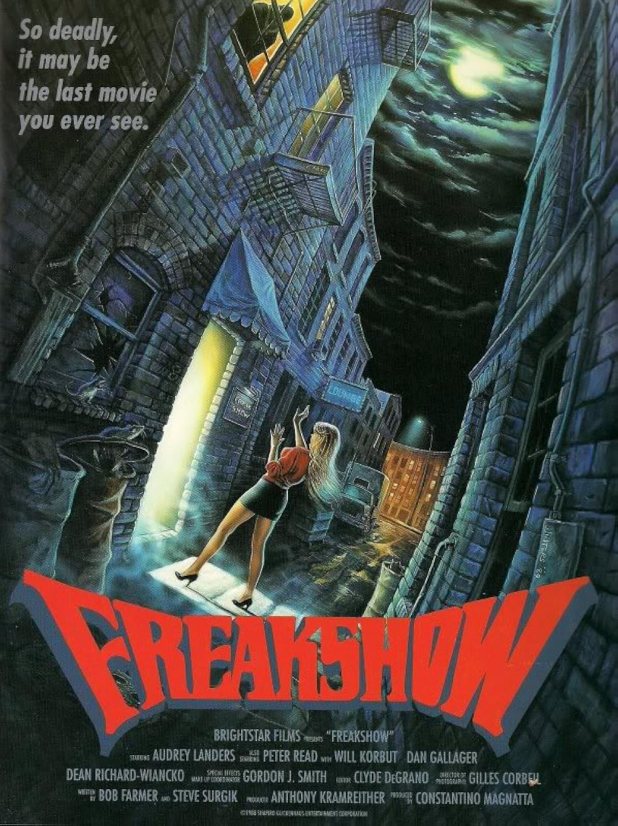
THE IMPORTANT CINEMA CLUB’S SUPER SCARY MOVIE CHALLENGE DAY 29: Freakshow (1989)

29. A Horror Film Without a North American, UK or Australian DVD or Blu-ray release, but that’s on the Internet Archive

Directed by Constantino Magnatta (The Dark Side) and written by Steve Surgik and Bob Farmer, who also wrote the song in the film, “There’s A Ghoul In School.”

A Canuxsploitation portmanteau, Freakshow starts with a massacre in a movie theater by a maniac with a gun — what is this, America and not Canada? — and Audrey Landers, playing a reporter named Shan Nichols, checks in before hiding out at a Freakshow Museum. There she’s told four stories: a poodle getting revenge for her owner, a pizza delivery turned music video that becomes a vampire orgy, a woman being alive for her own autopsy, and finally, zombies wanting the dirt from their graveyard returned from a golf course. Once Shan is added to the museum’s collection, we see that it’s all been a movie, and it starts over again.

This was mostly a cable release, and I’m unsure if it ever played theaters or made it on video in the U.S. It did play in Toronto, however. I’d like to tell you that it’s a great find, but really, it’s a precursor to the boring direct-to-streaming anthologies that litter our world today.

At least it has lots of late 80s Canadian metal like The Nylons, Clean Slate and The Wankers.

You can download this from the Internet Archive.

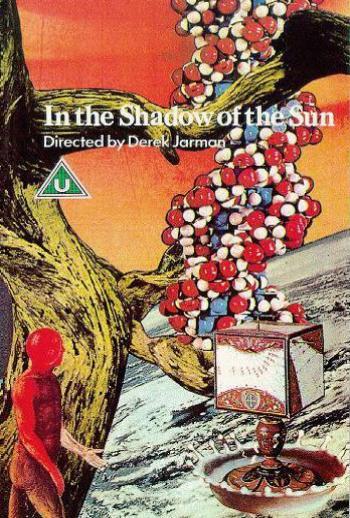
2025 Scarecrow Psychotronic Challenge Day 29: In the Shadow of the Sun (1981)

29. “OCCULT”URAL CENTER: This one’s gotta have a supernatural hotspot in it.

This was made by Derek Jarman, who was the production designer for The Devils and also made Jubilee. He also directed the Pet Shop Boys’ 1989 tour.

Jarman was also involved in music, directing videos and films for The Smiths, Marc Almond, Suede, Wang Chung and Psychic TV. This is a mix of Super 8 films shot by the director between 1972 and 1975, scored by Throbbing Gristle. There are scenes from his films Journey to Avebury. Tarot and Fire Island.

The title refers to the Philosophers’ Stone, which alchemists sought, believing it could transform base metals into gold.

I’ve heard people say this movie is boring. Maybe it’s the space I find myself in, but I found it relaxing and a perfect trance. I guess if it’s not for everyone, then it’s occult.

UNSUNG HORRORS HORROR GIVES BACK 2025: Fear In the Night (1972)

Each October, the Unsung Horrors podcast does a month of themed movies. This year, they will once again be setting up a fundraiser to benefit Best Friends, which works to save the lives of cats and dogs across America, giving pets second chances and providing them with happy homes.

Today’s theme: Hammer or British

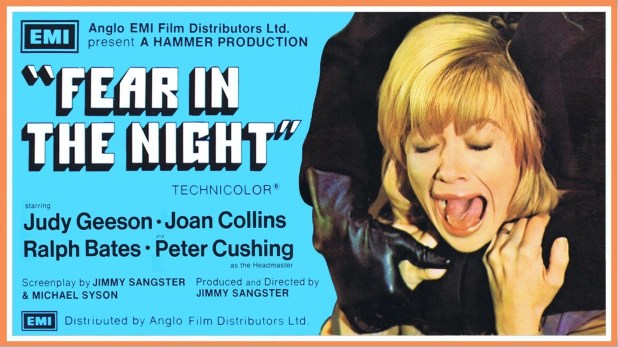
Playing with Straight On Till Morning in the UK and Demons of the Mind in the U.S., this Hammer film finds Peggy (Judy Geeson) moving with her husband Robert (Ralph Bates) to work at a school in the countryside. The night before they leave, she’s attacked by a man with a fake arm, which sends her into hysterics. 

Robert’s new boss is Michael Carmichael (Peter Cushing), who is married to Molly (Joan Collins). After their first meeting, Peggy is again attacked by the one-armed man. The next night, she notices that Robert only has one arm; she shoots at him with a shotgun, but it doesn’t stop him. She faints, only for her husband to reveal that there’s no job at the school. He’s treating Robert, who plays recordings of the old students to try to remember what it was like before a fire destroyed the school.

The twists start here, as Robert and Molly have been having an affair, and he only married Peggy to drive her insane and make her kill Michael. Michael, however, is a step ahead, using the intercom of the school to taunt his enemies, even tying up his wife and coaxing Robert into shooting her, thinking that it’s him. Peggy survives, thanks to the one-armed man she believed was her enemy; her husband’s body hangs from a noose as choir music plays from the empty school.

Directed by Jimmy Sangster, who co-wrote the script with Michael Syson, this is the kind of cold, dreary British murder mystery I love. It’s not as stylish as the Giallo, but it comes from the same fione. 

You can watch this on Tubi.

CHILLER THEATER MONTH: The Angry Red Planet (1959)

EDITOR’S NOTE: The Angry Red Planet was on Chiller Theater on Saturday, April 10, 1965 at 11:20 p.m.; Saturday, May 7, 1966 at 11:20 p.m.; Saturday, May 27, 1967 at 11:20 p.m. and Saturday, June 22, 1968 at 11:20 p.m.

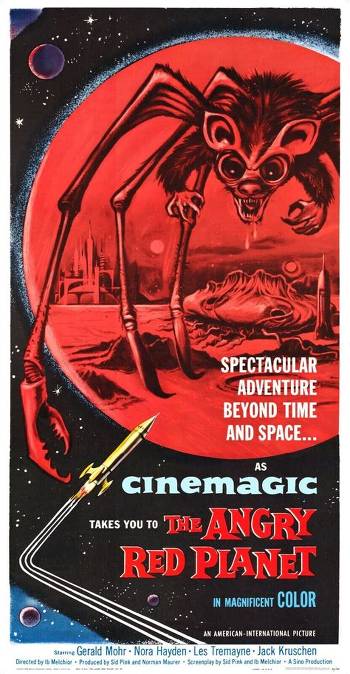
Directed by Ib Melchior, who wrote this with Sidney W. Pink, The Angry Red Planet starts with Dr. Iris Ryan (Naura Hayden) and Col. Tom O’Bannion (Gerald Mohr) barely making it back from Mars. He has a growth on his arm, and she’s struggling to find a cure. Chief Warrant Officer Jacobs (Jack Kruschen) and Professor Theodore Gettell (Les Tremayne) didn’t make it back. But what do you expect from a planet with gelatinous globs that devour people and giant rat spiders?

Mars sends back a warning. “We of Mars have been observing human development on Earth for many thousands of years and have determined that humanity’s technology has far outpaced progress in cultural advancement.” Stay on Earth, humans.

The budget was bad, so this was shot in CineMagic. It created a red glow in the Mars scenes, making the actors look like cartoons, which helped the effects seem higher budget. It’s basically a monochrome red film.

I learned of this movie thanks to The Misfits‘ Walk Among Us. That rat-bat-spider-crab thing on the cover was awesome.

You can watch this on Tubi.

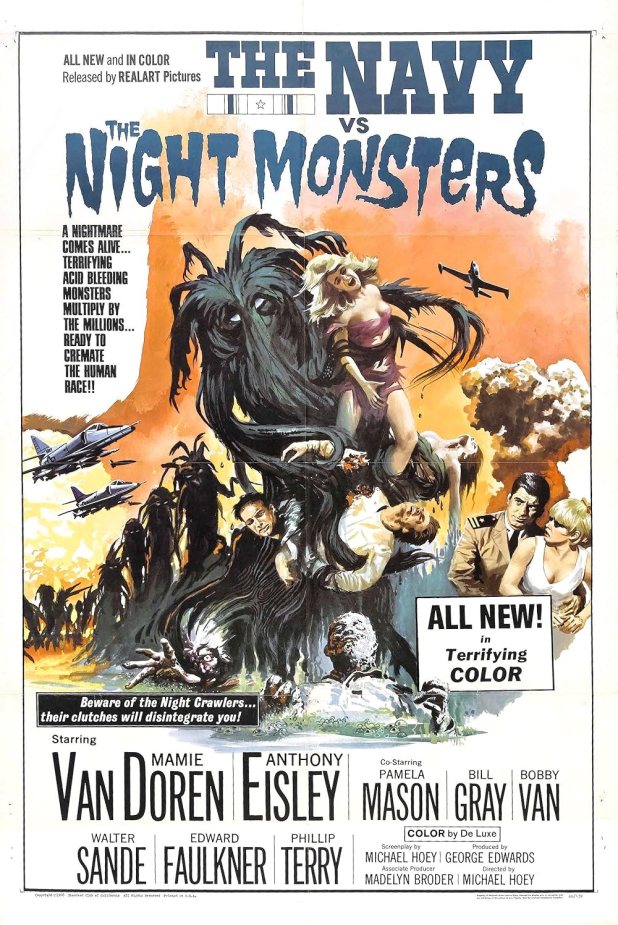
CHILLER THEATER MONTH: The Navy vs. the Night Monsters (1966)

EDITOR’S NOTE: The Navy vs. the Night Monsters was on Chiller Theater on Saturday, November 15, 1969 at 1:00 a.m.; Saturday, February 6, 1971 at 11:30 p.m.; Saturday, May 5, 1973 at 1:00 a.m.; Saturday, May 11, 1974 at 11:30 p.m. and Saturday, July 5, 1980 at 1:00 a.m. 

Directed and written by Michael A. Hoey, along with help from Jon Hall, this starts with a plane crashing into the small American Navy weather station based on Gow Island. Lieutenant Charles Brown (Anthony Eisley, admirably heroic despite so many minor roles), nurse Nora Hall (Mamie Van Doren) and biologist Arthur Beecham (Walter Sande) reach the wreck and find no survivors. No bodies, to be exact.

There’s only a freaked-out pilot and prehistoric trees, which get replanted and, yes, come to life. 

Do you know how to defeat evil trees? Molotov cocktails and napalm. Never overlook the American military-industrial complex’s ability to blow things up real good. Now, Eisley and Van Doren’s characters can get it on without the specter of walking murderous trees.

Based on The Monster from Earth’s End by Murray Leinster, this film features James Mason’s first wife, Pamela — who thought the film was beneath her — and two members of Elvis Presley’s Memphis Mafia, Sonny West and Red West. 

The original cut was 78 minutes, and this is where Hall came in, shooting new scenes to pad the film. Eisley said, “The producer totally recut the picture after it was made and totally destroyed any validity it might have had.”

When Anthony Eisley says bad things about your movie, you may want to reconsider your choices.

You can watch this on Tubi.

WEIRD WEDNESDAY: Doctor Death (1973)

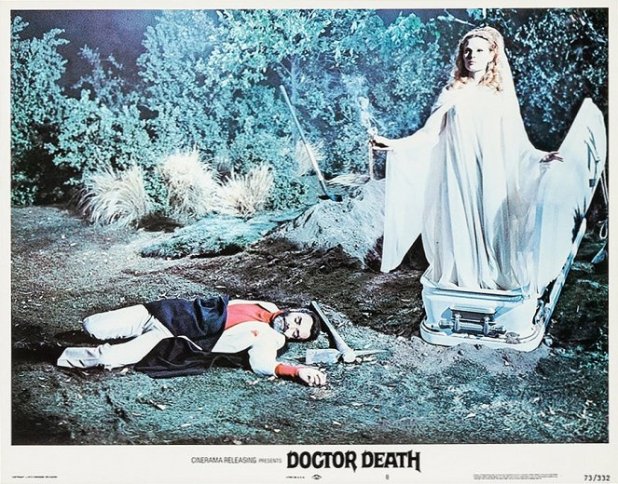
Dr. Death (John Considine) is a thousand-year-old magician who can transfer souls from one body to another. He keeps himself alive by jumping from one body to the next, and oh yeah — he has acid blood. I mean, sure, I’m down with that.

Sadly, this never got a sequel, as that was the plan. The main story is about Fred Saunders (Barry Coe), whose wife has just died and promised to return from the other side. After discovering that each spiritualist is a carny liar, he meets Doctor Death, who truly can bring the dead back from the grave. Of course, he’s also an absolute maniac.

One of the film’s financiers was Barry Gordy, who got to direct a scene. It’s also the last screen appearance of Moe Howard and has horror host Larry “Seymour” Vincent as a killer.

Consider this a 1973 TV movie that played theaters and drive-ins. It’s low budget, but groovy as it gets. I want to live in the world of this movie so badly. I really wish they’d made ten of these movies. “Enter that body!” says Doctor Death. Sure, whatever you want.

2025 Scarecrow Psychotronic Challenge Day 28: Vertigo (1958)

28. THIS IS JEOPARDY: Ken says you must solve the clues to survive the predicament.

I’m working through my central Alfred Hitchcock blind spot this year. Yes, I jumped right past him to Giallo, De Palma and Krimi. As I look back, I see the beginnings of my obsessions.

It was written by three people: playwright Maxwell Anderson (who worked on The Wrong Man), Alec Coppel and Samuel A. Taylor. Their work was inspired by D’entre les morts by Pierre Boileau and Thomas Narcejac; Hitchcock had tried to purchase their previous work, Celle qui n’était plus (She Who Was No More), which was made as Les Diaboliques.

San Francisco detective John “Scottie” Ferguson (Jimmy Stewart) has had to retire early. A rooftop chase led to the death of one of his fellow officers, and he’s been struck by a fear of heights, which comes out as vertigo. His former fiancée, Marjorie “Midge” Wood (Barbara Bel Geddes), thinks that he needs a shock to his system. As he looks for a way to fill his empty days, his friend Gavin Elster (Tom Helmore) asks him to follow his wife, Madeleine (Kim Novak).

He traces her to the Mission San Francisco de Asís and the grave of Carlotta Valdes — not a real person — then to the Legion of Honor art museum, where she gazes at a painting of her. The woman was Madeleine’s great-grandmother, and Gavin feels that she’s possessed his wife. Carlotta was the mistress of a rich man, but after she gave birth to his child, he kept the child and left her. Then, she killed herself. Whenever possessed, Madeleine has no memory of what she’s done or where she’s visited.

She tries to drown herself and is saved by Scottie, to whom they soon profess their love. She runs up the steps of Mission San Juan Bautista, Carlotta’s childhood home, and demands that he not follow her. He tries, but his vertigo keeps him grounded as she falls to her death. It’s ruled a suicide, but Scottie is institutionalized.

Once he comes back to reality, he sees another woman who reminds him of his lost love. She is Judy Barton and is the woman he knew, but was involved with Gavin in an elaborate murder; as Scottie was afraid to go up the stairs to save Madelaine, Gavin threw her already dead body to the ground below. As Judy has been cast aside by her lover, just as Carlotta was, she falls for Scottie, who asks her to start looking like Madelaine.

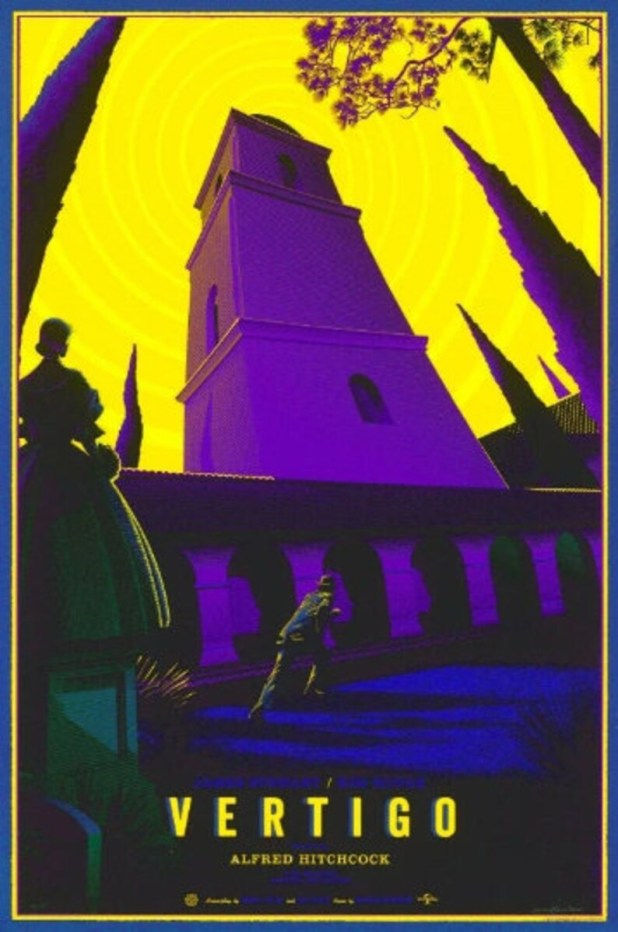
To finally get past his fear, he feels that he must go through the event all over again. At the top of the bell tower, he makes her admit her crime. She begs him for forgiveness; she embraces him, just as a nun appears and frightens Judy, who falls to her death. At least Scottie is no longer afraid of heights.

So much of Giallo can be traced to this film. Fulci’s Perversion Story takes the setting and idea of a woman coming back from the dead through someone who appears just like her. One of the shots in this has been used in suspense movies ever since. Uncredited second-unit cameraman Irmin Roberts invented the famous zoom-out and track-in that shows how vertigo feels. That moment — just a few seconds — cost $19,000 to film. Hitchcock based it on how it looked when he passed out at a party.

How Hitchcock explained this to Truffaut — “To put it plainly, the man wants to go to bed with a woman who is dead.” — could be any Giallo. The way light and color twist and turn at key moments is also echoed in Argento’s work.

What is interesting is that, as crucial as Madelaine/Judy is to the story and the motivations of its hero, she doesn’t speak until the movie is a third of the way in. She’s been nearly a cipher for so long, someone that Scottie can fall in love with in a day, projecting perfection onto someone he barely has met.

Judy: If I let you change me, will that do it? If I do what you tell me, will you love me?

Scottie: Yes. Yes.

Judy: All right. All right then, I’ll do it. I don’t care about myself anymore.

Does Scottie even love Judy? Or is he recreating the woman that he thought she was before, without knowing it? In the words of Roger Ebert, Scottie “…falls obsessively in love with the image of a woman–and not any woman, but the quintessential Hitchcock woman. When he cannot have her, he finds another woman and tries to mold her, dress her, train her, change her makeup and her hair, until she looks like the woman he desires. He cares nothing about the clay he is shaping; he will gladly sacrifice her on the altar of his dreams.”

When she remakes herself, emerging from a bathroom with green neon fog, she’s done it for him. As Ebert notes, “The other man has, after all, only done to this woman what Scottie also wanted to do. And while the process was happening, the real woman, Judy, transferred her allegiance from Gavin to Scottie, and by the end was not playing her role for money, but as a sacrifice for love.”

Hitchcock wanted to edit out Judy’s flashback sequence, which reveals that she and Madeleine are the same person. He was worried that if he gave away the twist, audiences would check out. He did a test in New York City. The version with the flashback was the clear winner. That said, the film didn’t do well at its initial release, which the director blamed on Stewart’s age.

Unlike every other movie the director made, the killer is not punished. The American Production Code Administration demanded an ending where a radio show reveals that Elster has been caught. That never made it into the film.