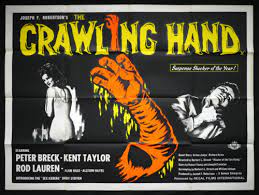
CHILLER THEATER MONTH: The Crawling Hand (1963)

EDITOR’S NOTE: The Crawling Hand was on Chiller Theater on Saturday, December 16, 1967 at 1:00 a.m., Saturday, May 30, 1970 at 1:00 a.m. and Saturday, April 17, 1971 at 11:30 p.m.

If an astronaut crash-lands and says things like, “My hand… makes me do things…. kill…. kill!” At this point, you may say that perhaps this is not a lack of oxygen in the astronaut’s helmet, but rather that he may have a medical issue.

There’s also a medical student named Paul (Rod Lauren was a singer who released the song “If I Had a Girl” before acting; he moved to the Philippines, where he married actress Nida Blanca. He became the lead suspect in her death when she was stabbed in a parking garage, then fought extradition back to the country for years before jumping off a hotel room balcony; sorry to bring everyone down with who Paul really was, who finds the astronaut’s hand and well, keeps it. Because that’s what doctors do: keep desiccated hands that they see from space crashes.

Paul begins to use the power of his hand to attack people he dislikes, becoming increasingly obsessed with it. The police — led by The Skipper Alan Hale Jr. — try to catch him, and the space agency starts to realize that the fingerprints of the dead astronaut are all over the place. So Paul takes the hand to the beach and tries to destroy it, and some cats try to eat it, because that’s the kind of movie The Crawling Hand is.

Somehow, writer Rick Moody used this film as inspiration for his novel Four Fingers of Death, the tale of writer Montese Crandall, who attempts to get over the death of his wife by throwing himself into his work and writing a remake of The Crawling Hand.

Director Herbert L. Strock also made Gog and The Devil’s Messenger, and one of the co-writers was Joe Cranston, the father of Bryan. None of them noticed that at times, the crawling hand is a left hand a right hand at other times.

UNSUNG HORRORS HORROR GIVES BACK 2025: The Body Beneath (1970)

Each October, the Unsung Horrors podcast does a month of themed movies. This year, they will once again be setting up a fundraiser to benefit Best Friends, which works to save the lives of cats and dogs across America, giving pets second chances and happy homes.

ABOUT THE AUTHOR: Adam Hursey is a pharmacist specializing in health informatics by day, but his true passion is cinema. His current favorite films are Back to the FutureStop Making Sense, and In the Mood for Love. He has written articles for Film East and The Physical Media Advocate, primarily examining older films through the lens of contemporary perspectives. He is usually found on Letterboxd, where he mainly writes about horror and exploitation films. You can follow him on Letterboxd or Instagram at ashursey.

Today’s theme: 1970s

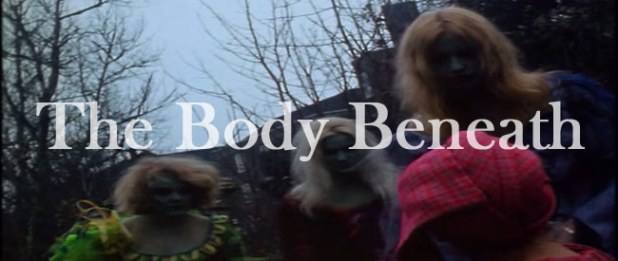
Diving back into the Andy Milligan box set from Severin Films with The Body Beneath, another one of Milligan’s horror films made during his London period. If you’ve ever watched an Andy Milligan film, you know that your mileage may vary.

Too much inbreeding has caused a degradation in the bloodline of a family of vampires. Led by the Reverend Alexander Ford (Gavin Reed), the brood sets out to gather some fresh blood, namely, relative Susan Ford (Jackie Skarvellis), who has recently disclosed to her boyfriend Paul (Richmond Ross) that she is expecting. After the Reverend takes over Carfax Abbey (obviously an allusion to Count Dracula’s London estate—you could never accuse Milligan of subtlety), he begins a reign of terror, kidnapping Susan for her offspring and others for their blood supply while punishing his hunchbacked servant (there always has to be a character with a hunchback in a Milligan movie). Can Paul rescue Susan before it is too late? 

No one could accuse Milligan about properly pacing a movie either. Fortunately for me, I’m never in any rush to get through one of his films. I never really expected to embrace his films like I have, but there is just something about the bad acting, low production values, and magnificent costumes that keeps me coming back for more. I’m not sure what I will do when I run out of new films to watch in this box set. I mean, I guess I’ll just start over. And I’m perfectly okay with that option. Although Severin did discover a couple of previously lost Milligan films recently. So that release will be something to look forward to. Hopefully soon.

CHILLER THEATER MONTH: Voyage to the End of the Universe (1963)

EDITOR’S NOTE: Voyage to the End of the Universe was on Chiller Theater on Saturday, November 25, 1967 at 11:20 p.m. and Saturday, August 1, 1970 at 11:30 p.m.

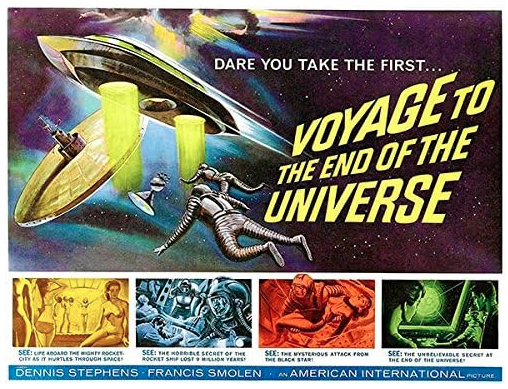
What were American audiences thinking when they got this Czechoslovakian movie dubbed into English, once Ikarie XB-1 and now Voyage to the End of the Universe?

I hoped they loved it.

2163: The 40-person multinational crew of the starship Ikarie XB-1 has spent 28 months at light speed — 15 years of human time — to get to the Green Planet, a mysterious body that humans may be able to live on. To get there, they have to deal with an ancient ship packed with nukes, a radioactive dark star and the crew slowly falling to pieces. Like Dark Star. Or even 2001.

American-International cut twenty-six minutes of this (including a scene where a UFO carries dead capitalists), changed the White Planet to the Green Planet and gave it the new name. However, the most significant change is that, at the end of the original, the crew discovers that the planet is inhabited. In this one, they land and see stock footage of the Statue of Liberty, giving it a gimmick ending.

Director Jindřich Polák used the same props from this film for his next project, a 1963 TV series entitled Klaun Ferdinand a raketa. His career went between science fiction and children-friendly movies, along with some crime movies. He based this on the Stanisław Lem book “The Magellanic Cloud” and co-wrote it with Pavel Juráček.

I really enjoyed this, as it seems to get across what it would be like to be a space traveler. The claustrophobia, the worry, the food not being digestible — encompass all the small details that others overlook.

THE IMPORTANT CINEMA CLUB’S SUPER SCARY MOVIE CHALLENGE DAY 10: Mohawk (2017)

October 10. An Indigenous Horror Film

Directed by Ted Geoghegan (We Are Still Here), who co-wrote it with Grady Hendrix, Mohawk is about Mohawk woman Okwaho (Kaniehtiio Horn), a woman torn between two men, Mohawk warrior Calvin (Justin Rain) and British soldier Joshua (Eamon Farren). One is the father of her child. While her tribe is trying to stay neutral in the battles between the U.S. and the UK, their people are being killed by the Americans. Calvin is driven to do something; he sets a fort ablaze and kills more than twenty soldiers. Only six soldiers and a translator Yancy (Noah Segan) survive.

As they plan their revenge, they encounter the Mohawk. In the first battle, Okwaho’s mother, Wentahawi (Sheri Foster) and the American commander, Colonel Charles Hawkes (Jack Gwaltney), are killed. They will not be the last casualties, as Captain Hezekiah Holt (Ezra Buzzington) hunts Calvin, finally killing him, but at the cost of several of his men, including his son Myles (Ian Colletti). In retaliation, he also hunts down Okwaho, shooting her in the chest and killing Joshua.

Somehow she survives and shaves her head before creating armor and, well, killing everyone in her way, including the gigantic Private Lachlan Allsopp (Jonathan Huber, the sadly departed pro wrestler Brodie Lee). Finally, she battles Holt into a tree, leaving him impaled as her people look to her as if she’s a spirit. Maybe she is.

Kaniehtiio Horn is a native Mohawk; Justin Rain is Plains Cree; Sheri Foster is a member of the Cherokee Nation.

I’ve always loved the work of both Geoghegan and Hendrix. In spite of, or maybe even because of, the budget, this succeeds in presenting a violent and unyielding world where the guilty, for once, are punished.

You can watch this on Tubi.

2025 Scarecrow Psychotronic Challenge Day 10: Fuga dal paradiso (1990)

10. ESTIMATION…DECIMATION: Today’s forecast is mushroom cloudy with a 100% chance of radiation.

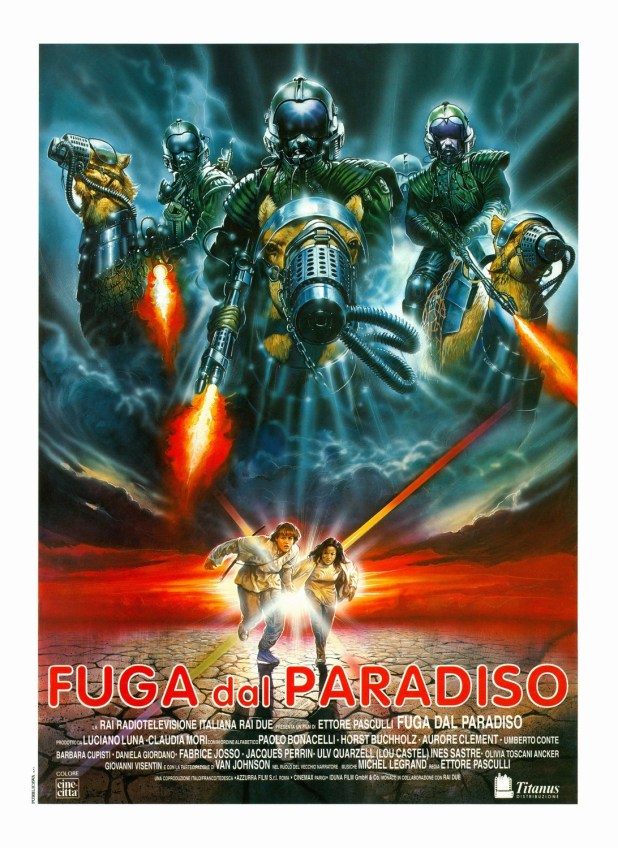
Fuga dal Paradiso has an awesome poster going for it.

Teo (Fabrice Josso) and Beatrice (Inés Sastre) have a mini-disc that they view as a religious talisman and use it as a totem as they leave behind their artificial paradise and attempt to escape Earth. So far, they’ve never met one another, and in an Italian post-apocalyptic film showing us the future, they mostly date via FaceTime. Or whatever it’s called in the world of this movie.

The first thing they do when they leave home? Find a dog named Bear, who, for some reason, has on a shirt and pants. They also find a mall that still has clothes and, of course, punk rockers ready to kill them. Teo’s dad sends Thor (Horst Buchholz), his head of security, to rescue them. Here’s where this gets better: Thor and his crew ride camels and like to roast mutants with flamethrowers. However, he fails at everything he does, and as a result, loses his title.

Van Johnson appears as the old narrator that we see at the beginning and end. You have to feel for the guy, being in this movie.

I do love an Italian end-of-the-world movie, but this one seems nearly tame. Director Ettore Pasculli worked at Cinecittà in the role of advanced cinematographic technologies and was a programmer director for RAI. His film The Steam Factory was one of the first all-digital movies made in Italy.

Barbara Cupisti (The New York RipperCemetery Man), Greta Valiant (The Daughter of Emanuelle) and Daniela Giordano (Four Times That Night) are all in it, at least.

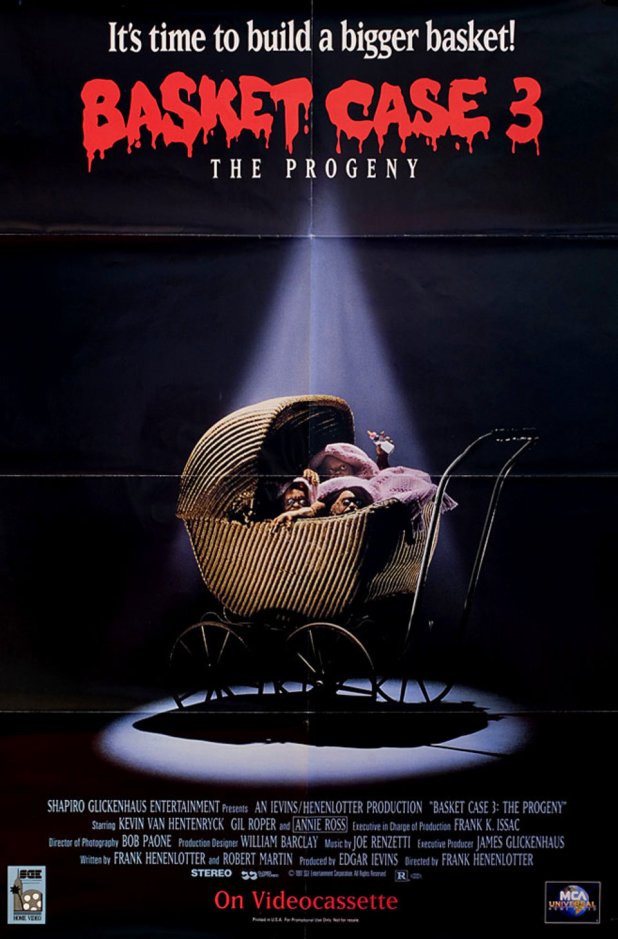
UNSUNG HORRORS HORROR GIVES BACK 2025: Basket Case 3: The Progeny (1991)

Each October, the Unsung Horrors podcast does a month of themed movies. This year, they will once again be setting up a fundraiser to benefit Best Friends, which works to save the lives of cats and dogs across America, giving pets second chances and providing them with happy homes.

Today’s theme: The Sweetest Taboo!

“…Belial suffers through his brother’s neurosis, his girlfriend’s death, and the death of one of his children when the sheriff’s daughter drops it.”

Poor Belial. Three movies in, and he’s still trying to adequately express his emotions.

Last time, his brother Duane (Kevin Van Hentenryck) was trying to sew him back on. Now, Duane’s being held by Granny Ruth (Annie Ross), but allowed to go on the bus trip to see his ex, Doctor Hal Rockwell (Dan Biggers), so that Belial’s children with his girlfriend, Eve, can be born. They’ll also see her son, Little Hal (Jim O’Doherty), a multi-armed blob who can also practice health care.

There’s also a bigoted sheriff (Gil Roper) and his bad girl daughter, Opal (Tina Louise Hilbert), to deal with; the cops bust in at one point, guns blazing — realistic — and murder Eve. Then, they take Belial’s children as if they’re a practice run for late-child-stealing government operations. To fight back, Belial has an exoskeleton built that allows him to kill even more people and cause the sheriff to kill his own daughter. Then, they arrived at Renaldo, where they killed the host, and Granny says that freaks will no longer hide in the shadows.

This is a Frank Henenlotter film, and if you know what that means, you’re either going to love or hate this. I loved it, perhaps even more than the last one, because it just gives in and lets go.

As for the song “Personality”, being in this, “the owner reportedly gave them the rights for a dollar after he found out that Annie Ross would be singing it.” I want IMDbs to be true.

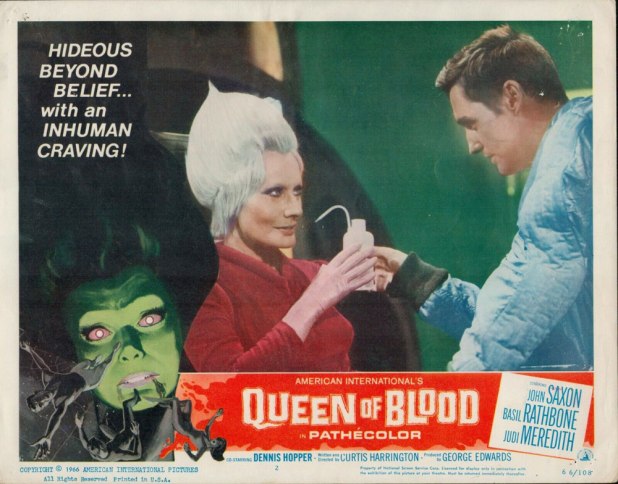
CHILLER THEATER MONTH: Queen of Blood (1966)

EDITOR’S NOTE: Queen of Blood was on Chiller Theater on Saturday, December 17, 1966 at 11:20 p.m. and Saturday, May 17, 1969 at 11:30 p.m.

Based on the screenplay for the Russian movie Mechte Navstrechu (A Dream Come True) and utilizing the special effects footage from that film and Nebo Zovyot (Battle Beyond the Sun), this American-International Pictures release, directed by Curtis Harrington, likely had some influence on Alien.

Harrington agreed, saying that Ridley Scott’s movie was a “greatly enhanced, expensive and elaborate” take on Queen of Blood.

This movie believed, and it made sense at the time, that by 1990, humans would be traveling in space and have united to form the International Institute of Space Technology. Astronaut Laura James (Judi Meredith) hears strange signals from space, messages that Dr. Farraday (Basil Rathbone) believes are from an alien race sending an ambassador to Earth, yet the ship has crashed on Mars.

The ship Oceano is sent to rescue the ambassador, but only one dead alien is aboard. They decide that a rescue ship must have picked up the crew, but when they follow what they think is the rescue ship, they find only one being on board, a green-skinned alien (Florence Marly, who made a short sequel to this movie called Space Boy! and is also in The Astrologer) and several eggs.

She refuses to eat food, won’t let them take a blood sample and when left alone with an astronaut named Paul (Dennis Hopper), she hypnotizes him and drains his blood. Soon, she takes over most of the male crew members and plans on making her way to our planet, with only Laura and Allan Brenner (John Saxon) left to oppose her.

This would be the first movie that Harrington would work with George Edwards (as a line producer for this movie). They met when Edwards produced a stage production of Tennessee Williams’ The Glass Menagerie, and this movie impressed Universal enough that they hired Harrington and Edwards to make Games.

UNSUNG HORRORS HORROR GIVES BACK 2025: Cute Devil (1982)

Each October, the Unsung Horrors podcast does a month of themed movies. This year, they will once again be setting up a fundraiser to benefit Best Friends, which works to save the lives of cats and dogs across America, giving pets second chances and providing them with happy homes.

ABOUT THE AUTHOR: Adam Hursey is a pharmacist specializing in health informatics by day, but his true passion is cinema. His current favorite films are Back to the FutureStop Making Sense, and In the Mood for Love. He has written articles for Film East and The Physical Media Advocate, primarily examining older films through the lens of contemporary perspectives. He is usually found on Letterboxd, where he mainly writes about horror and exploitation films. You can follow him on Letterboxd or Instagram at ashursey.

Today’s theme: The Sweetest Taboo!

Hold onto your penmanship medals! Nobuhiko Obayashi (Hausu) brings us a version of The Bad Seed, with a child perhaps even more devious than Rhoda Penmark.

I would say that The Bad Seed was a gateway horror film for me, but I was born in the 1970s. The idea of gateway horror had not been invented. Or even considered. One of my earliest memories is watching Carrie on our little television in the trailer we were living in. The pig’s blood dropped and I ran out of the room. Carrie was aired on CBS in 1978. Sure, they made a few edits, but a 3-year-old me would not have been able to notice. The real question is why would my parents let me watch it in the first place?

Sort of the blessing and the curse of being Generation X. I wouldn’t trade it for anything. My mom loved Alfred Hitchcock and she would often tape his films or television show any chance she got, and we would watch it on the weekends (along with a week’s worth of All My Children). But the film I most fondly remember is The Bad Seed. Taped off of WGN, complete with commercials for K-Tel records and Empire carpet (588-23 hundred Empiiiiire), we would watch it all of the time. Oh, how I wish I still had that old VHS tape! The Bad Seed had so many aspects that fascinated me. I was too young to understand the concept of translating a stage play to film. We do not see the evil Rhoda commits. We just hear about it. It might have made the idea of such an evil child more effective. Also, I’m still not sure what excelsior is exactly. But apparently, it is highly flammable.

As much as I love The Bad Seed, it is possible that Obayashi’s version is superior in many ways. He totally cuts out the psychological mumbo jumbo that drags down a significant portion of the original film. Our child killer here, Alice, is just a sociopath from the beginning. Is it possible that the suicide of her father is the root cause? Who cares? It doesn’t matter. We are just here to watch Alice bludgeon her teacher to death in order to get a prized doll. 

Obayashi also deviates from the original story by bringing in an aunt as the main protagonist. Ryoko ends up in a mental institution after believing she has caused her boyfriend’s death. I mean, she did wish death upon him as he was walking out the door, only to be struck down by a car. On that same day, Ryoko’s sister Fuyoko is getting married (why Ryoko isn’t there is not explained, other than she is studying music in Vienna). After Alice asks Fuyoko if she can have her veil when she dies, Fuyoko says yes, not expecting to be violently tossed out of a window minutes later. Years pass, and eventually Ryoko is convinced she was not responsible for the death of her boyfriend. Her brother-in-law (I guess—he was only legally married to her sister for mere minutes—talk about early release) asks Ryoko if she would come and be governess to Alice, sweet Alice. She does, but quickly begins to believe that Alice is responsible for the mysterious deaths happening around the family.

We do not approach the insanity that is Hausu of course, but Obayashi does have plenty of tricks up his sleeve. He foreshadows this glass vase so hard that you know something is going to happen with it. But I could have never expected what actually does happen. I thought “there it is”, immediately thinking that it is something that would have easily happened to one of the girls in Hausu.

The Leroy character, the guy who knows the truth but would have difficulty proving it, is even scummier than the guy in The Bad Seed. And Alice does not need to rely on him sleeping on a bed of excelsior to ignite those flames. 

All around, a great companion piece to both Hausu and The Bad Seed. I could watch both of those films back-to-back right now. Similar to other remakes of The Bad Seed in the United States, Cute Devil was made for television. I seem to be stacking up MFTV movies this month. A seemingly endless fount of goodness that unfortunately does not seem to exist anymore. 
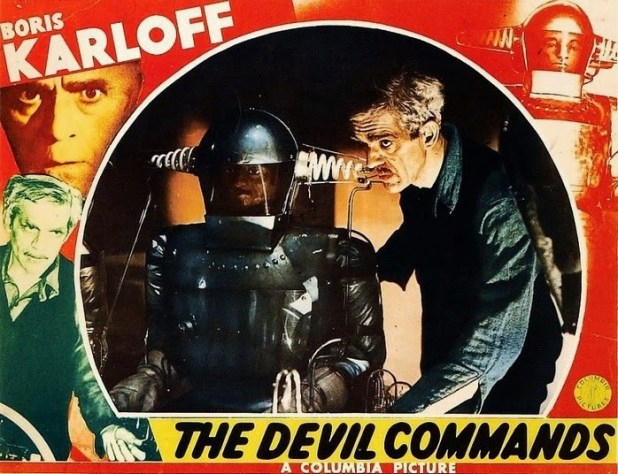
CHILLER THEATER MONTH: The Devil Commands (1941)

EDITOR’S NOTE: The Devil Commands was on Chiller Theater on Saturday, September 2, 1967 at 11:20 p.m.

Director Edward Dmytryk is best known for his film noir movies, winning Oscars for directing Crossfire and The Caine Mutiny and being named as one of the Hollywood Ten. This group of blacklisted film industry professionals refused to testify to the McCarthy-led House Un-American Activities Committee and, as a result, served time in prison for contempt of Congress. In 1951, however, Dmytryk testified to the HUAC and named Arnold Manoff, Frank Tuttle, Herbert Biberman, Jack Berry, Bernard Verhous, Jules Dassin, Michael Gordon and 15 others. He claimed that the Alger Hiss case, which found Communist spies in the U.S. and Canada, and the invasion of South Korea changed his mind. That said, he probably also wanted to improve his own career.

The screenplay was written by Robert Hardy Andrews and Milton Gunzburg, the inventor of the Natural Vision stereoscopic 3-D system, based on a story by William Sloane, who also wrote To Walk the Night.

Boris Karloff plays Dr. Julian Blair, a brain wave researcher, who loses his wife Helen (Shirley Warde) when she dies in a car crash. He becomes obsessed with communicating with her in the world beyond death. He is assisted by his butler, Karl (Ralph Penney), and a Spiritualist medium named Mrs. Walters (Anne Revere), whose influence over the once logical man worries his research assistant, Richard (Richard Fiske), and his daughter, Anne (Amanda Duff).

I enjoy how, in these Columbia films, Karloff is the villain, yet there are reasons why he has gone wrong. It’s an intriguing way of approaching an antagonist, and Karloff makes each of them their own unique version of an archetype.

THE IMPORTANT CINEMA CLUB’S SUPER SCARY MOVIE CHALLENGE DAY 9: Cross of the Devil (1975)

October 9. A Horror Film Directed by John Gilling

John Gilling’s first film since leaving Hammer Films in 1967, La Cruz del Diablo was written by Paul Naschy and based on three short stories by Gustavo Adolfo Bécquer. He gave the project to writer Juan Jose Porto, who cut him out, as did Gilling, who didn’t like his acting. He won a lawsuit and his name is on the movie, but he felt that what he wanted to make had been ruined.

Alfred Dawson (Ramiro Oliveros) has been dreaming of the Knights Templar attacking a woman. Is it all the drugs he smokes or is this a vision of his sister Justine being in danger? Well, by the time he arrives in Spain, she’s dead, and now he has to go to the ruins of the Templar castle, which does not seem like a good idea. There, he meets the woman from his dreams, Beatriz (Emma Cohen) and a magic sword.

This doesn’t have the lunacy of a Blind Dead movie, but it does have some drone doom going for it. I wanted to love it, but just liked it. That said, I don’t hate the time I spent watching it.

You can watch this on Tubi.