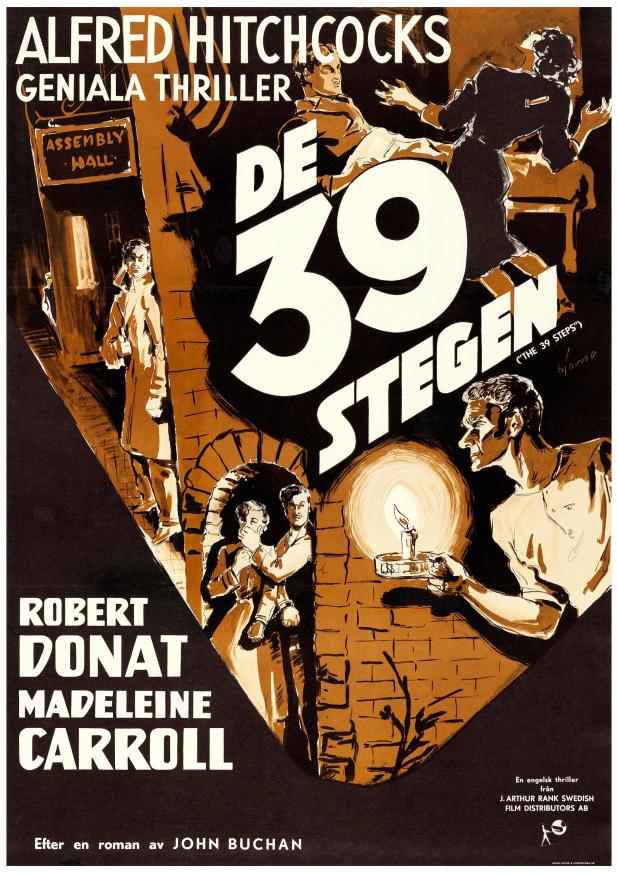
MILL CREEK LEGENDS OF HORROR: The 39 Steps (1935)

Based on The Thirty-Nine Steps by John Buchan, this is the story of Richard Hannay (Robert Donat), a normal man who somehow gets caught up in the evil deeds of spies who call themselves The 39 Steps. They’re stealing British military secrets, and when he tries to stop them, he’s accused of killing an agent. Richard has to run to Scotland, where he meets Pamela (Madeleine Carroll), falls in love and works to prove his innocence.

Like many Hitchcock movies, this is about an innocent man on the run, trying to prove that he didn’t commit a crime. It also has one of the first of many Hitchcock blondes, of which Roger Ebert said, “The female characters in his films reflected the same qualities over and over again: They were blonde. They were icy and remote. They were imprisoned in costumes that subtly combined fashion with fetishism. They mesmerized the men, who often had physical or psychological handicaps. Sooner or later, every Hitchcock woman was humiliated.”

That said, while Pamela doesn’t believe Richard and thinks he must be a criminal, she comes to his side by the end of the movie. 

Back to the writer of the original story, John Buchan. The character of Hannay would appear in five more books, which made Ian Fleming a fan, who claimed, “Without him, there is no Bond.” Another fan is Holden Caulfield and his sister Phoebe. In The Catcher In the Rye, he remembers “Her favorite is The 39 Steps, though, with Robert Donat. She knows the whole goddam movie by heart, because I’ve taken her to see it about ten times. When old Donat comes up to this Scotch farmhouse, for instance, when he’s running away from the cops and all, Phoebe’ll say right out loud in the movie, right when the Scotch guy in the picture says it, “Can you eat the herring?” She knows all the talk by heart.”

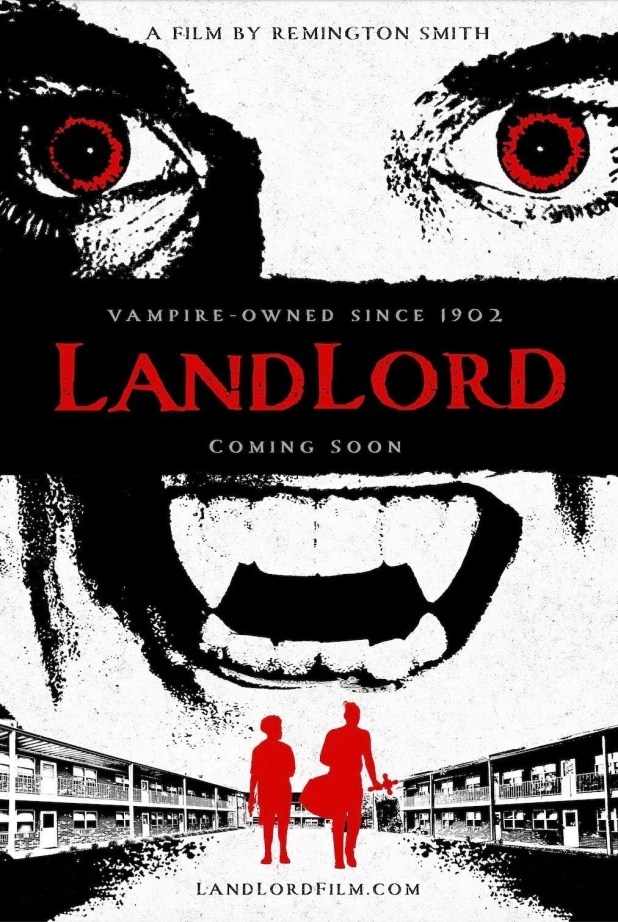
NIGHTMARES FILM FESTIVAL 2025: LandLord (2025)

ABOUT THE AUTHOR: Joseph Perry writes for the film websites Gruesome Magazine, The Scariest Things, Horror FuelThe Good, the Bad and the Verdict and Diabolique Magazine; for the film magazines Phantom of the Movies’ VideoScope and Drive-In Asylum; and for the pop culture websites When It Was Cool and Uphill Both Ways. He is also one of the hosts of When It Was Cool’s exclusive Uphill Both Ways podcast and can occasionally be heard as a cohost on Gruesome Magazine’s Decades of Horror: The Classic Era podcast.

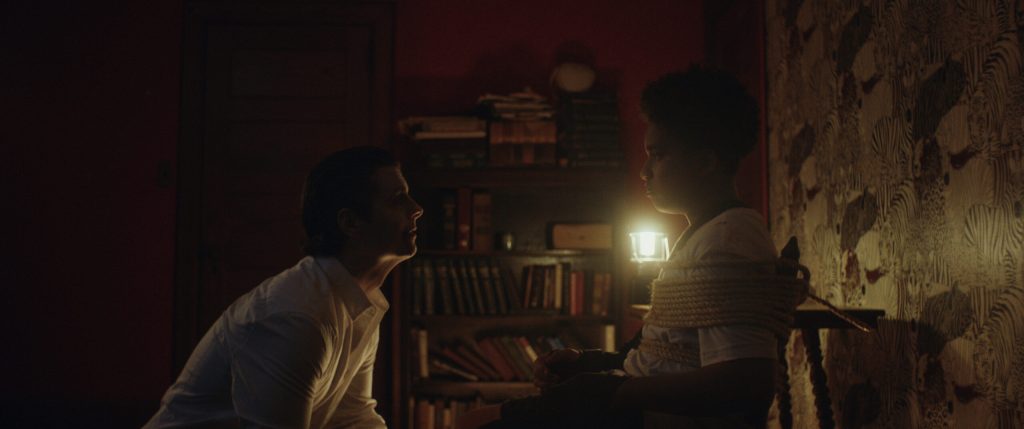
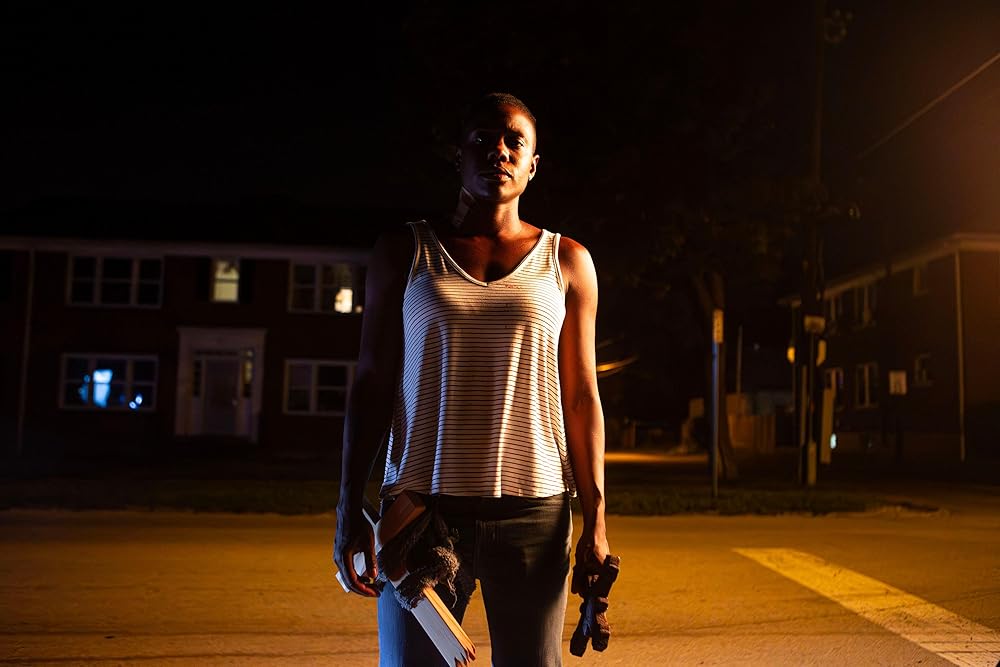
Official synopsis: A black bounty hunter moves into a rundown apartment complex, but finds herself forced to protect an orphaned boy from the white vampire landlord.

Writer/director Remington Smith’s LandLord is a gripping debut feature that blends social commentary with genre-film thrills. Although set in the present day, it has the urgency and feel of gritty 1970s drive-in features that packed a wallop of criticism along with their action and shocks. 

Adama Abramson gives an intriguing lead performance as a bounty hunter who unwillingly becomes involved in a vampire conspiracy. Cohen Cooper is solid in the second lead role as a young boy whose mother was killed by vampire John William Lawrence (William McKinney) who owns the shabby apartment building around which the film largely revolves. McKinney gives a truly chilling performance as a supernatural villain who exploits his poverty-stricken renters both financially and for their blood, draining them dry in more ways than one. 

Smith paces LandLord well, balancing the social bite and the crime and vampire themes winningly. This well-acted and well-directed feature has something to say, while always keeping the genre-cinema elements at the forefront.  

LandLord screened as part of Nightmares Film Festival, which took place October 16–19, 2025, at the Gateway Film Center in Columbus, Ohio. For more information, visit https://nightmaresfest.com/.

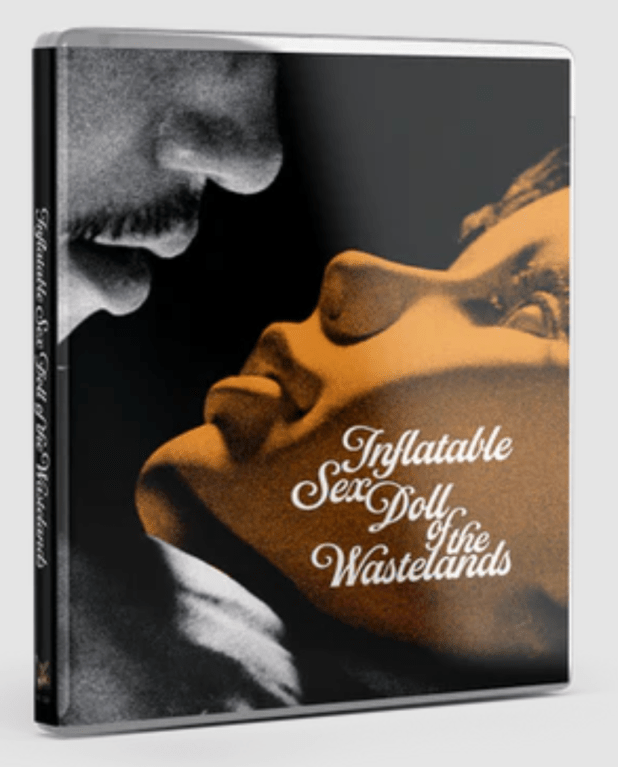
Inflateable Sex Doll of the Wastelands (1967)

ABOUT THE AUTHOR: Joseph Perry writes for the film websites Gruesome Magazine, The Scariest Things, Horror FuelThe Good, the Bad and the Verdict and Diabolique Magazine; for the film magazines Phantom of the Movies’ VideoScope and Drive-In Asylum; and for the pop culture websites When It Was Cool and Uphill Both Ways. He is also one of the hosts of When It Was Cool’s exclusive Uphill Both Ways podcast and can occasionally be heard as a cohost on Gruesome Magazine’s Decades of Horror: The Classic Era podcast.

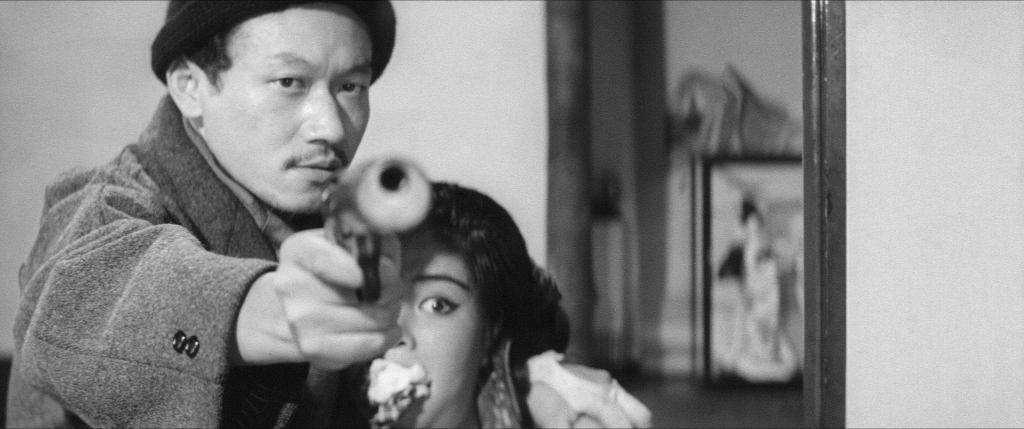
Official synopsis: A private detective is hired to find a woman who has apparently been murdered in a snuff film. It turns out the woman’s not dead, but very much alive, and he gets sucked into a torrid affair that leaves him questioning his sense of reality. An eerie, seedy, dreamlike noir with fractured, time-bending overtones of John Boorman’s Point Blank and Christopher Nolan’s Memento.

 You want odd? Writer/director Atsushi Yamatoya has you covered with Inflatable Sex Doll of the Wastelands, a black-and-white crime feature that boasts both pinku eiga and noir elements. Fair warning: This one is a roughie, with sexual assault and other forms of violence against naked and clothed (if partially so) women.  

Hitman/private eye Shō (Yūichi Minato) is hired by real estate agent Naka (Seigi Nogami) to rescue his girlfriend Sae (Noriko Tatsumi) from criminals who film their assaults on her and send the reels to Naka. Among the gang members is bar owner Kō (Shōhei Yamamoto), who assaulted and murdered Shō’s girlfriend Rie (Mari Nagisa). Shō’ finds Kō’s girlfriend Mina (Mika Watari) waiting for him at his hotel, and he roughs her up before giving in to her request for sex. Things get crazier from there — as if they weren’t enough already — and at times I wasn’t quite sure what was going on, but the insanity was so intriguing that the film had my full attention throughout. 

Yamatoya, who wrote such screenplays as Branded to Kill and Stray Cat Rock: Sex Hunter, infuses the film with disarming time jumps, arthouse experimentation, and a cool jazz soundtrack. The performances are gripping, even if there isn’t a character to feel comfortable about supporting.

Inflatable Sex Doll of the Wastelands is the type of film that you just have to give into and go along for the discomfiting, eerie ride. You may feel like you need a shower afterward, but you’ll also have seen a historical slice of genre film bravado. 

Deaf Crocodile’s restored version of Inflatable Sex Doll of the Wastelands premiered on OVID on October 17, 2025. For more information, visit https://www.ovid.tv/

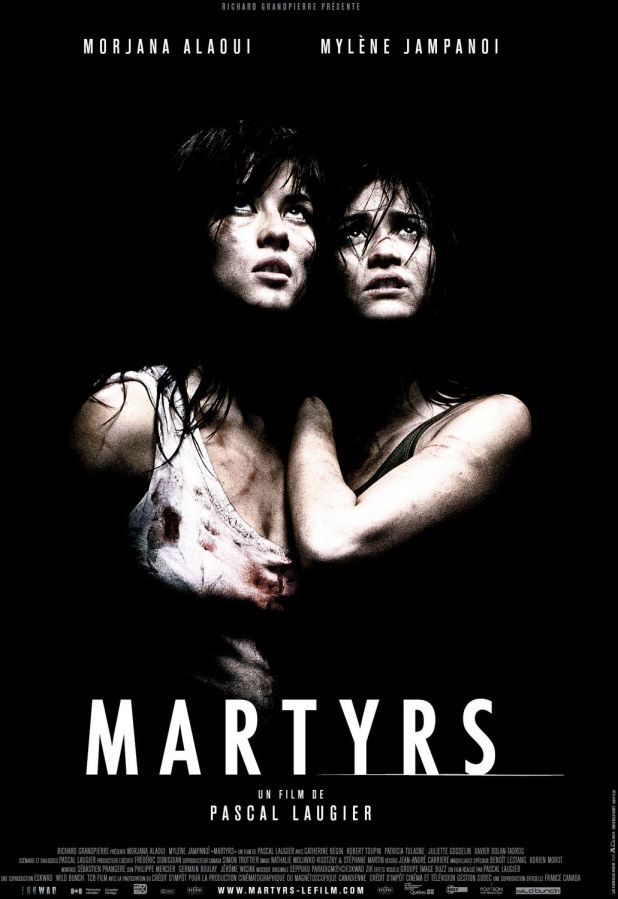
THE IMPORTANT CINEMA CLUB’S SUPER SCARY MOVIE CHALLENGE DAY 31: Martyrs (2008)

31. The Best Horror Film Ever Made You Haven’t Seen

Pascal Laugier went through a depressive episode before he made this; it may be one of the most Catholic movies ever made. It’s a movie about pain that so upset audiences that many walked out. It’s not an easy watch; it’s also a movie I’ve resisted, but this challenge finally got me to watch it.

Seriously: Wow.

Lucie Jurin (Mylène Jampanoï) barely escapes an abusive situation; at the orphanage, she bonds with another survivor, Anna Assaoui (Morjana Alaoui). Lucie has continued to abuse herself, seeing her self-mutilation as a demon attacking her. Years later, she decides to get revenge and kill a family she believes was part of her past. After she kills everyone with a shotgun — the movie does not shy from the gore — she calls Anna, who helps her clean up. The demon woman has also attacked Lucie, who needs to be stitched up. Some of the family survive, but Lucie follows them with a hammer and mutilates them; she runs outside and slashes her own throat.

The next morning, Anna learns that Lucie was right. The basement of the house contains photos of the abuse delivered there, as well as another captive. Soon, a group arrives, led by Mademoiselle (Catherine Bégin), who murders the other girl and explains that she has been seeking to create martyrs who will offer insight into the next world as they transcend due to the pain they have endured. None of their victims has ever been able to give them this insight.

As Anna is skinned while still alive, she enters an ecstatic state akin to that said to be created by saints. Mademoiselle asks her for the secrets of the next life; whatever she hears causes her to kill herself. The film ends with Anna staring into space, between life and death.

Laugier said of this movie, “Martyrs is almost a work of prospective fiction that shows a dying world, almost like a pre-apocalypse. It’s a world where evil triumphed a long time ago, where consciences have died out under the reign of money and where people spend their time hurting one another. It’s a metaphor, of course, but the film describes things that are not that far from what we’re experiencing today.”

As for the remake, directed by Kevin and Michael Goetz and written by Mark L. Smith, the original creator said, “I had a bad contract, I didn’t even get paid for it! That’s really the only thing I regret in my career: That my name is now associated with such a junk film, and I didn’t even get a cent for it! I tried to watch it, but only got through 20 minutes. It was like watching my mother get raped! Then I stopped. Life is too short. In the American system, a movie like Martyrs is just not possible – they saw my movie and then turned it into something completely uninteresting.”

I really don’t want to see that.

As someone who sat through church and heard about all the ways the martyrs died, the pain they endured and being told that this was a goal of worshippers, this movie truly hit me. It’s terrifying not for its gore but because it feels like this could happen.

You can watch this on Tubi.

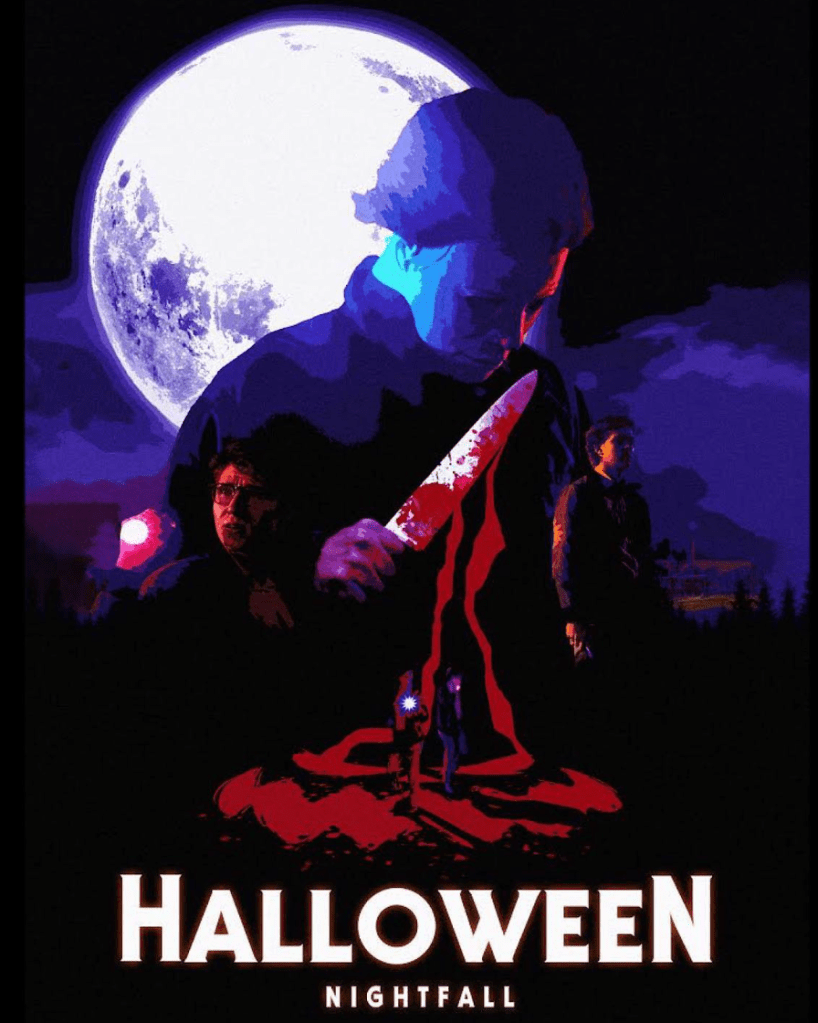
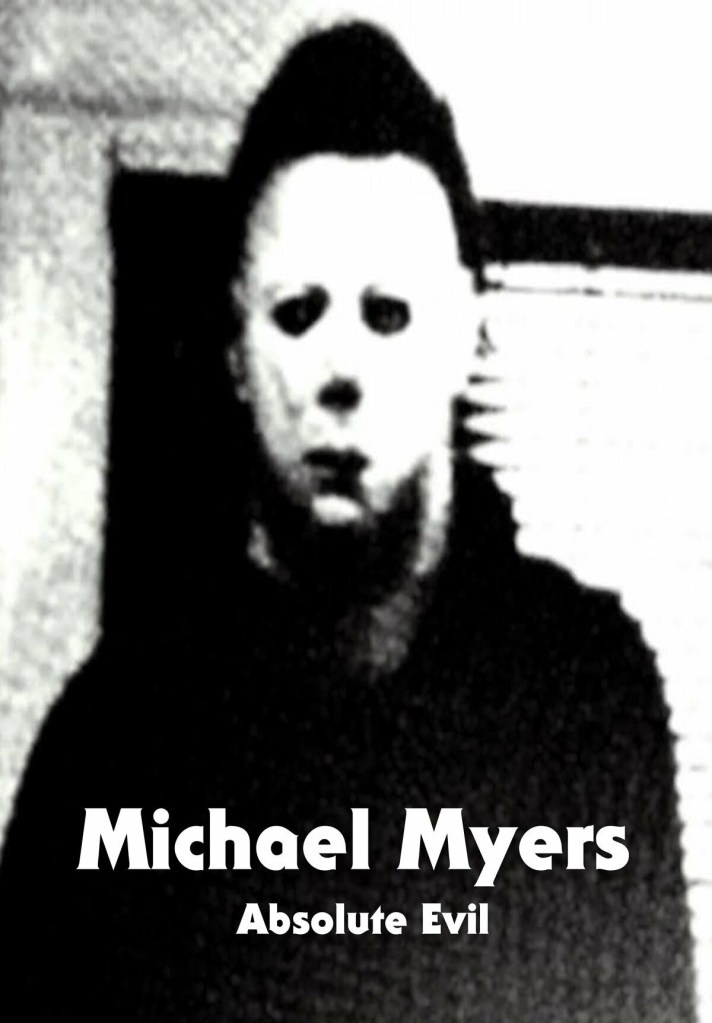
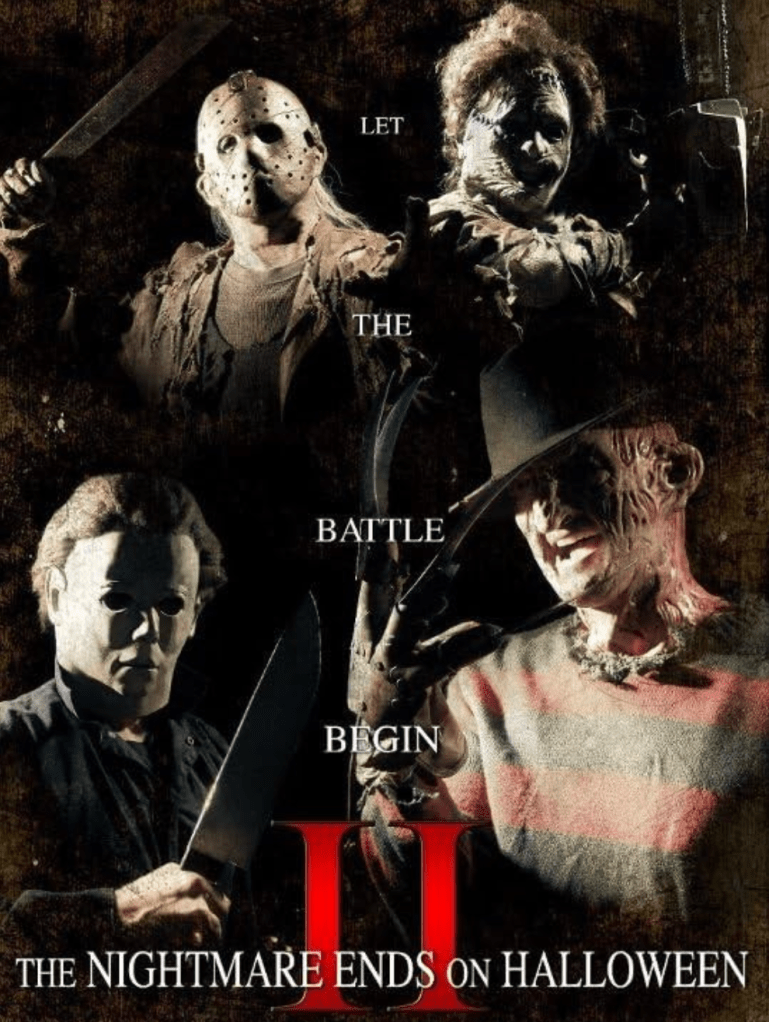
2025 Scarecrow Psychotronic Challenge Day 31: Halloween Fan Films: Halloween Nightfall (2023), Michael Myers: Absolue Evil (2016), The Nightmare Ends On Halloween II (2011)

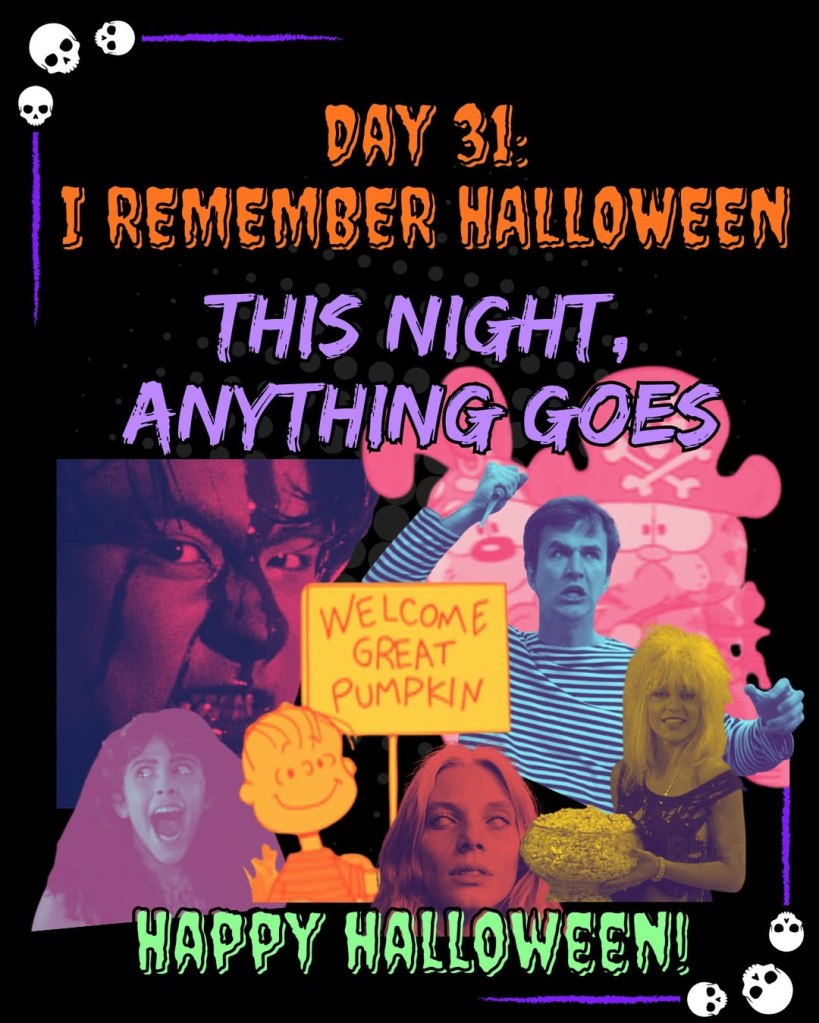
31. I REMEMBER HALLOWEEN: This night, anything goes.

I hate that in the new Halloween films, we’re told the sequels no longer exist, yet they’re still endlessly referenced. Sure, I could be happy with just watching the first two films, but every year, with every new Halloween, the movies that came before seem to get better.

Until we get a good one, there are fan films.

Halloween Nightfall is the kind of movie that you need to shut your mind off for. It tells how Michael got from Smith’s Grove to Haddonfield, but it’s not set in 1978. So you get a Scream mask, a Jason costume, an inflatable Stay Puft Marshmallow Man and “Thriller” playing in the same world where Annie, Laurie and Lynda walk home from school with the same dialogue and the same “Don’t Fear the Reaper.” And you get a way better-looking film than most streaming films, created by director Jackson Bennink.

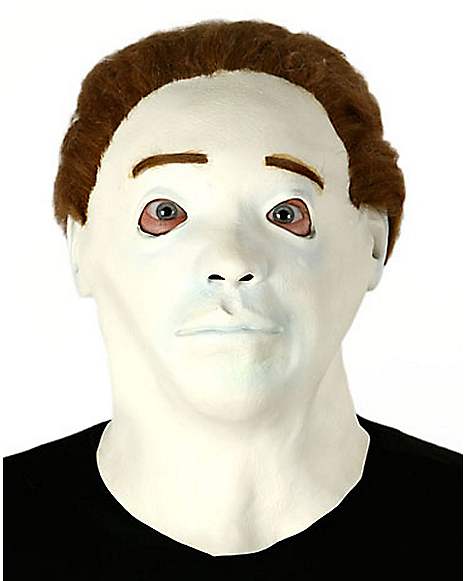
Maybe the Michael in this looks small, perhaps his mask is very Spirit Store, but the director actually took his time doing color balancing and setting up more than just medium shots the entire time, which is above and beyond what I expect for even professional streaming horror these days.

You can watch this on YouTube.

Michael Myers: Absolue Evil (2016): I hate it in true crime when they tell us that before a murder in a small town, that everyone once kept their doors unlocked and after, they knew what evil was. As this short starts, a movie that imagines the Halloween films as if they were real, we hear from Lindsay Wallace, who survived the original attack. She informs us that the entire town knew that he was just a few miles away in Smith’s Grove, at all times, so they had already lived in fear.

With experts like Edgar Warsam, the author of The Devil’s Eyes: The Story of Michael Myers, and filmmaker John Borowski, as well as a news interview with Michael’s mother Edith, director and writer Rick Gawel’s film expands on which of the movies told the right story — yes, the adaptions exist in this world — and an entire sequence that explains the Thorn cult and how it ties into the story of The Shape.

I wish this had a bigger budget; if it had a more TV-like look, it would have been perfect. That said, many of the actors are really great. The sequence that breaks down Halloween II as if it were an actual crime show is absolutely perfect. And going deep into the history of Dr. Loomis is incredible.

This could be a bit shorter and sharper, but for what it is and the budget that it had, it’s pretty good. I’d love to see this with a crew that has worked on true crime and a bit better graphic design. It’d make a great extra feature on a box set.

You can watch this on YouTube.

The Nightmare Ends On Halloween II (2011): Directed and written by Chris R. Notarile, this takes the mid-2000s idea of mixing franchises beyond what studios were ready for, creating a trial for Freddy Krueger in which he’s judged by Pinhead and forced to face off with Leatherface, Jason Voorhees, and Michael Myers.

Roberto Lombardi, who plays Krueger, has done so in several other fan films, while Hector De La Rosa, who is Jason, has also been in several Snake Pliskin fan films.

Notarile, who also did the effects for this, has also directed movies about the Black Terror, Red Widow, US Agent, Phantom Lady, Spawn, James Bond, Candyman, The Shadow, Darkman and more. You can see his movies on his YouTube page.

I love that Leatherface and The Shape are the same actor, Anthony Palmisano. Even more, I absolutely love that Freddy defeats Leatherface with a nut shot. “Fucking rednecks,” he says.

You can watch this on YouTube.

Harvest Brood (2025)


“In October 2006, the community of Briar, Alabama, was terrorized by a series of gruesome killings. This film is an account of the horrors that unfolded during that fateful autumn.”

That’s all that Joe Meredith is telling you about his latest film.

At times, this feels like a true doc. At others, a slasher. And then it feels like nothing else —a movie that approaches the SOV fuzz haze I love, a town filled with darkness, conspiracies, lost in a world that believes in nothing but decay.

There’s a moment when the strange mutant children of Briar are shown in artwork form, and it’s more frightening than any big-budget CGI that you will see this year. And now, there’s also an axe killer, heads getting sliced clean off their bodies and just a sense of dread in every frame. 

People always ask, “What movies scare you?” Joe Meredith’s movies scare me in the best of ways. Instead of falling back on his video game-infused future splatterpunk explorations, this is a totally different tone for him. There’s a final girl named Jax (Cidney Meredith) who is absolutely perfect here; I feel like Chris Farley reviewing this movie. “Remember when you cut off that head, Joe? Yeah? That was awesome.”

This begins and ends with video-distorted Halloween imagery, yet even in those, an evil baby is crying. It’s funny, because in so much horror, I see people walk toward monsters, and I never want them — or the camera — to stop getting closer. In Meredith’s films, I want a distance. I want to stay away, and yet I keep creeping closer, and when that little girl screams upon confronting the cojoined twin baby doll carrying a mutant, I feel like crying too, and the catharsis reminds me why I keep watching movies.

This is pure SOV black tar movie drugs, the kind that I wake up in another room, in the dark, thinking I’m back at my parents’ house, but no, I’m just high in the basement and don’t know how to get back upstairs. Thanks for dosing me, Joe.

You can watch this on YouTube.

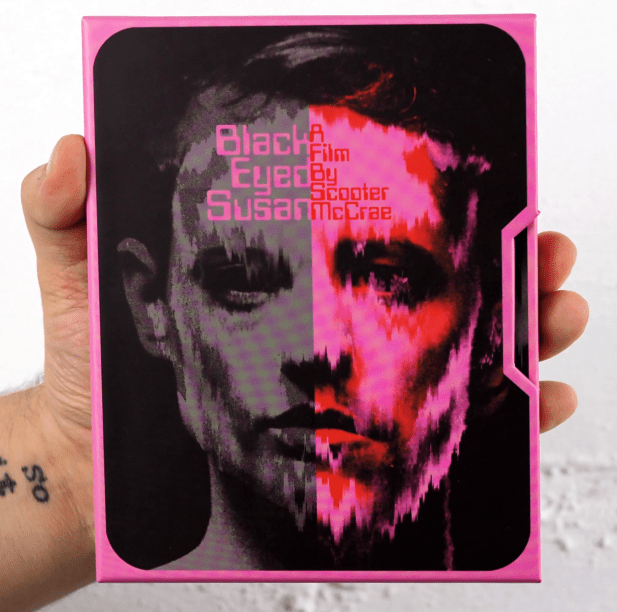
UNSUNG HORRORS HORROR GIVES BACK 2025: Black Eyed Susan (2024)

Each October, the Unsung Horrors podcast does a month of themed movies. This year, they will once again be setting up a fundraiser to benefit Best Friends, which works to save the lives of cats and dogs across America, giving pets second chances and providing them with happy homes.

Today’s theme: Viewer’s Choice

I love Scooter McCrae’s films (Sixteen TonguesShatter Dead, Saint Frankenstein), so like any band I adore — or director/writer in this case — I’m always worried when a new creation comes out from them. Definitely, if I’m a true believer of that artist, which I am with McCrae’s work. I mean, I own the script books and the Blu-rays; I’ve watched everything else he’s done multiple times. 

So while Black Eyed Susan is my least favorite of his films, that’s not a bad review. It’s still better and more thought-provoking than anything else I’ve seen this year.

Derek (Damian Maffei) is going through a rough divorce and barely getting by as an Uber driver. Then, he gets a strange offer from Gil (Marc Romeo), a childhood friend. He’s been creating an AI sex bot, one that can take the abuse that he believes men want to deliver to women. He thinks Derek, thanks to his bad marriage, alcoholism and violent nature, will be the perfect one to put the robot (Yvonne Emilie Thälker), called Black Eyed Susan by its tech team, through its paces.

We’ve already seen the robot be abused by another man — who later killed himself — earlier in the film. She is the utter definition of a lack of agency. She can’t walk; her dreams are only of her owner. All she wants to do is fuck. Even when she asks for things, it’s what she thinks her owner wants. In short, she’s the male gaze given form, but one that can’t walk and whose every moment is devoted to male pleasure, especially if that involves assault, as she’s ready to bleed from several areas, not just simulate female arousal.

What I disliked about this movie is that it thinks that BDSM sex is the same as abuse. Degradation, when consensual, is a part of the two partners’ contract and may be something they both enjoy. This suggests that all men, even those who try to be moral, only have the capacity to inflict pain. 

What I did enjoy was the 16mm filming, the Fabio Frizzi soundtrack, and so much of the idea. I wanted more; I wanted to learn what an actual relationship between Derek and Susan could be like. By the time the movie gets going, it feels like it’s already over. Thälker is also incredible in this, and I like how, for being the perfect male sex object, she has so many things that many men would be turned off by: body hair, an androgynous look, and an edge. She feels like an alien. I also enjoyed how Amanda (Kate Kiddo), one of the creators, wants to know how their sessions go. Derek seemingly is courting Susan, who keeps mentioning sex at every opportunity; it’s as if she makes him chaste by comparison.

For all the big questions this film raises, it feels like — again — it ends too quickly and too cleanly. Of course, the people who make the robots have further, darker plans. But is that any reason for Derek to give in to his rage? It feels like we’ve fast-forwarded and lost the plot a bit. That said, I’m not the filmmaker. I’d be interested to see why McCrae went in this direction.

In Anton LaVey’s Pentagonal Revisionism: A Five-Point Program, he said that Satanists should be part of significant change, including the development and production of artificial human companions. He wrote, “The forbidden industry. An economic “godsend” which will allow everyone “power” over someone else. Polite, sophisticated, technologically feasible slavery. And the most profitable industry since TV and the computer.”

In the Rolling Stone article “Symphony for the Devil,” this appears:

“On the way, LaVey talked about androids, his favorite hobbyhorse. He has spent years working on his own android prototypes—his mannequins—preparing for the day when the science of robotics will enable industry to begin producing artificial human companions. ”The forbidden industry,” he called it. “Polite, sophisticated, technologically feasible slavery.” Most of his dolls are store mannequins with their faces sawn off, replaced by latex impressions of his friends’ faces.

“I sculpted one entirely out of polyurethane foam,” LaVey said as we edged across the bridge through the fog. “I inhaled all those fumes trying to create a realistic woman with actual sexual parts. I put so much of my personal fetishistic desire into it that I became like Pygmalion. I kept expecting her to show up on my doorstep.”

“Do you have sex with your dolls?” I asked.

Pause.

“I tried to,” he said. “It was going to be my great test run. Just as I was entering her, the damn room started shaking. An earthquake hit. I figured it was God’s way of telling me something. So I ceased”—he laughed—“my activities of the moment.”

LaVey turned suddenly solemn. “When I say ‘God’, you know, it’s just a figure of speech.””

This feels like it only scratches the surface of what could be, but as I said, with a creator this talented, that may be enough.

You can get this from Vinegar Syndrome.
CHILLER THEATER MONTH: Invaders from Mars (1953)

EDITOR’S NOTE: Invaders from Mars was on Chiller Theater on Saturday, March 12, 1966 at 11:20 p.m.; Saturday, August 5, 1967 at 11:20 p.m.; Saturday, January 4, 1969 at 11:30 p.m.; Saturday, April 5, 1969 at 11:30 p.m.; Saturday, October 20, 1979 at 1:00 a.m. and Saturday, July 23, 1983 at 2:00 a.m.

Directed by William Cameron Menzies and written by Richard Blake, Invaders from Mars was made in a hurry to beat George Pal’s War of the Worlds to theaters. It worked; Steven Spielberg, Joe Dante, Martin Scorsese, and John Landis have all said it was an influence. 

David MacLean (Jimmy Hunt) wakes up to a thunderstorm and sees a UFO. His father, George (Leif Erickson), goes to investigate, and when he comes back, he’s not the same person. He tells David and his mother (Hillary Brooke) that there was no flying saucer. The cops arrive and tell David the same thing. As for the other kids, one of them, Kathy (Janine Perreau), disappears after the spaceship lands, then comes home and burns her house down. 

Only Dr. Pat Blake (Helena Carter) believes him. Working with Dr. Stuart Kelston (Arthur Franz) and Col. Fielding (Morris Ankrum), she realizes that the aliens are in town to take our nukes. Anyone controlled by the aliens has devices in their heads that cause their heads to blow up real good, but despite Martian rays and technology, good old-fashioned U.S. war mania wipes them out. Or so we believe, but it all turns out to be a dream, with David waking up to the UFO landing all over again.

The Martian leader is played by Luce Potter. She was also one of the Munchkins in The Wizard of Oz (1939) and said that she received letters from adults telling her how much she had scared them when they were kids.

I enjoy this one and love the Tobe Hooper remake even more.

You can watch this on Tubi.

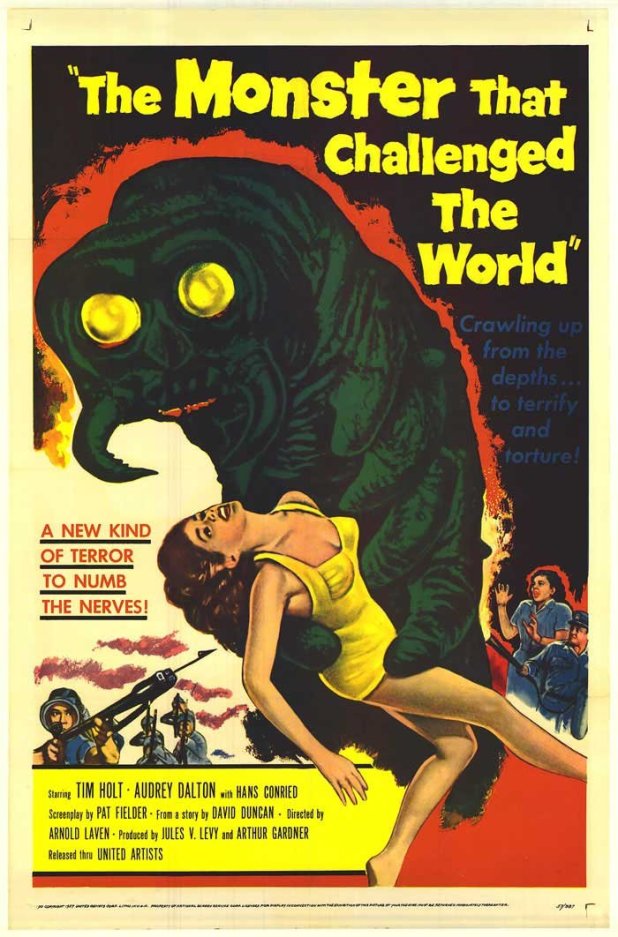
CHILLER THEATER MONTH: The Monster That Challenged the World (1957)

EDITOR’S NOTE: The Monster That Challenged the World was on Chiller Theater on Sunday, November 3, 1963 at 11:10 p.m.

Director Arnold Laven went from the mail room at Warner Brothers to producing The Rifleman and The Big Valley, as well as directing other movies. With a script by David Duncan and Pat Fielder (The VampireThe Return of Dracula), this finds an earthquake opening the ocean floor and unleashing prehistoric giant mollusks. Only Lt. Cmdr. John “Twill” Twillinger (Tim Holt) can stop them, along with Gail MacKenzie (Audrey Dalton), her daughter Sandy (Mimi Gibson) and Dr. Jess Rogers (Hans Conried).

Shot in 16 days, this features an actual-size monster, which helps the movie. It’s based on fact: in 1955, freshwater shrimp appeared in a once-dry Mojave Desert lake. This has it all, and by all, I mean slime and giant eggs, as well as people being eaten by these huge monsters. Will the hero win the widow’s heart? Will a morgue doctor eat food over the dead body he’s doing an autopsy on? Will giant snails blow up real good?

You know it.

You can watch this on YouTube.

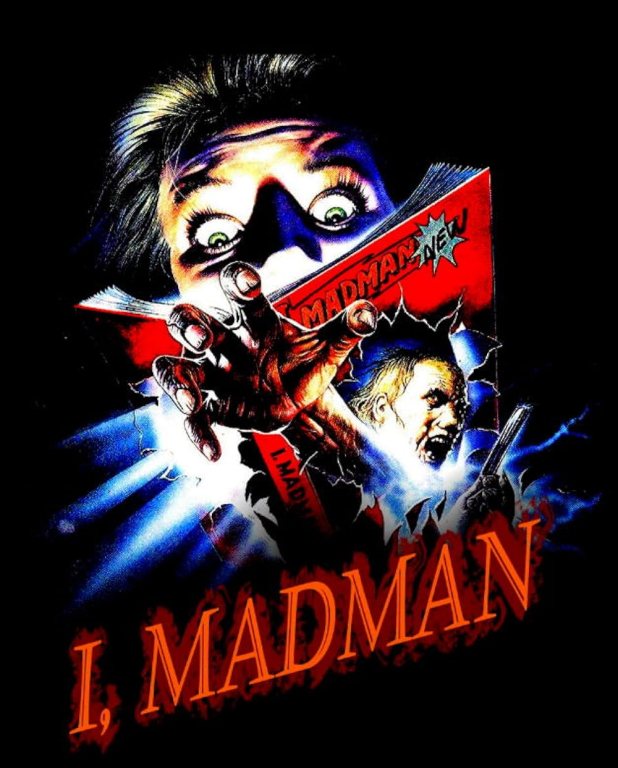
UNSUNG HORRORS HORROR GIVES BACK 2025: I,Madman (1989)

Each October, the Unsung Horrors podcast does a month of themed movies. This year, they will once again be setting up a fundraiser to benefit Best Friends, which works to save the lives of cats and dogs across America, giving pets second chances and providing them with happy homes.

Today’s theme: Viewer’s Choice

ABOUT THE AUTHOR: Adam Hursey is a pharmacist specializing in health informatics by day, but his true passion is cinema. His current favorite films are Back to the Future, Stop Making Sense, and In the Mood for Love. He has written articles for Film East and The Physical Media Advocate, primarily examining older films through the lens of contemporary perspectives. He is usually found on Letterboxd, where he mainly writes about horror and exploitation films. You can follow him on Letterboxd or Instagram at ashursey.

We’ve come to the final page in the last chapter of Horror Gives Back. Before I close the book on another successful journey through horror films I’ve watched for the first time, I’ve saved one of the best for last—Tibor Takács’ I, Madman.

By 1989, horror had pretty much run its course at the box office. Jason may have been taking Manhattan, but he grossed less than 15 million. Freddy didn’t fare much better with The Dream Child, garnering about 22 million dollars. The top grossing horror film of 1989? Pet Sematary with 57 million, slightly less than that Al Pacino film Sea of Love. Audiences were much more interested in spending money on action and family-oriented movies than horror. Perhaps the true horror was yet to come in the next decade.

As far as I, Madman’s box office, it is non-existent. After a regional release, the film was dumped on home video, as so many films were in those days. Eventually, it has taken on a bit of a cult following it seems. With one eye looking in the past and one eye looking forward, I, Madman combines the 1950s nostalgia so many films hoped to capture and pulled it into the turn of the decade.

The film follows Virginia (Jenny Wright), an aspiring actress who works at a local bookstore. She has come across an old book entitled Much of Madness, More of Sin, written by someone named Malcolm Brand. The main character of this novel forms an obsession around an actress named Anna. She does not care for his face, so he decides to just cut off all of his features. His nose. His ears. His lips. His scalp. You know, as one does when one is rejected by a woman.

Unable to find Brand’s follow up novel, I, Madman, Virginia is dejected, but, amazingly, she finds the book at the doorstep to her apartment. In this novel, the character is back, harvesting those body parts he had removed from unsuspecting victims in order to graft them onto his own body. But suddenly, fiction becomes reality, as Virginia begins witnessing murders and is haunted by the man from the novel. Could the events have truly leapt from the page? Or is Virginia experiencing some sort of psychotic break? The fantastical ending perhaps poses more questions than answers.

I, Madman does a fantastic job of combining two worlds: the seediness of a 50s pulp novel, complete with a film noir feel, and a bit of a neo-noir, as Virginia’s boyfriend, Richard (Clayton Rohner), is a detective on the case, torn between solving the crime and believing his girlfriend. Surprisingly, he does not totally dismiss Virginia’s claims. Add a touch of Rear Window, stop motion effects that you never see anymore, and some of the best production design of any film in the late 80s, and a cult classic is born.

I find myself guilty of saying clichés like “they just don’t make films like this anymore”. Truth is, they never made films like I, Madman. It’s almost singular in its originality. Filmmakers are not allowed to take these chances anymore unfortunately. Thus, I do not find modern horror to be that interesting. Like Virginia, I find myself scouring the past for content that lights up my imagination. Luckily, I’m not sure that I will ever hit bottom, as I keep finding fantastic films year after year. 

I can probably start making my Horror Gives Back list for next year. Note to self: add The Gate to films to try to squeeze into a category. I suddenly need more Tibor Takács in my life.