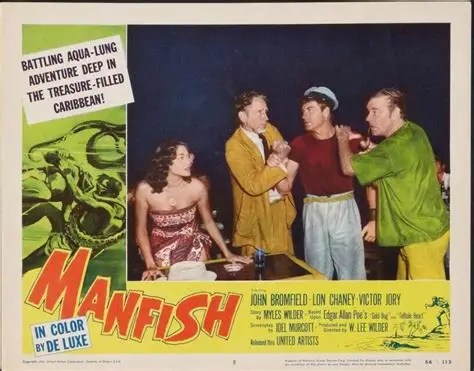
MILL CREEK LEGENDS OF HORROR: Manfish (1956)


Based on “The Gold-Bug” and “The Tell-Tale Heart” by Edgar Allan Poe, this at least has a great title. In the U.S., at least, as it was sold as Calypso in Great Britain.

Directed by W. Lee Wilder (Billy’s brother) and written by his brother Myles and Joel Murcott, this begins with Inspector Warren (Jack Lewis) coming to Jamaica to arrest a criminal known only as the Professor (Victor Jory). There’s also a captain named Brannigan (John Bromfield) who has won a ship called Manfish and the service of its first mate, Swede (Lon Chaney Jr.). Brannigan notices the ring the Professor wears and links it to a treasure map he finds, sending everyone to an island in search of the booty of pirate Jean Lafitte. Also: Brannigan wants the Professor’s woman, Alita (Tessa Prendergast, who would go on to design Ursula Andress’ bikini in Dr. No). Plus, you get another good-looking lady, Mimi (Barbara Nichols, The Human Duplicators). 

A lot of this movie finds the crew of the Manfish — “Big Boy” (Theodore Purcell) and Domingo (Vincent Chang) — turtle hunting. There’s also music by Clyde Hoyte and the Calypsos, and you’ll wonder, how do they get Poe into this? At least Chaney is good, all sweaty and drunk, but still wonderful.

You can watch this on YouTube.

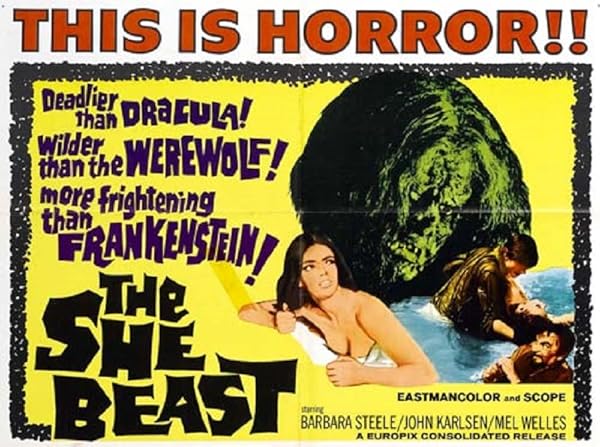
MILL CREEK LEGENDS OF HORROR: The She Beast (1966)

Michael Reeves only directed three movies: this film, The Sorcerers and Witchfinder General. He also had something to do with Castle of the Living Dead* and assisted Don Siegel, worked for Jack Cardiff on The Long Ships and for Henry Levin on his movie Genghis Khan.

Made in 21 days for hardly any money — even when Barbara Steele made $1,000 for one day of work, that day was 18 hours long — and most of the crew is in the movie. Reeves also wrote the script, along with F. Amos Powell and Mel Welles (the director of Lady Frankenstein), under the name Michael Byron.

Two hundred years ago in Transylvania, a witch named Vardella was burned at the stake, but not before threatening to come back for revenge. This would end up ruining the honeymoon of Philip (Ian Ogilvy) and Veronica (Barbara Steele) and that’s not even counting the squalid hotel owned by Ladislav Groper (Welles).

As they enjoy breakfast, Count Von Helsing (John Karlsen) delights in sharing the legend of Dracula and the story Vardella. Well, those foreigners have no interest in this weird old man and blow him off. That night, Phillip catches Groper peeping on his wife and beats him into oblivion. If that doesn’t make this a rough wedding getaway, he wrecks their car into a lake and when they pull out his new bride, it’s the dead body of the witch instead of the gorgeous Steele.

Now, Phillip has to make nice with Von Helsing and be part of his plan to take this dead body, drug it and perform an exorcism to get his wife back. It seems like a lot of work, but I’ve done so much more for women who couldn’t stand in the brightness of Steele’s flawless alabaster skin.

How do you kill a witch? You drown it. That’s also how you find out if someone is a witch.

This played double features in America — distributed by American-International Pictures — with The Embalmer

*Depending on who is asked, Reeves either did minor second unit work, a polish on the script’s dwarf character, a complete takeover of the movie or nothing at all.

You can watch this on YouTube.

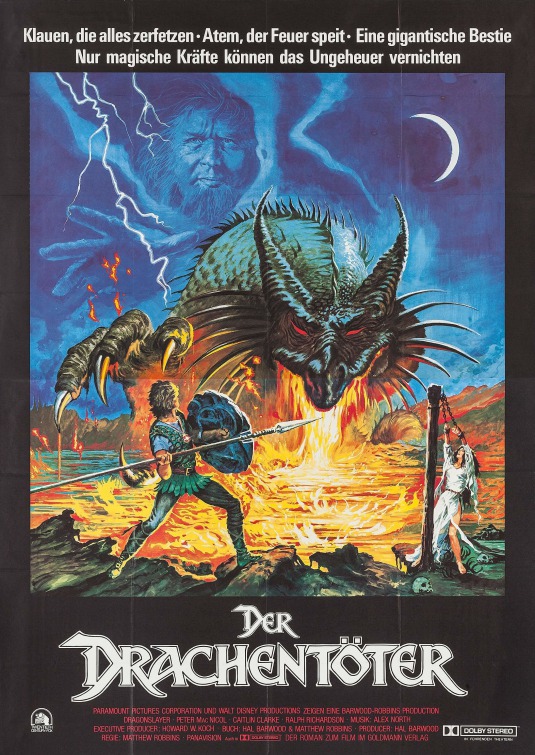
WEIRD WEDNESDAY: Dragonslayer (1981)

After Popeye, this was the second joint Paramount production with films more mature than the expected Disney offerings. That meant Dragonslayer’s violence, themes, and even brief nudity became controversial, despite its PG rating.

Set after the Roman departure from Britain, before the arrival of Christianity, the film presents a world of sorcery unlike many others in the genre. Co-writers Hal Barwood (who also wrote The Sugarland ExpressThe Bingo Long Traveling All-Stars & Motor KingsMacArthur and Corvette Summer, as well as writing and directing Warning Sign and creating video games like Indiana Jones and the Fate of Atlantis) and Matthew Robins (who wrote Crimson Peak and wrote and directed *Batteries Not Included and I would be remiss not to mention that he also directed The Legend of Billie Jean) were inspired to make something new. Barwood said, “Our film has no knights in shining armor, no pennants streaming in the breeze, no delicate ladies with diaphanous veils waving from turreted castles, no courtly love, no holy grail. Instead, we set out to create a bizarre world with a lot of weird values and customs, steeped in superstition, where the clothes and manners of the people were rough, their homes and villages primitive, and their countryside almost primeval, so that the idea of magic would be a natural part of their existence.”

Vermithrax is also one of the best dragons ever made, even forty years after the film’s release. More than 25% of the movie’s budget went to realizing the dragon. This was the first movie to use go-motion, in which parts of the mechanical dragon were programmed and filmed by computer. The forty-foot-tall beast was brought to life by sixteen puppeteers. Its full name — Vermithrax Pejorative — means The Worm of Thrace Which Makes Things Worse.

As for the story, it’s all about Galen Bradwarden (Peter MacNicol, who is embarrassed by this movie, perhaps because you can fully see his ween in it) saving Valerian (Caitlin Clarke) from being a virgin sacrifice to the dragon. She’s no damsel in distress, however, as she’d hidden her gender identity to help create the sword that can destroy the beast.

But yeah. It’s worth watching for just the dragon.

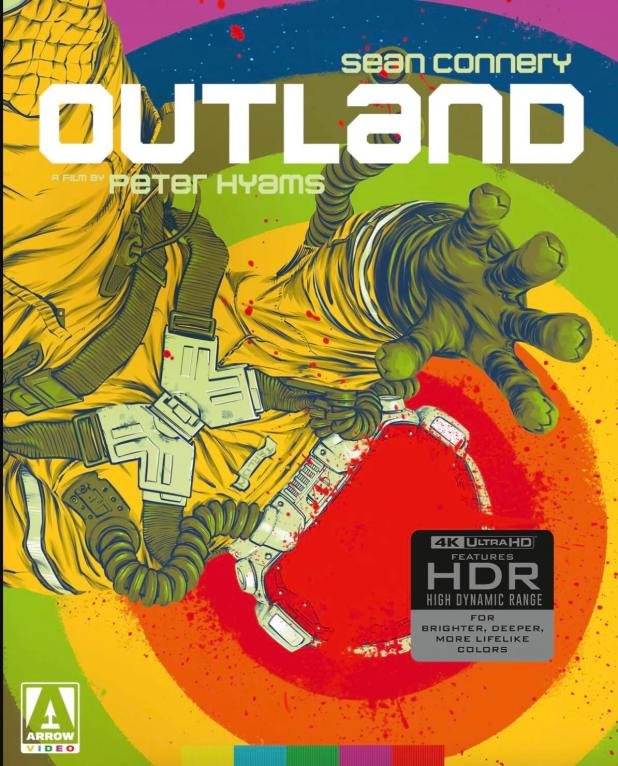
ARROW VIDEO 4K UHD RELEASE: Outland (1981)

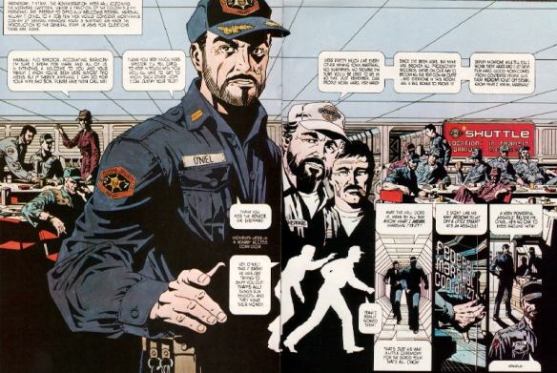
Federal Marshal William O’Niel (Sean Connery) has been assigned to the titanium ore mining outpost Con-Am 27, operated by the company Con-Amalgamate on the Jovian moon of Io. It’s rough work in a place where gravity a sixth of Earth’s with no breathable atmosphere and the men are forced to work in heavy spacesuits with hardly any air. But there is money and productivity is up ever since the new manager, Mark Sheppard (Peter Boyle), was hired.

O’Niel is left behind with his wife and son leaving for Jupiter, but he does have a mission. That’s because several miners have died from getting stimulant psychosis and tearing off their suits. That may be because the miners are abusing polydichloric euthimal, a drug that allows them to stay awake for days at a time. The side effect? After ten months, they go insane.

With only one person on his side — Dr. Lazarus (Frances Sternhagen) — O’Niel has to battle the corrupt mining company and their men, many of whom don’t want a chance to their way of life, no matter how wrong it is.

Outland is pretty much a Western in space, directed and written by Peter Hyams, who told Empire, “I wanted to do a Western. Everybody said, “You can’t do a Western; Westerns are dead; nobody will do a Western.” I remember thinking it was weird that this genre that had endured for so long was just gone. But then I woke up and came to the conclusion – obviously after other people – that it was actually alive and well, but in outer space. I wanted to make a film about the frontier. Not the wonder of it or the glamour of it: I wanted to do something about Dodge City and how hard life was. I wrote it and by great fortune Sean Connery wanted to do it. And how many chances do you get to work with Sean Connery?”

If you love this movie, I recommend the comic book adaptation by James Steranko.

The Arrow Video 4K UHD of this film has a new 4K restoration from the original 35mm camera negative by Arrow Films, an archive audio commentary by writer-director Peter Hyams, a new audio commentary by film critic Chris Alexander, interviews with Hyams, director of photography Stephen Goldblatt and visual effects artist William Mesa, appreciations and visual essays by Josh Nelson and Howard S. Berger, a trailer, an image gallery, a reversible sleeve featuring original and newly commissioned artwork by Pye Parr, a double-sided foldout poster featuring original and newly commissioned artwork by Pye Parr and an illustrated collector’s booklet featuring new writing by film critics Priscilla Page and Brandon Streussnig.

You can get it from MVD.

ARROW 4K UHD AND BLU RAY RELEASE: Teenage Mutant Ninja Turtles Trilogy

A shell-shocking saga of mutants, martial arts and New York mayhem, the Teenage Mutant Ninja Turtles trilogy brought comic book grit, practical effects wizardry and pizza-fueled fun to a generation of moviegoers, helping turn four sewer-dwelling brothers into global pop culture icons.
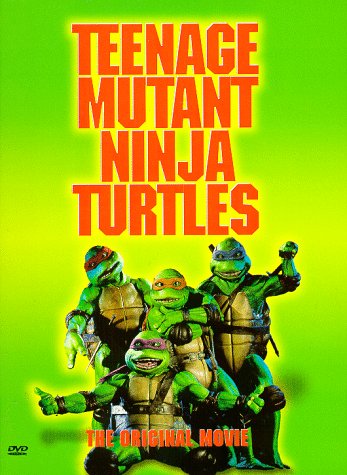
Teenage Mutant Ninja Turtles (1990): Before the internet, geeks like me read the Comics Buyer’s Guide Magazine — I devoured every tabloid-sized issue — and learned what new books were worth reading. Teenage Mutant Ninja Turtles, created originally as a joke sketch of a turtle with nunchucks by Kevin Eastman and named “teenage mutant” by Peter Laird, was a black and white comic packed with violence that hit the cultural zeitgeist of the late 80s. It hit all the trends of comics, like the teenage angst of X-Men and Teen Titans along with the ninjas of Daredevil. In fact, the same canister of radioactive material that gave Matt Murdock his radar sense is what turned four baby turtles into Leonardo, Michaelangelo, Donatello and Raphael.

Who knew that a few years later, they’d be the biggest cartoon and toy around?

In 1990, the movie came out, and yes, it has a lot of the kid elements of the cartoon, like the love of pizza, April O’Neil (Judith Hoag) being a reporter, and Michelangelo behaving like a surfer dude. But so much of the film comes directly from the first issue of the comic. And it has martial arts in its soul, as it was produced by Golden Harvest.

Every major studio turned it down for distribution, including Walt Disney Pictures, Columbia Pictures, Universal Pictures, MGM/UA, Orion Pictures, 20th Century Fox, Paramount, and Warner Bros., before New Line took a chance. It paid off, as its $32 million was the second-highest opening weekend at the time — behind Batman — and ended up being the ninth biggest movie of 1990.

The complicated turtle costumes took 18 weeks each to be created by Jim Henson’s Creature Shop. Henson said that the creatures were the most advanced that he had ever worked on. But they work — you really start to believe in the characters more than you do in the later CGI efforts.

The film begins with the four Turtles — Leonardo (Brian Tochi, Revenge of the NerdsPolice Academy 3 and 4), Raphael (Josh Pais), Donatello (pop culture force Corey Feldman) and Michelangelo (Robbie Rist, Cousin Oliver) — working for the sewers and the shadows to protect New York City — but actually North Carolina — and saving the life of April.

Leo is closest to their sensei, Splinter (former Elmo Kevin Clash); Don is the inventor; Mike is the partier; and Raph is filled with rage, which leads him to battle street vigilante Casey Jones (Elias Koteas).

Above I just listed the voices, but it took so many talents to bring the characters to life.

Inside the Leonardo suit was David Forman, an Olympic tumbler and stuntman, with Martin P. Robinson controlling the face. He is also Mr. Snuffleupagus and designed, built, and played Audrey II in Little Shop of Horrors. Leif Tilden was Donatello; he also performed several characters on Henson’s Dinosaurs show. He was supplemented by Ernie Reyes Jr. for martial arts scenes, skateboarder Reggie Barnes for skate scenes and facial movements by David Rudman. Michelangelo was a Broadway performer, Michelan Sisti, with facial movements by Mak Wilson. Raphael was performed by his voice actor, Josh Pais, with David Greenaway handling the facial animation, and Kenn Troum handling the fighting scenes. Splinter was puppeteered by Clash, who also provided his voice, with Rickey Boyd handling the face animation, and movement assisted by Robert Tygner.

The Turtles are in battle against a ninja clan known as The Foot — Daredevil fought The Hand — which is led by Oroku Saki, known as the Shredder (James Saito), the man who killed Splinter’s master, Tatsu. Yes, the “radical rat” used to watch his master do karate and picked it up. When he found the four mutated baby turtles in the sewer, he saved them and taught them how to become ninja.

The Foot Clan has some major actors in its employ. Look for Sam Rockwell as an unmasked member and Skeet Ulrich and Scott Wolf under hoods.

In the UK and Germany, this movie was known as Teenage Mutant Hero Turtles, and the violence is toned down. Also, Mike’s nunchaku aren’t shown, since that weapon is always censored. The German version goes even further, adding cartoon sound effects to all the fight scenes.

This was directed by Steve Barron (who also made Electric DreamsConeheads and the music videos for “Billie Jean” by Michael Jackson, “Take On Me” by a-ha and “Don’t You Want Me” by The Human League) and written by Bobby Herbeck, who had the original idea of making the movie, and Todd W. Langen, who did a Page One rewrite of the original script.

Sally Menke, who edited all of Quentin Tarantino’s movies until she died in 2010, was the original editor of this film, but Golden Harvest removed her because they didn’t like her work. Weird, huh?

Trust me, I was a big fan. I bought every single Playmates toy, had all the comics, and watched every episode of the show, but my heart was in the original black-and-white comics. That’s why I love the first film: while it’s made kid-friendly, it still has so much of that look and feel.
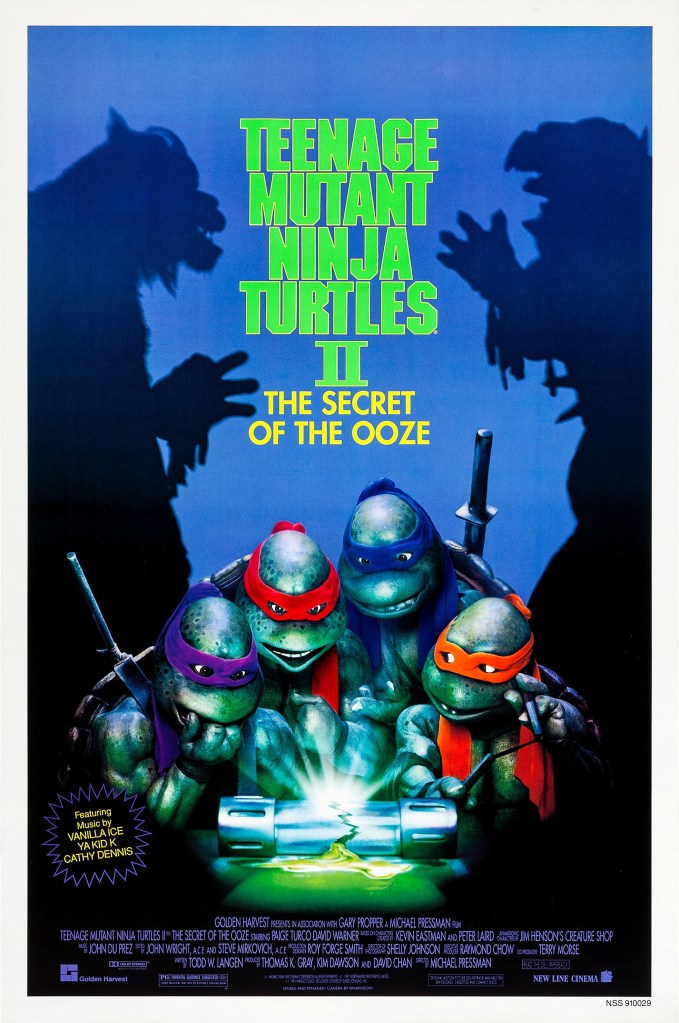
Teenage Mutant Ninja Turtles II: The Secret of the Ooze (1991): Directed by Michael Pressman (who is still directing episodes of Law and Order today, but also made Some Kind of HeroDoctor Detroit and The Great Texas Dynamite Chase) and written by Todd W. Langen, who also wrote the first film, the second Ninja Turtles movie toned down the violence, mostly removed the weapons from the turtle’s three fingered hands and was much more kid-like than the original. I mean, Vanilla Ice raps “Ninja Rap” at one point.

They also had twice the original budget and, at the time, ended up the second-highest-grossing independent film ever, behind the first movie.

Brian Tochi and Robbie Rist returned as Leo and Mike, while Adam Carl replaced Corey Feldman as Don and Laurie Faso replaced Josh Pais as Raph. Leo would now be played by Mark Caso, with Rob Tygner as the facial assistant and Larry Lam as the stunt double. Mike was Michelan Sisti with Mak Wilson as the face and Nick Palma doing stunts. Don was Leif Tilden, with Rob Mills moving the face and Steven Ho doing the fighting. Raph was Kenn Troum with David Greenaway as the facial assistant, and Hosung Pak did the stunts. He played Liu Kang in the first two Mortal Kombat games and was one of the fighters on WMAC Masters. Kevin Clash would return to voice and puppet Splinter with assistance from Rickey Boyd and Sue Dacre.

As Shredder died at the end of the last film, the Foot Clan would be led by Tatsu (Toshishiro Obata) before bringing their leader (François Chau replacing James Saito) back to life and transforming him into Super Shredder (wrestling genius Kevin Nash). They also gain two new mutants: an evil turtle named Tokka — Kurt Bryant in the suit, with Rick Lyon animating the face and David Rowden doing the stunts — and the wolf-like Rahzar — Mark Ginther in the costume, with Gord Robertson animating the face and Hamilton Perkins doing the stunts. Both of these new villains were voiced by Frank Welker, who, if you want an animal voiced in your movie or cartoon, you go to.

The new mutants were used instead of the cartoon’s Bebop and Rocksteady, who co-creator Peter Laird hated and said, “their constant one-note shtick in the first animated series was extremely annoying and silly to the point of being stupid.”

Paige Turco would replace Judith Hoag as April O’Neil, and Casey Jones doesn’t even show up.

Needless to say, I didn’t like this as much as the first, even if I love the look of the bad guys in the film.

What I do like is David Warner being in this as ooze expert Professor Jordan Perry, and Ernie Reyes Jr. getting to be in the movie in a turtle costume. And yes, Tokka, Rahzar and Super Shredder are all amazing, but come on. Ninja rapping.
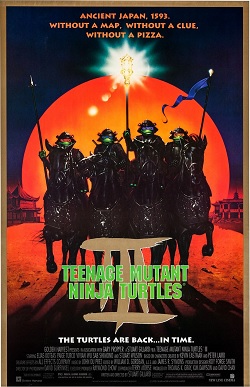
Teenage Mutant Ninja Turtles III (1993): If the first movie is close to the comic with some kid elements and the second backs off from that, the third Teenage Mutant Ninja Turtles movie goes all in on silliness, as the turtles go back in time to feudal Japan and switch places with the honor guard of Lord Norinaga (Saburo Shimono).

It’s all because of some things that April O’Neil (Paige Turco) buys at a flea market, including a scepter for Master Splinter. At least Casey Jones (Elias Koteas) gets to be in this one, even if he just sits around for most of the movie.

Only Brian Tochi (Leonardo) and Robbie Rist (Michelangelo) did voices for all three of the original movies, but Corey Feldman returned as Donatello, and Tim Kelleher is Raphael, with James Murray taking over as the voice and puppeteer of Splinter.

Co-creator Kevin Eastman said of this movie, “What we tried to do with the third movie was to make it as good a story as we could. We went through a painstaking level of dos and don’ts, what they could and couldn’t do. We wanted something that would be good for all ages again. I call movie one the best, movie two the worst, and movie three halfway in between.” A lot of the ideas in this come from the “Masks” story in issues 46 and 47 of the original comics. The time scepter looks a lot like the one that Renet, the apprentice timestress of Lord Simultaneous, uses.

What we do get to see is the Turtles helping Lord Norinage’s son, Kenshin (Henry Hayashi), and his lover, Mitsu (Vivian Wu), stop the war between villages and Walker’s (Stuart Wilson) sale of guns to the samurai. The whole idea of not changing time is never even considered by this movie.

The costumes were made by All Effects Company instead of Jim Henson’s Creature Shop. I guess Golden Harvest was pretty much done with the movies by this point and didn’t feel like spending much.

This was directed by Stuart Gillard, who wrote the script with Turtles creators Eastman and Laird. He also directed Lost Boys: The ThirstWar Games: The Dead Code, the remake of The Initiation of Sarah and the Disney movie Girl vs. Monster.

The Arrow Video release of these movies has brand new 4K restorations of all three films by Arrow Films; a perfect bound collector’s booklet in the style of a Roy’s Pizza menu, featuring new writing on the movie by Simon Ward, John Torrani and John Walsh; reversible sleeves featuring original and newly commissioned artwork by Matt Frank and Roberto Rivera Padro; a double-sided foldout poster featuring original artwork from Teenage Mutant Ninja Turtles and the “Map of the Kappa Realm”, a stylised re-creation of the ancient scroll that appears in Teenage Mutant Ninja Turtles III; two additional double-sided foldout posters featuring original and newly commissioned artwork by Matt Frank and Roberto Rivera Padro; eight character trading cards; a Roy’s Pizza loyalty card and four character stickers.

Teenage Mutant Ninja Turtles has a new 4K restoration of the film from the original camera negative by Arrow Films approved by director Steve Barron, two audio mixes, new commentary with director Steve Barron and another by comic book expert and podcast host Dave Baxter; interviews with Barron, Robbie Rist, Brian Tochi, Ernie Reyes Jr., Judith Hoag, Brian Henson and Rob Tygner. There’s also the UK version, an alternate ending, alternate Korean footage, trailers, an image gallery and a feature on the film’s locations.

The second film features a 4K restoration of the movie from the 35mm interpositive by Arrow Films, new commentary with director Michael Pressman, moderated by filmmaker Gillian Wallace Horvat, interviews with John Du Prez, Kenny Wilson, and Steve Mirkovich, an archival feature, plus a trailer and an image gallery.

The third movie has a 4K restoration of the film from the 35mm interpositive by Arrow Films, new commentary with director Stuart Gillard, interviews with Sab Shimono and Vivian Wu, an alternate UK opening, a trailer and an image gallery.

You can get the 4K UHD and Blu-ray box sets from MVD.
MILL CREEK LEGENDS OF HORROR: Deathhouse (1972)

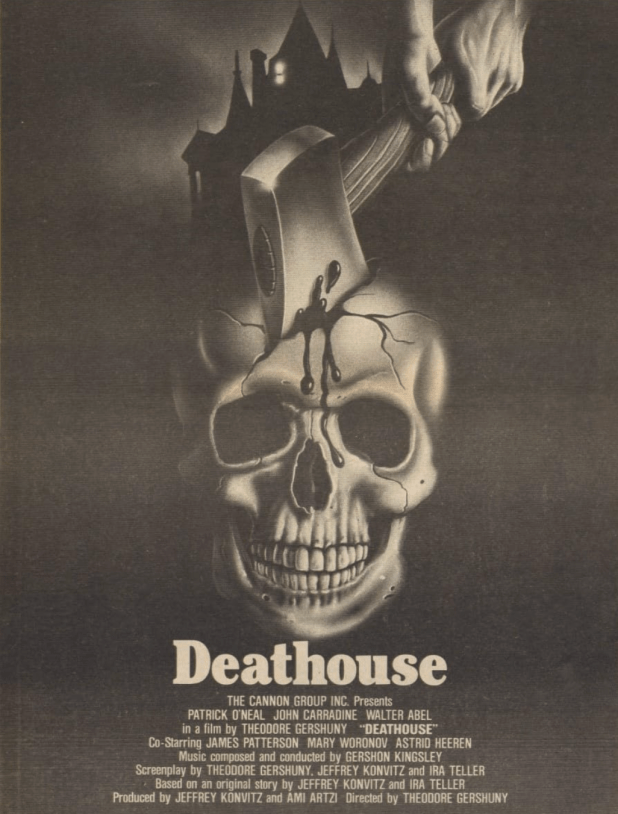
Yes, I realize that Silent Night, Deadly Night originally came out the whole way back in 1972. But nearly nine years after it first played theaters, Cannon released it as Deathhouse on May 8, 1981. If it makes no sense to release a holiday movie in May, well — don’t worry about it. It’s Cannontown.

Christmas Eve, 1950: Wilfred Butler runs from his home, on fire, and supposedly dies in the snow.

Christmas Eve, 1970: John Carter (Patrick O’Neal, The Stepford Wives, The Stuff) and his assistant Ingrid arrive in a small Massachusetts town. He meets with the town’s mayor, sheriff and major citizens like Tess Howard and Charlie Towman (John Carradine!), who may have lost his voice to a tracheotomy but not his need to smoke, about selling the Butler mansion as soon as possible. While staying overnight with Ingrid, who is also his mistress, they are both killed by an axe. The killer calls the police and says that they are Marianne.

Tess, the town’s telephone operator, hears the call and drives to the mansion, where she is greeted by Marianne Butler before she is hit in the head with a candle holder. Meanwhile, Sheriff Mason finds that Wilfred’s grave is empty. He is killed and thrown into the empty hole.

Mayor Adams is asked to go to the Butler mansion but leaves his daughter, Diane (Mary Woronov, Death Race 2000Chelsea Girls) at home. She meets up with a man who claims to be Jeffrey Butler, who has taken the sheriff’s abandoned car. Together, they search for the lawman but can’t find him.

After taking Towman to the mansion, Jeffrey goes back to get Diane. On their way to the mansion, Towman stumbles blindly in front of them and is hit and killed. His eyes had been stabbed out and Diane grows worried about Jeffrey.

Well, fuck me, this movie is also about incest! A diary found at the house reveals that Jeffrey is the son of Wilfred and his daughter, Marianne. Afterward, Wilfred turned the house into an asylum and admitted his own daughter. However, on Christmas Eve 1935, he turned all of the inmates loose. They killed every doctor as well as his daughter. Of note here is that many of the inmates in the flashback are played by former stars of Warhol’s factory, like Ondine, Tally Brown, Kristen Steen and Lewis Love, as well as Flaming Creatures auteur Jack Smith, artist George Trakas and his wife at the time, Susan Rothenberg. Warhol superstar Candy Darling also shows up in the film as a party guest.

Well, it turns out that some of the inmates of the insane asylum ended up being important parts of the town — that’s right, all of the important people John met with in the beginning!

Mayor Adams arrives at the mansion and he and Jeffrey face off, guns drawn, each believing the other is the killer. They kill one another as Marianne shows up, but she is really Wilfred, who is alive. He went after the inmates for their role in the death of his daughter and used his grandson/son/secret shame Jeffrey as a patsy. Diane gets the gun and kills the old man. One year later, the mansion is demolished as she watches.

Director Theodore Gershuny worked on plenty of episodes of Monsters and Tales from the Darkside after this film. He was also married to Woronov. The original title for the film was Night Of The Dark Full Moon and it was also nearly called Zora, which makes little to no sense.

There are some really interesting techniques here, especially in the flashback sequences, which feel like tinted photographs come to life with the saddest version of “Silent Night” ever playing behind the action. I love how experimental and dark these sequences look — they remind me a little of the film Begotten.

This is a dark film for your holiday viewing, so if you want to chase away the family for awhile, this is the one to do it.

VCI BLU RAY RELEASE: Psychonica Collection Volume 1: Delinquent Schoolgirls (1975)

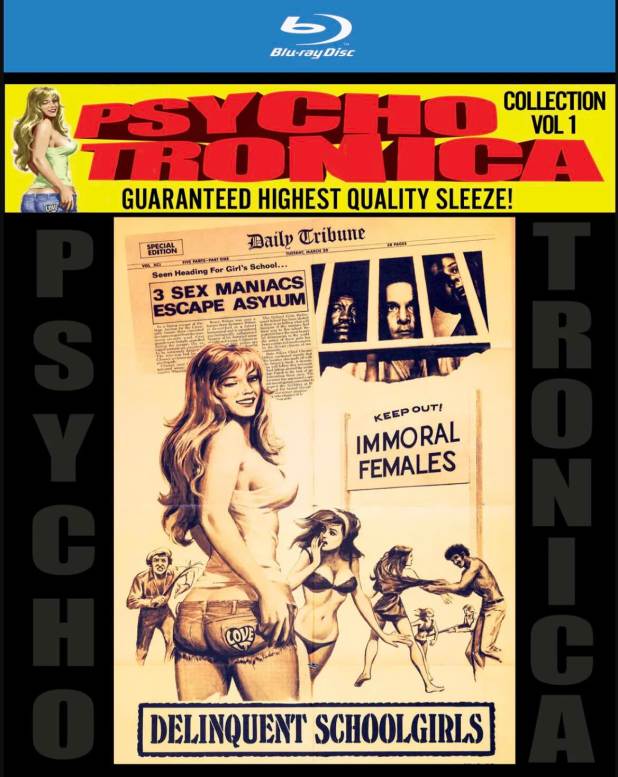
Homosexual fashion designer Bruce Wilson (Stephen Strucker, Johnny the air traffic controller from Airplane!), sexed up Dick Peters (Bob Minor) and Carl C. Clooney (Michael Pataki) escape the insane asylum and work their way into a girls’ school. Still, instead of this being a revengeomatic, it’s a comedy.

The Delinquent School Girls cut of this film missed the first half hour and all of George “Buck” Flower’s scenes that were in the Carnal Madness version. It was also released in the UK as Scrubbers 2 to cash in on the girl school movie Scrubbers and as Sizzlers as part of a double feature with Intimate Games.

Directed by Greg Corarito (who directed The Sadistic Hypnotist and Hard On the Trail, the adult film that sent Lash LaRue on a journey of redemption), who wrote the movie with John Lamb (Mondo KeyholeZodiac Killer), Maurie Smith (who wrote Recruits and Julie Darling), it starts with the men visiting the farm of Earl (George “Buck” Flower) and his wife Ellie (Julie Gant), who ends up in bed with Dick, a former baseball play r. Then, it’s off to the school where the girls end up kicking their asses more often than not, and Pataki gets to show his skill at impressions.

As for the girls, there’s Colleen Brennan (AKA Sharon Kelly, Olga Vault; she’s also in Supervixens and Ilsa She-Wolf of the SS), magazine starlet Roberta Pedon and several attractive actresses who made this their only movie.  Brennan said of this movie, “I always wondered how anybody managed to pull a movie out of that reeking pile of short ends.”

The VCI release of this film has a new commentary track by Rob Kelly, noted film historian, podcaster and artist. There’s also an archival commentary track by actor and stuntman, Bob Minor, as well as a featurette — Cuckoo for Pyschotronica — and a photo and poster gallery. You can get this from MVD.

ARROW VIDEO 4K UHD RELEASE: The House with the Laughing Windows (1976)

Pupi Avati made Zeder, the zombie movie that really isn’t a zombie movie, so I was excited to see his take on the giallo, basing it on a story he heard about a priest being exhumed in his childhood.

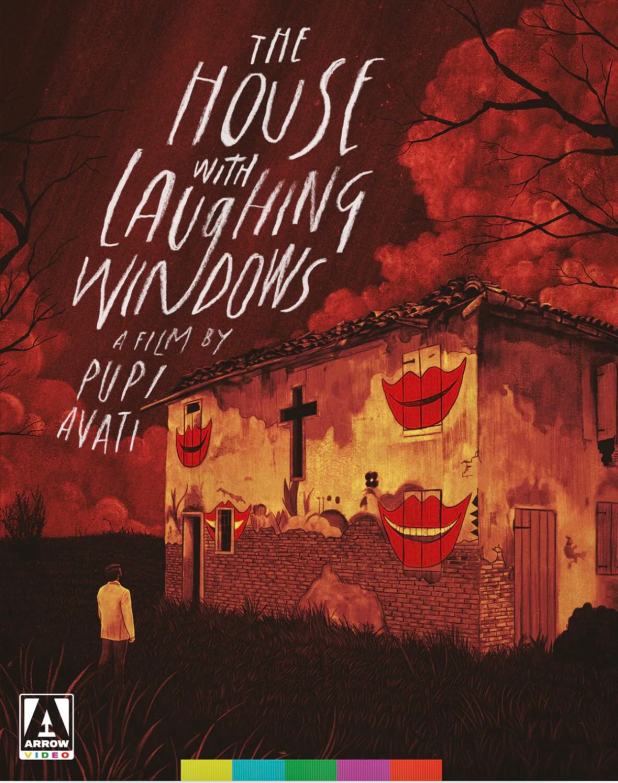
The Valli di Comacchio area has a fresco on the rotting wall of a church that may be the martyrdom of Saint Sebastian. Painted years ago by the long-dead and always mysterious Legnani, it is being restored by Stefano (Lino Capolicchio, who was the Italian voice for Bo Duke), who is also living in the home of the painter’s sisters. Those very same sisters — according to town legend — assisted their brother in torturing and killing people so that he would have inspiration for his artwork.

No one wants Stefano to fix this painting. People start dying and the secret behind the murders may be in the very painting that our lead is fixing. What a time to start a romance with school teacher Francesca (Francesca Marciano)!

I love when the giallo moves out of Rome and into the small cities, such as Fulci’s masterful Don’t Torture a Duckling and Antonio Bido’s The Blood Stained Shadow. Why should the metro locales have all the deep, dark secrets and horrific murders, right?

Don’t go in expecting sleaze and gore. Do expect to be surprised and delighted by the world and mood that this movie creates. This one needs to be unearthed and celebrated by way more than know it now.

The Arrow Video 4K UHD is a great way to do so. It has a 4K restoration from the original camera negative, graded by Arrow Films, as well as a restored original lossless mono Italian soundtrack and newly translated optional English subtitles. You also get two new commentaries, one by Alexandra Heller-Nicholas and Josh Nelson and the other by Eugenio Ercolani and Troy Howarth.

There’s also Painted Screams, a brand new feature-length documentary on the film directed by Federico Caddeo, featuring interviews with co-writer/director Pupi Avati, co-writer Antonio Avati, assistant director Cesare Bastelli and actors Lino Capolicchio and Francesca Marcia. There are also video essays by Chris Alexander and Kat Ellinger, the Italian theatrical trailer, a reversible sleeve featuring original and newly commissioned artwork by Peter Strain, a double-sided foldout poster featuring original and newly commissioned artwork by Peter Strain and an illustrated perfect bound collector’s booklet featuring new writing by Matt Rogerson, Willow Maclay, Alexia Kannas, Anton Bitel and Stefano Baschiera.

You can get this from MVD.

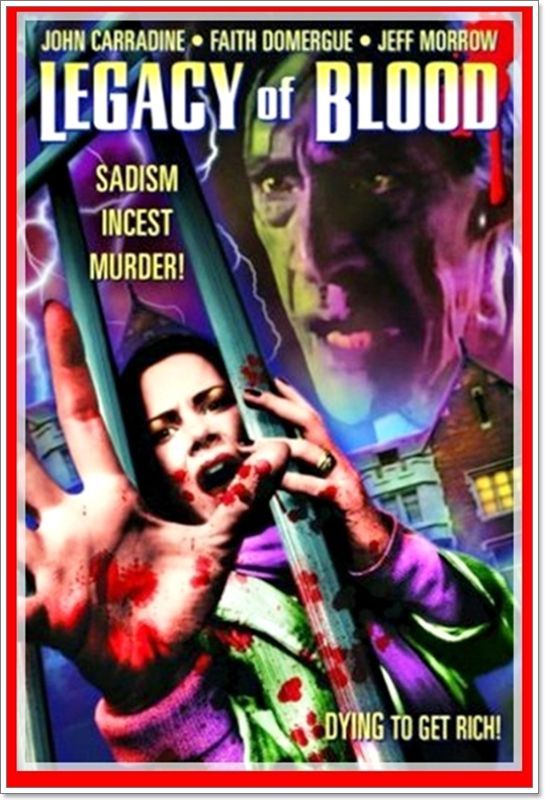
MILL CREEK LEGENDS OF HORROR: Blood Legacy (1971)

Will to DieBlood LegacyLegacy of Blood?

Whatever you call it, this 1971 film has a plot as old as movies themselves — a patriarch gathers his family to hear his will. Carl Monson, who wrote The Acid Eaters and also directed Please Don’t Eat My Mother was behind this.

This is the last movie for Rodolfo Acosta, who either played Mexicans or Native Americans in Westerns usually. John Carradine is also in this — of course, this movie was made for him — and Richard Davalos (Blind Dick from Cool Hand Luke and the cover image for The Smiths albums “Strangeways, Here We Come” and two of their greatest hits collections), Faith Domergue (Perversion Story), former pro wrestler Buck Kartalian, Jeff Morrow (The Creature Walks Among Us) and John Russell, who replaced James Doogan on the second season of Jason of Star Command.

Yes, the outside of the house is also the same mansion that was used for Wayne Manor. You haven’t gone completely bats yet.

You can watch this on Tubi with riffs from either Elvira or Cinematic Titanic.

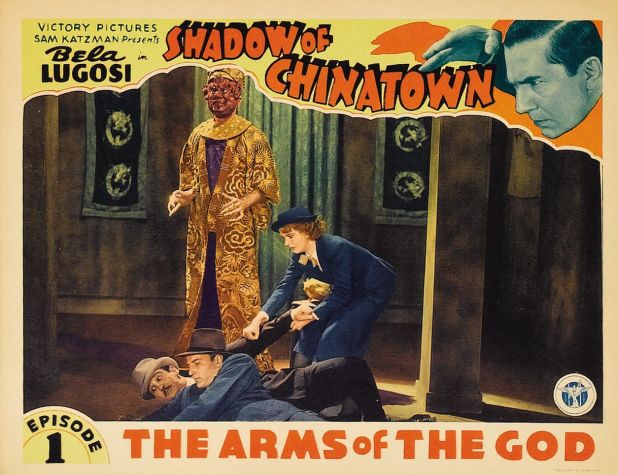
MILL CREEK LEGENDS OF HORROR: Shadow of Chinatown (1936)

Shadow of Chinatown, a condensed 65-minute version of the 300-minute serial, presents a unique narrative. It delves into the destruction of San Francisco’s Chinatown by Victor Poten (Bela Lugosi) and The Dragon Lady (Luana Walters), hired by white businesses to eliminate the new Chinese businessmen who threaten their profits. This atypical plot, where white individuals are the aggressors against Asians, stands out in a time when the sinister Fu Manchu was the stereotypical villain in most serials.

One of the intriguing aspects of the film is the character of Bela Lugosi, who has the power to influence others. In this movie, he uses his mesmerizing abilities to instill hatred towards the Chinese, a reflection of his own feelings.

This was directed and written by Robert F. Hill, who had 116 directing credits in his career. After World War II, Universal sent him to Japan to open a movie studio, where he warned that the locals would try to attack him if he started an American studio in their country. He needed to get a doctor’s permit to prove his wife needed care back home before Universal would let him give up. The following person Universal sent? The Japanese filmmakers attacked him and used the studio for themselves.

You can watch this on YouTube.