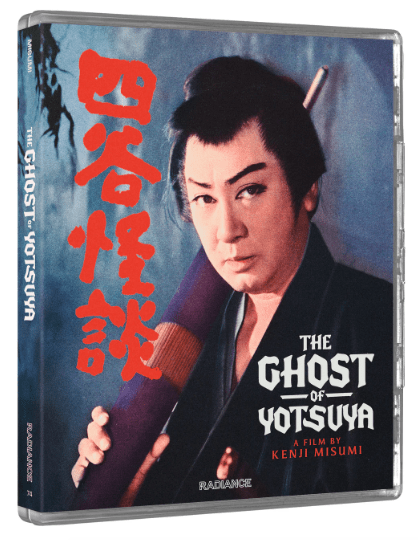
RADIANCE FILMS BOX SET RELEASE: Daiei Gothic: Japanese Ghost Stories: The Ghost of Yotsuya (1959)

Director Nobuo Nakagawa is known for his takes on Japanese folk horror, including Kaidan hebi-onna, Jigoku, Onna Kyuketsuki and Borei Kaibyo Yashiki. This is his adaption of the kabuki play Yotsuya Kaidan.

Umbrella maker and would-be samurai Iemon Tamiya (Shigeru Amachi) wants to marry Oiwa (Katsuko Wakasugi) and stands outside the home of her father Samon, beginning for her hand in marriage. He wants nothing to do with the boy, so he insults him, earning enough of his ire that he and his companion Sato are both killed by the samurai.

Naosuke (Shuntaro Emi) watched the whole thing and agrees to be quite if Iemon tells Oiwa and her sister Sode that their father was murdered by a criminal named Usaburo. He also asks for the samurai’s help in throwing Sode’s fiance,  Yomoshichi (Ryuzaburo Nakamura) to his death.

A year finds Iemon and Oiwa married, as well as her sister and Naosuke. Iemon is already tired of her and wants to move on in both beauty and status, so he hires a masseuse named Takuetsu (Jun Otomo) to seduce his wife, hoping she will give in and he can legally kill her as the result of adultery. Takuetsu fails, but she’s already taken the poison he brought, as her face breaks out in horrible blisters. She tries to kill him but only slashes herself, yet when Iemon returns, he kills the massage man and nails both of the victims to wood and sets it down the river.

That night, Iemon marries Ume (Junko Ikeuchi), the daughter of a rich nobleman. Just as quickly, the ghosts of Oiwa and Takuetsu appear. She finally attacks Iemon, who fights back with his sword, killing his wife and her parents. Hiding in a temple, he’s soon joined by Naosuke, who has also seen the ghosts. Oiwa tells her sister that Yomoschichi lives and together, they plan on revenge.

Iemon takes some of that by killing Naosuke, but when Yomoschichi and Sode arrive, the ghosts have so haunted him that he can’t defend himself. The movie ends on an image of Oiwa holding a child in the afterlife.

This has been filmed many times, but many say that this is the definitive version. It’s certainly bloodier and moodier than you’d expect for a movie made all the way back in 1959.
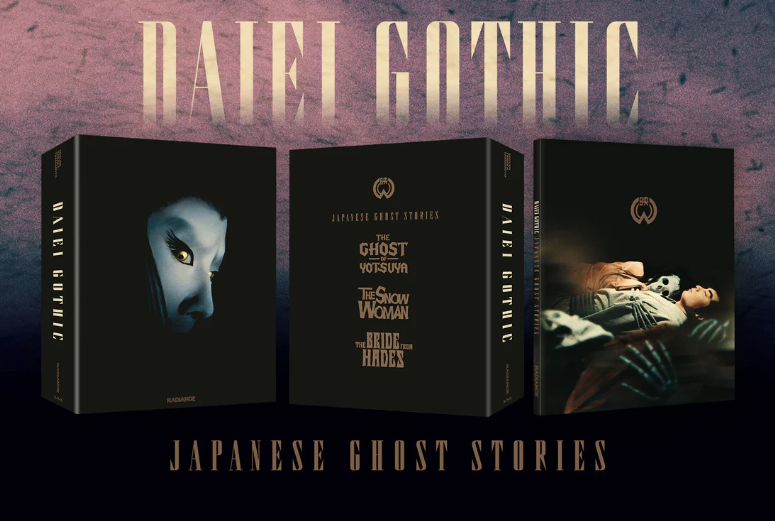
Past of the Daiei Gothic: Japanese Ghost Stories set from Radiance Films, The Ghost from Yotsuya has the following extras: a interview with filmmaker Kiyoshi Kurosawa, a visual essay on the history and adaptations of the classic Ghost of Yotsuya story by author Kyoko Hirano, a trailer and a reversible sleeve featuring original and newly commissioned artwork by Filippo Di Battista.

You can purchase this set from MVD.

RADIANCE FILMS BOX SET RELEASE: Daiei Gothic: Japanese Ghost Stories: The Snow Woman (1968)

An expanded adaptation of the Yuki-onna short story from the 1904 collection Kwaidan: Stories and Studies of Strange Things by Lafcadio Hearn, The Snow Woman was released in the U.S. — with subtitles — in 1969 under the title Snow Ghost. A similar story also is in the movie Kwaidan.

Director Tokuzo Tanaka directed many of Zatochi movies for Daiei, as well as the films Bad Reputation, The Haunted Castle and the incredible Killer Whale.  The script was by Fuji Yahiro.

An old sculptor and his student Yosaku (Akira Ishihama) are carving a statue of a goddess and looking for the perfect tree. As they shelter themselves from the snow, they meet a woman in white who freezes the master but allows his apprentice to live, as long as he never reveals that he saw her. If he does tell anyone about her, she will return to kill him.

Later, Yuki (Shiho Fujimura) comes to live near the apprentice, who waits five years for the tree to dry so that he may sculpt it. He’s dealing with a bailiff who kills the wife of the master sculptor, who reveals that her dying wish is that Yuki marries the young sculptor. The bailiff tries to make Yuki his concubine but she freezes him and all of his men, revealing herself, as the sculptor speaks of the night he met her. She leaves, rather than fulfill her oath to kill him, as she can’t leave their son an orphan.

This story had to have inspired the final story in Tales from the Darkside: The Movie. My favorite part of this movie is how any time the snow woman appears, the movie make an obvious removal from reality in color and brightness. What a gorgeous story.

Past of the Daiei Gothic: Japanese Ghost Stories set from Radiance Films, The Snow Woman has the following extras: a new interview with filmmaker Masayuki Ochiai, a visual essay on writer Lafcadio Hearn by Paul Murray, a trailer and a reversible sleeve featuring original and newly commissioned artwork by Filippo Di Battista.

You can purchase this set from MVD.
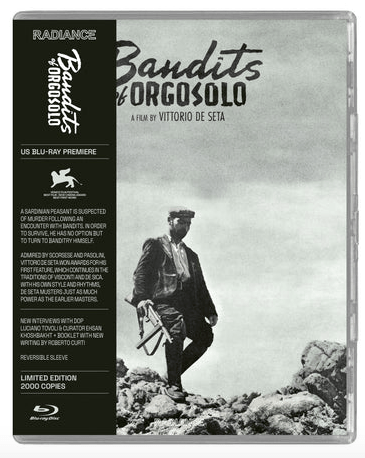
RADIANCE FILMS BLU RAY RELEASE: Bandits of Orgosolo (1961)

Michel (Michele Cossu) is a shepherd in Sardinia who has been wrongly accused of stealing livestock and killing a policeman. He runs into the hills with his brother Peppeddu (Peppeddu Cossu) and their flock, which they are still paying for. Losing the sheep would be too much to bear for his family, but that’s what happens as they are chased by the authorities. Then, facing a trial, he decides to be what he has been charged with: a criminal.

Directed by Vittorio De Seta, who wrote the script with Vera Gherarducci, this has a documentary feel, as those are the movies that De Seta started his career with. This is the story of a poor man who only has his job to sustain him, living within some of the most remote areas of the world, just trying to earn a living when the rest of the universe seems to conspire against him. There is no mastering nature just as there is often no way out when your back is against the rocks.

This is a gorgeous, if dismal, film and while set in the 20th century, it could have been set at any time, as the world that it comes from has remained the same since we counted time.

Radiance Films blu ray of Bandits of Ogrosolo is the first blu ray release of this movie in the U.S. It has a new 4K restoration from the original camera negative by The Film Foundation and Cineteca di Bologna at L’Immagine Ritrovata laboratory, in association with Titanus with funding provided by the Hobson/Lucas Family Foundation. Extras include interviews with cinematographer Luciano Tovoli and curator and filmmaker Ehsan Khoshbakht, a trailer, a reversible sleeve featuring original and newly commissioned artwork by Filippo Di Battista and a limited edition booklet featuring new writing by Roberto Curti.

You can order this from MVD.

RADIANCE FILMS BLU RAY RELEASE: Eighteen Years In Prison (1967)

Trying to survive post-war Japan, Kawada (Noboru Ando) and Tsukada (Asao Koike) are caught by the military stealing copper wire. While Kawada is arrested and goes to prison, Tsukada escapes and starts a gang with the money he’s made. As he suffers the cruel attention of Warden  Hannya (Tomisaburo Wakayama), Kawada dreams of getting out of prison and the revenge he must take.

Directed by Tai Kato, this was followed in the same year by a sequel, Choeki juhachi-nen: Kari shutsugoku. Noburo Ando volunteered for a suicide frogmen unit during World War II, but that ended before he could give his life. In 1952, he formed his own Yakuza family, the Ando-gumi, which had three hundred members at one point. He was sent to jail for six years after sending a hitman to kill a rival and when he got out, he dissolved the gang and went into acting.

He said, “In Japanese, the only difference between yakuza and yakusha — an actor — is one hiragana character. All yakuza have to be actors to survive.” He was also a singer and played himself in movies about his life, but American audiences probably know him best for New Battles Without Honor and Humanity and Graveyard of Honor.

As Kawada comes to terms with what the war has made him do, he rises to the defense of the underdog in jail life, all while Tsukada is the opposite, now firmly embracing power and ruthlessness.

Art imitates life, as Kawada also feels that he must atone for sending the brother of Hisako (Hiroko Sakuramachi) on a suicide mission during the war. Noburo Ando left prison to meet with the mother of the man he had killed and asked for forgiveness. In this movie, he tries for the same by attempting to mentor her brother Shuichi (Masaomi Kondo) when he is placed in the same cell.

When Kawada learns that his former partner hasn’t opened a market to help people but instead a brothel — and caused the suicide of a former lover — he must leave behind prison and the mentorship of the Yakuza elder Osugi (Michitaro Mizushima).

This is a movie that shows just how bad Japan was at the close of the war and how it had to both forgive itself and find a new path, even if it was one person doing so.

The Radiance Films blu ray of Eighteen Years In Prison has extras like an appreciation by critic and programmer Tony Rayns, a visual essay on Japanese prison films by author Tom Mes, a trailer, a reversible sleeve featuring original and newly commissioned artwork by Time Tomorrow and a limited edition booklet featuring new writing by Ivo Smits and an archival interview with Noboru Ando by Mark Schilling. It’s a limited edition of 3000 copies, presented in full-height Scanavo packaging with removable OBI strip leaving packaging free of certificates and markings.

You can order this from MVD.

RADIANCE FILMS BLU RAY RELEASE: Tokijiro: Lone Yakuza (1966)

Tokijiro (Kinnosuke Nakamura) has left behind being a killer and instead is wandering in search of freedom. That’s impossible, as he still has obligations, including one to a gang boss which forces him to kill a man named Mutsuda no Sanzo (Chiyonosuke Azuma). Seeking absolution, he listens to the man’s dying wish and vows to take care of his victim’s widow Okinu (Junko Ikeuchi) and her young son. That doesn’t matter to the Yakuza, who now want the entire family killed.

Directed by Tai Kato, whose Eighteen Years In Prison was also released by Radiance, this takes the novel Kutsukake Tokijiro by Shin Hasegawa and creates a gangster film that’s set in the Muromachi period. Tokijiro may be the deadliest of all swordsmen, but he has a code of honor that he must follow no matter what, even when it goes against his moral code. Complicated, yes. That said, he leads a violent, bloody and often depressing existence in which he must follow duty to the end.

Even those who kill for a living have to believe in something. Can someone ever wash their hands of all that murder? And for a movie that asks these questions, it isn’t afraid to present up close and gritty battles filled with blood.

The Radiance Films blu ray of Tokijiro: Lone Yakuza has extras including an interview with Koushi Ueno about the film’s place in genre cinema history, a visual essay on star Kinnosuke Nakamura by Japanese cinema expert Robin Gatto; a reversible sleeve featuring original and newly commissioned artwork by Time Tomorrow and a limited edition booklet featuring new writing by scholar Ivo Smits and a newly translated archival review.

You can get it from MVD.

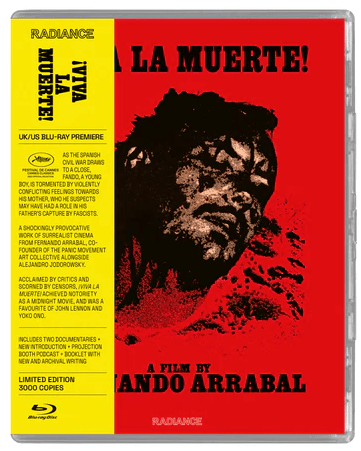
RADIANCE BLU RAY RELEASE: Viva La Muerte! (1971)

Filmed in Algeria, France, Spain, Italy, Portugal, Brazil, Philippines, Morocco and Tunisia, Long Live Death! is directed and written by Fernando Arrabal, who co-founded the Panic Movement with Alejandro Jodorowsky and Roland Topor.

He based much of the movie on his own experiences growing up during the Spanish Civil War. The main character is Fando (Mahdi Chaouch), whose mother (Nuria Espert) turns his father in to the authorities as a suspected communist. She tells her son that he was executed but in truth, he’s only been placed in jail. As a result, his son wonders if he’s even alive and what happened to him.

That’s a basic explanation of a movie that is a hallucination of violence with shocking moments in almost every frame. Arrabal’s father was captured by the Spanish Army, was supposed to spend thirty years in prison and then escaped after entering a mental hospital, disappearing into the snow. He was never seen again.

This movie feels like him trying to work that out. What emerges is a movie filled with real surgical footage and no shortage of animal violence. It’s near Italian in its slaughter so beware if you’re upset when that happens in movies. Humans are also destroyed in this, as a man is buried and has horses step on his exposed head, while a priest has his balls cut off and then fed to him.

Pure shock and not for shock’s sake. This is filmmaking and presents an unfiltered look at a world that no ten year old should have been put through.

The Radiance release of Viva La Muerte is the first blu ray release of the movie with English subtitles. It has a new 4K restoration of the original 35mm negative by the Cinémathèque Toulouse in collaboration with Fernando Arrabal; an audio discussion from the Projection Booth podcast featuring Mike White, Heather Drain and Jess Byard; Sur les traces de Baal, a short documentary by Abdellatif Ben Ammar in which the filmmaker followed Arrabal’s film and captured him at work on Viva la Muerte!VIDARRABAL, a feature-length documentary on Arrabal by Xavier Pasturel Barron capturing the life and work of this singular filmmaker, playwright, painter and essayist, featuring interviews with admirers, friends and family, including members of the Panic Movement he founded; an interview with scholar and Spanish cinema expect David Archibald; a trailer; a reversible sleeve featuring original and newly commissioned artwork and a booklet featuring new writing by Sabina Stent and an archival interview with Fernando Arrabal.

You can get it from MVD.

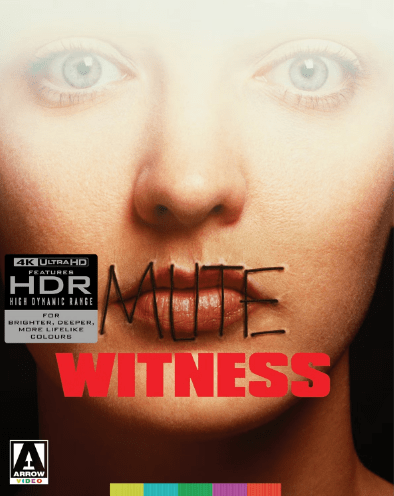
ARROW 4K UHD RELEASE: Mute Witness (1995)

The debut movie of Anthony Waller, who would go on to make An American Werewolf In Paris, Mute Witness is the story of Billy Hughes (Marina Zudina), a make-up artist working on a slasher movie in Moscow that is directed by Andy Clark (Evan Richards). She knows him, as he’s the boyfriend of her sister Karen (Fay Ripley).

What she does not know is that there’s also an adult movie being shot on the same set at night and it’s not just a pornographic film, it’s also a snuff movie.

She’s chased by the killer, Arkadi (Igor Volkov) and the director, Lyosha (Sergei Karlenkov), forcing her to jump out a window. Her sister arrives to save her and Lyosha acts like he happened on this accident.

After the police arrive, Billy is able to communicate that she’s seen a killing. They use her special effects to tell the authorities that it was all for a movie. Meanwhile, Arkadi is disposing of the woman’s body in an incinerator and a man known only as The Reaper (referred to as a special guest, we’ll get to that soon) shows up to make sure everything has proceeded properly.

Luckily for Billy, she’s protected by Detective Aleksander Larsen (Oleg Yankovsky), a Moscow cop who has been after this snuff film crew. Not that Billy can’t protect herself, as she throws a hairdryer into a bathtub to take out the director. But can Larsen be trusted? And why does The reaper think she has a disk that has all the information the police need to stop him?

Roger Ebert compared this movie to Halloween and Blood Simple. That’s how good it is. I wish it’s director didn’t get stuck with such a bad movie to make once he got to Hollywood.

As for The Reaper, that’s Alec Guinness. His cameo was filmed nearly a decade before this movie, as Waller worked with him on a commercial. The actor asked for no money, which ended up being one of his final roles. All that he asked was that he not be credited in the film and there be no press surrounding his involvement in it. That’s why The Reaper is played by Mystery Guest Star.


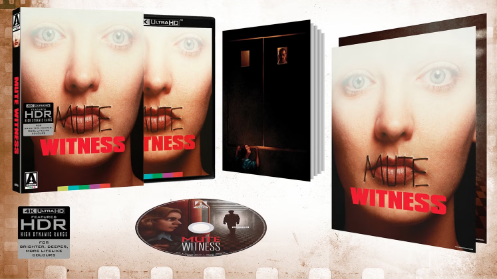
The Arrow Video 4K UHD release of this movie has a 4K restoration approved by director Anthony Waller, who also has a commentary track. There’s a second commentary with production designer Matthias Kammermeier and composer Wilbert Hirsch, moderated by critic Lee Gambin. Plus, there’s visual essays by Alexandra Heller-Nicholas and Chris Alexander; the Snuff Movie presentation used to get investors; original location scouting footage; original footage with Alec Guinness, filmed a decade earlier than the rest of the movie; a teaser trailer; a trailer; an image gallery; a reversible sleeve featuring original and newly commissioned artwork by Adam Rabalais; a double-sided fold-out poster featuring original and newly commissioned artwork by Adam Rabalais and an illustrated collector’s booklet featuring new writing on the film by Michelle Kisner.

You can order this from MVD.

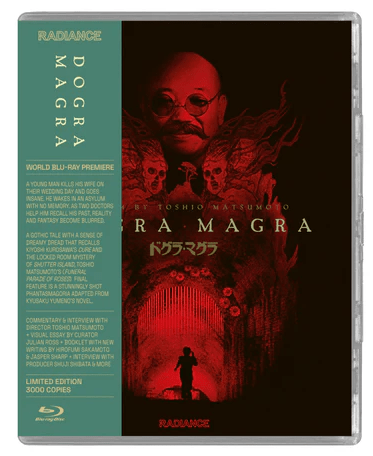
RADIANCE FILMS BLU RAY RELEASE: Dogra Magra (1988)

A man named Kure Ichiro (Yoji Matsuda) wakes in an asylum with no memory and is told by Dr. Wakabayashi (Hideo Murota) and Dr. Masaki (Shijaku Katsura) that he’s blocking the past as he killed his bride on his wedding day. However, his treatment begins to confuse fantasy and reality, especially a manuscript called Dogra Magra.

Based on the novel by Kyusaku Yumeno and the last film of director Toshio Matsumoto, Dogra Magra is a movie that features a hospital filled with pickled punk babies in jars, doctors who try and convince a man that he’s a character in a novel, rotten corpses and a reality that may or may not be true. One of the doctors might now even be alive.

This is a film with no easy answers and maybe the best way to watch it is just to let it wash over you and try to figure it all out on the tenth rewatch.

Presented on blu ray for the first time outside of Japan, this Radiance Films release has a digital transfer supervised by director of photography Tatsuo Suzuki and producer Shuji Shibata. It also has commentary and an interview with director Toshio Matsumoto; a visual essay by programmer and curator Julian Ross; information on the Ahodara Sutra chant by legendary street performer Hiroshi Sakano; a trailer; a reversible sleeve featuring original and newly commissioned artwork by Time Tomorrow; a limited edition booklet featuring new writing by Hirofumi Sakamoto, president of the Postwar Japan Moving Image Archive and author Jasper Sharp on screenwriter Atsushi Yamatoya, an interview with producer Shuji Shibata and Matsumoto’s director’s statement; and it’s all in a limited edition of 3000 copies, presented in full-height Scanavo packaging with removable OBI strip leaving packaging free of certificates and markings.

You can order this movie from MVD.

ARROW BLU RAY RELEASE: J-Horror Rising: St. John’s Wort (2001)

Otogirisō wasn’t marketed as a video game but instead a sound novel, today called a visual novel. Koichi Nakamura conceived the title after showing his work on the Dragon Quest games to a girl he was dating. She didn’t understand the game or why people would want to play it, so he decided to make a video game “for people who haven’t played games before.”

Obviously, his work was inspired by another video game that led to a series of better-known games (and movies), Sweet Home. Nakamura said, “The thing that was really interesting about Sweet Home was that it so scary that you didn’t want to continue playing. I wanted to create an experience where the user would be too afraid to press the button to continue the story, too.”

It’s less of a game and more of a Choose Your Own Adventure novel where you make choices at different point as you and your girlfriend Nami survive a car accident and arrive at a mansion. Nobody answers when they ring the bell, so of course they go inside.

If you play emulated games, you can try it out here in English.

Nami Kaizawa (Megumi Okina) has inherited her family’s money and gigantic home, which holds bad memories as her father, who abandoned her. Deciding that she should explore it, she takes her ex-boyfriend Kohei Matsudaira (Yoichiro Saito), who is a fan of her father’s sinister paintings. He has already decided that the house would be perfect for a new video game that he is working on with Nami, so he brings a web camera and sends back footage to his friends and fellow designers Toko Ozeki (Reiko Matsuo) and Soichi Kaizawa (Reiko Matsuo).

The film is not just a video game movie, but literally like a Twitch channel, as we see the designers drawing maps of the house as Nami and Kohei make their way through the secret rooms and keys that you would expect to look for in a game just like this.

Directed by Shimoyama Ten, this has strange multihued visuals that are very 2001, but that’s the joy of it to me. It plays with the idea of what is real and what is the game — like eXistenZ — and has creepy dolls, a frightening caretaker, a heroine with memory lapses and plenty of gore. As I got into other reviews, I couldn’t believe so many people didn’t like it as much as me. Maybe I watching other people enjoy games?

St. John’s Wort is one of the films on Arrow’s new J-Horror Rising set. It has extras including commentary by Japanese cinema expert Amber T.; a making of feature; interviews with actors Megumi Okina, Koichiro Saito, Reiko Matsuo and Koji Okura; trailers; TV commercials and an image gallery.

You can buy it from MVD.

ARROW BLU RAY RELEASE: J-Horror Rising: Inugami (2001)

Akira Nutahara (Atsuro Watabe) has arrived on Shikoku island to be a schoolteacher. He has fallen in love with Miki (Yûki Amami), an older woman and paper maker who cares for an urn that is said to carry Inugami, a forest wolf spirit. Her family is set to commemorate the 900 Year Rites in which they will celebrate the forest and their past connection to it, as well as the fact that they still own much of the land.

Miki’s family has also guarded these spirits and kept the village safe from nightmares, but with the arrival of Akira, supernatural events have been occurring. After she and Akira have a romantic cave moment, she begins to grow younger and tells the spirit of her mother that she no longer wants the responsibility of keeping the spirits and wants to leave the island with Akira.

It also turns out that due to the curse placed upon the family, they have become intermarried or have to find men that have no idea of what the family must endure. No woman can leave the island and even if they try, they always return. The family patriarch Takanao (Kazuhiro Yamaji) keeps TV and radio away from his family and he is the only person connected to the outside world.

The rest of the village grows angry that there have been several accidents and deaths, which they blame on the family, and prepare to kill them, starting by destroying the studio in which Miki creates her intricate art.

Director Masato Harada has created a gorgeous movie that may not always be horror, but looks at how Japan’s past and superstitions still exist, as well as how family secrets never seem to go away. It’s a slow moving film that demands that you stay with it, but when you get to the scenes where the family goes into the forest and it becomes black and white, your patience will be rewarded.

Inugami is one of the films on Arrow’s new J-Horror Rising set. It has extras including audio commentary by Japanese cinema expert Jonathan Clements, an interview with director Masato Harada and an image gallery.

You can buy it from MVD.