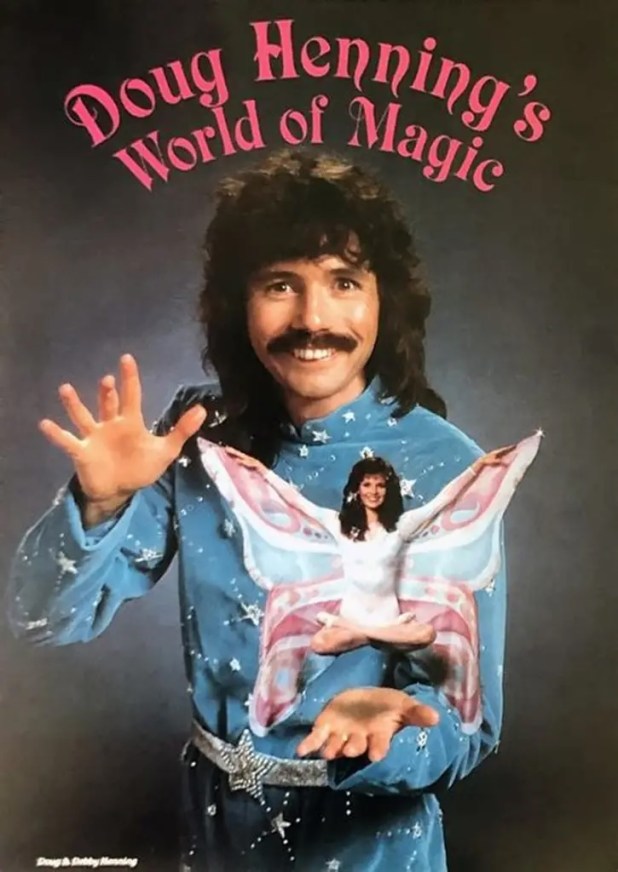
Doug Henning’s World of Magic (1978)

The fourth in a series of seven annual prime-time television specials that aired between 1975 and 1982, starring famous magician Doug Henning; this time, Brooke Shields appears, and Tom Bosley, for some reason, plays heel.

Oh, Doug Henning. The 70s, really. Starting as The Astounding Hendoo in Winnipeg, he won a government grant with the idea that his work wasmagic plus theatre equals art.The live theatrical show that would result, Spellbound, was written by David Cronenberg, directed by Henning’s college friend Ivan Reitman and had music by Howard Shore. His career went beyond magic, as he created looks for the Jacksons Victory Tour, had his own line of stuffed animals called Wonder Whims, co-wrote a b0ok about Harry Houdini, married relationship consultant Barbara De Angelis (who was married five times and one time to Men Are from Mars, Women Are from Venus author John Gray), moved to India in order to devote his time to Transcendental Meditation, almost started a TM theme park named Maharishi Veda Land in Florida, was the senior vice president of the Natural Law Party of Canada and a Natural Law Party candidate in the United Kingdom’s general election. Sadly, he died of liver cancer at the age of 52. Nothed crumudgeon James Randi said that Henningabandoned regular medical treatment for liver cancer, continued to pursue his diet of nuts and berries, and died of the disease.”

In his act, he always said the same thing:Anything the mind can conceive is possible. Nothing is impossible. All you have to do is look within, and you can realize your fondest dreams. I would like to wish each one of you all of life’s wonders and a joyful age of enlightenment.”

He was everywhere in the 70s. It’s hard to overstate how much Doug Henning’s psychedelic,rainbow-and-denimaesthetic defined the 1970s. He managed to pivot magic away from the stuffy, tuxedo-clad Victorian era and into the age of Aquarius.

Director Walter C. Miller was the man when it came to making award shows and specials. Buz Kohan, who wrote this, worked on similar stuff. 

You can watch this on YouTube.

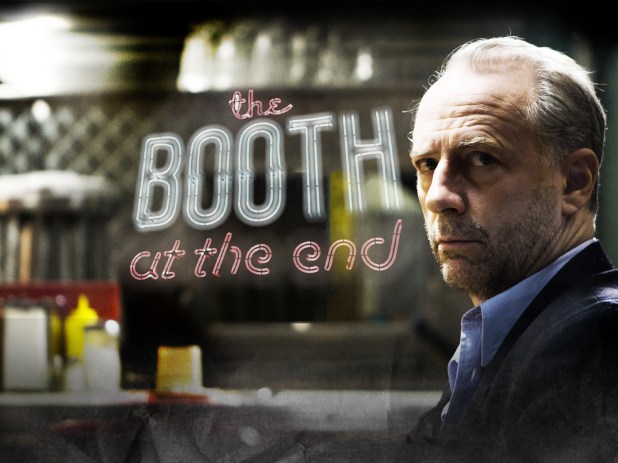
The Booth at the End (2010-2012)

ABOUT THE AUTHOR: Exploitation-film historian A.C. Nicholas, who has a sketchy background and hails from parts unknown in Western Pennsylvania, was once a drive-in theater projectionist and disk jockey. In addition to being a writer, editor, podcaster, voice-over artist, and sometime actor and stand-up comedian, he’s a regular guest co-host on the streaming Drive-In Asylum Double Feature and panelist on the Deep Images podcast and has made multiple appearances on Making Tarantino: The Podcast. He also contributes to the Drive-In Asylum fanzine, the B & S About Movies Podcast, and the Horror and Sons website. He currently programs a monthly film series, A.C. Nicholas’s Hidden Gems, at The Babylon Kino in Columbia, South Carolina.

“Show. Don’t tell.” This adage is as old as film itself. Looking at the first quarter of the twenty-first century, perhaps screenwriters have taken that statement too much to heart. Apart from the few films written by folks who can write memorable dialogue, like Quentin Tarantino and David Mamet, the typical film or TV show today is an empty spectacle, or as my father used to say, “parada,” Polish for “show” or “exhibition.” Fathers of my generation would tell kids, “You’d better stop your crying, or I’ll knock you into next Wednesday,” but my dad always used parada when sternly presaging an ass-whipping: “Don’t make a big parada out of it.” And that describes your typical $200 million Hollywood blockbuster—empty, soulless, and cynical, just a series of huge action set pieces strung together by the most perfunctory narrative, a big parada. (Quick, how many films in the past 25 years deal with a fight over “magic junk” or advanced technology, something that if it falls into the hands of the wrong people will cause mass destruction? There’s a Letterboxd list for you, Sam.) Let’s just say the era of dialogue-driven films–“all tell, no show”–such as My Dinner with Andre, Swimming to Cambodia, and Before Sunrise, is but a distant memory 

Which brings us to a weird little item called The Room at the End, which had its genesis as a web series of 62 two-minute episodes. They were later strung together and shown on Canadian and British television before floating around streaming services in this country. How I discovered it years ago, I cannot remember. But it’s something I’ll never forget. It’s one of the best things I’ve ever seen, from anywhere, from any era, in any medium. And, apart from a handful of reviews and posts online, it remains largely unknown. But not for long, I hope.

In the end booth of an old-school diner, sits a rumpled guy with a pen and a book. He’s never referred to by name. He’s just “The Man,” and he’s played by long-time character actor Xander Berkeley. As each vignette begins, he’s sitting there, perhaps reading the newspaper or having coffee, when he’s approached by someone who has heard that he can help them with a problem. A man has a terminally ill child. A young woman wants to be prettier. A nun has lost her faith. Each of them tells their story to The Man, who says that what they want can happen, but first, they must complete a task and return to report the details of carrying out that task. He then opens his book, jots a note or two, and tells them what they must do to receive their desire. For the man, his kid will get better if… he kills someone else’s child. For the young woman, she’ll be prettier if… she steals $101,043 from some banks. (The randomness of that number is like the randomness of the universe.) And the nun will hear God again if… she gets pregnant. The Man also tells each of them that they can walk away from his offer. In follow-up vignettes, we hear the decision each made and what happened.

The compiled vignettes form two seasons with a total of 10 approximately 23-minute episodes. (You can, as I did, binge the entire series in an afternoon. And once you get started, I’m betting you will.) Each episode follows the same format: Here is the diner, here is The Man in the booth at the end, and here are the clients entering one after another to either make a deal or give The Man updates. The only other character is a waitress named Doris, who takes on a greater significance in the second season when The Man sets up shop in the booth at the end of a different diner.

Who is The Man? Does he have supernatural powers? What is the significance of the book? How will the clients respond to their assigned tasks? Some of those tasks even intertwine. For example, the guy who must kill a child is unknowingly pitted against a guy whose task is to protect a child. In the end, how do these stories resolve? I think the true nature of the show is subtly found in its title: The Booth at the End. Yes, it’s the “end” booth in the diner, but “end” could also refer to the existential end of a person’s hope.

This is all the brainchild of writer/creator Christopher Kubasik, who got his start working on video games and writing tie-in novels. It’s easy to see that, in writing cut scenes for video games, he had the perfect training to write short-form internet content. Based on The Booth at the End, I wish he’d do more stuff. I was surprised to discover that there was a 2017 Italian movie adaptation of the show called The Place, which was nominated for a whole bunch of Donatello awards, the Italian Oscars. I must seek it out. 

Now before you cry “rip-off of Needful Things by Steve King from the University of Maine,” let me remind you that this plot about getting what you wished for–and then regretting it–has been around for ages and not just in the various adaptions of the short story The Monkey’s Paw. Folklore about wish fulfilment and its consequences goes back to the tales of the Arabian Nights. The Booth at the End is built upon a sturdy and reliable trope. And what makes it so special is how it subverts our expectations of that “genie and three wishes” plot. It does so entirely with dialogue. That’s right. Nothing is shown. Everything is discussed. In each vignette, a client sits in that booth and has a conversation with The Man. And these conversations are riveting, philosophical, and often horrifying. For, you see, life is like that, and Kubasik has stripped everything away, the action, the violence, the special effects, “the showing,” if you will, to concentrate on the thoughtful “telling”–and not a big parada.

On paper, this minimalistic approach would appear either boring or, at best, “twee,” as a cinephile friend likes to say. But watch a two-minute chunk, and you’ll see that it’s breathtakingly brilliant. The stories grab your attention with their complex dilemmas. Forgive me for using that overworked expression that you could do a semester college class in philosophy–or screenwriting–about the show, but it’s spot-on here. (The movie Groundhog Day similarly fits the description.) You, as the viewer, are drawn into this small, bell-jar universe of right and wrong, morality and immorality, and good and evil. It’s impossible not to ponder how you would react if faced with the same decisions The Man’s clients must make. The stories are like modern parables. 

And Kubasik tells these stories like the caveman who told his friends around the campfire how Ook fell into the pile of mammoth dung on their hunting trip, unadorned with CGI or VFX. It’s the oldest, yet most powerful, narrative device: simple storytelling. Too many filmmakers today forget the power of the spoken word. 

But an equally important reason this show succeeds, in addition to the weighty ideas and impressive writing, is the brilliant central performance by Xander Bekeley as The Man. All the actors here are good to great, but this is Berkeley’s day in the sun. While you might not recall his name, you’ll recognize him as a character actor who’s been kicking around for decades, quietly doing solid work in TV shows such as 24, Nikita, and The Walking Dead and the movies Candyman, Air Force One, and Heat, among many others. Lucy Mangan of The Guardian said Berkeley’s performance should be “used as an acting masterclass.” That’s 100% accurate. When the nun, played by Berkeley’s real-life wife, Sarah Clarke, asks him how she can be sure he’s not the devil, Berkeley’s delivery of “you can’t” is chilling. He’s so compelling that he could read a diner menu and be mesmerizing. But he’s equally compelling in his reactions to the details that his clients give him. He may be in a minimalistic show, but his acting is anything but minimal. He’s fantastic, demonstrating that sometimes the greatest acting is not always done by the big star in the big parada.

Over the years, I’ve recommended The Booth at the End to friends with discerning taste—this is not something you recommend to someone like that person who many years ago posted on a CompuServe board I moderated that Grease was the greatest movie ever made–yet no one has ever listened to me and watched it. I guess that description of “all tell, no show” was a buzzkill. Anyway, you’re an exceptional discerning person: Go watch The Booth at the End, which is streaming on Tubi. And then give me the details. I’ll be waiting for you at the booth at the end… of the drive-in snack bar.
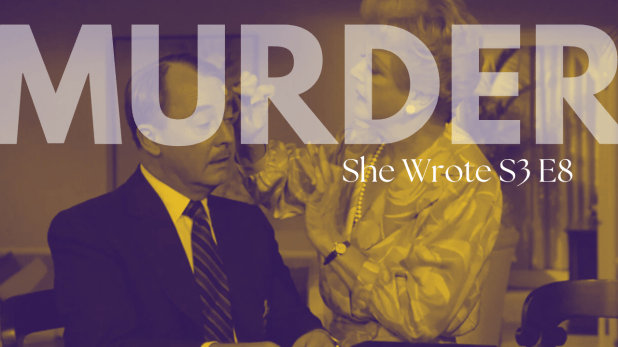
Murder, She Wrote S3 E8: Magnum on Ice (1986)

Jessica comes to the assistance of Magnum when he’s framed for two murders that occurred during her vacation in Hawaii in “Novel Connection.”

Season 3, Episode 8: Magnum on Ice (November 23, 1985)

Jessica has come to Hawaii to help a friend, Pamela, but along the way, she’s met Thomas Magnum and Jonathan Higgins. But then, Magnum gets blamed for a murder he didn’t commit, and she must save him.

Who’s in it, outside of Angela Lansbury (and Tom Selleck)?

Capt. Frank Browning is played by Ramon Bieri.

Amy Salyer is played by Stephanie Faracy.

Pamela Bates, who was in the Magnum, P.I. episode, is played by Dorothy Loudon.

Jason Bryan is played by John McMartin.

Andrew Prine is Victor Salyer! Wow, this also has Jessica Walter as Joan Fulton.

John Hillerman is Jonathan Higgins, Kwan Hi Lim is Lieutenant Tanaka, Rhonda Aldrich is a maid, Keahi Farden is a bellboy, Harry Endo is a desk clerk, Byron Ono is a house boy, Winston Char is another house boy, Pe’a is a police officer, and Conrad Hurtt is a policeman.

What happens?

Magnum got in a gun fight with a hitman at the end of his episode, but the police thought he shot a man in the back. Jessica and Higgins — all boned out for our writer friend, and wow, isn’t Higgins Robin Masters? Shouldn’t he use that to get into Jessica’s capris? — have to solve the case while Magnum is in jail.

Once Magnum gets out on bail, Arthur Houston is killed, and his Tigers baseball hat is found near the body.

Then, Higgins saves Jessica from Andrew Prine by karate chopping him. J.B. patches him up, and Higgins is fully randy and ready to unleash his John Thomas. I’m kidding, Higgins is a gentleman. He even drives Jessica to the airport by the end of the episode.

But after that fight, she figures out who did it and almost gets herself and Magnum killed.

Who did it?

Joan, who killed the hitman and Arthur, is revealed as the mastermind behind the crimes. She posted Magnum’s bail to keep framing him, adding a surprising twist to the episode’s plot.

Who made it?

This was directed by Peter Crane and written by Robert E. Swanson.

Does Jessica dress up and act stupid? Does she get some?

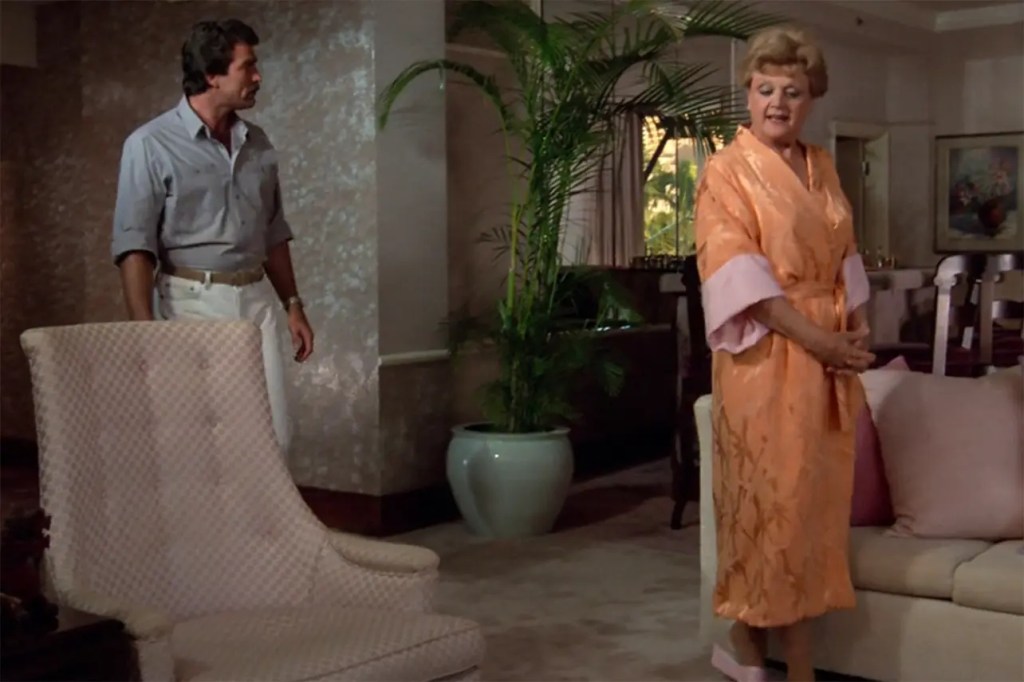
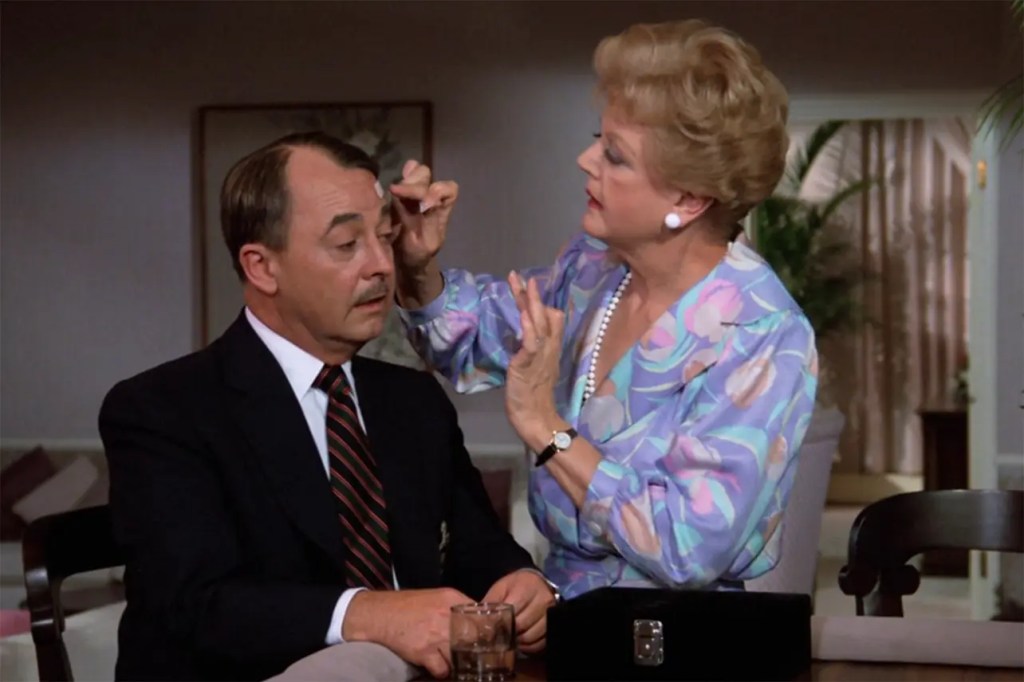
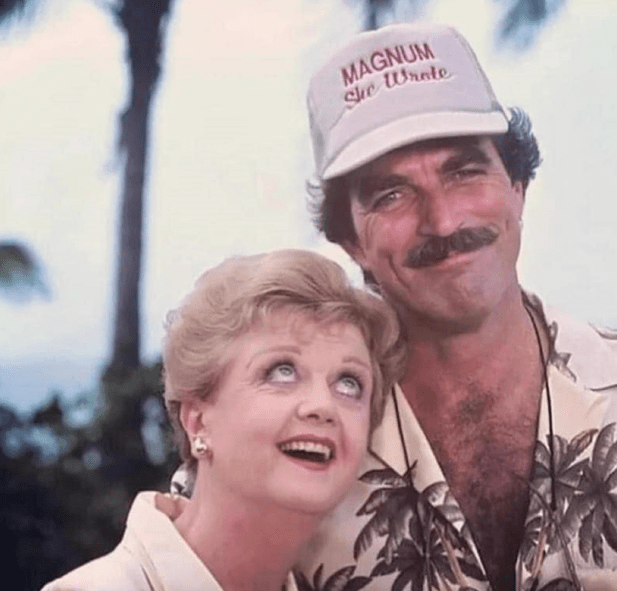
She doesn’t dress up, but take a look at this.

And this.

Was it any good?

It’s decent. I wish Jessica did more crossovers.

Any trivia?

Jessica Walter and Andrew Prine both appeared on the show four times, playing four different characters.

Give me a reasonable quote:

Thomas Magnum: So, Jessica, what do you say we make a deal? If you don’t take out a private investigator’s license…

Jessica Fletcher: Yes?

Thomas Magnum: …I won’t buy a typewriter.

Jessica Fletcher: Deal.

What’s next?

When an obnoxious out-of-town TV personality is murdered, it’s up to Jessica to figure out the killer. Plus, we get to find out what the B in J.B. Fletcher stands for.

Obsessive Love (1984)

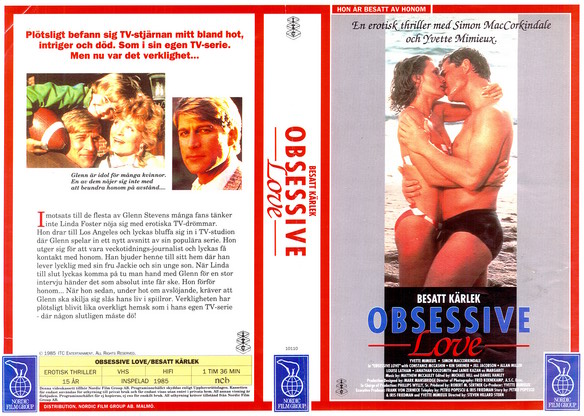
Directed by Steven Hilliard Stern (Rolling VengeanceThe Park Is Mine) and written by Iris Friedman, Petru Popescu and its star, Yvette Mimieux, this is about Linda Foster. She isn’t just a viewer of TV; she’s a resident of her favorite soap opera Savage Hills in her own mind. While the rest of the world sees flickering pixels, Linda sees a soulmate in Glen Stevens (Simon MacCorkindale). Her apartment isn’t a home; it’s a temple dedicated to a man who doesn’t exist.

So she does what any of us would: she gets a movie makeover, goes to Hollywood and does more than meet Glen. She carefully constructs a persona that mirrors his TV love interests to secure a one-night stand.

Of course, she doesn’t see him as a himan being. He’s Michael to her.

She can do just about anything. She systematically dismantles his marriage, positioning herself as the only person who truly understands him. Meta alert: She then works their true story into the actual show that she loves and makes everyone fall in love with her.

Who cares if she’s crazy?

Well, Glen, maybe.

The tension peaks when the real world and the soap world collide. When Glen realizes he isn’t being loved, but consumed, he uses the only weapon an actor has: the script. By demanding his character be killed off, he attempts to kill Linda’s reality.

Well, Glen does. He discovers the truth, then gets his character killed off. This upsets Linda so much that she goes back to the insane asylum. She falls in love with another character and that’s that.

You’ll want more violence and sex, as well as Linda to actually, you know, be mental. But she isn’t. She’s just in love. And this is a TV movie.

But it’s still fun and you can laugh at how much the shopping montage in Pretty Woman steals from this movie.

You can watch this on Tubi.

Tales from the Darkside S2 E5: Halloween Candy (1985)

Directed by Sex Machine himself, Tom Savini, and written by Michael McDowell (ThinnerBeetlejuice), “Halloween Candy” centers on Mr. Killup, played with skin-crawling bitterness by Roy Poole. Killup is the ultimate holiday bad guy, a mean man who doesn’t just dislike Halloween, but actively has disdain for the joy of children. His constant bickering with his weary son, Michael (Tim Choate), establishes a claustrophobic, mean-spirited atmosphere that feels ripped straight from the cynical pages of an old EC Comic. After a night spent tormenting trick-or-treaters with “treats” like spoiled food and hardware, Killup’s karma arrives in the form of a relentless, silent goblin (John Edward Allen).

The goblin isn’t just a monster; it’s a lingering, supernatural pest that slowly erodes Killup’s sanity. The finale where the creature uses its dark magic to accelerate time features gruesome, high-tier makeup effects that make Killup appear as though he has been rotting in neglect for weeks.

Even better, Fluffy from inside “The Crate” in Creepshow is in this.

This feels like one of the best shows of the series. Savini brings a cinematic eye to a low-budget TV format with relenteless pacing, His focus on the visceral details of the monster makes the segment feel more like a short film than a TV episode. With its heavy shadows, autumnal setting, and themes of greed and consequence, it is the quintessential Halloween watch. It captures that specific October vibes better than even some movies.

Magnum, P.I. S7 E9: Novel Connection (1986)

This week should have been Murder, She Wrote S3 E8 “Magnum on Ice,” but as that episode starts here in the first crossover between Murder, She Wrote and Magnum, P.I., let’s get into the world of Thomas Magnum.

In case you’ve never watched the show, Thomas Sullivan Magnum IV (Tom Selleck) lives in the Hawaiian guest house of an opulent 200-acre beachfront estate known as Robin’s Nest. At some point, he provided services for its owner, world-famous novelist Robin Masters (voiced by Orson Welles for all but the final time when Red Crandell spoke for the character), and he’s been allowed full run of the estate and use of the author’s Ferrari 308 GTB/GTS in exchange for some nebulous security detail. In between, he takes on cases that rarely pay and often put his life in danger. His arch-nemesis is Jonathan Quayle Higgins III (John Hillerman). Like Magnum, he’s ex-army, but he’s by the book, while our hero is laid-back. He’s in charge of Robin’s estate, patrolling it with his twin Dobermans, Zeus and Apollo. The relationship grows and changes as the series progresses, going from antagonistic to near friendship by the close, as well as the suspicion that Higgins is Robin Masters.

This episode begins with Higgins driving guest Pamela Bates (Dorothy Loudon) to the Robin’s Nest when someone tries to run them off the road. Usually, this is where Magnum would come in, but Pamela wants her mainland friend to take the case. That ends up being Jessica Fletcher. If you see this in syndication, they re-edited it to be a standalone episode. However, this was a two-parter that really did crossover the two different TV shows. Man, I love a crossover ep. In the original version, Magnum catches the killer and, after a gunfight, shoots the man. But then the evidence makes it look like he shot him in the back, so Jessica has to exonerate him.

How about this IMDbs? “Larry Manetti (who played Rick) stated that he did not enjoy working with Angela Lansbury, as she couldn’t be bothered talking to him during filming. Larry got the vibe that Angela felt she was “above” him.”

I always go all in on asking if Jessica has any in her stories. Well, here Jessica Walter, yes, the Bluth family matriarch, is all up in Thomas Magnum’s hairy business. While this episode isn’t the best, it was the Marvel Cinematic Universe for 1980s TV kids, connecting two worlds we never knew could be united.

Tales from the Darkside S2 E4: Parlour Floor Front (1985)

After a few light entries in the series, “Parlour Floor Front” marks a welcome return to the grim, ironic horror that defined the show’s peak. 

The undisputed highlight here is Adolph Caesar as Mars. Caesar was a titan of the industry, legendary for his booming, authoritative baritone. While he is immortalized as the voice of the United Negro College Fund’s “A mind is a terrible thing to waste” campaign and dozens of iconic movie trailers, his on-screen presence was equally formidable (earning an Oscar nod for A Soldier’s Story).

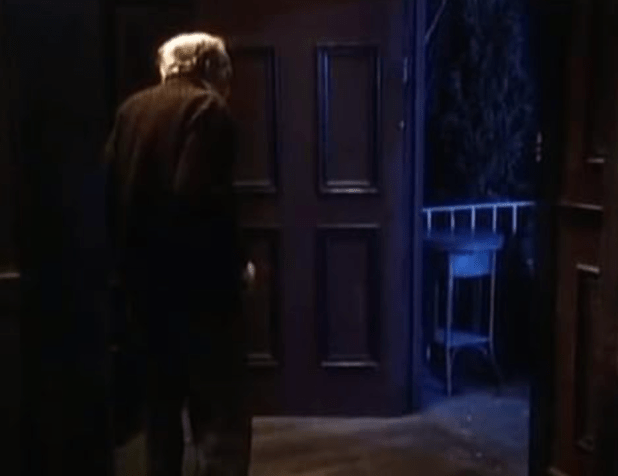
In this episode, he radiates a quiet, dangerous dignity. As the long-term tenant of a stunning apartment, Linda (Donna Bullock) sees him not as a human being, but as an obstacle to her plan. She is the quintessential 80s social climber, willing to use psychological warfare to get what she wants. Her husband, Doug (John Calonius), is happy for the help that Mars gives him in fixing up the place. But she keeps pushing, not knowing that the old man does voodoo and should not be treated this poorly.

Richard Friedman, who directed this episode, also made Phantom of the MallDoom Asylum and Scared Stiff. This episode was written by Carole Lucia Satrina, who scripted three of Cannon’s fairy tale films: Puss in Boots, Red Riding Hood and Beauty and the Beast.

This has a fantastic ending, and it’s nice to see the series return to horror rather than silliness.

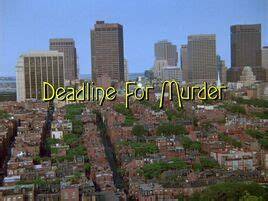
Murder, She Wrote S3 E7: Deadline for Murder (1985)

A veteran reporter who suffered a heart attack says his best medicine would be the removal of his publisher. Jessica gets involved after the man ends up dead.

A veteran reporter who suffered a heart attack says his best medicine would be the removal of his publisher. Jessica gets involved after the man ends up dead.

Season 3, Episode 7: Deadline for Murder (November 16, 1985)

Reporter Haskell Drake (Harry Guardino) has a heart attack after his editor, Lamar Bennett (Peter Mark Richman), rewrites his interview with Jessica. He flips out, Bennett drops dead, and then the reporter asks Jessica to solve it. I mean, is it a heart attack or murder?

Who’s in it, outside of Angela Lansbury (and Jarry Guardino)?

Katherine Cannon is Eleanor Revere. She’s in The Hidden.

Lt. A. Caruso is played by Gretchen Corbett. She was in The Rockford Files TV movies.

Tim O’Connor plays Walter Revere, Dr. Elias on Buck Rogers.

Ken Olin from Thirtysomething is Perry Revere.

Eugene Roche is Billy Simms.

William Smith! He’s Clyde Thorson! William Smith makes everything better!

Glynn Turman plays Stan Lassiter.

In more minor roles, Sydney Walsh is Kay Garrett, Tom Henschel is Dr. Framer, Morgan Jones is Sergeant Tierney, Mary Wickliffe is Nurse Phillips, Lisa Nelson is a policewoman, Dorothy Meyer is Nurse O’Hanlon, Matt Roe is a guard, and Erwin Fuller is Harry. Barbara Allyne Bennet is a secretary. Party guests are played by Robert Buckingham, Fritz Ford, Robert Hitchcock, Ethelreda Leopold, Mike Paciorek, Anthony Pecoraro, George Sasaki, Walter Smith and Geoff Vanderstock. Frank Slaten is an assistant, Steve Hershon is a waiter, Donald Chaffin is a reporter, and Freeman Love and Len Felber are detectives.

What happens?

Lamar Bennett bought the Sentinel, a newspaper, and consistently mocks the individuals who miss the days when it wasn’t a tabloid. He’s done this to tons of other papers, and this demoralizes Drake so much that he doesn’t want to live until Bennett dies, and he gets the chance to investigate with Jessica doing the in-person snooping.

It could be any of the reporters who want him dead. But it looks like…

Who did it?

Bennett’s assistant, Billy Simms, who knew about his illegitimate daughter Kay, took care of her for her entire life, all before Billy informed his boss who she really is and demanded that he fire her. Billy has enough and…well, that’s how we get to this episode’s death.

Who made it?

This was directed by Seymour Robbie and written by John Kennedy, Michael McGough and Tom Sawyer.

Does Jessica dress up and act stupid? Does she get some?

No. She needs to find the right costume party that also has everyone put their keys out, if you know what I mean.

Was it any good?

Sure.

Any trivia?

This is the first of two appearances by Harry Guardino as Haskell Drake.

Give me a reasonable quote:

Haskell Drake: I have been offered a big overseas assignment in Hong Kong, Singapore and Bangkok…

Jessica Fletcher: Oh. Haskell Drake: …by Newmonth, no less.

Jessica Fletcher: Haskell, that’s marvelous. When?

Haskell Drake: Oh, well, um, a-as soon as you hand me my trousers. And by the way, you can tag along if you want to. I figure that, uh, a couple of years of, uh, hard work, who knows, you may turn into a half-decent newspaperman.

What’s next?

YES! YES! YES! Jessica comes to the assistance of Thomas Magnum when he’s framed for two murders that occurred during her vacation in Hawaii!

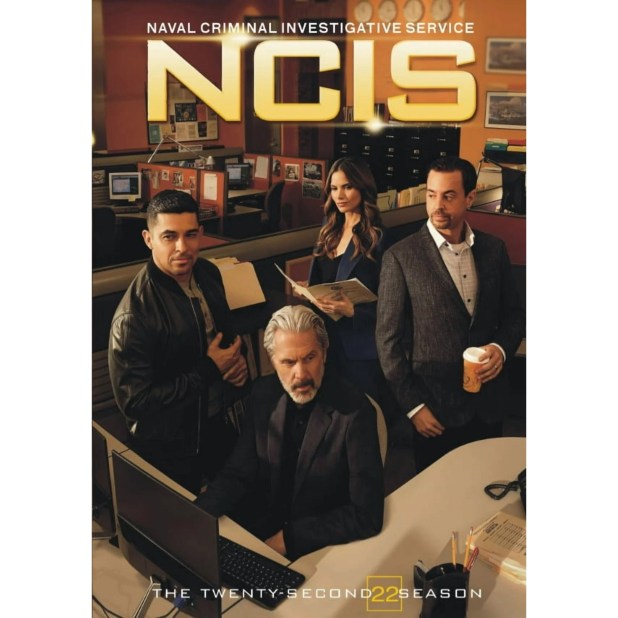
PARAMOUNT DVD SET RELEASE: NCIS Season 22 (2024)

NCIS (Naval Criminal Investigative Service) is about the police who handle criminal investigations involving the United States Navy and Marine Corps. Based at the Washington Navy Yard in Washington, D.C., the NCIS team is led by Supervisory Special Agent Alden Parker (Gary Cole). 22 seasons? How about there are two spin-offs on the air: NCIS: Origins and NCIS: Sydney.

Parker works alongside Timothy McGee (Sean Murray), Nick Torres (Wilmer Valderrama), Jessica Knight (Katrina Law), Dr. Jimmy Palmer (Brian Dietzen), Kasie Hines (Diona Reasonover) and Leon Vance (Rocky Carroll). This season has a recurring villain, Carla Marino (Rebecca De Mornay), the mob boss of the Kansas City mob. Plus, there are appearances by Laura San Giacomo, Donna Mills, Shari Belafonte, and LL Cool J, who is NCIS Senior Field Agent Sam Hanna.

I’ve watched this show from time to time, and it’s cool that they still mention characters like Ducky. I’m a big lover of continuity, so it’s nice to still have this on the air.

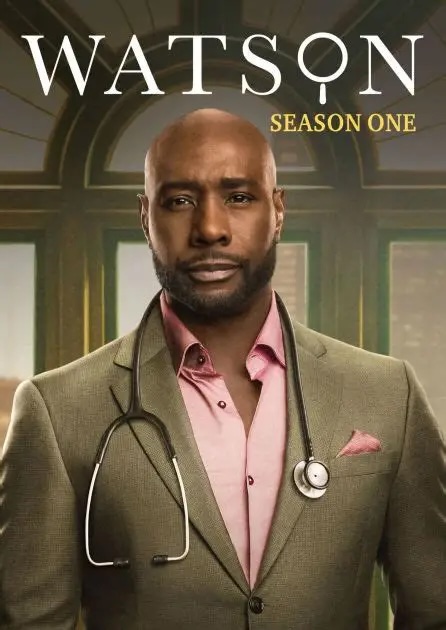
PARAMOUNT DVD SET RELEASE: Watson Season 1 (2024)

Just starting its second season on CBS, Watson stars Morris Chestnut as Dr. Watson in a modern version of one of history’s greatest detectives. Instead of crime, he solves medical mysteries. 

A year after Holmes’s (Robert Carlyle) apparent death at the hands of his archenemy Moriarty (Randall Park) at Reichenbach Falls, Watson opens the Holmes Clinic of Diagnostic Medicine in Pittsburgh — right dahntahn near The Pitt? — to treat patients with strange and unidentifiable issues. But is Moriarty still alive?

Created by Craig Sweeny, who also made Limitless and The Code, I like how this moves Watson from a moron, as he often appears in adaptations, to the hero. He has a team that includes neurologist  Dr. Ingrid Derian (Eve Harlow), identical twins Drs. Stephens Croft and Adam (both played by Peter Mark Kendall), who are constantly fighting because Adam is dating Stephens’ ex-fiancée, Dr. Sasha Lubbock (Inga Schlingmann), former criminal Shinwell Johnson (Richie Coster) and Watson’s ex-wife, surgeon Dr. Mary Morstan (Rochelle Aytes). Holmes founded this clinic so that after he died, Watson would have something to do with his life.

Cases include fatal insomnia, Cowden syndrome, a bullet stuck in a brain, QT syndrome, sickle cell anemia and more. By the end of the season, it’s revealed that Holmes didn’t die, and the show references a Pittsburgh mystery and a third-act surprise.

I kind of like it when Holmes is moved to modern times, and I’m interested in seeing where this series goes!