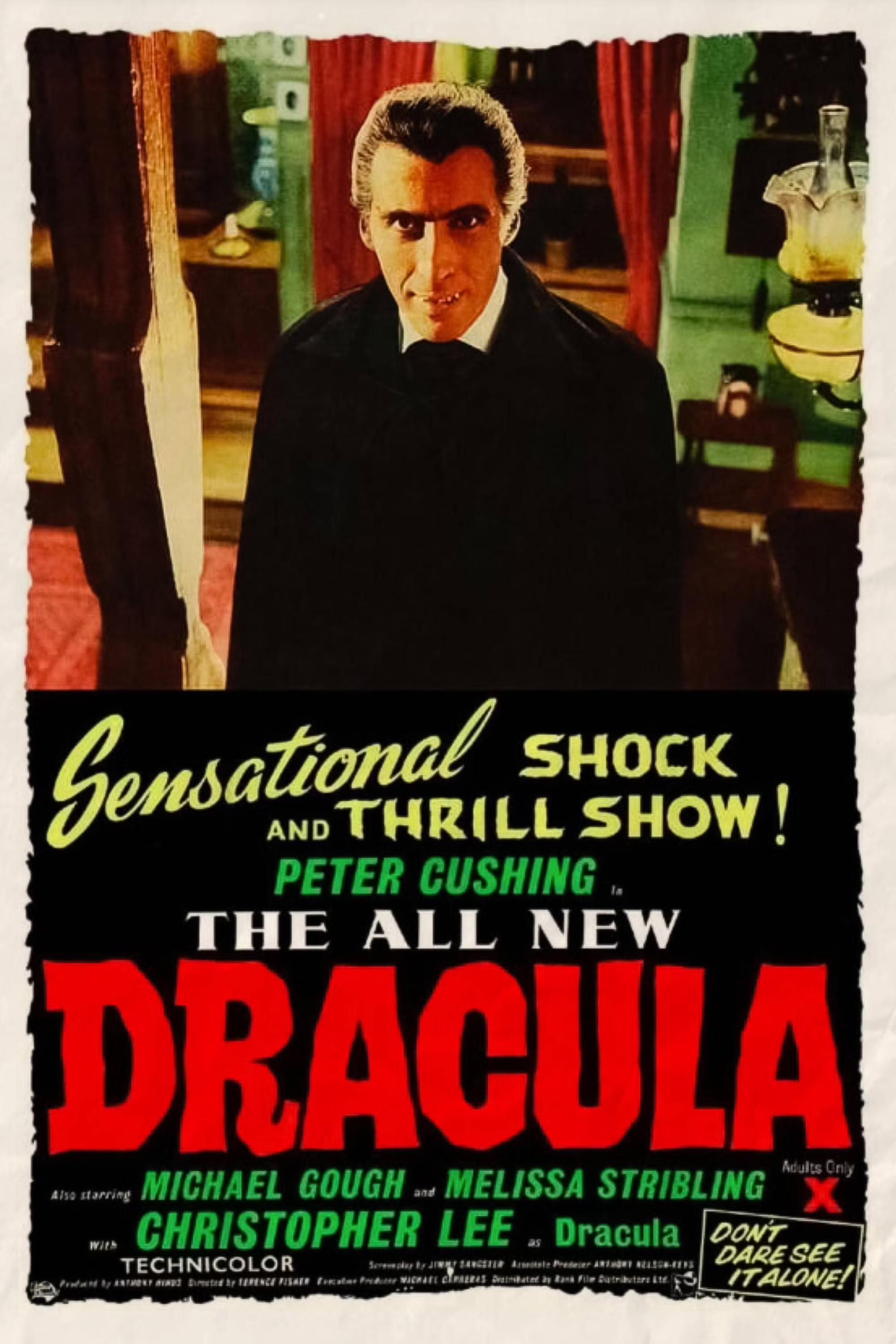
EDITOR’S NOTE: Dracula was on Chiller Theater on Saturday, December 7, 1963 at 3:00 p.m., Saturday, January 9, 1965 at 1:00 a.m. and Saturday, August 21, 1965 at 1:00 a.m. as Curse of Dracula.
I always wonder what it was like for audiences who only knew Universal Monsters to see Hammer for the first time. Before 1958, cinematic vampires were mostly stiff guys in white ties, tails and shiny patent leather shoes tiptoeing through monochrome fog. Then director Terence Fisher, writer Jimmy Sangster and the team at Bray Studios dropped £81,000 onto the slab, hired Christopher Lee and Peter Cushing, and permanently reshaped pop culture. Released in the US as Horror of Dracula to avoid a lawsuit from Universal, this was the first vampire movie ever shot in full color. And they put that color to work.
From the legendary opening credits—where blood spatters straight onto the Count’s tombstone—you know you’re in for a totally different animal. Forget the slow boat ride from Transylvania. Forget Quincey Morris or Renfield. Jimmy Sangster chopped Bram Stoker’s novel into an 82-minute, lean-and-mean Gothic machine.
In 1885, Jonathan Harker (John Van Eyssen) arrives at Count Dracula’s castle near Klausenburg, posing as a librarian. Secretly, Harker is a vampire hunter on a mission to put down the centuries-old monster. It goes about as badly as you’d expect: Harker gets seduced by Dracula’s vampire bride (Valerie Gaunt), bitten and trapped.
Enter Doctor Van Helsing (Peter Cushing). Cushing doesn’t play Van Helsing as some doddering old academic mumbling in a fake accent; he’s an athletic, sharp-suited, relentless action hero of faith. Van Helsing tracks Harker to the castle, finds his friend turned into a creature of the night and stakes him without hesitation.
From there, the battle moves to Karlstadt. Dracula—seeking revenge and a replacement bride—targets Harker’s fiancée, Lucy Holmwood (Carol Marsh), and her sister-in-law, Mina (Melissa Stribling). What follows is a desperate race against the clock as Van Helsing and Mina’s husband Arthur (Michael Gough) hunt down the Count before he turns Mina completely.
Lee didn’t just play Dracula. He created the modern archetype by blending the Count’s animalistic ferocity with dark, brooding, aristocratic sensuality. With his red contact lenses, sharp fangs and towering presence, he turned the monster into a walking aphrodisiac. And Cushing brings absolute authority and manic energy to the role. The climactic sprint through Dracula’s castle—where Cushing leaps onto a massive dining table, tears down heavy velvet drapes to let in the sunlight and improvises a cross using two brass candlesticks—is beyond perfect.
Director Terence Fisher didn’t play around. For the post-bite of Mina scene, he told Stribling: “Imagine you have had one whale of a sexual night, the one of your whole sexual experience. Give me that in your face!” And she delivered. The movie treats Dracula’s bite not as a curse, but as the ultimate forbidden release.
For decades, horror obsessives traded rumors about a legendary uncut “Japanese print” that featured a far more graphic, terrifying version of Dracula’s sun-disintegration climax. In 2011, parts of those long-lost, censored reels were actually uncovered at the National Film Center in Tokyo, leading to pristine restorations that finally reinserted the lost gore back into cinema history.
All I know is that I must have watched this every time it aired. I was obsessed. Still am.


