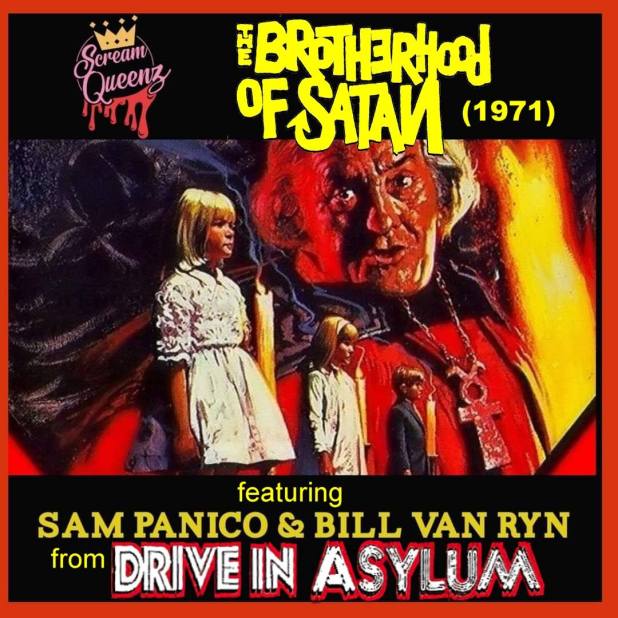
“For the first time in a long time, the door of THE NIGHTMARE CLOSET is about to slowly swing open once again and unleash another movie that completely traumatized me when I saw it as a child. This time, the evil let loose upon the world is Brotherhood of Satan. This movie has everything. Creepy kids! Creepy kids with creepy music boxes! Killer toys! Evil cake! Fidel Castro! Fake Jan! Literally, EVERYTHING!! But two things this movie does not have are two gentlemen who are experts in the field of cinematic sleaze and drive-in exploitation. Therefore, I am very fortunate to have two such gentlemen, BILL VAN RYN and SAM PANICO from GROOVY DOOM, as my guests this evening.”
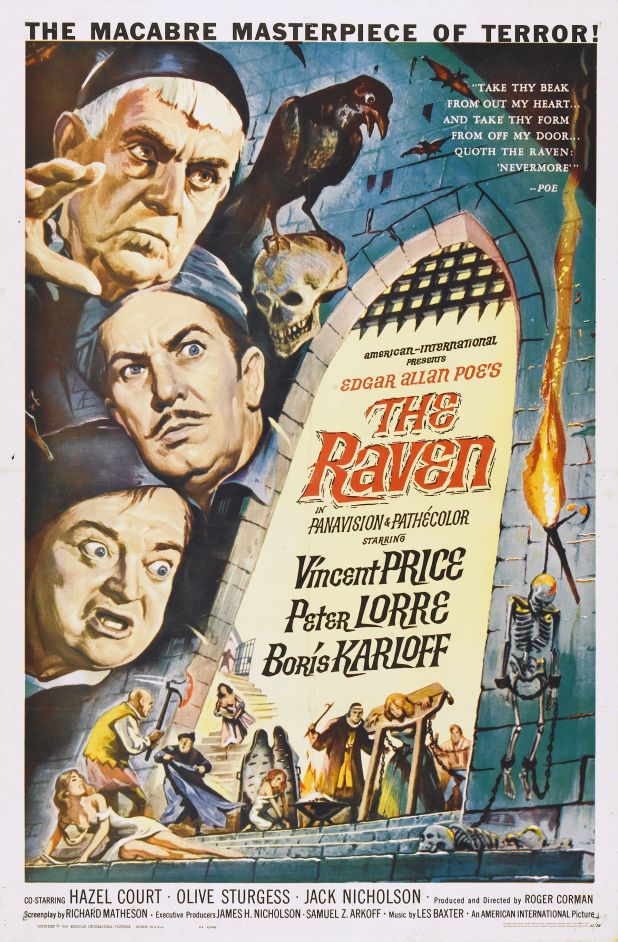
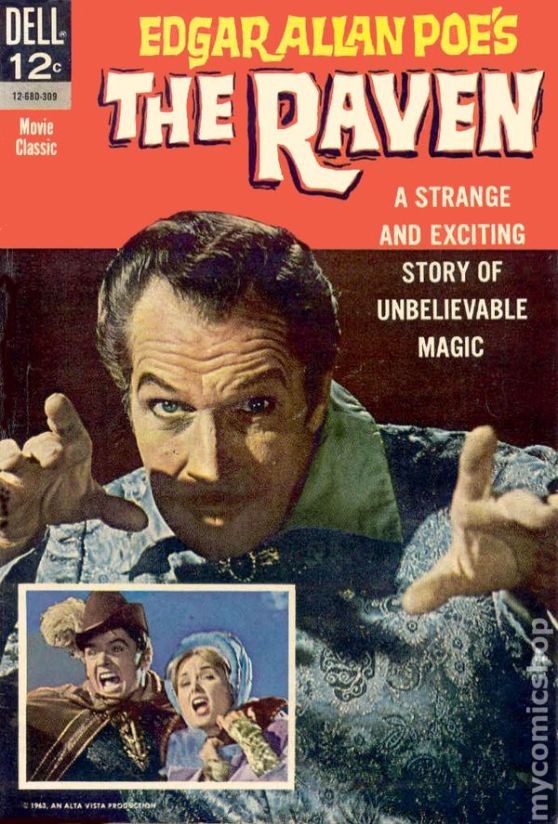
The fifth of Roger Corman’s Poe movies, this was written by Richard Mattheson and based on the poem “The Raven.” It has an astounding cast with Vincent Price, Peter Lorre and Boris Karloff — who was also in the 1935 adaption — as sorcerers locked in magical combat with one another.
In the book The Raven, Mattheson said, “After I heard they wanted to make a movie out of a poem, I felt that was an utter joke, so comedy was really the only way to go with it.”
As Dr. Erasmus Craven (Price) pines for his lost wife Lenore (Hazel Court, The Man Who Could Cheat Death), he is visited by a raven that he helped to transform back into the human form of Dr. Bedlo (Lorre). Now, Bedlo wants revenge on the man who turned him into a beast — Dr. Scarabus (Karloff) — and gets Craven to come with him, claiming that he’s seen Lenore’s ghost in his enemy’s castle. Along for the ride are Craven’s daughter Estelle and Bedlo’s son Rexford, who is a very young Jack Nicholson.
It all turns out that Lenore is alive and faked her death to become Scarabus’ mistress and doesn’t even bat an eye when the evil wizard tortures her daughter. Of course, a duel between magicians is the only way this can all end.
Lorre was given to improv, which Price grew to enjoy, Nicholson loved and Karloff hated. Between that and the goofy Latin phrases the magicians say when they cast spells, this movie always makes me laugh.
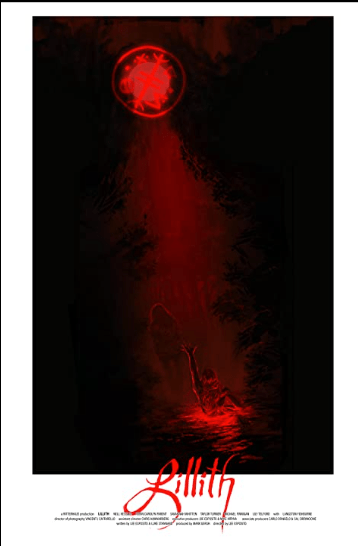
Lilith — called Lillith in this movie — may have gotten a friendly makeover of sorts in the 90s, but there’s such a dividing line in the thought as to who she is. Is she Adam’s first wife, created at the same time and from the same clay? Did she leave Adam after she refused to become subservient to him and wouldn’t return to the Garden of Eden after she’d made love to the archangel Samael? Or is Lilith a primordial she-demon, a vampire, a night bird and to quote the Dead Sea Scrolls, part of “the destroying angels, spirits of the bastards, demons, Lilith, howlers and desert dwellers and those which fall upon men without warning to lead them astray from a spirit of understanding?” Still — it’s spelled Lillith, so it can really be anything it wants!
In Lee Esposito’s Lililth, she’s a succubus conjured by Jenna (Nell Kessler), who has discovered that she’s been done wrong. Lillith (Savannah Whitten) is a redhead that the boys — and girls — of Rising Wood Community College are just, well, dying to sleep with. Well, they get their wish.
While this film has a low budget, it has a high fun quotient. It totally fits into the Linnea Quigley direct to VHS demon films of the past and that’s high praise.
Lililth is available on demand and on Tubi from Terror Films. Want to learn more? Check out the official Facebook page.
Based on the Reverend Doctor Christopher Syn series of books by Russell Thorndike — just like Disney’s The Scarecrow of Romney Marsh which was released a year later — this Hammer film was called Night Creatures* in the U.S.
A sailor (Milton Reid, who wrestled as The Mighty Chang and showed up in three Bond movies) has his tongue removed fromhis mouth and is left behind to die on an island after attacking the wife of pirate captain Nathaniel Clegg.
However, when we get back to England, the prevailing theory is that Clegg has been hung by the Royal Navy and rests in the Romney Marsh. However, by night, glowing spectral riders known as the Marsh Phantoms are terrorizing the people of the village of Dymchurch.
Captain Collier rescued that sailor and keeps him as a slave. He arrives in the village to investigate rumors of smuggling, attacking bars and safehouses before he finds a secret passage in the home of Jeremiah Mipps (Michael Ripper), a coffin maker, that leads to the smugglers’ headquarters. When the mute sailor goes into their lair, he meets clergyman Dr. Blyss (Peter Cushing), who he attacks and even tries to open the grave of Clegg.
Is Clegg still alive? Is he one of the phantoms that roam the night? Are the villagers in on it? All of these questions have very easy answers, but this film has so much style that you just enjoy it. It’s directed by Peter Graham Scott, who created Into the Labyrinth, which aired in the U.S. as part of Nickelodeon’s The Third Eye, along with The Haunting of Cassie Palmer, Under the Mountain, Children of the Stones and The Witches and the Grinnygog. It was written by Anthony Hinds, who wrote a ton of films for Hammer, including The Curse of the Werewolf**, The Kiss of the Vampire, The Reptile, Frankenstein Created Woman, Taste the Blood of Dracula and many more.
In Rob Zombie’s Halloween 2, the band in the movie is Captain Clegg & the Night Creatures. It’s Jesse Dayton, who played as the band Banjo and Sullivan for The Devil’s Rejects.
*Hammer was planning to adapt the Richard Matheson story I Am Legend into a film that would be titled Night Creatures. The British Board of Film Classification told them that they would not pass the film — the script must be sent to the BBFC before a movie is filmed — and because Hammer had promised Universal a movie with that title, Captain Clegg became Night Creature.
**The werewolf star from that movie — Oliver Reed — is in this in a rare heroic role.
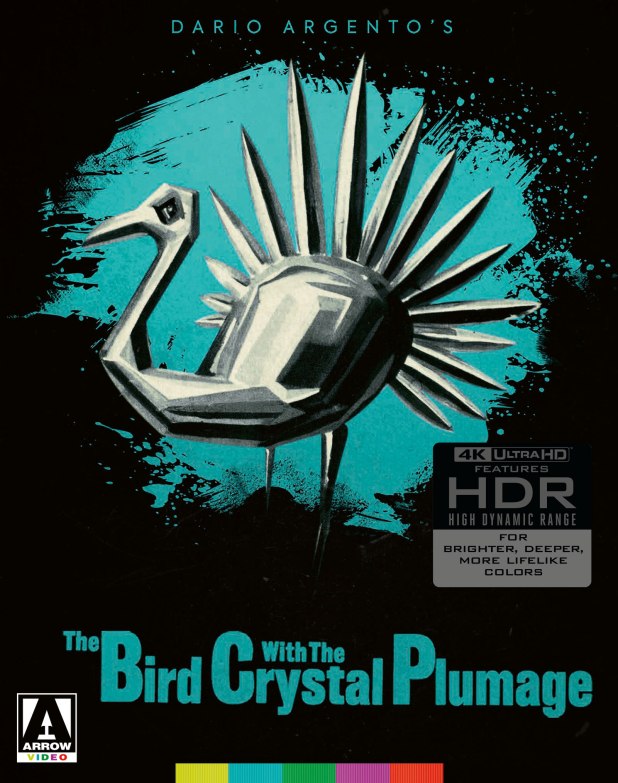
EDITOR’S NOTE: We originally covered this giallo masterwork back on March 26, 2019. Now that Arrow Video has released a UHD edition of this film, it’s time we look back on it and talk about this expanded version.
Other than the films of Mario Bava (Blood and Black Lace, The Girl Who Knew Too Much), there’s no other film that has no influenced the giallo. In fact, the most well-known version of the form starts right here with Dario Argento’s 1970 directorial debut. Until this movie, he’d been a journalist and had helped write Leone’s Once Upon a Time in the West.
Sam Dalmas (Tony Musante) is an American writer suffering from an inability to write. He’s gone to Rome to recover, along with his British model girlfriend (yes, everyone in giallo can score a gorgeous girl like Suzy Kendall). Just as he decides to return home, he witnesses a black-gloved man attacking a girl inside an art gallery. Desperate to save her, he can only watch, helpless and trapped between two mechanical doors as she wordlessly begs for help.
The woman is Monica Ranier and she’s gallery owner’s wife. She survives the attack, but the police think Sam may have had something to do with the crime, so they keep his passport so he can’t leave the country. What they’re not letting on is that a serial killer has been wiping out young women for weeks and that Sam is the only witness. That said — he’s haunted by what he’s survived and his memory isn’t working well, meaning that he’s missing a vital clue that could solve the crime.
As you can see, the foreign stranger who must become a detective, the missing pieces of memory, the black-clad killer — it’s everything that every post-1970 giallo would pay tribute to (perhaps rip off is the better term).
Another Argento trope shows up here for the first time. It’s the idea that art itself can cause violence. In this film, it’s a painting that shows a raincoat-clad man murdering a woman.
Soon, Sam is getting menacing calls from the killer and Julia is attacked by the black-clad maniac. The police isolate a sound in the background of the killer’s conversations, the call of a rare Siberian “bird with the crystal plumage.” There’s only one in Rome, which gets the police closer to the identity of who is wearing those black gloves (in truth, it’s Argento’s hands). It’s worth noting that the species of bird the film refers to as “Hornitus Nevalis” doesn’t really exist. The bird in the film is actually a Grey Crowned Crane.
Alberto, Monica’s art gallery husband, tries to kill her, finally revealing that he has been behind the attacks. Ah — but this is a giallo. Mistaken identity is the main trick of its trade. And even though this film was made nearly fifty years ago, I’d rather you get the opportunity to learn for yourself who the killer really is.
I may have mentioned before that my parents saw this movie before I was born and hated it to a degree that any time a movie didn’t make any sense, they would always bring up “that weird movie with the bird that makes the noises.” Who knew I would grow up to love Argento so much? It’s one of those cruel ironies that would show up in his movies. I really wonder if my obsession with giallo and movies that are difficult to understand is really me just rebelling.
An uncredited adaptation of Fredric Brown’s novel The Screaming Mimi, this film was thought of as career suicide by actress Eva Renzi. And the producer of the film wanted to remove Argento as the director. However, when Argento’s father Salvatore Argento went to speak to the man, he noticed that the executive’s secretary was all shaken up. He asked her what was wrong and she mentioned that she was still terrified from watching the film. Salvatore asked her to tell her boss why she was so upset and that’s what convinced the man to keep Dario on board.
The results of all this toil and worry? A movie that played for three and a half years in one Milan theater and led to copycats (and lizards and spiders and flies and ducklings and butterflies and so on) for decades. Argento would go on to film the rest of his so-called Animal Trilogy with The Cat O’Nine Tails and Four Flies on Grey Velvet, then Deep Red before moving into more supernatural films like Suspiria and Inferno.
The first global UHD release of this film from Arrow Video is packed with everything you expect from this prestige label. First up is the 4K restoration from the original negative by Arrow Films that come on a 4K (2160p) UHD Blu-ray presentation in Dolby Vision. It features audio commentary by Troy Howarth, author of So Deadly, So Perverse: 50 Years of Italian Giallo Films and also has an interview with author and critic Kat Ellinger exploring the film’s themes, a visual essay on the cinema of Dario Argento by Alexanda Heller-Nicholas and interviews with Argento and actors Gildo Di Marco and Eva Renzi. Plus, you get the original Italian and international theatrical trailers, the 2017 Texas Frightmare trailer, an illustrated collector’s booklet featuring writing on the film by Howard Hughes and Jack Seabrook and a new essay by Rachael Nisbet, a fold-out double-sided poster featuring original and newly commissioned artwork by Obviously Creative, six double-sided, postcard-sized lobby card reproduction artcards and limited edition packaging with a reversible sleeve featuring originally and newly commissioned artwork by Obviously Creative. Whew! You can get it from MVD.
It’s also available on the ARROW player. Head over to ARROW to start your 30 day free trial (subscriptions are available for $4.99 monthly or $49.99 yearly). ARROW is available in the US, Canada and the UK on the following Apps/devices: Roku (all Roku sticks, boxes, devices, etc), Apple TV & iOS devices, Android TV and mobile devices , Fire TV (all Amazon Fire TV Sticks, boxes, etc), and on all web browsers at https://www.arrow-player.com.
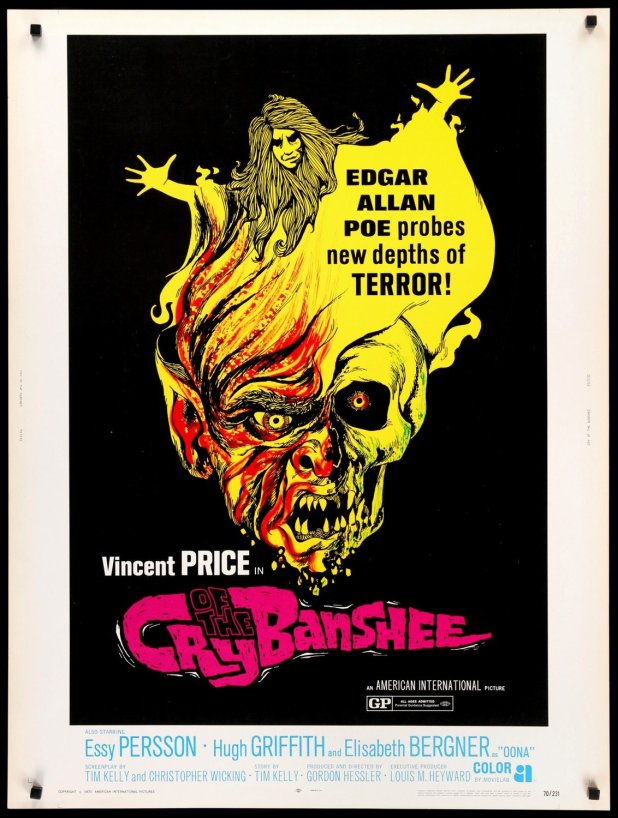
That poem is Edgar Allan Poe’s “The Bells,” which sets the tone for this unique movie, the last of the American-International Pictures Poe movies. Directed by Gordon Hessler, this film, unlike its predecessors, had nothing to do with the Baltimorean author, offering a fresh take on the horror genre.
According to Peter Fuller on Spooky Isles, AIP promoted this movie as the hundredth film that its star, Vincent Price, was in. The truth is that it was probably his seventy-sixth. Undaunted, AIP did the same publicity for his next movie, The Abominable Dr. Phibes.
This movie is a visual treat — it was shot in the Grim’s Dyke House, the same location as Curse of the Crimson Altar and The Devil Rides Out. The film opens with an incredibly excellent animation by Terry Gilliam, a visual masterpiece that, unfortunately, was cut from the American print, leaving the audience captivated from the start.
If you enjoyed Vincent Price’s portrayal as a witch hunter in Witchfinder General, you’re in for a treat! In this film, he plays the role of Lord Edward Whitman, a character who has taken it upon himself to rid England of every witch. His relentless pursuit leads to the disruption of Black Masses and the death of many witches, until one of them, Oona, possesses his loyal servant Roderick, complicating his mission.
The movie also inspired a band to name themselves Siouxie and the Banshees. Perhaps you’ve heard of them?
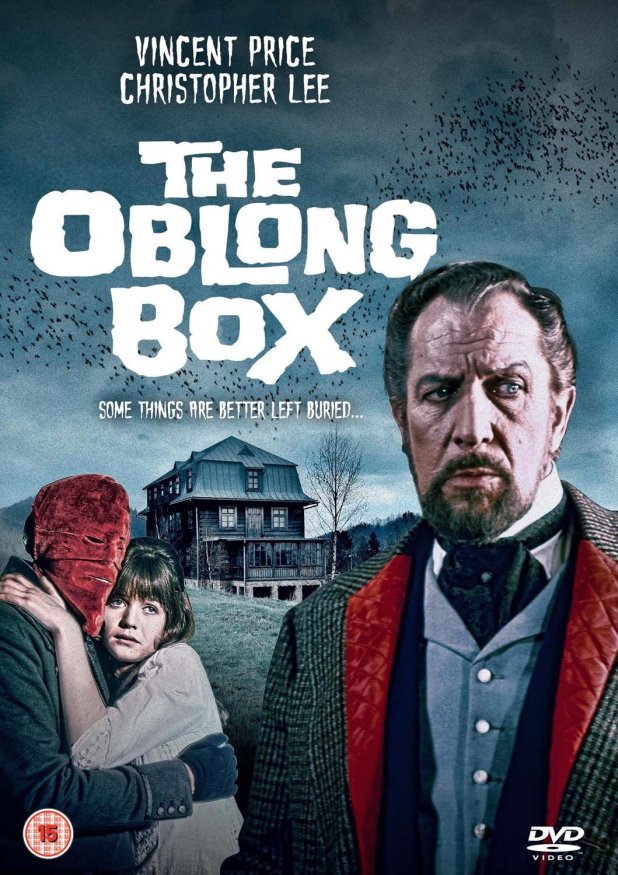
Based on the Edgar Allan Poe short story “The Oblong Box,” the script for this movie by Lawrence Huntington and Christopher Wicking also brings in plenty of other Poe themes like masked men, premature burial and, well, voodoo. Which has nothing to do with Poe, but hey — this is the first time Christopher Lee and Vincent Price were in a movie together, so let’s just ignore that.
While in Africa, Sir Edward Markham (Alister Williamson, who usually is in a supporting role) has his face ruined in a voodoo ceremony — shades of how The Great Kabuki (Japanese version) got his facepaint — and is kept locked up by his brother Julian (Vincent Price). The secret is that the crime that he was punished for — killing a child — was really the fault of his brother. Now, he wears the scars for the crime he did not commit.
He soon gets the family lawyer and a witchdoctor (Harry Baird, Cool It Carol) to help him fake his death, but his brother buries him — but first, a proxy as nobody wants to see what Sir Edward has become — before going off to marry his true love Elizabeth (Hilary Dwyer, which means that Matthew Hopkins finally got to have his way with Sara).
Meanwhile, Sir Edward is dug up — still alive — and given to Dr. Newhartt (Lee) to use as an experimental autopsy. The facially deformed madman blackmails the doctor and starts murdering nearly everyone he meets. By the end of this movie, numerous people have been horribly killed and both brothers are sentenced for their crimes, if not by the law, then by karma.
Sadly, this movie was to reteam Witchfinder General director Michael Reeves with Price. That film led to a renaissance of Poe films from AIP. However, Reeves fell ill while working on the film — he was also going to make an adaption of H.G. Welles’ When the Sleeper Wakes with AIP. He’d die a few months later of an accidental drug overdose. Instead, this was directed by Gordon Hessler, who also made Pray for Death and Kiss Meets the Phantom of the Park.
The pro-black scene of the slaves rising up against Sir Edward was enough to get this movie banned in Texas, which happened within several of our lifetimes. The world changes eventually, right?
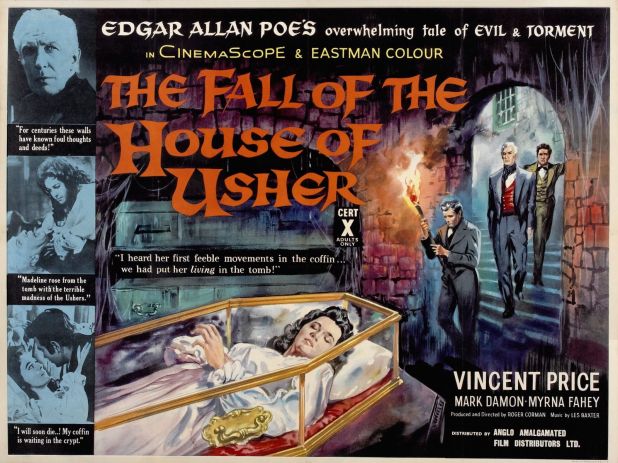
Adapted from Edgar Allan Poe’s short story The Fall of the House of Usher, this film marked the beginning of a series of eight Poe adaptations by Roger Corman, often in collaboration with writer Richard Matheson. Shot in a mere fifteen days, it was a bold departure for American-International Pictures, known for its black-and-white double features. This venture into color cinema with a substantial budget was a significant risk by AIP’s standards, adding a unique twist to the film’s production history.
Central to the narrative is the tragic fate of the Usher family, cursed to descend into madness. This ominous prophecy has not only engulfed their home but also the very ground it stands on, leading to its gradual decay and destruction.
Philip Winthrop (Mark Damon, Black Sabbath) traveled to the House of Usher to take his fiancee Madeline, who is opposed by her brother Roderick (Vincent Price), who is determined to see his family’s bloodline end with this generation. This leads to an argument so brutal that Madeline’s catalepsy is triggered, making her appear dead, and when she’s buried alive, she fully gives in to the madness within the Usher family, bringing the entire home down in flames all around everyone but our hero, who leaves with nothing.
Although Corman and Lou Rusoff are usually given credit for the AIP Poe cycle of films, Damon spoke up on a Black Sabbath commentary track, claiming he gave Corman the idea and was even allowed to direct The Pit and the Pendulum. This story hasn’t been confirmed, as there are several images of Corman directing that movie.
The success of House of Usher not only paved the way for more collaborations between Corman and Price but also set a precedent for reusing the same sets and special effects. The iconic Usher house set, which was actually a scheduled demolition, was set ablaze, and the footage used in multiple films, a testament to the enduring influence of this production.
In the world of myth, Medusa was a gorgeous woman who was assaulted inside the temple of Athena by Poseidon, who gained power over the goddess of wisdom through this attack. Angered, Athena punished Medusa by transforming her into a horrific creature, her radiant hair replaced by snakes. Today, feminists see the story of Medusa as one of the first cases of victim blaming. There’s also the theory that she was transformed into a beast because men have always feared female desire.
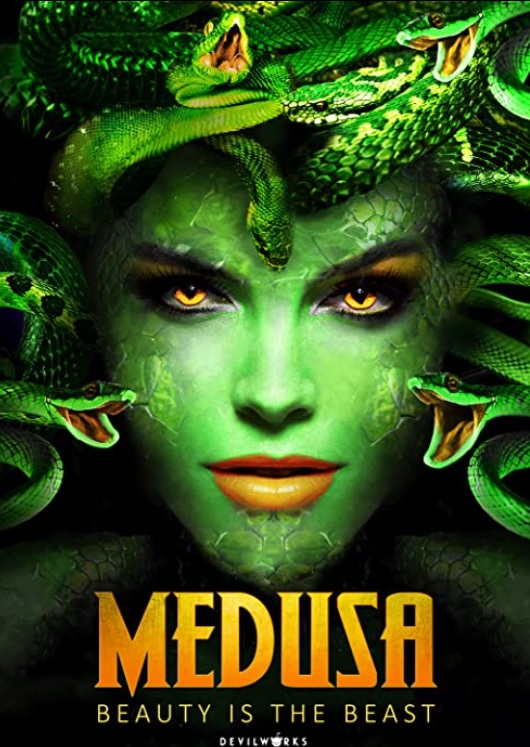
That brings us to the movie Medusa, in which a young woman suddenly finds that a snake’s bite has begun to change her into something new, beautiful and deadly.
The first full-length movie from director Matthew B.C. — working from a script by Scott Jeffrey — tells the story of a caravan of prostitutes facing a variety of addictions, violent customers and an existence bereft of any hope.
When a new girl named Carly — who had escaped this caravan once before, only to succumb back to the siren’s call of heroin addiciton — is taken to work there by her pimp, her first job introduces her to Alexis, who is both a snake and a woman. Once Carly is bitten, she becomes something that will change the world of all of the women.
If you told me the premise of this movie without showing it to me — and told me the budget — I’d think it was a trifle. Yet I was pleasantly surprised by the way the narrative is in the now without clubbing you over the head with its messages. It’s a talented filmmaker who can thread the narrow divides of commerce, exploitation and message. Somehow, against the odds, this movie does that.
And hey — I’m all for movies that feature snakes growing out of a woman’s head.
Medusa is available on demand and on DVD from New Era Entertainment.
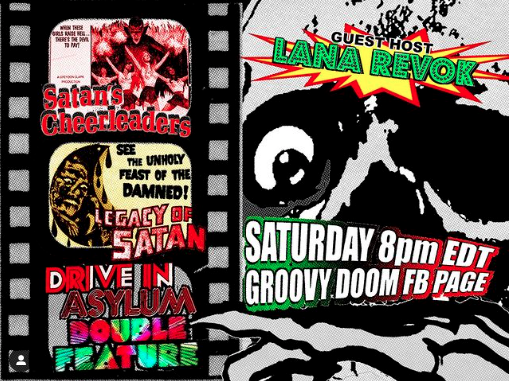
Get ready to join special guest Lana Revok this Saturday on the Groovy Doom Facebook page starting at 8 PM East Coast Time.
We’re showing two totally devilish movies, starting with Satan’s Cheerleaders. You can watch it on YouTube.
During the talk segments of the show, we discuss the film, show an ad gallery and teach you how to make a themed cocktail. Here’s the recipe for the first movie.
2-4-6-8 who do we appreciate? You! And Satan! So throw everything in a shaker with ice and shake it all about.
Pour, drink and do a split.
Up next, a demon movie — with no sex — from a guy who made a demon movie with some sex. Yes, it’s Gerard Damiano’s Legacy of Satan — watchable on Tubi.





 B&S About Movies
You must be logged in to post a comment.