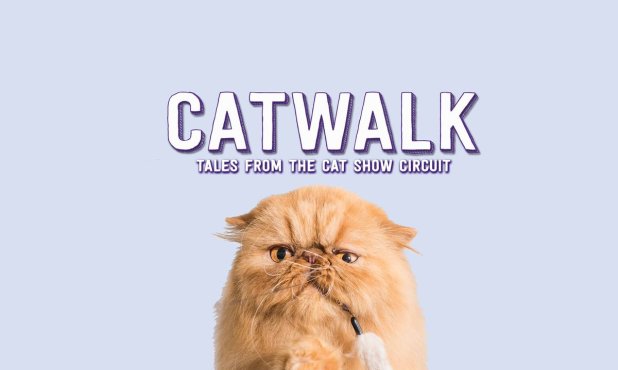
There can only be one Best Cat in Canada. It’s either going to be Oh La La the Red Persian or Bobby the Turkish Angora. As Kim, Bobby’s owner says, “If you’re not number one, you’re the first loser.” Get ready for the battle of the century, which will be fought in curling facilities and high school gyms. Other cats will get close, but at the end of the day, the real fur is about to fly between these two.
Kim Langille’s cats have won nearly everything there is to win. He’s in first place right now, but then Bob and Elaine Gleason’s cat Mr. Oh La La comes out of retirement to re-enter the world of the Canadian Cat Association.
Soon, the greatest cat judge in the history of cat judges will decide who will reign supreme. Along the way, we meet the owners, their many cats and learn what it takes to get someone to spend the money to fly all over Canada to do something like this.
I loved this movie. It’s 75 minutes of pure fun. It could totally make fun of its subjects and while it makes light, it is never mean. Seriously, the scene where the judge almost loses his mind judging Mr. Oh La La might be one of the best moments I’ll see in any movie this year.
This is streaming on Netflix right now. Watch it with a cat you love.
In this episode, we’ll discuss how much Becca liked or didn’t like the latest Halloween, what slashers we actually like, what movies make Sam cry and why some people don’t like the movies Sam chooses to watch on movie nights.
Thanks for listening!
You can listen here on Podomatic: https://bit.ly/2B3g1P8
I don’t have a favorite movie to be honest. There are tons of worthwhile movies that I adore, thinking of them as old friends. They’re experiences that transport me away from my day to day concerns. How does one choose just a single solitary individual movie to hold above all others as their top choice?
My tastes are broad, too. So it could be a blockbuster like Raiders of the Lost Ark, which is a perfect distillation of so many influences, a movie serial for eighties kids, packed with flying wings and Nazis and a flawed hero with a bullwhip and a hat that never comes off? Or would it be something arty like Jodorowsky’s El Topo or The Holy Mountain, films about image and religion and violence and transformation? Something gory like Fulci’s The Beyond or Romero’s Dawn of the Dead? A movie that will never fit into the time it was released and is still finding an audience, like Carpenter’s Big Trouble in Little China or The Adventures of Buckaroo Banzai? Or maybe Strange Brew or The Kentucky Fried Movie or Beyond the Valley of the Dolls?
Man, this is hard.
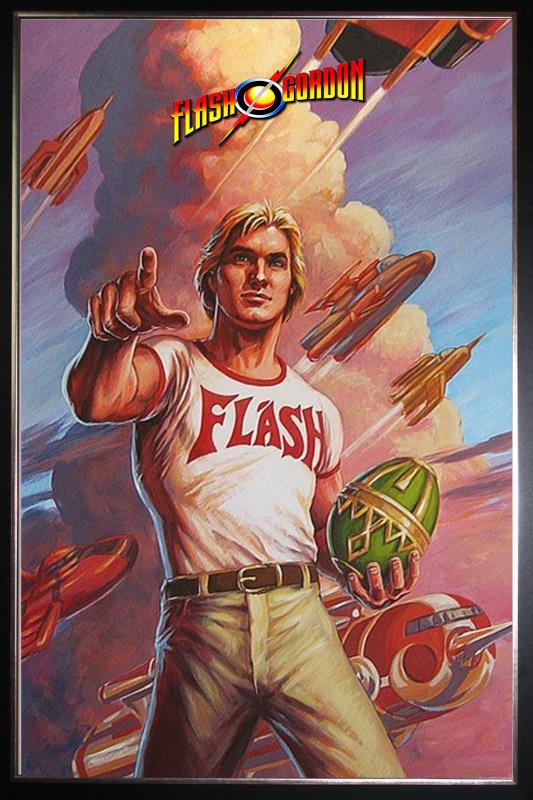
If hard pressed, I’ll have to pick Flash Gordon. It’s not the best movie ever made, but the more I think about it, it’s my favorite film ever made. It’s like a warm bowl of soup on a cold winter’s day. Someone tucking you in and letting you sleep in. A cool fresh squeezed lemonade when you’re parched. It is all of these things and more.
When they were planning this movie — and look, I wasn’t there, I was right when this came out — I imagined that they all stopped doing coke for a second — because in my heart of hearts, I fervently believe that every movie pre-1990 was dreamed up with mountainous piles of cocaine for fuel — and said, “You know, instead of making this movie realistic, let’s make it as fake and garish and ridiculous as we can. Fuck it.”
Whereas Star Wars and Alien – movies influenced by the aforementioned Jodoworsky’s abandoned Dune project — envisioned working class spaceships, everything in Flash Gordon is shiny and new and fresh out of Studio 54.
It’s a film daring enough to find its star, Sam J. Jones, from TV’s The Dating Game. Then, take that untested star and match him with master thespians like Max Von Sydow and Topol.
It’s also a film stupid enough to feature a football fight as one of its main action pieces. But I’ll punch anyone square in the face that makes fun of that scene. The cheerleading, the sound effect when Flash gets knocked out, the lizard aliens cheering, Klytus calling plays — it’s really the craziest thing committed to celluloid. This wasn’t some art film or ragtag B movie — this was a major blockbuster motion picture.
And at the same time, it has the greatest soundtrack ever recorded. Queen was at the top of their game — hey, they had just released The Game — and they went nuts on this epic. Pretty much every drum part I’ve ever tracked for my many metal projects starts here, with the loud pounding tribal beat featured in the song “In the Space Capsule (The Love Theme).” I’m listening to this while I type these words and I can envision exactly what is on screen, Dale, Flash and Dr. Zarkov. Man — dialogue all over these songs on the soundtrack, like it should be.
Flash is such an influence on me that I randomly scream things from it just about every single day. Stuff like, “DIVE!” and “Gordon’s alive?!” and “No, daddy, not the bore worms!” or “Ah, well; who wants to live forever?” and “Klytus, are your men on the right pills?” and “Rocketship Ajax approaching!”
It’s packed with everything a movie needs: crazy scenery that isn’t afraid to throw glitter and day-glo everywhere; Ornella Muti steaming up the screen in every single frame she appears in (I didn’t get a ton of the sexual stuff in here until maybe my mid-teens, then I started watching the film all over again from a totally new perspective); both the funniest and most awesome wedding scene in the history of film; a button marked HOT HAIL that Ming just fires at the Earth because he can. I could, can and will go on — it’s that good.
The first time I saw this movie was at the Westgate Plaza Cinema in New Castle, PA. I forced my parents to watch it twice the same day and I was a completely maniac, standing on my seat and screaming, “KILL MING!” until I had to be told to settle down. Then, HBO saw fit to air it every single minute of every single hour or every single day, except for when they showed Burt Reynolds movies like Hooper and Sharky’s Machine. And I watched it every single time.
I should have just wrote this piece like a disjointed screed from a maniac of things that make me go goo goo in this flick: Klytus’ eyes bugging out when he melts and dies; the jump at the end and the YEAH!; the Hawkmen spelling Flash’s name at the victory celebration; Rocky Horror’s Richard O’Brien showing up on Arboria; even an ending that promised more. Well, 37 years later, I’m still waiting.
They say you should never meet your heroes. And I hate bugging celebrities and being a fanboy, but there’s one picture that I have — and Sam J. Jones is in it. That pretty much says it all.
PS – The end of the movie, when they play Queen’s “The Hero?” Let me quote:
“So you feel that you ain’t nobody/ Always needed to be somebody/ Put your feet on the ground/ Put your hand on your heart/ Lift your head to the stars/ And the world’s for your taking”
I can run through walls after listening to that song or watching this movie.
Jon Chu has really turned his fortunes around with this movie. Originally the director of musical theme films like Step Up 2: The Streets, Step Up 3D and Justin Bieber: Never Say Never, he moved on to two Hasbro properties, G.I. Joe: Retaliation and Jem and the Holograms, which was out of theaters in about a week. Lucky for him, this film has been a success, with a sequel being announced a week into its run. Strangely enough, Chu is mentioned in the book as a distant cousin of main character Rachel Chu!
Based on the book by Kevin Kwan, the movie faced early controversy. Despite being the first major American release with Asian stars since 1993’s The Joy Luck Club, it received criticisms for casting biracial actors over fully ethnically Chinese ones in certain roles, as well as failing to include non-Chinese Singaporean ethnic groups, such as Malay or Indian actors.
This played out in its international release, as Singaporeans didn’t really enjoy it, criticizing it for its lack of diversity and authenticity. But domestically, its success — it’s the highest grossing romantic comedy in a decade — should hopefully lead to plenty of work for Asian actors from every country.
Nick Young (Henry Golding, A Simple Favor) and his girlfriend, Rachel Chu (Constance Wu, TV’s Fresh Off the Boat) are going to Singapore for the wedding of his best friend Colin to Araminta (Sonoya Mizuno, Annihilation), a fashion icon. Rachel hasn’t learned much about Nick’s family, but once she sees their flight accommodations, she’s shocked to learn just how rich they are. Meanwhile, thanks to someone named Radio One Asia, everyone in Singapore knows all about her.
Just how rich Nick’s family is gets cemented by a visit to her old college roommate, Goh Peik Lin (Awkwafina) and her family, which includes Ken Jeong. Despite a giant bachelor and bachelorette party, Nick feels out of place and Rachel gets a dead fish — and lots of blood — all over her bed.
If that reception seems bad, it gets worse when she meets Nick’s mother Eleanor (Michelle Yeoh, whose stunts in movies like Police Story 3: Supercop put her on the same level as Jackie Chan even before more dramatic films like Crouching Tiger, Hidden Dragon and Memoirs of a Geisha), who wants nothing to do with a foreign girl coming into her family. And that’s before she even gets to know his grandmother Su Yi (Lisa Lu, who was in The Joy Luck Club and Demon Seed).
I loved both Jimmy O. Yang (who is also in HBO’s Silicon Valley) and Nico Santos (from Superstore) as Oliver T’sien, who gets the Young family anything they need.
If you love fashion, you’ll really love this, as clothes from Ralph Lauren, Elie Saab, Dolce & Gabbana, Valentino and Dior all appear. Yet for all these designers, Michelle Yeoh was dissatisfied with the ring that she was to wear. The emerald and diamond ring that she does wear is her personal ring, as are many pieces of jewelry in the movie.
Interestingly enough, Netflix wanted to produce the film and offered a much bigger budget, but Kevin Kwan turned down the offer in favor of a smaller $30-million budget from Warner Brothers. Why? Simple. He wanted to prove to studios that Adian-Americans would come to see this film and others like it.
There’s all manner of family drama, revelations, lavish parties, insanely expensive weddings, fireworks both personal and in the sky, love lost and love found. And the film looks gorgeous, with so many lavish sets. I may be Italian/Polish/American, but there’s still plenty of truth that I found even in my family.
I know that Lon Chaney Jr.’s career highlight was being in the Universal monster movies. I realize that the end of his life seems sad — he suffered from throat cancer and heart disease after decades of hard drinking and smoking. In fact, Robert Stack claimed in his autobiography that Chaney and Broderick Crawford were known around the Universal lot as “the monsters” due to how much they drank and raised hell.
Despite living in his father’s shadow, Chaney could be one hell of an actor. After all, he played Lennie Small in the original Of Mice and Men. You get reminded of that when you watch late period Chaney and he has to use his voice and body instead of makeup in films like Spider Baby (why I haven’t reviewed that yet I have no idea).
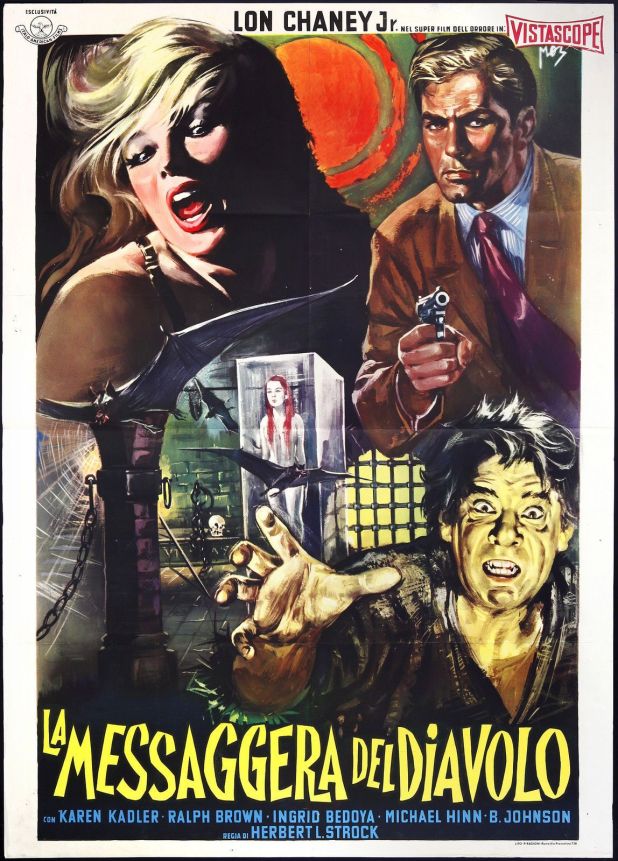
That brings us to The Devil’s Messenger, a 1961 anthology that takes three episodes of the Swedish TV series 13 Demon Street. From the tale of a 50,000-year-old woman trapped in ice bewitching scientists to a man who learns of his death in a dream to a photographer who attacks a woman in teh snow and can’t escape her, these are some pretty decent stories. And oh yeah — there’s a framing device starring Chaney, Karen Kadler and John Crawford that was directed by Herbert L. Strock (I Was a Teenage Frankenstein).
Guess what? Those three Swedish episodes — The Photograph,” “The Girl in the Glacier,” and “Condemned in Crystal” — were directed by Curt Siodmak. Who is that? Oh, only the guy who wrote the original The Wolf Man, I Walked with a Zombie, Son of Dracula and House of Frankenstein as well as directing Curucu, Beast of the Amazon and The Magnetic Monster.
Look, any movie where Lon Chaney Jr. makes good on Satan’s plot to nuke the world is one I’m going to love.
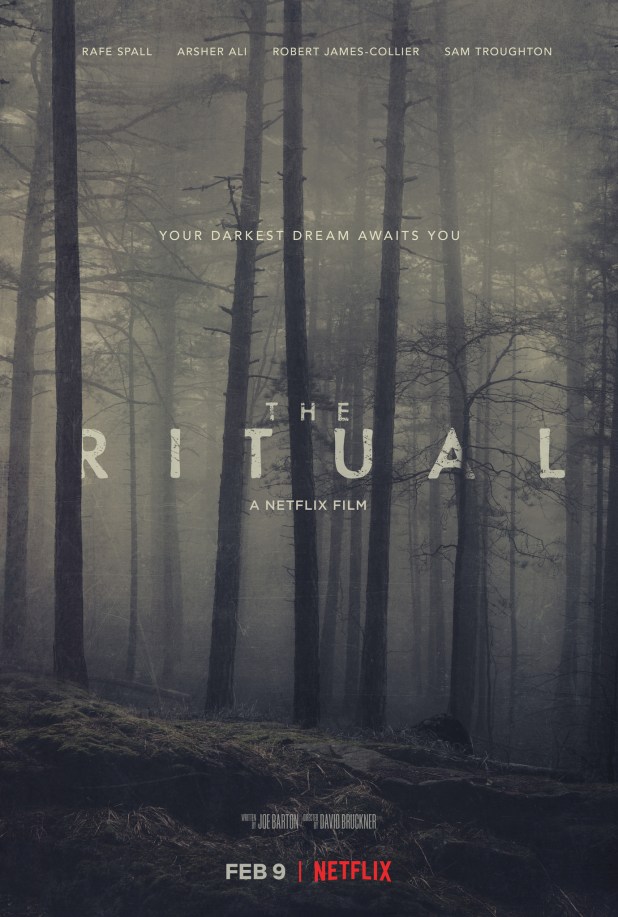
Five old college old friends meet to get drunk and discuss their annual vacation together. Rob wants to hike in Sweden, but the others all make fun of him. On their way home, Luke decides to get a bottle of vodka in a convenience store. Inside, Rob is killed by criminals when he won’t give up his wedding ring. Luke is too slow to help and can only watch his friend be killed. From these very urban origins, the rural horror of The Ritual begins.
To celebrate their friend, the survivors take the trip he wanted to Kungsleden, or King’s Trail, in Sweden’s Sarek National Park. One of them hurts his knee, so they decide to take a faster path home, but start to discover strange things like animals gutted and hung from trees and strange runes carved in the trees.
Seeking shelter in an abandoned house, the men discover more runes and strange statues, yet they stay there for the night. When Luke wakes from an evening of nightmares, he has puncture wounds all over his chest. As they go deeper into the forest, their feelings toward one another — some blame Luke for Rob’s death — come to light. And they start getting killed off by whatever is tracking them and left hung like the animals they say before.
Soon, only Luke and Dom are left and the latter has been selected as a sacrifice to the Jötunn, who takes human lives and gives immortality in return. Luke must take part in the ritual and submit to the god or die. He refuses and the creature makes him relive his nightmares again and again until he’s able to fight back and make his way to the edge of the woods, a place where it loses its power. Screaming in its face, Luke has survived.
Directed by David Bruckner (V / H / S, Southbound), whose work I hadn’t enjoyed much until this film, this is a great throwback to 1970’s occult horror. It has a dark and sinister feel from the moment everyone journeys into the forest. It doesn’t hold any surprises, but that doesn’t mean it’s not a great ride.
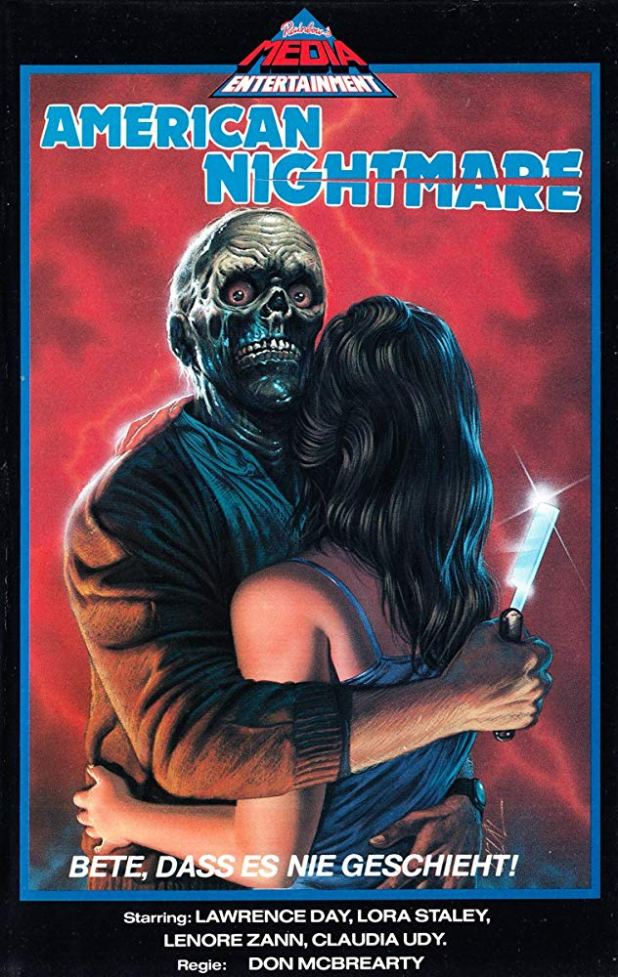
This is a movie that starts off in a way that got me quick. A prostitute named Isabelle (pre-Baywatch Alexandra Paul) is naked in bed, smoking a joint and trying to get a man in the bathroom to come out and make love to her. He keeps washing his hands obsessively while she apologizes for some videos she appeared in. The man comes out, gets out top of her and slices her throat open. In the world of exploitation movies, this is what we call a good start.
American Nightmare isn’t from this country. It’s from our pals in Canada, where we for some reason aren’t building a wall.
Isabelle’s brother Eric is a famous musician who is coming to find his sister after she writes him — no cell phones yet — to let him know that she’s in trouble. This sends him on a journey through strip clubs, adult theaters and dens of prostitution, all to find his sister — who was killed at the beginning of the movie.
This movie is pretty scummy — when Eric confronts his father about he and his sister leaving the family, the old man kicks him out and then fondles a photo of his daughter. Is this how the Great White North sees us?
The killer starts murdering all of Isabelle’s friends, except for Louise, who Eric saves. They end up becoming lovers, because that’s how the world works in movies.
Of course, the video in question is one of Eric’s dad having sex with his sister. The reveal causes the old man to blow his brains out. This is the kind of movie my wife walks into the room and just stares and walks out angry. Then I yell, “But Michael Ironside is in it!”
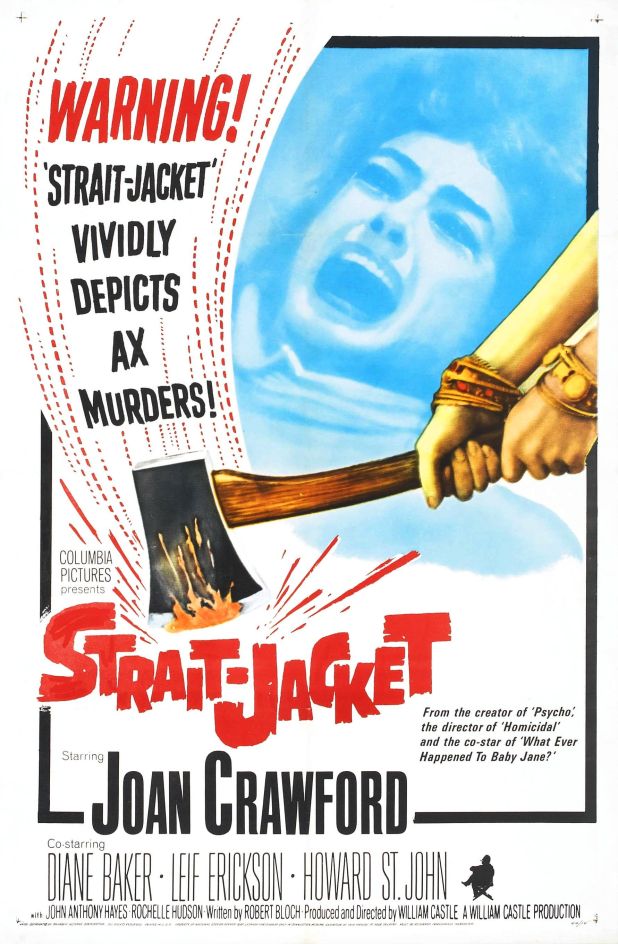
After the success of What Ever Happened to Baby Jane?, Hollywood suddenly had roles for older actresses, as part of psycho-biddy films. And no one was more in demand than Joan Crawford, who agreed to be in this William Castle film with the following demands: script and cast approval, a $50,000 salary and 15 percent of the profits.
Lucy Harbin (Joan!) has spent two decades in a mental hospital after the axe murders of her philandering husband (Lee Majors!) and his mistress. After she gets out, she moves in with his brother Bill (Leif Ericson, who is also in I Saw What You Did with Crawford, along with his wife Emily and her daughter, Carol (Diane Baker, who Crawford hired to replace Anne Helm).
Ironically, Crawford herself was a replacement for Joan Blondell, who was injured before filming and couldn’t make the movie.
Carol seems happy and unharmed by the fact that she watched her mother sliced up her father and his lover with an axe. In fact, she does everything she can to keep her mother from being depressed, changing her look back to how she appeared when she was young.
Soon enough, Joan is acting the hell out of this movie, a new series of axe murders are happening and George Kennedy shows up looking young and perverted. Oh yeah — you can also totally play a drinking game by looking for every appearance of Pepsi in this movie. Even crazier, the character of Dr. Anderson was played by Mitchell Cox, who was not an actor, but rather the Vice President of the Pepsi-Cola Company. Joan did this one all on her own, without even asking Castle. Oh Joan!
Even though William Castle had the best gimmick of all — an A-list star in a B-movie horror flick — he still gave audience members little cardboard axes for coming to see the movie. And at several theaters, he brought Joan along, coming out to greet her public.
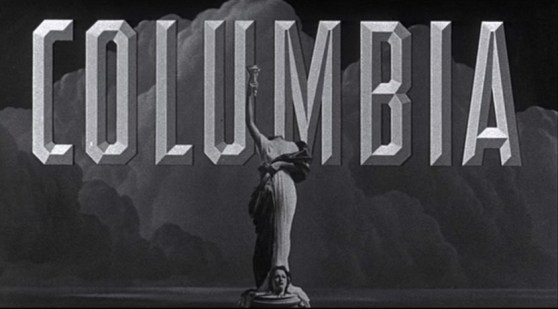
My favorite thing in this entire movie is that the Columbia logo’s torch-bearing woman is decapitated at the end of the movie!
Look — I’m not going to be unbiased when it comes to Joan Crawford movies. This one is ridiculous — a near giallo with Joan acting decades younger than she should — but that makes it so much greater than it should be.
When asked what makes Queen different from any other band, Freddie Mercury is quick with an answer. “We’re four misfits who don’t belong together, we’re playing for the other misfits. They’re the outcasts, right at the back of the room. We’re pretty sure they don’t belong either. We belong to them.”
In 1980, when Queen’s “The Game” came out, I was that eight-year-old misfit. Too chubby, too weird, too loud, too nice. I hated school because it meant getting beat up every single day. And even on a day when I’d get the opportunity to bring in a record for music class, the other kids would all make fun of me. I didn’t listen to popular music, but brought in the band’s “News of the World” album, with a Frank Kelly Freas cover of a robot killing people, including Queen itself. No one liked it. In fact, they hated it. But when “Another One Bites the Dust” came out that year, more than a few of them learned about the power of Queen.
Queen was always too much in the best of ways. They’ve continued to be there for the best and worst moments of my life. In fact, the solo on “We Will Rock You” is probably my favorite of all time, as you can hear the hum of Brian May’s guitar even before the first note is played. When this movie was announced, I worried, as how could any movie, no matter how huge, capture the spirit of Queen?
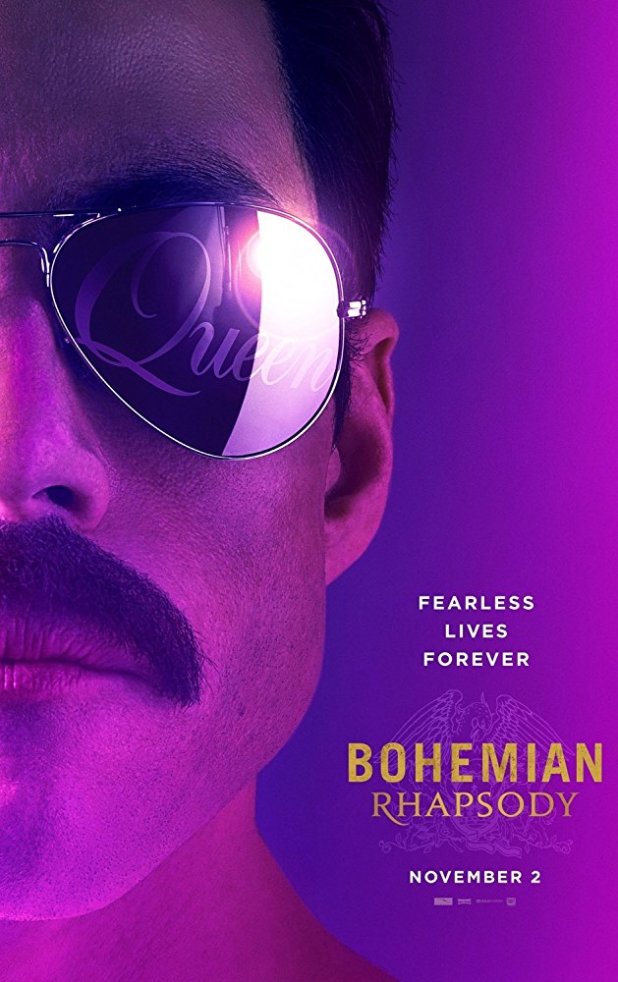
Originally announced in 2010, with Sacha Baron Cohen cast as Mercury before leaving in 2013 because of creative differences, the film sat unmade until Rami Malek (TV’s Mr. Robot) was cast in November 2016.
Directed by Bryan Singer (the X-Men films, Apt Pupil and The Usual Suspects), the film concentrates on Freddie Mercury while also touching on the rest of the band.
It starts when young Farrokh Bulsara is just a college student and airport baggage handler who has been following a band named Smile. After one of their shows, he meets Brian May (Gwilym Lee, guitarist in the band Male Friends and a near identical twin for the man he’s playing) and drummer Roger Taylor (Ben Hardy, who played Archangel in Singer’s X-Men: Apocalypse). With their lead singer quitting, he joins the band along with bassist John Deacon (Joe Mazzello, the kid from the original Jurassic Park).
After selling their van to finance their first album, the band quickly signs to EMI, travels to America and Freddie adopts his stage name as his real name. He also gets engaged to Mary Austin (Lucy Boynton, who is great in this) while beginning to question his sexuality, including a scene where he stares at a truck driver played by Adam Lambert, who has performed with Queen.
That’s the crux of people’s worries with the film — that the movie plays hard and fast with the facts of Mercury’s sexuality and AIDS-related death. Many believe Mercury learned he had HIV between 1986 and 1987, but not before Live Aid in 1985 as depicted in the film. He didn’t tell the band until 1989.
But back to the movie — when Queen record their fourth album “A Night at the Opera” they end up leaving EMI when Ray Foster (a made-up person loosely based on EMI chief Roy Featherstone, who was actually a fan of the song) refuses to release a six-minute long single. There’s an interesting meta moment here, as Foster is played by Mike Myers, whose use of the song in Wayne’s World led to it being loved by a whole new generation. The best part of this scene is the triumph of the song being released, only for horrible reviews to emerge. Such is Queen — they didn’t belong to critics.
Freddie falls for Paul, the band’s manager, and comes out as bisexual to his fiancee. They live next to one another for years, but Freddie is hurt when she finally moves on. The band has ups and downs, but Freddie decides to leave in 1982, recording an album for CBS for more money than he could make with Queen.
This is another fallacy, as doing a solo record is seen as Freddie sinning against the band. The trust is that Taylor released “Fun in Space” and “Strange Frontier” while May released “Star Fleet Project” years before Mercury’s “Mr. Bad Guy” was recorded.
Also, remember that when the band breaks up before Live Aid, that never happened. Queen released “The Works” in 1984 and toured all over the world to support it, with the final date just two weeks before they played that massive charity event.
That said, the end of the movie is amazing. The performance at Live Aid is captured perfectly, featuring the songs “Bohemian Rhapsody”, “Radio Ga Ga”, “Hammer to Fall” and “We Are the Champions.” I also thought that they used archival footage of Bob Geldof, but it’s really Dermot Murphy. In a nice bit of caemo work, look for Brian May and Roger Taylor in this scene as they watch from the rafters.
Interestingly enough, Singer didn’t even finish the film. He often showed up late to set or disappeared for long stretches, including three straight days after the Thanksgiving break, at which point cinematographer Newton Thomas Sigel took over. Singer was fired and 20th Century Fox terminated his production deal before finishing the movie with new director Dexter Fletcher, who is also directing the Elton John bio Rocketman. However, the Director’s Guild assigned sole directed credit to Singer.
If you’re seeking an examination of Mercury’s refusal to come out and how he dealt with AIDS, as well as his identity as Indian-British Parsi man, this isn’t that movie. This is Queen’s greatest hits, an exploration of their music less than one of the truth. It’s packed with plenty of audience-pleasing moments instead of personal revelations. Maybe we’ll get that movie someday. This isn’t it. And that’s fine — I never expected it to be.
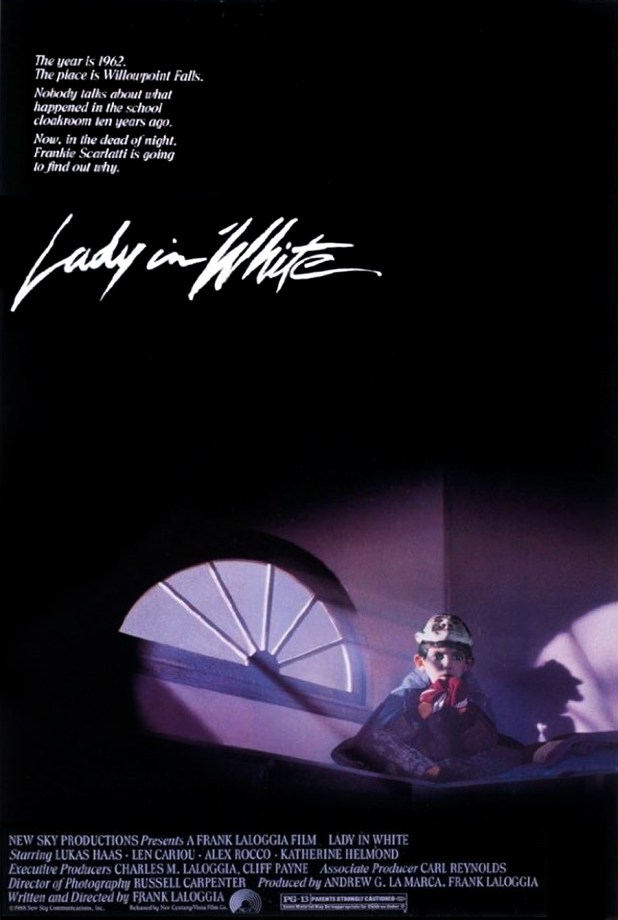
If all Frank LaLoggia had made was the utterly bizarre Fear No Evil, he’d still be a filmmaker to celebrate. Luckily, he also gifted us with this film, a ghost story that bombed on initial release but has gone on to be a celebrated film, one that’s just as much about growing up as it is about murder.
Horror author Franklin “Frankie” Scarlatti (as an adult, he’s played by the director, but in the film itself, it’s Lukas Haas) is on his way back to Willowpoint Falls and relates the story of how way back in 1962, over Halloween, he was attacked and nearly strangled to death by a mysterious figure in black. Even more frightening, he witnesses the death of a young redhead girl, who has ties to the mysterious lady in white, an urban legend that all of the schoolboys live in fear of.
The police arrest the school’s black janitor, Harold “Willy” Williams, for the killings and the way the town reacts to this forms the moral backbone of the film. There’s also a lot about family, with father Angelo (a welcome Alex Rocco), his adopted brother and the near comical shenanigans of Frankie’s grandparents.
Along the way, Frankie becomes obsessed with bringing closure to the redhead girl’s ghost, solving her murder and bringing her back to her mother. There’s also the matter of the real or unreal lady in white (Katherine Helmond from TV’s Who’s the Boss?).
The film has a really great scene where the killer reveals himself within the foggy woods as the lighting in the scene progressively grows darker, a really interesting camera trick that is all but forgotten in our CGI era. In fact, all of the night scenes in the woods almost feel like an otherworldly affair, as if shot just outside our reality.
LaLoggia wrote, directed, produced and scored this film, which was based on the legend of the Lady in White,a woman who roams Durand-Eastman Park in Rochester, New York searching for her daughter. It’s a place hat the auteur knows well, as he grew up there and filmed much of the movie on location.
It’s a shame that LaLoggia didn’t get to make more films, because of the two I’ve seen, he is able to tell a simple story that still feels intensely personal and nuanced. He’s teased several projects over the years, including being attached to the Cannon Spider-Man movie that never got off the ground. Here’s to another film coming from him, someday, someway.


 B&S About Movies
You must be logged in to post a comment.