SON OF MADE FOR TV MOVIES WEEK: Don’t Be Afraid of the Dark (1973)

For the first installment of our return to the wonder of TV movies, Bill Van Ryn from Drive-In Asylum and Groovy Doom returns to tell us about one of his favorite movies.
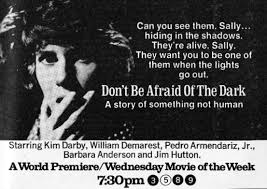
Considering the reputation of 1973’s Don’t Be Afraid of the Dark as a TV movie that forever scarred some impressionably young viewers, it’s surprising that the movie got dismissive reviews when it was current. The LA Times reviewer said the film was unintentionally funny and pointless, and a paper from Massachusetts claimed actress Kim Darby was “miscast” in the lead role of a housewife who finds herself confronted with tiny, demonic homunculi inside the spooky house she and her husband have just inherited.

Darby plays Sally Farnham, whose task of redecorating the old mansion turns dire when she unwisely removes a bolted barrier covering the ash pit of a bricked-up fireplace. Ignoring the warnings of the elderly handyman of the house (played by William Demarest), Sally soon discovers she has unleashed three tiny, misshapen monsters who lurk in the shadows of the old house. The goblins are driven off by light, so many of the film’s horror episodes involve the creatures tampering with the lights and hunting Sally when it’s dark, with the intention to either kill her or make her one of them–or maybe those two things are the same.  

The strange, whispering imps were enough to give many viewers nightmares, especially those of the young and impressionable type. The film avoids any back story on the creatures, other than to suggest that at least one of them is a family member of Sally’s who was transformed, which could mean that each of the monsters was once a human being. It’s this sense of uncertainty that, hopefully, inspires the viewer to imagine their own explanation of the weird things we see happening. The director, John Newland, creates the illusion of miniature demons by filming diminutive actors in monster costumes on oversized sets. Some of the shots are convincing, others are not, but the film relies just as much on atmospheric touches to communicate a sense of dread. The creepy house used in the film is none other than the Piru Mansion in Piru, California, and it’s appeared in numerous films and TV shows, including Curse of the Black Widow, The Folks At Red Wolf Inn, Pets and Tarantulas: The Deadly Cargo.

It was still common in the 1970s for a scary movie to be slowly paced and easy on the horror, and yet it could still be effective if the filmmakers were focused on suspense and atmosphere. Since it was a made-for-tv movie, Don’t Be Afraid of the Dark is forced to be restrained in the way it depicts onscreen death and peril. There’s only a single death in the movie, when one of the characters falls down the stairs. It’s worth noting that it isn’t death that the heroine of the film has to fear, since the implication is that the homunculi are former residents of the house who are damned to forever inhabit the strange void that seems to be accessed by the ash pit behind that fireplace. What they really want is to make her one of them, alive forever, and presumably trapped in the house.

The plot is made much more suspenseful because of the inability of the characters to communicate effectively. What Ever Happened to Baby Jane? would have been over right away if Blanche had simply gone to her window and started screaming “HELP, MY SISTER IS TRYING TO KILL ME!”, and there are several moments where Don’t Be Afraid Of The Dark would have over if Demarest’s character would have stopped speaking in riddles. Additionally, Sally’s husband (played by Jim Hutton) shows an unbelievable disregard for everything his wife says, despite the fact that she seems to be a sentient adult to whom he is married. Even at the film’s conclusion, when Hutton finally becomes a believer and rushes off to question Demarest one final time about what threat could be lurking in their house, he still chooses to leave Sally alone *in the house*, instead of taking her away and ending the entire ordeal.

Let’s not quibble over logic, though—it’s a horror movie we’re talking about. Don’t Be Afraid of the Dark has a grim conclusion, something that was becoming more common as the 1970s progressed, and the downbeat ending delivers the goods without offering any kind of explanation about everything that came before it. Of course, this fear of the unknown seems lost on modern audiences, and the 2010 remake of Don’t Be Afraid Of The Dark offered us detailed information about the creatures–something that was utterly pointless, because it brought nothing new to the story arc itself, and the details just became diversions to pad out the run time.  The remake also overexposed the creatures and rendered them powerless in doing so, and if the miniatures in the 1973 original are unconvincing, at least this seems to have inspired the director to show them as little as possible, giving them a greater sense of mystery.
FULCI WEEK: Voices from Beyond (1991)

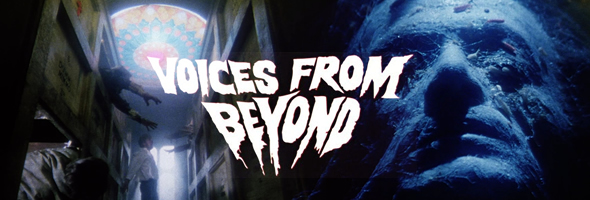
This is Fulci’s next to last movie, dedicated “to my few real friends, in particular to Clive Barker and Claudio Carabba.” At this point, Fulci was shooting TV movies and direct to video stuff, often lending his name to lesser directors.

Giorgio Mainardi lies dying, surrounded by his uncaring family, wondering why. He has an internal hemorrhage from an ulcer and nothing can be done. His daughter Rosie comes for the funeral and the reading of Giogio’s will, which has caused a family rift. Giogio’s stepmother refuses an autopsy. Giorgio’s father is on death’s door from a stroke. And Giogio’s stepbrother was having an affair with his third wife. It’s Fulci, the soap opera!

Giogio is rotting away in his coffin, but his spirit communicates with Rosie. At the funeral, everyone remembers the dead man and how he treated them. Lucy remembers that he hated how frigid she was. Mario remembers being humiliated. Hilda remembers how cheap he was. And Rita, his mistress, remembers him going back to his wife and cutting her off. In short, Giogrio loved — and was loved by — nobody. It gets worse — Rosie gets the entire will, but Lucy is allowed to stay in the house. However, there is no money for David, Lucy’s son who Giogio would not claim as his own.

An autopsy happens despite protests and the pathologist (hello, Fulci!) discovers the small intestines are damaged. And those intestines — kept for further observation — are destroyed.

Despite Hilda’s objections, an autopsy on Giorgio goes ahead. The pathologist (Lucio Fulci) takes a sample of his small intestines and discovers some lacerations to the interior wall. He puts the sample in a jar of formaldehyde for later inspection. A little later, Rosie and her college boyfriend Gianni (Lorenzo Flaherty) discover that the jar containing the organ pieces removed from Giorgio’s corpse has been “accidentally” smashed. But Gianni, a medical student with access to the pathology lab, tells Rosie that he’d found tiny splinters of glass in the intestines before the accident accrued later that night. He suggests that they go the police with their suspicions, but Rosie, who is now frequently and telepathically in touch with the spirit of her dead father, insists they investigate themselves rather than attract a public scandal.

After some twists and turns, Hilda is revealed to be the culprit, using David as her patsy. She created a game where he would use a mortar and pestle to smash up light bulbs and put them in Giogio’s ice cubes. However, instead of informing the police, Rosie tells the family that her father will haunt them for the rest of their lives.

There are plenty of gory dream sequences, a decomposing corpse and lots of blood being vomited. It’s not his best film, but it’s interesting. And definitely worth watching.

UPDATE: You can watch this for free with an Amazon Prime membership.

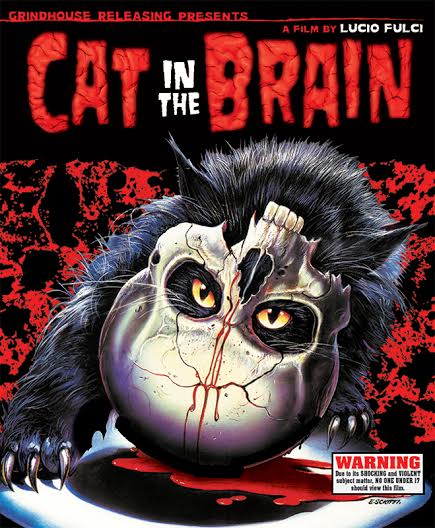
FULCI WEEK: Cat in the Brain (1990)

Whenever I’m watching a Fulci movie — or even discussing him — I turn to Becca and often speak in an Italian accent and say things like, “Can I stab the woman in the eyeball now? I’m bored.” If we’re to believe this meta-biographical film, my impression is not far off.

Fulci plays himself, a man haunted by the ever-worsening gore that his movies use. Now, real-life murders — and an obsession with violence everywhere he looks — have taken over his mind. He has, quite literally, a cat in the brain, eating away at the soft tissue, that we see while he’s trying to finish writing a script.

Finishing his latest film, Touch of Death, Fulci tries to eat a meal, but even the fillets and steak tartare he’s offered remind him of the gore he’s just directed. And then when he gets back to work, he’s irritable, even smashing a plate of animal eyeballs. Fulci is and at eyeballs? Something’s wrong!

He can’t even sleep when he gets home, as a handyman is using a chainsaw outside. Fulci flips out and uses a hatchet to smash some paint cans while the music from The Beyond plays.

Fucli decides to see a shrink, Professor Egon Swharz, who we first see fighting with his wife, Katya. His nurse, Lilly (Paola Cozzo, the pregnant nun from Demonia) lets him know that Fulci has arrived. Lilly instantly knows who the director is and Swhartz is interested to break down the barriers between film and reality.

Back at work, Fulci is struggling to complete both Touch of Death and Ghosts of Sodom (Sodoma’s Ghost) at the same time. What follows are two completely batshit sequences where Fulci directs a Nazi seduction scene and imagines a Nazi orgy while being interviewed by a long-legged German reporter. Fulci mutters a non-stop stream of sexual demands as the action unfurls in front of him, reducing him to only being able to say, Sadism. Nazism. Is there any point any more?” When we come back to reality, Fulci has smashed all of their cameras and must apologize.

When he returns for more therapy, the trap is sprung. Swharz wants to use Fulci to commit crimes, killing a string of prostitutes (using footage of other Fulci movies). The toll is taking over his professional life, as his assistant director has started working on his movie without him. Everywhere Fulci goes, death follows and even the police aren’t there to take his confession. When he goes to the police inspector’s house, he sees the man and his family stabbed, chainsawed and decapitated.

Everywhere Fulci goes, death follows and even the police aren’t there to take his confession. When he goes to the police inspector’s house, he sees the man and his family stabbed, chainsawed and decapitated. He still can’t convince anyone that he’s the murderer — he’s a kindly looking older man in a cardigan who people know creates these little gore movies.

Swharz finally flips out and kills his wife, cutting her head off with piano wire. He hypnotizes Fulci, who suffers through a series of violent images before passing out in a field next to a cute cat digging up the remains of one of the doctor’s victims. His friend the inspector finally arrives, but it’s to tell Fulci that they’ve caught the doctor in the act and that he’s innocent.

Months later, Fulci and Lilly, the nurse from earlier, are on his sailboat, named for his first movie Perversion. He uses a chainsaw to chop her up and then makes fishing lures with her bloody fingers. Is Fulci a killer? Nope. He’s just finishing the exact movie that we just watched. The film wraps and he sails away with Lilly, who is really an actress. Everything ends happily — at least in this version. Another has a scream during the credits to suggest that maybe Fulci is a killer.

Cat in the Brain — its title is a play on The Cat in the Hat — is a weird one. Fulci is the main actor in the film, but he had no confidence in his acting abilities, so his voice is dubbed by Elio Zamuto (who was also the Italian dubbing voice for Tom Selleck in Magnum P.I.).

Supposedly, the film started with a script with no dialogue that was a catalog of mutilations and the sound effects that would go with them. And Brett Halsey had no idea he was even in the film until long after it was done, as Fulci just used previously shot footage. This hurt their friendship, as Halsey felt he should have been paid.

In Fulci’s one U.S. convention appearance at the January 1996 Fangoria Horror Convention in New York City, he appeared on crutches with a bandaged foot. He was sick — he’d die two months later — and blizzards had covered the city with inches of snow. Yet fans came from all over the country for the rare chance to meet Fulci. This footage is on the second disk of Cat in the Brain and features the man himself speaking to the crowd, where he claims that Wes Craven’s New Nightmare rips off this film.

Sure, Cat in the Brain raises issues of the effect of horror on the people who make it. But is it really just a greatest hits of Fulci’s later period work? Did he feel trapped within the genre? Was it cathartic to create? These are all questions I would love to have heard him answer.

You can find this at Diabolik DVD.

FULCI WEEK: Contraband (1980)

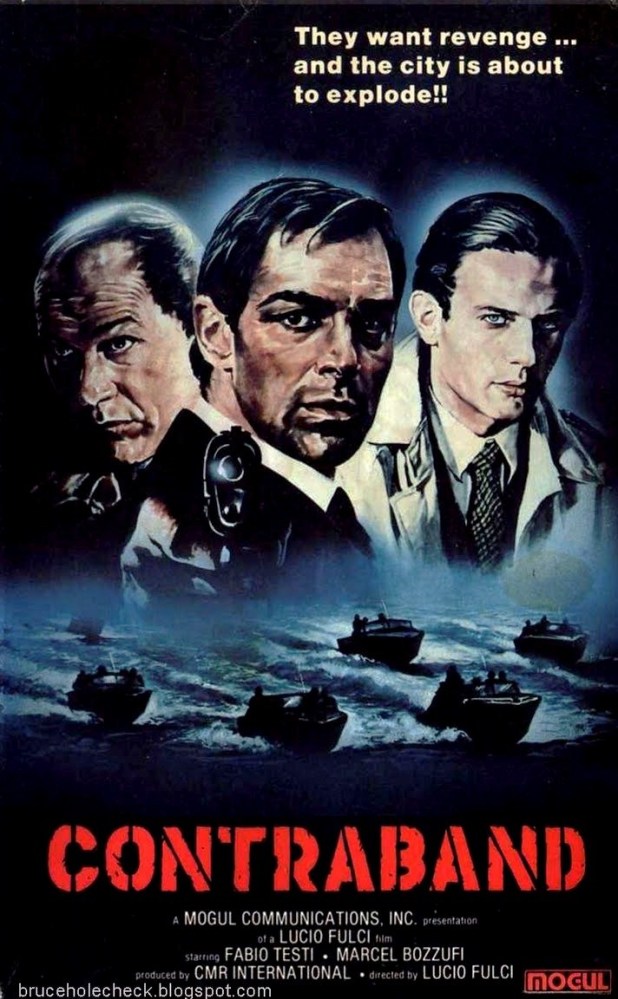
Imagine Fulci making a cop movie. Imagine that the budget ran out two weeks in. Imagine that real mobsters paid for the film, asking for a title change and for more violence (like Fulci was going to say no). Don’t imagine. All of these things are wonderfully true and make Contraband such a weird addition to your Fulci collection.

Luca Di Angelo smuggles near Naples with his brother Mickey. They have a close call with the police and suspect a rival gangster, Scherino, of turning them in. After sharing their concerns with their boss Perlante, one of Mickey’s prize horses is killed and a fake police roadblock leads to Fulci paying homage (or straight up ripping off, depending on your perspective) to the scene where Sonny dies in The Godfather. Luca escapes death while his brother is not so lucky. Despite warnings that he should leave town, he has a speedboat funeral for his brother and vows revenge. Breaking into Scherino’s house, he almost kills the man before running into his henchmen. He gets his ass kicked, but his life is spared after the boss tells him he had no part in the death of his brother.

Adele, Luca’s wife, wants him to forget this life. But he’s in deep after discovering that a vicious French criminal named The Marsigliese is responsible. We meet this criminal during a drug deal, where he responds to a bad batch of heroin by burning a woman’s face with a blowtorch. If you haven’t realized that you are watching a Lucio Fulci movie, this would be the point in the film where you realize that fact.

The Marsigliese starts killing all of the Mafia leaders so that he can become the sole boss of Naples. Even Perlante is nearly killed, only being saved by the fact that his chief capo was having sex with his mistress and triggered a bomb under the bed. After a meeting between Luca, Perlante and The Marsigliese, where they discuss working together, Luca warns his fellow smugglers that if the French boss has his way, there will be more drugs, more overdoses and more problems — with less money for all of them.

The police are using all of the intercine battling to round up smugglers, but Scherino saves Luca and suggests they work together. They meet at Perlante’s house, but Luca smells The Marsigliese’s cologne. That’s when gunmen bust in and shoot everyone but Luca, who escapes by crashing through a window. Scherino is mortally wounded, but not before shooting Perlante in the neck, killing him.

Again, in case you wonder who directed this film, The Marsigliese kidnaps Adele and demands Luca turn over his smuggling operation over the phone…and then plays him the sounds of our hero’s wife being beaten and gang-raped. Luca unites all of the retired mob bosses and old guard bosses, who are sick of hearing about the Frenchman taking over. They take out most of his men and Luca guns him down in a garbage-strewn alley in a scene packed with blood spraying everywhere.

Adele and rescued and Morrone, the leader of the old school mob guys, tells the police that he has no idea who Luca is.

Contraband was made as Fulci was starting to claim his gore crown. It’s his only crime movie, but it’s not a bad effort. And if you’re looking for his trademark tics, as you’ve read above, this film is full of them. It has way more blood and guts than any film of this type and subverts the genre it should be in, so it’s quite similar to how Fulci treated sword and sorcery with Conquest. This may not be one of his best-known films, but it’s worth checking out. You can find it on Amazon Prime.

A funny postscript: I tried ordering this film three times, with the first two attempts netting me two blu rays of the 2012 Mark Wahlberg film, Contraband. Therefore, when you look at my DVD collection and wonder, “Why does Sam have a Mark Wahlberg movie?” just know that I got it for free. Twice.