The Theatre Bizarre (2011)

Paris’ legendary Grand Guignol theatre has inspired so many films and this story actually begins in a theater much like that infamous historical landmark. As a Enola Penny walks into Theatre Guignol, she is gifted with the six stories that make up this movie, all while she becomes more of a puppet and the host — Udo Keir — becomes human. The framing sequence was directed by Jeremy Kasten (The Attic Expeditions).

The first segment, “The Mother Of Toads,” was co-written (with his former partner Scarlett Amaris* and Emiliano Ranzani) and directed by Richard Stanley. I have to say that this segment looks gorgeous and hits all the right buttons for me, as its based on a Clark Ashton Smith story. It also has  one of Fulci’s recurring actresses Catriona MacColl in it as Mere Antoinette, which delighted me to no end.

“I Love You” — directed and written by Buddy Giovinazzo (Combat Shock) really didn’t work for me. It’s a simple story of a man finally being dumped by a long-suffering lover, yet I was struggling with the fact that it just seems to end.

“Wet Dreams” gives Tom Savini a rare chance to direct in a chapter devoted to a man telling his psychiatrist (Savini) about his nightly dreams that concern his wife (Debbie Rochon) castrating him.

Plus, you get “The Accident” from Family Portraits: A Trilogy of America director Douglas Buck. This may not be a horror story as much as a meditation on life and death.

Karim Hussain’s (the cinematographer of Possessor) “Vision Stains” is all about a serial killer who has lost the ability to dream, so she uses a needle to extract them from the eyes of her victims.

Finally, David Gregory — who also directed Lost Soul and Blood & Flesh — wrote and directed “Sweets,” about the break-up of a couple who use food in their lovemaking. Big points for getting Lynn Lowry in this story.

A co-production between Severin Films and Metaluna Productions, each director was given the same budget, schedule and narrative directive. Other than that, they were given free rein to create their own story. The results may not be even, but you can tell that this was made by filmmakers who understand that a horror anthology can be a very powerful movie.

*As a Stanley fan for some time, her story of the abuse suffered at his hands has soured me on his work, which kept me away from watching this for some time.

You can buy this at Severin Films.

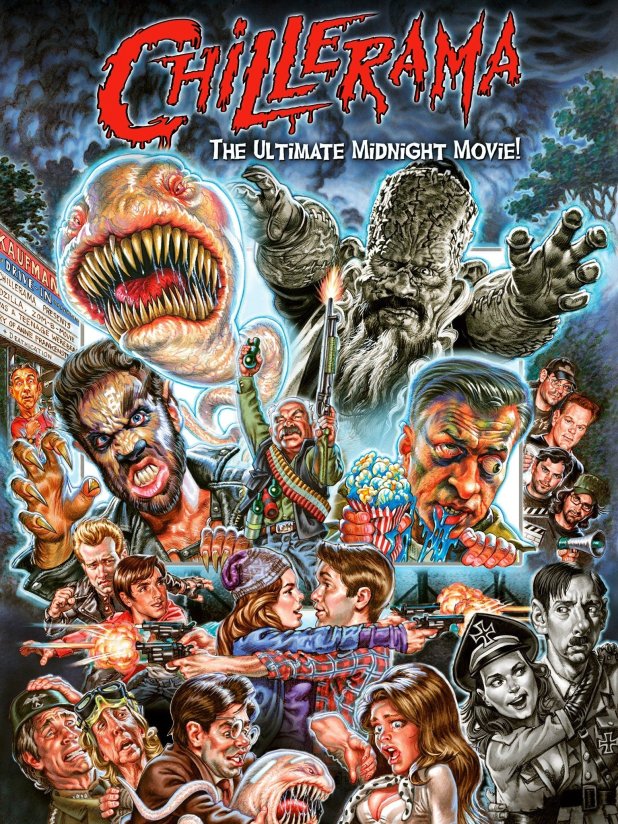
Chillerama (2011)

Adam Rifkin (The Dark Backward) and Tim Sullivan (2001 Maniacs) met during the making of Detroit Rock City and quickly discovered how much they both loved drive-in movies. They planned on making a movie called Famous Monsters of Filmland that was to be based on the magazine and each segment would be about a different era.

The deal with the magazine — and a Gene Simmons-hosted MTV series — fell through. Years would go by before Rifkin and Sullivan teamed with directors Adam Green (Hatchet) and Joe Lynch (Mayhem) to make this movie.

The first story by Rifkin, “Wadzilla,” has great effects by The Chiodo Brothers and somehow has Eric Roberts as a character named General Bukkake. Ray Wise and Lin Shaye also appear, but the real draw is the giant sperm.

Tim Sullivan’s “I Was a Teenage Werebear” takes GreaseTwilight and every rebellious teenage movie and throws, well, homosexual werebears into the pot and cooks up all hot and steamy.

Adam Green directed “The Diary of Anne Frankenstein,” which is the kind of title that Jerry Gross would have delighted to have come up with. There’s also a short called “Deathication” which seems to just be out to upset viewers if they haven’t already been offended.

Joe Lynch’s “Zom-B-Movie” is the open and close of the movie. There’s one more night for the drive-in before zombies attack and Richard Riele dispatches them while saying catchphrase after phrase.

I wanted to like this more than I did, but as we all know, my sense of humor cannot and will not see Troma-ish films as funny nor fun.

You can watch this on Tubi.

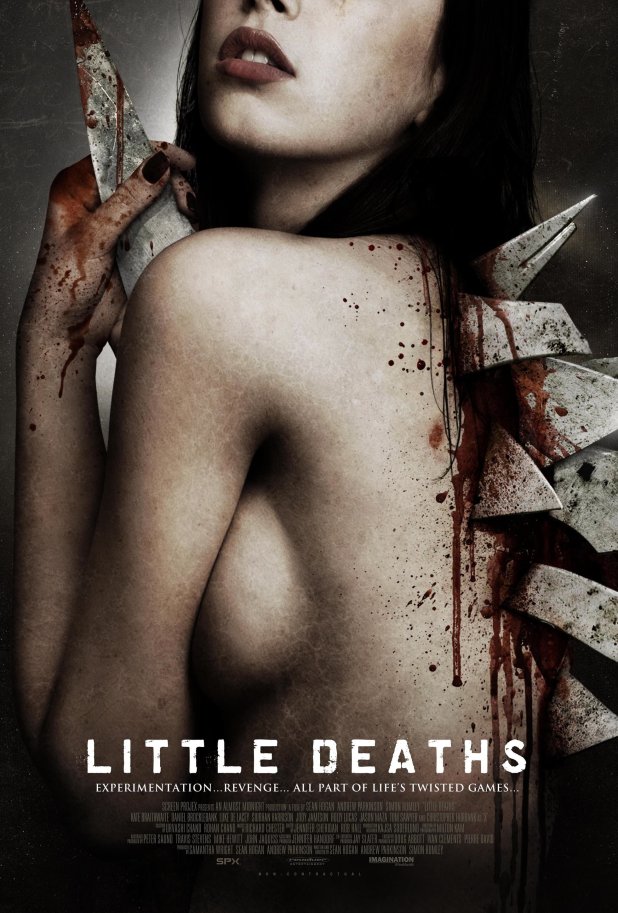
Little Deaths (2011)

Produced, written and directed by Sean Hogan, Andrew Parkinson and Simon Rumley, Little Deaths lives up to its title by being a sex and violence filled anthology.

Hogan’s “House and Home” concerns a couple that keeps kidnapping homeless women under the cover of charity and then use them up as playthings. Yet when they pick Sorrow, they soon learn they’ve picked the wrong woman.

In Parkinson’s “Mutant Tool,” a sex worker starts to see visions after starting drug rehab. That’s because she’s been connected to a mutant captive of the doctor whose mental emissions create hallucinations. By the end of this body horror story, she’s, well, grown a new mutant tool that the doctor starts to harvest.

Rumley’s “Bitch” tells the tale of a couple whose BDSM sex life includes her making him live like a dog due to her hatred of canines. After she cucks him despite his struggles to improve their relationship, he does what any of us would by training a pack of feral dogs to destroy her. To be honest, the end makes little to no sense as I wouldn’t see Claire suddenly switching from being dominant, but the story needed to work out that way one supposes.

If you have an issue with sex mixed with violence or with the way men view sex with violence, perhaps you should stay away from this. The idea of a sex and violence themed portmanteau is a good thought, even if this movie doesn’t live up to the promise.

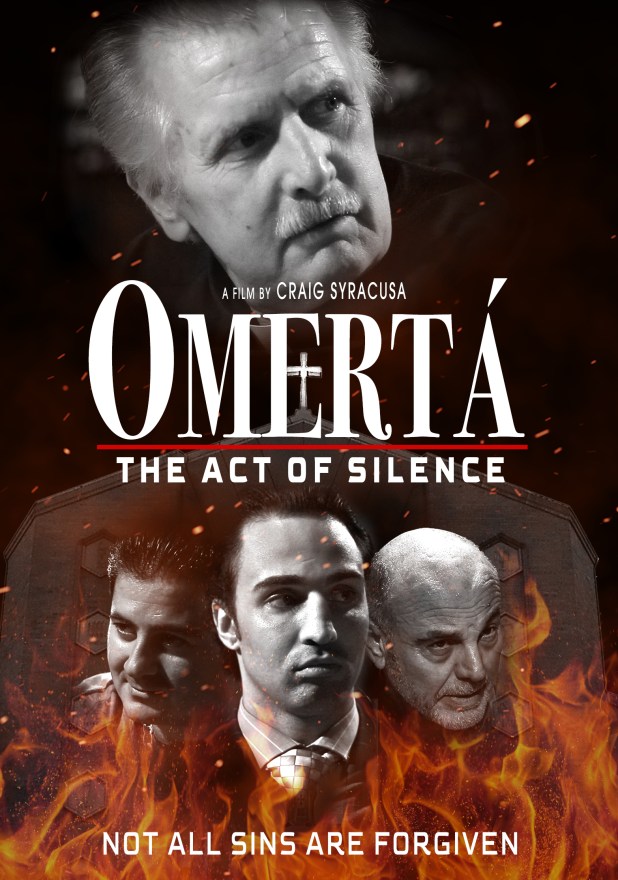
Omerta (2011)

Starring former pro boxer Paul Malinaggi, Will Wallace, Joe Estevez (The Zero Boys), Adam Nelson (Mystic River), Joe D’ Onofrio (A Bronx TaleGoodfellas), and Carmen Argenziano (Sudden Impact), Omerta tears the lid off the secrets of Bensonhurst, a place where connected men own all of the political and legal power. Yet one man learns that the code of loyalty simply means being a street soldier in a battle that he can’t win.

At once a religious and a mob movie, Omerta is written and directed by four-time Emmy nominated Craig Syracusa (Ring Of FaithWalk in Faith) and has music by Ceazar Reyes and Raekwon from The Wu-Tang Clan.

From the office of a priest to a bloody battle on the streets, mob fans will find something to like in this film, if only to see some of their favorite actors from those films in different roles.

You can watch this on Tubi or get the DVD from MVD.

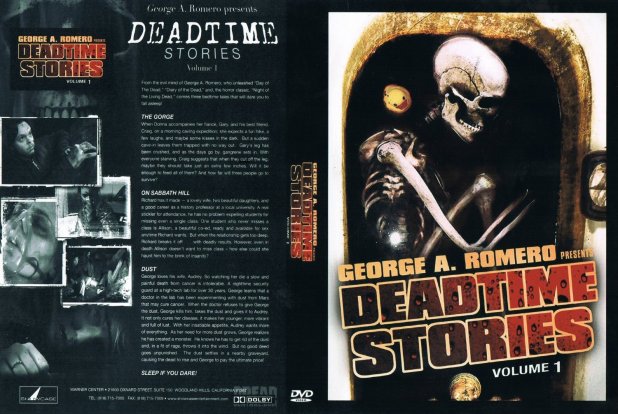
Deadtime Stories (2009 and 2011)

I characterize George Romero’s post-Creepshow output the same way that I do Lucio Fulci’s post Manhattan Baby output, except that, you know, I actually like some of what Fulci did. His films feel like a man struggling for relevance, falling back on outdated tropes and the same old, same old one more time.

But man, as rough as Fulci’s life got, he never started a middling anthology film off with absolutely dreadful dialogue like “Now I lay me down to rest, but there’s a goblin upon my chest. He’s grey and ugly and very gory and he wants to tell me a deadtime story.”

For shame.

The first film has three stories:

  • Valley of the Shadow, in which a woman takes people into the jungle on a cursed trip to find her missing husband)
  • Wet, the story of digging up a mermaid
  • Housecall, which has a doctor visit a boy who claims to be a vampire.

At least Tom Savini directed the last story and tried. The rest of this, put together by Michael Fischa (My Mom’s A Werewolf) and Jeff Monhahan, who appeared in Romero’s films Two Evil Eyes and Bruiser, made me question just how bad movies can be and I just spent a week watching every Bruno Mattei film I could get my hands on.

The second film finds Fischa and Monahan returning to direct a segment each, with Matt Walsh directing another.

Sadly, it’s no better:

  • The Gorge is about three friends whose hiking trip ends in an avalanche and cannibalism.
  • On Sabbath Hill is the closest the film gets to something unique with a tale of a professor’s dead girlfriend coming back to haunt him.
  • Dust has a doctor discovering that Mars dust can cute cancer and the security guard who steals his breakthrough.

I really hope that Romero at least got some money for these films, because I see no reason that he should be involved in these pictures. I struggled to get through these. Don’t make the same error that I did.

Tubi has Deadtime Stories: Volume 1 and Deadtime Stories: Volume 2 streaming for free, just in case you don’t believe me.

LEE MAJORS WEEK: Jerusalem Countdown (2011)

God bless Christians and their end of the world movies.

Seven backpack nukes, code named The Seven Wonders, have been placed in the U.S. by terrorists as the result of the battle for Jerusalem. FBI Agent Shane Daughtry (David A. R. White, the co-founder of Pure Flix Entertainment, as well as the co-writer and producer of this movie) and agent Eve Rearden (Anna Zielinski) must find these weapons before they destroy the world. Or at least America.

Where does Lee Majors fit in? Well, he’s Arlin Rockwell, the arms dealer who smuggled the weapons into the country. There’s also a Russian-Iranian terror cell called The Revolution of God, Stacy Keach as a retired G-Man and Randy Travis, of all people, as the Deputy Director of the CIA. Ironically, there are two different songs in this movie and neither are sung by Travis.

So yeah. A Christian spy epic that I only sat through because I love Lee Majors. I really will watch anything.

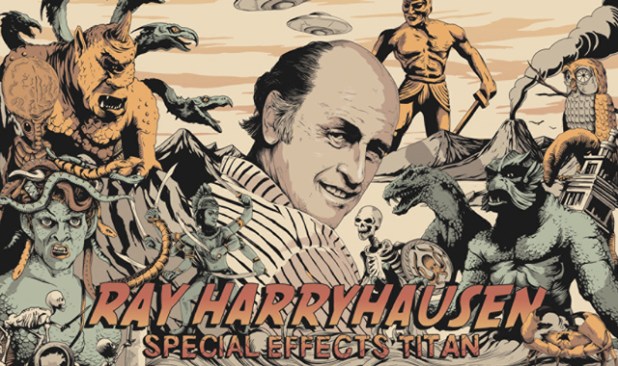
Ray Harryhausen Special Effects Titan (2011)

Ray Harryhausen did more than just special effects for movies. He changed the lives of people who looked at what he did — just like he did when he watched the work of Willis O’Brien — and they decided that they wanted to make films just like his.

Those people include Rick Baker, John Landis, Tony Dalton, Randy Cook, Peter Jackson, Nick Park, Phil Tippet, Peter Lord, Terry Gilliam, Dennis Muren, Ken Ralston, Guillermo Del Toro, Jean-Pierre Jeunet, Robert Zemeckis, James Cameron and Steven Spielberg, all of whom appear in this movie to discuss just how important the special effects of Harryhausen and that fact that his influence remains so vital even today.

Director Gilles Penso has also made documentaries like Phil Tippett: Mad Dreams and Monsters, Creature Designers: The Frankenstein Complex and Derrière le Masque des Super-Héros (Behind the Super-Hero Mask). With so much footage and so many interviews, this seems like it would have been a daunting task. But for those who love the films of this special effects master — or those that have never heard of him before — this is a necessary watch.

A decade in the making, this documentary also features footage from the 1990 documentary Ray Harryhausen: Movement Into Life by film student John Walsh (who eventually became a trustee of the Ray and Diana Harryhausen Foundation).

You can watch this on Tubi.

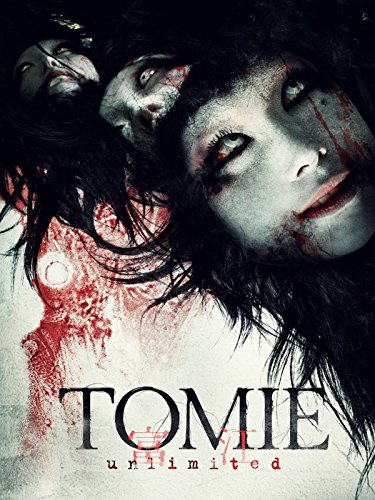
Tomie Unlimited (2011)

After eight Tomie films, the time seemed ready for a reboot and Tomie Unlimited — kind of like Marvel’s Unlimited newer universe — was the answer. Noboru Iguchi (Zombie Ass: Toilet of the DeadThe Machine Girl) would be the creative force to make this one happen.

The movie starts with Tsukiko Izumikawa (Moe Arai) taking photos when she runs into her stepsister Tomie Kawakami (Miu Nakamura). The two both are in love with the same boy, Toshio Shinoda (Kensuke Owada). Tsukiko hates her stepsister yet is in love with her beauty, unable to stop taking photos of her, even as a steel cross falls from a building and kills her.

A year later, on her eighteen birthday, Tsukiko is trying to get back to a normal life, which changes forever when Tomie returns. On the first night, she grabs an electrical cord and demands that her family beat Tsukiko for letting her die.

Meanwhile, Tomie has grown a scar in her shoulder that contains a talking tumor before her father kills her and her mother tears apart her body. This unleashes multiple Tomies, from small heads that can infect others to her main head that asks her father to kill his wife and feed the remains to her.

By the end of the film, women all over Japan, including our heroine, have all become Tomie, all destined to die at the hands of men, all fated to come back to ruin the sanity of everyone they encounter.

After watching all of the Tomie films, this is up there as one of my favorites in the series. It has just the right mix of abject horror and ludicrous humor. And the floating head of Tomie conjures pleasant memoirs of Mystics In Bali and that’s a good sign.

You can watch this on Amazon Prime and Tubi.

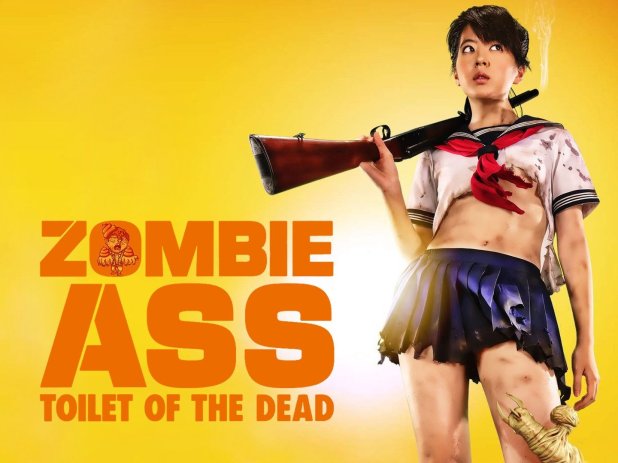
Zonbi Asu (2011)

When you have a movie called Zombie Ass: Toilet of the Dead, you’re not expecting subtlety. Well, you’re not getting any with this one, a movie that proved to me that I can still be grossed out and upset me a movie, which I guess makes me happy.

After her sister gets bullied to the point that she commits suicide, Megumi and four friends go on a trip in the woods, which gets out of control when Maki eats a parasitic worm that she finds inside a fish in the hopes that she can keep her weight down. Later, when she’s trying to take the Browns to the Super Bowl in an outhouse toilet — you know the kind that have like a 15-foot drop off into nothingness that scare you when you’re a kid? — and ends up laying eggs and feces all over some bodies that have been hidden in the poop pile.

Director Noboru Iguchi somehow went from adult video to making movies like The Machine Girl and this. That said, his pervy heart is still on display, as this is one of the few movies that I’ve seen where girls pose provocatively while tentacles emerge from their rectums.

There’s also a moment where the girls are in danger because the zombies are attracted to flatulence and fecal matter, so they all have to hold it or die. I would never make it in this zombie apoopcalypse.

Kimi Wa Zonbi Ni Koishiteru (2011)

With a title that translates as Bite Me If You Love Me, this is a movie for people who love zombies and understands that if you want purely bonkers genre cinema, go to Japan.

Naoyuki Tomomatsu, who also made Vampire Girl vs. Frankenstein Girl, directed this, which tells the story of Hitomi (AV starlet Ai Haneda), a high school girl obsessed with zombies. When she finds an Italian book — where else would one learn how they undead walk — that can make the dead live, she hooks up with a geeky boy named Shota who everyone already calls Zombie. She knocks him off the roof, pours powder all over him and before you can say Romero, she’s aardvarking with one of the living dead.

There’s a great moment when the girls are all comparing boys and Hitomi shows everyone the maggot zombie from Fulci’s Zombi and talks about how hot he is.

Shota ends up becoming a celebrity, but as his body rots, so too does Hitomi’s love for him. She soon falls for a fat Japanese Jason Vorhees, turning this into a love triangle with deadly consequences.

This is cheap, scummy, gory and goofy. These are all adjectives that I love.