A couple of weeks ago, I watched the Full Moon remix movie The Haunted Dollhouse, which had a chapter entitled “Worry Dolls.” That was really this movie and somehow, Charles Band directed a movie that was at once a movie about killer dolls and a women in prison movie. If he’d somehow had the prison be in his Italian castle, this would have really been the most Full Moon of all Full Moon movies.
Somehow, this movie also has two more titles, Dangerous Chucky Dolls or ParasiteDolls. No matter the title you see it under, it’s about Eva, who is abused by everyone in the prison, including a — spoiler — trans guard who forces her to participate in webcam sex to make more money for the warden.
One night, she lies down and her worry doll climbs inside her ear and learns how to walk out of the hole in her forehead when it isn’t taking over her brain. This feels like one of the more transgressive Full Moon features I’ve seen in a while, as there aren’t many killer doll WIP movies that have the heroine peg the evil guard.
This was shot in the same place that they made Reform School Girls and it is in no way as great as that movie. But come on. You knew that.
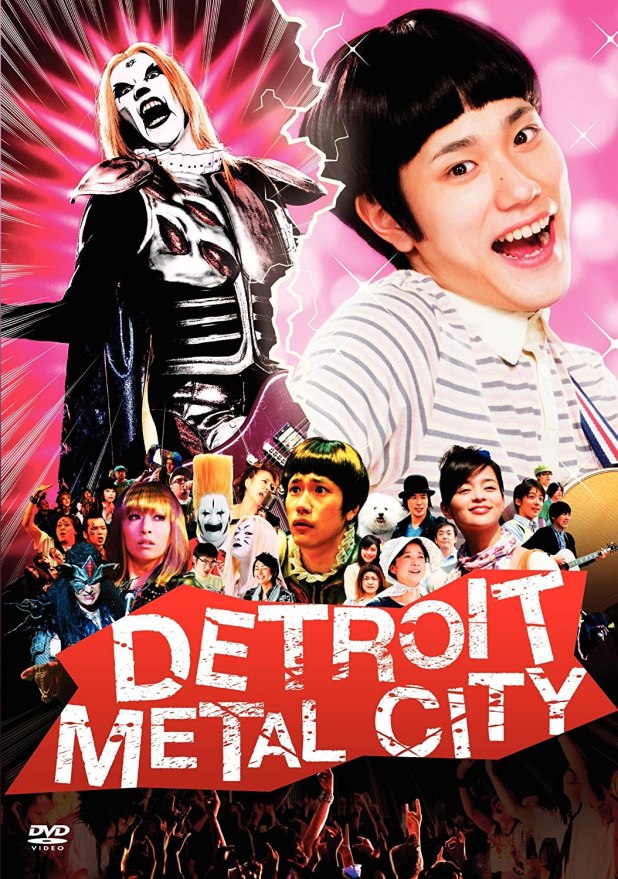
Soichi Negishi may be a shy young man who loves pop, but he’s found success as the demon known as Johannes Krauser II, lead singer of Detroit Metal City. He hides his anger over never getting further as a normal musician behind this character, but is slowly becoming Krauser.
He’s in love with Yuri Aikawa, who enjoys his old music and hates Detroit Metal City. But is the lure of huge crowds and being rock star the goal or will it be true love?
Based on the manga and anime, Detroit Metal City was a blast. Directed by Toshio Lee and starring Ken’ichi Matsuyama (L from the Death Note films), it’s silly but isn’t that the point? And Gene Simmons is awesome as the Emperor, a metal god whose last show in Japan is about challenging Detroit Metal City.
I think if you like metal, you’re probably going to like this a lot more than people who aren’t into the musical form. But hey, I can barely hear any more, so what do I know?
Stuart Gillard directed the third Teenage Mutant Ninja Turtles film, the remake of The Initiation of Sarah and episodes of the classic and reboot of Charmed. For some reason, MGM wanted a sequel to WarGames a quarter of a century later and he was the man to make it. The more cynical of us would say, “That was just to keep the copyright.”
I don’t know who else has been trying to make WarGames that it would need a copyright.
This film has RIPLEY instead of WOPR, but that old computer also shows up. Where we only had nukes back in 1983, this time there are drones and the fully connected World Wide Web. It also has some brand synergy, as the main character is playing Stargate Worlds, a game that would never be released.
Brand synergy you say? Back in 2008, this was announced as just one in a series of direct-to-DVD sequels, which also included two new Stargate films, a remake of Audrey Rose, Cutting Edge 3 (also directed by Gillard), a sequel to the 2002 movie Dark Blue, a spin-off called Legally Blondes and Species: The Awakening.
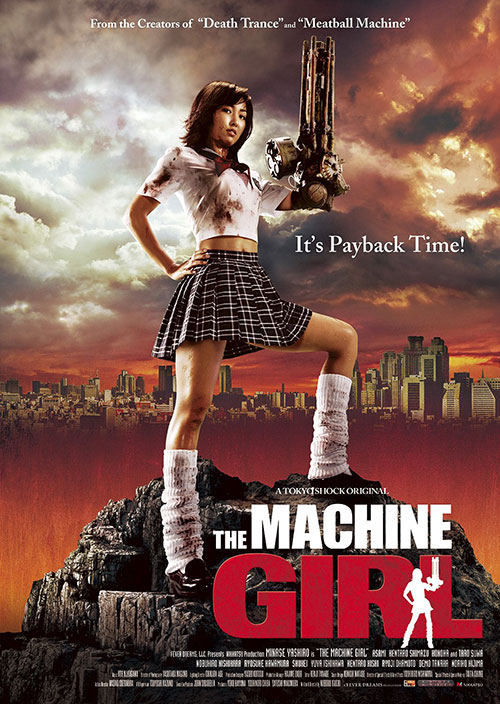
Ami is a schoolgirl just trying to deal with avenging the death of her brother and his best friend when her quest for revenge leads to a ninja yakuza clan cutting off her arm. Luckily, two mechanics give her a machine gun where her arm once was, then she teams up with the chainsaw carrying mother of the slain best pal and all hell breaks loose.
Yes, welcome to The Machine Girl.
Writer and director Noboru Iguchi was influenced by the sideshows and ghost houses that he went to as a kid. He started as an AV director (Adult Video) but the first evidence of this horror angle to his films began with Final Pussy, which features crossover star Nana Natsume as a woman who has guns emerge from her breasts when she reaches arousal. He’s since made everything from horror comedies like Koi-suru Yōchū (A Larvae to Love), the manga adaption Nekome Kozō (Cat-Eyed Boy) and the update to 1970’s robot show Denjin Zaborgar, Karate-Robo Zaborgar.
The special effects for this movie come from Yoshihiro Nishimura, who made Tokyo Gore Police and has been called the Tom Savini of Japan.
While this movie is relentlessly gory and ridiculous, it’s also surprisingly effective in its exploration of grief. That is probably the weirdest part of this very strange film. Come for the blood sprays and chainsaw death, stay for the strong female heroine, you know?
You know how Videodrome would destroy the brains of those that watched it? Yeah, that’s exactly what this movie is.
While working on special effects for The Machine Girl, Media Blasters asked director Yoshihiro Nishimura if he was interested in making another movie. He decided to take his short Anatomia Extinction and expand it into this film, which more than lives up to its title of Tokyo Gore Police. It has plenty of influence from RoboCop, which is seen through the commercial scenes in the film, which were filmed by Noboru Iguchi and Yūdai Yamaguchi.
In the future — let’s call it 200X — Japan is overpopulated. That’s why a mad scientist (Itsuji Itao) has created a virus that transforms humans into mutants called Engineers that kill everything in their path. The privatized Tokyo Police Force has started a team of Engineer Hunters and this special force is devoted to violence, sadism and executions with no trials.
Joining them is a loner named Ruka (Eihi Shiina, who was a fashion model before movies like this and Takeshi Miike’s Audition) who excels at destroying Engineers before the scientist implants her with a tumor that makes her one of them. Meanwhile, as policemen are being turned into them, the commissioner announces that anyone even suspected of being an Engineer will be killed.
Ruka makes her way to the scientist’s — known as Key Man — home, where he explains that her father had actually adopted her after assassinating her activist father. When he went to the commissioner to find out why, he was killed in front of Key Man, who has injected himself with the DNA of Japan’s most famous criminals.
Runa goes to war with the police, her left arm mutating into an alien appendage and her eye being replaced when it is shot. The commissioner confesses to killing her father, but says that he has tried to apologize by making her the perfect killing machine. She responds by slicing him apart and decapitating him.
If you read our site, you know that I have seen some things, but man, Tokyo Gore Police has moments of bloody excess and utter depravity that have shocked even me. There’s not a moment of this movie that isn’t filled with sprayed blood, destroyed body parts that would make Cronenberg wince and berserk sexuality. I mean, big points for the flying samurai commissioner who uses spraying blood like a jet to fly himself around the room and attack with his inner organs. Also, Eihi Shiina is most gorgeous person you’ve ever seen to sport a giant lobster claw hand and a glowing cybernetic eye. She doesn’t have any competition, but no one is going to steal the title from her. And man, I loved that she liberated the commissioner’s gimp sex slave, gave her machine guns for body parts and has brought her on board at the end.
This is the kind of film that will ruin you for anything else you try to watch that day. Or that week. Seeing as how I watched it on January 1, here’s hoping that other movies can come close to it this year.
Although Man Maid was made in the backwash of the 2005 critical and box office comedy hit The 40 Year Old Virgin (Jane Lynch from that film cameos here as a dominatrix) — and lost somewhere in the Judd Apatow comedic raunch-o-verse — this quirky tale about a male housekeeper at a dying hotel in the Pacific Northwest feels like one of those off-beat, innocuous ‘80s comedies John Cusack used to make — on his way up to the likes of Con-Air — such as Better Off Dead and The Sure Thing. But since Man Maid was released in the early 2000s and filled with eccentric characters, a more accurate reference would the out-of-the-ordinary, ’90s indie comedy hits Bottle Rocket, Little Miss Sunshine, and Napoleon Dynamite. And if this was made in the ’80 with major studio backing, John Cusack would have been our male maid; in the ‘90s, Jon Heder would have been cleaning rooms; a pre-Office Steve Carell would have been tailor made for the role of our off-the-grid geek hero — complete with motor scooter — who gets the girl and saves the day. In fact, if DreamWorks-Paramount had backed Man Maid, Jay Baruchel from their 2010 joint venture, She’s Out of My League, would have his face inside the washing machine.
Also known as The Cleaning Man in overseas markets, Man Maid was plucked off the festival circuit by Canadian TV Movie purveyor Marvista Entertainment, which airs their catalog on channels such as Hallmark and Lifetime.
Shot in 22 days on a shoestring in Oregon back in 2006 and hitting the festival circuit in 2008, Man Maid feels as if it comes from a place of erudition. Self-financed and mini-major indie comedies usually come from aspiring filmmakers and burgeoning actors with the burning desire to make something and, to that end, they’ll keep the story simple and write it around locations that they know (and know they can secure for shoots to avoid costly set builds) and write characters that they know. And considering this is a tale about a male maid, one wonders if writer-director Chris Lusvardi and lead actor Phillip Vaden worked as maids — or at least as hotel concierges or managers — to work their way through college.
Vaden — who’s very good here and brings a definite Cusack-Carell vibe to the proceedings — is Vincent Van Metcalf: a slightly more ambitious Pacific Northwest slacker — and second generation male maid — who finances his camping-tent lifestyle as a member of the housekeeping staff of a historic, dying hotel. During his off-days, he feverishly builds a piecemeal structure — as an act of love (reminding of the tale of eccentric South Floridian Edward Leedskalnin and his Coral Castle mystery) — that’s to serve as an outdoor concert stage for the way-out-of-his league Chloe Flaminghawk (nary a strand of Elizabeth Warren’s Native American DNA in her body), a free-spirited, aspiring singer who can’t sing, write, or play a harmonious chord on her accordion. (Played by a wonderfully ditsy-cute Amanda Walsh from SyFy’s Lost Girl, she’s bumped-off-the-marquee for Jane Lynch; that’s Walsh, poster right. And yes . . . the Bryce Johnson on the marquee is Detective Darren Wilden from ABC Family’s Pretty Little Liars.)
Move it on over, Woody. This machine kills fascists.
Proving that even off-beat dorks can get girls . . . and couldn’t be more clueless: Vincent is oblivious to his more realistic romantic goal of Tory (Sara Rue, TV’s The Big Bang Theory), the hotel’s “plain and boring” manager. Love blossoms when it’s learned the in-debt-to-the-IRS hotel is about to face foreclosure at the hands of a heartless developer (is there any other kind), played by omnipresent comedic television actor Stephen Hytner (who — sorry, Sam — will always be the ovaltine-obsessed Kenny Bania from Seinfeld). So the makeshift, outdoor stage, once to serve as a musical home for the dreamy-eyed Chloe Flaminghawk, will now host a benefit concert to save the hotel. And Chloe’s godfather — Americana-Country star Sissy Taylor (John Doe), known for his protest anthems — will headline the show.
Aggravating Sam — one Seinfeld reference at a time.
Ah, but beware, ye streaming John Doe fan. While John gets top-billing on the theatrical one-sheets, he only appears in the film’s last 15-minutes — to stand up to the cops and sing a tune — but it’s worth the wait to see Doe mixing it up with Stephen Hytner. (Oh, and while Rue and Doe worked together in Gypsy ’83 — also reviewed this week — they have no scenes together here.) All in all, Man Maid is an enjoyable, competently shot and acted film that rises above the usual indie norms — and is actually on par with the other comedies named checked in this review.
Sadly, unlike indie writer-directors Wes Anderson, Jonathan Dayton and Valerie Faris, and Jared Hess, each who found critical and box office acclaim with their respective indie-darlings, along with major studio and A-List actor acceptance with their sophomore films, the equally quirky Man Maid — which served as their film debuts — would be the only feature film from the writer-director and acting team of Chris Lusvardi and Phillip Vaden.
You can enjoy this “John Doe Week” entry — with its hard-to-find DVDs currently out-of-print — as a free-with-ads stream on TubiTV and decide to give it a go after you watch the trailer.
About the Author: You can learn more about the writings of R.D Francis on Facebook.He also writes for B&S About Moviesand publishes on Medium.
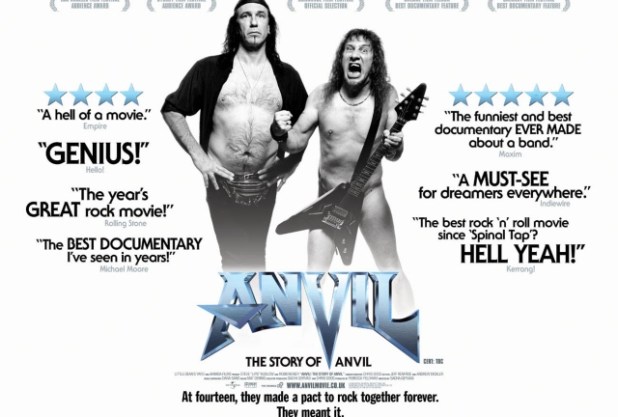
Super Rock ’84 in Japan was a touring rock festival that had Bon Jovi, Whitesnake, Scorpions, Michael Schenker Group and Anvil playing. Of these bands, Anvil had the least success, but it wasn’t for lack of effort. At the time of this movie, Steve “Lips” Kudlow is working for a catering company and Robb Reiner is in construction. Their real lives are in constant juxtaposition with what being a rock star promised them, which is the story of this film.
Sacha Gervasi wrote the Tom Hanks movie The Terminal, but two decades before, he had been a roadie for Anvil. Who knew that someday he’d make the movie about them that would let the world know they existed, as well win an Independent Spirit Award and an Emmy?
It seems like every time the band gets close to their dreams, things go wrong. It always makes me think, when I wonder what it would have been like to be a rock star instead of having a day job, exactly how it would all turn out. This movie is a sobering reminder that not everyone makes it. Until, well, they do.
I kind of love the moment where Kudlow and Reiner nearly kill a promoter for not paying them. I had a similar moment happen when I first started in pro wrestling. A promoter wanted to pay us in checks and I didn’t know any better. That’s when I learned to always get paid in cash. A vet taught me that, as he grabbed that promoter, shoved a revolver in his face and demanded that the two of us get our money right now. I was kind of shocked by it all, but it was nice to drive home with actual cash, even if a man’s life had to be put in jeopardy. I remembered all of that when I watched this.
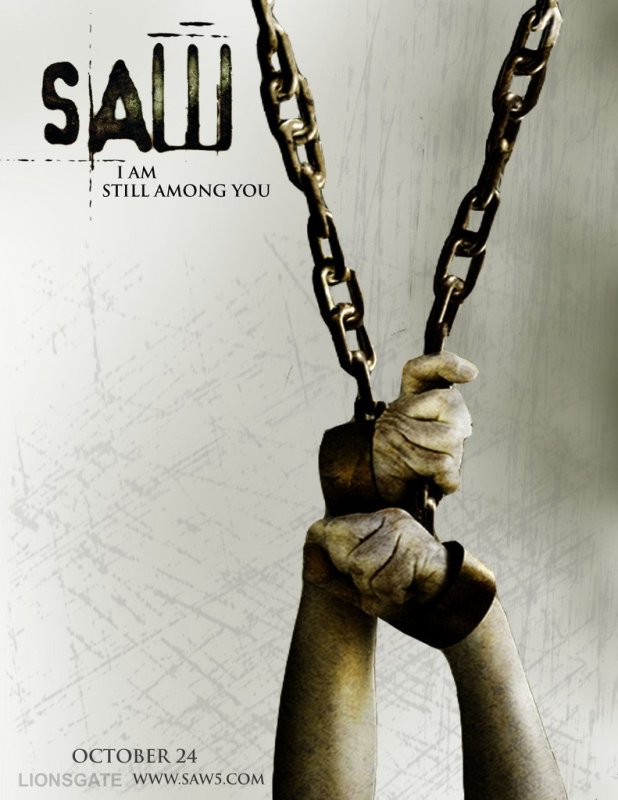
David Heckl was the production designer and second unit director for the second, third and fourth movies in the Saw series before coming on to direct this version from a script by Patrick Melton and Marcus Dunstan. This time, Detective Mark Hoffman makes a journey to become the apprentice of the Jigsaw Killer.
I watched every Saw film in just a day, so the fact that they flash back and tell the different sides of the story can be a bit confusing, particularly when people who die in one film suddenly show up alive. I am certain that there are fans of this series who can explain every nuance, but to me, they are all excuses to feature elaborate death traps that are, like the Final Destination films, the real stars of the movies.
For example, Danny Glover’s Detective Tapp character shows up, despite dying in the first film (this was never really explained, other than the first Saw video game).
This was the first Saw movie not to open in first place at the box office, but would be far from the last movie in the series. Did I keep going and make it through six, seven and the film Jigsaw? Of course I did. My resolve is made of the same metals as these traps.
The title for this film is a translation of Burzum’s fourth album. Do you not know who Burzum is? You may walk away from this movie — with no past knowledge of black metal — believing that sole member Varg “Count Grishnackh” Vikernes is a pretty intelligent, level-headed fellow. Then you remember, “Oh yes. He stabbed his rival Øystein “Euronymous” Aarseth twenty-three times and also was broken out of jail by white nationalists. Yet — you can find plenty of photos of me wearing Burzum shirts, if you look on social media. And I own all the albums. And, well, I have no easy answers when it comes to black metal.
That’s a cop out. I get it.
If you think that gangster rap — with it’s need to prove who was real and who was fake, leading to actual murder — is crazy, you’re about to get an awakening. This film may jump around a bit to give you a balanced accounting. That said, it’s a million times better than the excoriable Lords of Chaos.
Once upon a time, in the basement of what would one day be a Benetton, a bunch of people would meet to talk about bands they liked. And that turned into a contest to see who could be legit and the most evil. As these things turn out, things went a bit far. The kind of far that involves murder, burning churches and intercine warfare, which ended up with — as we began — Varg and Euronymous proclaiming that they would kill one another.
Pretty much everyone in the scene gets a part, like Mayhem vocalist Per “Dead” Ohlin, who lived up to his nickname and whose suicide supplied a ghoulism album cover photo as well as supposed jewlery made from his skull fragments. Perhaps Fenris from Darkthrone comes off the nicest of anyone in this, as he seems like someone who genuinely just loves music.
The thing I dislike most about this movie is the sound and editing. They had the opportunity to get interviews with some people that have been very difficult to track down and yet, you can barely hear them at times and the imagery on screen rarely matches up. It’s incredibly frustrating.
That said, I was shocked that Bård “Faust” Eithun appeared, despite only being seen in shadow. After stabbing Magne Andreassen outside Lillehammer’s Olympic Park, he spent almost ten years in jail. One of his many bands, Thorns, put out several influential demos and their lone 2001 album is incredible.
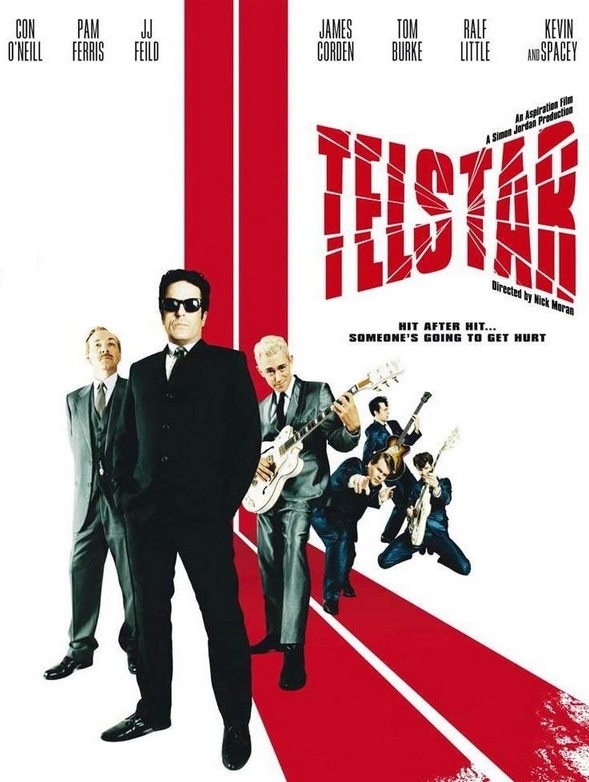
As with Clint Eastwood’s 2014 film adaptation of the 2005 Tony Award-winning Broadway musical Jersey Boys chronicling the career of Frankie Valli and the Four Seasons, I equally anticipated this rock bio concerned with British record producer Joe Meek. Sadly, as with Jersey Boys, I was left empty. Granted, the production designs of both films (as with Tom’s Hanks’s love letter to ’60s one-hit wonder pop-rock ditties, That Thing You Do!) are fantastic. However, the films underneath the period accurate sets and costumes are derivative raison d’être—despite their quality, one viewing is enough. And, for U.S. audiences, the thick British accents and harsh, Royal Shakespearean moments of actor-emoting can be a bit much to handle. Yes, this is purely meant for U.K. audiences, you yank rocker.
Joe Meek was an electronics-tinkering child prodigy who developed such sound engineering innovations as multi-tracking, overdubbing, sampling and reverb (with addition kudos to guitar and recording innovator Les Paul), and was the original trailblazer in viewing the recording studio itself as “a music instrument”—an instrument Meek skillfully mastered, regardless of his being tone deaf and lacking any playing or composition skills, into “Telstar,” the 1962 worldwide #1 instrumental hit by his assembled studio band, the Tornados.
Sadly, Meek was a tortured genius who suffered from bouts of depression and paranoia that led to fits of rage fueled by his closeted homosexuality (a punishable crime in the U.K. at the time) and his addiction to amphetamines and barbiturates (to fuel his maniacal quest for perfection). As result—even with the financial backing of ex-military officer and business entrepreneur Major Wilfred Alonzo Banks (Kevin Spacey nailing the demeanor and accent of an acidic, cultured British gentleman; but opinions on his performance vary)—Meek was never able to get out of his electrical hodgepodge of a studio on a cramped, second floor flat over a luggage store (and yes, he utilized the loo for recordings).
So acidic his personality, no labels, producers, or managers of note wanted to work with him; Meek was forced out of his business concerns with the U.K.’s pre-Beatles superstar, Billy Fury, (that the Tornados backed; by 1964, it was over for both artists); when Meek received offers to record bands from the likes of the burgeoning manager Brian Epstein, Meek dismissed the Beatles as “awful”; when fan Phil Spector reached out to work with him, Meek accused the “Wall of Sound” creator of plagiarism; Meek also turned away David Bowie and Rod Stewart (and told Rod’s then band, the Moontrekkers, to fire him); he also gave up developing a career for a Welsh lad by the name of Tom Jones—who soon became a star (“It’s Unusual,” “What’s New Pussycat,” “She’s a Lady”) after leaving Meek’s stable.
Outside of his own ego and arrogance, why did Meek turn away those future superstars: for love—the bleach blonde bassist of the Tornados, Heinz (Burt), in particular, with whom he became obsessed in transforming him into a solo artist that would crush the likes Billy Fury and Gene Vincent (who Meek admired-despised).
Sadly, in the end, Meek crushed himself.
When a copyright infringement lawsuit over “Telstar” held up 3 million pounds in royalties and his business partnership with the Major soured as result, Meek was drowning in debt. And because of his arrest for a homosexual-public toilet encounter, he was under suspicion in the 1967 Tattingstone Suitcase Murder.
Meek snapped.
He murdered his rent-griping landlady and turned the shotgun (that he used to threaten musicians into submission in the studio) on himself at the age of 37.
And now for the music trivia: The Tornados backbeat was handled by the portly Clem Cattini (portrayed by U.K. comedian James Cordon; of those annoying, faux-German dubbed coffee machine commercials and his NBC-TV late night gab fest). When it comes to drummers, no other (studio) drummer has appeared on more #1 chart-topping singles (42 in all) . . . and he was almost a member of the New Yardbirds. During his Joe Meek days, Cattini shared the studio/stages with a young Ritchie Blackmore (later of Deep Purple), along with Jimmy Page and John Paul Jones who, at the time, were backing several Meek protégés (Screaming Lord Such in particular; a precursor to the likes of Alice Cooper). When the Yardbirds fell apart, with Page obligated to fulfill touring contracts, the first call he made to reform the band was to Cattini. Telling the story years later, he didn’t think much of the offer and failed to call Page back. He also turned down Paul McCartney’s request to join Wings. After he was sacked/quit the Tornados, Meek replaced Cattini in the studio with future Jimi Hendrix skinsmeister, Mitch Mitchell. Catttini published his memoirs, My Life, Through The Eye of A Tornado, in July 2019.
You can stream this as a VOD on Amazon Prime, Vudu, and You Tube Movies, but we found you a freebie rip on You Tube to enjoy. If you’d prefer a more straight ahead telling of Meek’s life, then check out British sound engineer Beth McGowan’s hour-long TV documentary, The Strange Story of Joe Meek (1991), on her You Tube page.
About the Author: You can learn more about the writings of R.D Francis on Facebook.He also writes forB&S About Movies.







 B&S About Movies
You must be logged in to post a comment.