In the Mouth of Madness (1994)

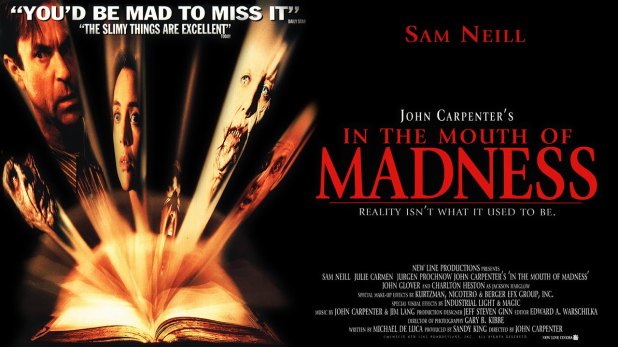
After The Thing and Prince of Darkness, this is the third and final part of John Carpenter’s  Apocalypse Trilogy. It’s a film that plays with the very notion of reality, how fictional characters perceive themselves within a narrative and issues of creation itself. It’s a natural next step after Prince of Darkness, playing with many of the same themes.

The film starts with a narrative device that will be familiar to readers of H.P. Lovecraft, as Dr. Wrenn (David Warner, The OmenFrom Beyond the Grave) visits a patient in a psychiatric hospital who has written all over the walls and himself, covering them with crosses.

John Trent (Sam Neill, Jurassic Park) is an insurance investigator who can smell out a co like no one else. We’re shown an example in the beginning, as he breaks down a scam being perpetrated by a business owner (Carpenter regular Peter Jason). Later, he meets with the owner of an insurance company (Bernie Casey, Gargoyles) who gives him a new case: investigating a claim made by Arcane Publishing that their biggest selling author, Sutter Cane, has disappeared.

Just then, a man attacks them with an axe. He stops to ask Trent, “Do you read Sutter Cane?” The police shoot him and later, we learn that this man was Cane’s agent, who was so influenced by reading his latest manuscript that he killed his entire family.

Trent meets Arcand Publishing owner Jackson Harglow (Charlton Heston!) who asks him to look into the disappearance with the help of Cane’s editor, Linda Styles (Julie Carmen, Fright Night Part 2). As he begins to read Cane’s books, Trent learns that his readers have been known to suffer from disorientation, memory loss and paranoia first-hand.

He’s also convinced that this disappearance is a publicity stunt. Yet he spends plenty of time tearing apart Cane’s book covers, which form the state of New Hampshire and mark Hobbs End, the location for many of Cane’s stories — which is quite like Castle Rock in Stephen King’s tales.

As they travel to the fictional town, Linda begins to see things and they both lose track of day and night. Once in the town, the people and landmarks are exactly as they appeared in the written word. Trent believes this is still a publicity stunt. Linda comes clean and says that the disappearance started as a stunt, but no one can find Cane. Everything happened from now on is real, she claims.

For example, inside their hotel room, Trent claims there should be a black church out the window. The only problem is that he didn’t read the books closely enough. While the first window he opens reveals nothing, that evil cathedral is revealed when he opens the window that faces the east.

As they travel to the church, an army of black dogs emerges to defend Sutter Cane (Jürgen Prochnow, DuneThe Keep) who sits inside. Linda confronts him, but simply being exposed to his final novel, In the Mouth of Madness, drives her insane.

The fabric of reality has begun to tear asunder. A man (former pro wrestler Wilhelm von Homburg who played Viggo in Ghostbusters 2 who led an insane and demented life) tells Trent that Cane has his son and he can no longer save him. His own daughter attacked him and he could do nothing to stop her. He wishes that he could tell him more, but this is how Cane wrote him. With that sentence hanging in the ether, the man blows his brains out with a shotgun.

The townspeople have become monsters and the story beats of each of Cane’s tales have started to come true. Trent tries to drive away but keeps coming back to the center of town. He takes Linda with him, but she transforms into a monster. Finally, he crashes his car and wakes up inside the church. Cane explains to him that his stories ended up being true, an almost Bible for a new and more horrible world. As more of his readers began to believe in his stories, they raised a race of Ancient Ones from the before times. Again, this is well-trod ground for anyone that has read Lovecraft but not something that makes it to the screen that often.

Cane explains that Trent is just one of his characters and his role is to help end humanity by delivering his final story to Arcane. He then tears his face open, sending Trent to the dimension of the monsters from beyond time and space. As he runs down a long tunnel to come back to the real world, he begs Linda to come with him. She says that since she has read the whole book, she can’t.

Once Trent makes it back, he destroys the story. But once he visits Arcane, he learns that Linda never existed and the final book has already been published. In fact, they are almost done making a movie. Trent is then arrested after attacking readers of the book with an axe.

We come back to the asylum, where Dr. Wrenn laughs off the story and walks away to leave, only to have the attendant, Saperstein (John Glover, Gremlins 2) ask him, “Do you read Sutter Cane?”

Trent barely sleeps the night, convinced that people are fighting and dying outside the walls of his cell. He awakens to find the hospital and most of the city abandoned, with only the pages of Sutter Cane books left behind. A radio announces that mass murder and suicides are happening in every major city, with some people mutating into monsters.

Finally, he wanders into a theater where In the Mouth of Madness is playing. As he watches the entire movie replay, he begins to laugh hysterically before crying. He is just another character in another story, never real in the first place.

Between characters named Pickman and the closeness of Cane’s titles to Lovecraft’s (Sutter Cane’s novels have similar titles to H.P. Lovecraft stories: The Whisperer of the Dark is The Whisperer in Darkness, The Thing in the Basement is The Thing on the Doorstep and The Haunter Out of Time is almost The Haunter of the Dark or The Shadow Out of Time), this is probably the closest we’ll get to a major budget Lovecraft film that isn’t Re-Animator. All of the words read from Cane’s books are also from Lovecraft, including parts of The Rats in the Walls and The Haunter of the Dark.

Beyond that, even the town’s name — Hobb’s End — is a reference to a work that is close to the heart of Carpenter. It’s the train station where the spaceship is found in Quatermass and the Pit. And the inscription on the church, “Let these doors be sealed by our Lord God and let any who dare enter this unholy site be damned forever,” are similar to the words “Terribilis est locus iste” at France’s Rennes Le Château. In English, that should read “This place is terrible.”

Even more interesting, if you pause and read the movie poster for the movie within the movie, you’ll learn that other than the three main characters, all of the actual people who worked on the movie are listed. So is the movie real? Was Cane ever real? Was Trent just a made up character? Are we real? Is reality just an illusion?

These are some big questions. Maybe you should get the Shout! Factory blu ray or watch this on Shudder and come up with your own answers. Have you watched Sutter Cane?

STEPHEN KING WEEK: The Stand (1994)

The unabridged version of the stand is 1,152 pages. How do you film that? How do you capture everything? This 1994 miniseries — originally airing from May 8 – 12 of that year — made a valiant effort.

It’s nearly impossible to get in every character from the book, but that doesn’t mean that these guys didn’t try. With a screenplay by King, Mick Garris stepped into the director’s chair, armed with a huge cast that does a great job of capturing their roles.

The hard part of The Stand is that there’s more than one hero and multiple casts to follow. I guess Stu Redman (Gary Sinise) would be the main hero, but you could also argue that the deaf and mute Nick Andros (Rob Lowe, who is deaf in his right ear) is the hero. Or maybe singer Larry Underwood is. When you’re reading the book, you can determine who the protagonist you like best is, you can also see them as you want in your mind. With a film, it’s not so simple.

As Captain Trips, a weaponized flu virus, sweeps across America, the end of the world takes shape and Mother Abagail Freemantle (Ruby Dee) gathers the forces of good against Randall Flagg and his followers. Flagg, otherwise known as the Walkin’ Dude, the Dark Man, the Ageless Stranger, the Man in Black and the Hardcase (as well as Walter Padick, Nyarlathotep, Rudin Filaro and a ton of other names), is the villain of more than one King story. He shows up in The Dark TowerHearts in Atlantis and The Eyes of the Dragon. His character goes all the way back to a poem that King wrote in 1969.

Amongst his forces are the bonkers crazy Nadine Cross (Laura San Giacomo), criminal rat eater Lloyd Henreid (Miguel Ferrer), the explosive loving Trashcan Man (Max Headroom himself, Matt Frewer, who has appeared in more King adaptions than anyone else), the Rat Man and so many more. But the good guys also have Judge Ferris (Ossie Davis), the worst dressed heroine ever in Frannie (Molly Ringwald), her wannabe boyfriend and potential traitor Harold (Parker Lewis Can’t Lose star Corin Nemec), simple-minded Tom Cullen (Bill Fagerbakke, Dauber from TV’s Coach), wise Glen Bateman (TV legend Ray Walston, who was also Mr. Hand in Fast Times at Ridgemont High) and many, many more.

This is a film packed with stars, even in small roles, like Ed Harris as General Starkey, Kathy Bates as Rae Flowers, Kareem Abdul-Jabbar as a man proclaiming the end of the world and King, Sam Raimi, Tom Holland and John Landis show up in cameos. Even Joe Bob Briggs is in this!

The four parts, The Plague, The Dreams, The Betrayal and The Stand, tell as much of the story as possible. I was kind of let down by the casting of Flagg, but it’s hard to find anyone to live up to the ultimate evil that he’s presented as in the book.

This is the second King book that George Romero planned to make into a film that ended up as a TV movie (Salem’s Lot is the other).

Interestingly enough, none of the Boulder Free Zone scenes were shot there. Soon before production started, Colorado passed Amendment 2, an amendment to their state Constitution which nullified any existing laws protecting the rights of homosexuals. In protest — and perhaps because King’s daughter Naomi is a lesbian — the production moved to Utah.

The fact that the film was finished is a testament to the production team. With 460 script pages that were shot across 100 days in 6 states, that meant that the final project is nearly 8 hours long. They had to figure out how to dress 95 shooting locations on their budget, including a cornfield and a decimated Las Vegas.

There’s been talk of a digital CBS mini-series, but it seems as if they’ll try to tell the whole story in one movie. Josh Boone, a legitimate Stephen King fan and the director of The Fault In Our Stars, is slated to direct.

I hope however they remake this, they make sure to get better outfits for Frannie. I realize that this mini-series is 24 years old, but her fashion taste has not aged like a fine wine. Every single time she appears, her sartorial splendor — or lack thereof — takes me out of the movie!

That said, the main body of The Stand is quite enjoyable. You can find this film on DVD for a really low price, considering how much movie you get.

By the way, if you’re wondering what my favorite scene is, it’s when Nadine informs everyone that they’re in Hell before she rides up the elevator to be further assaulted by Randall Flagg. I quote this scene way more often than I’d like to. And often, it’s to people who have no idea of the reference.

Night of the Demons 2 (1994)

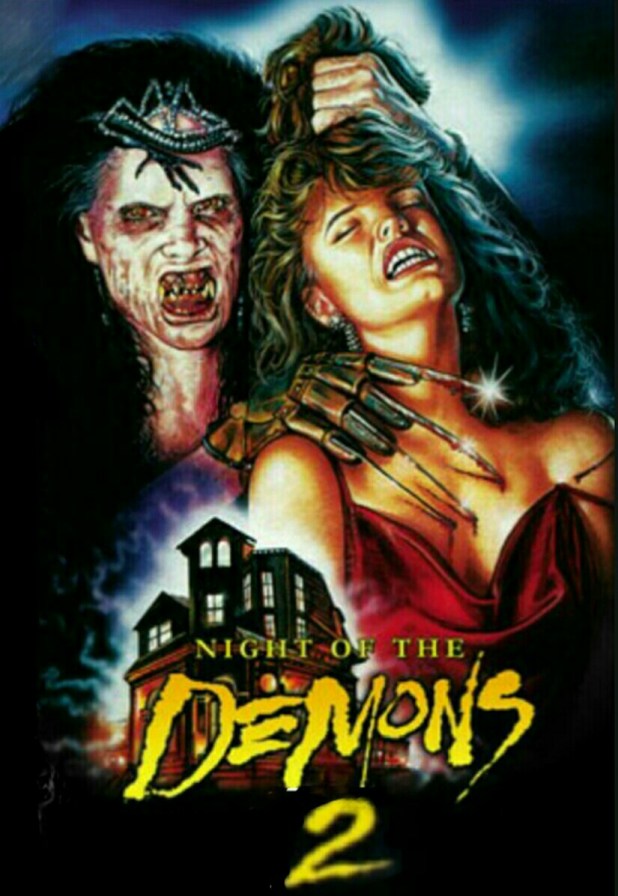
Six years after the events of Night of the Demons, all of the bodies at Hull House have been recovered except Angela. Urban legend suggests that she went body and soul directly to Hell. But the real truth? Upon getting a Halloween card with her signature last year, her parents committed suicide. Ladies and gentlemen, welcome to Night of the Demons 2, one of the many sequels that Becca loves more than the original.

Meet Melissa, who everyone calls Mouse. She’s Angela’s sister, who is now attending St. Rita’s Academy, a school for troubled teens. The school bully, Shirley, gives her a hard time while Sister Gloria, the head nun, tries to look out for her.

Shirley isn’t allowed to attend the school dance after the nuns catch her fooling around with Kurt, so she decides to have her own Halloween party at Hull House, complete with a demonic ritual and help from the school nerd, her boyfriend, a guy named Z-Boy, Johnny, Johnny’s girl Bibi and Terri (Christine Taylor, years before she was in The Brady Bunch Movie).

Of course, all Hell breaks loose. What you might not expect is that the demonic Angela rises and rapes Z-Boy in the attic in an inversion of horror movie tropes. And a tube of lipstick possesses Shirley, which leads to the girls being possessed and murdered by Angela, who wants to sacrifice her sister Mouse to the Devil.

The nerd, Perry, uses his demonology skills and the help of Father Bob and Sister Gloria to try to rescue the teens. Bibi, Johnny and Sister Gloria survive, killing all of the demons except Angela, who tries to cut the nun’s head off. A combination of a sword strike, a supersoaker filled with holy water and light coming through a cross shape finally kills Angela. But oh no! The evil lipstick survives!

Brian Trenchard Smith (Turkey ShootLeprechaun 4: In Space) puts together a quick moving fun piece of cinema junk food here. It’s not anything that will stay with you for long, but it’ll certainly keep you laughing and somewhat entertained while it’s in your DVD player or streaming on your media player.

LEAGUE OF FORGOTTEN HEROES: Blankman (1994)

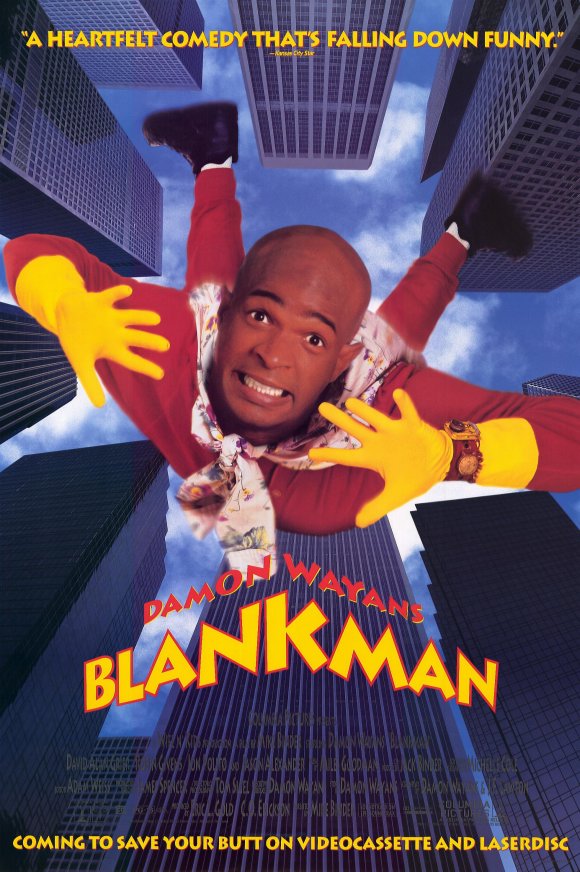
Daryl and Kevin Walker (Damon Wayans and David Alan Grier) are brothers who grew up idolizing Batman, watching the 1960’s show and dressing up and playacting crime fighting. As their neighborhood deteriorated around them, Kevin became a cameraman. Daryl may be a simple man-child, but he excels at repairing and inventing things. And he may have never given up on his dreams of being a superhero.

He finally gives in to his dreams after his grandmother (Lynne Thigpen, the Chief on TV’s Where in the World is Carmen Sandiego?)  is killed by a mobster. Despite nearly getting killed several times, Daryl becomes the media sensation known as Blankman.

He even gets a love interest — Kimberly Jonez (Robin Givens) — whose kisses reduce him to a quivering mess. However, not everything is easy. Minelli’s gang attacks a bank and takes the mayor hostage, tying him up and rigging the building with explosives. But Blankman can’t stop every bomb and is forced to run, causing him to give up on his superheroic dreams and going to work at McDonald’s.

Kevin’s boss Larry Stone (Jason Alexander) uses Kimberly to get an exclusive interview with Minelli. But the mobster takes over the station, so Kevin convinces Blankman to come back and stop the man who killed their grandmother. Kevin even gets his own superheroic identity as the “Other Guy.” And, of course, they save the day.

Blankman has really inventive set design, as Daryl’s inventions are string together pieces of junk that somehow work. This film is kind of/sort of a spinoff of the In Living Color superhero that Wayans played named Handi-Man. That character was as un-PC as you can get and Blankman softens down the very rough edges.

This is a time capsule of the 1990’s and worth digging up to enjoy. You can find it relatively cheap in used DVD stores and streaming on Brown Sugar.

LEAGUE OF FORGOTTEN HEROES: The Shadow (1994)

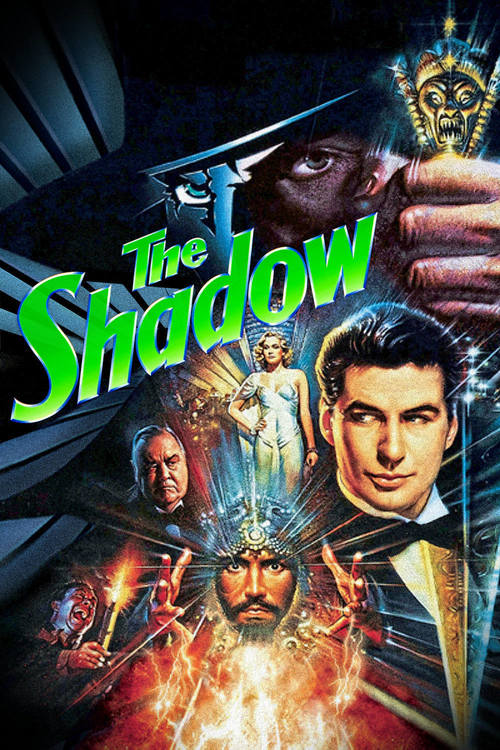
After Tim Burton’s Batman, producers scrambled to get a comic book movie — any comic book movie — up on the screen. So why not the hero who directly inspired the Caped Crusader (Batman’s first appearance in Detective Comics #27 is a tale that’s directly influenced by The Shadow story “Partners of Peril”)?

The trouble is that The Shadow hadn’t really appeared in anything pop culture related since 1958’s The Invisible Avenger, two episodes of an unaired TV series that were edited together as a movie (it was also re-released with additional footage in 1962 as Bourbon Street Shadows). And explaining to audiences why a character was popular 60 years ago isn’t always easy.

In Tibet, Lamont Cranston (Alex Baldwin, Glengarry Glen Ross) has become the opium dealer known as Yin-Ko. But Tulku, a mystic in the body of a young boy, takes him away from his dissolute life and uses the Phurba, a talking dagger, to begin redeeming the man. For seven years, Cranston learns the physical and mental skills that he’ll need to stop evil — including the power to cloud men’s minds.

It’s a rough conceit to start your film with your hero killing his own men and basically being the villain of the story. It’s why in so many stories of The Shadow, they start with the good side first before revealing his origin.

In New York City, Cranston is a wealthy playboy who is really The Shadow, a vigilante who has created a network of agents to help him battle the forces of evil. He meets Margo Lane (Penelope Ann Miller, Adventures in Babysitting), a woman who gets through his defenses, possibly because she’s telepathic.

Shiwan Khan (John Lone, Rush Hour 2) is Tulku’s fallen student who claims to have murdered the holy man. His powers are beyond The Shadow’s and he claims to be the descendant of Genghis Khan. He’s amassed a large army and has kidnapped Margo’s father Reinhardt (Ian McKellen, Lord of the Rings) to create an atomic bomb for him.

Khan hypnotizes Margo into killing The Shadow, but he stops her as Cranston. She realizes they are one and the same, but there’s no time to reflect. The Shadow has to rescue her father from Khan’s men, who now include Reinhardt’s treacherous assistant Farley (Tim Curry, Legend), who The Shadow hypnotizes into jumping off a balcony to his death.

Inside the Hotel Monolith, Khan and The Shadow have a final battle involving the Phurba, which demands a peaceful mind. Overcoming his past, The Shadow masters the weapon, frees Reinhardt from his brainwashing and defeats Khan inside a hall of mirrors by telekinetically using a shard of a mirror to give him a lobotomy.

Oh yeah — Jonathan Winters shows up as Barth and Peter Boyle plays Moe Shrevnitz, one of our heroes many lieutenants.

Sam Raimi originally wanted to adapt and direct this film, but was supposedly denied the rights to it. You can see echoes of the character in his 1990’s film Darkman.

Russell Mulcahy ended up directing the film. He came from the world of music videos, where his directorial efforts for Duran Duran helped create the image for the band. His first work that got noticed in the U.S. was the Australian horror film Razorback, followed by his work in the first Highlander (we shouldn’t discuss Highlander 2: The Quickening). Today, he’s known for the MTV series Teen Wolf.

The film does a good job getting plenty of references in to past tales of The Shadow, but again, it’s a rough character to sell to modern audiences without explaining why he’s so awesome before you show where he came from.

This was planned to be a franchise, with plenty of tie-ins like an entire line of action figures from Kenner.

The toys are typical of the mid 1990’s Kenner design aesthetic, with limited poseability and action features. They fit in well with the Super Powers and Swamp Thing lines that came out several years before.

The original DVD of the film was out of print for some time (indeed, it goes for around $12 in most used stores, a lofty price) but was re-released on blu-ray in 2013. It’s worth looking for, especially if you’re someone like me that stayed awake late at night to listen to the 1970’s re-airings on the syndicated program Golden Age of Radio.

VIDEO GAME WEEK: Street Fighter (1994)

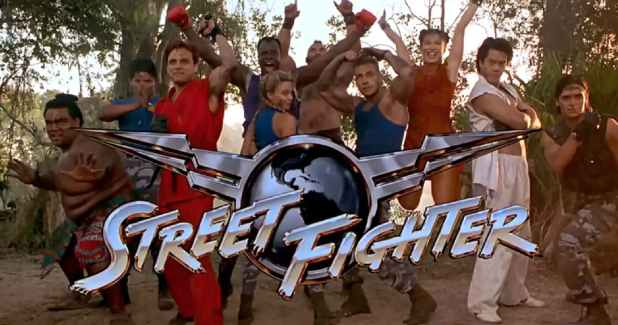
Street Fighter features many of the characters from the game and some of them hit the mark. Many of them don’t. And for years, I wrote the film off. I wondered, why did they pick Raul Julia to play M. Bison? After finally watching it, I now know that no one else could have played him.

How much do you really love the game? Then you’ll probably hate how idiotic Ken and Ryu are. You’ll probably dislike that E. Honda isn’t Japanese. And you’ll have trouble with the fact that Dhalsim is a scientist and that Charlie and Blanka have been turned into the same character.

But if you can get away from that, you pretty much get a live action cartoon. There’s a great scene where E. Honda and Zangief (Andrew Bryniarski, Leatherface in the 2003 remake of The Texas Chainsaw Massacre) have a fight while Godzilla sound effects play. Kylie Minogue is great as Cammy, even if her costumes are a little more modest than the video game. Wes Studi makes a fine Sagat. And the fights are really fun.

Best of all, Julia really makes M. Bison sing. There’s a great scene of him trying to seduce Chun Li in his chambers and he has a portrait done of him by John Wayne Gacy. And he brings a Shakespearean gravitas to a role that a lesser actor would not work hard on at all. The fact that he was suffering from stomach cancer (he died two months before the movie was released) is amazing when you see how much he put into his performance.

Street Fighter was the first movie that Steven de Souza directed. Up to then, he’d been better known as a writer, working on films as diverse as 48 HoursThe Return of Captain InvincibleCommandoThe Running ManBad DreamsDie HardDie Hard 2 and Hudson Hawk. He was beholden to a really rough schedule while working on the film, as Capcom had a hard and fast date that he had to hit. That said — he succeeds in making a silly take on the franchise. There’s even a Goofy falling sound effect made by one of the enemy soldiers!

Instead of the poster for this film, I decided to share the image that ends the film. It made me laugh out loud and here’s hoping you’ll find it as entertaining as I do.

VIDEO GAME WEEK: Double Dragon (1994)

Released in 1987 by Technos, Double Dragon is the spiritual successor to Nekketsu Kōha Kunio-kun (known to the US as Renegade), a game that was inspired by the high school life of creator Yoshihisa Kishimoto. Basically — you fight to survive.

When Renegade was released in the U.S., it was localized so that it appeared to be a video game version of The Warriors, with punk rock inspired bad guys. Double Dragon takes that to the next level, where Billy and Jimmy Lee (or Hammer and Spike, as the original cabinets called them) have to battle through hordes of post-apocalyptic punkers to rescue Billy’s girlfriend Marian. There had never been a game like this before, where two players could beat up a near endless array of bad guys and even steal their weapons from them. It felt like you were in a movie. So making a movie of Double Dragon — and its many sequels — seemed like a great idea.

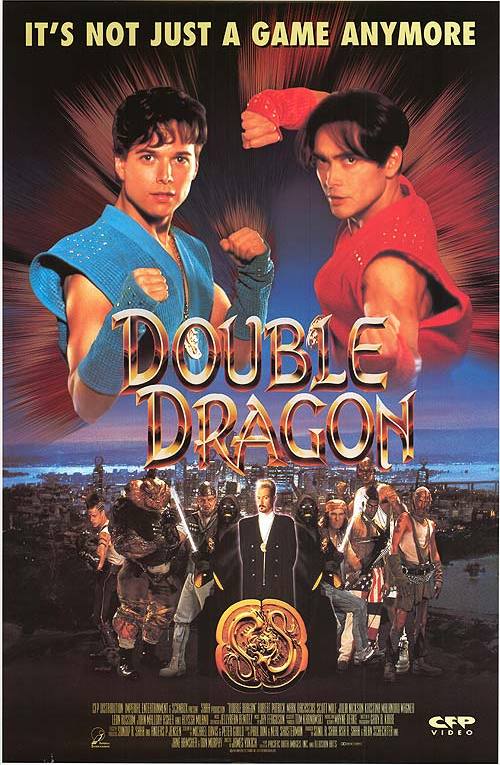
Koga Shuko (Robert Patrick, Terminator 2) is a crime lord looking for a magic medallion called the Double Dragon, which has been broken into two pieces. He already has one half, but now he needs the other.

Meanwhile, brothers Billy and Jimmy Lee (Scott Wolf of TV’s Party of Five and Mark Dacascos, the American chairman of Iron Chef and Mani from Brotherhood of the Wolf) and their adopted mother Satori (Rambo: First Blood Part II) are racing home to beat curfew after a martial arts tournament. Oh, a curfew? Yeah, it turns out that in the Los Angeles of 2007, an earthquake has made the city an apocalypse, lorded over by gangs. One of those gangs, led by Abobo (one of the game bosses) attacks, but they’re saved by the Power Corps, led by Marian (Alyssa Milano, Commando, every 90’s boy’s bedroom wall). Coincidentally, Satori has the other half of the medallion and Shuko mutates Abobo so he can go back out and get it.

The gang attacks again with Shuko even possessing their mother. The boys escape thanks to her sacrifice and go on the run as Shuko unites the city’s gangs, which have Michael Berryman (The Hills Have Eyes) among their members.

If you’re reading this and thinking, “This has nothing to do with the video game I’ve played and loved so much,” congratulations. Welcome to the world of 1990’s video game adaptions!

Will Billy and Jimmy finally stop being dweebs and learn how to fight? Will there by rollerblade attacks on an evil shopping mall? Wil they fight over Marian? Will there be fart jokes because all video games are really for children and not adults despite all evidence to the contrary? Who are the Power Corps and what do they have to do with Double Dragon?

Amazingly, this movie was written by Paul Dini, who created the most perfect media adaption of Batman ever, Batman: The Animated Series and also wrote for Lost. Wow. I’m kind of shocked. So I asked Dini on Twitter and was delighted by his reply:

There are some weird Frank Miller-esque talking heads on Channel 69 News, played by George Hamilton and Vanna White that try to make this movie into Robocop. Oh yeah — Andy Dick is also the station’s weatherman. They have nothing really to do with anything else in the film.

Because I come from Pittsburgh, allow me to make fun of Cleveland, where this was filmed. The boat chase sequence was filmed on the Cuyahoga River and ends with a gigantic explosion filled with 700 gallons of gasoline and 200 gallons of alcohol. Despite warnings in all manner of the news, the explosion caused a panic, leading to 210 phone calls to emergency services in 10 minutes. Oh Cleveland.

This movie defines the word missable. I have probably played hundreds of hours of the video games they inspired it and have often written my own tales in my head of my character’s motivations. Every single one, even back to when I was 16, are miles beyond this film. I’ve never seen a movie before where a bad guy hugs someone until he passes out, so there is that.

Then again, if you always wanted to watch a kid-friendly version of The Warriors, I guess this could be it.

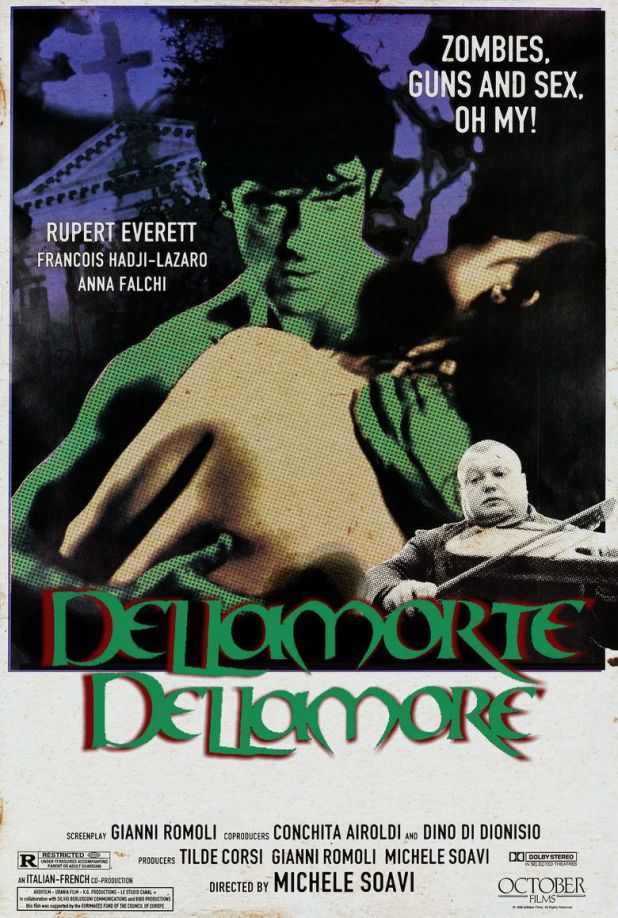
Cemetery Man (1994)

Throughout the 1990’s, Michele Soavi kept the traditions of Italian horror alive. Starting as an actor in films like Aliens 2: On EarthCity of the Living DeadDemons and The New York Ripper, Soavi would also become an assistant director to greats such as Dario Argento (TenebrePhenomena), Lamberto Bava (Blastfighter and the previously mentioned Demons) and Terry Gilliam (The Adventures of Baron Munchausen and The Brothers Grimm). Finally, he’d graduate to creating his own films, including StagefrightThe Sect and The Church.

Cemetary Man is based on Tiziano Sclavi’s novel Dellamorte Dellamore (the best translation is “About Death, About Love”). Sclavi also created the comic book Dylan Dog, whose protagonist looks exactly like this film’s star Rupert Everett (and which was also made into a 2011 film).

Francesco Dellamorte (Rupert Everett, My Best Friend’s Wedding) takes care of the Buffalora cemetery. He lives in a shack, with death and his mentally challenged assistant Gnaghi his only friends. Quite frankly, his life sucks. Young punks in town tell everyone he’s impotent. And his only hobbies are putting together a skull-shaped puzzle and crossing out dead people’s names in the telephone book.

That said, he has a hell of a job to do. The gates of the cemetery read “For those who will rise again,” and after a week, the dead rises from their graves, ready to kill the living. Francesco must kill them when they rise, even if no one wants to hear what a problem he’s facing. Again, the townspeople think he’s a moron, the mayor doesn’t care and, according to Franco, the town’s bookkeeper, he’d have to do a ton of paperwork if he really wanted the help.

While watching a funeral, Dellamorte falls in love with a widow. He waits for her to visit the graveside of her dead husband, then takes her on a tour of the grounds. As they have sex on the graves, her dead spouse rises and fatally bites her. Or maybe it’s a heart attack. Or maybe she isn’t even dead.  That said, seven days later, she also rises from the dead and Dellamorte must put her down as well.

Meanwhile, Gnaghi falls in love with the mayor’s daughter, Valentina. Even when she’s decapitated, he won’t fall out of love, instead digging up her head and starting up a romance. And the widow rises again, leading Dellamorte to believe that he was the one who killed her, not her husband. This causes him to either go insane or to begin seeing the truth, as the Angel of Death appears to him, begging him to stop killing the dead and only kill the living.

The widow has become the unattainable object of Dellamorte’s desire. He even tries to talk a doctor into removing his penis so that one aspect of her, the assistant to the new mayor (oh yeah, Valentina killed her dad when he shunned her new relationship) who is afraid of penetration, will fall in love with him. That relationship ends when she is raped, loses her phobia and marries her attacker.

Dellamorte then goes into town and kills anyone who said he was impotent. Meeting a prostitute in a bar, he realizes that she is also his unattainable love. He kills her and everyone in her apartment by setting it on fire.

Remember that bookkeeper, Franco? Well, he’s killed his whole family and the other murders that Dellamorte has done are all pinned on him. He drinks iodine to kill himself, but before he dies, Dellamorte visits. While visiting, he kills a nun, a nurse and a doctor, finally trying to confess to everything but no one will believe him.

Death reveals himself again and laughs that Dellamorte has not figured out what the difference between life and death is. So our hero packs up the car, grabs Gnaghi and tries to escape the town. As they race out of a tunnel, their car wrecks and Gnaghi is critically injured.

Dellamorte fears that the rest of the world has ceased to exist. He decides to kill himself and Gnaghi before his assistant is miraculously healed. He throws Dellamorte’s gun off a cliff and the two men decide to go back home.

If you’re looking for a narrative film that makes sense, this is not the movie. If you’re seeking a dream meditation of life, love and loss, then fire up your DVD player. Or streaming device, it is 2017 after all. Shot in a real abandoned cemetery, there are moments of poetic beauty and grace, like when the floating fool’s fire lights dance around the graves as Dellamorte and She make love. And there are also moments of abject horror and dread, as the film has an incredibly memorable personification of death.

Soavi would drop out of filmmaking to take care of his sick son in the late 1990’s, returning to work in television in the early 2000’s. Here’s hoping that he gets another chance to return to features, as Cemetery Man is everything I love about film — strangeness that is not easily accessible or categorized.

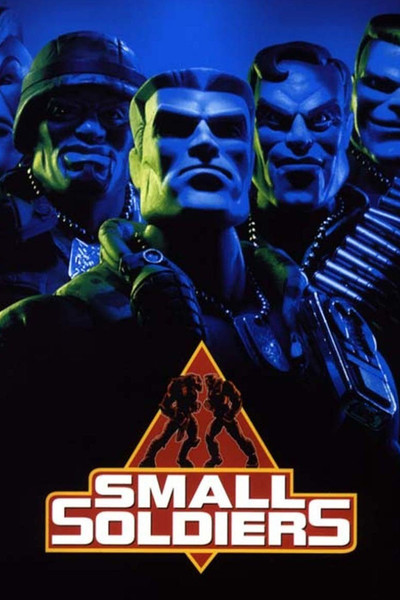
Small Soldiers (1998)

A Joe Dante movie always like a conflict — a battle between blockbuster and personal statement, led by a filmmaker with keen commercial instinct, yet the heart of a non-conformist. Through it all, one walks away with the feeling that while the film itself may have some rough edges, there’s a true love for moviemaking (heck, movies themselves) at the core. That makes perfect sense — before Dante was in the industry, he wrote opinionated mini-reviews for the Castle of Frankenstein magazine. After apprenticing as an editor for Roger Corman, he directed Piranha and The Howling, the latter a film that is a veritable love letter to the history of werewolves on film wrapped within a postmodernist take on them. Again, always that juxtaposition.

Perhaps Dante’s biggest monetary — if not critical — success was 1984’s Gremlins, as is its 1990 sequel, Gremlins 2: The New Batch. The former is a cute and cuddly big budget affair on one hand; an incredibly dark, depressing and borderline horror film on the other. There aren’t many family pleasing films that detail father figures dying in chimneys and left unfound for months, after all. And the latter is sequel that does everything but scream at the viewer that sequels are inferior cash grabs devoid of art while simultaneously throwing everything that Dante and a fleet of the most talented FX guys and animators can invent at the screen, including Chuck Jones coming out of retirement and an insane Hulk Hogan cameo (look, any movie where Paul Bartel asks for the Hulkster’s help dealing with unruly Gremlins in a movie theater demands numerous rewatches).

1998’s Small Soldiers is, on the surface, all about war. And again — it’s a picture at war with itself. GloboTech Industries — no relation to GloboChem, despite David Cross’s appearance in the film — has acquired the Heartland Toy Company. CEO Gil Mars (Dennis Leary) demands toys that play back, so he selects two toylines — Irwin Wayfair’s (the aforementioned David Cross) Gorgonites and Larry Benson’s (Jay Mohr) Commando Elite — and combines them into one storyline of forces at war with one another. Thanks to a tight deadline, safety testing is ignored and Benson uses GloboTech’s overly powerful X1000 microprocessor to be part of the toys — which makes them self-aware. Trivia note — the stolen password that Benson uses is Gizmo, a reference, of course, to Gremlins.

There’s another war between perception and reality. The toys cast as the bad guys, the Gorgonites, are caring individuals who want to protect the planet, while the militaristic GI Joe-esque Commandos become the heels.So what happens when they arrive at toy stores? That’s answered when Alan Abernathy (Gregory Smith, whose character is potentially named for Clayton Abernathy, GI Joe’s Duke) purchases the entire line from delivery driver Joe (Dick Miller, who appears in every one of Dante’s films). Alan discovers that the toys are living and breathing sentient beings when Archer sneaks away in his backpack. Upon returning to his dad’s store the next day, the Commando Elite have awakened and decimated the Gorgonites and the rest of the store, leaving traditional, non-mass produced toys a smoking wreck.

Alan attempts to warn the company of the malfunctioning Commando Elite, who do not understand they are just toys (the Gorgonites have accepted their fate and just want to go to Yosemite National Park, which they feel is their homeland), going on the attack and kidnapping Alan’s love interest, Christy. To defeat their militaristic foes, the Gorgonites must battle their very nature, embracing the violence they abhor.

Small Soldiers is a strange film, a near spiritual sequel to Gremlins in that small terrors come to life to battle in the full sized real world. But it’s unsure whether of its audience and what it wants to be, a fact that Dante himself admitted: “Originally I was told to make an edgy picture for teenagers, but when the sponsor tie-ins came in the new mandate was to soften it up as a kiddie movie.” Kenner made the tie-in action figures, albeit for a movie that condemns the toy industry for embracing militaristic conflict over peaceful learning. And the Burger King Kids Meals were controversial as the film was to have a PG rating, instead of the PG-13 it received.

It’s also a blockbuster that, instead of being relentlessly driven to make money by playing to the lowest common denominator, goes way deep in its references to past films and themes. Plus, the casting is based on who works best for the film versus who sells tickets, a Dante trademark. Tommy Lee Jones may voice the leader of the Commando Elite, Chip Hazard, but Arnold Schwarzenegger was Dante’s original choice (and the rest of the team would have been filled out by the entire cast of Predator). Instead, the surviving cast members of The Dirty Dozen — George Kennedy, Clint Walker, Ernest Borgnine, and Jim Brown — were cast. Richard Jaeckel sadly died before filming began and Charles Bronson refused to lend his voice to a cartoon. The Gorgonites are voiced by Frank Langella (who knows toy tie-ins well, thanks to his role as Skeletor in He-Man and the Masters of the Universe) and the entire Spinal Tap crew of Michael McKean, Harry Shearer and Christopher Guest. Even better, there are references aplenty to past Dante works, including Robert Picardo’s character, Ralph Quist, sharing the same last name as his character in The Howling, Eddie Quist.

Small Soldiers may have NASCAR, fast food and toy tie-ins, but it feels like a deeply personal film that savors biting the hand that fed the beast that financed it. It may be many things, all at once, but above all, it does not commit the most grievous of all movie sins. It is never, ever boring.

This was originally written for an as yet unpublished zine.