Alien Warrior (1985)

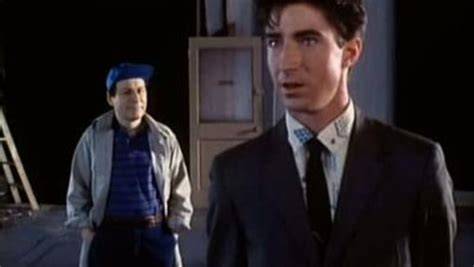
Buddy’s (Brett Baxter Clark, Nick the Dick from Bachelor Party, Bruiser from Teen Witch and the gardener of Young Lady Chatterley II; seriously these are the kind of roles that make me light headed when reading an IMDb and that’s not even bringing up the Andy Sidaris movies and starring in Delta Force Commando, Deathstalker IV, Cirio H. Santiago’s Eye of the Eagle and Cobra Mission 2) origins are like a mix of Superman and the Terminator. He wants to come to Earth to fight a great evil, so he’s put in a tube and launched here, but gets to our planet buck naked. He doesn’t beat up some bikers for his clothes, however. 

After rescuing Lora (Pamela Saunders, who appeared on All My ChildrenRyan’s HopeLoving, and Days of Our Lives), she asks him to help her with her literacy center.  

Every superhero needs a supervillain, and Buddy has a lame one in a pimp named Mr. One (Reggie De Morton, who started his career alongside Robert Kerman and Jamie Gillis in the adult movie Fiona on Fire; he’s also in Satan War and Legion of Iron). This pimp is enraged that Buddy is teaching gang members how to read, as well as do more positive graffiti and build futuristic cars. This is cutting into the profits of his girls, so he sends some cops to beat up Buddy, who ends up in jail.

Buddy gets shot and becomes, well, a ghost. Luckily, the gang members remember how to use guns, so they shoot Mister One and toss his body into a smelter. This allows Buddy to go back home, where his father (Norman Budd) is so proud of him.

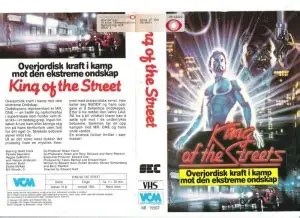
Man, this movie. Women are menaced with snakes and a power drill. Mexican gangbangers learn how to read at a higher level. Custom cars show up, like a fiberglass Invader GT5. Buddy learns kung fu just by watching it. And it has the alternate title King of the Streets? And a ninja is played by Frank Dux, the man whose life story of lies would become Bloodsport? Plus a lot of nudity as Mister One sends his girls to sleep with politicians?

Imagine if Space Jesus wasn’t fighting Ted Turner and Satan, like The Visitor, and instead was kind of remaking Death Wish 3, yet with more breakdancing. 

This was directed and co-written by Ed Hunt, who also made The PlagueThe BrainBloody BirthdayUFOs Are RealStarship InvasionsPoint of No Return and Diary of a Sinner. He’s joined on the script by Ruben Gordon (Legion of Iron), Buddy Pearson (who also wrote Firebird 2015 AD) and Steve Schoenberg. 

Amazingly, movies can still surprise me. If you’re looking for a movie where a Messiah from beyond solves the crack epidemic with literacy and breakdancing, Alien Warrior is the only choice.

You can watch this on YouTube.

Tales from the Darkside S2 E12: Monsters In My Room (1985)

Biff (Greg Mullavey, Mary Hartman’s husband) doesn’t get kids. His new wife, Helen (Beth McDonald), has a son, Timmy (Seth Green!), who keeps claiming he has monsters all around him.

Instead of being toughened up and not believing in these supernatural frights, as Biff wants, Timmy decides to make peace with those things that go bump in the night, which include a boogeyman in the closet, an octopus under the bed and a witch in the bathroom. Biff wants to make a man out of Timmy through verbal abuse and threats of physical violence. Ironically, his cruelty works, just not the way he intended. Timmy does toughen up. In fact, he becomes so cold and calculating that he manages to domesticate literal demons.

By the end, when Biff and Timmy are left alone, the drunken stepfather threatens to paddle our hero. Instead, the monsters follow Timmy’s orders. Sure, Biff died of heart complications, yet we know the actual culprit. But then, we must wonder: are these scary things real or just how Timmy deals with abuse? Or maybe that’s what Biff deserves for killing Ernie, his stepson’s pet potato bug. If the monsters are a coping mechanism, Timmy is essentiallyweaponizinghis trauma. The heart attack Biff suffers is a convenient medical cover-up for a child’s revenge.

The most chilling part of the ending isn’t Biff’s death. It’s the fact that the monsters are now afraid of Timmy. This suggests that to survive a monster like Biff, Timmy had to become something even more terrifying. He didn’t just reclaim his space. Now, he has become the new landlord of the dark.

James Steven Sadwith, who directed and wrote this, would go on to make the Elvis and Sinatra TV mini-series.

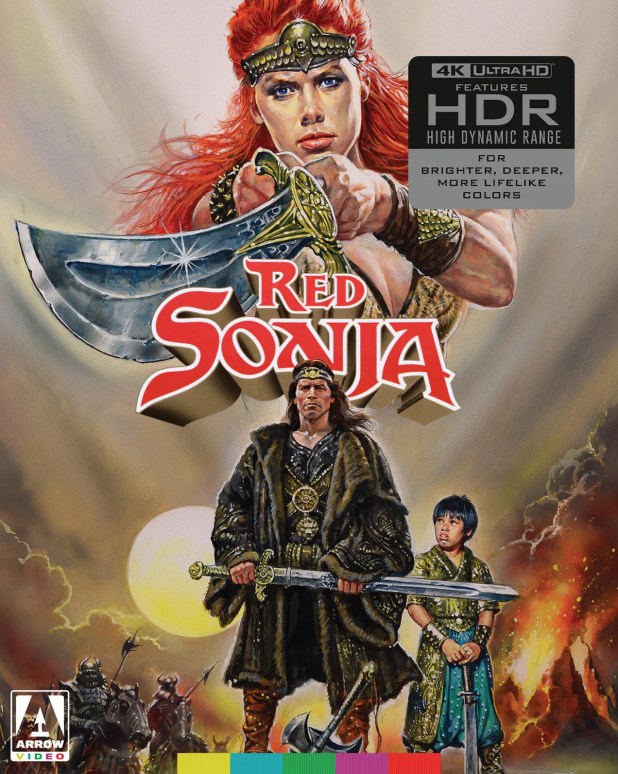
ARROW VIDEO 4K UHD RELEASE: Red Sonja (1985)

I am sorry, Red Sonja. For years, I have doubted you. Surely you cannot be as good as Conan the Barbarian and Conan the Destroyer. You have to be a weaker sister, I always thought, so I avoided you.

I was wrong. So wrong.

Today, dear reader, I am here to tell you that while this film is not as good as the first two Conan romps, it’s still an astounding sword and sorcery adventure filled with plenty of great effects, well-shot battles and a cast of some of my favorite actors.

Oddly enough, Red Sonja may be owned by the Robert E. Howard estate, but the character itself was really created by Roy Thomas and Barry Windsor-Smith. In the original Howard story, The Shadow of the Vulture, Red Sonya of Rogatino was actually a 16th-century gun-toting warrior fighting the Ottoman Empire. Thomas and Windsor-Smith took that fierce spirit, swapped the pistols for a broadsword and dropped her into the Hyborian Age, and thus, the She-Devil with a Sword was born.

Man, those 70’s Conan comics were so popular! People fell in love with the idea that Sonja could be as tough as Conan and had promised the goddess Scáthach that, in exchange for heightened strength, stamina, agility and fighting skills, she would never lie with a man until he could defeat her in fair combat.

Let’s not debate how the survivor of sexual assault must pretty much get beaten up to enjoy lovemaking, because that’s the kind of complex argument that won’t be solved inside a movie that’s really about stabbing people. I’m not saying it’s an important discussion to have, but I’m an expert in exploitation movies, not humanity.

Directed by Richard Fleischer, whose career goes from the heights of Soylent Green and 20,000 Leagues Under the Sea to the depths of The Jazz Singer and Amityville 3-D — not to mention Mandingo — this moves quick, looks good and is just plain fun.

After surviving the death of her family and being attacked by the soldiers of Queen Gedren (Sandahl Bergman*, who seems to relish the opportunity to play a villain instead of the female sidekick), Sonja trains to become a legendary warrior.

Meanwhile, her sister Varna (Janet Agren, Hands of SteelCity of the Living Dead) has become a priestess in an order of women who plan on banishing the Talisman, which created the world but could now destroy it. If any man touches it, he disappears, so of course, Gedren wants to use it for her own ends. Led by Ikol (Ronald Lacey, Toht from Raiders of the Lost Ark), her army kills the priestesses and takes the Talisman for their queen.

Lord Kalidor** (Arnold Schwarzenegger) finds Varna and brings Sonja to her, where she learns of the Talisman and how she can kill two birds with one stone by destroying it and Gedren. Her adventures take her to meet Prince Tarn (Ernie Reyes, Jr.), a young king of a land destroyed by Gedren, and his bodyguard Falkon (Paul L. Smith, who was the handyman in Pieces and Bluto in Popeye). She also defeats the ominous Lord Brytag (Pat Roach, the former pro wrestler who shows up as a major bad guy in so many movies, from the mechanic that Indiana Jones knocks into a Flying Wing in Raiders of the Lost Ark to Hephaestus in Clash of the Titans, Toth-Amon in Conan the Destroyer and General Kael in Willow) before an awesome duel with Kalidor for the right to aardvark*** and then another battle against Gedren as her castle explodes with lava flowing everywhere.

Speaking of that great cast, this also features a third Indiana Jones alum, Terry Richards, who played the Arabian swordsman that Indy so memorably shot after a long flourish of sword-swinging. Plus, Tutte Lemkow, best known as the Fiddler on the Roof, is a wizard, and the Swordmaster who trains Sonja is Tad Horino, who was also Confucius in Bill and Ted’s Bogus Journey. Erik Holmey, who played the soldier who asked, “What is best in life?” and replied, “The open steppe, fleet horse, falcons at your wrist, and the wind in your hair!” is in this. And of course, Arnold’s buddy Sven-Ole Thorsen shows up.

Plus, how can you be let down by an Ennio Morricone score?

Again, I’m sorry, Red Sonja. You’re actually pretty darn good.

*Bergman was offered the role of Red Sonja, but turned it down, choosing instead to play Queen Gedren. Producer Dino De Laurentiis met with actress Laurene Landon and was set to offer her the role until he learned that she had already played the same part in Hundra. He spent a year looking for an actress who looked like an Amazon, almost picking Eileen Davidson (The House On Sorority Row) before discovering Brigitte Nielsen on the cover of a magazine.

**There’s a fan theory that Kalidor is really Conan, as some heroes would use “adventuring names” while they were in other counties, like how Gandalf was also known as Mithrandir. De Laurentiis didn’t have the rights to use Conan again, which explains the financial situation. Speaking of money, Arnold signed up for a cameo as a favor to the producer, but one week turned into four, and when he saw a rough cut of the movie, he realized that he was really a co-star. This is why he terminated his 10-year deal with De Laurentiis.

***They totally did, for real, according to Arnold in his book Total Recall – My Unbelievably True Life Story. Nielsen confirmed this in her book You Only Get One Life, saying that they had “no restrictions” in their lovemaking. You know, while some of us debated whether Stallone or Schwarzenegger was the best action hero, Neisen has Biblical knowledge.

The Arrow Video 4K UHD release of this film has a 4K restoration from the original negative with new HDR grading by Arrow Films. Extras include two coimmentaries, one by critics Eugenio Ercolani and Troy Howarth and the oyther by comic book expert Dave Baxter; new interviews with Ernie Reyes Jr.; action unit supervisor Vic Armstrong; Arnold’s stunt double Pietro Torrisi, stuntman Ottaviano Dell’Acqua, assistant production manager Stefano Spadoni, FX artist Domingo Lizcano discussing the work of Emilio Ruiz del Río and make-up FX assistant Adriano Carboni; archival interviews with poster artist Renato Casaro and assistant director Michel Ferry; The Man Who Raised Hollywood, an archive featurette on Schwarzenegger’s career featuring filmmakers Peter Hyams and Arthur Allan Seidelman, producer Edward Pressman and others; a trailer; an image gallery; a reversible sleeve featuring two original artwork options by Renato Casaro; a collectors’ perfect-bound booklet featuring new writing on the film by John Walsh, Nanni Cobretti and Barry Forshaw; a double-sided foldout poster featuring two original artwork options by Renato Casaro and six postcard-sized reproduction artcards. You can get it from MVD.
Tales from the Darkside S2 E11: Effect and Cause (1985)

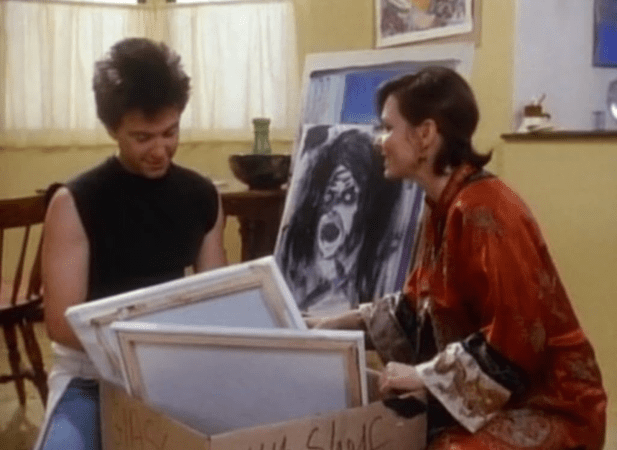
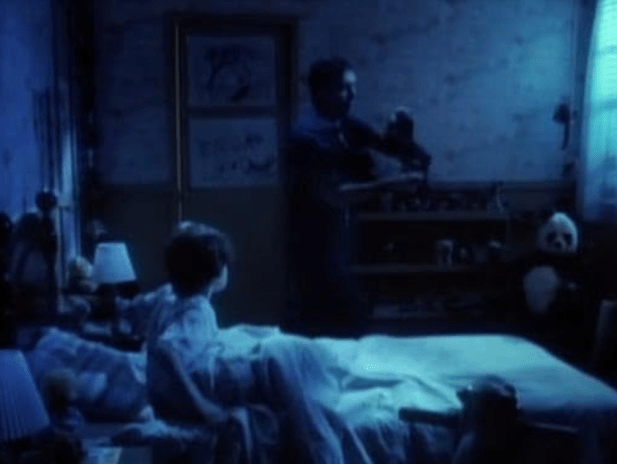
Kate Collins (Susan Strasberg) is afraid to paint over her old canvases. Yet after receiving a batch of bizarre paintings from her friend David (Ben Marley), she decides to whitewash one of the canvases and reuse it. Kate’s decision to whitewash David’s canvas isn’t just an artistic choice; it’s a symbolic erasure of the past. By painting over what already exists, she inadvertently hits the reset button on the linear flow of time.

Shortly after, she experiences a series of bizarre events, including falling down the stairs just as paramedics arrive at her door. She has somehow reversed cause and effect, allowing her to change reality. 

The episode delves into the concept of karma and the unpredictable nature of reality. Kate’s newfound ability comes with unforeseen consequences, as her chaotic lifestyle and whimsical decisions lead to increasingly dangerous situations. Kate tries to use her ability for minor conveniences, but because the “Effect” happens first, she is forced to commit the “Cause” to satisfy the loop. She becomes a slave to her own future. As she loses control of her abilities, the episode builds to a chaotic, explosive climax.

Directed by Mark Jean (who went from TV series directing to Hallmark movies) and written by Michael Kube-McDowell, this has Kate as a hippy who did acid in college, suddenly learning that there does need to be some order to the world, or things just fall to pieces. Yet this is another episode of Tales from the Darkside where things just happen. There’s no moral lesson; no one escapes. It just happens, and people die. We move on. I wonder if that’s what keeps this show from being considered in the upper echelon of TV horror anthologies? 

In The Twilight Zone, a character like Kate would be punished for her hubris. In Tales from the Darkside, she’s just… there.

Tales from the Darkside S2 E10: Ursa Minor (1985)

Will I ever get over the fact that Theodore Gershuny, who directed and wrote this episode, was married to Mary Woronov? Am I really that jealous of a person? Yes.

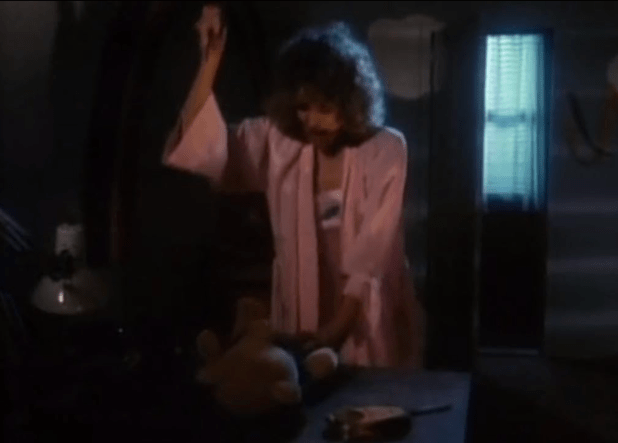
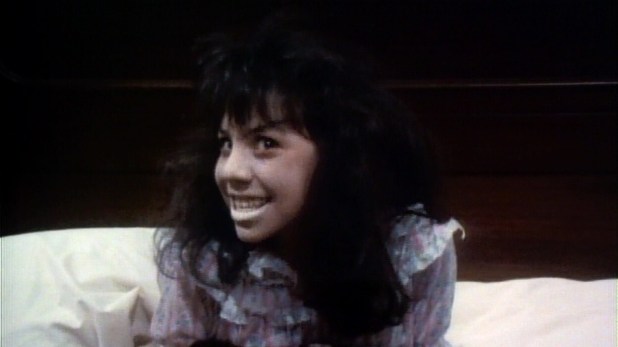
Based on a story by John Sladek, a former tech writer who was also the author of The New Apocrypha: A Guide to Strange Science and Occult Beliefs, in which he examined the supernatural from a materialist lens, this is the story of Susie (Jamie Ohar), who gets a stuffed bear from her parents (Marilyn Jones and Timothy Carhart). But is it just a teddy bear, or is it something more?

But did her parents even buy it? Neither of them remembers, and soon, bear marks are all over the house and anything that goes wrong is blamed on the bear. Basically: Kids are insane people who live in your house who are ready to kill you at any time. That’s what I learned from this. That and the fact that evil can be inside very small things, and perhaps you should just leave it alone unless you want to end up holding your child as a big bear breaks its way through a door.

The parents spend half the episode debating the logic of the bear’s existence. That’s because in Sladek’s world, the bear isn’t necessarily a demon; it’s a physical object that is simply wrong. The horror isn’t spiritual. It’s a failure of the physical world to behave in the way we want it to.

Plus, the bear acts as a surrogate for Susie’s own burgeoning agency and perhaps her resentment. More than her blaming the bear and trying to get away with it, she’s also in a psychodrama with her parents, as they are actually terrified of the idea that their daughter might be the one marking the house. The bear is just the medium for the chaos kids naturally bring into a sanitized adult world.

Tales from the Darkside S2 E9: The Trouble with Mary Jane (1985)

Desperate to save her granddaughter, Mary Jane, from an encroaching supernatural rot, the wealthy Mrs. Nugent turns to the only experts she can find: Nora (Phyllis Diller) and Jack Mills (Lawrence Tierney). Nora is a wisecracking, flamboyant medium, while Jack is a hard-nosed cynic. They are career con artists used to fleecing pockets and putting on dim-lit seances, but Mrs. Nugent’s $50,000 bounty is enough to make them ignore the smell of sulfur.

Mary Jane claims to be Aisha Candisha, a Moroccan demon of legendary malice. To prove her pedigree, she doesn’t just growl. She casually unhinges her jaw and consumes a silver spoon like it’s a communion wafer. Nora, realizing they are wildly out of their depth, tries to bow out, admitting they are merely fortune tellers. Jack, fueled by greed and a stubborn refusal to be intimidated, doubles down. He wants to try a transfer ritual, removing the entity from Mary Jane and trapping it inside a live pig.

Directed by T.J. Castronovo and written by Edithe Swensen, this ends with both Aisha and Gad finding new bodies to live in. As the demons argue over their prize, the con artists realize that playing at being the Warrens has invited a darkness that doesn’t care about their bank accounts.

Tales from the Darkside S2 E8: Distant Signals (1985)

Lew Feldman (Joe Bova) is on the phone, being a Hollywood agent, when Mr. Smith (Lenny von Dohlen) appears in his office. He tells him that he wants to speak to Gil Hurn (David Margulies) and wants the agent to find him. Feldman says that Hurn is a big writer now and doesn’t want to revisit one of his failures. Smith offers a $35,000 gold bar to find Smith and discuss his one-season-canceled show, Max Paradise.

Smith wants Hurn to write and direct six more episodes of the show, including the ending. He’s willing to pay him $2 million to make it happen, but Hurn is unsure, since he thinks the show was corny. Smith claims that fans are yearning to see how the story ends. To do that, they have to find the star, Van Conway (Darren McGavin), who has given up on acting and, well, life. Smith promises him money, and if he takes the pills he’s brought, he will feel healthy again, as he once did before he started drinking. He even rebuilds the studio where the show was set, with no expense spared, to ensure that a show nobody watched can come back.

Even when Conway walks away, Smith won’t give up, even removing his fear and need to drink. When asked why he’s doing all of this, he replies that he’s Conway’s greatest fan. Conway is amazed by Smith’s belief in him and wonders who the millions of people Smith refers to are who would watch a black-and-white show in modern times. All Smith can say as he watches the show being filmed is that it’s mythic.

It’s never said where Smith is from, but Hurn and Conway decide he’s from space, a place that saw the show years after everyone else and always wondered how it ended. As the Max Paradise theme plays and the cameras roll in that reconstructed void, Hurn and Conway realize they aren’t just filming a cancelled show; they are providing the “ending” for an entire civilization’s mythology. They find their own purpose by becoming the wanderers they once portrayed.

Directed by Bill Travers (his only directing job; he played Senator Boutwell in The Lincoln Conspiracy) and written by Theodore Gershuny (who was married to Mary Woronov) from a story by Andrew Weiner, this is one of my favorite episodes of the entire series. Max Paradise was based on Coronet Blue, which ran for only 11 episodes on CBS in the summer of 1967. Created by Larry Cohen, it was about an amnesia-suffering man (Frank Converse) chased by killers who only knew two words, which were the title of the show. It never returned after those episodes, and the mystery was never resolved.

Tales from the Darkside S2 E7: The Devil’s Advocate (1985)

Three Pittsburgh-centric episodes in a row, starting with Tom Savini directing, then John Harrison and now Michael Gornick behind the camera. The director of Creepshow 2, as well as episodes of this show and Monsters, also has the pedigree of being written by George Romero.

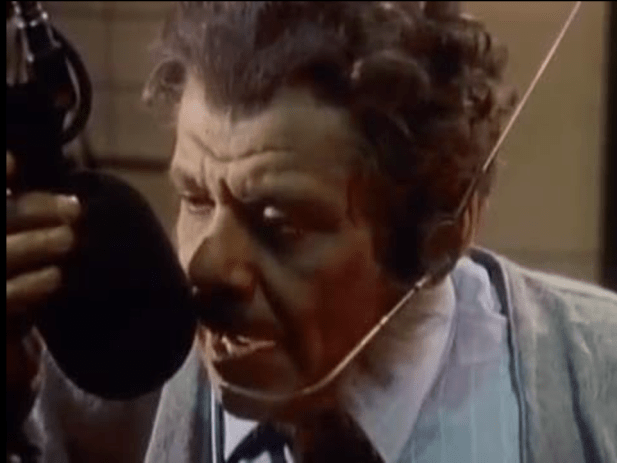
Luther Mandrake (Jerrt Stiller) is the kind of burned-out shock jock that horror movies are made about. He starts off mid-rant, late for his show, The Devil’s Advocate, and angry that the cops dared to question him after someone was found dead in his car. Mandrake has the midnight to 4 AM shift, the Art Bell time, the middle of the darkness when only crazy people are listening and even weirder people are calling in. 

Mandrake hasn’t had it easy: his mother died in a plane crash, his father died in a picket line, his wife is in a coma, and his son just died, the victim of a drunk driver. One of his callers — from Pittsburgh — reacts by calling him the devil, all as Mandrake begins to turn into a wolf. Before too long, callers from across time appear, complaining about President Wilson and World War II. That’s because — shudder — he’s become the devil’s advocate for real, broadcasting from hell, as he’d already killed himself in his car, and that’s the body the police found.

Still’s son, Ben, did his own version of this on his Fox show, presenting “Low Budget Tales of Horror.” Jerry would dress as a wolf again in the Monsters episode “One Wolf’s Family.” That brings the Pittsburgh connection full circle, because that one was directed by Jon Thomas, who worked as a sound mixer on many Romero projects.

Tales from the Darkside S2 E6: The Satanic Piano (1985)

Directed and written by John Harrison (First Assistant Director on Creepshow and Day of the Dead — not to mention his stunning turn as the villain of Effects), this episode is all about composer Pete Bancroft (Michael Warren, Hill Street Blues), who is burned out on playing the piano, out of ideas and seemingly discourages his daughter Justine (Lisa Bonet) from following in his footsteps. But then Wilson Farber (Philip Roth) offers him an electric piano out of the blue. It’s powered by thought, not by playing, and seems to turn his ideas into hit songs. But you know what they say: if an offer is too good to be true, well…the keyboard acts as a psychic parasite, feeding on Justine’s youthful vibrance. And this is after Pete ignored her talent! Now, he wonders how he can escape this Faustian deal.

At its core, the story explores the commodification of art. Pete Bancroft isn’t just a tired musician; he’s a man experiencing the soul-crushing weight of professional expectation. When Wilson Farber presents the thought-powered keyboard, it represents the ultimate shortcut of output without the labor of practice or the pain of composition. Keep in mind, this was made decades before AI.

Speaking of music, Harrison also composed the score, with cues very similar to those in Day of the Dead.

Tales from the Darkside S2 E5: Halloween Candy (1985)

Directed by Sex Machine himself, Tom Savini, and written by Michael McDowell (ThinnerBeetlejuice), “Halloween Candy” centers on Mr. Killup, played with skin-crawling bitterness by Roy Poole. Killup is the ultimate holiday bad guy, a mean man who doesn’t just dislike Halloween, but actively has disdain for the joy of children. His constant bickering with his weary son, Michael (Tim Choate), establishes a claustrophobic, mean-spirited atmosphere that feels ripped straight from the cynical pages of an old EC Comic. After a night spent tormenting trick-or-treaters with “treats” like spoiled food and hardware, Killup’s karma arrives in the form of a relentless, silent goblin (John Edward Allen).

The goblin isn’t just a monster; it’s a lingering, supernatural pest that slowly erodes Killup’s sanity. The finale where the creature uses its dark magic to accelerate time features gruesome, high-tier makeup effects that make Killup appear as though he has been rotting in neglect for weeks.

Even better, Fluffy from inside “The Crate” in Creepshow is in this.

This feels like one of the best shows of the series. Savini brings a cinematic eye to a low-budget TV format with relenteless pacing, His focus on the visceral details of the monster makes the segment feel more like a short film than a TV episode. With its heavy shadows, autumnal setting, and themes of greed and consequence, it is the quintessential Halloween watch. It captures that specific October vibes better than even some movies.