Cinematic Void January Giallo 2024: A Blade in the Dark (1983)

EDITOR’S NOTE: Cinematic Void will be playing this movie on January 6 at 7:00 PM MT at Sie FilmCenter in Denver, CO. You can get tickets here. For more information, visit Cinematic Void.

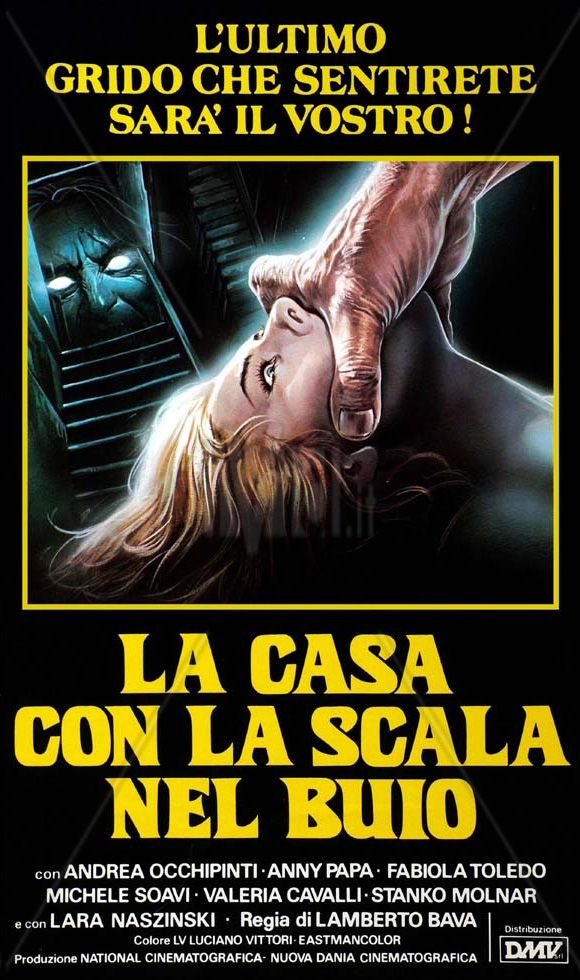
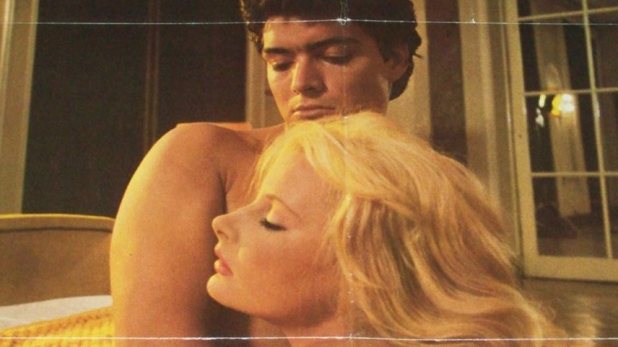
Known in Italy as La Casa con la Scala nel Buio (The House with the Dark Staircase), Lamberto Bava’s A Blade in the Dark was originally intended to be a four-part TV mini-series, with each segment ending with a murder. However, it was too gory for regular audiences, so it was released as a film. It was written by the husband and wife team of Dardano Sacchetti and Elisa Briganti, whose script was often at odds with what Bava wanted to put in his film.

Bruno (Andrea Occhipinti, The New York Ripper) is a composer hired to create the soundtrack for a horror movie. He’s been having trouble concentrating on the job, so he rents a house to sequester himself. He meets two women who used to know his rented villa’s former tenant, but when they disappear, he’s forced to watch the movie he’s scoring closer, as there’s a clue to the razor-wielding killer’s identity hidden within.

Bava worked as Dario Argento’s assistant for the movie Tenebre two years before this movie was made, so that has a big influence on this work. This is a movie unafraid to wallow in gore, feeling closer to the American slasher than the giallo. Then again, Lamberto was an assistant on the movie that predates the slasher, his father’s A Bay of Blood.

For the killer, he had difficulty finding someone who could convincingly appear to be a man and a woman. He turned to his assistant, Michele Soavi, who went on to direct plenty of great horror on his own.

For those that care about these matters like me — Giovanni Frezza, forever Bob from The House by the Cemetery — shows up in the movie within a movie that Bruno is writing the music to. He’s taunted by voices that chant “You are a female! You are a female!”

Also, in the true spirit of giallo and what the word means, every victim — and then the killer him or herself — is called out by the color yellow.

SUPPORTER DAY: Firesign Theatre Presents Hot Shorts (1983)

EDITOR’S NOTE: Today’s movie is brought to you by AC Nicholas, who has graciously become a Big B&S’er, a monthly supporter of the site and got to pick an entire week of movies. His idea this time was for a series on movies that started as one film and were dubbed into something else.

Would you like to have me write about the movies of your choice? It’s simple!

  1. Go to our Ko-Fi site and donate. There’s no set amount and I won’t tell you what to do. In fact, if you just keep reading for free, we can still be friends.
  2. Join as a monthly member for just $1. That makes you a Little B&S’er.
  3. As a Medium B&S’er at just $3 a month, if you pick a movie or a director, I’ll write about them for you. In fact, I’ll do one for each month you subscribe and even dedicate the post to you.
  4. For $5 a month, you basically get some major power. As a Big B&S’er, I’ll write an entire week on any subject you’d like. How awesome would that be? In fact, I’ll do it for every month you’re a member. Do you think any of your other movie sites will do that for you?

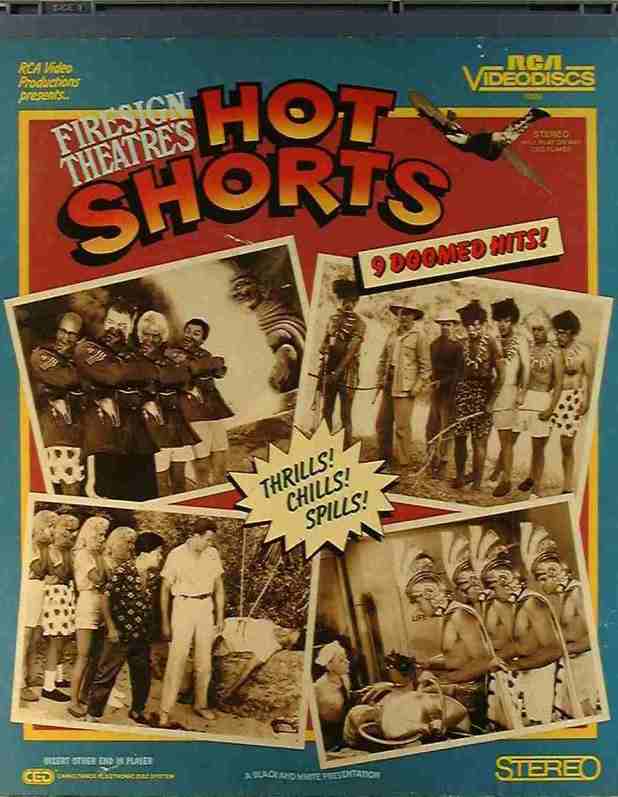
The Firesign Theatre was an American surreal comedy group that first appeared on November 17, 1966, in a live performance on Radio Free Oz on station KPFK FM in Los Angeles. In their career, they produced fifteen record albums and one single and had three nationally syndicated radio programs, The Firesign Theatre Radio Hour HourDear Friends and Let’s Eat!

Created by Peter Bergman, all of their material was conceived, written and performed by Bergman, Philip Proctor, Phil Austin and David Ossman. They have the name as all four were born under the three fire signs of astrology, with Austin being an Aries, Proctor a Leo and Bergman and Ossman both Sagittarius.

The comedy of the group was based on fooling people. Proctor said, “We each independently created our own material and characters and brought them together, not knowing what the others were going to pull. And it was all based on put-ons; that is, we were assuming characters that were assumed to be real by the listeners. No matter how far out we would carry a premise, if we were tied to the phones we discovered the audience would go far ahead of us. We could be as outrageous as we wanted to be and they believed us—which was astonishingly funny and interesting and terrifying to us, because it showed the power of the medium and the gullibility and vulnerability of most people.”

With titles like How Can You Be in Two Places at Once When You’re Not Anywhere at All and Don’t Crush That Dwarf, Hand Me the Pliers, their concept albums could be about nothing. Or also about people growing old as they watched TV. They were unlike anything else at the time or since, to be perfectly truthful.

After a break in 1973, the group reformed and went after new targets. Everything You Know Is Wrong attacked the New Age before some people even knew what it was. Ossman referred to it as a “complicated and cinematic record, we were trying to write a radio movie.” Working with Allen Daviau, who would later be the cinematographer of so many Spielberg movies, they used the album as a soundtrack for a film that was released in 1993.

For most of the 70s, the Firesigns were quiet. Norman Lear and Bud Yorkin’s Tandem Productions bought the rights to their character Nick Danger for a TV series that would star George Hamilton and New Line wanted to make a movie from the same stories with Chevy Chase. The group did make five episodes of a show called Nick Danger: The Case of the Missing Shoe for radio, which was pretty much a dying format, and when it wasn’t sold, they released it on an EP.

Proctor and Bergman made J-Men Forever and then Austin and Bergman finally reunited to start performing again. However, when Reagan was in office, the political waters were not safe for the group. They faded, only to reappear later in the 80s. As Bergman said, “I dreamed it back. Sure enough, when we kicked the fascists out of office it was time for the Firesign Theatre to come back.” They lasted until the 2010s and claimed to be the longest surviving group from the classic rock era to still be intact with the original members. Sadly, Bergman would die in 2012 and his memorial would be their last performance. Austin died in 2015.

As for the movies that they worked on, the Western musical Zachariah is one. They were also involved with Tunnel VisionAmericathon and Nick Danger in The Case of the Missing Yolk, which was an interactive video game that became a movie and was shown — just like J-Men Forever — on USA’s Night Flight.

Just like the aforementioned — twice — J-Men Forever, this is a series of old movie serials redubbed into entirely new stories by the Firesigns. Daughters of the Canadian Mounties becomes The Mounties Catch Herpes. Panther Girls of the Congo transforms into Claws IISpy Smasher presents a world where no one lights up anymore in Revenge of the Non-SmokersSperm Bank Hold-Up is The Black WidowNazi Diet Doctors is Darkest Africa. Toy Wars has turned into Manhunt of Mystery IslandOlympic Confidential transforms into Undersea KingdomThe Last Handgun On Earth is Radar Men from the Moon. Heaven Is Hell is dubbed and turned into She Demons.

Luckily, we live in a world where you can find this on the internet. The humor is silly but you can see that Mystery Science Theater 3000 was influenced by how the Firesigns dubbed these movies. As someone who loves both serials and stupidity, I loved every moment of this.

You can watch this on Tubi.

THE MOVIES OF AL ADAMSON: Doctor Dracula (1983)

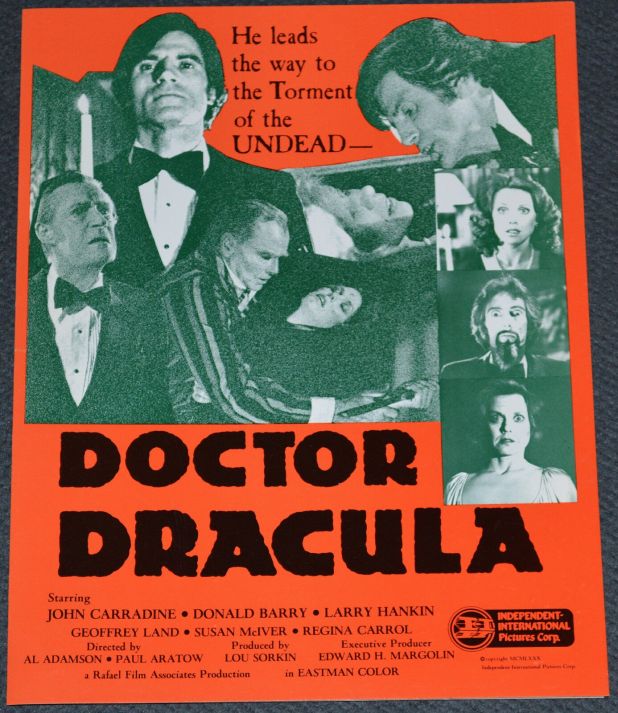
Al Adamson loved remixes more than any DJ. Doctor Dracula is a re-edited version of Paul Aratow’s Lucifer’s Women with new footage that was shot, re-edited it into the film and released to TV. Want to know how goofy this movie is? Anton LaVey is listed as a consultant.

Dr. John Wainright (Larry Hankin) was once an academic but now is an illusionist who believes that he is the reincarnation of Svengali. His publisher, Sir Stephen Phillips (Norman Pierce) tells him that he is also reincarnated and the leader of a Satanic cult known as the Society of the Bleeding Rose. Stephen explains to John that he must refill the cult’s psychic energy through human sacrifice. He must place his soul into someone else’s during a murder/suicide during a simultaneous orgasm.

This sounds like a lot of work.

Well, that was the story of Lucifer’s Women, a film packed with sex, violence and nudity. I mean, Paul Thomas was in it. How does it get to air on TV?

Enter Sam Sherman and Al Adamson.

Now, Svengali is battling the reincarnation of Dracula, Dr. Gregorio (Geoffrey Lund) and we have another Satanic cultist, Hadley Radcliff (John Carradine!) also in the plot. Dracula has a victim, who you knew had to be played by Regina Carrol. Love interest Trilby (Jane Brunel-Cohen) from the original film is nearly gone and they even got Hankin back to do voice-overs to try and explain it.

It’s exactly the mess you knew it had to be, but come on. You should know what you’re in for by now.

NEON EAGLE VIDEO BLU RAY RELEASE: Kill Butterfly Kill (1983) and American Commando (1987)

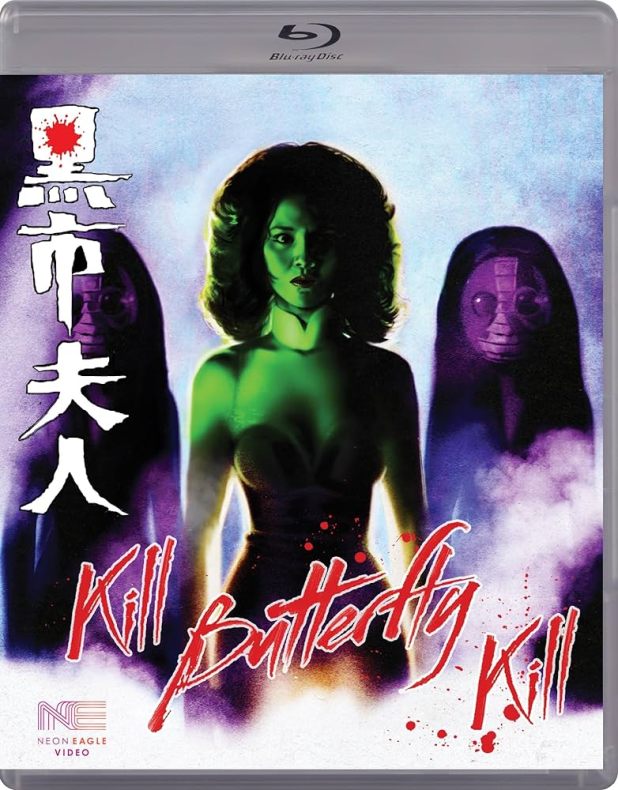
Kill Butterfly Kill: Years after being assaulted by five men, Tang Mei-Ling (Juliet Chan) — or Donna, depending on the language you choose — hunts them down one by one, joined by Richard, a retired hitman (“Tattooed Ma” Sha) and several of her girlfriends. She’s spent six years to get bloody revenge and she’s going to take her time getting it.

The wild thing is that there are times that this is a rape revenge movie, other times when it’s an action film and then moments when it gets surreal. Fog rolls in, neon lighting takes over and Tang Mei-Ling becomes a female demon, purring that she wants to kill. The entire screen itself gets taken over and moves and bends and distorts as we become part of her destruction of these evil men.

Also known as Underground Wife, this is a Taiwan black movie that shares exploitation themes and action with socially conscious themes. That said, these films never forget that they are scummy.

American Commando 6: Kill Butterfly KillIFD is a company that you probably know. They had Joseph Lai, Godfrey Ho and Thomas Tang make hundreds if not thousands of similar titled ninja movies that combine other films with hastily shot gunplay or martial arts battles.

It’s like watching two movies that only have one moment where they meet.

Three years ago, special agent Aaron Nolan (Mark Miller) broke up the Garvino gang. But now the brutal Garvino (Mike Abbott) is on the street again. Aaron and his partner Rick Hammet set out to neutralize him. Meanwhile, Donna is a nightclub owner who is their only ally in the war against Garvino, spurred on because years ago, five of his men raped her. Now, teaming with Richard, she’ll get the revenge she needs while Arron goes after his target.

This feels like the two movies are nearly decades apart, much less the quality of the film stock, so in no way does it ever appear to be seamless. And isn’t that how we want it?

If you know IFD movies, you know that the music is always stolen from incredible places. This one features “Arca” by Richard Norris, “Divine Particles” by Takkra and “Oxygene Part 1” by Jean-Michael Jarre. IFD loves some Jean-Michael Jarre.

The Neon Eagle Video release has a new 4k restoration from the best surviving elements of the export English language cut of the film prepared by IFD Films. It also has the Mandarin edit — Underground Wife — and a 4K scan of the IFD remix American Commando 5: Kill Butterfly Kill.

All of these various versions of this unique film are here making their official U.S. home video and worldwide blu ray premieres.

Extras include audio commentary by Kenneth Brorsson and Paul Fox of the Podcast On Fire Network for Kill Butterfly Kill and — worth the price of the entire thing — an IFD trailer collection.

You can buy this from MVD.

You can learn more at the Neon Eagle Video website.

SUPPORTER DAY: Aphrodesia’s Diary (1983)

Shot in 1979 but not released until 1983, this was directed by Gérard Kikoïne but had Radley Metzger as an advisor. It was filmed at the same time as Metzger’s 1979 movie The Tale of Tiffany Lust, which also had French actresses Dominique Saint Claire and Morgane in the cast and uses cinematographer Gérard Loubeau.

Adrianne (Dominique Saint Claire) finds herself working as a non-performer in adult movies and somehow gets a ticket to New York. There she meets a gambler who introduces her to sexual freedom, as if she were Emanuele, but not Black Emanuelle. Of course, with those risks comes danger, as always lurks in these golden age movies which were less about the act and more of the reasons before.

Vanessa Del Rio is in this as a therapist and Désirée Cousteau as Cassandra, an erotic spirit who guides our heroine through her adventures, which at the end take her back home to a committed relationship, which is an odd close for a Radley Metzger movie, but who am I to judge?

Gérard Kikoïne also made Dragonard and Master of Dragonard Hill for Cannon, as well as Edge of Sanity and Buried Alive, the 1990 one with Donald Pleasence, John Carradine, Robert Vaughn and Ginger Lynn.

Imps* (1983)

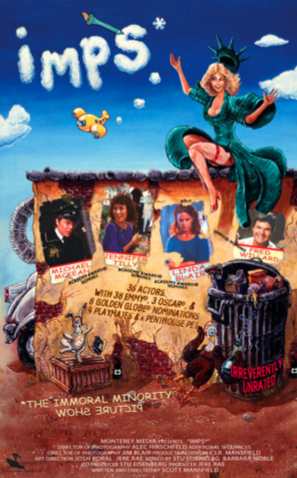
Immoral Minority Picture Show was made in 1983 and went unreleased until 2009. It’s very much a Kentucky Fried Movie but probably closer to Movie 43.

Director and writer Scott Mansfield — yes, the same director as Deadly Games — put together this sketch-filled movie and sure, most of them aren’t funny, but there’s a great slasher sequel parody called Don’t Scream On My Face that has a great part for Linda Blair. There’s also a Lite Blood ad with Count Dracula (James Sikking) talking about how he needs to cut the fat. And John Carradine introduces great moments in Polish history, which means he sits in silence. How about a slasher called The Hanukah Horror?

None of these jokes are funny but I can’t hate a movie that includes such a cast. I mean, David L. Lander and Michael McKean as Third Reich soldiers? Marilyn Chambers as Marilyn Chambers? Colleen Camp is in this! Barbara Bosson (did she and Sikking ever talk about this on Hill Street Blues?)? Georg Stanford Brown from Roots and the former husband of Tyne Daly? Sybil Danning? Juila Duffy? Meadowlark Lemon and Jimmie Walker as the first black men on the moon? Deborahg Harmon? Sunny Johnson (Flashdance)? Audrey Landers from Dallas? Kim Lankford from Knots Landing? Squire Fridell (Ronald McDonald in Mac and Me)? P.J. Soles!?! Wendi Jo Sperber!?! Jennifer Tilly? James MacKrell (Lew Landers in Gremlins and The Howling)? Ed Marinaro (did he also discuss this movie on the set of Hill Street Blues?)? Diana Muldaur? Newhart‘s William Sanderson and Peter Scolari? Bruce Weitz (can I make that Hill Street Blues joke again? I can.)? Fred Willard? Keenan Wynn?!? Jere Rae Mansfield, who called herself “the blonde that died on every Aaron Spelling show?” Marie-Alise Recasner (Island of Blood)? Miguel A. Núñez Jr. (Spider from Return of the Living Dead)? Erika Eleniak? Adult director Paul Thomas? Karen Lorre? Sniglets Rich Hall?

Yes, it’s not good, but I loved it.

You can watch this on Tubi.

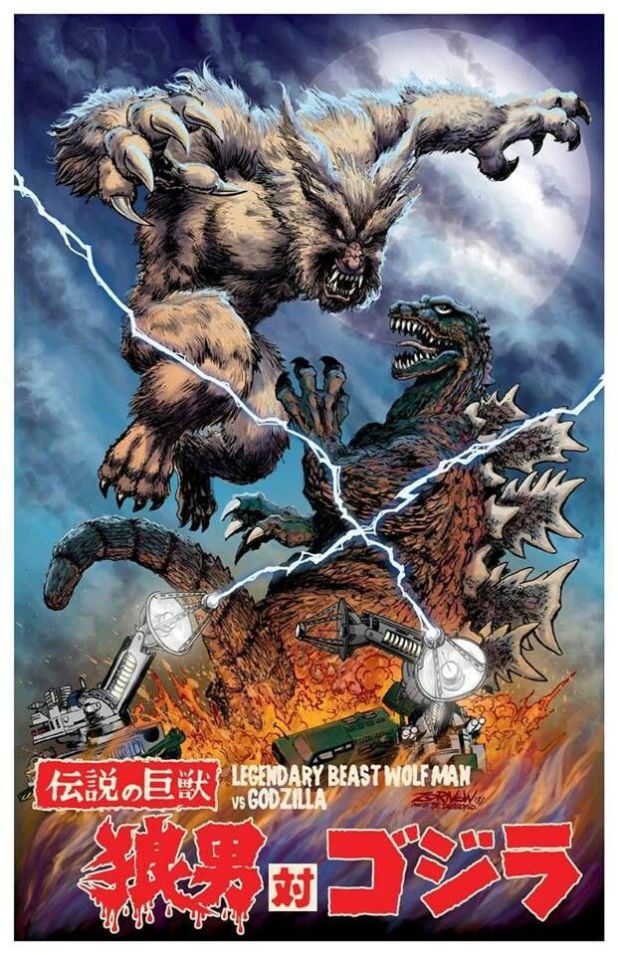
THAN-KAIJU-GIVING: Legendary Giant Beast Wolfman Vs. Godzilla (1983)

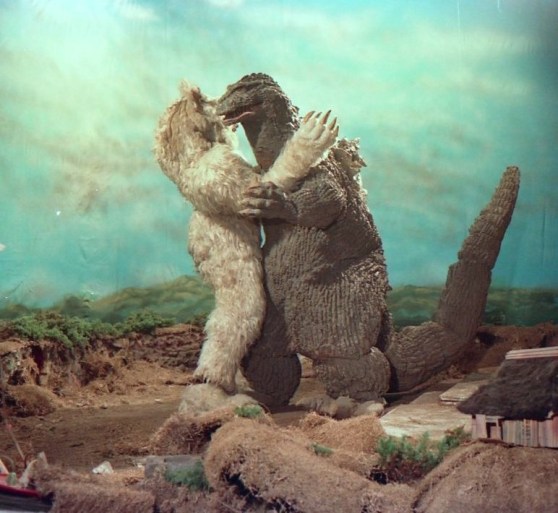
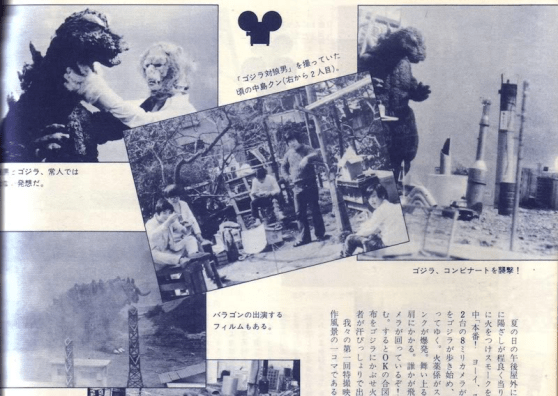
Wolfman vs. Godzilla (Densetsu no Kyojū Ōkami Otoko tai Gojira or Legendary Beast Wolfman vs. Godzilla) is an incomplete fan film that was directed by Shizuo Nakajima. Nakajima also made Wolfman vs. Baragon, another fan film that he made with the assistance of several former Toho employees. Though filming began in 1983, it is unknown if the film is complete or will ever be released.

During his tenure at Toho, Nakajima served as a production assistant on Godzilla vs. Mechagodzilla and Terror of Mechagodzilla. He still updates his Facebook page with clips of the movie.

With costumes by  Fuyuki Shinada, who would go on to design the monsters in Godzilla, Mothra and King Ghidorah: Giant Monsters All-Out Attack, there was ten hours of footage shot for this movie. It was unknown until a panel at a Godzilla convention in 2012.

Images from Wolfman vs. Baragon.

As far as can be told from the story, a werewolf becomes irradiated and grows to daikaiju size. Godzilla awakens from the North Pole and the two creatures fight. Godzilla may be a more out of control monster such as he was in the early Showa series but is the hero.

You can see the footage that exists here:

References:

2022 Scarecrow Psychotronic Challenge Day 10: The Prize of Peril (1983)

10. “I GOT YOU, BABY GIRL”: A post-apocalyptic film with some emotional heft.

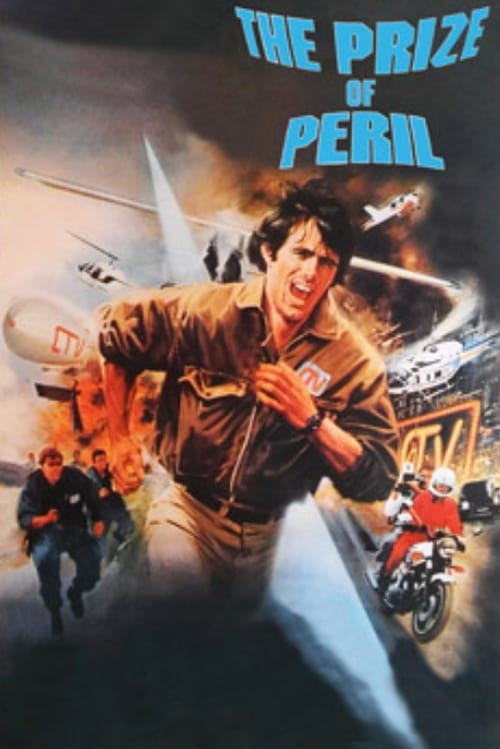
The Prize Of Peril is a game show that everyone in France is crazy about. The rules are pretty simple. A helicopter takes contestants a mile away from the studio and they’re given four hours to get back. If they do, they win a million. But ah, the show also has five hunters who can kill the contestants. No one has ever won. Frederick Jacquemard (Gerard Lanvin) thinks he can do it.

Based on a story by Robert Sheckley and not Richard Bachman AKA U of M graduate Steve King, whose The Running Man came out only one year before, Le Prix du Danger is the second adaption of the story after the German made for TV film Das Millionenspiel.

Directed by Yves Boisset, The Prize of Peril has a great host in the middle of all of this craziness, Frédéric Mallaire (Michel Piccoli), which is also something that, you know it, shows up in The Running Man.

What the Arnold movie does much better is explain the rules of the game show. And have characters who have meaning and that you care about. Frederick seems like someone we shouldn’t like, the journalist character seems like she’s going to stop the show and the other contestants barely register.

But Yves Boisset thought that this movie and Twentieth Century Fox’s films were real close. Too close. He thought the screenplay was the same one, in fact. He sued and IMDB claims that the paperwork for the case was lost in a plane crash in the New York bay, which yes, is IMDBS.But nonetheless, it may have taken eleven years, but Boisset won.

Maybe because the novel The Running Man is nothing like the film.

Looking for more game show movies? Try The 10th Victim, which was also written by Sheckley. I also recommend Warriors of the Year 2072 and Endgame.

USA UP ALL NIGHT MONTH: Private School (1983)

EDITOR’S NOTE: Private School was on USA Up All Night on October 1, 1991; May 29, 1992; May 29, 1993; January 7 and July 23, 1993; April 15 and July 14, 1995; August 2, 1996 and May 23 and August 7, 1997.

I honestly can’t get my head around the fact that the same Noel Black who made the intense and upsetting Pretty Poison also made Mischief and Private School. Life’s odd.

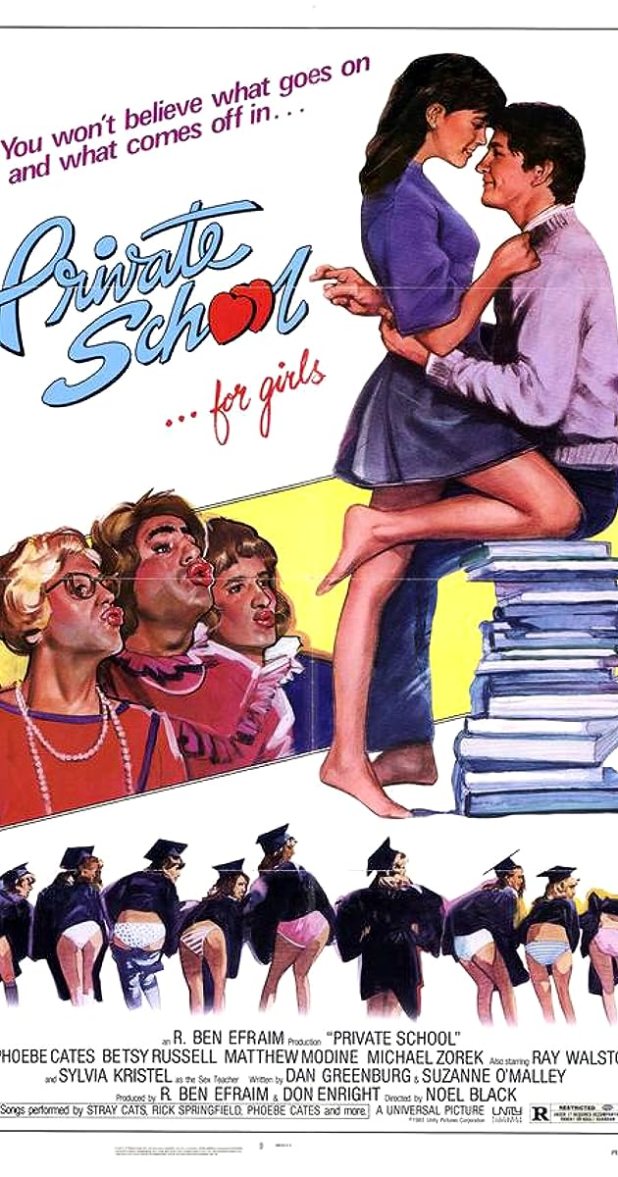
Christine “Chris” Ramsey (Phoebe Cates) and Jim Green (Matthew Modine) keep trying to lose their virginity while his friend Bubba Beauregard (Michael Zorek) somehow hooks up with Betsy (Kathleen Wilhoite) and Jordan Leigh-Jensen (Betsy Russell). Chris and Jordan hate each other over Jim too, so there’s that.

Once Private Lessons did well, this was easy to get made. It doesn’t have anything to do with that movie other than bring back R. Ben Efraim as a producer, Dan Greenburg as screenwriter and that movie’s star Sylvia Kristel, who is reduced to playing a cameo as a new character.

Speaking of cameos, Martin Mull is a druggist, Paula Abdul is a cheerleader — she also choreographed the routine — and Brinke Stevens is in the shower scene.

But this is, at heart, a movie where the guys dress as girls Bosom Buddies style to sneak into the girl’s dorm and where sex acts are played over loudspeakers to humiliate people. The Cherryvale Academy for Women and the Freemount Academy for Men basically exist so that horny young men can look at bare breasts. The women are unfulfilled, the men go home to masturbate, such would be 1983.

At least this has a fun soundtrack. “You’re Breaking My Heart” by Harry Nilsson, “The American Girl” by Rick Springfield, “Rock This Town” by The Stray Cats, “Nasty Girl” by Vanity 6, “I Want Candy” by Bow Wow Wow, “Da Da Da” by Trio, “Li’l Red Riding Hood” by Sam the Sham and the Pharaohs and Phoebe Cates, performing two songs and not just starring in the movie.

Efraim was a big believer in market research and literally tested every single thing about Private School down to the title. He loved the word private in his movies and he also produced Private Resort.

USA UP ALL NIGHT MONTH: Staying Alive (1983)

EDITOR’S NOTE: Staying Alive was on USA Up All Night on September 16, 1995.

Saturday Night Fever producer and writer Robert Stigwood and Norman Wexler dreamed of a sequel to the film pretty much since the original was released. What they came up with, Staying Alive, was a script that John Travolta disliked. It was too much of a downer and he couldn’t be convinced to do the film for several years.

Finally, after four years of this, Travolta and Stigwood met. The star had an idea. What if Tony Manero became a dancer on Broadway? And what if he was a big star? Wexler thought that it would be better if Manero ended up in the chorus and the two reached an agreement to start the film.

Travolta had just seen Rocky III and wanted the same energy for Staying Alive. Paramount got Sylvester Stallone on board, Travolta told him his idea of the happy ending and toned down the rawness of the original film.

What emerged was…well, whatever this movie is.

Tony Manero was once the king of 2001 Odyssey, ruling the disco dance floor. Now, he lives in poverty and works on his dream of being in a modern dance musical. When he isn’t teaching or dancing, he’s a waiter that’s constantly beset upon by beautiful women. Ah, the sad life of Tony Manero — constantly getting laid and dancing his heart out.

Our hero has changed — moving away from Brooklyn has matured him somewhat and toned down the levels of profanity he used to freely toss around. But he’s still horrible to women, particularly his dancer and rock singer girlfriend Jackie (Cynthia Rhodes, Tina Tech from Flashdance and Penny from Dirty Dancing; she’s also in Xanadu, but let’s cut her some slack). He can go after anyone, but she has to be his alone. Speaking of guys that surround Jackie, Richie Sambora and Frank Stallone play in her band.

Tony’s really into Laura (Finola Hughes, who was nominated for both the Worst New Star and Worst Supporting Actress Razzies for her role in this film; she’s also in The Apple, pretty much damning her soul to bad dance movie hell for all eternity). He pursues her right into a one night stand and can’t understand why that’s all it ends up being. She replies, “Everyone uses everybody.”

Jackie and Tony break up just in time for the two of them — and Laura — to try out for the biggest dance musical to ever hit Broadway — Satan’s Alley. They get small parts and our villain gets the lead. Look for Patrick Swayze as one of the other backup dancers.

This leads Tony into his very own walkabout spirit quest, where he takes the 16 mile walk from Manhattan to Bay Ridge. The 2001 Odyssey is now Spectrum, a gay club, and this makes him realize how much his life has changed. He apologizes to his mother for how he was. She tells him that being so selfish is how he escaped a dead-end life. Of note, Donna Pescow was to return in the audience of Tony’s Broadway show and Tony’s father (Val Bisoglio) filmed scenes that were deleted. Now, the film implies that he is dead.

Tony and Jackie get back together, with her helping him work hard and take over the vacant lead male role. While he and Laura openly hate one another, they have as much chemistry dancing vertically as they once did horizontally. Tony takes things too far on the sold out opening night and kisses her at the end of the first act; she responds by slashing at his face.

Backstage, the director flips out on Tony and Laura tries to lure him back into bed. The second act is everything of the 1980s — fog, lasers, glitter, silver lame and probably metric tons of white flake. Our hero throws away Laura at the end and goes wild with his very own solo dance before she jumps back into his arms to a standing ovation. He reunites for good with Jackie and celebrates as only he can — by recreating the strut from the beginning of Saturday Night Fever.

Despite being a critical failure — that’s putting it mildly —  Staying Alive was a commercial success. The film opened with the biggest weekend for a musical film ever with a gross of $12 million dollars, finally earning $127 million on a $22 million budget.

I have my own theory on this film: it’s a Jacob’s Ladder situation.

Some time after Saturday Night Fever, Tony died. As dance was the most important thing in his life, his limbo — the time between heaven and hell — is spent trying to get a role as a dancer. The play Satan’s Alley is quite literally the place he could go to, if he makes the wrong choice. His apartment building is filled with other dead people; his life of constant temptation is the devil trying to convince him to follow him and give up on purity, just as Satan once led his brother Frank Jr. to renounce the priesthood.

Tony’s walk back to his hometown is literally a journey to the land of the dead — his mother is the one who has passed on and that’s why she can now forgive him. 2001 Odyssey, once a place full of life, has now become Tony’s worst fear, a loss of his masculinity. The place where his racist, gay bashing friends once called home has become their hell.

When Tony dances on to the Broadway stage, he must choose — heaven or hell. Or, as he does, making one’s own choice. He tosses Laura — the scarlet woman, the temptress — down to joyously dance and realize his full potential. He offers a hand in forgiveness to her before realizing his one true love — no, not Jackie. Himself. He struts down the street and on his way to heaven, which is embodied in the alpha and omega of Saturday Night Live and Staying Alive as that strut, down the street, to the Bee Gees.

Sometimes, a movie is so bad that you have to invent your own mythology to get through it. This, obviously, would be one of those films. Just don’t ask me to explain that Stallone cameo in the beginning.