CBS LATE MOVIE: Falcon’s Gold (1982)

EDITOR’S NOTE: Falcon’s Gold was on the CBS Late Movie on May 1 and August 26, 1987.

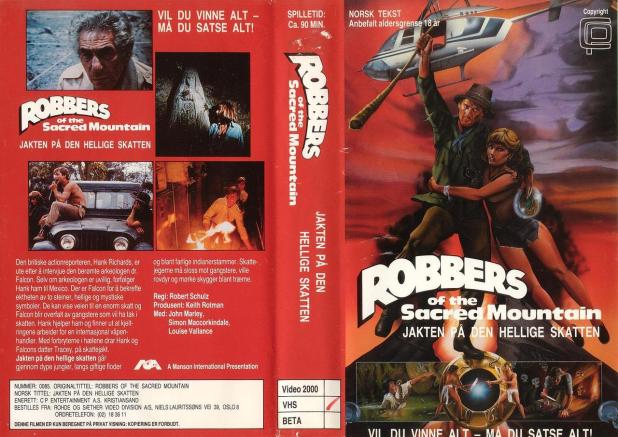
This played on the CBS Late Movie as Robbers of the Sacred Mountain, which is very much a “we have Raiders of the Lost Ark at home” title. Made for Showtime, this film was the very first TV movie produced for cable TV.

They say it’s based on Sir Arthur Conan Doyle’s Challenger’s Gold, but if Indiana Jones hadn’t been a hit, I doubt it would have been made.

Reporter Hank Richards (Simon MacCorkindale, Manimal) and Professor Christopher Falcon (John Marley) learn that a meteorite with cavite in it has crashed to Earth. If the wrong people find it, they could make a laser weapon. Joined by the professor’s granddaughter Tracey (Louise Vallance) and jungle guide B.G. Alvarez (Blanca Guerra, Santa Sangre), they head to South America to find a fertility idol, which ties into this, trust me, and leads to them battling the forces of Ivar Murdoch (George Touliatos).

This is the only movie that Bob Schultz directed, but he was a technical director on several TV shows like Three’s CompanyThe Ropes and the TV special Telly…Who Loves Ya, Baby? It was written by Olaf Pooley (Crucible of HorrorThe Godsend) and Walter Bell.

If you want more Raiders ripoffs, let me know.

Sizzlin’ Summer of Side-Splitters 2025: Zapped! (1982)

July 7-13 Teen Movie Hell Week: From the book description on the Bazillion Points website: All-seeing author Mike “McBeardo” McPadden (Heavy Metal Movies) passes righteous judgment over the entire (teen movie) genre, one boobs-and-boner opus at a time. In more than 350 reviews and sidebars, Teen Movie Hell lays the crucible of coming-of-age comedies bare, from party-hearty farces such as The Pom-Pom Girls, Up the Creek, and Fraternity Vacation to the extreme insanity exploding all over King Frat, Screwballs, The Party Animal, and Surf II: The End of the Trilogy.

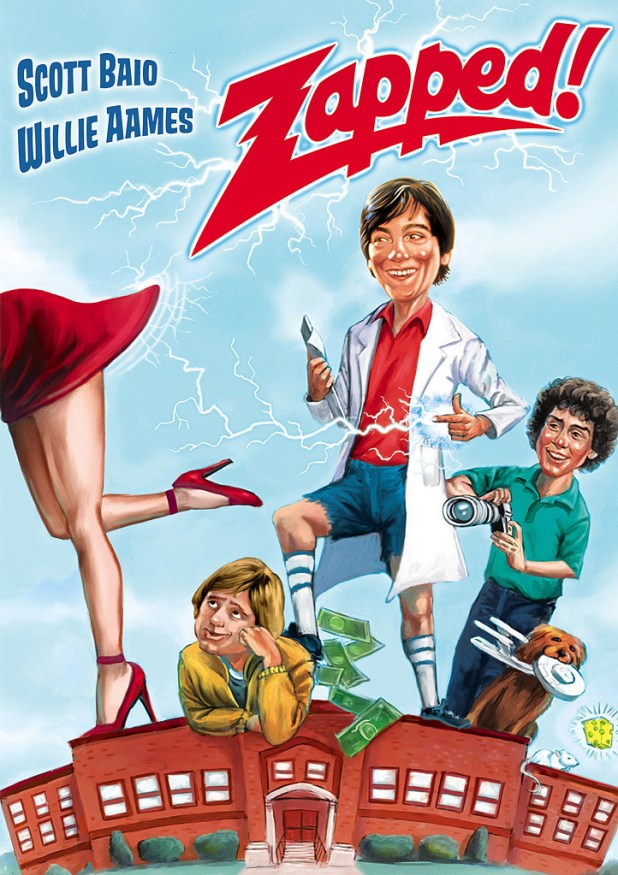
Zapped is not a feel-good movie, especially as we realize that Scott Baio and Willie Aames grew up to be right-wing and super religious, respectively. Here, they turn the act of getting mental powers into the chance to torment people, and if not sexually harass, then outright sexually molest women.

Barney Springboro (Baio) wants to do scientific experiments. Peyton Nichols (Aames) wants to ball, starting with school administrator Connie Updike (Hilary Beane). Peyton is asked by yearbook editor Bernadette (Felice Schachter) to take pictures of Barney in front of his GMO orchids — again, evil — an accident causes the mice food to be ingested as a gas, and Barney gets the telekinesis, the ability to move things with his mind.

Everyone has a crush on Jane Mitchell (Heather Thomas), who has a college boyfriend, so when she crushes Barney’s dreams again, he’s able to rip the buttons off her top and show off her bra, which is a crime. He also torments his mother (Marya Small) with a ventriloquist dummy that he can control. Is he the Carrie of this or the bullies who abused her?

More crimes: Causing Jane’s college guy, Robert Wolcott (Greg Bradford), to lose a drinking contest, and then Peyton seducing her, taking photos of her with a hidden camera that he sells at graduation. There’s also Barney scaring away two priests by pulling off Exorcist ripoff tricks.

Principal Walter J. Coolidge (Robert Mandan, Chester Tate on Soap) ends up having public sex with another older person, Rose Burnhart (Sue Ane Langdon, the only actor to return for Zapped Again!), and Scatman Crothers, Eddie Deezen and LaWanda Page all show up.

There wasn’t enough nudity in this, so supposedly they sent the crew back to shoot more nude scenes. The filmmakers used a body-double for Heather Thomas’ nude scenes, but she filed a complaint when they pasted her head on another nude actress. That’s why there’s a disclaimer that says, “A double was used for Miss Thomas in her nude scene and in the photograph.”

Jewel Shepard, a girl in a car in this, had no such complaints after Barney’s mental male gaze power tore her top off.

As if that wasn’t sad enough, Felice Schachter skipped her prom to film the prom scene.

This was directed by Robert J. Rosenthal, who wrote The Pom-Pom GirlsThe Van and Malibu Beach, which he also directed. He co-wrote this movie with Bruce Rubin, who also wrote Blood Rage.

You can watch this on Tubi.

CBS LATE MOVIE: I, Desire (1982)

EDITOR’S NOTE: I, Desire was on the CBS Late Movie on August 5 and 23, 1988..

When you see the name John Llewellyn Moxey on the credits of a movie, you know you’re getting into something extraordinary. Just look at The House That Would Not DieA Taste of EvilThe Night StalkerNightmare In Badham CountyDeadly Deception and, well, just about everything he did. I didn’t even mention The City of the Dead and Psycho-Circus!

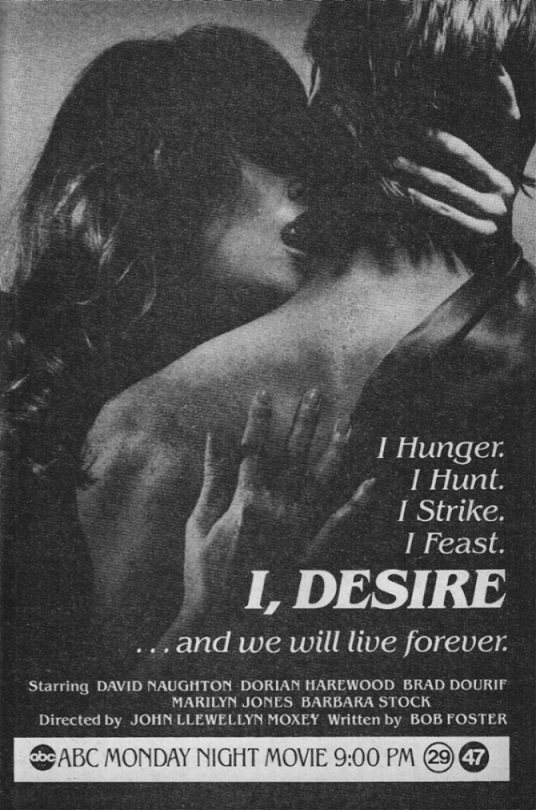
Originally called I, Desire and airing November 15, 1982 on ABC, who knew this little vampire film would be amongst the best ones I’d find for our vampire week? There’s a great cast — David Naughton from An American Werewolf In London makes for a fine lead, as well as Brad Dourif as a priest, Barbara Stock as the bewitching vampire, Dorian Harewood (he was in Sudden Death!) as a cop, Marilyn Jones as Naughton’s fiancee and even an appearance from Not Necessarily The News‘ Anne Bloom (or Frosty Kimelman in that long-lost HBO program).  Oh yeah — and Marc Silver, who was the guitarist in Ivan and the Terribles, the ill-fated band in Motel Hell.

There are some great twists and turns in this one, as well as an incredible vampiric apartment at the end that I wish I could live in. I’ll assume it’s just a studio set so that I don’t get sad that I can never go back in time and see it for myself.

You can watch this on YouTube.

WEIRD WEDNESDAY: Boardinghouse (1982)

The first horror film in history to be shot on video, Boardinghouse is… well, there really isn’t anything else like it. Somehow, this movie seems at once ten minutes and ten hours long, taking you on a journey into — man, I’ve no idea how we got here or where we’ve been, but we really went somewhere.

Back in 1972, Dr. Hoffman and his wife — who one assumes were doctors of the occult — died in their Mulholland Drive home on the night of their anniversary, committing double suicide in front of their daughter Debbie, who had a nervous breakdown. Everyone who has lived in the house since has died. And now, a decade later, the nephew of the last owner of the home, James Royce, puts out an ad looking for single women — beautiful women with no ties — to move in with him — he plans on you know, studying the occult while they’re there — so Sandy, Suzie, Cindy, Gloria, Pam, Terri and — you know it — Debbie all move in.

To say this movie has a disjointed narrative is like saying that you’re reading this on a website.

James is also trying to get with Victoria, a singer, and shows her how she can use her own latent telekinetic powers. After a dream in which she is dragged to the grave of Dr. Hoffman, she begins to grow jealous of the women of the boardinghouse who are all potentially sleeping with the occult master that she has come to love.

Oh man, before you know it, people are throwing cake at one another, women are clawing their eyes out, Debbie revealing herself as the psychic monster who killed both her parents after sleeping with her father, Jim shows up with less clothes in every scene and the end credits look like they came from a Apple 2E.

Directed by, written and starring John Wintergate, this is the kind of movie that defies description, despite my writing so many words about it already. It has a lead actress with one name — Kalassu. And she’s the wife of Wintergate and their children show up. And then there are monsters, hallucinations and bloody showers. And the cut I watched has a running time of 2 hours and 38 minutes.

This movie was also shot in Horror-Vision, which is a swirl of color and a glove, and it’s supposed to warn you when something scary happens, but nothing like that seems to happen, and man, they blew this up on film and played it in theaters, and Wintergate must have quite the thong collection.

You can watch this on Tubi.
WEIRD WEDNESDAY: Bloodtide (1982)

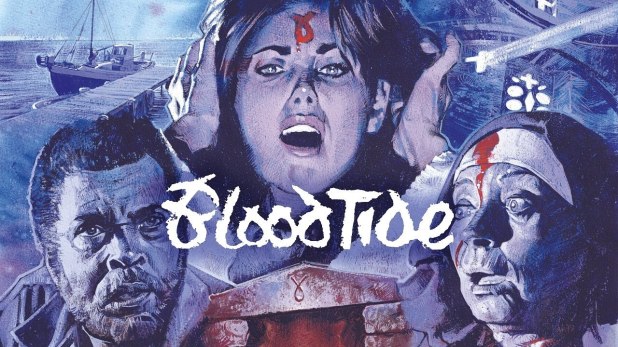
When you see the names Brian Trenchard-Smith and Nico Mastorakis listed as producers, you know that you’re probably getting into something good. Also known as Demon Island, this film was directed by Richard Jefferies, who is perhaps better known for the films he wrote, such as Scarecrows and Cold Creek Manor. He has directed only one other film, the 2008 TV movie Living Hell.

It’s funny, when I discussed this movie earlier today with Bill from Groovy Doom, he referred to it as “the monster movie with no monster.” That’s an apt description.

It’s also about a treasure hunter named Frye (James Earl Jones) whose underwater scavenging brings back an ancient sea monster that demands virgin blood.

Meanwhile, Neil and Sherry (Martin Kove and Mary Louise Weller, who appeared in Q The Winged Serpent the same year as this movie) have come to the island looking for his missing sister Madeline (Deborah Shelton, who also sings the song over the end credits with her then-husband Shuki Levy). Plus, Lydia Cornell stops hanging out with Cosmic Cow on Too Close for Comfort and shows up as Jones’ girlfriend.

Inexplicably, Lila Kedrova from Zorba the Greek and Jose Farrar — well, he’s less of a surprise as Jose may have been the first actor to win the National Medal of Arts, but he’s also in spectacular junk like The SentinelBloody Birthday and The Being — both appear.

Arrow’s write-up promised “blood, nudity and beachside aerobics.” This delivered, as well as some great dream sequences and moments where beachfront rituals seem to go on forever. That said, I had a blast with this movie, as any film that features Martin Kove skipping around the waves, showcasing a miniature engine, while the ladies go wild, and James Earl Jones is involved, will hold my attention.

WEIRD WEDNESDAY: Ator the Fighting Eagle (1982)

Let’s list the reasons why this movie made it to our site:

Joe D’Amato directed it. Where do we even start with his filmography? Emanuelle and the Last CannibalsAntropophagusEndgame?

It’s an Italian ripoff of Conan the Barbarian, which means it will be better, worse and more inventive than the movie that inspired it.

It’s written by Michele Soavi (StagefrightThe ChurchThe SectCemetery Man)!

Once, Ator was just a baby, born with the birthmark that prophesied that he’d grow up to destroy the Spider Cult, whose leader Dakar (a pro wrestler who appeared in Titanes en el Ring against Martín Karadagian) tries to kill before he even gets out of his chainmail diapers.

Luckily, Ator is saved and grows up big, strong and weirdly in love with his sister, Sunya. It turns out that, luckily, he’s adopted, so this is only morally and not biologically upsetting. His father allows them to be married, but the Spider Cult attacks the village and takes her, along with several other women.

Ator trains with Griba, the warrior who saved him as a child (he’s played by Edmund Purdom, the dean from Pieces!). What follows are pure shenanigans — Ator is kidnapped by Amazons, almost sleeps with a witch, undertakes a quest to find a shield and meets up with Roon (Sabrina Siani, Ocron from Fulci’s batshit barbarian opus Conquest), a sexy blonde thief who is in love with him.

Oh yeah! Laura Gemser, Black Emanuelle herself, shows up here too.

Ator succeeds in defeating Dakkar, only to learn that the only reason that Griba mentored him was to use him to destroy his enemy. That said, Ator defeats him too, leaving him to be eaten by the Lovecraftian-named Ancient One, a monstrous spider. But hey, Ator isn’t done yet. He kills that beast, too!

Finally, learning that Roon has died, Ator and Sunya go back to their village, ready to make their incestual union a reality. Or maybe not, as she doesn’t show up in the three sequels, The Blade MasterIron Warrior and Quest for the Magic Sword.

Ator is played by Miles O’Keefe, who started his Hollywood career in the Bo Derek vehicle Tarzan the Ape Man, a movie that Richard Harris would nearly fist fight people over if they dared mention it. He’s in all but the last of these films, and while D’Amato praised his physique and attitude, he felt that his fighting and acting skills left something to be desired.

Ator the Fighting Eagle pretty much flies by. It does what it’s supposed to do — present magic, boobs, sorcery and swordfights — albeit in a PG-rated film.

You can watch this on Tubi.

APRIL MOVIE THON 4: Cuando calienta el sol… vamos a la playa (1982)

April 16: Filmirage — Give in to the sleaze and write about a Joe D’Amato produced movie. There’s a list here.

Directed and written by Mino Guerrini (The Third Eye), this is the story of Stefano (Alessandro Freyberger, The Wild Beasts), a mechanic who dreams of being a boxer. It’s also a love story, as he falls for Giulia (Claudia Vegliante).

This is totally Lemon Popsicle in Italy and I love it, because it’s filmed by Aristide Massaccesi and has Michele Soavi as an assistant director. As if that’s not enough, Bob — Giovanni Frezza  — is in the cast.

I have no idea of anyone other than me that would care even the least bit about this movie, but such is my love for Filmirage. This obviously never came to America, where its translated title may have been When the Sun Shines…Let’s Go to the Beach but probably would have been given an insane name like Beyond the Sun or The Punch of Love.

You can watch this on YouTube.

MOVIES THAT PLAYED SCALA: Koyaanisqatsi (1982)

Thanks to the British Film Institute, there’s a list of films that played Scala. To celebrate the release of Severin’s new documentary, I’ll share a few of these movies every day. You can see the whole list on Letterboxd.

The first movie in Godfrey Reggio’s Qatsi trilogy — followed by Powaqqatsi and Naqoyqatsi — this combines Ron Fricke’s cinematography and Philip Glass’s score to create a feeling of zen or restlessness, depending on how it is viewed. There are no words as Reggio said, “…it’s not for lack of love of the language that these films have no words. It’s because, from my point of view, our language is in a state of vast humiliation. It no longer describes the world in which we live.” Instead, the Hopi word koyaanisqatsi is all we know, which means “life out of balance.”

Reggio and Fricke met when the director was working on a media campaign for the Institute for Regional Education and the American Civil Liberties Union. These ads were about how technology controls the world and invades our privacy. The TV spots were so popular people called stations to see when they would air again; it was also successful in that it got ritalin eliminated as a behavior controlling drug in New Mexico schools. Afterward, with just $40,000 left in his budget, Fricke told Reggio that they should make a film.

Shot with a mix of styles and media — 16mm, 35mm made with a 16 mm zoom lens shot on to 35 mm film with a zoom extender, time lapse photography, captured stills in New York’s Time Square with chemicals changing up the results, the New York traffic and congestion time lapse work of cinematographer Hilary Harris and even images added of the Great Gallery at Horseshoe Canyon by Francis Ford Coppola, who became a champion of the movie —  Koyaanisqatsi is about giving you an experience. The director has even said that what the movie is about is up to you. It ends with these three prophecies:

  • “If we dig precious things from the land, we will invite disaster.”
  • “Near the day of Purification, there will be cobwebs spun back and forth in the sky.”
  • “A container of ashes might one day be thrown from the sky, which could burn the land and boil the oceans.”

You can watch this on Tubi.

SEVERIN BLU RAY RELEASE: Scala!!! shorts disc two (1982, 1986, 1988, 1989, 1990, 2024)

The third disc of Severin’s new Scala!!! Or, the Incredibly Strange Rise and Fall of the World’s Wildest Cinema and How It Influenced a Mixed-up Generation of Weirdos and Misfits blu ray set has several documentaries and some shorts that are worth the entire price of this release. You can buy it from Severin.

The Art of the Calendar (2024): Kier-La Janisse has created this look at the art of film programming and marketing. Starting with the first repertory cinema calendars in California and Chicago in the late 70s and early 80s, this expands to interview several film programmers, including Mike Thomas (founder of Strand Releasing), Kim Jorgensen (founder of Landmark Cinemas), Craig Baldwin, Chicago film historian Adam Carston and Mark Valen (programmer for the Scala).

Thanks to this age of physical media and streaming that we live in, small theaters like the ones featured in this film, are always in danger of going away. More than just a “things were better back then” view, The Art of the Calendar presents a strong reason for you to support the movie houses around you, particularly the non-corporate ones that need you in their audience.

Also: If you love graphic design and the art of selling movies, this is an essential watch.

Splatterfest Exhumed (2024): This documentary covers Splatterfest ’90, the notorious all-night horror festival held at London’s legendary Scala Cinema. Directed by Jasper Sharp with David Gregory as supervising producer, this gets into how this well-remembered weekend was put together by a teenaged Justin Stanley and how it was amazing that it even happened at all.

Splatterfest ’90 was the UK premiere of several movies and the showing of several favorites, including Combat Shock, Evil Dead II, Brain Dead, Rabid Grannies, Within the Woods, Henry: Portrait of a Serial KillerDocument of the DeadThe Laughing Dead, The Toxic Avenger 2 and Bride of Re-animator; promo reels for Maniac 2, Horrorshow and Hardware; as well as the opportunity to meet horror icons like John McNaughton, Greg Nicotero, Brian Yuzna, Buddy Giovinazzo, Roy Frumkes and Scott Spiegel.

What emerges is a combination of people extolling the virtues of just how this event brought so many together with the challenges of running just such a massive undertaking. You also get to hear from those who were in the audience, such as Graham Humphries, Sean Hogan and Severin founder David Gregory.

My favorite parts in this concern how in the middle of the night, bootleggers suddenly arrived to sell tapes of banned video nasties and how The Comic was presented as the first film from a “new Hammer,” which stopped when the audience nearly rioted during the movie. It was so bad that the organizers didn’t show Cold Light of Day, another film by director Richard Driscoll.

This is perfect for lovers of horror, as well as movie history. I had a blast with it and am sad that I couldn’t have been in the audience.

Maniac 2: Mr. Robbie (1986): A proof of concept for a sequel to Maniac that never happened, this was directed by Buddy Giovinazzo (Combat Shock) and written by Joe Cirillo and its star Joe Spinell.

Shot in a bar that Spinell frequented and filled with his friends, this was a concept featuring Spinell as Mr. Robbie, a drunken kid show host who is dealing with letter after letter from abused children. The only way that he knows to deal with them is murder. What’s strange is that this is the same plot — and nearly the same name for its protagonist — as An Eye for an Eye/The Psychopath, a movie that finds Mr. Rabbey attacking parents who beat their children.

You only get a few minutes of what may have been, but when I see the craggy face of Joe Spinell, I feel like life could be OK. In some other world, I’ve bought this several times and just got the UHD release of it, having to explain to my wife why I keep buying the same film so many times.

I adore that Giovinazzo did a commentary for this, explaining how it happened and some of the sleazier things that he learned about the cast and where this was filmed.

Horrorshow (1990): Director and writer Paul Hart-Wilden wrote the script for the little-seen — and great — movie Skinner. He also wrote Living Doll, but Dick Randall gave it to George Dugdale and Peter Mackenzie Litten to direct.

It’s got a simple story — a man tries to stay in a room only to learn that it’s still possessed by a demon that has already killed one person — but it has plenty of gore to make it stand out. Its creator is obviously a big horror fan and his commentary on working on this is quite interesting. Hart-Wilden is still working, directing the TV series 31 Days of Halloween.

Cleveland Smith: Bounty Hunter (1982): Directed by Josh Becker, who wrote it with Scott Spiegel, this is a little-watched short that has many of the players of the Evil Dead series, including Bruce Campbell as the hero, Sam Raimi as a Nazi and Robert Tapert as a native.

As you can tell, Cleveland Smith is pretty much Indiana Jones, down to being chased by a bolder, but he also gets caught in quicksand and is nearly killed by a dinosaur. He has a whip, just like Dr. Jones, but he also has a ventriloquist dummy and a special pair of pants known as the Waders of the Lost Park.

This is totally politically incorrect and as dumb as it gets. I mean that in the best of ways.

Mongolitos (1988): Director Stéphane Ambiel made this short that the Scala ad copy claimed “Taking ten minutes to do what John Waters achieved in ten years.” This is great for selling the movie, but it’s nowhere in Waters league. That said, it has something to offend everyone, including shooting up with toilet water, puking up a turd, pushing a transgender woman’s head into the bowl while taking her from behind while a nun teams up on her and then everyone eating feces with crackers. I can only imagine that some people will be horribly upset by this, but it’s made so goofily that you can’t help but laugh at it. Somewhere, staunchly British people are also upset that the French are doing a Monty Python sketch with poo eating.

The Legendary H.G. Lewis Speaks! (1989): Herschell Gordon Lewis is at the center of the Venn diagram of my life, someone who was a leader in my two obsessions: movies and marketing. Just hearing his voice makes me feel good about things, like everything is going to work out alright. When you see his older face and his wry smile, you may almost forget that he once used animal guts dumped in Lysol over and over again in the Florida heat to upset almost everyone before anyone even considered what a gore movie was.

This was filmed on October 4, 1989, when Lewis spoke at the Scala before Gruesome Twosome and Something Weird. Before he went on stage, he asked to be paid in cash. At once a gentleman in a suit and a carny lunatic, at the dual poles of juxtaposition, only he could wax so enthusiastically about fried chicken and trying to figure out how to get Colonel Sanders into one of his movies.

MOVIES THAT PLAYED SCALA: Blade Runner (1982)

Thanks to the British Film Institute, there’s a list of films that played Scala. To celebrate the release of Severin’s new documentary, I’ll share a few of these movies every day. You can see the whole list on Letterboxd.

I was ten years old when Blade Runner came out and it played theaters so briefly in my small hometown that I never got the chance to see it. Also, ten year olds didn’t get to see R rated films in 1982. So my first experience was reading the Archie Goodwin/Al Williamson Marvel Comics adaptation, a book of which I literally read until the cover came off.

I must have read this issue a thousand times.

Steranko cover!

I also asked my uncle, a librarian, for a copy of Philip K. DIck’s Do Androids Dream of Electronic Sheep? Perhaps a ten-year-old was not yet ready for the complexity of Philip K. Dick, but he never dumbed it down for me.

The first time I finally saw Blade Runner on HBO it was after a year of reading about the film in Starlog, obsessing over the comic book and the source novel, so my experience was so alien to anyone else that saw it in theaters in 1982.

For a movie seen as a failure — it made $41.6 million on a $30 million budget, so I have no idea how that is failure — this is a movie that literally changed the world and has grown to become our world.

And yet, this is a movie that has seven different versions thanks to all of the changes from studio executives. Even the voiceover, which was added by them, has star Harrison Ford reading the words as if he has no interest, perhaps hoping if they were bad they’d never be used.

The blade runner is former police officer Rick Deckard (Ford), who is charged by Gaff (Edward James Olmos) and Bryant (M. Emmet Walsh) with doing what he does best: hunting down robotic humanoids and retiring them. Now, he must stop four Nexus-6 replicants: Leon  Kowalski (Brion James), Zhora Salome (Joanna Cassidy), Pris (Daryl Hannah) and Roy Batty (Rutger Hauer).

Yet within this film noir story set in a neon-filled future straight out of a Moebius drawing, the real tale is about whether Rick and his lover Rachael (Sean Young) are humans or machines themselves. In fact, of all the characters, Batty is the most human of them all, a character of both deep menace and surprising tender thoughts.

Blade Runner arises from pain. Ridley Scott had left Dune and lost his brother in short order and wanted something to take his mind off life. Dick had no idea it was even being made, but his initial distrust was saved somewhat when he saw the script revisions and special effects footage. Ford and Scott also fought throughout.

Neither can agree if Deckard is human or replicant, even if they’ve made up.

I think about Blade Runner a lot. I think about Pris flipping across the room, how her face paint looks, how deadly these killing machines are with such grace. I think of Rutger Hauer ad-libbing “All those moments will be lost in time…like tears in rain” and caressing the dove. I remember the spinner police car and Deckard’s car that I had as a kid and played with constantly. And I wonder, does Gaff leave the silver unicorn after not killing Rachael as him telling Deckard to pursue his dream or is Deckard’s dream of the unicorn just one programmed into him?

Most of all, I’m so thankful for this movie because without it, I may not be so fascinated by Philip K. Dick, a person who I quote or reference every day. My uncle knew what he was doing.