CBS LATE MOVIE: Soggy Bottom, U.S.A. (1981)

EDITOR’S NOTE: Soggy Bottom, U.S.A. was on the CBS Late Movie on May 7 and October 14, 1987 and September 15, 1988.

Directed by Theodore J. Flicker (the creator of Barney Miller; he also wrote and directed Jacob Two-Two Meets the Hooded Fang) and written by Eric Edson, Stephen C. Burnham, Joy N. Houck Jr. (director of Creature from Black Lake and Night of Bloody Horror), Hal Harrison and Patrick Pittelli, this is about Jacon (Don Johnson) trying to build a hoverboat to impress Charlene (P.J. Soles).

Jack Elam, Brion James and Anthony James play the bad guys,. Ben Johnson, Dub Taylor, Anthony Zerbe, Lane Smith, Severn Darden and Lois Nettlejohn are the friendly citizens of this small town. There’s also a farting dog.

Otherwise, this is basic hicksploitation, but in a few years, Don Johnson would be a much bigger star.

WEIRD WEDNESDAY: Butcher, Baker, Nightmare Maker (1981)

William Asher was credited by many as inventing the TV sitcom. He brought Our Miss Brooks from radio to TV, directed 100 out of 179 episodes of I Love Lucy, produced and directed Bewitched (which starred his second wife Elizabeth Montgomery) and also had episodes of Make Room for Daddy, The Twilight Zone, The Patty Duke Show, Gidget, The Dukes of Hazzard and Alice on his resume. He even planned JFK’s inauguration ceremony along with Frank Sinatra.

He was also one of the leading beach party directors, with Beach PartyMuscle Beach, How to Stuff a Wild Bikini, Beach Blanket Bingo and Bikini Beach to his credit. Of this time in his life, he would say, “The scripts of the Beach Party films were sheer nonsense, but they were fun and positive. When kids see the films now, they can get some idea of what the ’60s were like. The whole thing was a dream, of course. But it was a nice dream.”

I tell you all this to set you up for one of the strangest films I’ve ever seen — imagine what that entails — and one that has stuck with me for years: Butcher, Baker, Nightmare Maker.

Originally, Michael Miller (Jackson County Jail) was set to direct this film. Still, he was replaced by Asher (he had also recently lost the job on The Eyes of Laura Mars to Irvin Kershner). He did direct the opening, however.

And what an opening it is!

Years ago, Billy (Jimmy McNichol, brother of Kristy, who is shirtless pretty much for the entire film) was sent to stay with his aunt Cheryl (Susan Tyrell, owning this movie like no one has ever owned a movie before). However, not only did their brakes give out, but a giant log beheads Billy’s dad, and the car goes off a cliff, where we see a photo of young Billy floating out into the water as the car explodes, floating, all of that, in the very first scene of the movie!

Now, Billy is a high school senior living with his aunt. He has a dream of playing basketball on a scholarship at the University of Denver, but Cheryl is having none of it. His school life isn’t much better, as his teammate Eddie (Bill Paxton!) is jealous of his closeness to their coach Tom Landers (Steve Eastin, Field of Dreams). But there’s a bright silver lining: the school’s newspaper photographer, Julia (Julia Duffy from TV’s Newhart), is into him.

On Billy’s seventeenth birthday, his aunt changes her mind about the scholarship just in time for her to put the moves on TV repairman Phil Brody (William Caskey Swaim, Friday the 13th: A New Beginning), who rebuffs her, only to then pull down his pants and tell her to “work it.” She flips out and attacks him, so he shoves her down. She retaliates with a kitchen knife as Billy watches from outside the window, as blood sprays all over his birthday balloons.

Cheryl hysterically tells the police that Phil tried to rape her. But his blood is all over Billy and so are the kid’s prints on the knife. That brings in Joe Carlson (a brutal Bo Svenson), whose homophobic mindset deduces that Billy’s coach Tom was his love and that Billy killed Phil — who was Tom’s lover — as part of a love triangle gone wrong. He thinks Cheryl is just covering up for her nephew when the truth is anything but that.

What follows is Cheryl going bonkers, doing all manner of things like drugging Billy’s milk so that his basketball tryout goes wrong and shearing her hair into an unmanageable chunk of a hairstyle. Oh yeah — she also treats her nephew way too lovingly, to the point that it’s uncomfortable. And then she goes completely insane when she catches Billy in bed with his new girlfriend.

Of course, by the end of the film, she’s nearly murdered that girlfriend twice, stabbed a noisy neighbor, killed a cop, and we discover that she’s really Billy’s mom and his birth father’s body is mummified in the basement while his head floats in a jar of formaldehyde.

Even after their final confrontation, Billy must deal with Joe the cop and his bigoted ways. To say that this movie builds to a fever pitch is an understatement. And I really don’t want to give all that much more away. Yes — even with those spoilers above, there’s so much more to explore here.

Nearly all of the major creative forces of this film came from places of personal pain. Asher lived through the Depression, losing his father before he was even a teenager. His mother (stage actress Lillian Bonner) became an alcoholic, so he escaped by way of the Army Signal Corps at the age of 15.

Screenwriter Alan Jay Glueckman (his script Russkies was made into a film directed by Halloween II and Halloween: Resurrection director Rick Rosenthal, plus he wrote two home invasion made for TV movies, The Fear Inside and Facemade-for-TVlus, his short film Pickup was the first film appearance of Glenn Close) continually wondered about who his birth parents were and had a tumultuous relationship with his adoptive ones due to their refusal to accept his homosexuality.

And Susan Tyrell, the heart of this film, was born into show business. Her father was a top agent at the William Morris Agency, representing Loretta Young and Carole Lombard. Yet she always described her proper upbringing as miserable, due to her demanding British mother, a socialite and member of the diplomatic corps in China and the Philippines during the 1930s and 1940s.

By her teenage years, Tyrell had cut off contact with her mother, of whom she would say, “The last thing my mother said to me was, “SuSu, your life is a celebration of everything that is cheap and tawdry.” I’ve always liked and I’ve always tried to live up to it.”

She stayed in contact with her father, who was able to use his connections to get her a bit part in a touring play with Art Carney, as well as have Look magazine follow the show. He’d die a few months later from a bee sting.

Even her Playbill obituary says that she specialized in roles like “whores, lushes and sexpots.” Perhaps her most famous role was in John Huston’s Fat City, which earned her an Academy Award nomination. She was also part of the Warhol Factory scene and appeared in numerous films. She appeared in various roles, including the Queen of the Sixth Dimension in Forbidden Zone, Solly in Angel and Avenging Angel, the miniature Midge Montana, wife to Kris Kristofferson’s ringmaster in Big Top Pee-Wee, and Ramona Ricketts, the grandmother to Johnny Depp in Cry-Baby.

What I’m saying is, this is a movie made by people who actually lived.

This movie has it all — malignant motherhood, a modern-day retelling of Oedipus, an inversion of a modern-day girl trope where Billy becomes the victim and Julia the helpful savior, and — strangely enough for a film made in 1981 — the homosexual characters are the positive characters in the story and not the monsters. In fact, Billy may be homosexual himself, if you chose to read the movie that way.
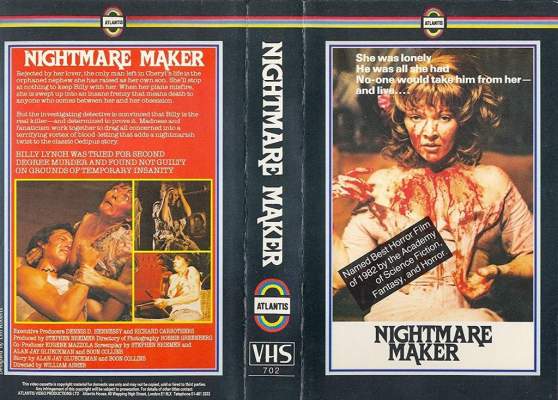
Of course, the movie was pretty much dead on arrival, thanks to a disastrous test screening and a new title, Night Warning, that says nothing about what the audience is about to see. It’s also a movie so strange that it seems to occupy its own universe, unlike any other film before or since. I can see why the general public wouldn’t enjoy it. In England, it made the infamous Category 2 video nasty list.

Basically, what I’m saying is rush out, find this and watch it. Now.

WEIRD WEDNESDAY: Burial Ground (1981)

I’ve often said that I prefer Zombi 2 to Dawn of the Dead — at least if I am looking for a more fun movie — because it skips the political allegory and gets right to the zombie splatter that I really want to see.

Burial Ground (also known as Le Notti del terrore, Nights of Terror, Zombi Horror, The Zombie Dead and most confusingly, Zombi 3) raises you that lack of Romero’s restraint and storytelling, doubles down by ripping off Fulci’s work which is in itself a ripoff (but a masterful one) and piles on the sleaze. No, really. This is a film that is ready to outright offend everyone.

The film starts with a professor accidentally unleashing an evil curse that reanimates the dead. He’s instantly killed. Meanwhile, three “jet-set couples” (I’ve heard them referred to this way several times and it always makes me laugh) and a creepy man child named Michael (who was played by Pietro Barzocchini, who was 25-years-old at the time…more on that soon) arrive at a nearby mansion, invited by the professor. We catch Evelyn (Mariangela Giordano, The Sect) stealing lingerie that she found in the mansion, to which her boyfriend James replies, “You look just like a little whore, but I like that in a girl.” At that point, that creepy manchild of hers, Michael, comes in and freaks out while his mom absentmindedly just stands there, nude.

It doesn’t take long before the dead attack. A maid is decapitated with a scythe because these living dead can use tools. Why are they more evolved than Romero or Fulci zombies? We never learn.

The zombies break into the mansion and attack everyone. This leads to that young creep, Michael, becoming totally shell-shocked. Evelyn, his mother, attempts to confront him, so he becomes to fondle her breasts. As he kisses her, he tries to get his hand between her legs. She slaps him as he runs away, shouting, “What’s wrong? I’m your son!” He runs right into one of the party guests, Leslie, who is now a zombie. Like a Fulci librarian, he stares at her as she makes her way toward him.

At this point, everyone reasons that they should just let the zombies into the house, because they are slow and it will allow them to escape. Sure. That always works. Evelyn goes to find her son, who has been killed by Leslie. She flips out and smashes Leslie’s head against a tub, screaming as loudly as possible, all the while.

Everyone runs toward a monastery, where the film decides to become a Blind Dead film. The zombie monks chase everyone to a workshop where they kill Mark with power tools. Creepy Michael has now become an even creepier zombie. Evelyn has lost her mind and thinks it’s a miracle, so she bares her breasts for her son to suck on. He replies by eating her breast off in graphic detail.

Finally, Janet is menaced by multiple zombie hands as the film ends with the Profecy of the Black Spider. Yes, that’s how they spell prophecy. “The earth shall tremble, graves shall open, they shall come among the living as messengers of death, and there shall be the nigths of terror.” And yes, they also spelled nights incorrectly.

Director Andrea Bianchi isn’t one for subtlety, which is evident in films like Strip Nude for Your Killer and Confessions of a Frustrated Housewife on his IMDB credits. Suppose you’re looking for unrepentant gore (Fulci’s through-the-door eye gouge is repeated here with a window). In that case, consider the bad special effects (the latex zombie heads are near Troll 2 in their quality), the playing with guts and gore ala Blood Feast, and the total lack of storyline or sense. Then I’d advise you to watch this one.

This movie is ridiculous, but man, I love it. It’s the kind of film you can say, “But yeah, did you see Burial Ground? That one is totally insane.” And I love Berto Pisano’s atonal, goofy soundtrack that blares any time the zombies show up. But if you’re looking for a movie with any class, well, don’t say I didn’t warn you.

Here’s a drink to enjoy during this movie.

This Cocktail Smells of Death

  • 1/2 oz. vodka
  • 1/2 oz. rum
  • 1/2 oz. apple schnapps
  • 1/2 oz. blue curacao
  • 1/2 oz. Chambord
  • 1/2 oz. blueberry vodka
  • 1/2 oz. orange juice
  • 2 oz. cranberry juice
  • Frozen blueberries
  1. Fill a glass a quarter of the way with frozen blueberries.
  2. Combine all ingredients in a shaker and mix with ice, then pour over blueberries.

CBS LATE MOVIE: So Fine (1981)

EDITOR’S NOTE: So Fine was on the CBS Late Movie on April 26 and October 18, 1988.

“The Unknown King of Comedy,” Andrew Bergman wrote Blazing Saddles and The In-Laws, which led him to this movie, which wasn’t a success. He also made The FreshmanBig TroubleFletchOh, God! You Devil and Striptease. Not a bad career!

Bobby Fine (Ryan O’Neal) is a professor of English at Chippenango State College. The head of his department, Chairman Lincoln (Fred Gwyne), let’s him know that he’s up for tenure. Yet he soon discovers that his dress-making father Jack (Jack Warden) is millions in debt to a loan shark named Mr. Eddie (Richard Kiel), who sends his underlings Eddie’s henchmen (Tony Sirico and Michael LaGuardia) to collect. They take Bobby, who has agreed to run the company, and threaten him. He’s only interested in Mr. Eddie’s wife, Lira (Mariangela Melato, Kala from Flash Gordon).

Their infidelity leads to Bobby wearing a pair of her jeans as he escapes the mansion, fixing the ripped back with a piece of clear plastic. Buyers who see him think that he intended these jeans to look this way. Called So Fine Jeans — and giving men a view of butt — they become huge. Everything works out and Lira gets to do opera again, as Eddie is defeated.

Producer Michael Lobell had his firsthand experience in the garment industry, as his father made dresses and he made Mod clothes himself. He claimed that he told the idea of this to Bergman and costumer Santo Loquasto came up with the pants.

The results? Pauline Kael said that it was a “…visual insult: crudely lighted and framed, and jumping out at you.”

A Warner Bros. press release claimed that Gail Robinson of Denver, Colorado won a search to find ”the girl who best suited to wear a pair of So Fine Jeans.” The competition’s prize? To be in the movie. Nope. She’s not in it.

At least the pants almost got made. In 1996, Joanne Slokevage filed a patent for a garment rear that made cut-out areas on the rear of various bottom garments that could be revealed with a glap. The patent was unregisterable and in her filing, she did include information on the movie So Fine.

Well, OK at least they got Ennio Morricone to do the music.

RADIANCE FILMS BLU RAY RELEASE: Yokohama BJ Blues (1981)

A loose remake of Robert Altman’s The Long Goodbye and Visconti’s Death in Venice, this is about private eye and part-time blues singer BJ (Yusaku Matsuda), who is blamed for the death of his police detective best friend. Struggling to clear his name all on his own, he makes his way through a violent world of gangsters, bad cops and the underground gay and biker scenes of Tokyo.

Directed by Eichii Kudo, this neo-noir is one weird and wild movie, an unexpected detective story set in early 80s Japan, a time when the country was at the height of its financial power. It’s filled with neon and too many cigarettes; it’s also wonderful.

The Radiance Films Blu-ray release marks the world premiere of this film on Blu-ray. Extras include interviews with star Mari Hemmi, screenwriter Shoichi Maruyama and writer and Yokohama expert Toru Sano; a trailer; a reversible sleeve featuring designs based on original posters and a limited edition booklet featuring new writing by Dimitri Ianni on Toei Central Film, a subsidiary of Toei studios famed for releasing Pink Films and independent productions such as Yokohama BJ Blues and an archival review of the film. This is a limited edition of 3,000 copies, presented in full-height Scanavo packaging with a removable OBI strip, allowing the packaging to remain free of certificates and markings. You can order this from MVD.

CBS LATE MOVIE: Sharky’s Machine (1981)

EDITOR’S NOTE: Sharky’s Machine was on the CBS Late Movie on March 10, 1989.

Man, when I was a kid, the only movie that I think HBO had — besides The Car — seemed to be Sharky’s Machine. I never watched it back then and I totally should have, because it would have changed my life.

Yes, I know this is from The Movie Channel. I got it from https://twitter.com/ClassicHBOGuide/status/1070400413726269440

Based on the book by William Diehl, which was sent to the film’s director and star, Burt Reynolds, by Sidney Sheldon, this was Reynolds’s chance to move away from the funnier movies he’d been making. He told the Boston Globe, “I figured it was time to get away from Smokey. I’d been doing a lot of comedy in recent years, and people had forgotten about Deliverance.”

Reynolds wanted to make a movie like his favorite film, the noir masterwork Laura, and he wanted John Boorman to direct it. However, he was busy with Excalibur.

A bust gone wrong has moved Tom Sharky (Reynolds) from drugs to the vice squad, the worst occupation a police officer can have. Working under Frescoe (Charles Durning), our hero discovers a high-class prostitution ring that includes a thousand-dollar-a-night girl named Domino Brittain (Rachel Ward) who is connected to governor candidate Donald Hotchkins, who is owned by Victor D’Anton (Italian star Vittorio Gassman).

One evening, while conducting surveillance and falling for Domino, Sharky watches her get blasted in the face with a shotgun by the evil William “Billy Score” Scorelli. Let me tell you, if you think Henry Silva was great before, this is perhaps the best I’ve ever seen him. He’s a force of complete terror and mayhem in this and I couldn’t love him any more after the ending of this film, which features the highest free-fall stunt ever performed from a building for a commercially released film.

As everyone thinks Domino is dead, she suddenly shows up and tells Sharky that it was her friend who got blasted in the face. Now, she could bring the entire conspiracy down if everyone could just stay alive.

Tough cop movies only wish they were a sliver as good as this movie. I mean, you’ve Bernie Casey and Brian Keith as cops, you’ve got bad guys slicing off Burt’s fingers, and you’ve a Doc Severinsen-orchestrated theme that Tarantino took for Jackie Brown.

Supposedly, when Clint Eastwood made Every Which Way but Loose, Reynolds said, “Clint, you’re getting into my territory and if it’s a success, I’m going out and make Dirty Harry Goes to Atlanta!”. When this film went into production, Eastwood sent a telegram to Reynolds saying, “You really weren’t kidding, were you?”

JUNESPLOITATION: Woman Revenger (1981)

June 15: Junesploitation’s topic of the day — as suggested by F This Movie— is Revenge! 

Nu xing de fu chou (New Type Revenge) AKA The Nude Body Case In Tokyo is a 1981 Taiwanese movie directed by Yang-Ming Tsai (Phoenix the RaiderThe Legend of Broken Sword) and written by Chen Kuo Tai and Chen-hsiang Tai. Sure, it’s a revenge-o-matic, but it’s also a Taiwan Black Movie, so called because it takes real life and goes hard in its depiction of a woman done wrong going for blood.

Ling (Elsa Yeung) is a dance instructor who has learned that her best friend Meihua has been killed in Japan. To add more pain, Meihua’s sister Meifeng is tied up in this, forced into prostitution to pay for the cocaine she’s stolen. Ling saves her, at the cost of her eye, making her into the Frigga of this film.

This is also wildly unfocused and padded, which I loved, because it includes Ling going to watch a KISS band play in the park and attend a sumo match. How this advances the plot is unknown, but then this goes for broke by having Yakuza gangsters torture women by crucifying them upside down before covering them with ants. After all this lunacy, Ling gets all of their victims together for the eye for an eye that they need. Literally.

You will believe that sexy gymnasts can obliterate evil men. This is how it should be.

You can download this from the Internet Archive. You can also watch it on the TaiwanPlus site.

JUNESPLOITATION: Thrilling Bloody Sword (1981)

June 7: Junesploitation’s topic of the day — as suggested by F This Movie— is Kung Fu!

Directed and co-written — is unleashed a better word? — by Hsin-Yi Chang (Snake In the Eagle’s Shadow 2Kung-Fu Commandos), Thrilling Bloody Sword is a movie that can only be described by a run-on sentence of a paragraph: Snow White and the Seven Dwarves meets Russian adventure film plus Hong Kong wuxia with effects and colors that are a blend of Shaw Brothers horror, Mario Bava wizardry and cardboard magic, all infused with moments that would seem low tech even in the days of Georges Méliès while ideas and music are openly stolen in the ways of Bruno Mattei and Godfrey Ho, plus fighting bears, paper mâché demons, more borrowing from Flash Gordon than Star Wars, swords that shoot other swords, a BDSM costume for its heroic Prince that would have Chang Cheh wondering, “Is that too femme?” and a comet impregnanting a queen.

You know how when people talk up a movie and it never lives up to everything they’re telling you? This is not that movie.

Yaur-gi (Fong Fong-Fong) is the girl born from that comet, a princess to the King and Queen, who dies giving birth to a Cronenberg-esque lump with a beating heart. The King wants nothing to do with that “little ball of flesh” and sends her, like Moses, down the river where the seven dwarves find her. Prince Yur-juhn (Lau Seung-Him) falls in love with her and has to prove himself to the King, the same one who sent his daughter in a boat to her doom. That same dumb leader also has hired two magicians, Gi-err (Elsa Yeung Wai-San) and Shiah-ker (Chang Yi), to get all the demons out of his country. The problem is that they are collecting those demonic guys and getting ready to take over, as they also pray to a Satanic figure by the name of Spirit Ah-Ua.

Don’t worry, our heroes have a fairy who used to be a rabbit and a super magic user with a butt for a head to help them out. And the dwarves used to be generals who were shrunk down but could still fight. And fart. But mostly fight.

Yaur-gi is saved by the Prince, and she falls in love with him, but he’s off fighting a nine-headed dragon. When Yaur-gi comes to meet him after he defeats the monster, he’s turned into a bear and runs into the woods. So they put him in a barrel filled with healing chemicals, and he gets that really wild armor that looks like either something a bad guy feuding with Jushin “Thunder” Liger would wear or something out of an Italian peplum.

There are also literally hundreds of fights and a Magic Monster who lives in a coffin box like those Robobeast toys that Panosh Place put out for Voltron. What follows after this is a multiple sword battle with crystal, laser and shooting swords, people flying around on wires and music stolen from various movies, including Battlestar Galactica.

If that doesn’t make you love this, the production company was named Lusty Electric Industries.

Remember when Jademan Comics — man, the references in this one, sorry — and they were so strange and fascinating? This is even beyond that, a movie that cannot seemingly quit being weird, and it’s barely 80 minutes. Most films would not even go so far as to have a woman give birth to a thing after a comet hits her in the belly, but that’s where this starts. The highest and dankest movie drugs of all time. 999,999 stars out of 5.

Get this from Gold Ninja Video. Seriously, I will post a low-quality video link online, but you need to buy this.

JUNESPLOITATION: Il ficcanaso (1981)

June 6: Junesploitation’s topic of the day — as suggested by F This Movie— is giallo!

My Letterboxd list of Giallo movies is at 498, so I am running out of movies to watch and ones that are easy to find. Instead of diving into the world of erotic thrillers, I sought out Il Ficcanaso (The Nosy One).

Pippo Franco is usually in comedies, and this is really no different. He plays Luciano Persichetti, a man haunted by a killer known as The Guardian Angel. Well, that name doesn’t really give you an idea of how frightening the masked lunatic is.

After getting phone calls from the killer, a dead body is found in his apartment and the cops think he could be the murderer. Also: Pippo’s character is psychic.

Directed by Bruno Corbucci, the man who brought us Miami SupercopsAladdinWhen Men Carried Clubs and Women Played Ding-DongLa casa stregataThe Cop In Blue Jeans and many more, and written by an entire room of people that included Aldo Florio, Mariano Laurenti, Sergio Martino, Raimondo Vianello, Aldo Grimaldi, Sandro Continenza, Corbucci and Franco, this is a comedy giallo that has way too many characters in it, but the girl that the protagonist is in love with, Susanna Luisetti, is played by Edwige Fenech. She realizes that this movie needs some help and has two nude scenes, adding literally every star in the firmament of heaven to the proceedings.

There’s also a scene where Pippo goes to the theater and watches City of the Living Dead! The bad guy also tries to kill him with a sewing machine, kind of like Goldfinger. For an Italian comedy, it’s actually good. I was surprised by this.

You can watch this on YouTube.

APRIL MOVIE THON 4: Dragonslayer (1981) and Trancers (1984): Two Great Film Scores but Only One in Service of Its Film

April 3: National Film Score Day- Write about a movie that has a great score.

ABOUT THE AUTHOR: Exploitation-film historian A.C. Nicholas, who has a sketchy background and hails from parts unknown in Western Pennsylvania, was once a drive-in theater projectionist and disk jockey. In addition to being a writer, editor, podcaster, and voice-over artist, he’s a regular guest co-host on the streaming Drive-In Asylum Double Feature and has been a guest on the Making Tarantino podcast. He also contributes to the Drive-In Asylum fanzine. His essay, “Of Punks and Stains and Student Films: A Tribute to Night Flight, the 80s Late-Night Cult Sensation,” appeared in Drive-In Asylum #26.

Dragonslayer (1981) and Trancers (1984): Two Great Film Scores but Only One in Service of Its Film

The mating of visuals to music can be transcendent. Think of how many movies, even stone-cold masterpieces, wouldn’t be as effective without their iconic scores by musical geniuses such as Max Steiner, Erich Korngold, Bernard Herrmann, John Williams, Miklos Rozsa, Henry Mancini, John Barry, Jerry Goldsmith, Vangelis, Danny Elfman, and, of course, the greatest film composer of all time, Ennio Morricone.* And we can’t forget groups who did scores, like Goblin, Tangerine Dream, The Beatles, Pink Floyd, The Who, Nine Inch Nails, and Queen. Music has always been a part of movies even in the silent era. 

A great score can elevate a movie or hurt it. My fundamental maxim for judging the effectiveness of a score is whether I’m paying more attention to the score than the film itself. During my prime theater-going days, I went to see Dragonslayer, a now-forgotten film from 1981, a year packed with classics like Raiders of the Lost Ark, The Empire Strikes Back, Superman II, Altered States, Flash Gordon,** The Evil Dead, An American Werewolf in London, The Howling, Ms. 45, and Possession. I’d read in reviews before buying my ticket that the score by legendary composer Alex North was exceptional. My expectations were high.

So there I sat on opening day in a Philadelphia grindhouse—not one of the scarier ones—enjoying Dragonslayer, a decent enough film. And the reviewers were right: Alex North’s score was fantastic. (It was later nominated for an Academy Award.***) The score was so good that it took me right out of the film’s universe. The music had transformed this urban shithole, with urine-stained floor, broken seats, and tattered velvet curtain, into Carnegie Hall. (If only it could have literally done that—and changed the wino snoring next to me into a tuxedoed high-society type offering me a single malt Scotch.)

It was then that I realized that this was not a good thing. All the effort that had gone into creating that awesome-looking dragon had been lost on me. I’d closed my eyes and was zoning out to the music. While it was a classic symphonic score, it wasn’t the usual rousing John Williams stuff. Instead, it was more brooding. North had incorporated complex lines with counterpoint and some atonality. It’s not that the score was inappropriate to the action. It’s just that it was so much better than the film itself that it became a distraction and put a damper on my viewing experience. Dragonslayer’s score, though outstanding, does no service to the film it supports.

But sometimes—more accurately, rarely—a film with a few good elements that would otherwise be forgotten is improved so much by an unexpectedly great score that both the film and its score live on, each beloved. Case in point: Trancers (1984) a film I first watched on home video. 

On paper, Trancers doesn’t look like much: a low-budget mash-up of Blade Runner and The Terminator that Charles Band and his Empire International Pictures dumped into Chicago and LA theaters to make a few bucks before the VHS cassettes hit the shelves at Blockbuster. But Empire made exploitation films that were a cut above the rest, so it looked good, courtesy ace cinematographer Mac Ahlberg. And it had some other good things going for it: stand-up comedian Tim Thomerson, perfectly cast as Jack Deth, the futuristic gumshoe; future Best Actress winner Helen Hunt as his juvenile love interest; and a funny, clever screenplay from Danny Bilson and Paul De Meo. That duo went on to write even more great stuff, including Zone Troopers (1985), Eliminators (1986), and The Wrong Guys (1988) for Empire; The Flash (1990) for television; The Rocketeer (1991) for Disney; and Da 5 Bloods (2020) for Spike Lee, which was released after De Meo’s death. These things make Trancers memorable, to be sure, but you’ll be blown away by the score by Phil Davies and Mark Ryder.

Like the score in many 80s films, the Trancers score used the premier electronic instrument of the day, the Fairlight synthesizer. The main theme, which serves as the musical motif throughout the film, is simplicity itself: an initial burst of synthesizer whine, followed by a slow, haunting melodic line in a minor key supported by swelling harmonies. It’s mournful mood music that stands in contrast to the film’s action scenes. The film may be part science fiction, part noir, but the music emphasizes the noir. Like the Dragonslayer score, it calls attention to itself, but does so in a way that doesn’t violate my rule. Instead of distracting, it engages.**** George Bernard Shaw once said, “Music washes away from the soul the dust of everyday life. To this day, I can’t listen to the Trancers soundtrack without being moved.

Trancers was so successful on home media that it became a franchise with seven installments.***** Charles Band’s brother Richard, Empire’s house composer, reworked Davies and Ryder’s compositions through Trancers III before the uneven series turned to other composers and music with lesser effect. Recently, there’s even been talk of a Trancers TV series. Jack Deth may live on, abetted, I hope, by the original Trancers score.

But, you ask, “Isn’t the Trancers soundtrack just a knock-off of Vangelis’s opening theme from Blade Runner?” It’s true that Trancers and Blade Runner are both science-fiction films with synthesizer scores. The difference is that the Trancers score, even if it was inspired by Blade Runner, is better. If you weren’t scorched by my hot take there, here’s a molten-lava take: The Trancers score is among the best movie scores of all time. If you don’t believe me, some kind soul has put together a 10-hour loop of the theme, which you can listen to on YouTube.

There you have it: two genre films, Dragonslayer, a big-budget studio film with high ambitions, and Trancers, a low-budget exploitation film with modest ambitions, both with excellent scores. But only one score does what it’s supposed to do, and it does so beautifully. I want the Trancers theme played at my funeral as I head down the line to the next life.

* For my money, the scene in The Good, the Bad and the Ugly with Eli Wallach as Tuco running through the cemetery to “Ecstasy of Gold” by Maestro Morricone is the greatest music cue in any movie ever. If perfection can exist in this world, this is it. 

** If you read any discussion of movie soundtracks mentioning the rock group Queen, you’ll always sing aloud “Flash! A-ah… Savior of the universe!” See? You did just now. It’s an immutable law of the universe.

*** North received 15 Academy Award nominations, including one for the American standard “Unchained Melody,” which he wrote early in his career for the film Unchained. If that was the only thing he’d ever written, I’d say he had an amazing life.

****  Just last month, Band released to YouTube a black-and-white remastering of Trancers. The noirish score complements the monochrome images even more brilliantly.

*****Six features and one 20-minute short. The short, originally intended as a segment of the Empire portmanteau film Pulse Pounders, was shot in 1988 but was unreleased until 2013. It fits between Trancers and Trancers II on the series’ timeline and is lovingly called “Trancers 1.5” by fans.