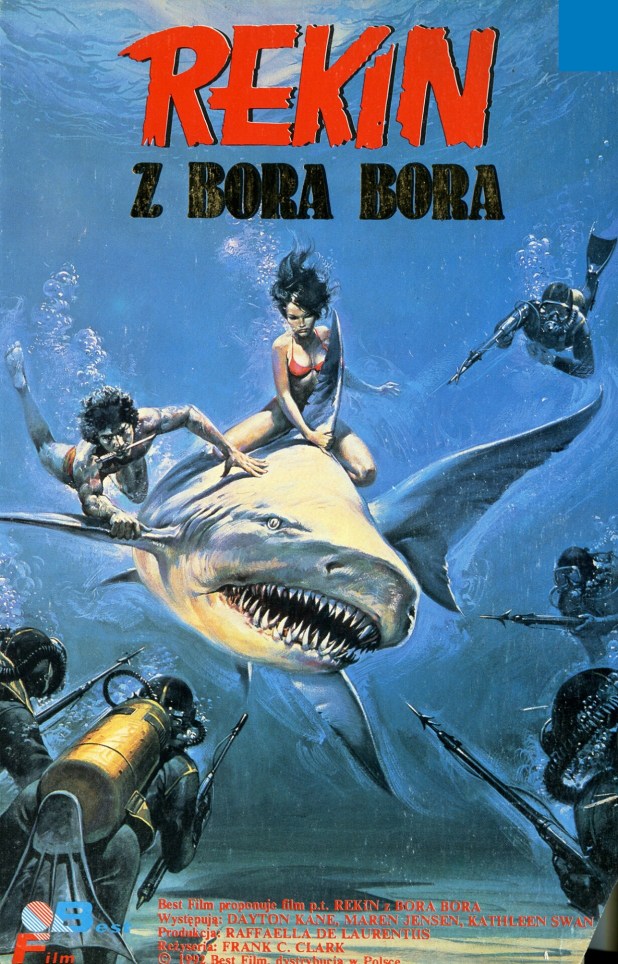
Also known as Sea Killer — the name it was originally released in the U.S. — Mein Freund, der Hai (My Friend, the Shark); Peripeteies ston okeano (Adventures In the Ocean); Manidù – Uno squalo ribelle, un indigeno selvaggio, un fiore di ragazza (Oh Italy; this means Manidu – A Rebellious Shark, a Wild Native, A Flower of a Girl); Shark Boy of Bora Bora and The Hero King, Beyond the Reef often has posters that make it seem like it’s going to be sharksploitation.
Shot at the same time as the remake of The Hurricane with the same cast and crew minus Mia Farrow, this was produced Raffaella De Laurentiis, whose father Dino thought Dayton Ka’ne was going to be a star.
Beyond the Reef is a movie about a 16-foot tiger shark named Manidu, which has been named for the old man (Oliverio Maciel Diaz) who introduced him to Tikoyo (Ka’ne) when the shark was only a foot long and the boy was young. He also had a friend, Diana (Maren Jensen), who goes off to America and forgets all about him. Meanwhile, the boy grows into a man and can mentally speak to his shark, like a friendlier version of Mako: The Jaws of Death except when the shark has to protect Tokoyo or Diana, which strangely has her brother Jeff (Keahi Farden) being evil and seeking a cave of black pearls.
All of the underwater footage has been shot by Ramon Bravo, who was a real renaissance man. He was a swimmer who competed in the 1948 Summer Olympics, then learned how to shoot cameras underwater and discovered the phenomena of sharks sleeping on the ocean floor. He also wrote the novel that Tintorera is based on and is also the zombie that fights the shark in Zombi. When he died, a collection of luminaries, including Jean-Michael Costeau, placed a memorial to him in the ocean that said “Ramón Bravo, protector of the sea and the ocean, sleeps forever next to his sharks in this cave. Isla Mujeres 02–28–98.”
Based on the novel Tikoyo and His Shark by Clement Richer, this was directed by Fred C. Clarke (his only movie) and written by Louis LaRusso II (The Closer) and James Carabatsos (Hamburger Hill). The novel was also made in 1962 as the Italian/French film Ti-Koyo e il suo pescecane.
If you thought it was strange that sharks can roar, this one purrs. Also, this movie has toplessness, which is kind of shocking with how charming it is. It kind of comes out of nowhere.
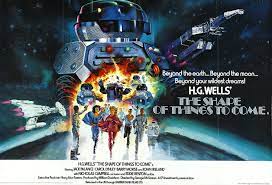
After the Robot Wars, what is left of Earth lives in a city on the moon by the name of New Washington, surviving because of the anti-radiation drug Raddic-Q2 from the distant planet Delta 3. They are soon under the grip of Omus, the Robot Master (Jack Palance), who has crashed the latest vessel filled with the drug and plans on being emperor.
He’s opposed by Senator Smedley (John Ireland), Dr. John Caball (Barry Morse), Jason Caball (Nicholas Campbell), Kim Medley (Anne-Marie Martin) and the cute robot Sparks, who teleports by turning the camera off and turning it on again once he’s moved.
I remember being really excited about this movie because it was an H.G. Wells story, but no, it’s not. It’s a Canadian science fiction movie made by George McCowan. Hey, it has Carol Lynley (The Beasts Are On the Streets) in it so I watched it. The effect of Palance projected into the sky was also a major reason, as I’m a sucker for him just getting a paycheck anywhere that he can.
If I watched this when I was under ten, I’d be telling you how insane it is.
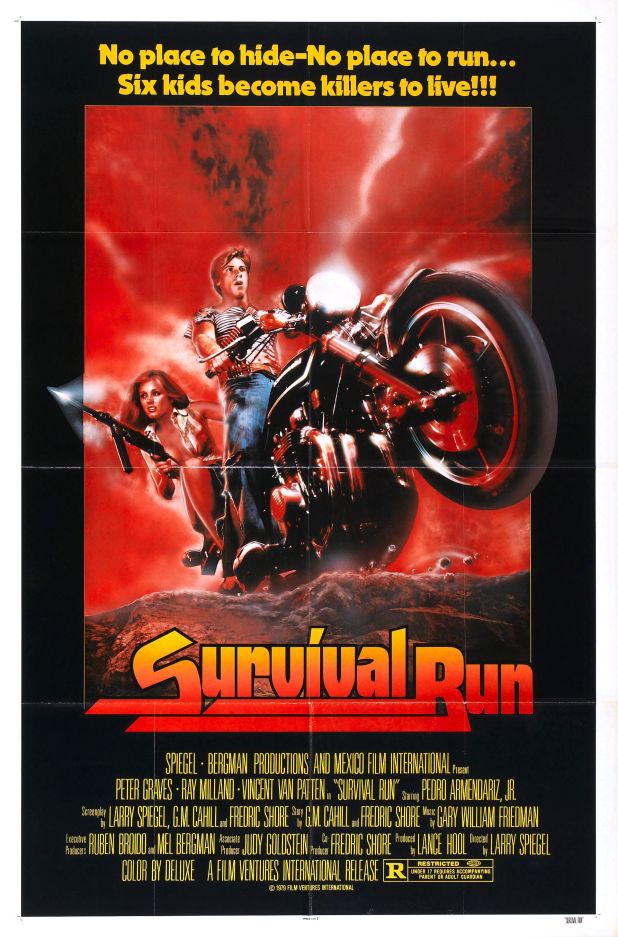
Chip (Vincent Van Patten) and his friends Stephanie (Susan Pratt), Brian (Robert Weaver), Angela (Robert Weaver), Sal (Cosie Costa) and Dianne (Randi Meryl) just wanted to head out to the desert, get drunk and probably have sex. Then they crashed their van and have to walk through the hot sands to get help, running into Kandaris (Peter Graves) and Professor (Ray Milland), who seem like good guys but nope, they’re not. Everyone is in trouble. You are too, because that poster looked so exciting and then this movie just seems like it’s grinding you into pure ennui.
Yes, Larry Spiegel directed and wrote this (he also made Evil Town a few years later) and you start to feel like this is the kind of movie that they keep on hand for when you have panic attacks and need to calm down and finally get some sleep. Maybe I’m letting you in a bit too deeply into my life. And I hate writing about a movie just to tear it down, but this film has Graves and Milland in charge of a Mexican drug gang while some kids just want to have soft swinging while camping in a van.
Oh yeah — Spiegel also produced Death Game, so that’s where I recognize him from.
I wish I could report this was better than it was. But…it isn’t.
In 2013, when the Alamo Drafthouse presented the uncut version of this film for the first time in the United States, they referred to it as an “unforgettable assault on reality.” Those words best describe what is otherwise an indescribable film.
But I’m going to try.
Maybe a recipe will help.
Take Chariots of the Gods, and some of Rosemary’s Mary, then a little bit of The Omen, throw it in a blender and then pour the whole thing down the sink.
No? Maybe a synopsis.
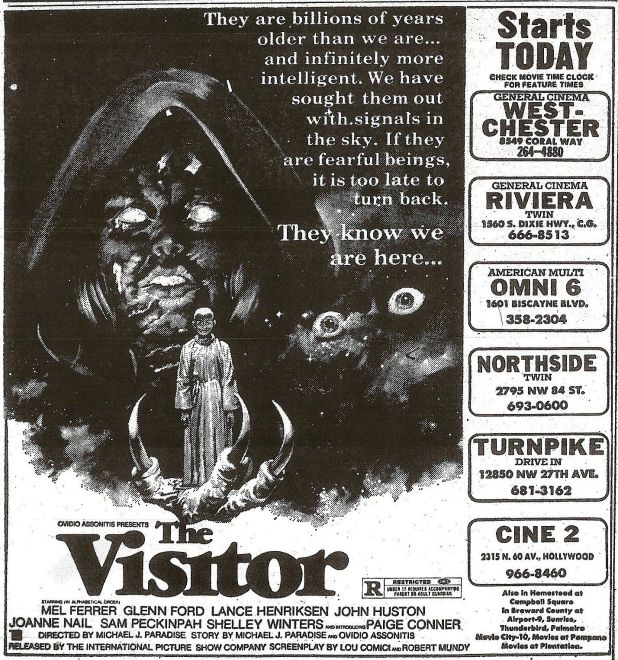
We start in Heaven, or somewhere very much like it, where Franco Nero (the original Django) is one of those space gods that Erich von Däniken wrote about. He tells the bald children who surround him that there was once a war between two aliens, one good and one bad. The bad one — who is either called Sateen or Zathaar — was defeated, but not before he slept with a whole bunch of Earthwomen. Cue the Book of Enoch in the Lost Books of the Bible. Or cue the Scientology myth of Lord Xenu. Or Xemu, because he has two different spellings, too.
Only one child is left — a young girl — and a vast conspiracy wants her mother to have another child — a brother this time — so they can mate. The Christ figure sends John Huston — yes, the director of The Maltese Falcon and The African Queen — and the bald children to a rooftop somewhere in Atlanta to stop this plot. To do that, the children become adult bad men and dance around a lot while Huston walks up and down the stairs to triumphant music. If you think I’m making that last sentence up, you’ve never been blessed with this movie.
Meanwhile, Lance Henriksen (Near Dark, Aliens) is Ted Turner, pretty much. His name is Raymond Armstead and he owns the Atlanta Rebels basketball team that plays at the Omni and is dating Barbara (Joanne Nail, Switchblade Sisters), who of course is the woman who has the seed of the gods inside her. Her daughter Katy is 8 years old and already using her powers to help the Rebels win their games. But that isn’t all the help Raymond is getting. The rich, powerful and ultra-secretive Zathaar cult control the world and are helping his team become winners. All he has to do is marry Barbara, knock her up and let their kids fuck. Hopefully, they have a boy, or Raymond is gonna have to get in the saddle all over again.
Raymond can’t even do that right and the leader of the bad guys, Mel Ferrer (The Antichristand Eaten Alive!) is upset and ready to quit on Raymond. Barbara doesn’t want more kids and certainly doesn’t want another child. But who can blame her? Her daughter is one creepy little girl. Her daughter knows all about the conspiracy and begs her mom to get married so she can have a brother (and this is where, in person, I’d throw in “…to have sex with” but I’d use the f word). How creepy is Katy? Well, she kills a bunch of boys with her mental powers because they make fun of her while she ice skates. And then she accidentally shoots her mother at a birthday party. Yep, it’s as if The Bad Seedmet Carrie!
Then, as all 70’s occult movies must, the stars of Hollywood’s golden age make appearances!
Glenn Ford, the actor, plays a cop that Katy curses out and uses hawks to make wreck his car!
Shelley Winters plays Barbara’s nurse who once had one of the space babies and killed it, but can’t bring herself to kill Katy! According to interviews, Winters really smacked around Paige Conner, the actress who played Katy!
Sam Peckinpah, the director (!), plays an abortionist who removes one of the space babies from Barbara after the conspiracy pays a bunch of things to artificially inseminate her. Turns out Peckinpah had trouble remembering his lines, which is why we never learn that he’s Barabara’s ex-husband! Then is he Katy’s dad? Who knows! His voice is even Peckinpah’s! They had to ADR all of his dialogue.
In response to the abortion, Katy shoves her mom through a fish tank. She also decides to throw her down the stairs, Whatever Happened to Baby Jane?-style. And by throw her down the steps, I mean do it over and over and over again.
Meanwhile, John Huston is still going up and down the stairs. Finally, they HAVE HAD ENOUGH (I like to emphasize that so you get the gist) and sent their John Woo-ian flock of doves to fight the hawks. And meanwhile, Mel Ferrer and all his men show up dead with black marks on their bodies.
And Katy? Well, as Huston tells us, kids can never be evil. She gets her head shaved and goes to space to meet Instellar Jesus Christ. The title comes up as insane music blares.
Writer/director/insane man Michael J. Paradise (Giulio Paradisi) also was in Fellini’s 8 1/2 and La Dolce Vita. What inspired him to this level of cinematic goofiness? He was helped along by Ovidio G. Assonitis, whose resume includes writing Beyond the Door, Madhouse and Forever Emmanuelle before becoming the major stockholder and CEO of Cannon Pictures in 1990. That may explain some. But not all.
I know I often write things like “I don’t have the words to describe this” when I do these reviews — especially after I write a few hundred words all about said subject. But this is one time that that statement is not pure hyperbole. Just watch the trailer and be prepared to lose your grasp on normalcy!
The Visitor defies the logic of good and bad film. It can only be graded on the is it an absolute film, ala Fulci or Jodorowsky. It is something to be experienced.
If any film earned being a video nasty, it would be this one, a movie that has a man who was abused as a child growing up to be a serial killer obsessed with burning people alive. There is no one to root for or cheer for, only mayhem, malice and murder.
In short, the kind of movie that Gene Siskel would have a conniption over.
When Donald (Dan Grimaldi, a math professor who also played Philly and Patsy Parisi on The Sopranos) was a kid, his mother would use a stove to burn the evil out of him. Now fully grown, he seeks out women that remind him of her and kills them with a flamethrower in relentlessly graphic detail.
While the killer tries to confess his sins, he can’t stop. Even a simple double date ends with him smashing a candle over a woman’s head. And get this, it even has an ending very similar to Maniac, another movie that offers no easy answers or way out.
This is also a definite disco slasher. A truly mean spirited blast of sheer degeneracy — and therefore everything wonderful about the slasher form — Don’t Go In the House has songs like “Boogie Lightning,” “Dancin’ Close to You,” “Straight Ahead” and “Late Night Surrender” playing in between moments of women being set ablaze and a mother rotting somewhere in a house that has an impossibly huge torture chamber in the basement.
You can watch this on Tubi or buy the blu ray from Severin.
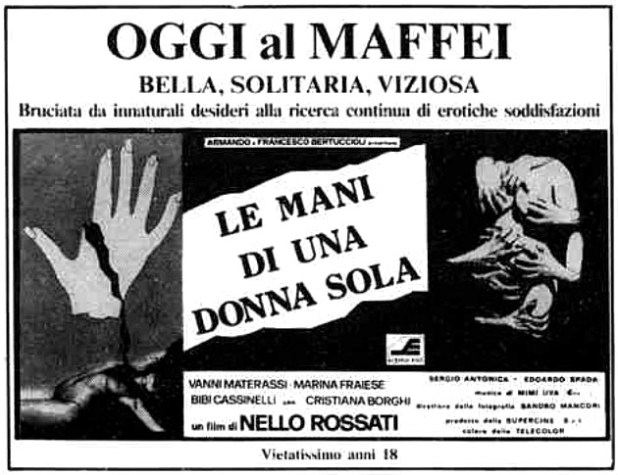
Soft Hands or The Hands of a Single Woman is about Countess Eugenia Fabiani (Marina Hedman, La bimba di Satana) and her deserted cottages overlooking a series of cliffs in Southern Italy. English writer Tom MacLaglen (Vanni Materassi) has come there looking for inspiration. He is joined by his wife Sara (Bibi Cassanelli). They’ve reached what may be the end of their marriage after he forced her to have an abortion, which causes her to no longer allow him to touch her.
This allows Eugenia to pursue Sara, leaving behind her servant Fosca (Christiana Borghi) who finds herself in the bed of the husband as well as working up a lunatic and a blind man. This is not a good idea, as Dr. Oscar (Edoardo Spada) and his two nuns run a mental hospital. Of course, one night, five of the patients — lured on by the idea that all of these sexualized women are so close after watching them on the beach — escape and attack, taking Eugenia’s hands. These men may as well be out of a horror movie.
This is one weird film. Director and writer Nello Rossati may have never made a normal picture, as he also made the comedy zombie movie Io Zombo, Tu Zombi, Lei Zomba; the 1972 giallo La gatta in calore; the seemingly post-apocalyptic western Django Strikes Again, a Napoleon film named Bona parte di Paolina; Ursula Andress slumming it in The Sensuous Nurse; the crime movie Don’t Touch the Children!; a female revenge movie by the name of Fuga scabrosamente pericolosa and the delirious weirdness that is Top Line. He wasn’t going to let me down here, because this is at times comedy and other times outright horror.
EDITOR’S NOTE: Cinematic Void will be playing this film on January 29 at 7:00 PM PT at Los Feliz 3 in Los Angeles, CA. For more information, visit Cinematic Void.
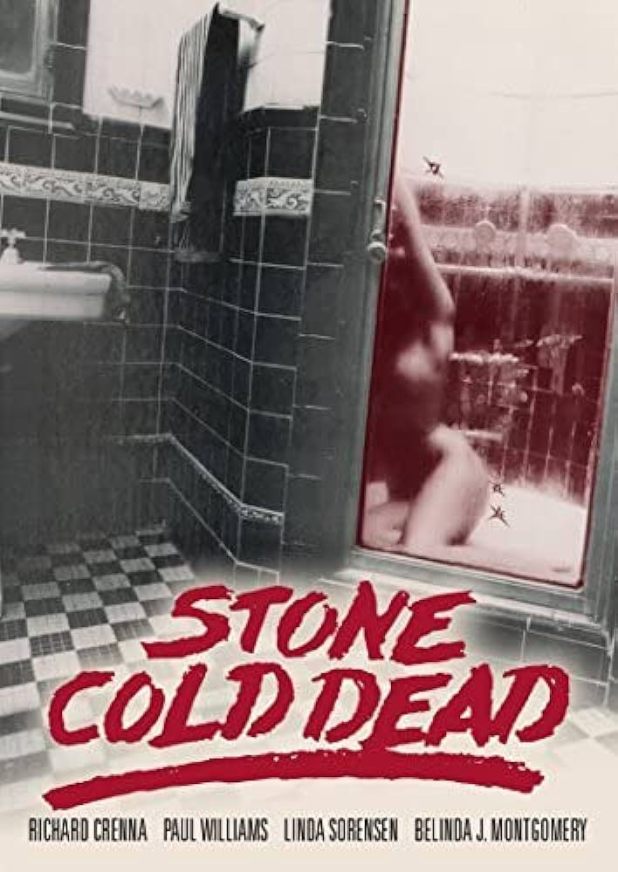
Directed and written by George Mendeluk (Doin’ Time, The Kidnapping of the President, Meatballs III: Summer Job), and based on The Sin Sniper by Hugh Garner, this has a killer with an interesting weapon: a camera with a long-range lens takes a photo of each victim seconds before the killer shoots them. The killer is sending these photos to the police to taunt them as he kills as many women as possible.
Sergeant Boyd (Richard Crenna) is Toronto’s meanest cop and he wants this killer dead or in jail. He’s trying to protect the sex workers of Yonge Street, who include both real girls of the night and actresses, like Linnea Quigley, who plays the first victim. Plus, Paul Williams plays the man who owns all these women, Julius Kurtz. There’s also the typical call girl with a good heart, Monica Page (Linda Sorensen) and a tough undercover female cop, Sandy McCauley (Belinda J. Montgomery). This is a Canadian movie, which is definitely proved to be true when Lesleh Donaldson has a small role. She was in almost every northern horror movie that mattered, including Funeral Home, Happy Birthday to Me, Curtainsand Deadly Eyes.
There are a lot of reviews online that don’t enjoy this movie. How can they feel that way with such a powerful ending and the chance to see the actual darkness of Toronto before it was all cleaned up? I mean, the former Psychedelic Avenue might not be the same any more, but Zanzibar survives. I wish I could have seen it back in the 60s when it had what owner David Cooper said was a “Twenty-first Century total environment with “stroboscopic” lights, mannequins and closed-circuit cameras that would take photos of the dance floor and project them on the wall.”
EDITOR’S NOTE: Today’s movie is brought to you by AC Nicholas, who has graciously become a Big B&S’er, a monthly supporter of the site and got to pick an entire week of movies. His idea this time was for a series on movies that started as one film and were dubbed into something else.
Would you like to have me write about the movies of your choice? It’s simple!
Go to our Ko-Fi site and donate. There’s no set amount and I won’t tell you what to do. In fact, if you just keep reading for free, we can still be friends.
Join as a monthly member for just $1. That makes you a Little B&S’er.
As a Medium B&S’er at just $3 a month, if you pick a movie or a director, I’ll write about them for you. In fact, I’ll do one for each month you subscribe and even dedicate the post to you.
For $5 a month, you basically get some major power. As a Big B&S’er, I’ll write an entire week on any subject you’d like. How awesome would that be? In fact, I’ll do it for every month you’re a member. Do you think any of your other movie sites will do that for you?
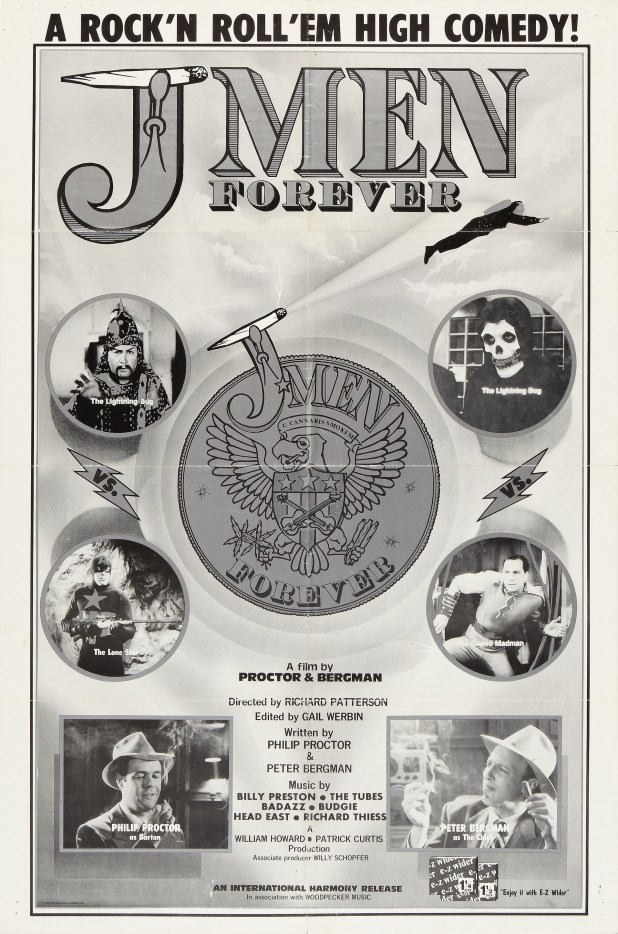
The Lightning Bug — voice by DJ Machine Gun Kelly, not the Cleveland waste of time rapper but the host of seven weekly programs who also shows up in The Fifth Floor, Roller Boogie and Voyage of the Rock Aliens — is taking over the world with sex, drugs, rock ‘n roll and five different costumes. Five costumes? That’s because this movie uses footage from Undersea Kingdom, The Fighting Devil Dogs, Mysterious Doctor Satan, Adventures of Captain Marvel, Spy Smasher, Captain America, The Masked Marvel, The Crimson Ghost — someone alert Glenn — as well as The Black Widow and Zombies of the Stratosphere.
Also known as The Day the Earth Got Stoned and The Second World War, this has Firesign Theater members Peter Bergman as The Chief and Philip Proctor as Agent Barton. They explain what’s going on as the J-Men battle evil. Yes, thrill to the adventures of Yank Smellfinger, James Armhole, Buzz Cufflink, Agents Spike, Claire and Lance, Rocket Jock (Commando Cody from Radar Men from the Moon), the Lone Star (Captain America), the Caped Madman (Captain Marvel), Spy Swatter (Spy Smasher), Sleeve Coat, Juicy Withers and Admiral Balzy, who work with the FCC (Federal Culture Control) to battle the evil army of MUSAC (Military Underground Sugared Airwaves Command).
Even if it seems like the J-Men have died, don’t worry. They get out of everything by the end of the movie.
Using music by Budgie, The Tubes, Head East, Billy Preston and Badazz, this movie became a cult favorite thanks to how many times it was shown on USA’s Night Flight. It was directed by Richard Patterson, who made a Western film like this in 1976 titled Meanwhile, Back at the Ranch. He also made documentaries on Charlie Chaplin and the Marx Brothers. It was written by Bergman and Proctor.
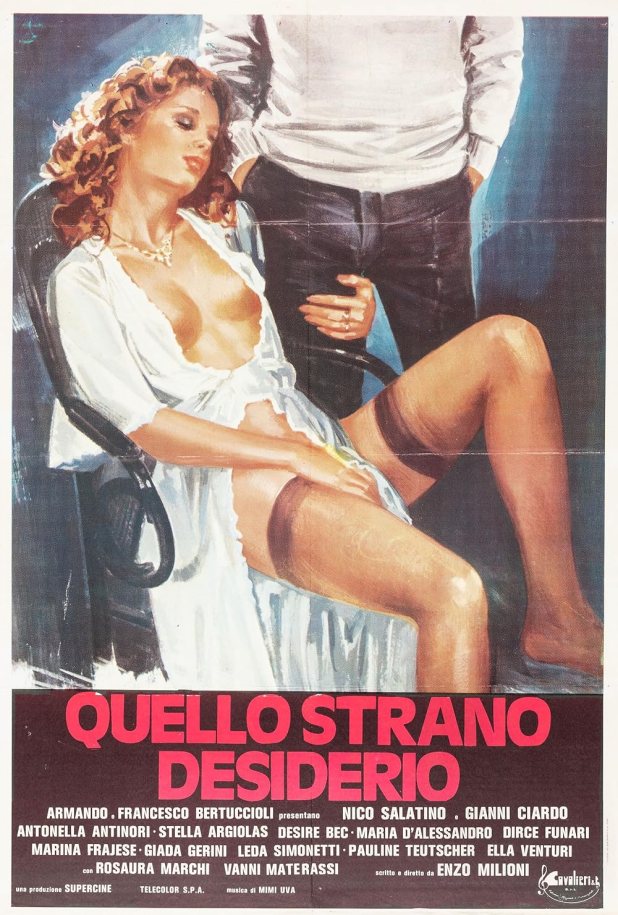
Directed and written by Enzo Milioni, That Strange Desire is the story of two aliens from the planet Alpha 4 who have been on the game show Cripto-Tivvu and won a trip to our planet. They possess the bodies of Casimiro (Nico Salatino) and Peppino (Gianni Ciardo) and learn that while their race has not had sex for thousands of years, it’s still an act here on our planet.
Filmed almost entirely at the former Grand Hotel Ambasciatori in Bari, this comes from the director of The Sister of Ursula, so you should not be surprised when it feels a bit scuzzy. Most of the movie feels like he turned the camera on and filmed whatever happened and then threw some wacky music over it.
For some reason, this movie has two very quick moments of hardcore inserts, which seem even more gratuitous than usual. I also wonder how this made it on the list of Italian Gothic films I’ve been working from, but at least I made it through this one.
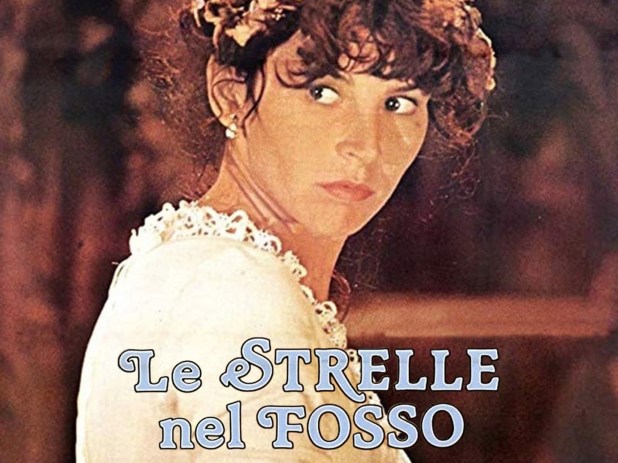
According to Roberto Curti in his book Italian Gothic Horror Films 1970-1979, director and writer Pupi Avati refused to “oblige to the rules of commercial film-making” and this movie — thought of as improvisational film jazz, mostly written and shot on the spot — was him trying yet again to create his own vision. While his previous TV movie Jazz Band was well-received, none of his movies had made money (there’s a moment in Curti’s guide to 1980s Italian Gothic where Lamberto Bava, while speaking about his film Macabre, says “…a week after the film’s release, the producer told me it was the first Avati production that made any money.).
This begins with a ratcatcher (Ferdinando Orlandi) staying overnight at a farmhouse and telling a young girl a bedtime story. There was once a house in the swamp and in it lived a family — father Giove (Adolfo Belletti) and his sons Silvano (Lino Capolicchio), Marione (Gianni Cavina), Marzio (Giulio Pizzirani) and Bracco (Carlo Delle Piane) — in a place where no woman had been for years. Possibly, this was because Giove’s wife died while giving birth to his fourth son.
One night, a pianist named Olimpia (Roberta Paladini, What Have They Done With Your Daughters?) appeared and in time, each member of the family asked her to marry them. She accepted each of their engagements and the marriages were celebrated throughout the day and night. But the next day, she was gone and they were all dead in a tableau reminiscent of Leornardo’s The Last Supper.
As the ratcatcher finishes his story, we notice that the girl looks just like Olimpia.
Pizzirani remembered that it was not an easy movie to make. “We did not know anything about the story. Pupi showed up at morning, gave us a sheet of paper and we had to study our lines. Sometimes the dialogue lines were not call and response, and I recall having to learn very long parts, deadly difficult speeches which later on I would repeat, improvising upon them a bit. It was traumatic.”
What emerges is a story made of stories and each of those tales deals with how we confront the story we don’t know the ending of. Our own. Avati said, “I have a problem with death and so I tried to make it beautiful, sunny, warm.” Is Olimpia even real? Did the mother die or leave the men alone to their own lives? How much is allegory and how much is actual? Avati always makes me ask so many questions.

 B&S About Movies