EDITOR’S NOTE: The Bermuda Depths was on the CBS Late Movie on October 7, 1983, May 30, 1984 and April 18 and July 11, 1985.
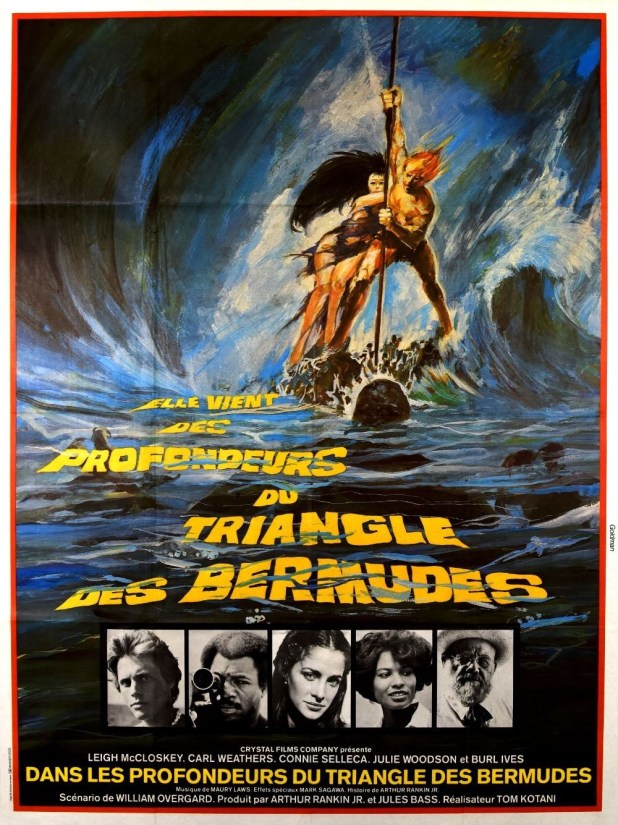
When Rankin/Bass and Tsuburaya Productions, two powerhouses in the film industry, join forces, they create something truly unique. Their collaborations are always a bit off the beaten path, but none are quite as intriguing as this one. This film, with its ghost girl, childhood trauma, and the iconic kaiju turtle, is a testament to their innovative spirit.
It was written by William Overgard, who created the comic strips Steve Roper and Mike Nomad and Rudy and wrote scripts for several collaborative films like The Last Dinosaur, The Ivory Ape and The Bushido Blade. He also wrote episodes of ThunderCats and Silver Hawks. He also worked with Arthur Rankin Jr.* on this story.
Directed by Tsugunobu “Tom” Kotani, the mastermind behind all these bizarre American/Japanese films, this one takes the cake in terms of its outlandishness. When I say weird, I mean it’s the kind of film that will leave you scratching your head, but in the best possible way.
Magnus Dens (Leigh McCloskey, who was in Inferno and now paints art based on occult, alchemical and esoteric themes) is asleep on an island when he is woken up by Jennie (Connie Sellecca) who claims to know him. He’s been dreaming of his childhood and she may be the girl he remembers from it, the love of his life who watched a turtle hatch on the beach with him and craved J+M into its shell before she rode that giant turtle into the sea and disappeared forever. This happened on the very same night that a monster emerged from the cave beneath his house and killed his father!
Our hero also has a job working alongside another childhood friend, Eric (Carl Weathers), for marine biologist Dr. Paulis (Burl Ives!). Paulis informs him that Jennie doesn’t exist and is the name of a legend in which a beautiful but vain woman was saved from a storm by a mysterious god and given eternal life at the cost of never again being able to live on land.
With a harpoon-shooting bazooka known as Horror, women with glowing green eyes, the mid-movie appearance of a giant turtle wiping out most of the cast, and a total downer ending, this movie was made for me. The ending alone is enough to make you wonder how it all wraps up. I can’t even imagine what people thought of it when it ran on ABC on January 27, 1978.
*Rankin loved Bermuda so much that he moved there after making this.
EDITOR’S NOTE: Manbeast! Myth of Monster? was on the CBS Late Movie on October 17, 1984; August 8, 1985 and June 15, 1988.
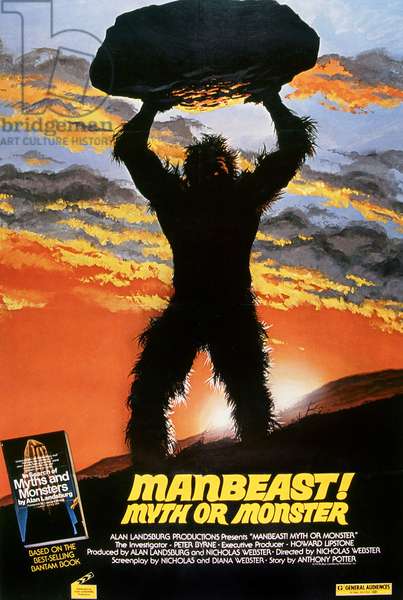
Drink every time that Peter C. Byrne says, “I believe in the Manbeast.”
At some point in 1978, Peter decided to remake the In Search Of episode about Bigfoot as this movie, taking his wife Cecelia out for a ride. In fact, director Nicholas Webster would go on to direct three episodes of that syndicated Leonard Nimoy-hosted show that would often give me nightmares. But he can’t hide perhaps the darkest secrets, as Webster also directed Santa Claus Conquers the Martians.
This was written by Anthony Potter (whose resume mostly consists of hard news and documentaries) and Diana Webster, who wrote nine episodes of In Search Of, appeared in movies like Death Ray 2000 and played a nurse in two early Marvel movies, Dr. Strange and Captain America.
As we watch a Rob Bottin-created Manbeast interact with people and appear in reenactments, we hear stories like the Russian farmer who kept a female Manbeast — a Fembeast? Femalebeast? Ladybeast, shout out to Pittsburgh metal?!? — for years, one that even gave birth and accidentally killed her children by washing them in a frozen stream until the farmer’s wife started raising the children for her own, and the kids looked very human and wait, was the farmer putting it on the female Manbeast because yes, I totally believe that story as well as a skier straight up murked by a Manbeast.
That said, Peter is the most sympathetic person ever toward the lost species, saying that man has destroyed the forest and that we must help the Manbeast survive. And then some insane scientist shows up and says, “Look, they’re going extinct. Or maybe they don’t exist. I don’t care. But if I do find one, I’m going to kill it and do an exhaustive autopsy and enjoy every moment,” and I’m absolutely sure that that man is a serial killer. Or an actor. Or an actor who is a serial killer.
Roger Ebert said of this movie, ” I’m not quite sure it makes a lot of sense, but that’s the sort of criticism you only make after it’s over. During the movie, too much else is happening.”
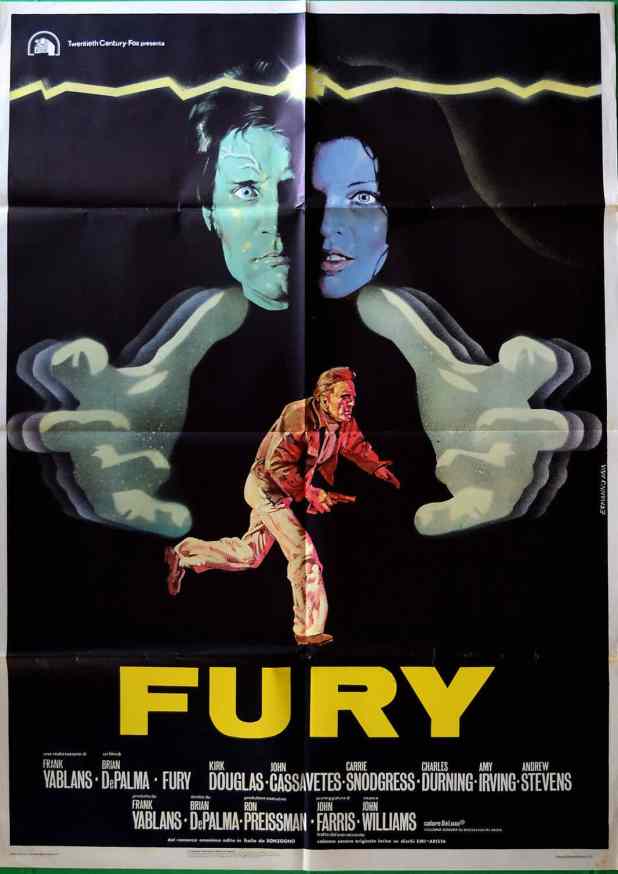
Ex-CIA agent Peter Sandza (Kirk Douglas) and his psychic son Robin (Andrew Stevens) meet up with Ben Childress (John Cassavetes), one of Peter’s old spy friends. Peter is leaving the life behind, but Ben is prepared. He stages a terrorist attack that nearly kills his supposed friend and takes his son away.
Across the world, student Gillian Bellaver (Amy Irving) learns that she has powers of her own. She can barely control them, so she goes to the Paragon Institute, a front for the same organization that Childress is running, one that kills parents and takes their psychic teens away to make them into weapons for the U.S. government. Thanks to having a girlfriend (Carrie Snodgress) on the inside, Peter starts to track down his son.
Gillian grows in power and soon meets Robin psychically. Childress determines that she knows too much, so he plans to eliminate her, while Peter plans on following her to find his son. Working with Dr. Susan Charles (Fiona Lewis, between this and Strange Behavior not someone I would trust with my teenage child), they have successfully transformed Robin into a killing machine. That said, he can’t be controlled and his abilities have already caused one mass homicide at a theme park.
As Peter and Gillian break into Childress’ mansion, Robin goes full-on mental and thinks that PSU wants to replace him with Gillian. He kills his handlers and even tries to murder his father, who tries to keep him from falling. When he responds by scratching Peter’s face and causing his own death. Seeing his son dead, the old agent decides life isn’t worth living and he kills himself.
As he lies dying, he gives Gillian all of his power, power she soon uses to cause Childress to bleed from the eyes and then to literally blow up. It’s one of the wildest stunts ever and one that took two tries. De Palma told The Talks, “I had 8 or 9 high-speed cameras and he explodes. He explodes. And the first time we did it, it didn’t work. The body parts didn’t go towards the right cameras and this whole set was covered with blood. And it took us almost a week to get back to do take two.”
How was this achieved? In the same interview, the director said, “Nobody had ever done this before. I had these incredible high-speed cameras that the astronauts use and about three of them jammed because they were going so fast. They were all shooting super, super slow-motion – this is in the ’70s – and then it’s all over and you look around and the set is completely in shambles.”
EDITOR’S NOTE: This was originally on the site on .
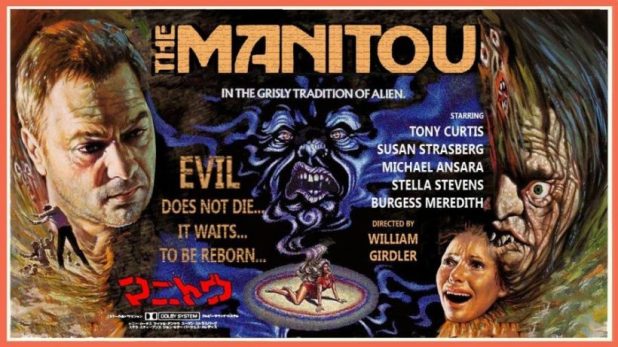
“Evil does not die…it waits…to be reborn…”
Yet sadly this would be the last movie for William Girdler, who died in a helicopter crash while scouting locations for his next movie.
It’s a shame because Girdler had a talent for taking cheap movies with big ideas and making them beyond entertaining. This movie features a wild cast for him, including Tony Curtis as psychic Harry Erskine, Michael Ansara as shaman John Singing Rock and Susan Strasberg as our heroine Karen Tandy — who is suffering from a gigantic growth in her neck that ends up being the reincarnation of Misquamacus, a wonder worker of the Wampanoag tribe.
Misquamacus comes from the book of the same name by author Graham Masterton, who brought the villain back in his novels Revenge of the Manitou, Burial, Manitou Blood, Blind Panic and Plague of the Manitou, as well as the short story “Spirit Jump.”
Plus, there’s Stella Stevens, Burgess Meredith, the “First Lady of Radio” Lurene Tuttle, Ann Sothern and Jon Ceder on hand for this body horror by way of possession films by way of Native American hoodoo bit of lunacy. I also kind of dig how the posters would say, “In the grisly tradition of Alien” when it was made a year before that movie.
I’ve gone back and watched this again and I’m amazed by it. The image of Misquamacus coming out of Strasberg’s body is horrifying and the end battle, with Curtis yelling into the void of space, is the kind of movie magic I want more of.
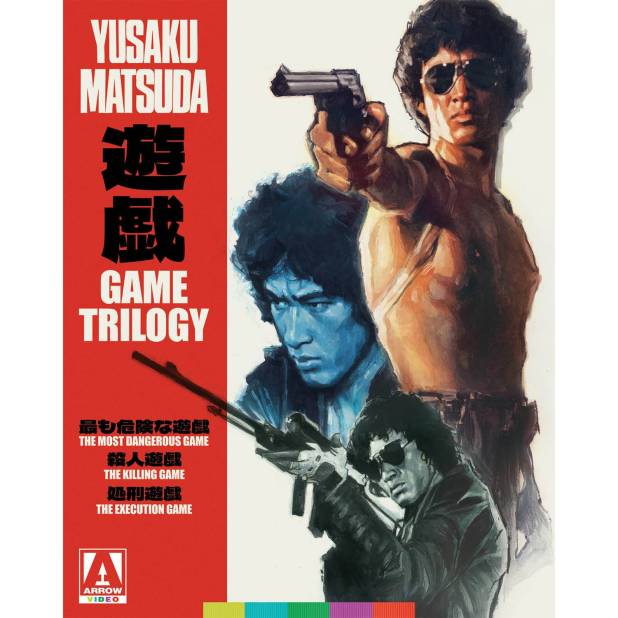
At the end of the 1970s, Toru Murakawa’s Game Trilogy launched actor Yusaku Matsuda as the Toei tough guy for a new generation. Sadly, he would die from cancer at the way too early age of 40 after appearing in Black Rain.
As Shohei Narumi, he’s a killing machine who speaks little, shoots often and never falls for anything. The new Arrow Video set of these films is the first time these movies have been released outside of Japan and man, I loved every minute of these movies.
The Most Dangerous Game (1978): You first meet Shohei Narumi when he’s being roughed up after he contests a game of mah-jong. mah-jong game. He recovers from that in time to find and rescue a kidnapped businessman, at least for a few minutes before that guy is killed in the middle of a gun battle. Narumi is saved by Kyoko (Keiko Tasaka), the mistress of one of the men he’s trying to stop. He gets another job once he’s back on his feet: kill the boss of the kidnappers, which he does. Twice.
How twice? The guy has a public double, so they both have to go. But even the cops are on the take, setting an ambush, but he escapes and, well, kills everyone except one car of criminals who kidnap Kyoko and drive her across Tokyo while somehow, incredibly, Narumi keeps up while wearing cowboy boots. Look, I’ve been on Japanese streets and even though they are clogged with traffic, there’s no way you can chase a car on foot.
The one issue I have with the movie is that it’s kind of hard to like the hero. I mean, he isn’t even a hero, for one. He wins over Kyoko by assaulting her. But then, the film almost demands that you become a fan of him, what with the cool as cool gets clothes, him drinking gin when shot in the stomach instead fo going to the hospital and just being an all around amoral killing machine. Because you never see anything the bad guys do or plan because the movie moves from action moment to action moment like an ADHD kid playing with his toys, you eventually have to concede that he is the protagonist that you must be in favor of.
Directed by Tôru Murakawa and written by Hideichi Nagahara, this film has literally a slam bam pace that never slows down. Ever.
The Killing Game (1978): Shohei Narumi has been in hiding for five years after a major assassination assignment. He’s poor, no longer able to afford his fancy lifestyle. He can’t even get a drink at the hostess bar he gets pulled into.
We don’t have anything like a hostess bar in America. They aren’t places of prostitution but instead a modern version of geishas, providing entertainment and flirtation to lonely salarymen.
While there, Shohei Narumi runs into two women from his past. A hostress named Akiko (Kaori Takeda) was the daughter of the man our protagonist killed five years ago. Yet she doesn’t hate him for it. The other is the mama-san — the boss of the place — named Misako (Yutaka Nakajima). As he shot everyone he could five years ago, she is the one person he let live. Now she’s dating another boss, Katsuda (Kei Sato), and he wants Shohei Narumi to start killing for him. So does another boss. That means that everybody is going to die, many of them from bullets that Shohei Narumi shoots.
What comes across at the end of this film is the fact that without someone to kill, his existence is pointless. He’s like an unfired gun. All he knows in this life is how to end others.
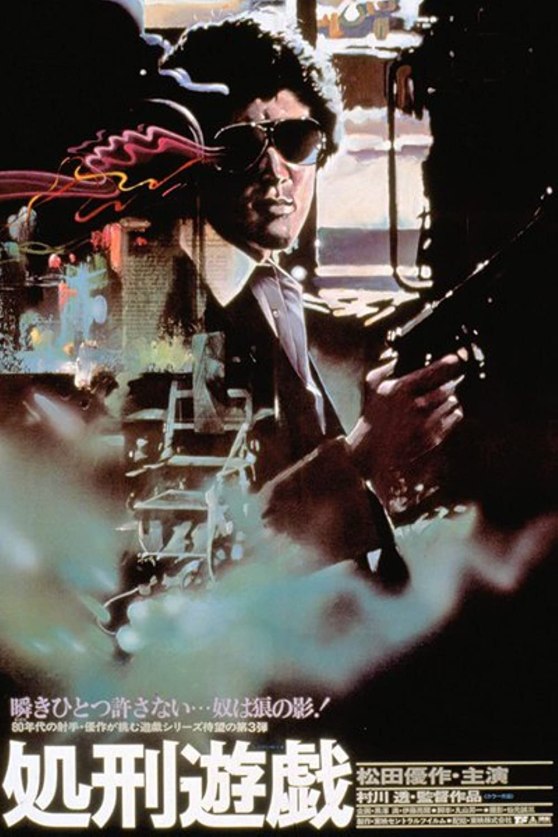
The Execution Game (1979): Shohei Narumi wakes up alone in a filthy room. All he can remember is a girl, a car and a hit to the head, but now he’s hanging from a ceiling and finds out that this is all a trial to test his skills for a new client. They want him to kill their current hitman, who has started acting strangely, but that’s just the start of his new work.
He also has a relationship in this movie, even if she betrays him, and tells a young woman to avoid shady men at one point. This is in contrast to how he acted in the first film, so is this growth? I believe so, as is the idea that he sees the ocean as where he wants to return, growing up close to it and its ebbs and flows symbolize the way his life goes: bloody bursts of ultraviolence mixed with solitude, sometimes for years.
The past films have seen him exhausted and nearly passed out as women strip around him or frantically trying to pay for everyone in a hostess club, knowing that he has nearly nothing. Here, he’s a man that knows his job and what he has to do. That means always being ready to be sold out, always prepared to be in the sights of someone’s weapon and constantly willing to kill someone, anyone, at any time.
The limited edition Arrow blu ray box set of The Game Trilogy has a high definition blu ray version of each movie with new English subtitles. You get a reversible sleeve featuring original and newly commissioned artwork by Tony Stella, a double-sided fold-out poster featuring original and newly commissioned artwork by Tony Stella and an illustrated collector’s booklet featuring new writing on the films by Hayley Scanlon and Dimitri Ianni.
The Most Dangerous Game has new audio commentary by Chris Poggiali and Marc Walkow, a 30-minute interview with director Toru Murakawa, the original Japanese theatrical trailer and an image gallery.
The Killing Game has commentary by Earl Jackson and Jasper Sharp. The Execution Game has new commentary by Tom Mes. Extras include an interview with Yutaka Oki, film critic and personal friend of Yusaku Matsuda; an interview with screenwriter Shoichi Maruyama, the original Japanese theatrical trailers and image galleries for both films.
Sammo Hung made his directorial debut with The Iron-Fisted Monk and was ready to show more of who he was with this, his second film. Starring Casanova Wong as Cashier Hua and Hung as his friend Fat Chun, this is what happens when Hua is left for dead after discovering a conspiracy against the mayor. Chun tells his friend that if he wants to stay alive, he must study the fighting style Wing Chun from Master Leung Tsan (Bryan Leung Kar-Yan).
Master Tsan is a doctor and master of Wing Chun who can trace his martial arts lineage all the way back to the style’s founder. What’s amazing is that Wing Chun has at least eight different distinct lineages and each of those have their own origins. Those eight schools are based on the teachings of Ip Man, Yuen Kay-shan, Gu Lao Village, Nanyang / Cao Dean, Pan Nam, Pao Fa Lien, Hung Suen / Hung Gu Biu, Jee Shim and Weng Chun. We will never know the true origins of the fighting art, as the skills, movements and even history were shared from teacher to student by voice only. Nothing was in writing, as it was connected to anti-Qing rebellion and must remain in the shadows.
Tsan does what we expect from a martial arts movie. He makes Hua go through a series of training sessions to become a fighting expert, but will he learn enough in time, what with the men who tried to kill him before still searching for him?
The final battle proves that yes, he knows enough.
The Arrow blu ray release of Warriors Two has 2K restorations from the original elements by Fortune Star of both the original Hong Kong theatrical cut and the shorter export cut. You can listen to two different English dubs, as well as Cantonese and Mandarin options.
There are two commentary tracks. Martial arts cinema expert Frank Djeng and actor Bobby Samuels discuss the Hong Kong version and action cinema experts Mike Leeder and Arne Venema are on the export version. There’s also The Way of the Warrior: The Making of Warriors Two, featuring interviews with stars Sammo Hung, Bryan “Beardy” Leung Kar-Yan, Feng Hak-An, Casanova Wong and Wing Chun master Guy Lai, an interview with Bryan Leung Kar-Yan and the original theatrical trailers.
You also get a double-sided fold-out poster featuring original and newly commissioned artwork by Joe Kim, a reversible sleeve featuring original and newly commissioned artwork by Joe Kim and an illustrated collector’s booklet featuring new writing by Jonathan Clements and original press materials.
VIDEO ARCHIVES NOTES: This movie was discussed on the October 11, 2022 episode of the Video Archives podcast and can be found on their site here.
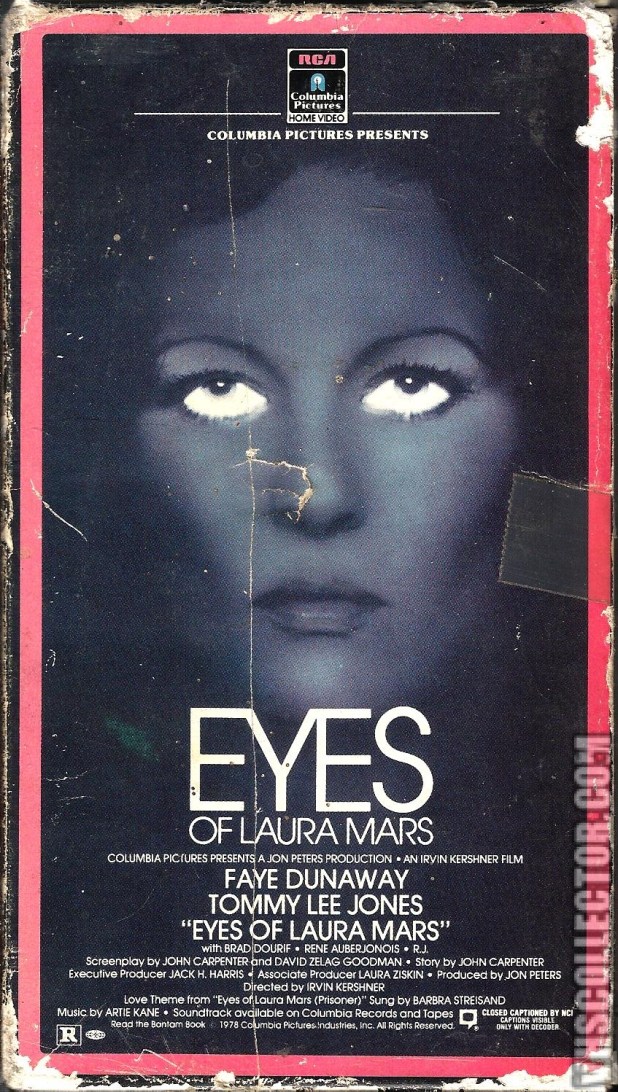
Never say never, but I think this will be the only movie we ever feature on this site that has a love theme by Barbara Streisand in it. I could be wrong, but I just get the feeling that there aren’t going to be many more crossovers quite like this one.
Eyes of Laura Mars was adapted from a spec script titled Eyes, written by John Carpenter; making this Carpenter’s first major studio film. Producer Jon Peters, the beau of Barbra Streisand in this era, bought the screenplay as a vehicle for her, but Babs felt that it was too “kinky” and passed. However, she felt that “Prisoner,” the song that she lent to the film, would be a great single. She wasn’t wrong — it peaked at #21 on the Billboard Hot 100.
Instead of Ms. Streisand, we get Faye Dunaway, who had just won an Oscar for Network and had not yet become Mommie Dearest. She plays Laura Mars, a fashion photographer whose Chris Von Wangenheim by way of Helmut Newton-style photos (Newton and Rebecca Blake supplied the actual photos for the film) glamorize violence. As she’s due to release the first coffee table collection of her work, she begins seeing the murders of her friends and co-workers through the eyes of the killer. I love how until now, she’s only been detached and seen things through the eye of a camera.
John Neville (Tommy Lee Jones) is the cop in charge. After she rushes to a murder scene exclaiming that she saw who did it blocks away, the cops keep her in custody, showing her numerous unpublished crime scene photos that match her new fashion photos perfectly. Throughout the film, Larua and Neville fall in love as her visions — and the murders — increase in intensity and violence.
This is a great example of an American giallo filled with the twists, turns and red herrings of the genre. It’s done with a much higher budget and way better locations than you’re used to. And it gets closer to the psychosexual elements, but as great a director as Irvin Kershner is, he isn’t a maniac like Argento and his ilk. It’s also packed with talent, like Raul Julia, Battle Beyond the Stars‘ Darlanne Fluegel, Rene Auberjonois and Chucky himself, Brad Dourif.
The Eyes of Laura Mars would be parodied as The Eyes of Lurid Mess in MAD Magazine #206, with art by Angelo Torres. As was often the case with R rated movies when I was six years old, I first experienced this movie through the black and white ink lens of MAD.
When seen through the lens of the giallo form, The Eyes of Laura Mars reminds me of post-Deep Red era Argento — taking the basics of the detective form and grafting on one supernatural element. Here, it’s the fact that Laura Mars (Faye Dunaway), a high glam fashion photographer, can see the violent deaths of people as she takes photos. The images that they inspire lead her to great success and controversy, creating an intriguing narrative of the violent and at times bloody battle of inspiration for artists. I’m also struck by how detached Mars is from the art and fashion world in which she lives, until she’s in the midst of shooting. Then, she finally opens not just herself up, but her posture. She spreads low to the ground, sexualizing herself when she’s often covered by clothing throughout the film that hides her body from the world.
Going from an independent picture produced by Jack H. Harris to big studio affair by Jon Peters (who dreamed of then-girlfriend Barbara Streisand in the lead), The Eyes of Laura Mars struggled with a new writer being brought in to adjust John Carpenter’s script (the auteur said “The original script was very good, I thought. But it got shat upon.”) and the production lasted 7 long months, including a 4 day shoot in the middle of New York City to capture a major fashion shoot with models, wrecked cars and fire everywhere.
It has assured direction by Irvin Kershner, which led to him being hired for The Empire Strikes Back. After watching so much giallo, I’ve noticed that the America versions of the form are very much like Laura Mars herself: detached, cold and not all that interested in the murder as art that native Italian creators like the aforementioned Argento immerse themselves in. This film is made in hues of black and white when their world is neon and always the most red possible.
Upon a new view of this film, I was also struck by just how great the cast is. Tommy Lee Jones is perfectly cast, with his final speech near-perfect. In truth, he wrote that ending monologue, but credited it to Tommy Lee Jones actually wrote his own monologue, crediting it to Kershner, unbeknownst to the Writers’ Guild. Brad Dourif is routinely amazing in movies and his small role here is still a stand-out, as is the acting of Rene Auberjonois and Raul Julia.
This movie also features one of my favorite settings: New York City at the end of the 1970’s, which I feel is the closest place to Hell on Earth that has ever existed. As a child, I watched WOR Channel 9 news from the safety of being a few hundred miles away in Pittsburgh and wondered who would ever want to live in this city. You can almost smell the garbage and desperation in the air here, which is in sharp contrast to the cold, metallic and not so real world of fashion and art.
VIDEO ARCHIVES NOTES: This movie was discussed on the November 22, 2022 episode of the Video Archives podcast and can be found on their site here.
Slithis is a lot like Godzilla. He comes from radiation, he’s green and he wants to make humanity pay. But really, the comparisons stop there.
Shot over twelve fifteen-hour days, Slithis seems like it was hell for the actor who portrayed the monster, Win Condict. He had to be sewn into the rubber Slithis costume at the beginning of every day and stay in it until shooting was done. There were no buttons. No zippers. Only Slithis.
The monster’s rage starts with dogs, who frankly had nothing to do with his condition. Please join our dog Angelo in his protest of movies that use threatening and murdering dogs to cheaply draw our attention.
My biggest question is why is Wayne Connors’ (the hero of the film) wife named Jeff (Judy Motulsky from the little known Idaho Transfer)?
The entire first hour of this movie concerns the boring research and tracking of the creature. By the time they find him, it’s shocking just how well done the costume is. It doesn’t need hidden, so why did we have to wait so long to see it?
No, instead the film forces us to watch a turtle race. I shit you not. You know what? That’s actually kind of awesome that instead of telling a gripping, horror-filled tale, the directorial choice was to show the entirety of a race between animals that are classically known as the slowest around.
How do you survive a Slithis attack? Simple. Join his fan club. He’ll remember you when he’s in your neighborhood.
VIDEO ARCHIVES NOTES: This movie was discussed on the November 22, 2022 episode of the Video Archives podcast and can be found on their site here.
Directed by Carl Reiner and written by Steve Gordon (who would direct his next script, Arthur, and then die at the age of 44), The One and Only has an unlikeable hero at its core. Andy Schmidt (Henry Winkler) is someone who thinks he’s better than everyone at everything he does, out for only himself, even using bit parts as opportunities to ruin everyone else’s work, as long as he gets noticed. He falls for Mary Crawford (Kim Darby), a college student who is already engaged. I have no idea why she falls for him, because there’s nothing there, despite something that she sees below whatever surface Andy has. Somehow, they get married and she has to learn that being the wife of a starving actor is harrowing.
Yet Andy finds something he’s good at. He may not have the build for it, but he’s great at wrestling. He’s brought into the business by little lothario Milton Miller (Hervé Villechaize) and starts working for Sidney Seltzer (Gene Sakes), who drops this knowledge on the audience: “There’s two kinds of people, those who put lampshades on lamps and those who put lampshades on their heads.”
Her parents — William Daniels and another sitcom star who took over the show she was just a secondary character on, Polly Holliday, who played Flo on Alice — don’t approve. And eventually, she gives up on Andy while they come around on him. They even become wrestling fans when he gets on network TV. And he really learns nothing, being the same person no matter what.
The film is well-written — Gordon was a sitcom veteran and writes wonderful dialogue — but you end up caring more about the accouterments of the film more than its characters. That said, it has lots of wrestling cameos, including Hard Boiled Haggerty — of course — as Captain Nemo, Chavo Guerrero Sr. as Indian Joe, ring announcer Jimmy Lennon Sr., Gene LaBelle — of course again — as the world champion, Ed Begley Jr. (not a wrestler, but still good in this) as Arnold the King and “Rowdy” Roddy Piper as “Leatherneck” Joe Grady.
Throughout, Andy keeps trying to find a gimmick that works until finding The Lover, a man who believes that everyone should be in love with him. He understands what wrestler Raven preached about your character. It should be 80% you and 20% of the most idealized version of you, the you that you wish you could be. This movie gets a lot of pro wrestling right — I wrestled for over 25 years in the lowest rungs on the independent wrestling periphery — and the one part that it gets wrong is that most heels are the most giving and nicest people you’d ever meet. The faces, the good guys? They’re usually Andy Schmidt.
What’s amazing is that this movie came out at the height of Winkler’s Happy Days fame and he played a character totally unlike the Fonz. That’s brave and while not the best for this film’s box office, it was for his career. We’re still thinking about him today.
The working title of this movie was Gorgeous George, which makes sense, as “Gorgeous” George Raymond Wagner was a huge star in the early days of television, someone who was the kind of star that even casual non-fans would have known.
Winkler’s parents Ilse Anna Marie and Harry Irving Winkle left Germany in 1939, as they were Jewish people worried about the Nazis. The star told The Wall Street Journal, “At the time, my father, Harry, told my mother, Ilse, that they were traveling to the U.S. on a brief business trip. He knew they were never going back. Had he told my mother that they were leaving Germany for good, she might have insisted on remaining behind with her family. Many in their families who stayed perished during the Holocaust.” His Unlce Helmut was one of them. Knowing that, it’s astonishing that Winkler dresses in a Nazi gimmick in this movie.
But that’s very much in spirit of the carny roots of pro wrestling. It’s heat. And heat draws money.
Oh man! I forgot the best part! Mary Woronov is in this and gets set up with Hervé!
VIDEO ARCHIVES NOTES: This movie was discussed on the September 22, 2022 episode of the Video Archives podcast and can be found on their site here.
Robin Cook graduated from Wesleyan University and Columbia University College of Physicians and Surgeons before finishing his postgraduate medical training at Harvard. One of his first medical jobs was running the Cousteau Society’s blood-gas lab. He later became an aquanaut with the U.S. Navy’s SEALAB program and reached the rank of lieutenant commander. His first novel, Year of the Intern, was written while he was on the crew of the submarine USS Kamehameha. When that book failed, he studied how best sellers became big books and used those techniques to write Coma, saying “I studied how the reader was manipulated by the writer. I came up with a list of techniques that I wrote down on index cards. And I used every one of them in Coma.”
He said of the book, “I suppose that you could say that it’s the most like Coma in fact that it deals with an issue that everybody seems to be concerned about. I wrote this book to address the stem cell issue, which the public really doesn’t know anything about. Besides entertaining readers, my main goal is to get people interested in some of these issues, because it’s the public that ultimately should be able to decide which way we ought to go in something as ethically questioning as stem cell research.”
Michael Crichton, who directed this, met when Cook when the future Jurassic Park writer was doing post-doctoral work in biology at La Jolla’s Salk Institute. This would be the first movie he’d direct after Westworld.
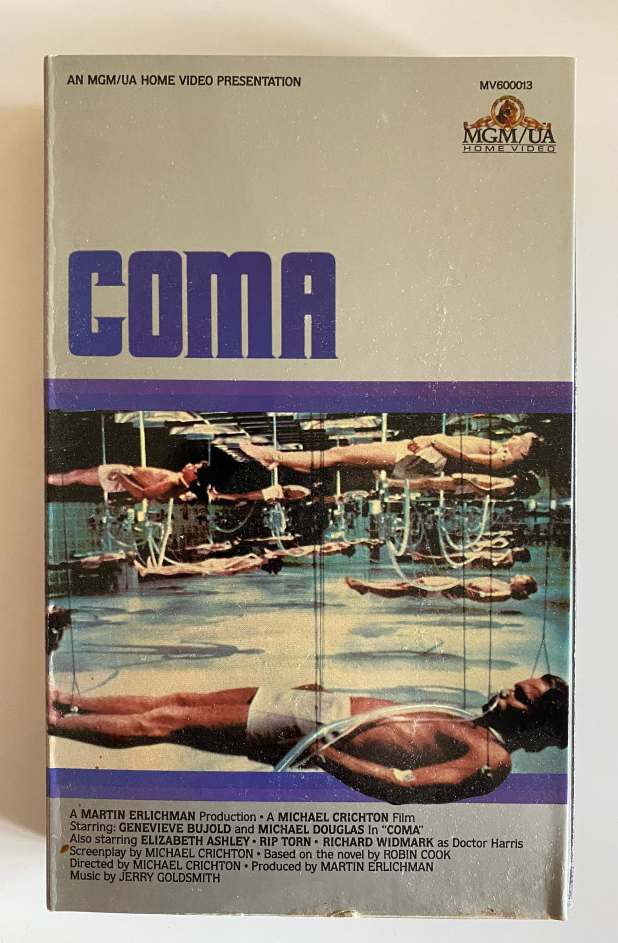
Dr. Susan Wheeler (Geneviève Bujold and wow, she’s amazing and gorgeous in this) is a surgical resident at Boston Memorial Hospital. One day, her friend Nancy Greenly (Lois Chiles, Moonraker) dies on the operating table during a basic surgery. She starts to take notice of how many otherwise healthy young people are dying in operating room 8. Yet her boyfriend Dr. Mark Bellows (Michael Douglas) thinks it has to be a coincidence.
She tries to investigate but ends up angering Dr. George (Rip Torn), the Chief of Anesthesiology, and Dr. Harris (Richard Widmark), the Chief of Surgery. She begins to feel all alone, even doubting her lover Mark. It’s all connected to the mysterious Jefferson Institute, a place where all of those supposedly dead people are kept alive to be sold to the international human organ black market. Soon, she’s knocked out and being wheeled into surgery herself and headed to OR 8. Can her boyfriend save her in time? I was worried until the credits.
Crichton said, “This is a story that contains many elements of reality: the fear people have of surgery, the fear of dying at the hands of your doctor, phobias about hospitals. Those are very real fears, and so to exaggerate them would not be much fun. My idea was to put the picture together in such a way that the fears are put in a safe prospective, and can be enjoyed as scares, without awakening deeper and more real anxieties.”
Despite Crichton trying not to scare audiences away from hospitals, many physicians and hospital administrators claimed that that was exactly what happened.
You know who did see this movie? Harry Manfredini. That noise that rings out when someone is being stalked would get used by him a year later in Friday the 13th.










 B&S About Movies
You must be logged in to post a comment.