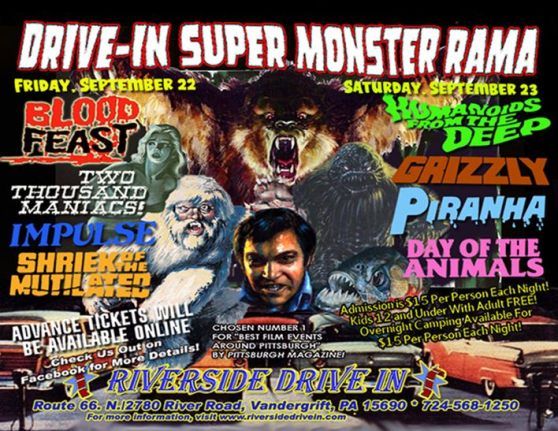
EDITOR’S NOTE: This weekend is the Drive-In Super Monster-Rama! Get more info at the official Drive-In Super Monster-Rama Facebook page and get your tickets at the Riverside Drive-In’s webpage.
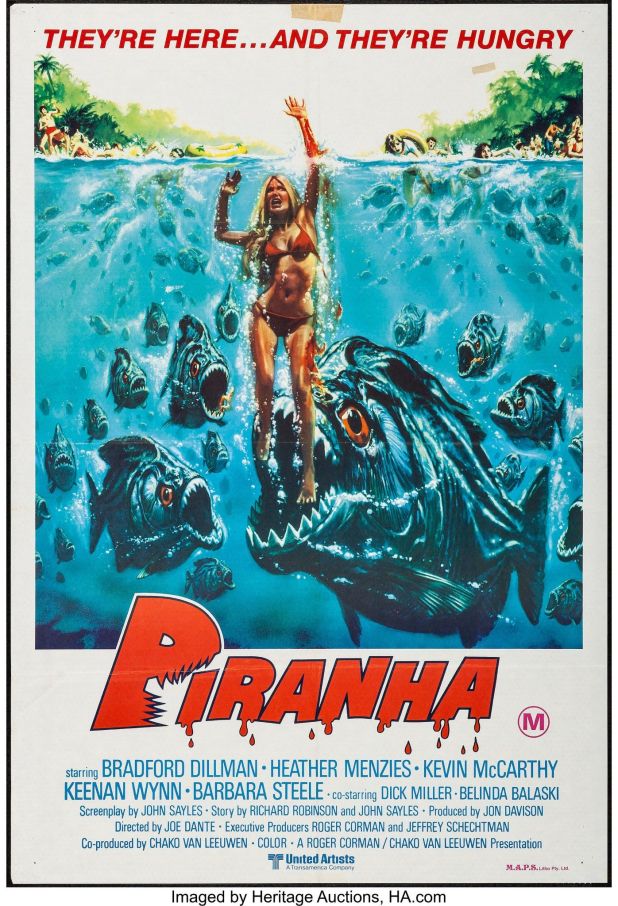
Piranha almost never made it to the theater. Universal Studios had considered obtaining an injunction to prevent it from being released, particularly as they had Jaws 2 out that year, but the lawsuit was called off after Steven Spielberg himself gave the film a positive comment (he also called the film the “best of the Jaws ripoffs”).
Joe Dante is my favorite type of filmmaker. Even when you think you know what to expect, he zigs and zags, giving you genuine surprises and fun at every turn.
The action starts with two teens swimming in the waters of an abandoned military base — as you do. Of course, they’re instantly obliterated by an unseen creature.
Skiptracer Maggie McKeown (Heather Menzies, who beyond being the wife of Robert Urich was Louisa Con Trapp in The Sound of Music and even appeared in an August 1973 Playboy pictorial entitled “Tender Trapp”) is looking for those missing teens and she’s hired Paul Grogran (Bradford Dillman, who battled many an ecological horror in Bug, The Swarmand Lords of the Deep) for help. He’s a drunk and surly mountain man, which in the 1970s makes you a sex symbol.
Why is Grogan so multi-layered? It turns out that Bradford Dillman wasn’t pleased with how flat his character originally was, so he asked writer John Sayles why. The response was that producer Roger Corman never hired good actors, so he rarely wrote nuanced characters. However, Dillman offered Sayles the opportunity to do something deeper, if you’ll pardon the pun.
They discover the abandoned compound where the teens died and discover that it’s a militarized fish hatchery. Maggie drains the outside pool and discovers too late that she’s released Operation: Razorteeth, a strain of piranha made to survive the cold North Vietnamese rivers and win the war in Southeast Asia.
That’s when Grogan realizes that if the local dam is somehow opened, the piranha will attack the Lost River water park and the camp where his daughter is spending the summer. Everybody pays the price for the piranha, like their now crazed creator Dr. Robert Hoak (Kevin McCarthy from Invasion of the Body Snatchers). Soon, the military is involved and our heroes are on the run, trying to warn the media and anyone that will listen that these killer fish are on their way. Nothing will stop them, not even the poison that Colonel Waxman and Dr. Mengers (Barbara Steele!) think will do the job.
Of course, the fish survive and attack the summer camp, wiping out nearly everyone but Suzie thanks to her fear of water. Now, they’re on their way to Buck Gordon’s (Dick Miller, perfect as always) waterpark, where they end up killing Waxman.
Grogan and Maggie come up with a totally ridiculous plan: to use the hazardous waste from the smelting plant to kill off the fish before they spread into the ocean. Our hero, such as he is, must go deep underwater to make this happen and he barely survives, left in a catatonic state at the end of the film.
Dr. Mengers gives the government’s side of the story, downplaying the danger of the piranha and saying there’s nothing left to fear, but as we see another beach, we now hear the sound of the deadly school of fish.
Beyond Dick Miller, this film features plenty of actors that Dante would work with again and again, like Belinda Balaski, the film’s writer John Sayles and the always welcome Paul Bartel. Plus, Francis Xavier Aloysius James Jeremiah Keenan Wynn shows up, but we all know him better as his stage name, Keenan Wynn. And another Invasion of the Body Snatchers alum, Richard Deacon, is here as well.
Piranha is the rarest of films — one that rises above being a simple ripoff and comes close to eclipsing the source material. It’s quick, bloody and fun as hell, with awesome effects from Phil Tippett and the debuting Rob Bottin, who was only 17 at the time.
Can’t make it to the drive-in? You can watch this on Tubi.
EDITOR’S NOTE: Starhops aired on USA Up All Night on June 2, 1989; June 1, 1990 and April 26 and 27, 1991.
Stephanie Rothman was studying at UC Berkeley when The Seventh Seal made her want to become a filmmaker. She was the first woman to be awarded the Directors Guild of America fellowship, which was one of the reasons why Roger Corman hired her as his assistant (selecting her over another applicant, the woman who became his wife Julie).
She directed It’s a Bikini World, which was not the kind of movie she wanted to do and was semi-retired until working on the film Gas-s-s-s. She then directed The Student Nurses, an exploitation film that she was not aware was an exploitation film, as she had carte blanche to explore political and social issues in the film that interested her.
She said, “I went and did some research to find out exactly what exploitation films were, their history and so forth, and then I knew that’s what I was doing, because I was making low-budget films that were transgressive in that they showed more extreme things than what would be shown in a studio film, and whose success depended on their advertising, because they had no stars in them. It was dismaying to me, but at the same time I decided to make the best exploitation films I could. If that was going to be my lot, then that’s what I was going to try and do with it.”
She wasn’t interested in making a sequel to The Student Nursesor making The Big Doll House, but her next movie was The Velvet Vampire. Moving to Dimension Pictures, she directed Terminal Island, The Working Girls and Group Marriage.
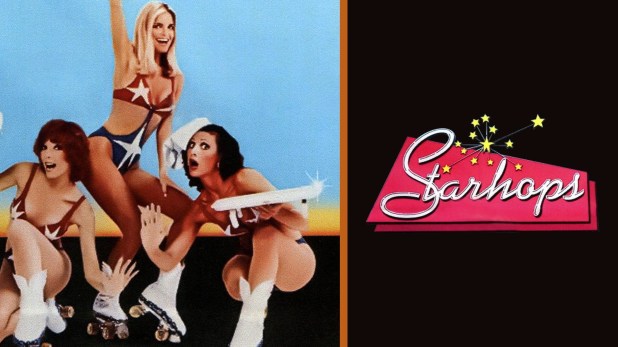
However, attempts to go mainstream were stigmatized by the films that she had made. Before ending her movie-making career, the rumor was that she reshot some scenes in Rubyand definitely wrote Starhops before taking her name off it, as it was not the film she wanted it to be.
It is, however, directed by Barbara Peeters, the only other female director from New World Pictures. She famously warred with Corman over the additions to Humanoids from the Deepand directed favorites like Bury Me an Angel and the TV series The Powers of Matthew Star.
But what about the movie itself? Well, it’s a trifle, about three waitresses, Danielle, Cupcake and Angel, who all work together to stop their fast food restaurant from going broke. Of course, Dick Miller shows up, as this is a Roger Corman-associated film.
What’s interesting about Angel is that she’s played by Jillian Kesner-Graver, who was not only Fonzie’s girlfriend Lorraine on Happy Days, but worked with her husband Gary to preserve the films and legacy of Orson Welles.
Starhops isn’t really funny. Or sexy. It’s just kind of there. But sometimes, you watch a bad movie and learn about some interesting people.
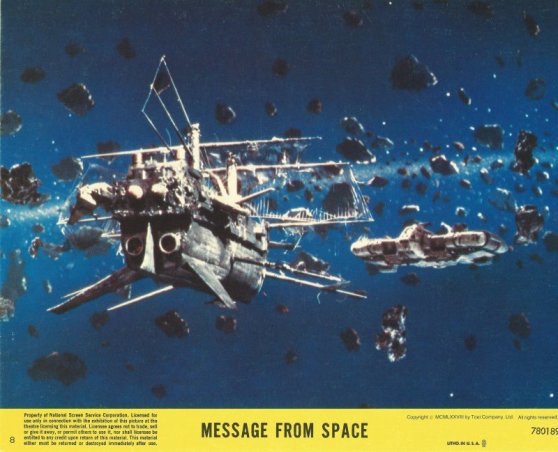
EDITOR’S NOTE: Message from Space aired as the third movie on USA Up All Night on December 1, 1990.
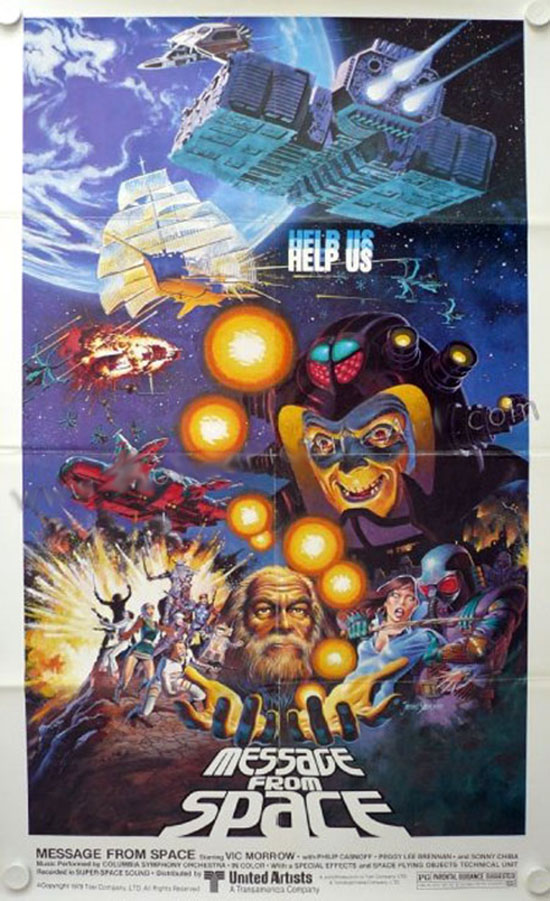
At nearly half the budget of Star Wars — $6 to $7 million dollars — Message from Space was the most expensive movie in Japanese history up until 1980. At the time, it was routinely panned by the critics. Yet watching it nearly 40 years later, I was struck by just how ambitious, fun and strange it is.
Jillucia was once a planet of peace, but that was before the Gavanas Empire turned it into one of their military bases. Kido, one of the planet’s leaders, sends eight Liabe seeds into space to find soldiers strong enough to liberate the planet from the steel grip — and faces — of the Gavanas. Princess Emeralida (Etsuko Shiomi, Sister Street Fighter) and Urocco follow them into space in a space galleon.
We meet some space racers — Shiro (Hiroyuki Sanada, Shingen from The Wolverine) and Aaron — and a spoiled rich kid named Meia who are chasing one another through some asteroids. These guys mess up the Kessel Run and wreck, but then find some Laibe seeds in their ships.
General Garuda (the name means phoenix and the role is played by Vic Morrow, who graced the screen in films like 1990: The Bronx Warriors and Humanoids from the Deepbefore dying while making Twilight Zone: The Movie) is a drinking man, embittered by the loss of Beba-1, his robot. He orders that a rocket send the body of his faithful companion into space, which gets him in trouble with his superiors, who see it as a waste. This leads him to retire and take up a bar stool on Milazeria, where he also finds a Liabe seed.
In that very same bar, Jack puts the pressure on Shiro and Aaron to repay their debts, as he himself owes the gangster Big Sam (no relation to Jabba) plenty of dough. Oh — he also finds a seed. To get the cash, they agree to take Meia to a forbidden zone where she can watch fireflies. On the way, the Gavanas attack, destroying the space galleon and a police ship.
All of our heroes battle, but when the seeds — and Garuda, who is sleeping off his drinking — reveal themselves, Emeralida explains that the seeds have chosen them to liberate her planet. Garuda responds by leaving in a huff, but Beba-2 promises to get him to change his mind. There’s supposedly a Chris Isaak cameo as a gambler in the bar scenes, way before he became famous.
What follows next is a confusing mess of double crosses and people trying to get rid of their seeds and ten-year-old Sam would probably be not paying attention, just wishing that some aliens would show up and have a laser battle. Luckily, the Gavanas do show up to declare war on Earth and Garuda realizes his destiny is to defend his home planet. And to make the film a million times more exciting, they meet Prince Hans, the rightful leader of the Gavanas. He doesn’t have their silver skin, but he is played by Sonny Chiba.
Urocco, Jack, Shiro and Aaron fly to Jilutia, with Shiro and Aaron’s ships mounted on Mayah’s ship. As they near their destination, Mayah’s Leyabe seed explodes, causing the ship to crash on a planet in the Bernard system. There they find what appears to be a Gavanas warrior without a metallic skin, and wearing a Leyabe seed around his neck. The warrior introduces himself as Prince Hans, the rightful heir of the Gavanas’ throne. He explains that Rockseia killed his royal parents and took the throne for himself.
The Emperor and Empress of the Gavanas meet with Garuda, who challenges one of their warriors to a duel. After walking less than ten paces, that warrior sneak attacks Garuda, who shrugs off a laser beam to the back (it must have been his snazzy military uniform and phoenix patch). Garuda bests the soldier, yet gives him mercy before the Emperor wipes the disgraced soldier out. The leaders — who had to have inspired Prince Zarkon and Haggar from Voltron — destroy the moon and demand that Earth surrender.
Garuda, Jack and Beba-2 leave Jilutia but then turn around. All three parachute to the surface. In the meantime Maya’s ship approaches Jilutia, making the ‘chicken run’ approach used earlier by Aaron and Shiro. The pair separate their ships near the surface, and the three ships pull up and fly through a rocky canyon, simulating a meteor impact. The ships then re-connect and land. Urrocco finds the Jilutian survivors hiding in the hull of a space galleon. Urrocco and the others meet Jack, Garuda and Beba-2. They realize there are now six Leyabe warriors, but wonder who the other two might be.
Finally, it’s time for space battles and sword fights. Sonny Chiba goes off slashing everyone with his sword. There are suicide runs — Meia uncomfortably says, “They don’t call me kamikaze for nothing.” — and ships blowing up and planets exploding and all manner of space opera nonsense, ending with all of the heroes being saved from death by the seeds.
Message from Space was popular enough that it became a TV series in Japan. Over here, it didn’t fare as well. It’s a crazy looking movie, with gigantic sets, gorgeous costumes and lunacy aplenty, like people skydiving from space and silver faced aliens doing battle with drunken space captains and a rich girl and dudes who just like to race rockets.
Director Kinji Fukasaku (Battle Royale) really has a great time with the budget he’s been given and wastes none of it. It’s a glitzy, gaudy spectacle that the cynical amongst us would choose to deride and make fun of. I chose to watch it through younger eyes and find a fun and infectious joy at the heart of the film. Sure, it’s no Star Wars, but it’s still a fun Saturday afternoon film.
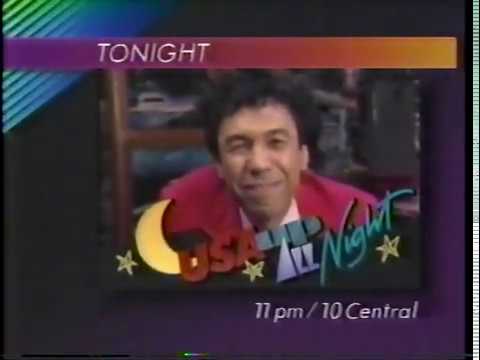
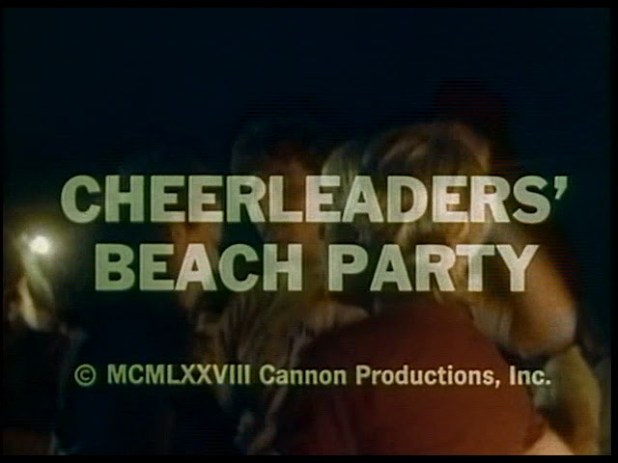
EDITOR’S NOTE: Cheerleader’s Beach Party was the first movie ever played on USA Up All Night on January 7, 1989. It played five more times after that: April 22 and October 6, 1989; March 16 and 17 and September 15, 1990.
Alex E. Goitein had already made Cherry Hill High for Cannon, but now he had Chuck Vincent writing his script, the man who would one day be able to boast of making Bedroom Eyes, Hot T-Shirts, American Tickler, Bedroom Eyes II, Sensations, Deranged, Young Nurses in Love and so many more movies. In fact, if you watched a lot of USA Up All Night, the chances were quite high that you were watching a Chuck Vincent movie.
Animal House then came out the same year and changed how sex comedies went from dirty little drive-in movies to big business. This film follows a similar story and was also known as California Cheerleaders.
The cheerleaders of Rambling University — Monica (Elizabeth Loredan), Toni (Jamie Jenson), Sissy (Lynn Hastings, also in Cherry Hill High) and Sheryl (Gloria Upson, who was also in…did you guess Cherry Hill High?) — fight to keep their players from going to another college, which means stealing the van of an opposing coach and putting crabs into the jockstraps of his players. They also destroy an old person pool party — or make it so much better — with some pot-laced brownies.
One of the teachers in this movie, Mr. Langley, is played by John Hart. Hart was a war hero who came back to Hollywood as an action film actor — he’s in the Jack Armstrong serial — and he was offered the opportunity to replace Clayton Moore on The Lone Ranger television series. The producers of the show believed that it was the character and not the actor that was the true star and when Moore asked for a better salary, he was let go. The public never accepted Hart as a replacement and by 1954 the producers returned Moore to the role. In his book I Was That Masked Man, Moore claimed that he’d never asked for a raise and had no idea why he was replaced. This was not the last time that producers screwed with Clayton Moore and the public stood up for the man they saw as the true Lone Ranger.
Back to Cheerleader’s Beach Party.
This movie is as 1978 as it gets, filled with disco, a Saturday Night Beaver, Billy Carter references and Fleetwood Mac pillow talk. There are, however, better cheerleader movies and to the point, better Chuck Vincent movies. But hey — if you were a kid and up late, Gilbert would make fun of this movie before and after the commercials, getting your weekend started.
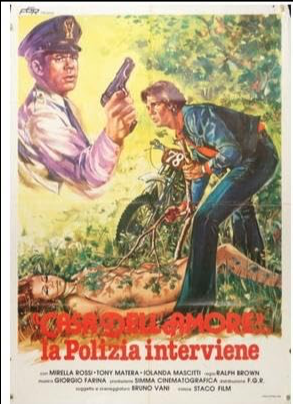
I’ve been trying to work my way through the non-horror films of Polselli and they’re fine, but I was missing something, Missing women standing wide-eyed and screaming, tree branches being used for the most nefarious of reasons and strange rituals happening for no reason at all. Thankfully — after much searching through some of the most nefarious of websites — I have found Casa dell’amore… la polizia intervene AKA House of Love… The Police Intervene.
My excitement was palpable just from the IMDB summary: “Three young hobby archeologists witness a Satanic ritual in a secluded villa. Instead of helping poor female victims they decide to secretly document the events.”
Hobby archaeologists! Satanic ritual! Secluded villa! This movie is my new plans for the day.
Directed by Polselli and written by long-time associate and often production manager Bruno Vani, this has Polselli using the name Ralph Brown and also having access to footage from the unfinished movie A Virgin for Satan by Alessandro Santini. That film was co-written by Vani and the ritual scenes in this film come from that film.
According to an article in Nocturno, this was called I torbidi misteri della sensualità (Obscure Mysteries of Sensuality) and was a reworking of another Polselli script for a movie called Tilt that was based on the Manson Family. In that script, a cult named The Children of Satan conducts an occult marriage ceremony with a nude bride covered with the blood of doves. What could have been…
Helm (Tony Matera, who is also in Torino centrale del vizio), Brigitte (Mirella Rossi, Oscenità, Confessioni segrete di un convento di clausura) and Charlotte (Iolanda Mascitti, Revelations of a Psychiatrist on the World of Sexual Perversion, Nude for Satan — how did Polselli not get in on that movie, what with Rita Calderoni as the star? — and the continuity person for Oscenità and script supervisor for Mania, which is incredible because who knew those movies had those roles?) are our three young hobby archaeologists who are looking for bones in the Italian countryside. Brigitte watches as two men overpower and kidnap a woman, which means that they now become twenty-something teen detectives.
Their search brings them to an old house on the edge of town where the elderly Claudia, her niece Elisabeth (Matilde Antonelli, No One Will Notice You’re Naked, Django’s girlfriend in the Brad Harris-starring, Roberto Mauri-directed Death Is Sweet from the Soldier of God) and Phillip live. Are you surprised to learn that these are the followers of Astoroph who sacrifice virgins in Black Masses? Well, the real shock is that instead of going to the police, our protagonists decide to do the investigation themselves and sell it to the press for big money. As for the cult, they plan on making Kathy Cunningham (Katia Cardinali, who is whipped to death in Delirio caldo by Rita Calderoni before she’s drowned in a bathtub and thrown from a window) their next sacrifice, as she has been willingly offered by her boyfriend Lawrence.
With around eleven minutes left in the movie, things start getting nutty, with robed figures chanting, a nude Elisabeth is leading the ritual and ah, man, the cops intervene, just like they promised in the title. There’s also a scene where two people fight with a chain and ladder as a weapon — what is, ECW? — before throwing hens at one another, followed by rocks being launched at a cultist who is then flattened by a bulldozer. There are also love scenes in the cut I’ve found that go to black, which I assume are where the hardcore inserts would find a home, and a skiing scene out of absolutely nowhere. I watched this as it should be watched: a seventh-generation VHS transferred to a porn site filled with pop-ups while sick or high with COVID-19 at 6 in the morning in the hours where it is late and not early.
This also has the thing that every Polselli movie needs: reaction shots of people bugging their eyes out. That’s what else these other movies have been missing. He must have given the direction, “Stand up and stare at the camera like someone is naked in public and no one knows what to do!”
Seriously, this movie has an extended scene of hens being thrown at people before someone’s head gets cut off with a bucket while our two leads run. Helm is straight up mounting this dude and it’s way intense, so upsetting that the girls just take off. Then they all chain themselves together while he and Brigitte laugh like lunatics while Charlotte looks afraid? What an ending?
What does it all mean? Who cares!
I also have to say, Pier Giorgio Farina turns in one strange soundtrack that is totally perfect for this movie. There are just electronic noises that drop in and out before going into synth runs and it’s like a super sparse affair that goes into church organs and I’m all about it.
It introduced me to his DISCOCROSS album, where he’s backed by Goblin.
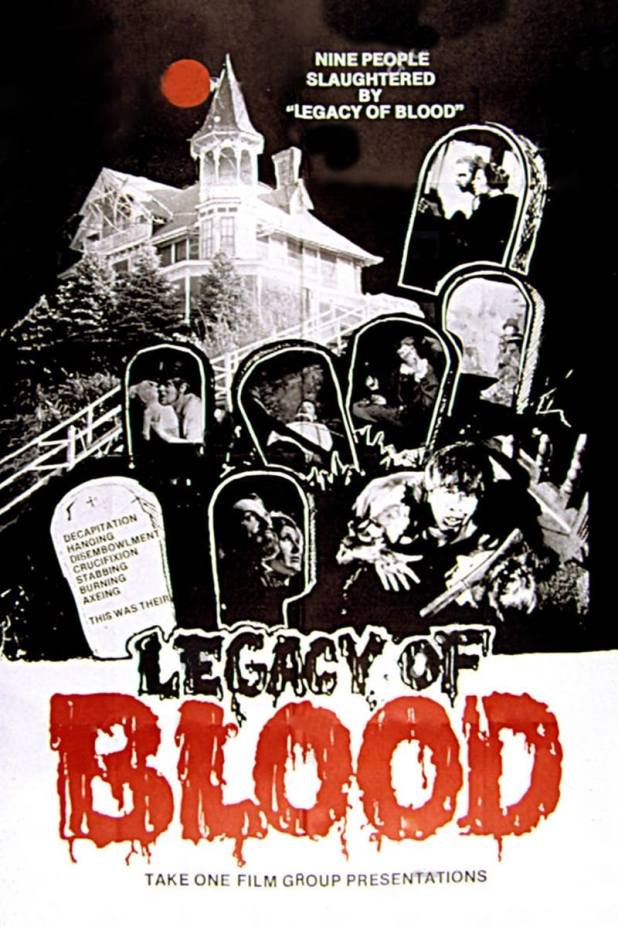
A remake — a loose one — of The Ghastly Ones, this movie has three sisters and their husbands arrive at a remote inn to attend the reading of their uncle’s will. One by one, they are dispatched by an unknown killer. It sounds simple, but this is Andy Milligan. It’s going to get strange.
“Think of your worst nightmare… It’s about to happen again!” That’s what brought people in for this movie and it’s a pretty good tagline. As for the movie, it’s set in the 1800s but obviously shot in modern day Staten Island. And who cares? By this point, if you’re watching this, you’ve given into the world of Andy Milligan.
Margaret (Elaine Boies) and Mary Lennox (Marilee Troncone) work in the Hanley Mansion, which is also home to their mentally challenged brother Carl (Chris Broderick). The master of the house is long gone, but now his daughetrshave finally come to claim their pieces of the estate. There’s Regina (Dale Hansen) and her husband Joe (Joe Downing); Jennifer (Louise Gallandra) and Robert (Peter Schwartz); and Louise and John (Peter Barcia), all of whom must spend three days together to get their inheritance. Well, that is if any of them survive, as the psychic Baba (Bob Elia) predicts at least one will die.
This was also edited into a TV cut, Legacy of Horror, that is a little longer but is missing the gore. That’s so much of the fun, as someone gets their guts sawed into, there’s a decapitation, a hand chopped off and an accidental hatchet to the head.
Legacy of Blood may be the most technically well-made of Andy Milligan’s films, but do we even come to his work for that?
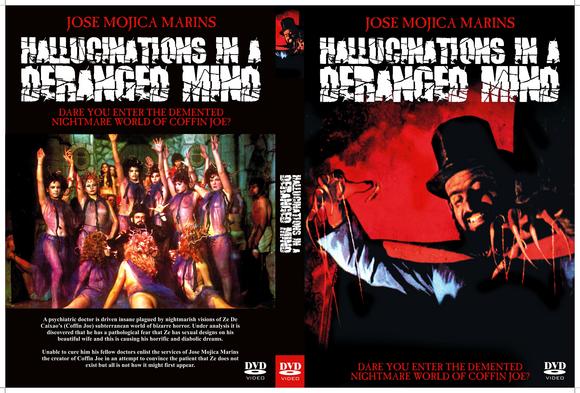
Dr. Hamílton (Jorge Peres) is a psychiatrist who is having nightmares in which Coffin Joe is taking his wife. Hse seeks help from filmmaker Jose Mojica Marins, who assures him that he created Coffin Joe, who doesn’t really exist.
By this point, even though it’s mentioned several times in this movie that Coffin Joe was not real, he has become real. He has become more than an idea and is Brazil’s national boogeyman. He exists in our imagination as real as an actual living being. Kind of like, oh you know, Freddy Kreuger, who took a similar path 16 years later.
It’s also a great way to get out all the strangest stuff that couldn’t be seen in the past. Sure, it’s barely connected, but if you’re looking for a Coffin Joe mixtape to put on with some fuzzed out music for a party, well, this is it.
EDITOR’S NOTE: The Beasts Are On the Streets was on the CBS Late Movie on February 22, 1984 and March 8, 1985.
Peter R. Hunt is best known for his work on the James Bond movies, editing many of the early movies and directing one of my favorites, On Her Majesty’s Secret Service.
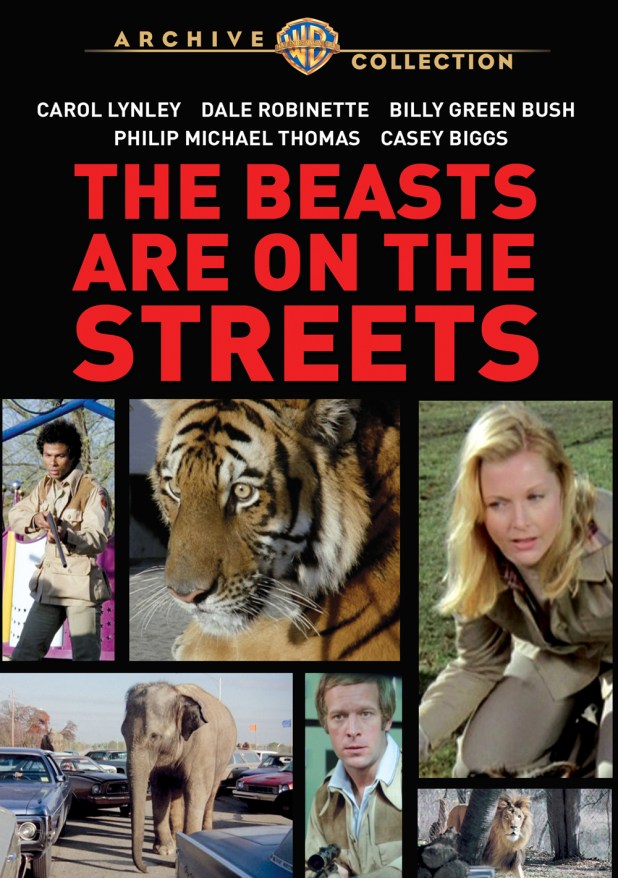
He also directed this Hanna-Barbera Production, written by Laurence Heath and Frederick Louis Fox, in which a tanker truck smashes into the fence of a Texas wildlife preserve, unleashing all of nature’s fury into the city, including bears, bison, zebras, rhinos, tigers, camels, antelopes, ostriches, elephants, lions and bears. Only Dr. Claire McCauley (Carol Lynley, Elevator) can save the day.
The strangeness of this movie comes from the fact that it uses the Hanna-Barbera audio library, so every sound effect for real happenings has the audio of a cartoon and what we know of cartoons, you know? It’s disconcerting.
A pre-Miami Vice Philip Michael Thomas is here, as is Bill Thurman, who is in several Larry Buchanan movies. He’s the pill-loving trucker who gets the movie in this mess.
Don’t expect Roar or Wild Beasts, but still, maybe you can ethically enjoy this film more, even if it doesn’t have some of the lunatic thrill of those other two animals gone wild films.
EDITOR’S NOTE: Matilda was on the CBS Late Movie on December 23, 1985.
When Melvin Simon Productions out up half the cash for this movie, they made nearly half a million in profit by selling the TV rights to CBS for $2.5 million, foreign sales which went around $1.6 million and American-International Pictures paid an advance of $1.8 million on the movie.
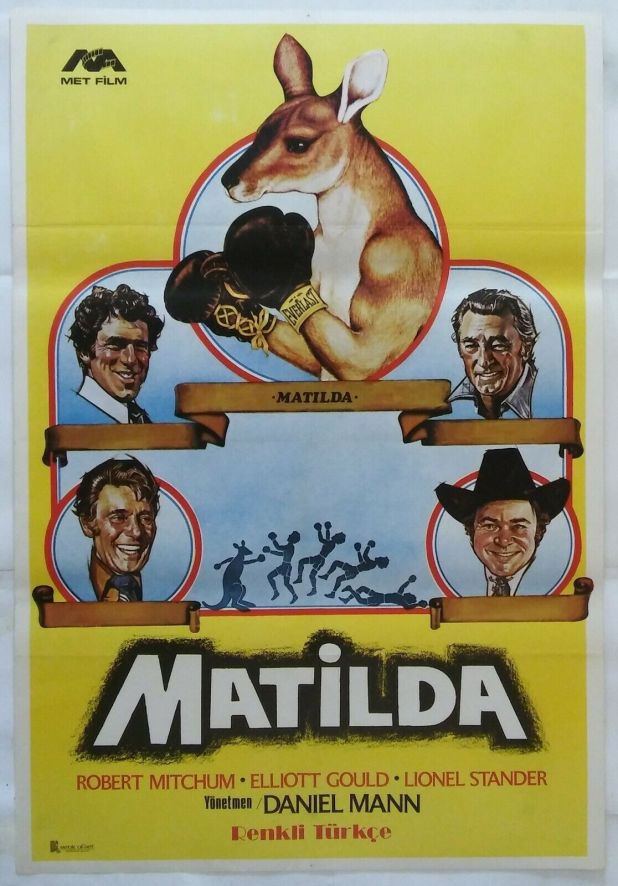
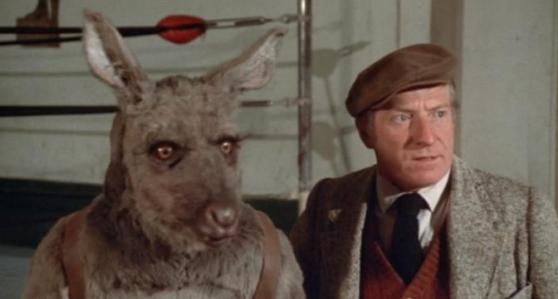
The fact that anyone made any money on this upsets me to no end, because this is amongst the most terrifying movies I’ve ever seen. The decision to not use a real kangaroo and instead spend thirty grand on a suit with Gary Morgan in it will give me nightmares for the rest of my life.
At one point, my wife walked in as the kangaroo had been hit for the first time and started loudly screaming and she said, “Why would anyone watch this?”
I just sheepishly looked at her and she left the room.
Clive Revill plays Billy Baker, the Irish pub owner who somehow gets the ownership of the boxing kangaroo Matilda. He alone has the power to see you in the audience and will speak to you through the fourth wall twice in this movie.
Elliot Gould, who plays Bernie Bonnelli, the man who thinks he can make money off a boxing kangaroo, said of this movie, “When Al Ruddy wanted to buy back my position, my points in the picture, he offered me hundreds of thousands of dollars, which at that point I decided would be bad karma. That was bad judgment on my part.”
I have no idea why Karen Carlson’s character falls in love with him, but I am fascinated by the fact that this movie is filled with so many of my favorite actors: Lionel Stander, Robert Mitchum and even Roberta Collins. Even more amazingly, this came out the same year that Gould made The Silent Partner, so he wasn’t hurting for work.
It also gets Harry Guardino into another animal movie in the same year, as he would also be in Every Which Way But Loose, while Roy Clark takes a break from Hee-Haw to play Wild Bill Wildman.
Directed by Daniel Mann, yes, the same man who made Willard and Our Man Flint, this was written by Timothy Galfas, Paul Gallico and the aforementioned Ruddy. They made a movie that’s supposedly for kids but in which organized crime figures try to cut off the tail of a kangaroo and shameless promoter Gould makes the kangaroo literally do carny shoot boxing against marks in the audience. It’s upsetting, the suit is uncanny valley dead eye nightmare fuel for the rest of your life and, well, at least Mitchum and Gould got to smoke a joint together every day at lunch. I’d make any movie if I got to smoke with Mitchum, the star of one of my favorite movies of all time — The Night of the Hunter — and someone who seemed full of venom and hilarious stories with every interview I’ve ever read. Just don’t get in his way with your camera when he has a basketball in his hands.
EDITOR’S NOTE: Bud and Lou was on the CBS Late Movie on December 25, 1984 (Merry Christmas!) and June 3, 1987.
This movie crushed me as a child. I had always loved Bud Abbott and Lou Costello, watching their thirty-six films on Sunday mornings, right after Ma and Pa Kettle films. Seriously, weekends in Pittsburgh in the 70s and 80s were amazing. You stayed up all night watching Chiller Theater and then woke up late and took in some Abbott and Costello. Ah, memories.
That said, when this aired on November 15, 1978, I excitedly watched it from my parent’s black and white kitchen TV, ready to have fun reliving my favorite memories of the comedy duo. I wasn’t ready to learn how much they hated one another and their foibles. Cut me some slack — I was six.
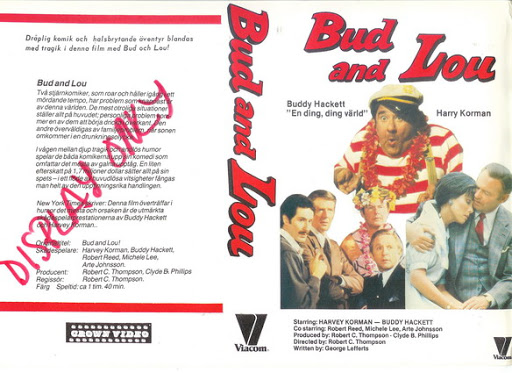
Abbott and Costello are played by Buddy Hackett and Harvey Korman. Interestingly, Hackett and Hugh O’Brian replaced the team when Costello’s health forced them to drop out of 1954’s Fireman Save My Child.
The team came together when Abbott’s original partner was ill and it gelled pretty quickly. The film hints that Bud used to date Lou’s wife — this is unproven — but as we’ve learned from tabloid-style films, facts are rarely important. For example, while they did debut on The Kate Smith Hour on February 3, 1938, they didn’t do the “Who’s On First?” routine until a month later and they had developed their distinctive voices (audiences initially thought they sounded alike until Costello came up with his high-pitched, childish affect).
They debuted their own show, The Abbott and Costello Show, as Fred Allen’s summer replacement in 1940 before joining Edgar Bergen and Charlie McCarthy on The Chase and Sanborn Hour in 1941. That was also the year that their first two films — Buck Privates and Hold That Ghost — debuted (they made their actual first film appearance in 1940’s One Night in the Tropics, essentially playing their greatest hits from burlesque on screen).
By 1942, they were the top box office stars in the country, earning over $789,000 ($12 million in today’s money) that year alone. To show how big of stars they were, a 35-day War Bonds tour in the summer of 1942 earned $85 million dollars ($1,299,767,105 today!) in war bonds purchases. This is important — because soon, the government would come calling for this money and forget all about this. That’s a major part of the film.
Here come the bad parts. Abbott had epilepsy, which in the film just means you have to sit down every once in a while, as well as drink way too much. Costello got rheumatic fever from a military base tour and was bedridden for the rest of 1942 and into ’43, when he returned to radio after a year layoff. That very same day, his infant son drowned in the family’s pool and the comedian was never the same. He was quick to anger and constantly vindictive to the point that a major rift happened when In 1945 a rift developed when Abbott hired a servant who Costello had fired. That led to Costello refusing to speak to his partner except when performing. From them on, they would play separate characters in films, rather than be a team. This led to their loss in popularity when faced with other teams like Martin and Lewis.
Abbott resolved the rift when he suggested naming Costello’s charity the “Lou Costello Jr. Youth Foundation.” Finally some good news — this charity still helps underprivileged youth in the Boyle Heights district of Los Angeles.
Despite their dip in popularity, they still starred in several films with the Universal monsters and hosted The Colgate Comedy Hour. From 1952 to 54, Costello created, owned and syndicated The Abbott and Costello Show, paying Abbott a salary, a point this movie hammers home as proof that any reconciliation was only on one man’s part. That said, the movie totally ignores that this show was a success and aired in reruns for a long time.
The film never gets into the point that the duo was overexposed and worried about creating new material, which is one of the reasons why Universal couldn’t reach a contract with them. They were forced to sell all of their assets to the IRS to pay taxes, a point the movie definitely makes.
After one last film, Dance with Me, Henry and Lou appearing on This Is Your Life, the duo split for good in 1957. Errol Flynn claimed in his autobiography that he was the reason. At a party he had invited Bud, Lou and their families to, he showed hardcore pornography and Bud and Lou both blamed the other. This is skipped by the movie, because how would you explain that on TV in 1978?
The movie makes it seem that Costello died quickly after the pair split, but he lived until 1959, after ten appearances on The Steve Allen Show doing old routines without his partner. He died shortly after finishing his last film, The 30 Foot Bride of Candy Rock.
In 1960, Abbott formed a team with Candy Candido, a voice actor in Disney films. He also did his own voice for the Hanna-Barbera Abbott and Costello cartoons. He died of cancer in 1974.
Let’s go back to me being a kid. I always thought that Lou was the nice one, with Bud being the mean adult, always grumpy with him. Little did I know the truth — or what passes for it in this movie. I remember crying my eyes out during the last scene where Lou dies.
This whole movie is based on the book by Hollywood correspondent Bob Thomas and trust me, it’s as over the top and ridiculous as you hope it is. It’s been said that Thomas got most of his gossip from Eddie Sherman, Abbott and Costello’s longtime manager who had been fired by the duo, so obviously there was a reason why it’s so venomous. It’s also remarkably unfunny in the comedy segments, which is weird when you consider who is starring in it. Arte Johnson and Robert Reed also show up, just to remind you this is a made for TV movie.
Both the book and movie upset Lou’s daughter Chris so much that she wrote the book Lou’s on First to refute many of its claims.
I’m not the only one obsessed by this film. On his podcast, Gilbert Gottfried has brought the death scene at the end up several times. I wasn’t the only one shattered by it, I guess.
I guess if you want to catch up on memories, you should skip TV movies and go right back to the real movies. But as you may have learned by now, I love junk.
EDITOR’S NOTE: Bud and Lou was on the CBS Late Movie on December 25, 1984 (Merry Christmas!) and June 3, 1987.
This movie crushed me as a child. I had always loved Bud Abbott and Lou Costello, watching their thirty-six films on Sunday mornings after Ma and Pa Kettle films. Seriously, weekends in Pittsburgh in the 70s and 80s were amazing. You stayed up all Night watching Chiller Theater, then woke up late and took in some Abbott and Costello. Ah, memories.
That said, when this aired on November 15, 1978, I excitedly watched it from my parent’s black and white kitchen TV, ready to have fun reliving my favorite memories of the comedy duo. I wasn’t prepared to learn how much they hated one another and their foibles. Cut me some slack — I was six.
Buddy Hackett and Harvey Korman play Abbott and Costello. Interestingly, Hackett and Hugh O’Brian replaced the team when Costello’s health forced them to drop out of 1954’s Fireman Save My Child.
The team came together when Abbott’s original partner was ill, and it gelled pretty quickly. The film hints that Bud used to date Lou’s wife — this is unproven — but as we’ve learned from tabloid-style films, facts are rarely necessary. For example, while they did debut on The Kate Smith Hour on February 3, 1938, they didn’t do the “Who’s On First?” routine until a month later, and they had developed their distinctive voices (audiences initially thought they sounded alike until Costello came up with his high-pitched, childish effect).
They debuted The Abbott and Costello Show as Fred Allen’s summer replacement in 1940 before joining Edgar Bergen and Charlie McCarthy on The Chase and Sanborn Hour in 1941. That was also the year that their first two films — Buck Privates and Hold That Ghost — debuted (they made their first film appearance in 1940’s One Night in the Tropics, essentially playing their greatest hits from burlesque on screen).
By 1942, they were the top box office stars in the country, earning over $789,000 ($12 million in today’s money) that year alone. A 35-day War Bonds tour in the summer of 1942 earned $85 million ($1,299,767,105 today!) in war bond purchases to show how big of a star they were. This is important because the government would soon call for this money and forget all about it. That’s a significant part of the film.
Here come the bad parts. Abbott had epilepsy, which in the film means you have to sit down every once in a while, as well as drink way too much. Costello got rheumatic fever from a military base tour and was bedridden for the rest of 1942 and into ’43 when he returned to radio after a year layoff. That very same day, his infant son drowned in the family’s pool, and the comedian was never the same. He was quick to anger and constantly vindictive to the point that a significant rift happened.
In 1945, Abbott hired a servant whom Costello had fired. That led to Costello refusing to speak to his partner except when performing. Then, they would play separate characters in films rather than work together, which led to their loss of popularity when faced with other teams like Martin and Lewis.
Abbott resolved the rift by suggesting naming Costello’s charity the Lou Costello Jr. Youth Foundation. Finally, some good news: this charity still helps underprivileged youth in the Boyle Heights district of Los Angeles.
Despite their dip in popularity, they still starred in several films with the Universal Monsters and hosted The Colgate Comedy Hour. From 1952 to 54, Costello created, owned and syndicated The Abbott and Costello Show, paying Abbott a salary, a point this movie hammers home as proof that any reconciliation was only on one man’s part. That said, the film ignores that this show was successful and aired in reruns for a long time.
The film never gets to the point that the duo is overexposed and worried about creating new material, which is one reason Universal couldn’t reach a contract with them. The movie definitely makes the point that they were forced to sell all their assets to the IRS to pay taxes.
After one last film, Dance with Me, Henry, and Lou appeared on This Is Your Life, the duo split for good in 1957. Errol Flynn claimed in his autobiography that he was the reason. At a party he had invited Bud, Lou and their families to, he showed hardcore pornography and Bud and Lou both blamed the other. The movie skipped this because how would you explain that on TV in 1978?
The movie makes it seem that Costello died quickly after the pair split, but he lived until 1959 after ten appearances on The Steve Allen Show doing old routines without his partner. He died shortly after finishing his last film, The 30-Foot Bride of Candy Rock.
In 1960, Abbott formed a team with Candy Candido, a voice actor in Disney films. He also did his voice for the Hanna-Barbera Abbott and Costello cartoons. He died of cancer in 1974.
Let’s go back to when I was a kid. I always thought Lou was the nice one, and Bud was the mean adult who was always grumpy with him. Little did I know the truth—or what passes for it in this movie. I remember crying my eyes out during the last scene when Lou dies.
This movie is based on the book by Hollywood correspondent Bob Thomas, and trust me, it’s as over the top and ridiculous as you hope it is. It’s been said that Thomas got most of his gossip from Eddie Sherman, Abbott and Costello’s longtime manager, who the duo had fired, so obviously, there was a reason why it’s so venomous. It’s also remarkably unfunny in the comedy segments, which is weird when considering who is starring. Arte Johnson and Robert Reed also showed up; to remind you, this is a made-for-TV movie.
The book and movie upset Lou’s daughter, Chris, so much that she wrote Lou’s On First to refute many of its claims.
I’m not the only one obsessed with this film. Gilbert Gottfried repeatedly mentions the death scene at the end of his podcast, and I wasn’t the only one shattered by it.



 B&S About Movies
You must be logged in to post a comment.