Rock and Roll Wolf (Ma-Ma) (1976)

Fairy tales are alike in many countries. This film is based on “The Wolf and the Seven Young Kids” from Grimm’s Fairy Tales, which Russian kids known as “Волк и семеро козлят” (“The Wolf and the Seven Kids”) and Romanian young ones know as “Capra cu trei iezi” (“The Goat and Her Three Kids”). So yes, there are five kids in this, but that feels like splitting the difference.

Directed by Elisabeta Bostan, this was filmed in three languages — Romanian, Russian and English — and features performers from the Moscow Circus, the Moscow Circus on Ice and the Bolshoi Ballet.

It’s also way weird.

Rada (Lyudmila Gurchenko, who was awarded People’s Artist of the USSR in 1983) is gathering fruit in the woods, leaving her children home. She’s watched by Petrika the donkey (George Mihaita), Rassul the lynx (Valentin Manokhin), a young wolf (Savely Kramarov) and leader Titi Suru (Mikhail Boyarsky), who listen to her singing and begin plotting on taking her family from her.

Matei (Petya Degryarov), the oldest child, runs away from home to the fair while Titi Suru keeps trying to sing Rada’s song to the children, convincing them that he is their mother. They are too smart for him — keep in mind, this guy looks like a glam rock werewolf — but when their mother’s voice gets sore from calling for her lost son, they no longer recognize her. Everyone gets kidnapped by Titu Suru and his gang, except that Rada is too smart for him, ice skating with him until he falls into the cold water, only saving him when she has her children safe.

Now, re-read that and get this in your head: the big bad wolf is sexy, always smoking a pipe and looking kind of like Phil Lynott if he were, you know, a wolf. The goat mother — a single mom, mind you — Rada is also quite attractive and every time the two get together, sparks fly. They’re going to get it on. You know it. They know it. But the wolf is a wolf and he wants to steal her children, because for all he protests how much people treat wolves so badly and have preconceived notions of them, he’s also, well, a wolf.

Sure, all the songs sound pretty much the same — I can hear you now, “It’s a leitmotif, you moron!” — but who cares? It’s the 70s and everyone is wearing makeup and everyone has glitter all over them and this is what the children of the world of The Apple are put in front of to be babysat while their parents go do mad coke at Mr. Boogalow’s latest record release.

These songs will get stuck inside your head but you won’t feel bad about that.

There’s also a parrot that is a human with a gigantic rainbow pompadour. The whole world of Ma-Ma feels like no other place on Earth, even starting with all of the actors getting into their costumes together. This will both delight and terrify your child.

You can watch this on YouTube.

ARROW VIDEO 4K UHD RELEASE: Alice, Sweet Alice (1976)

Alfred Sole was an architect who dreamed of making movies. His first film, 1972’s Deep Sleep, which starred Deep Throat‘s Harry Reems and The Devil In Ms. Jones‘ Georgina Spelvin, was made for only $25,000. However, it was ruled obscene and pulled from theaters. His second film — the one we’re about to cover — may not have done well at first thanks to spotty distribution, but thanks to Brooke Shields’ popularity and multiple re-releases under multiple titles, like Holy TerrorCommunion and The Mask Murders.

Sole wrote the film with his neighbor Rosemary Ritvo, an English professor with whom he often discussed films. A Catholic herself, they would talk at length about the church in between discussing theater and horror films. Nicolas Roeg’s Don’t Look Now was a huge influence, as is evident by the yellow raincoat worn by the film’s villain.

The film is set in 1961 in Paterson, New Jersey, the director’s hometown; as such, much of it was based on his childhood. In fact, Mrs. Tredoni is directly based on a woman who lived next door to his grandmother, who would look after the priests.

While Sole claims he had never seen any Giallo before he made this, Alice, Sweet Alice is perhaps the most giallo of all American films before DePalma would make Dressed to Kill.

The film begins with Catherine Spages (Linda Miller, the daughter of Jackie Gleason and the mother of Jason Patric) visiting Father Tom with her two daughters, nine-year-old Karen (Shields) and twelve-year-old Alice (the astounding Paula Sheppard), who are students of St. Michael’s Parish Girls’ School. Father Tom gives Karen his mother’s crucifix as a gift for her first communion, making Alice jealous.

Alice is a wild child, her hair barely tied back, constantly in trouble for all manner of mischief. Is she a bad girl or just a misunderstood little girl dealing with the specter of her parent’s divorce in 1961, a time when this rarely happened and in a heavily Catholic neighborhood where this would indeed be judged? Her antics include wearing a clear mask and repeatedly frightening and threatening her sister.

This all ends on the day of Karen’s first communion, when someone in the same school raincoat and mask as Alice kidnaps the young girl, strangles her, rips the crucifix from her neck and then sets her body on fire inside a church pew. This is insanely brutal and lets the viewer know that this movie is unprepared to take it easy on you.

At the same time, Alice enters the room and attempts to receive communion while wearing her sister’s veil. It’s never really established where she found it or whether or not she knew it belonged to her sister. There are no easy answers here.

Catherine’s ex-husband Dominick (Niles McMaster, Bloodsucking Freaks) returns for the funeral and fulfills the Giallo role of a stranger pushed into becoming the detective. Furthering the giallo narrative, the ineffective Detective Spina takes over the case, pursuing the lead that Alice is the killer thanks to Catherine’s sister Annie’s suspicions. This lead seems even more apparent after the killer attacks Annie, and Alice is found at the scene, wearing the same clothes.

Alice is sent to a psychiatric institution where it’s revealed that she’s been in trouble numerous times in school, a fact that Father Tom has concealed as he believed he could solve her problems.

The killer tightens her noose around Alice’s neck by luring her father to an abandoned building,g where she gets the jump on him, beating him with a brick, binding his body and pushing him off a ledge. Before he dies, he’s able to swallow the crucifix that the killer had stolen from his daughter. That’s also when we learn who the killer is, way before the film is over: it’s Tredoni, who sees Dominick and Catherine — and by extension, their children — as sinners due to their premarital sex and divorce.

Alice may have been eliminated as a person of interest, but the danger remains. On a visit to Father Tom, Catherine learns that Tredoni lost a daughter on the day of her first communion, which taught her that children pay for the sins of their parents. In her grief, she gives herself over to the church. Her feelings about her calling are confirmed when Father Tom misunderstands her confession.

Finally, Alice’s scheme to leave cockroaches all over, frightening landlord Mr. Alphons,o neatly ties into Tredoni sneaking in to kill either her, Catherine or both of them. Alphonso is stabbed, and the mad older woman runs to the church. Father Todd assures the police he can handle her, but even his mercy and the church’s teachings fail in the face of mania.

The end of this movie shocked me out of my theater seat. It’s visceral in its intensity, and the ending—where Alice walks away—is even more harrowing.

It’s rare to find a movie that completely destroys an audience. Alice, Sweet Alice did that when it played here to a packed house as part of a Drive-In Asylum night of film.

In these modern times, Alice takes on a whole new light. Nearly every male in the movie treats her blossoming womanhood as an invitation, from the lie detector operator who says that when he bound her breasts with the machine, it looked like she wanted it to the guard at the children’s home who silently watches her as she meets with her parents. Perhaps even more disquieting is that Sheppard was 19 when this was made. Her only other film appearance is in the equally bizarre Liquid Sky, which is a shame, as she was incredible in both of these equally strange movies.

Alphonso DeNoble, who plays the grotesque Mr. Alphonso, also appeared in Bloodsucking Freaks. While his main career was as a bouncer at a gay bar, as his side hustle, Alphonso would dress up as a priest and hang around cemeteries, where widows would ask for a blessing, and he’d indulge them for a monetary donation.

This film truly lives up to the ninth Satanic Statement: Satan has been the best friend the church has ever had, as He has kept it in business all these years! And the Satanic Sin of Herd Mentality is obvious. From the actual church, “…only fools follow along with the herd, letting an impersonal entity dictate to you.”

Also, Alice posits that even the pre-Vatican II Catholic Church of 1961 was finding itself ill-equipped to understand the modern world and that people—from the old like Tredoni to the young like Alice—would suffer. It’s women who do most of that suffering, constantly propping up the male members yet never able to ascend to the power of the clergy unless they want to be second-best sisters.

Even 43 years after its debut, Alice Sweet Alice has the power to destroy. It’s a near-perfect film that demands introspection and multiple viewings.

BONUS CONTENT:

This article by Bill Van Ryn of Groovy Doom and the horror and exploitation fanzine Drive-In Asylum provides an even better look at this film.

I also had the opportunity to discuss this film with Alfred Sole’s cousin, Dante Tomaselli, the maker of the astounding Desecration.

The Arrow Video 4K UHD release of Alice, Sweet Alice has a brand new 4K restoration by Arrow Films from the original camera negative, as well as three cuts: Communion; Alice, Sweet Alice and Holy Terror. There’s new commentary by Richard Harland Smith and archival commentary by co-writer/director Alfred Sole and editor M. Edward Salier; interviews with composer Stephen Lawrence and actor Niles McMaster; First Communion: Alfred Sole Remembers Alice, Sweet AliceSweet Memories: Dante Tomaselli on Alice, Sweet Alice; a location tour with Michael Gingold; deleted scenes; a split-screen version comparison; a trailer and TV commercial; an image gallery, including the original screenplay; a reversible sleeve featuring original and newly commissioned artwork by Gilles Vranckx and an illustrated collectors booklet featuring new writing on the film by Michael Blyth. You can get it from MVD.

MOVIES THAT PLAYED SCALA: In the Realm of the Senses (1976)

Thanks to the British Film Institute, there’s a list of films that played Scala. To celebrate the release of Severin’s new documentary, I’ll share a few of these movies every day. You can see the whole list on Letterboxd.

Sada Abe (Eiko Matsuda) is a former prostitute who now works as a maid in a hotel, where she falls for the owner, Kichizo Ishida (Tatsuya Fuji), an affair that starts simply with non-stop sex and continues to become an obsession, as she doesn’t want to share him even with his wife. Soon, their love games include strangling one another during sex and her holding a knife to his manhood, saying that she’s going to take it with her. Well, that’s exactly what happens, as she accidentally kills him while they make love and takes his member with her, walking with it inside her before she’s arrested.

Directed and written by Nagisa Ōshima, who also made Merry Christmas, Mr. Lawrence, this is a rare mainstream film that doesn’t shy from unsimulated sex, made in a culture that even hides the mere glance at female genitals. It was made in France, while in Japan, it was fogged and blurred so that it could appear in theaters.

Eiko Matsuda had worked in sexploitation films but was never treated as harshly by the public as she was when this film was made, finally moving to France and ending her acting career. Society remains unfair, as her male partner in the movie, Tatsuya Fuji, regained his career after two years.

This was based on a true story and Sada Abe did not fade from the world after serving five years of her six-year sentence even though she asked for the death penalty. The police record of her interrogation and confession became a best-selling book. Over the next few years, the public perception of her moved from a pervert to someone who murdered for love. She acted in a traveling show and worked in a bar in downtown Tokyo for twenty years before appearing in Teruo Ishii’s documentary History of Bizarre Crimes by Women in the Meiji, Taishō, and Shōwa Eras. When  Oshima tried to find her before making this movie, he learned that she was in a nunnery, yet most reports claim that she disappeared.

RETURN OF KAIJU DAY: The Five of Super Riders (1976)

Produced by Taiwaan’s Tong Hsing Company Limited in 1976, this movie is based on the 1974 tokusatsu film Kamen Rider X, taking most of its footage from Five Riders vs. Kingdark and the earthquake from Godzilla vs. Megalon. It was re-released twenty years later in Taiwan, as well as many other countries, in this bootleg form.

Emperor Chi-Wu (King Dark), the leader of the Demon & God Organization, is the bad guy. And with a company name like that, he kind of has to be, right? It’s just moving around the Japanese name of the bad guys, GOD (Government of Darkness). His final form was taken from a stage show costume of another final boss, Great General of Darkness from Great Mazinger.

This is a Kamen Rider movie and I feel like me going too deep into its mythos will result in tokusatsu fans feeling like I do when I read uninformed giallo articles. But what I do know that is instead of Kamen Rider (Masked Rider, if you watched Fox in the 90s and 2000s), you get Super Rider X and four of his friends, including a never-before female Kamen. Or Super Rider. Or Masked Rider. This is a lot of Kamen Rider X and even has Riderman show up, who was dead. He got better.

This does, however, answer a thing I always wondered. What if Darth Vader — I know, this predates Star Wars — was super Satanic and also had fashion leanings toward both the samurai and a peplum movie? Also: What if he could turn into a gigantic demon and fought motocross dudes? And what if there was a monster called Franken Bat which is exactly what it sounds like, a Frankenstein’s Monster, painted silver, with bat wings, and he carries around beakers filled with the blood of young women that he drinks when he needs energy? Could all the mythological monsters show up, too? And what about the god Pan, who is now a monster by the name of Pannic, who has missile horns?

I have no idea what I watched but I loved it.

You can watch this on YouTube.

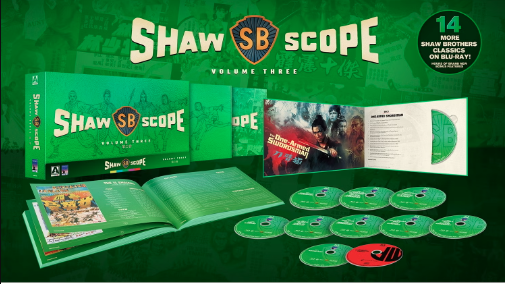
ARROW VIDEO SHAW SCOPE VOLUME 3 BOX SET: The Magic Blade (1976)

Fu Hung Hsue (Lung Ti) is one of the many heroes of writer Gu-long. In this film, directed by Chor Yuen, he learns of a weapon called the Peacock Dart. It’s so powerful that it could disrupt the entire martial world. Even though he has sworn off violence, our hero must come back to protect others from this armament, which is kind of like little bombs in the fan tail of a peacock. Yes, it is amazing.

There’s also the matter of another warrior, Yen Nan Fei (Lo Lieh), who has challenged Fu Hung Hsue to a duel. But as they’re both being targeted by a series of killers, they decide to work together until they get to the bottom of this mystery.

Master Yu has put a price on both of them so all manner of wild looking killers have come to collect. I mean, one of them is called Devil Granny and she hides in the shadows, laughing at you after she poisons you with incense. Oh yeah, she also eats people, has a giant chessboard and has turned a food cart into a weapon.

The other bad guys all have weird supernatural martial arts weapons, but come on. None of them are in their twilight years yet biting down on people and making the most elaborate death traps.

The creator of the McGuffin weapon also sends his daughter Yu-cheng (Ching Li) along with our heroes as they seek to destroy Master Yu. Will she fall in love with one of the heroes? Will Fu Hung Hsue do incredible things like move the acupuncture points of his body by one inch so that he can’t be paralyzed? Will the heroes finally have their duel?

Yes to all of this, as well as more blood and sleaze than you were expecting. That is to say, this is wonderful, a movie contained within the Shaw Brothers lot but feeling like it could go anywhere and do anything.

You can also read what Jenn Upton had to say about this movie here.

The Arrow Video Shaw Scope Volume Three box set has a brand new 2K restoration of The Magic Blade as well as extras such as commentary by critic Samm Deighan and a trailer.

You can get this set from MVD.

SEVERIN BOX SET RELEASE: All the Haunts Be Ours: A Compendium Of Folk Horror Vol. 2: The Rites of May (1976)

Known in its native Philippines as Itim (Black), The Rites of May is the first movie by director Mike de Leon. It begins during a seance, as the medium tells Teresa (Charo Santos) that her sister Rosa (Susan Valdez), a Catholic nun, is dead. Teresa asks if she may speak to the dead, but the medium says that she must wait until Good Friday.

Meanwhile, Jun (Tommy Abuel) has come back home to visit his infirm and mute father Dr. Torres (Mario Montenegro). While there, he is doing photography work for a magazine, shooting the celebrations of Lent in Manila, an extremely religious city. As he takes photos, he meets Teresa, which is supernaturally predestined to happen. She keeps going in and out of fugue states. As Jun takes photos of her, he will see her sister Rosa as well as her connection to his father.

The director told the Cannes Film Festival, “I got interested in doing a film that used a camera to tell a story with one character, no dialogue and just sound effects. One thing I liked about Blow-up was the idea of existential alienation. Monologo was a ghost story. The character takes photos and he does not realize that he has photographed a ghost or a presence in his own house. I mean, his camera saw it but he did not. That kinda blew my mind.”

Despite failing in cinemas, this movie won  Best Picture, and Charo Santos was recognized as Best Actress, at the 1978 Asian Film Festival. Since then, it’s been recognized as a classic. It’s heart in the unknown feels authentic, as spiritist Becky Gutierrez wrote the seance scenes, which she based on actual ritual. It also uses the ghost in its story to symbolize the past of the Philippines, a country that seems as if it can move past a history filled with violence yet will forever remain haunted by it. de Leon started this as a simple ghost story but it grew into this epic with deep themes.

This was shot in shot in de Leon’s grandparents’ house in San Vicente, San Miguel, Bulacan. I have an affinity for films that get into the supernatural and the religious filmed in family homes, like Martin. Can you think of any others?

The Rites of May is part of the new Severin box set, All the Haunts Be Ours Volume 2. It has extras including audio commentary by Filipino film historian Andrew Leavold, the documentary Itim: An Exploration In Cinema and Filipino film scholar Anne Frances N. Sangil discussing this film.

You can order this set from Severin.

CHILLER THEATER MONTH: Track of the Moon Beast (1976)

EDITOR’S NOTE: Track of the Moon Beast was on Chiller Theater on Saturday, January 10, 1981 and Saturday, November 20, 1981 at 1:00 a.m.

Bill Finger wrote Death Comes to Planet Aytin, The Green Slime and this film, as well as two episodes of the Batman TV show, which would be the first time he was credited for writing Batman, a character that he co-created with Bob Kane, who ended up taking most of the credit for years. Finger co-wrote this with Charles Sinclair in two days, calling their story The Lunar Analog. Sinclair totally forgot working on it and was shocked when his son called him and said he saw his name on Mystery Science Theater 3000.

Directed by Richard Ashe (the only movie he ever directed, although he was second unit on A Place for Today, Diary of a Mad Housewife and Girls Are for Loving) and shot in Albuquerque, New Mexico, this is the story of mineralogist Paul Carlson (Chase Cordell) and how he gets smacked on the head with meteor, which makes him turn into a lizard at night.

His girlfriend Kathy Nolan (Donna Leigh Drake) and former anthropology professor and noted stew maker Johnny “Longbow” Salinas (Gregorio Sala) try to help as much as they can until NASA figures out that the meteor has become part of him and that he will soon blow up real good. So Paul goes into the desert to die alone. You’d think his friends and the government would help him, but no, Johnny uses a meteorite arrow to shoot him and make him explode. One presumes he ends up curling up with Kathy that night and they have a piping hot mug of his chicken, corn, green peppers, chili and, sign, onion stew.

Frank Larrabee and his band are the real stars of this, as they perform the song “California Lady.” They were the house band at the Ramada Inn in Albuquerque where the filmmakers were staying and also where the footage was shot.

Originally, Kathy was going to have been played by Cheri Caffaro from the Ginger movies. If that isn’t exciting enough, this never really played theaters and went straight to TV, meaning that there is a gore cut of Track of the Moon Beast that has never been seen.

CHILLER THEATER MONTH: Lipstick (1976)

EDITOR’S NOTE: Lipstick was on Chiller Theater on Saturday, March 5, 1983 at 2:00 a.m. I can’t believe it.

Never trust Chris Sarandon.

I learned this at a young age with Fright Night, but this was before that and you still should never trust him. Don’t trust him in The Sentinel, don’t trust him in The Princess Bride, don’t even trust him as the voice of Jack Skellington.

Christine McCormick — played by Margaux Hemingway, herself a supermodel who appeared on the covers of Cosmopolitan, Elle and Vogue as well as serving as the spokesperson for Fabergé’s Babe perfume — is the face of a new brand of lipstick. She also is the guardian of her 13-year-old sister Kathy (Margaux’s sister Muriel, who was also in Star 80 and Personal Best), who has a young girl crush on her teacher, Gordon Stewart (Sarandon). For some reason, he thinks that Christine has the connections to get his music out to the world.

He comes to her beach photo shoot, but there’s no time to chat, and she forgets that they were to meet at her apartment. As he plays his atonal music — more on that in a second — she leaves the room to take a phone call from her lover Steve (Perry King, who really was in some awesome junk and I say that in the best of ways).

Hurt by her seeming rejection, his assault is brutal in its quickness. Saying, “So you fuck priests, too” he shoves a photo of her brother Martin (John Bennett Perry, Matt Perry’s dad) in her face, breaks it and then smears lipstick all over her face, telling her he wants it all over him. He ties her to the bed and takes her — the scene is too male gaze, too beautiful in a way because it’s a disgusting act — and even when they’re caught by Kathy, he suggests that the little girl joins them.

Once free, Christine gets a lawyer, Carla Bondi (Anne Bancroft), who tells her that it won’t be easy to convict him. And it isn’t. Christine’s sexual image as a model, even the fact that she has fantasies and a sex life, is used against her. So when Gordon goes free, it’s no great surprise.

Christine decides that she’s done with California and modeling after one last job. Except that the last job is in the same exact abandoned building where Gordon is rehearsing a synth ballet. He ends up finding Kathy, using her heartbeat as an instrument and then raping her as well. When she gets back to the photo shoot, Christine finds the rifle she had packed — literally, they packed to leave and are doing the photoshoot and then getting out of town — and shoots at Gordon as he tries to get away. As he gets out of the car, she pumps round after round into him. And in the end, no jury will convict her.

But maybe not. Because I believe that everything that happened after the not guilty verdict is in her head. There’s no way that she’d leave modeling literally from her last shoot. The coincidence that Gordon would be in the same building, in a California filled with places to rehearse, is infinite. The idea that she can successfully shoot him so many times in broad daylight and still not go to jail is the kind of fantasy that only appears in exploitation movies. Like Lipstick.

Director Lamont Johnson started as an actor and was mainly known for TV movies like Crash Landing: The Rescue of Flight 232Crisis at Central High and That Certain Summer, as well as Spacehunter: Adventures In the Forbidden Zone. It was written by David Rayfiel, who was the scriptwriter for The FirmHavana and the 1995 remake of Sabrina.

Michael Winner turned down producer Dino De Laurentiis’ offer to direct this film and that shocks me. In his autobiography, Winner said that “Chris Sarandon was not a very good actor unless he was playing nut cases.” Then again, he used him in The Sentinel.

Even stranger, in 1998’s Little Men, Muriel Hemingway and Sarandor played husband and wife Jo and Fritz Bhaer.

That’s really fashion photographer Francesco Scavullo shooting the lipstick ads, while the clothes for this movie were designed by Jodie Lynn Tillen, who was the costumer for Messiah of Evil and Lemora! While uncredited, Donfeld also worked on the clothes. He was most famous, perhaps, for creating the TV costume for Wonder Woman.

French singer and music composer Michel Polnareff did the music for this, which is beyond wild. It’s completely unsettling — he also did a disco soundtrack for the film — and when it plays while Gordon assaults Christine, it’s horrifying, setting up his assault of her body, brain and ears as his atonal noise blasts, filling the room with painful beats and shrill screams. Later, when it’s played in court and the jury must hear it, you nearly feel bad for the bad guy but no, he’s absolutely the worst.

Despite critics hating this movie and it failing with audiences, it was remade as Insaf Ka TarazuCollege Girl and Edi Dharmam Edi Nyayam in India and Arzu in Turkey.

The real victim? Margaux. This movie was supposed to launch her career in Hollywood, but Muriel got most of the notice. She would make a few movies over the next seven years — Killer FishThey Call Me Bruce and Over the Brooklyn Bridge, the first movie for Sam Firstenberg — before working in foreign genre movies like Goma-2 and straight to video films like Fred Olen Ray’s Inner Sanctum and Inner Sanctum II, Joe D’Amato’s A Woman’s Secret and Donald Farmer’s Vicious Kisses. Sadly, she became heavily involved in drugs and died at 41 from suicide. Her sister Mariel has always claimed that her death was not self-induced, but instead drugs.

Harlan Ellison, that cantankerous madman of my heart, once said of this movie, “Lipstick panders to the basest, vilest, lowest possible common denominators of urban fear and lynch logic. It is the sort of film that, if you see it in a ghetto theater filled with blacks, will scare the bejeezus out of you. The animal fury this film unleashes in an audience is terrifying to behold. It gives exploitation a bad name; and it has less to do with rape, which is the commercial hook on which they’ve hung the salability of this bit of putrescence, than it does with the cynicism of Joseph E. Levine, a man who probably has no trouble sleeping with a troubled conscience.”

CANNON MONTH 3: God’s Gun (1976)

EDITOR’S NOTE: Over the next several days, I’ll be covering movies either directed by Menahem Golan or produced by Golan and Globus before they bought Cannon.

I had no idea that this Italian Western was an Israeli co-production and just a few years before they’d make it to the USA, Menahem Golan and Yoram Globus would work with The Irwin Yablans Company and Cannon Film Distributors to bring this movie to screens all over the world.

Sam Clayton (Jack Palance, as always, a grinning force of complete menace) and his gang have taken over Juno City, stabbing men and assaulting women before leaving the town in the bloody dust. No man will ride out to stop them, except Father John (Lee Van Cleef), a holy man who rides out unarmed and takes the guilty gang members to jail.

The gang breaks them out of jail and kills the priest, sending a young boy named Johnny (Leif Garrett!) to Mexico to bring Lewis, the twin brother of the dead man of the cloth, and he comes back with vengeance on his mind, even if it turns out that Clayton ends up being Johnny’s father.

Also known as Diamante Lobo and A Bullet From God, this is Lee Van Cleef’s last filmed Western (and second movie with Garrett). It was a rough film for Richard Boone, who had started having health problems, then got drunk and walked off the set, leaving the Israeli location before he even dubbed his dialogue. He’d say in an interview, “I’m starring in the worst picture ever made. The producer is an Israeli and the director is Italian, and they don’t speak. Fortunately it doesn’t matter, because the director is deaf in both ears.”

That deaf director was Gianfranco Parolini, better known in America as Frank Kramer, and the maker of some wild stuff like SabataYeti: Giant of the 20th CenturyKiss Kiss, Kill KillThe Three Fantastic Supermen and writing If You Meet Sartana… Pray for Your Death. It was written by John Fonseca, whose career is all over the place, acting in The Uranium Conspiracy (also produced by Golan), serving as a dialogue coach and even shooting stills on the sets of Don’t Open Till Christmas and Slaughter High.

How did I get this far without telling you Sybil Danning is in this movie? Am I slipping?

This may not be the best Italian Western you’ve ever seen, but honestly, the end with Palance rambling in a cemetery and alternating between being paternal and horrifying, well, that’s worth the price of this blu ray. And Lee Van Cleef? Always just right.

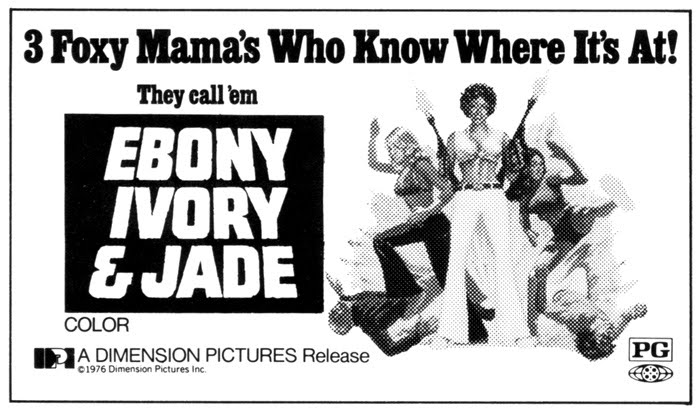
CANNON MONTH 3: Ebony, Ivory & Jade (1976)

EDITOR’S NOTE: As the journey through Cannon continues, this week we’re exploring the films of 21st Century Film Corporation, which would be the company that Menahem Golan would take over after Cannon. Formed by Tom Ward and Art Schweitzer in 1971 (or 1976, there are some disputed expert opinions), 21st Century had a great logo and released some wild stuff.

Ebony is track star Pam Rogers (Rosanne Katon, Zapped!Motel HellBody and SoulThe Swinging Cheerleaders).

Ivory is Ginger Douglas (Colleen Camp!) is her enemy on the track, a rich girl who is the scion of a supermarket empire.

Jade is Jackie.

They’re all She-Devils in Chains — the original title — trapped after being kidnapped at a Hong Kong track meet. Director Cirio Santiago is working with a bit more budget and a PG rating here, which leads to this being way less sleazy than the prison movie that you think it is going to be.

One of the bad guys is played by Rocco Montalban, which is one of the best acting names I’ve ever seen.

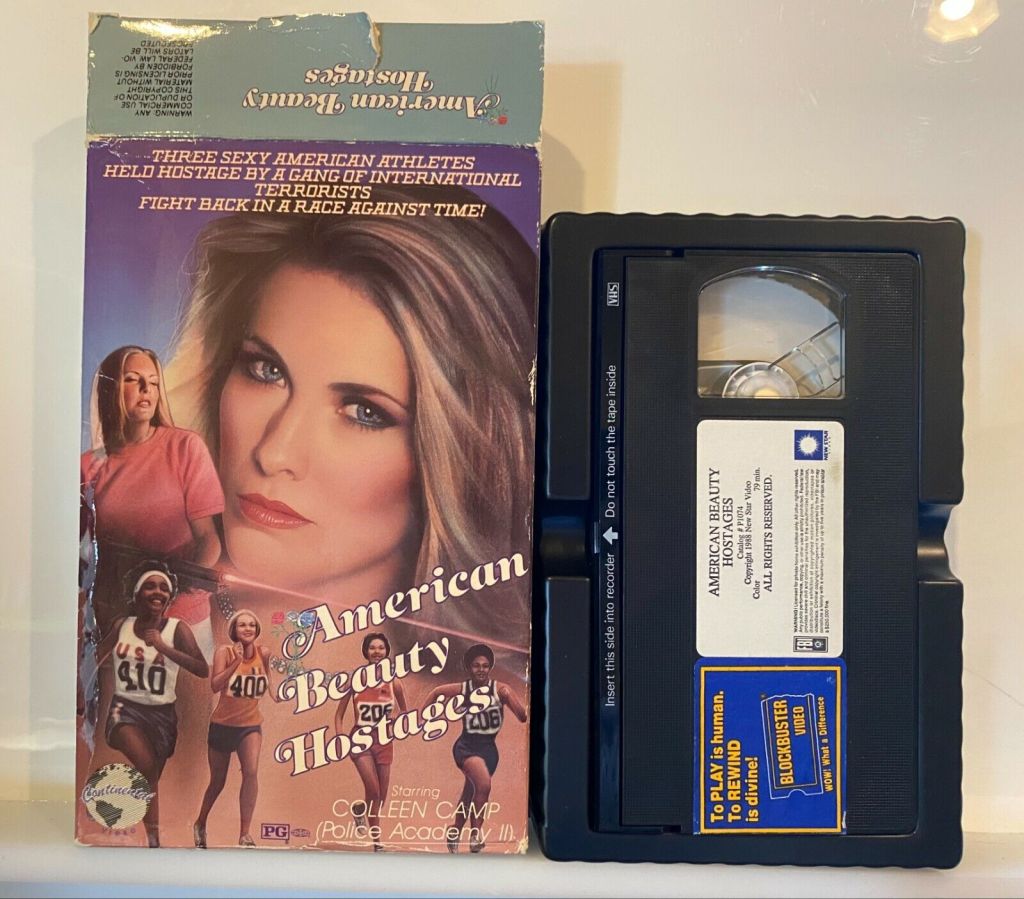
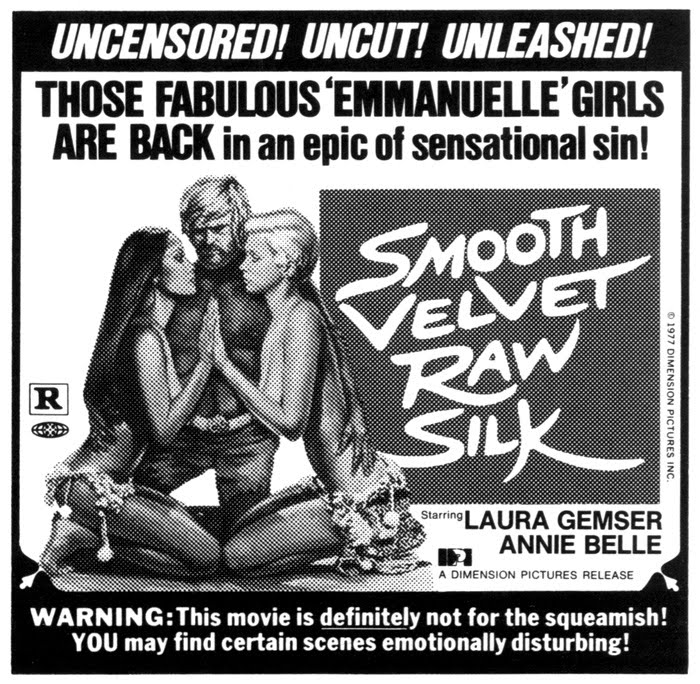
A Dimension Pictures film, this was bought by 21st Century. It was released by Wizard Video as Foxforce — hey Quentin — before 21st Century licensed it to Continental Video as American Beauty Hostages.

Speaking of Tarantino, the back of the box — The Unknown Movies has the entire text and it’s so good — refers to this movie’s protagonists as “3 spittin’ kittens on a roaring rampage of revenge!” That’s the same phrase used to describe the bride’s vengeance, a “roaring rampage of revenge,” in Kill Bill.