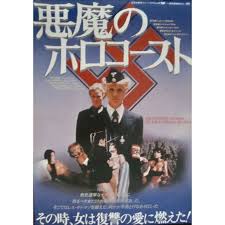
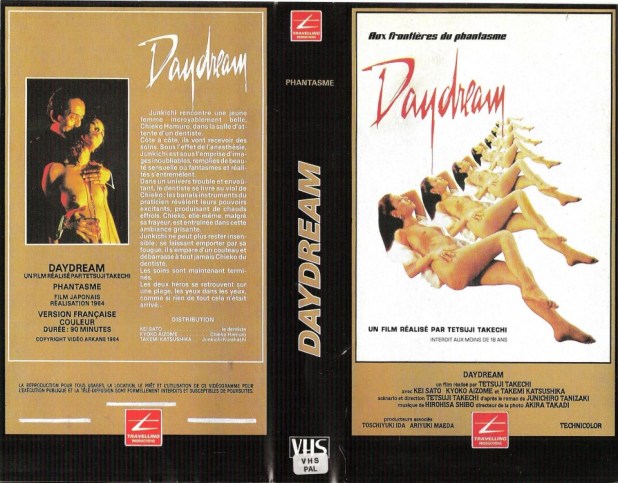
Hakujitsumu is based on a 1926 short story by Junichirō Tanizaki, which explores the nature of reality.
An artist and a young woman are in a dentist’s waiting room, and the man is too shy to even connect with her. In the same examining room, they’re both given an anesthetic as he imagines that she is being abused and tortured and even chased by a vampire. The uncut Dutch version even has a sexually explicit scene during which the woman is digitally attacked by the dentist.
A significant budget example of a pinky violence movie, this film even dared to show female pubic hair, a major cultural crime in Japan. Most instances — even in the most hardcore of films — are digitally fogged or have a mosaic over them.
Director and writer Tetsuji Takechi was nearly 70 when this was made. He’d already filmed Day Dream once before in 1964, after starting his career in kabuki theater and having his own TV show, The Tetsuji Takechi Hour, during which he reinterpreted Japanese stage classics. His next film, 1965’s Black Snow, saw him arrested on indecency charges and embroiled in a public battle over censorship between Japan’s intellectuals and the country’s government. Takechi won the lawsuit, which paved the way for the pinky films of the 1960s and 1970s.
Black Snow may be more controversial for its themes than its sex: its protagonist is a young Japanese man whose mother serves the U.S. military at Yokota Air Base as a prostitute. He’s impotent unless making love with a loaded gun in his hand, and before long, he’s killed a black soldier before being cut down by several Americans. The film is also fiercely nationalist with Americans — most pointedly the black man who is killed — shown to be nothing but sex-wild animals.
In the journal Eiga Geinjutsu, Takechi said, “The censors are getting tough about Black Snow. I admit there are many nude scenes in the film, but they are psychological nude scenes symbolizing the defencelessness of the Japanese people in the face of the American invasion. Prompted by the CIA and the U.S. Army, they say my film is immoral. This is, of course, an old story that has been going on for centuries. When they suppressed Kabuki plays during the Edo period, forbidding women to act, because of prostitution, and young actors, because of homosexuality, they said it was to preserve public morals. In fact, it was a matter of rank political suppression.”
The remake of Day Dream came a full decade after newspapers would not advertise his movies, and the director was only writing. That film is literally Japan’s first hardcore pornographic movie, and it was a big-budget movie played on big screens.
Yet while Westerners see his influence, in Japan, Takechi was an outsider in the mainstream and pinky world, so he’s forgotten. His right-wing politics clash with the protest ethos within other pinky films, so all in all, he’s lost in many ways.
Female star Kyoko Aizome, who plays Chieko, would gain notoriety from this film and become a star in the worlds of feature dancing (being arrested for indecency due to her on-stage behavior) and hard and soft AV (adult video) movies. According to an article on The Bloody Pit of Horror, she had her hymen surgically repaired so she could lose her virginity again on camera and also had her own King Kong vs. Godzilla moment when she starred in Traci Takes Tokyo opposite an underage Traci Lords.
As for the vampires, the dentist’s assistants (Saeda Kawaguchi and Yuri Yaio) have fangs, and the dentist himself is Kwaidan actor Kei Sato, a mainstream talent appearing in a movie that is anything but. Even after Chieko runs over the dentist and decapitates him, he comes back as a traditional film vampire.
After the original movie was made, South Korean director Yu Hyun-mok remade it as Chunmong (Empty Dream) and was arrested because there was a rumored nude scene. There were also rumors that actress Park Su-jeong had been humiliated by appearing naked on the set. The truth was that she wore a body stocking. Supposedly, the Korean film, which was kept off screens until 2004, is a superior piece of surrealist art.


 B&S About Movies
You must be logged in to post a comment.