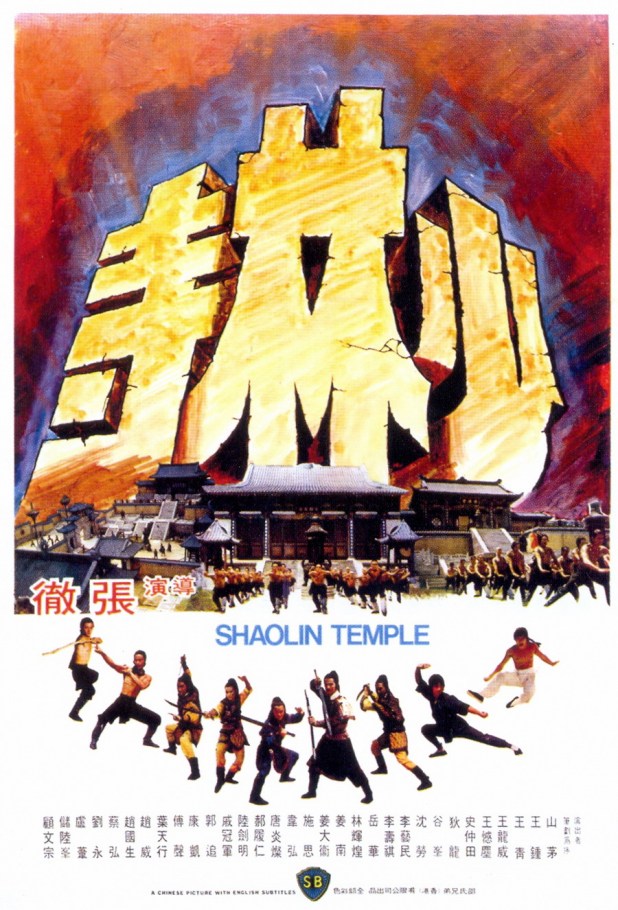
Filled with the stars of the second and third generations of director Chang Cheh’s stable of actors such as Alexander Fu Sheng, David Chiang, Ti Lung and Chi Kuan-Chun, as well as several of the actors that would later become collectively known as the Venoms Mob, Shaolin Temple — also known as Death Chambers— is so much more than just the prequel* to Five Shaolin Masters.
The leaders of the Shaolin Monks have started to come to the conclusion that time is running out and they must train more fighters to fight the Qings, yet they’re still forcing fighters to sleep outside the temple for weeks at a time to test their resolve.
Two of those fighters — Fang Shih Yu and Ma Chao-hsing — are accepted and must survive the even harsher world that is inside the temple. Fang Shih Yu struggles to learn tiger boxing and keeps failing until a mysterious person begins teaching him the tiger-crane style, which makes him a much stronger fighter.
Yet will all the training — and new monks — be enough when the Qing army attacks and attempts to burn the temple down?
This movie has an amazing training sequence that lasts ten minutes within the maze inside the temple. You have to respect people that only are concerned with fighting and meditation when they’re not building thrill rides that beat people into submission. And the last half an hour is one gigantic fight as the monks use all the skills that they’ve learned in the film.
*Actually, it’s the fifth part of the Shaolin Cycle, following Heroes Two, Men from the Monastery, Shaolin Martial Arts, Five Shaolin Masters and The Shaolin Avengers.
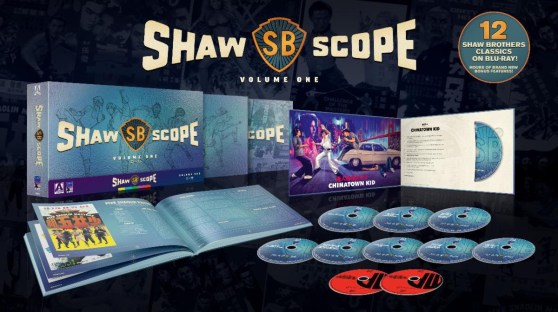
The Arrow Video Shaw Scope Volume One box set has Shaolin Temple with uncompressed Mandarin and English original mono audio, as well as newly translated English subtitles and English hard-of-hearing subtitles for the English dubs.
It also has an alternate standard-definition version and opening credits, as well as Hong Kong and German trailers.
You can also stream this movie on the Arrow player. Visit ARROW to start your 30-day free trial. Subscriptions are available for $4.99 monthly or $49.99 yearly. ARROW is available in the US, Canada, the UK and Ireland on the following Apps/devices: Roku (all Roku sticks, boxes, devices, etc), Apple TV & iOS devices, Android TV and mobile devices, Fire TV (all Amazon Fire TV Sticks, boxes, etc), and on all web browsers at https://www.arrow-player.com.
Director Lau Kar-Leung trained in martial arts under the strict instruction of his father Lau Cham, who studied Hung Gar under Lam Sai-wing, who was a student of Wong Fei-hung, the man that this movie is all about. After working as an extra and choreographer, Lau Kar-Leung became one of Shaw Brothers’ main choreographers and worked often with director Chang Cheh.
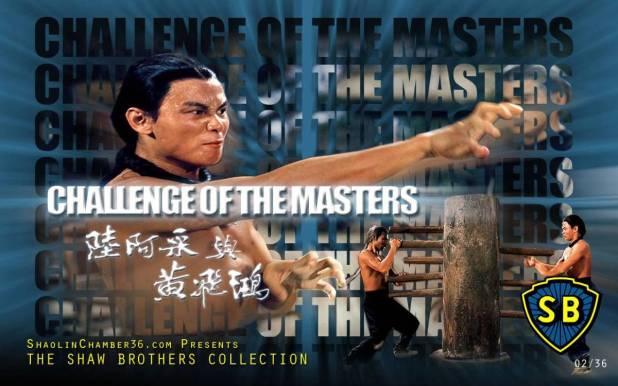
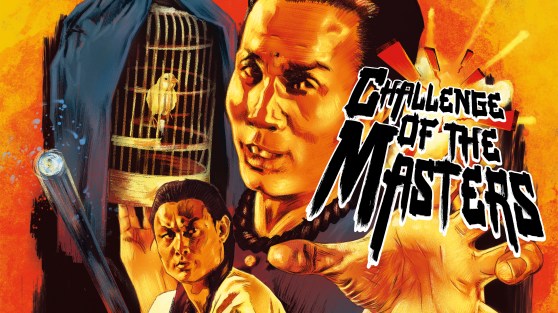
Teenager Wong Fei-hung (Gordon Liu) has been sent to train in the art of hung gar kung fu from his father’s teacher, Luk Ah-choy, after entering — and losing — a tournament on his own and causing his father’s school to be dishonored.
The true beauty of this film is the knowledge that martial arts bring one a centered feeling and can take a brash and angry young man and create a tempered adult. Luk Ah-choy continues to remind the hero that he must give more forgiveness and less aggression. These may seem alien concepts for those that only see these films as poorly dubbed fights, but to those that love the genre and have taken their own fighting journies, it will ring with absolute sincerity.
The Arrow Video Shaw Scope Volume One box set has a brand new 2K restoration of Challenge of the Masters from the original negative by Arrow Films. There’s uncompressed Mandarin, Cantonese mono and English original mono audio, as well as newly translated English subtitles and English hard-of-hearing subtitles for the English dubs.
There’s also alternate textless opening credits, a Hong Kong trailer and interviews with Gordon Liu and Chen Kuan-tai, as well as an appreciation of director Lau Kar-leung by film critic and historian Tony Rayns.
You can also stream this movie on the Arrow player. Visit ARROW to start your 30-day free trial. Subscriptions are available for $4.99 monthly or $49.99 yearly. ARROW is available in the US, Canada, the UK and Ireland on the following Apps/devices: Roku (all Roku sticks, boxes, devices, etc), Apple TV & iOS devices, Android TV and mobile devices, Fire TV (all Amazon Fire TV Sticks, boxes, etc), and on all web browsers at https://www.arrow-player.com.
The Old School Kung Fu Fest is back and the Museum of the Moving Image and Subway Cinema will co-present eight newly restored films and one fan favorite classic by Kuo on glorious 35mm. Four titles will be available exclusively online, December 6–13, and another five films for in-person big-screen viewing at MoMI, December 10–12.
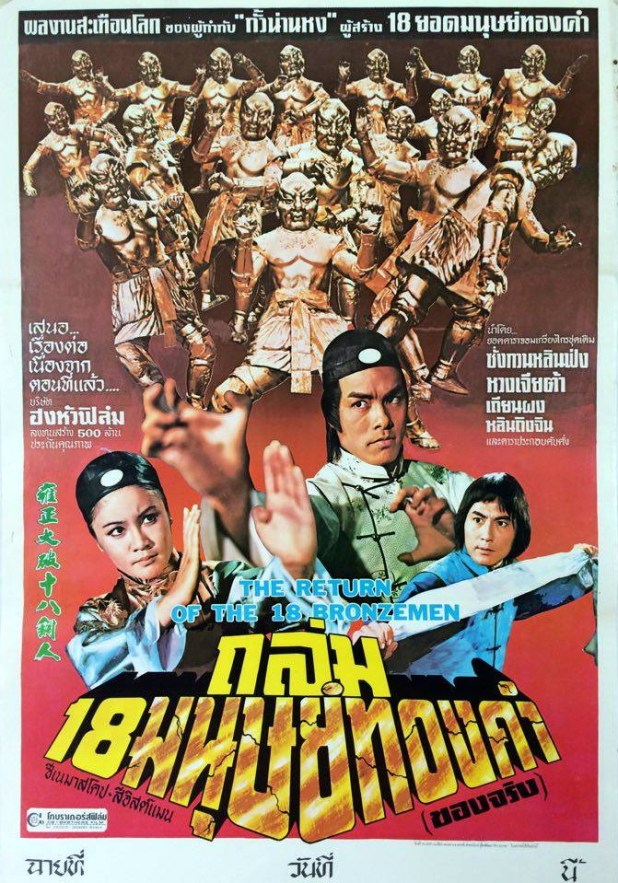
Carter Wong may be the star while Tien Peng and Polly Shang Kwan show up — in different roles for each of them — but Return of the 18 Bronzemen isn’t a direct sequel to The 18 Bronzemen. Wong is Ai Sung-Chueh, a murderous prince who leaves behind the throne to study the rebels up close by studying at the Shaolin temple. He’s at once determined to pass the tests of the temple to gain their skills and to destroy it.
This installment has way less story, but the real reason to watch it is the nearly hour-long sequence where Wong studies and then challenges the Bronzemen. It’s literally a movie based around one long fight and it’s just as great as it sounds. There’s not much more of a story than that. Really, you expect Wong to get some kind of change of heart or become a better person and he never does, which is odd for someone who has devoted three years of his life to being part of the Shaolin.
The titular fighting masters remain the real draw of this film and the scenes where they battle Wong are worth whatever price of admission that you pay. Kuo would tell further stories of the Shaolin and the Bronzemen in another film made in 1976, Blazing Temple.
The Old School Kung Fu Fest is back and the Museum of the Moving Image and Subway Cinema will co-present eight newly restored films and one fan favorite classic by Kuo on glorious 35mm. Four titles will be available exclusively online, December 6–13, and another five films for in-person big-screen viewing at MoMI, December 10–12.
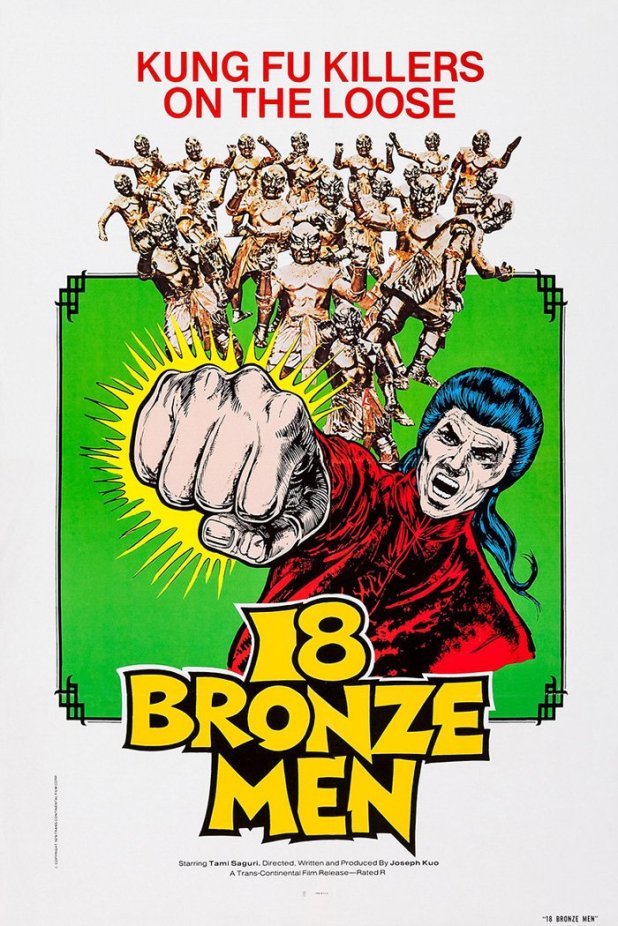
Shaolung’s family was murdered before he was able to escape to the Shaolin Temple, a place where he has learned to become a pretty strong fighter. Before he can get the revenge that he needs, he must face one final challenge: battling and defeating the titular 18 men of bronze.
What makes this movie — beyond how great it always is to see Carter Wong — is the battle scenes between the students of the Shaolin and the golden army. Some of them look like robots, others look like men just painted gold and no matter how silly that sounds, it’s completely awesome. So is Polly Shang Kwan, who plays the potential future wife of Shaolung who instead dresses as a man and continually defends his life.
This has the best budget I’ve seen in a Joseph Kuo film and he makes the best use of it possible. What an absolute blast.
There’s nothing quite like watching an actor or musician reaching the top of their profession to relish the schadenfreude of their ego crash, burning down their career — regardless of the fact this received three Primetime Emmys (in technical fields). Such a project is this early ’70s Christian Cinema oddball inspired by The Holy Bible tales of Adam and Eve and the parable of Noah and the Flood.
Yes, step right up!
Menahem Golan’s rock ‘n’ roll take on Eve and that damned apple with The Apple has nothing on this hour-long prime time special written by Jack Good (the Monkees’ equally off-the-hut 33-1/3 Revolutions Per Minute and Patrick McGoohan’s rock ‘n’ roll inversion of Othello with 1974’s Catch My Soul) and co-directed by TV’s Jamie Rogers and Gene McAvoy (Sonny & Cher).
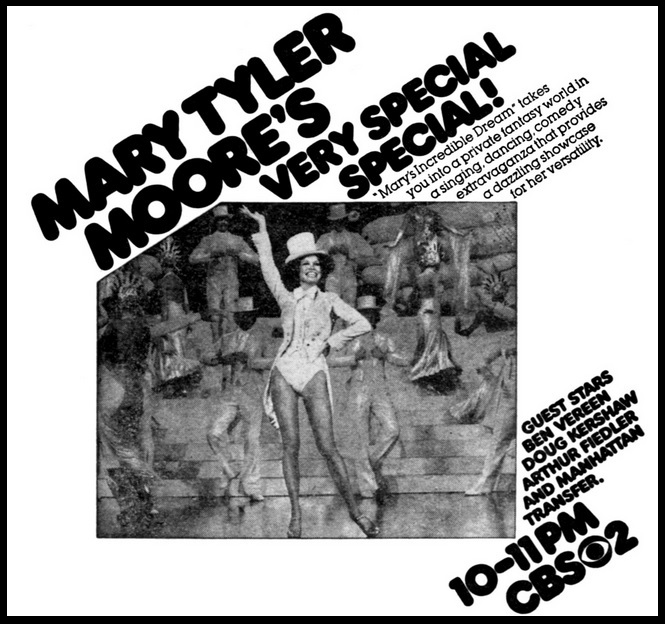
Does The Devil singing the Rolling Stones’ “Sympathy for the Devil” — in full cabaret regalia — interest you? Does Ben Vereen (Gas-s-s-s in 1970, later Will Smith’s deadbeat dad in The Fresh Prince of Bel-Air) in a skin-tight red jump suit, his chest exposed, as he jumps around like David Lee Roth during his Van Halen-prime to the tune of “Ball of Confusion” by the Temptations do it for you? No? Perhaps Ms. Moore taking a crack at Cat Stevens’s “Morning Has Broken” — during the Noah’s Flood sequence, while she floats on God’s plaster of Paris hand — floats your boat?
Yeah, didn’t think so. But I implore you, it should.
For watching Moore decimate the carte blanche gained from The Dick Van Dyke Show in the 1960s and The Mary Tyler Moore Show in the 1970s, with this disco-ballet-musical knockoff of The Wizard of Oz — with Ms. Moore as an angelic, Eve-Dorothy amalgamate — is a whole lot of fun. More fun that should be humanly allowed. As fun as Jesus returning during the disco-era to take on the Mafia in White Pop Jesus (1980)? Hey, it’s your thirty pieces of silver to spend however you want.
For a wee lad, a leggy Mary was a heartbreak/courtesy of Moviefone.
In her 1995 memoir, After All, Mary Tyler Moore explained that this special was originally going to be titled Mary Tyler Moore Explains the History of the World (Mel Brooks, of course, would do it so much better in 1981 with History of the World: Part I). Mary’s “version of the world” went down in history on Mary’s home channel, CBS-TV — and bombed — on January 22, 1976, taking Ben Vereen (who doubles as Noah and the Devil, in his TV acting debut) and lauded cajun-county fiddler Doug Kershaw (he appeared on Arlo Guthrie’s “Alice’s Rock and Roll Restaurant” and records by Grand Funk Railroad; in the stoner western,Zachariah, and concert doc Medicine Ball Caravan; here, he doubles as Adam and the Devil), acclaimed Boston Pops maestro Arthur Fiedler (as God), and the Manhattan Transfer (angles, devils, and everything else) (who were always annoying, yet very hot before this, and not so much after this), down with the Ark.
Oh, the vanity of Ms. Moore tapping, dancing, and singing her way across the stage to a mixture of rock, pop, and classical tunes (even a good ol’ country Hair-inspired “washboard” number) in a tale about man’s creation, fall, and rebirth. Oh, but it’s not really happening . . . for it is all Mary Tyler Moore’s “dream.”
The “dream” is Mary drifting off to sleep . . . then being whisked away to the Pearly Gates — where Heaven is a giant, Westinghouse Radio (the kind Grandma kept on top of the refrigerator) to meet God (Arthur Fiedler conducting an angelic choir), the Manhattan Transfer show up with several (awful) numbers of musical wisdom, and Ben Vereen in that green tuxedo with a “666” on it, well, not since Jim Carrey in that awful Batman movie.
Does Mary become a cave girl to pull out a Flintstone-sytled bone microphone? Does a giant, plaster-cast “hand of God” save Vereen and Mary’s Mr. and Mrs. Noah from the flood, set to the backing of a Planet of the Apes-styled, waist-deep Statue of Liberty? Does Mary and a cast of Nazi dancers sport some green-glilter, Nazisplotation SS-uniforms for a softshoe? Is that stock film footage of Richard Nixon and Henry Kissinger making a timely political statement?
Yes to all! Yes. Yes. And, oh, my God. YES! This is Sgt. Pepper’s Lonely Hearts Club Band on acid with a speedball chaser. No, it’s not a dream. Mary Tyler Moore in this ersatz collision of Hair tangled with Godspell and Jesus Christ Superstar really happened . . . just like those musical variety nightmares of the late ’70s starring the washed-up cast of The Brady Bunch that left our parents snickering and us wee lads and lassies scratching our heads.
Courtesy of the folks at Mod Cinema, we learn the “why” of this ungodly musical: Moore decided that the next season of The Mary Tyler Moore Show (which morphed into the dramatic Lou Grant with Ed Asner) would be the last, as she was developing a variety show as her next project. And this “incredible dream” served as the (failed) pilot.
Yeah, uh, no more weekly variety show for Ms. Moore.
Well, not, not really.
During 1978 – 1979 TV season, Moore, once again, attempted the musical-variety genre by starring in two more, unsuccessful CBS variety series. The first was Mary*, which featured a pre-stardom David Letterman, Michael Keaton, Swoosie Kurtz and Dick Shawn in the supporting cast. Making its debut on September 24, 1978, it ran for a total of three, low-rated episodes (its highest ranking was 64th out of 114 shows), until its cancellation on October 8, 1978.
Then, in March 1979, a mere five months after the cancellation of Mary, the network brought Moore back in a new, retooled version called The Mary Tyler Moore Hour**. Described as a groundbreaking “sit-var” (part situation comedy/part variety series), Moore portrayed a TV star putting on a variety show. The show-within-a-show format, which starred the likable and dependable Joyce Van Patten (Bad News Bears, 1976), Ron Rifkin (Silent Running), and a returning Micheal Keaton was cancelled in June 1979 after eleven episodes. Not even guest appearances by Lucille Ball, Dick Van Dyke, and Gene Kelly — starring as themselves and appearing on the “show” within the show — could save it.
Yes, dear reader, Mary’s Incredible Dream is incredibly, epically delicious. If there’s ever a time where you NEED to waste 51-minutes of your life — at least you’re not losing 9-minutes on commercials — this is it. Watch it on You Tube . . . but I have a feeling this two minute opening of Mary adorned in a flowing, pink chiffon nightie fly upward into the heavens just may be all you need to decide if you want to spend another 51-minutes with this, well, train wreck that gives the teachings of Jesus a bad name.
Oh, by the way . . . if you need to know more (we know you don’t, but anyway) about Mary Tyler Moore, there’s an hour-long Reelz-exclusive documentary (well, 44-minutes, since the TV commercials are cut) Behind the Smile on Tubi.
* Mary Tyler Moore has rabid fans, so yes, you can find episodes and clips of Mary on You Tube.
** Yeah, The Mary Tyler Moore Hour is on You Tube, so take your pick of the clips or episodes.
About the Author: You can read the music and film reviews of R.D Francis on Medium and learn more about his work on Facebook.
Based on the book Breakheart Pass by Alistair MacLean, this movie begins with a remote settlement in Eureka, California suffering from a diphtheria epidemic. An express train is dispatched toward the fort, filled with reinforcements and much-needed medical supplies. There are also some important civilians on board, like Nevada Governor Richard Fairchild (Richard Crenna) and his fiancée Marica (Jill Ireland), the daughter of Fort Humboldt’s commander.
Then, the train stops to let on United States Marshal Pearce (Ben Johnson) and his prisoner, John Deakin (Charles Bronson), a notorious outlaw with a price on his head.
The truth is that Deakin is really a Secret Service agent and that anyone who seemed on the side of the law is really using the epidemic as an excuse to send weapons to Native Americans to use against their fellow Americans. Anyone who isn’t part of the conspiracy is being killed one by one.
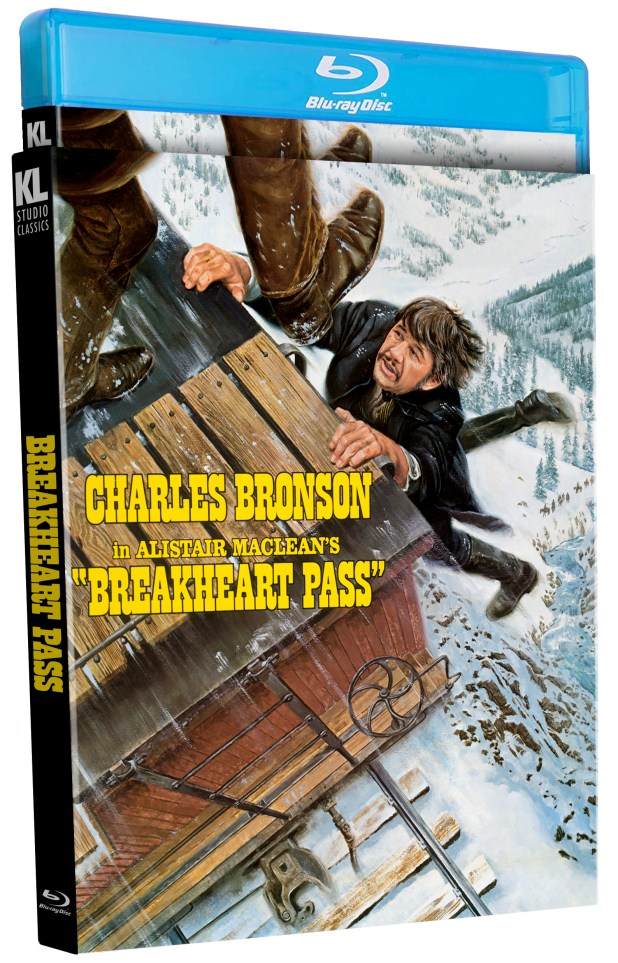
Beyond boasting other cast members like Sally Kirkland, Charles Durning and Ed Lauter. there’s ultra-heavy bad guy Robert Tessier and an insane fight on a train car in the snow that looks like one of the most dangerous scenes I’ve ever seen filmed. It was performed by stuntmen Howard Curtis (who was doubling Bronson) and Tony Brubaker (who was Archie Moore’s stand-in). It’s the last stunt directed by Yakima Canutt, who directed the chariot race in Ben-Hur and performed the stagecoach drop in Stagecoach that inspired the scene in Raiders of the Lost Ark where Indiana Jones goes under the German truck. He also taught John Wayne how to fall off a horse, as well as inspired how the Duke acted on screen. The drawling, hesitant speech and the hip-rolling walk that made Wayne famous were all how Canutt actually behaved in real life. Along the way, Cannutt got hurt so many times that his injuries seem hyperbole: multiple broken ribs, breaking both legs at the ankles and even having his intestines split in half while doubling for Clark Gable in Boom Town.
In spite of all of those injuries, he lived to be ninety.
Directed by Tom Gries (The Rat Patrol TV series, Earth II), this film has another astounding practical effect. Those aren’t model train cars getting destroyed. They’re full-sized cars bought just to be run into each other.
The new Kino Lorber blu ray of Breakheart Pass has a brand new 2K master, new audio commentary by film historians Howard S. Berger, Steve Mitchell and Nathaniel Thompson, and reversible cover art. You can order it from Kino Lorber.
EDITOR’S NOTE: We originally watched and logged this on January 7, 2020. Do you have an opinion on this movie? Let us know! You can also see our thoughts on the sequel here.
The Sultan of Sexploitation! The King of Camp! And as H. Hershey, you directed early 80’s hardcore like Moments of Love. You were scum and I say that with the kind of infection I usually reserve for small animals. I wish you were alive so I could hug you.
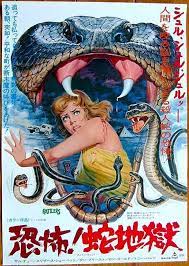
How can you not love any movie that starts with two young boys getting repeatedly bitten and killed by an entire pit of angry rattlesnakes after their parents pretty much ignore them for cans of beer?
Soon, the local sheriff has to call on underpaid college professor and herpetologist Dr. Tom Parkinson to learn why the snakes are just so darn aggressive. Of course, Dr. Tom can barely keep his own cobras in their cages.
Parkinson and war photographer Ann Bradley soon learn that the military base has authorized the disposal of a nerve gas called CT3 and it’s causing all this commotion. Colonel Stroud, the guy behind it all, ends up killing the base’s medical officer before the cops close in and gun him down, too. The snakes, presumably, are still on the loose.
Director John McCauley waited nine years to make another movie, 1985’s Deadly Intruder. The movie also features Darwin Joston, who was Napoleon Wilson in Assault on Precinct 13 and Dr. Phibes in The Fog.
You can watch the Cinematic Titanic riffed version of this movie on Tubi.
ABOUT THE AUTHOR: Benjamin Merrell lives in Seattle, WA. You can check out his blog at cestnonunblog.com and follow him on Letterboxd.
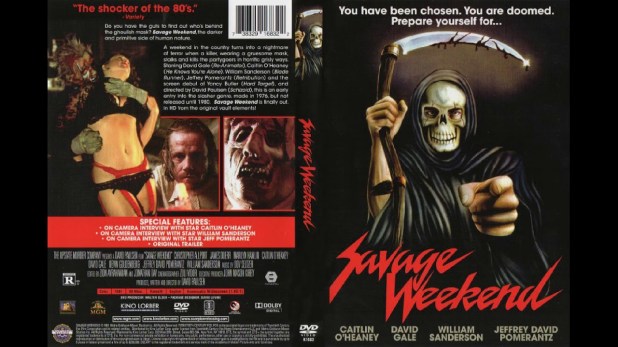
Several Manhattan yuppies escape the city for a nice, relaxing weekend in the hillbilly-infested Appalachian hills of…Upstate New York. Little do they know that their weekend of fun is about to turn deadly…
Recently divorced Marie has a new stockbroker boyfriend who just bought a farmhouse upstate and is in the process of building a boat on the property. So they, along with Marie’s sister and her gay best friend, leave the city to check on the progress of the boat and enjoy a pleasant weekend out in the country. But not long after they arrive at the farmhouse someone puts on the gruesome Halloween mask Marie’s sister bought as a joke and is now killing them all one by one.
The possible suspects are numerous; too many if you ask me. The biggest weakness this movie has is how they handle the mystery of the killer’s identity. The whodunit aspect relies heavily on having way too many red herrings, especially considering there aren’t even that many characters in the movie. They want you to believe that anyone could be the killer, but the overabundance of potential suspects only succeeds in making it more obvious as time goes on who the killer actually is. There’s a scene towards the end where three of the potential suspects are running with weapons through the woods after Marie. They could have built this moment up as a real nail biter of a finale where Marie (and the audience) would have no idea which one of them was the real killer and which was her savior, but unfortunately by that point in the story the killer had already been long revealed, which sapped a good deal of the tension out of what could have been a really great finale set piece for the film.
The two most obvious suspects for the masked killer are Mac, the guy providing lumber for the boat, who is way too comfortable sexually harassing Marie (who, to be fair, hasn’t been doing a particularly great job of showing that she’s not interested) and Otis (played by the always fantastic William Sanderson), whose father was the previous owner of the farmhouse and is currently helping with the construction of the boat. Mac, who gives off his own creeper vibes, tells them a story about how Otis attacked a couple, almost beat the guy to death and then branded his girl with an ‘H’ (for ‘whore’. Otis is not the brightest bulb.) It’s never really clear if there’s any truth to the story or if Mac was just making up the whole story about Otis, but regardless Otis definitely is a creepy motherfucker. Of course, Mac is no saint either. After telling his story he then enjoys the hell out of watching his big city boss step on a fishhook.
They aren’t the only ones the movie casts suspicion on though. Could it be Jay, the gross boat engineer whose hands have been all over Marie’s sister all weekend? Or what about the gay best friend, Nicky? This is the red herring I find the most questionable. Nicky is actually pretty badass at the start of the movie. The first thing he does after they get into town is he tries to order a fancy martini at the local watering hole, much to the confusion of the bartender, who has apparently never heard of a martini before, and the local hicks who don’t take kindly to gay folk in their small backwoods town (despite the fact that they’re both dressed like reject Village People). Nicky has a pretty good grasp of the situation though, and he handily kicks their asses before they get a chance to gang up on him, and he looks pretty cool doing it. But instead of using that to set him up as a character who can take care of himself when the killer eventually shows up, the rest of his character arc quickly becomes a lot more problematic. Some unfortunate gay panic was definitely slipped into the script because from then on he’s portrayed much more like a sexual predator than a potential victim, despite not having really done anything to deserve that portrayal. Everyone in this movie has to be at least a little suspicious though.
Released in the late summer of ‘79 as one of the early proto-Slashers, but shot in 1976, Savage Weekend definitely has more in common with 70’s grindhouse sleaze like The Last House On The Left or Deliverance (both released in 1972) than the more kill-focused slashers of the 80’s. The gore factor might be a little disappointing for an audience raised on 80’s slashers (forget gore, there’s barely any blood), but Savage Weekend actually does a great job of making that violence feel visceral and real, even if they don’t end up showing much. Most of the violence lives, not up on the screen, but in your head long after the scene is over, and much like with Texas Chain Saw Massacre, you’re probably going to walk away from this movie thinking it was a lot gorier than it actually was.
This does make sense, as people were much less obsessed with gore in the mid-70s and much more obsessed with sex, which this movie has in spades. Everyone’s constantly getting naked, or hooking up, or getting naked and hooking up, or watching someone get naked and hooking up. Every aspect of the movie feels constantly sexually charged, which leads you to believe there’s going to be more of a psychosexual aspect to the killer that never really pans out. Horror usually reflects the fears of the era it was produced in and Savage Weekend is no different. Fears of sexual liberation, female empowerment, gay liberation, and divorce all have roots in the themes of this film.
Savage Weekend isn’t perfect. The writing is sloppy and unfocused. It tries to do too much with too little, and the small budget limitations definitely show at times. But it also captures a little magic that not all of its contemporaries can make claim to. There’s a reason Savage Weekend has a cult following. It has a very unique quality to it that’s hard to pin down. It has this odd rhythm to it that really draws you in, so even if the whodunit aspect of it turns out to be a real bust, there’s still a real mystery hanging over its atmosphere that makes this movie a real blast to watch for fans of the genre.
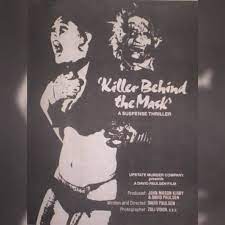
While it wasn’t released until 1979, the movie that became Savage Weekend — also The Killer Behind the Mask — started as The Upstate Murders. That means that it predates most of the commonly accepted “first” slashers like Halloween and Friday the 13th.
This is a slasher with the most ridiculous of conceits — everyone comes to upstate New York to see a new schooner — but it also has a heroic gay character (Nicky, played by Christopher Allport, who was in both Jack Frost movies and ironically killed in real life by an avalanche) and a woman escaping a bad marriage which seemingly has followed her. Also, since the aspect ratio got screwed up, the boom mic is a frequent co-star.
That said, it has a sewing needle through the head, someone accidentally killed by a bandsaw when the wrong light switch gets turned on, a hanging and an Upstate New York Chainsaw Massacre. It’s not perfect — it’s barely even worthwhile — but at least director/writer got to go on and make the much more interesting Schizoid, which has hot tub therapy sessions, scissor murders, Donna Wilkes being in love with her father Klaus Kinski and a love scene where Kinski has sex with a stripper against a hot water heater.
EDITOR’S NOTE: This is the third time we’ve posted about this movie. Sam wrote about it on and Jennifer Upton wrote a great article on November 27, 2018. Here’s her take on the film. Feel free to share yours in the comments.
Thanks to Jennifer Upton for contributing this review. An American living in London, she is a freelance writer for International publishers Story Terrace and others. In addition, she has a blog where she frequently writes about horror and sci-fi called Womanycom.
The 1970s were the pinnacle decade for Bigfoot films.
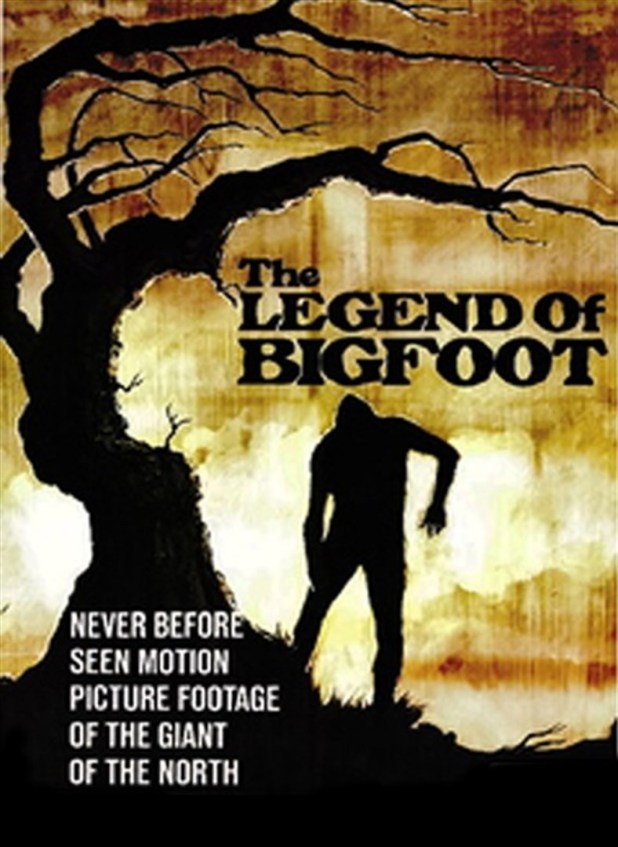
The film that kicked off the craze was Charles B. Pierce’s classic Legend of Boggy Creek, which was a huge hit on the Drive-In circuit in 1972. Derivative in style to this far superior predecessor, The Legend of Bigfootis a 1976 docudrama that follows researcher/tracker/nature photographer Ivan Marx on an expedition to find the elusive creature. Through narration of footage shot by Marx himself, he guides the audience through a series of events that may or may not prove the existence of the elusive North American ape. Where Boggy Creek succeeds in re-creating some supposedly true stories to great (and creepy) impact, Legend wastes a lot of time on lengthy digressions that focus on the other animals that live in the creature’s habitat.
In his search, Marx travels from his home in Northern California to Alaska, Oregon, Arizona and even the Arctic Circle. Along the way, we see Musk Oxen, Moose, deer and many other animals. We see them chilling out, defending their territories, eating and basically doing what animals do. Unfortunately, we are also subjected to several scenes of what today, would be considered animal cruelty. These include footage of a cougar being forcibly removed from its den and a mortally wounded ground squirrel dragging itself to its nest to die. Animal lovers beware.
The nature footage and gorgeous landscapes probably looked great in their time, but Mill Creek’s extremely poor transfer is almost unwatchable on a modern high-resolution Television. Even a basic color correction on a home editing system would go a long way towards improving the source material. At times, it’s hard to even make out what’s happening in the darker shots.
True to the Bigfoot subgenre, Legend includes a lot of close-ups of footprints and incorporates many theories of the creature’s potential lifestyle and habits. What the film is probably most famous for is the conclusion, which features what Marx claimed was actual footage of a real Sasquatch. Spoiler Alert: It’s a guy in a gorilla suit. It was just one of many hoaxes perpetrated by Mr. Marx over the years, leaving his reputation maligned within the Cryptozoology community. Nevertheless, he released two sequels. In the Shadow of Bigfoot (1977) and Alive and Well (1982) and maintained his footage was real up until his death in 1999. All but the biggest Bigfoot aficionados would do well to avoid The Legend of Bigfoot.
It’s duller than many other films of its type and at a running time of 1 hour and 16 minutes, it feels a lot longer. In the beginning Marx opines, “You’ll never know what it is to wait…until you become a tracker.” Yes, Mr. Marx, we do know what it is to wait…for something to happen in this movie.





 B&S About Movies
You must be logged in to post a comment.