DRIVE-IN SUPER MONSTER RAMA PRIMER: Grizzly (1976)

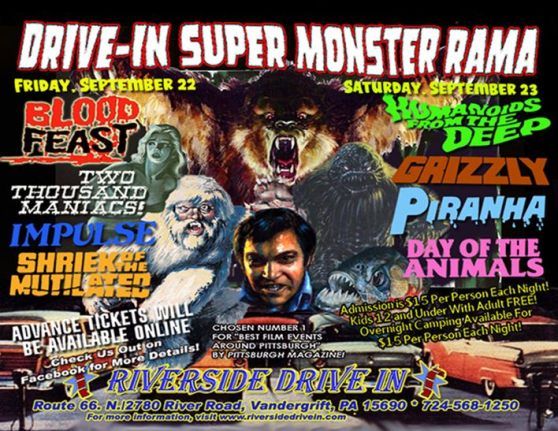
EDITOR’S NOTE: This weekend is the Drive-In Super Monster-Rama! Get more info at the official Drive-In Super Monster-Rama Facebook page and get your tickets at the Riverside Drive-In’s webpage.
From 1972 to 1978, William Girder directed nine feature films and would have probably never stopped, were it not for the helicopter crash that took his life while scouting the Philippines filming locations. From Asylum of Satan and Three on a Meathook to The ManitouSheba Baby and Project: Kill, his films may have been derivative but they made money.

Here’s the best example. Around these parts, Girder is celebrated for Abby, a movie that was removed from theaters because of its similarity (let’s say total ripoff) of The ExorcistThat brings us to Grizzly, which is essentially Jaws on dry land. With a bear. A grizzly bear.

Grizzly found its inspiration when its producer and writer, Harvey Flaxman, came face to face with a bear during a camping trip. Co-producer and co-writer David Sheldon thought about how they could make a bear version of Jaws and they wrote a script that Girdler discovered and offered to finance, as long as he could direct.

Grizzly begins with military vet and helicopter pilot Don Stober (Andrew Prine, The Town that Dreaded SundownThe EliminatorsAmityville II: The Possession) flying over a national park and explaining how the woods remain untouched, much like they were in when Native Americans made their homes here.

The first two attacks happen quickly — in bear POV no less — when two female hikers are dismembered by the ursus arctos horribilis villain of this story. That brings in park ranger Michael Kelly (Christopher George, Gates of Hell/City of the Living DeadDay of the Animals, MortuaryPieces) and photographer Allison Corwin (Joan McCall, who besides being in Devil Times Five is also married to the film’s writer, Sheldon) in on the case.

At the hospital, a doctor tells the park ranger that a bear killed the girls, but the park’s supervisor blames the ranger and naturalist Arthur Scott (Richard Jaeckel, The DarkMako: The Jaws of Death and TV’s Salvage 1) for the girls’ deaths. And guess what? Just like Jaws, there’s no way the park is getting closed before tourist season.

The rangers all decide to search the mountain for the grizzly, which isn’t accounted for in their census of animals in the park. One of the rangers — of course — decides to get nude in a waterfall because that’s what you do when you’re hunting a killer bear and gets murked for her stupidity.

Kelly and Stober think they have found the bear from the air, yet it’s just naturalist Scott wearing an animal pelt and tracking the bear himself. Scott tells them that this bear is actually a prehistoric version of the grizzly that stands 15 feet tall and weighs at least 2,000 pounds.

No matter how many people the grizzly kills, no one will close the park. So when the story becomes national news, the owners of the park — a national park can have owners? — allow amateur hunters to shoot the shark (this has nothing to do with the very same thing happening in Jaws, right?). Those hunters are pretty much the worst people ever, as they use a bear cub as bait, thinking the grizzly will protect its young. Nope — it eats that baby bear and keeps on coming.

The grizzly literally shreds his way through the park and nobody closes it down until it murders a young mother and mutilates her child. And get this — the grizzly is so smart, it knows how to bury the naturalist in the ground and then waits for him to wake up so it can kill him. Can a bear be a slasher killer? Well, we already know that Bigfoot can be, thanks to Night of the Demon.

The grizzly kills every hero in this movie other than Kelly the photographer, who magically finds a bazooka in the wrecked helicopter and remembers the end of every shark movie: you must blow this beast up real good. She does and that’s the end of Grizzly.

An interesting personal note: I was telling my dad about this movie and he remembered that it has played on a bus that took he and my mother on a casino trip. That’s right — at 1 AM, pitch blackness, the TV on their bus blared this gorefest as loudly as possible. “I couldn’t wait for that movie to end,” was my mother’s review. My father’s was a bit kinder.

Warner Brothers originally wanted to finance Grizzly, but were furious that Edward L. Montoro and Film Ventures International (FVI) had taken the project. That’s because a year before, the studio sued both of these companies for copyright infringement when they released Beyond the Door in the US.

Sadly, while Grizzly was one of 1976’s best-performing films, earning $39 million worldwide (adjusted for inflation, that’s around $177 million in 2018 dollars), its distributor Edward L. Montoro and Film Ventures International kept all the profits. Girdler and Harvey Flaxman and David Sheldon (the film’s screenwriters/producers) had to sue to get their share.

Even after all that, Girdler still directed Day of the Animals, a spiritual sequel to Grizzly, for Montoro. While this film added Leslie Nielsen and Lynda Day George to the returning cast of Christopher George and Richard Jaeckel, it wasn’t as successful.

Grizzly just seems like a movie that’s buried in legal shenanigans. A sequel, Grizzly II: The Predator (also known as Grizzly II: The Concert, a title that would assuredly guarantee that I would buy this film) was made in 1983.

Filmed in Hungary by André Szöts and written by Sheldon, the co-producer and writer of the original, it was never released. The film had Louise Fletcher, John Rhys-Davies and unknowns but about to be big stars like Charlie Sheen (who took this movie over the lead in Karate Kid), George Clooney and Laura Dern in the cast, as well as live performances (hence Grizzly II: The Concert) by musicians like Toto Coelo (who had one song I can name, “I Eat Cannibals Part 1”) and Landscape III.

The movie was such a mess that the film’s caterer ended up rewriting it. And while the main filming was completed, special effects and all of the actual bear footage wasn’t. That’s because the film’s executive producer Joseph Proctor had disappeared with the money (and may have even been already jailed when filming began). While a mechanical bear was to be used, there was still footage shot of a live bear attacking concert-goers filmed (!). There’s a bootleg workprint, but the full film has ever emerged. This New York Post article has even more amazing info about Grizzly 2. Now that film has been released, if you’d like to see it.

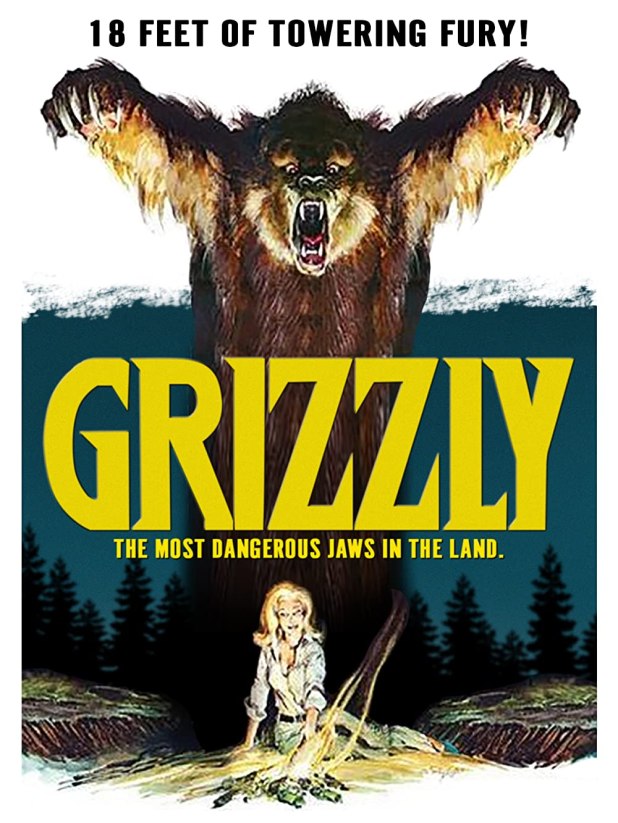
Finally, a trivia note for comic book fans. The amazing poster for this movie? Neal Adams did the art.

And in the universe of Tarantino, Don Stober was played by Rick Dalton, not Andrew Prine.

Here’s the recipe I’ll be bringing.

Honey Bear

  • 1 oz. bourbon
  • 2 oz. apple cider
  • 1/2 oz. Cointreau
  • 1 oz. honey, orange and sage syrup
  • Sliced orange

Pre-work: To make the syrup use the following ingredients:

  • 1 cup water
  • 1/3 cup honey
  • 3 tbsp. sugar
  • 1 tsp. ground sage
  • 2 orange slices
  • 1 tsp. orange zest
  1. Heat a small pan on high, then heat up all ingredients to boiling.
  2. Simmer for 3 minutes and let cool. Store in refrigerator for up to a week.

To make the drink:

  1. Pour bourbon and honey, orange and sage syrup in an ice-filled glass.
  2. Top with apple cider.

You can watch this on Tubi or get it from Severin.

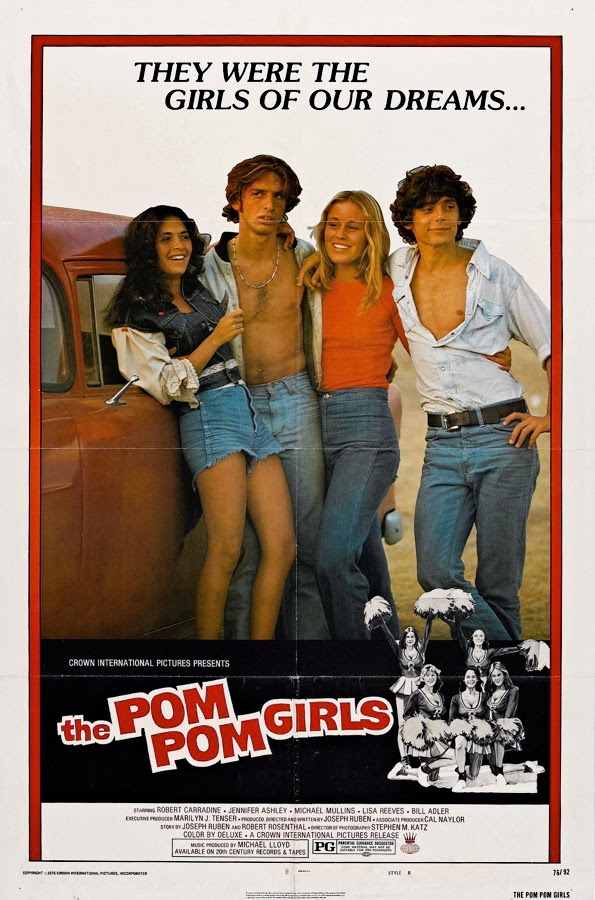
USA UP ALL NIGHT MONTH: The Pom-Pom Girls (1976)

EDITOR’S NOTE: The Pom-Pom Girls was on USA Up All Night on June 30, July 1 and November 18, 1989; April 14 and December 7, 1990 and August 24, 1991.

Director Joseph Ruben has made some pretty good movies like DreamscapeThe StepfatherSleeping With the Enemy and The Good Son. This Crown International Pictures movie was directed by him and written by Robert J. Rosenthal, who also wrote The Van and directed and wrote Zapped! and Malibu Beach.

Johnnie (Robert Carradine) is the hothead. He has a crush on Sally (Lisa Reeves) but he’s dating a tough guy named Duane (Bill Adler). Jesse (Michael Mullins) is the ladykiller and he’s all into Laurie (Jennifer Ashley). These teens end up hanging out, stealing fire engines, getting in chicken races and falling in and out of love.

It’s not as sexual as you think. I mean, there’s sex. But it’s more about growing up. It’s a hang out movie and so much of it doesn’t go anywhere, like the coach who doesn’t like Jesse. But look, Cheryl Rainbeaux Smith is in it and when I saw her name in the credits, I literally said a little prayer thanking whatever intelligent design created her.

For maniacs like me: There’s a scene where Ashley wears a Boy Scouts Of America shirt from the San Gabriel Valley Council. She’s wearing that same shirt again in  Tintorera…Tiger Shark.

You can download this movie with USA Up All Night clips at the Internet Archive.

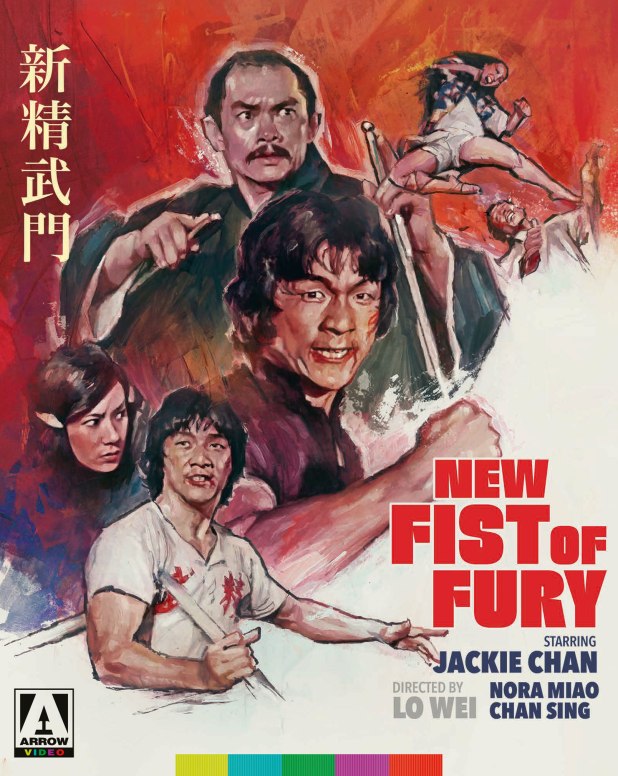
ARROW VIDEO BLU RAY RELEASE: New Fist of Fury (1976)

New Fist of Fury is the first film Lo Wei directed — of many! — that starred Jackie Chan, who used the stage name Sing Lung which he is known in China as. It means “becoming a dragon.”

Chan had previously appeared in the original Fist of Fury as a stuntman. This movie was Lo’s attempt to market Jackie Chan as the new Bruce Lee. Chan became known for it, but didn’t become a true star until he began infusing comedy with his martial arts.

Theatrical 1976 edition: A brother and sister escape from Japanese-occupied Shanghai to Japanese-occupied Taiwan. There, they work with their kung fu teacher grandfather, who is dealing with a Japanese martial arts school that is attempting to dominate all of the other schools, even using murder to get their way. Chan plays a young thief who resists learning kung fu yet finally accepts them and becomes a master who fights the Japanese to support the rights of the Chinese people.

Rerelease 1980 version: Chan plays the same thief, but who is met earlier when he steals a pair of nunchaku from Da Yang Gate, a Japanese martial arts school. They offer him a job in their casino and when he refuses, they attack him. He’s saved by the students of the Jingwu school and is invited to their master Mao Li Uhr’s 80th birthday party. Those same Japanese martial artists attack the party, causing the master to have a heart attack and strengthening the resolve of the Jingwu to reestablish their school. Chan joins them and learns that he must defend the Chinese people.

Produced three years after Bruce Lee’s death — the movie opens with his lover Li-Er mourning the death of his character Chen Zhen — this was Chan’s first big break. Sure, he had played in uncredited roles, done stunts and smaller movies, but at one point he even moved to Australia and was working in construction. Luckily, he returned and worked hard to become the star that he is today.

This movie is fine, however, but it doesn’t establish who Jackie Chan really could be. He wasn’t the next Bruce Lee. He was the first Jackie Chan and would soon have his own copycat clones. After all, he even has a genre named after him, Jackiesploitation.

The Arrow Video blu ray release of New Fist of Fury has a new 2K restoration from the original negatives by Fortune Star for both the 120-minute theatrical cut and the 82-minute 1980 re-release. It also has commentary on the theatrical cut by martial arts cinema experts Frank Djeng and Michael Worth, co-directors of Enter the Clones of Bruce Lee and a commentary on the re-release cut by action cinema expert Brandon Bentley, who also contributed a video essay that compares this film to another sequel that came out at the same time, Fist of Fury Part II. There’s also a trailer gallery, including a Chen Zhen trailer reel of sequels and reboots; an image gallery; a double-sided fold-out poster and reversible sleeve featuring original and newly commissioned artwork by Tony Stella and an illustrated collector’s booklet featuring new writing by Jonathan Clements and an archival retrospective article by Brian Bankston. You can get it from MVD.

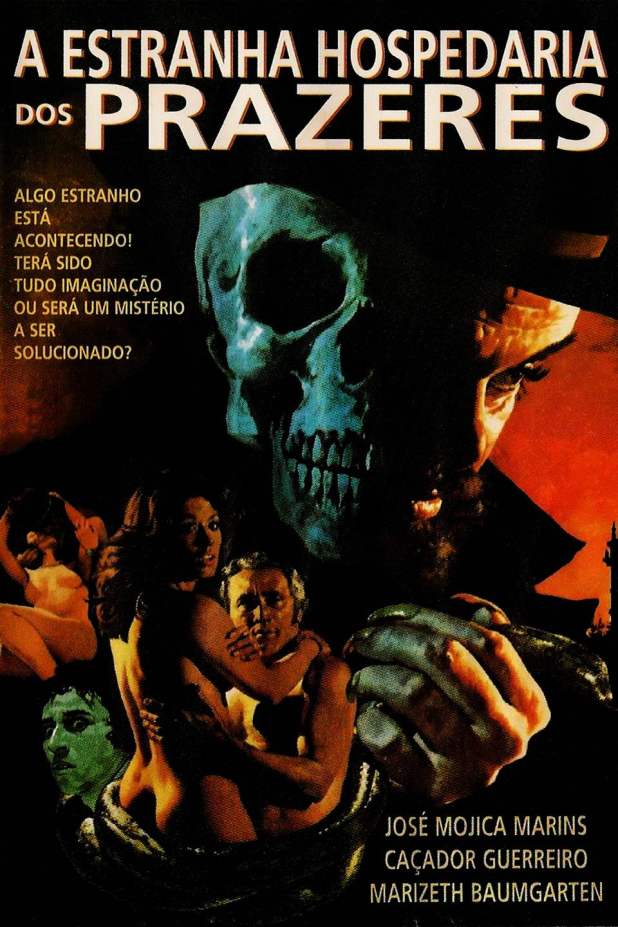
THE FILMS OF COFFIN JOE: The Strange Hostel of Naked Pleasures (1976)

This film begins with dancing women, native Brazilian drummers and an old man who chants over a coffin which opens to reveal…begins chanting over a closed coffin. The coffin opens and a man rises. Zé do Caixão! Coffin Joe!

At an isolated inn — “Hospedaria dos Prazeres” (Hostel of Pleasures) — the owner (Jose Mojica Marins, who is also Coffin Joe) turns away some and allows others already in the guest book to stay. Those without a place to stay are enraged, as after all, there’s a storm outside. Yet he has room for hedonistic Hell’s Angels, a couple sneaking out on their respective partners, a man ready to kill himself, gamblers out to bankrupt someone and criminals escaping their last robbery.

When they wake up in the morning, all of the clocks and their watches are set to midnight. That’s because they’re all in Hell and the absence of time is one of the many things they must deal with, as well as having to watch their deaths again and again. The owner warns them all that they don’t want to see his evil side — Coffin Joe.

One of the rich men who argued about getting to stay the night before leads the police to the hotel. In its place is a graveyard, where we eventually see the owner. As the camera zooms in, his face is replaced by a skull with bleeding eye sockets.

This is a Cinema da Boca do Lixo (Mouth of Garbage films), called that because they were made in that downtown neighborhood of São Paulo, Brazil. These films — Killed the Family and Went to the MoviesThe Red Light BanditAwakening of the Beast — are down and dirty exploitation films that are close to American exploitation of the 70s with sex and violence often in equal measure.

This is worth watching just for the opening speech from Coffin Joe: “Live to die or die to live? Is there an answer? No! Only doubts! Only deductions… Only the conviction of emptiness… of loneliness… the desperate search for the whole and the nothing in the vastness of the dark. The unveiling of this enigma would be the end of the mystery. The end of the secret of eternity. The apogee of happiness. The mission is accomplished! Men would be facing his biggest conquest… the awakening of his own origin.”

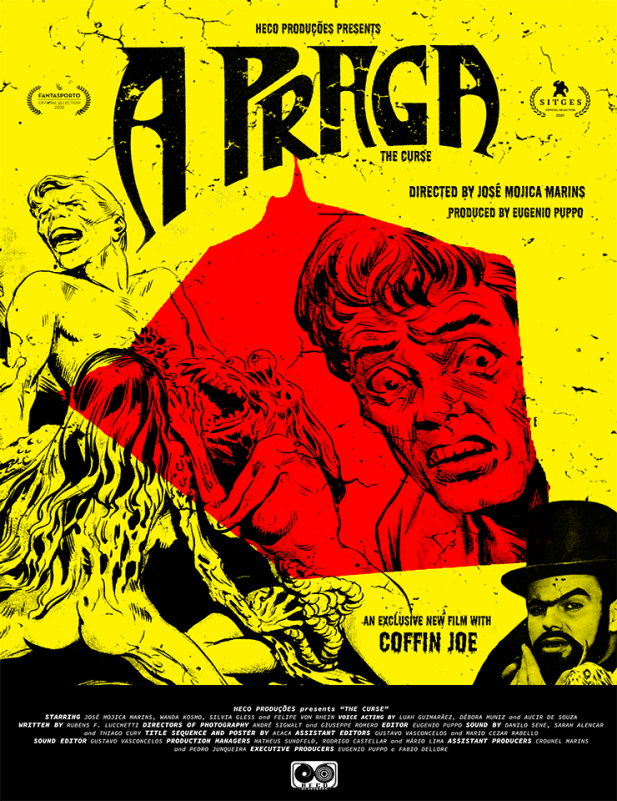
THE FILMS OF COFFIN JOE: The Curse (A Praga) (1967, 2022)

Coffin Joe may be dead and yet he lives. How else do we have a new film that he hosts? Yes, through the fire and the flames, he comes back to us, warning us about making a joke of the unknown world. Perhaps he would also do well to warn us that if you see a witch in the countryside, there’s really no reason to take her photo.

José Mojica Marins, the human repository for the evil being known as Coffin Joe, originally filmed The Curse for his Brazilian TV show in 1967, but it was lost when a fire burned down the station two years later. In 1980, he started a second version, but production was halted due to financial issues. The existing footage went missing until 2007 when producer Eugenio Puppo rediscovered it while preparing a retrospective of the work of Marins.

Years of intensive restoration later — including shooting new scenes and recovering the lost dialogue with the assistance of a lip-reader — The Curse is making its U.S. debut along with a making of documentary The Last Curse of Mojica.

Based on a story in the graphic novel series O Estranho Mundo de Zé do Caixão, this near-hour-long story has Juvenal (Felipe Von Rhine) and his girlfriend Mariana (Silvia Gless) meeting that witch we discussed above (Wanda Kosmo) and deciding that it’s not only a good idea to take that photo but also to be rude to her. He’s soon left with a gaping and festering wound in his side that demands raw meat at all times or it will destroy him. Of course, his lover would make the perfect meal to stop that insatiable hunger, right?

How magical is it that we can find this film as part of our lives? All hail Coffin Joe. You shall never die.

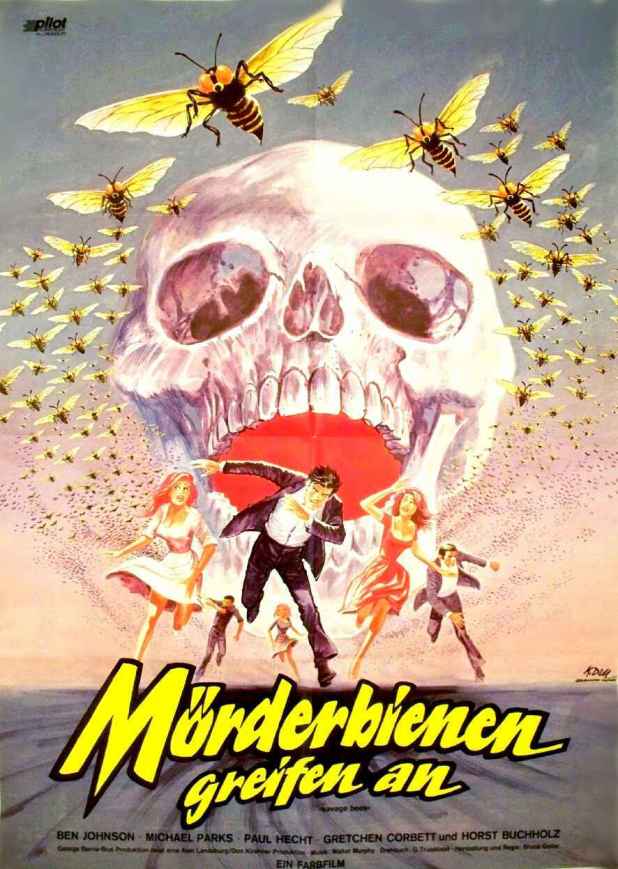
The Savage Bees (1976)

In the U.S., this movie played TV. But in the UK, it was in theaters, where people could be as freaked out as I was when I was four and had to watch bees cover a VW Bug and sting people of all ages, shapes and sizes.

It was the movie that Guerdon Trueblood made after The Candy Snatchers, so obviously he’s all about punching the audience in the head, heart and gut. He also wrote Tarantulas: The Deadly Cargo and Ants, so once he realized little creepy crawlers freaked people out, he kept at it. He also was the writer for SST Death Flight and Jaws 3D. And oh yeah — the sequel to this movie, Terror Out of the Sky.

Norman Gary is the real hero here. He was an entomologist and acted as the production consultant and bee wrangler/handler for this film. All of the swarming shots were handled by him and he also plays a victim. Hundreds of thousands of bees were used for this movie, but there were few injuries.

Sheriff Donald McKew (Ben Johnson) finds his dog dead just as an abandoned freighter pulls into New Orleans, kind of like Zombi, except with bees instead of zombies. Assistant Medical Director Jeff DuRand (Michael Parks) and entomologist Jeannie Devereaux (Gretchen Corbett) learn that the bees in the dog’s stomach are violent ones that could only come from South Africa. This is all happening during Mardi Gras and yes, the parade should be canceled, but the tourists! It’s all psychological. You yell spider and everybody says, “Huh? What?” You yell killer bee, we’ve got a panic on our hands on the Fourth of July. Or Mardi Gras.

But the scene where Devereaux has to drive that Volkswagen into the Super Dome hoping that it will get cold enough to kill the bees? Still horrifying. Kids covered in bees? The UK poster? It’s all bee trauma.

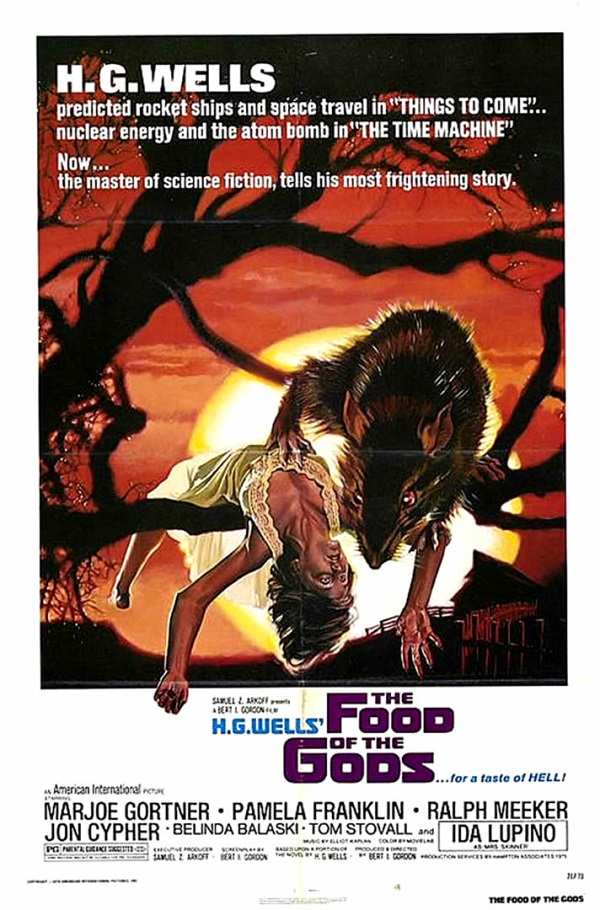
The Food of the Gods (1976)

Eww, look — that rat has a woman in its mouth,

Man, what a poster.

Directed and written by Bert I. Gordon, The Food of the Gods was ever so loosely based on H. G. Wells’ novel The Food of the Gods and How It Came to Earth.

The food of the gods does indeed appear to Mr. and Mrs. Skinner (John McLiam and Ida Lupino), who feed it to their chickens. Bok bok, those things grow bigger than a person, but so do the rats, wasps and even worms that eat it, so soon enough their island near British Columbia is filled with dangerous human-sized creatures.,

Meanwhile, professional football player Morgan (Marjoe Gortner) — wait a second here, what position does Marjoe Gortner, no offense, play in American football? Punter? — is hunting with his friends when one of them is killed by a giant wasp. He’s so into this that he comes back to see even more, meeting up with a dog food CEO named Jack Bensington (Ralph Meeker) who wants to sell these gigantic animals for food, his assistant Lorna (Pamela Franklin) and the pregnant Rita (Belinda Balaski) and her husband Thomas (Tom Stovall).

Giant rats killed almost everyone, but then Marjoe drowns them all because they’ve become too big to swim, which is the most BS science ever, but sure, why not Bert I. Gordon. Of course, man screws up again and lets cows use the formula and they get huge and so do the kids, eventually but not in this, that drink their milk. Doesn’t pasteurization take care of giant drugs?

This did so well for American-International Pictures that they decided to make H.G. Welles movies, such as Empire of the Ants and The Island of Dr. Moreau. They were lucky Welles was dead, because if he were alive, they’d also have to pay for using a lot of his book Mysterious Island in this, not just the source book of the same title.

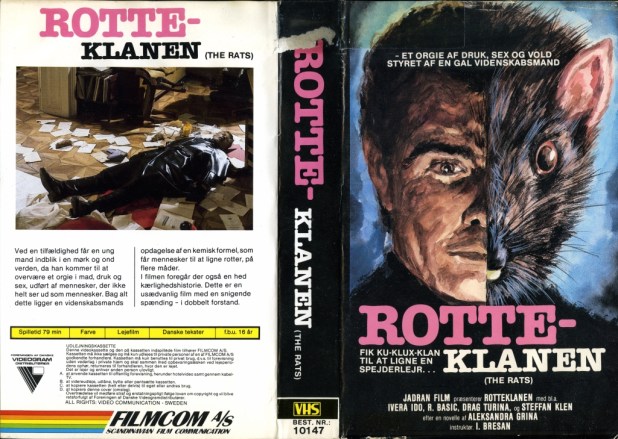
The Rat Savior (1976)

Directed by Krsto Papic, who wrote the script with Ivo Bresan and Alexander Grin (who wrote Morgiana), The Rat Savior is the tale of writer Ivan Gajski (Ivica Vidovic). He’s been evicted from his apartment for failing to pay the rent, as he has no money as no publisher will buy his novel about a plague. He goes to sell his books in the streets and is eventually sent to a collapsed bank to spend the night. Inside, he discovers a rat-like opulence who feasts on cheese and plot to kill the professor father of his new love interest, Sonja (Mirjana Maurec).

The professor is the only other human who knows of these rats and believes that a rat savior exists, a rat who can look human and the one who will lead them to power over the humans. Ivan tries to do the right thing and goes to the mayor and learns that he’s done exactly the worst possible thing, because he’s the titular savior and even worse, a rat is now passing as Sonja and Ivan kills it. Or her, we’re really not sure.

There is a concoction that when splashed on the rat humans reveals them like sunglasses being worn by Roddy Piper. And that seems to put the rat people down for some time, but then again, an even worse dictator is in the wings, one that will lead Germany all over Europe soon enough and have way worse plans for humanity than these rat folk and their divine leader.

And if you get bitten by one of these rats, like vampires, you become one of them. But then again, they seem like the only ones who are happy and actually have something to eat.

Not my favorite human rat movie — Bruno Mattei’s Rats: The Night of Terror forever — but this is pretty wild.

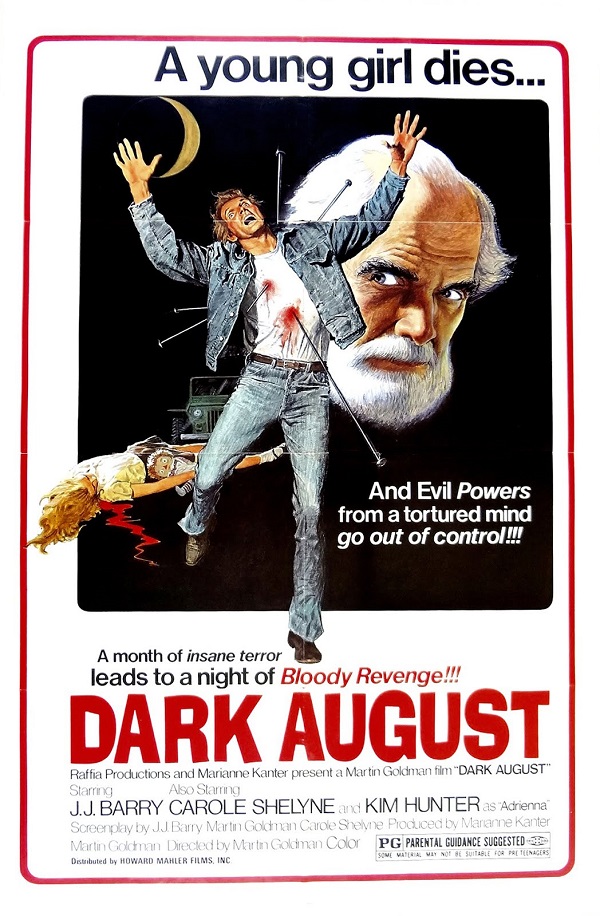
CBS LATE MOVIE MONTH: Dark August (1976)

EDITOR’S NOTE: Dark August was on the CBS Late Movie on December 14, 1988; April 21 and August 25, 1989.

This is something I’ve never seen before: Vermont rural horror. It has strange art-house leanings and long takes, like a French film directed by Martin Goldman, who also directed The Legend of CENSORED Charley after a career in advertising. It also has an incredibly unlikeable lead, but it was the 1970s. For being the “Me Decade,” it doesn’t feel like anyone liked themselves or anyone else.

Sal (J.J. Barry, who also co-wrote the film along with Goldman and lead actress Carole Shelyne) is amid a divorce and a resulting mid-life crisis, bringing him to Vermont. He sets up a photography business, starts building a studio and hooks up with an artist named Jackie (Shelyne, who also appeared as Carolyne Barry), who has been through a divorce herself.

It was all going so well — until Sal runs over the granddaughter of Old Man McDermitt, who just so happens to have the powers of the occult at his command. Whoops.

From then on, Sal feels even more out of place than before. His body constantly gives out on him, he has visions of a hooded demon, and everyone around him is getting maimed. One of his friend’s girlfriends tries tarot reading, but that upsets him even further. Even consulting the town’s foremost witch—Academy Award-winning Kim Hunter, getting top billing for her short screen time—can’t stop fate, particularly when Old Man McDermitt busts in with his shotgun.

Much of this film is devoted to the experience of being a stranger in a strange town. Long pauses, worried glances and even moments of weakness add to an overwhelming dread.

The good news is that everything ends if you enjoy movies where things happen slowly. Dark August is for you. Actually, there’s plenty to like here, and you can see how a lesser director would make this into a Blumhouse movie of the month that would end up pissing me off. Here, it just intrigues me, and I end up spending all day doing more research on this film.

CBS LATE MOVIE MONTH: Vigilante Force (1976)

EDITOR’S NOTE: Vigilante Force was on the CBS Late Movie on February 13, 1981.

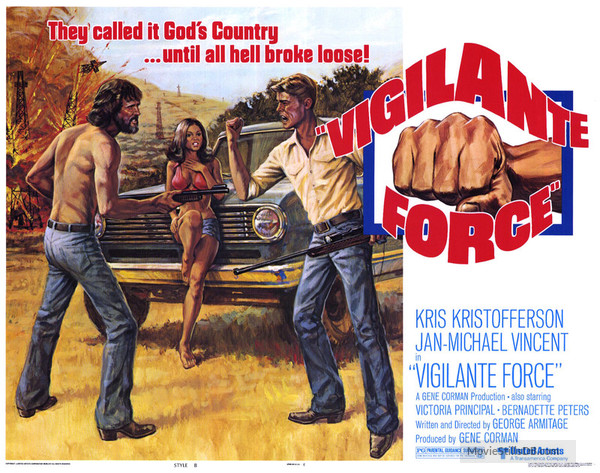
The town of Elk Hills, California, has been getting rough ever since the oil field workers stuck around. Ben Arnold (Jan-Michael Vincent) joins the police to try and keep things safe while his brother Aaron( Kris Kristofferson), a Vietnam vet, hires mercenaries — his war buddies Beal (Charles Cyphers), Viner (Shelly Novack) and Selden (Carmen Argenziano) — to deal with the problem. But much like what happens after someone hires cats to get rid of the mice, who gets rid of the cats? The mercenaries — and Aaron — are now out of control and take over the town.

Director and writer George Armitage said that the film was a “very slightly coded reference to the Revolutionary War…although what I was really doing there was Vietnam.” Jan Michael-Vincent’s character was named after Benedict Arnold, while Kristofferson’s was named after Aaron Burr.

If the town where all this goes down seems familiar, it’s the Mayberry back lot set at Desilu Studios in Culver City, California.

Ben’s also a widower who falls for schoolteacher Linda (Victoria Principal), and Aaron gets with bar singer Little Dee (Bernadette Peters); who can blame either of them? Plus, David Doyle, Dick Miller and Loni Anderson all appear.

This movie gets wild because it’s almost a white version of Bucktown and has a bizarre ending where Kristofferson and his buddies dress as a marching band to rob a bank. I can’t think of another movie that ends with the guy who wrote “Sunday Morning Coming Down” standing on top of an oil tower blasting townsfolk with a machine gun while dressed like a drum major.

Produced by Gene Corman, this fine exploitation film has an above-average cast. It’s also nearly a modern Western, with an ending that pits brother against brother, and only one can walk away.