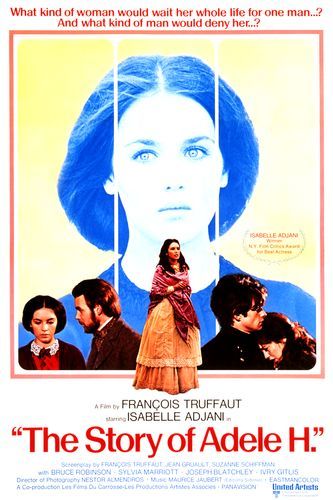
Distributed by United Artists in director and co-writer François Truffaut’s native France, this was put out by New World in the U.S. It’s a love story about Adèle Hugo (Isabelle Adjani), the second daughter of Victor Hugo, and also was a love story for Truffaut, who fell for his twenty-year-old leading lady. She turned him down; dude, I saw Possession and yeah, I get it. I totally get it.
Also, by love story, I mean that Adèle spends the entire movie pining for Lieutenant Albert Pinson (Bruce Robinson), first in innocuous ways and then in ways that ruin his life and then in ways that grasp at straws, such as trying to have him hypnotized into loving her and attempting to connect with her dead by drowning sister from beyond the grave to aid her in winning over the military man.
She says at one point that she will walk across the ocean to be with her lover. She has built him up into near mythic levels of nobility and romantic power. Surely, were their relationship to ever be consummated, he could never live up to the man that he is inside her head. Again, I totally get it. While never consumed with the mania that she displays — the film ends with her wandering the streets of a foreign country, unable to even recognize Pinson but still in love with the man she conjured years before — I am guilty of falling in love with the people I have believed people to be, want them to be, need them to be and unfairly wondering why they can never live up to my near-impossible romantic notions. It’s a horrible thing to be in love with someone who does not exist as the person you know them as.orrible thing to be in love with someone who does not exist as the person you know them as.
It’s pretty amazing seeing how many movies from New World or distributed by Roger Corman are in the Criterion Collection: The Harder They Come, Cries and Whispers, Fantastic Planet, Amarcord and this movie. While Corman’s produced films may be about car crashes and half-nude nurses (in jail), he could certainly pick movies to champion.
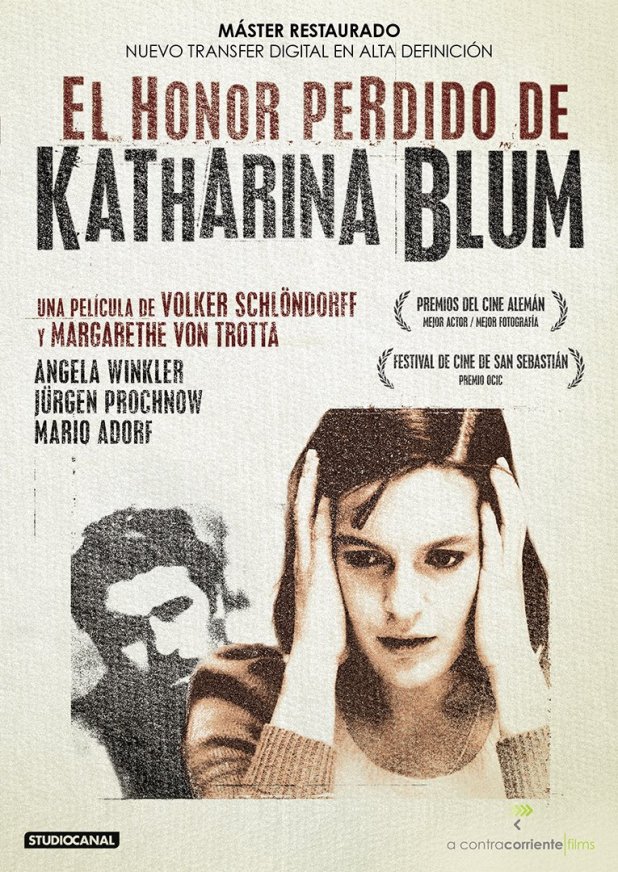
The Lost Honour of Katharina Blum, or: How violence develops and where it can lead is based on the novel of the same name by Heinrich Böll and is an indictment of how society and the media can demonize women, which is a heady subject for a movie, again, distributed by Corman.
Katharina Blum (Angelina Winkler) is a housekeeper whose lawyer boss refers to as “The Nun” because of what a prude she is. Yet when she gets involved with Ludwig Götten (Jürgen Prochnow), an anarchist and bank robber, she gets her name hung out to dry in the tabloids and accused of aiding and abetting the would-be terrorist. That newspaper goes so far that it ruins all of Katharina’s relationships and even causes her mother to die in the hospital, misinterpreting her last words to make it appear like she hated her daughter.
Unable to get her own story out, she finally kills a reporter and his photographer. That reporter is buried as a hero, seen as someone using his ability to tell the real story. His coffin gives the film an opportunity to call out the yellow journalism of German tabloid Bild-Zeitung.
When this was made, West German tabloid newspapers worked hand in hand with the police to publish pretty much anything they wanted about anyone they wanted. The reporter makes up stories about Katharina for the entire film and then expects her to sleep with him because he gave her what so many people want. He made her famous.
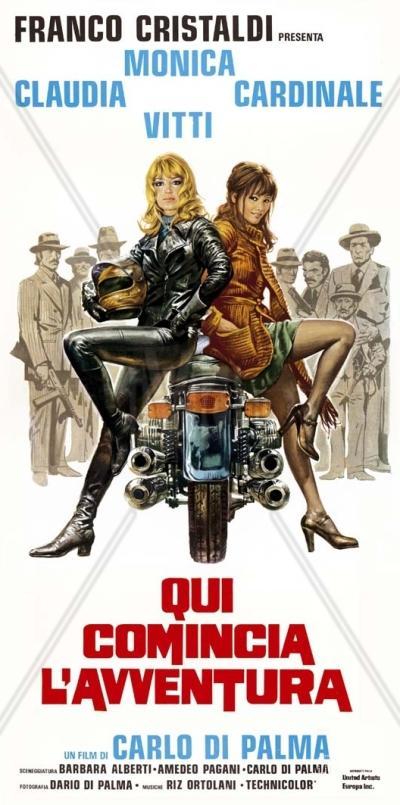
Lucky Girls is the name New World Pictures gave to Qui comincia l’avventura or the even better title Blonde In Black Leather. It was directed by Carlo Di Palma, who is probably better known for his cinematography on movies like Mighty Aphrodite, Shadows and Fog, Hannah and Her Sisters, and, under the name Charles Brown, Terror-Creatures from the Grave. He also directed Teresa the Thief and was a focus puller all the way back in 1948 on Bicycle Thieves.
He co-wrote this film with Barbara Alberti, who also worked on one of my favorite films, Hotel Fear, and Amedeo Pagani, who had collaborated with Alberti on that film and The Night Porter.
What emerges is a charming romp in which the leather-clad Miele (Monica Vitti, dubbed by Carolyn De Fonseca) takes her friend Claudia (Claudia Cardinale, The Butterfly Affair) on an episodic adventure driven by the sheer force of the personality of its leads. Miele spends one moment having her leather suit hand polished while she’s wearing it; if you were Claudia, slaving in a laundrette for a horrible husband, wouldn’t you leave behind your mediocre life and jump on the back of Miele’s motorcycle?
There’s also an incredible moment where Miele and Claudia outfight every man in a casino and the scene almost takes on a filmstrip feeling where with each click, we’re seeing her knock out another man. As if that isn’t enough, the score by Riz Ortolani makes it all work even better.
By the end, maybe Miele is more of a tall tale teller than we originally believe, but she’s given agency and escape to Claudia. Consider this Thelma and Louise but with a happier close.
New World released this on a double feature with Candy Stripe Nurses, which is what I call a dream night at the drive-in.
The fabulous Temple of Schlock shared this image of it playing under the Blonde In Black Leather title.
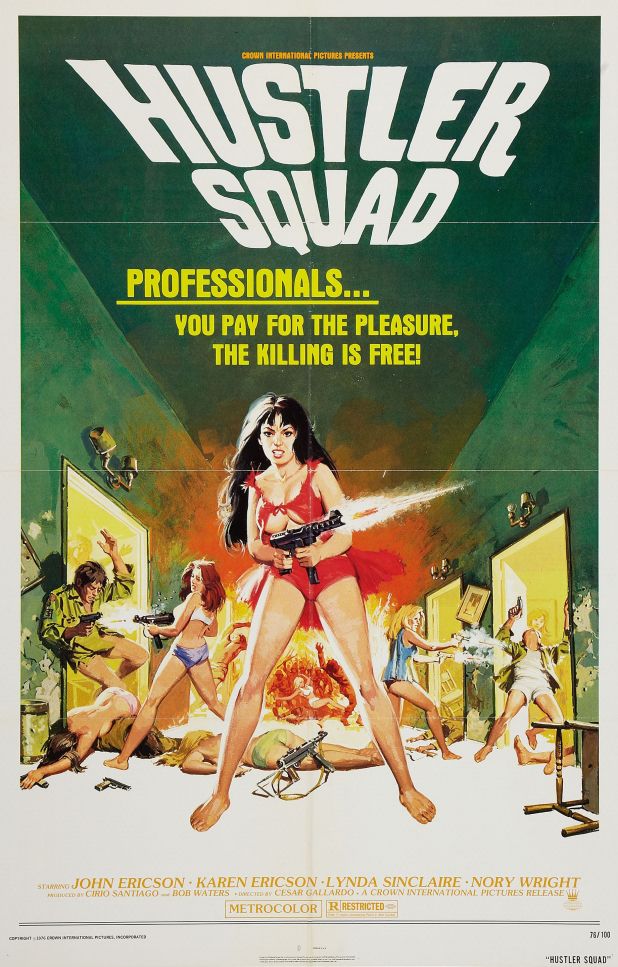
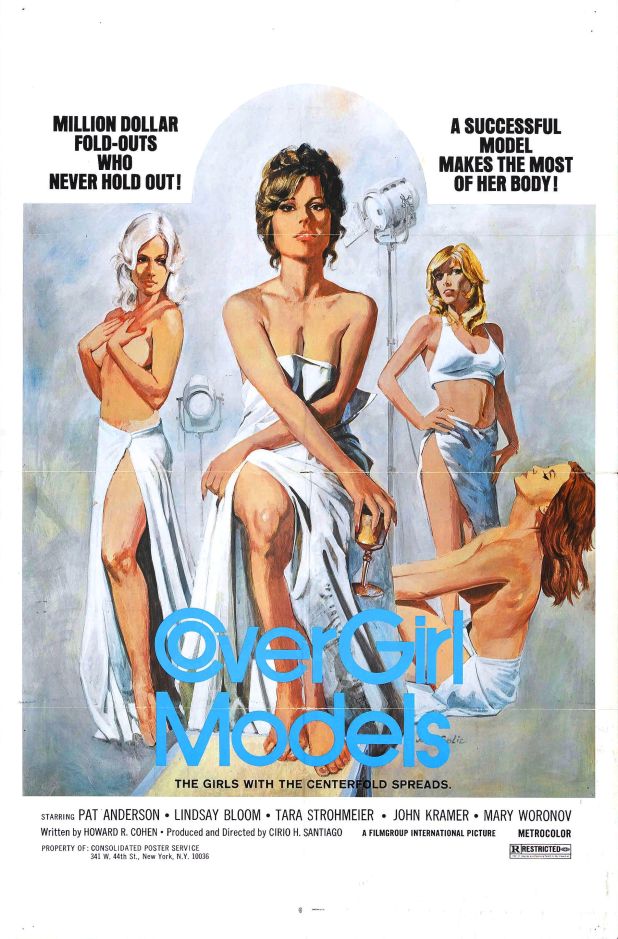
One of the last movies New World Pictures made in the Philippines — due to rising costs — this was directed by Cirio H. Santiago and written by Howard R. Cohen. Outside of Hollywood Boulevard, it’s also the last of the New World occupation movies.
Barbara (Pat Anderson, Summer School Teachers), Claire (Lindsay Bloom, The Happy Hooker Goes Hollywood) and Mandy (Tara Strohmeier, Van Nuys Blvd.) are, well, cover girl models flying from Los Angeles to Hong Kong for a photo shoot. As always, the three girls each get an adventure: Barbara finds a microfilm that several spies are looking for, Claire wants to be in a movie and Mandy falls for a photographer.
If you know me, you know that I wish this movie had been about fashion editor Diane (Mary Woronov), who only makes an appearance in the first few minutes. But hey! Vic Diaz shows up as a bad guy. This didn’t really get a big release in 1975, but a year later — and a time when Charlie’s Angels was big deal — it came back out.
The difference between New World and, let’s say, Cannon, is that New World has more movies that are in the Criterion Collection or considered high art, because Roger Corman distributed a lot of films from high end directors while staying hands-off on the final product.
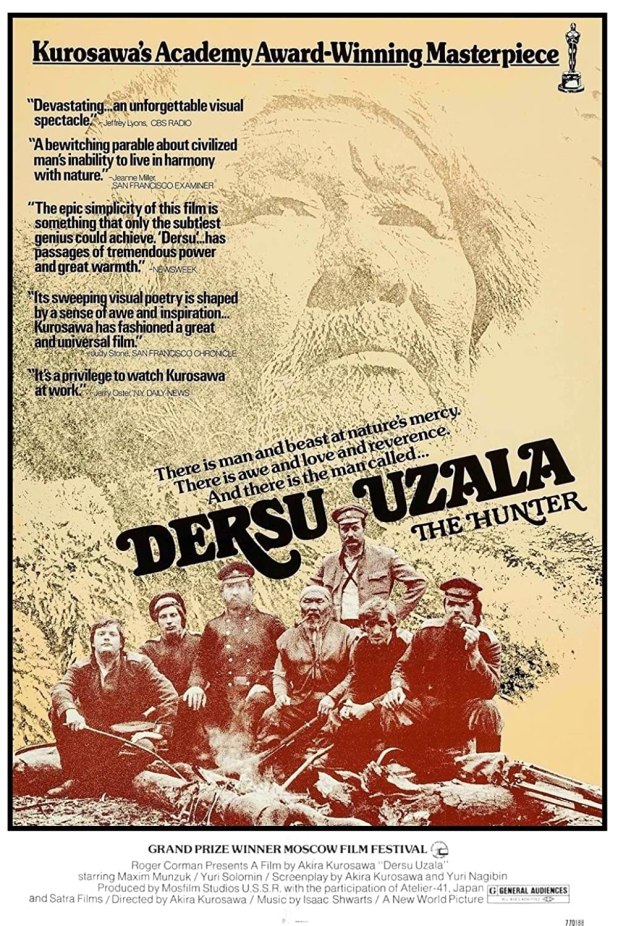
Directed and co-written by Akira Kurosawa, this was both his only non-Japanese-language film and his only 70mm film. Based on the 1923 memoir of the same name by Russian explorer Vladimir Arsenyev, Dersu Uzala won the Academy Award for Best Foreign Language Film and was a big hit in the USSR, Europe and even the U.S.
This is a story told by Captain Arsenyev (Yury Solomin), who years ago hired a named Dersu Uzala (Maxim Munzuk) and was amazed by the way the man may have been uneducated, yet could deduce nearly anything and knew instinctively how to survive in the harsh world of winter that he lived in. Yet he was also capable of great kindness, as at one point he builds a hut and stocks it not for himself but for those who will come after him.
In 1971, Kurosawa attempted suicide, questioning his creative ability after the commercial failure of Dodes’ka-den and his inability to get another film funded. He had to have seen himself in Uzala, a man growing older whose once incredible powers are reduced to having to live in normal society and afraid when he can no longer see enough to hunt for himself.
He had wanted to make this movie since the 50s, but couldn’t figure out how to make it in Japan. Imagine his surprise when a member of the Russian embassy reached out. He asked him to make a Russian film for Russians. They needed him as their country lacked the talent to make a quality film. It was as if two different dreams could come true and reason to remain alive. The Russians were shocked when he asked if he could film Vladimir Arsenev’s book, because at that time it was little known outside their country.
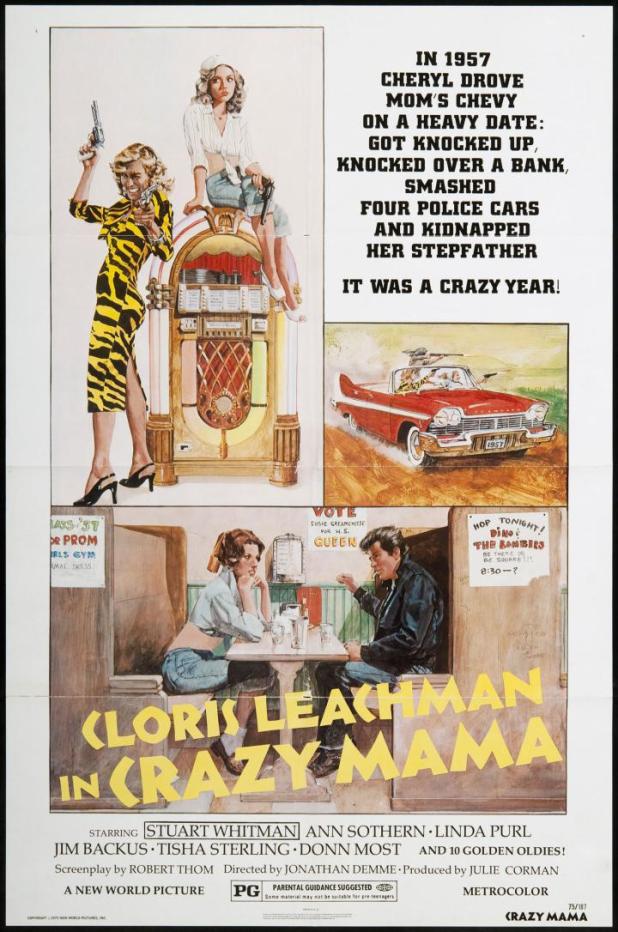
Directed by Jonathan Demme and written by Robert Thom, Crazy Mama was the kind of movie you used to stay up late to watch on cable when your parents went to sleep.
Melba Stokes (Cloris Leachman) owns a beauty parlor and lives with her mother Sheba (Ann Sothern) and daughter Cheryl (Linda Purl, who has a career of playing relatives, as she was Matlock‘s daughter and Pam’s mom on The Office; she’s also in Visiting Hours). When their landlord Albertson (Jim Backus) kicks them out and takes their belongings, they go on the run and decide to start a crime spree, eventually joined by former Texas sheriff Jim Bob Trotter (Stuart Whitman) and pursued by Cheryl’s would-be baby daddy (Donny Most).
This was to be originally directed by Shirley Clarke. I have no idea how her dance and art background would have worked and we’ll never find out, because she was fired ten days prior to filming. Demme changed the ending to the movie, which was to have everyone die, which he just thought was too much.
Hey — it’s also Bill Paxton and Dennis Quaid’s debut! And John Milius is a cop!
Blacklisted by Hollywood in the 1950s, Joseph Losey moved to Europe. His exile from Hollywood started when Howard Hughes bought RKO and purged it of people he thought were Leftists. In the book Losey On Losey, he said “I was offered a film called I Married a Communist, which I turned down categorically. I later learned that it was a touchstone for establishing who was a “red”: you offered I Married a Communist to anybody you thought was a Communist, and if they turned it down, they were.” He’d later tell the New York Times that although the blacklist was frightening at first, it ended up making him a better artist: “Without it I would have three Cadillacs, two swimming pools and millions of dollars, and I’d be dead. It was terrifying, it was disgusting, but you can get trapped by money and complacency. A good shaking up never did anyone any harm.”
Losey made The Boy with Green Hair; noir like The Big Night and The Lawless; The Damned for Hammer; Secret Ceremony and Boom! with Elizabeth Taylor; Modesty Blaise and the Palme d’Or winning The Go-Between. He was right. The blacklist didn’t harm him as an artist.
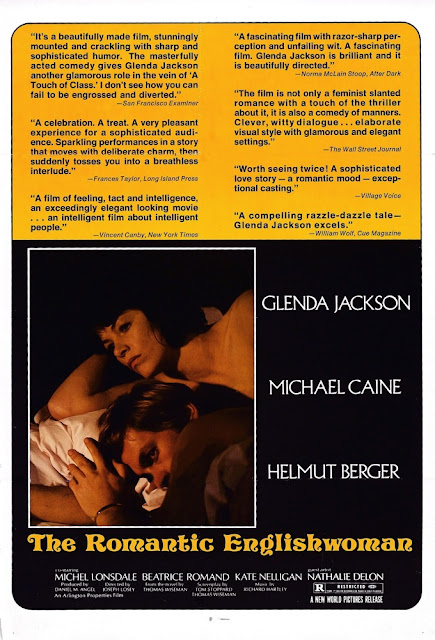
What’s amazing is that this film, screened out of competition at Cannes in 1975, was released in the U.S. by New World. I shouldn’t be surprised, as along with drive-in movies about women in prison and men in cars, Roger Corman championed films by artists like Fellini and Bergman.
Lewis Fielding (Michael Caine) is a pulp novelist who provides for his wife Elizabeth (Glenda Jackson), but she finds their marriage boring. She runs to Germany and into the arms of Thomas (Helmut Berger), a younger and much more exciting lover, but also one who doesn’t have the stability and, well, legal standing of her husband. They never consummate their affair, but when she returns home, he follows. Lewis decides to hire him as his secretary. As you can imagine, being alone in the house with the object of her lust ends with Elizabeth and Thomas canoodling and running back for Germany with gangsters seeking Thomas’ head and Lewis wanting to win his wife’s heart back.
Thomas gives Elizabeth the attention her husband holds back — he doesn’t even react when she walks across their yard nude in front of the neighbors — while his disguise as a fan of the writer’s work feeds Thomas’ needs as well. Whether that attention is carnal or artistic, he’s the person that each wants and needs. The only problem is that Thomas is none of those things. He’s just a con man that screwed up a drug deal and is trying to save his own life. And yet while Thomas holds back the sexual energy his wife demands, he grows angry and resentful of his secretary, knowing that they’re about to have that affair as if he has willed it into existence as a self-fulfilling prophecy.
In his biography, Caine said that Losey was so dour that he bet the crew that he could make Losey laugh before the movie wrapped. Caine lost the bet.
New World had already brought The Water Margin to the U.S. as Seven Blows of the Dragon, so they also played the sequel here as Seven Soldiers of Kung Fu, which is I guess thematically a decent sequel title.
Co-directed by Chang Cheh and Wu Ma, this follows up the 108 Bandits having freed second-in-command Lu Jun Yi and being called by their former enemies to stop a rebellious new faction, led by Fang La, and promised a pardon upon the success of that mission.
Where the first film takes time to introduce the viewer to so many characters, All Men Are Brothers is all about action, with gigantic battles taking place on the sprawling Shaw Brothers backlot sets.
If you’ve watched enough Chang Cheh movies, you may have been a bit weirded out when The Water Margin ended and all of the heroes were alive. Don’t worry — he comes back to form on this, which ends with the kind of sacrificial bloody battle that he’s better known for. In fact, this just might be the bloodiest of all Shaw Brothers films. The American cut goes to black and white in some of these moments, one of those tricks that get you an R rating instead of an X.
The early to mid 70s were a magical time for martial arts films, as just about anything could come to America and play drive-ins, grindhouses and even occasionally mainstream movie theaters.
EDITOR’S NOTE: This was first on the site on August 31, 2018.
There are people that say there’s no such thing as a perfect movie. Those people have never seen Death Race 2000, a film that’s packed with pop culture references, ultraviolence, black humor, political commentary and great character moments.
After the “World Crash of ’79”, the United States government declares martial law. To keep the people happy, the Transcontinental Road Race is created. It’s a race across the country — ala Cannonball Run — except that drivers score points for killing people.
This is the twentieth race and each driver has their own character and themed car, including the mysterious champion Frankenstein (David Carradine, Kill Bill) who has been torn apart and rebuilt so many times, no one is sure what parts of him are real any longer; Machine Gun Joe (Sylvester Stallone, Rocky), a Chicago gangster who calls people mashed potato and will even drive over his own pit crew for points; Calamity Jane (Mary Woronov, Night of the Comet), a tough cowgirl; Nero the Hero (Martin Kove, Kreese from the Karate Kid!) and Matilda the Hun (Roberta Collins, Eaten Alive, Caged Heat), a Nazi. They each have a navigator who is also generally their sexual partner.
Covering the race is a parody of network news coverage — that would become even more true in today’s Fox News and CNN climate — which includes loudmouth Junior Bruce (Don Steele, Rockin’ Ricky Rialto from Gremlins), Harold, who is pretty much Howard Cosell and Grace Pander, the gossip columnist who refers to everyone as her close personal friend.
Meanwhile, Thomasina Paine, the great great great great and maybe even great-granddaughter of American Revolutionary Thomas Paine is sabotaging the race to rebel against the President. These revolutionaries have even placed Annie, Thomasina’s granddaughter, into the race as Frankenstein’s new navigator. That said — the government keeps covering up all of the deaths of the racers and blames it all on the French — who have already destroyed the country’s phone system — one of director Paul Bartel’s (Eating Raoul) favorite jokes. In fact, the film was packed with even more silliness before Roger Corman chopped out most of the strangeness that Bartel loved so much.
Everyone but Machine Gun Joe and Frankenstein are left in the race. Before the final day of the race, Annie learns that Frankenstein isn’t even the original man — he was a ward of the state who was raised from birth to compete in the Death Race. When he’s used up, another will take his place. And he’s closer to the spirit of the rebels than Annie would ever think — he plans on using his fake right hand to blow up the President. Of course, that was the plan. But Annie saves Frankenstein using this “hand” grenade in the final battle
Frankenstein is injured, so Annie takes his place and tries to stab the President. But her own grandmother shoots her, as she wants revenge thinking that the champion Death Racer had killed her granddaughter. And this all takes place after the President declares war on the French and appoints Frankenstein to lead his armies!
The real Frankenstein recovers and runs over the President to the roar of the crowd. He becomes President, marries Annie and runs over Junior Bruce as he puts an end to the Death Race.
This film may have been remade (and there are several sequels to that franchise) and Corman finally put out Death Race 2050, his own sequel to the film, in 2017. But do we need anything else when the original is so epic? It’s so much fun, punctuated by moments of sheer lunacy. Viva la Death Race 2000!
Before he moved into making TV movies, Michael Miller made Silent Rage and Class Reunion in the same year, as well as another rough film, Jackson County Jail. Street Girls is more raw than all of them, a movie that seemed to be sleazier than the majority of New World’s catalogue.
Shockingly, it was co-written by Barry Levinson.
Yes, the same person who directed Rainman.
Angel (Christine Souder in the only movie she’d ever make) goes from college girl to exotic dancer to getting hooked on heroin. Her father (Art Burke) decides to go the Hardcore route four years before that movie was made and head out into the filthy streets to find his little girl. At first, he has the help of her co-worker Sally (Carol Case, also in her only movie) until he learns that she was Angel’s lover. Disgusted, he abandons her and continues his search.
This also shows the life that Angel is in, down to a scene where a client brings her a swimming mask so that he can urinate on her. She locks herself in a filthy motel bathroom while he keeps banging on the door, begging for the opportunity to defile her. This scene goes way beyond any small town girl gone wrong movie than any I’ve seen in mainstream movies.
It’s not great, but man, it’s not afraid to show how cheap life can be.
You must be logged in to post a comment.