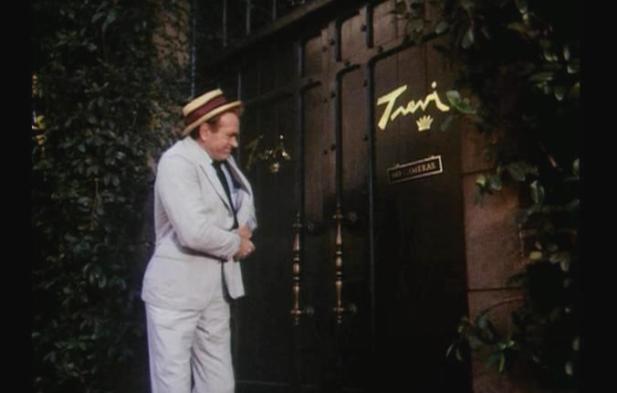
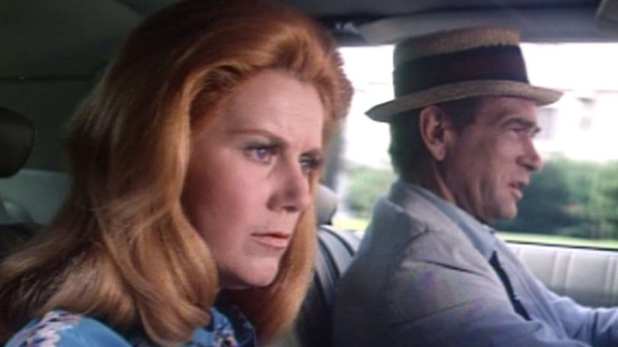
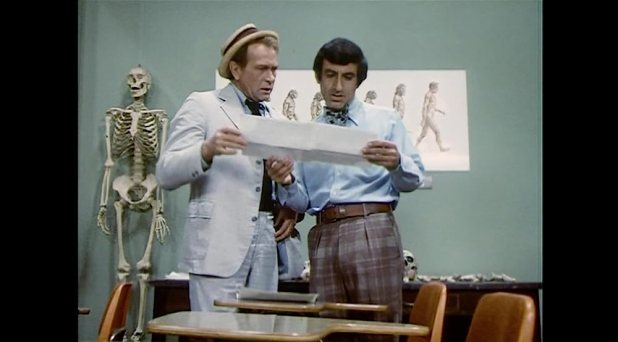
CBS LATE MOVIE MONTH: Kolchak: The Night Stalker: Mr. R.I.N.G. (1975)

EDITOR’S NOTE: This episode of Kolchak: The Night Stalker aired on the CBS Late Movie on July 13, 1979; July 31, 1981 and January 29, 1988.

“I don’t know when exactly I was in this office last. In some ways it seems like I never left. But, no, that’s not right. For at least a few days I was away, far away, in the hands of men with no faces and no names. They broke me down, broke my story down, telling me how it hadn’t happened the way I claimed. At least that’s what I think they did between injections. Memories fade fast enough without chemical help. But if I don’t tell this story now, I don’t think I ever will. Now… what was that date?”

That’s the words of Kolchak that start this episode, one that’s perhaps the closest to the show inspired by Kolchak: The Night StalkerThe X-Files.

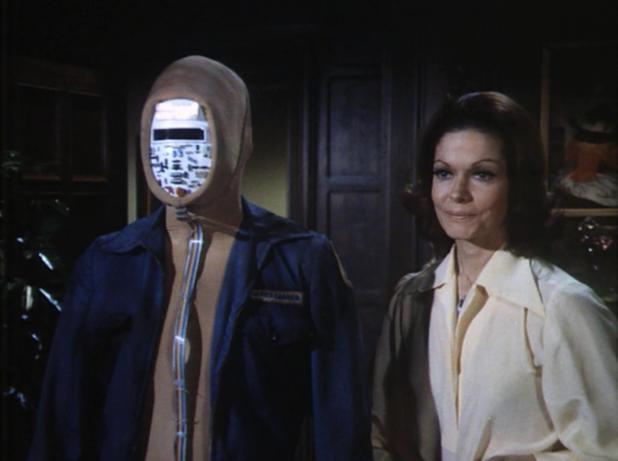
Mr. R.I.N.G. (Craig R. Baxley) is a robot that we see kill one of his creators, leaving behind his widow (Julie Adams). The other person who made him, Dr. Leslie Dwyer (Corinne Camacho), has survived. She tells Carl that Mr. R.I.N.G. wants to be human — indeed, he makes his own face out of mortician’s wax — and yet he can’t stop wiping out human life, throwing around stuntmen as only a monster of the week on Kolchak can.

R.I.N.G. stands for Robomatic Internalized Nerve Ganglia, and the automaton doesn’t want to kill unless threatened. That said, it’s been threatened several times, and even when it wants to give up peacefully, that doesn’t happen. Man is more warlike than the machine it created to wage battles. The problem is that Dr. Dwyer has Mr. R.I.N.G.’s human characteristics and feelings, but studying the readings of St. Thomas Aquinas and Aristotle’s Ethics and finding out you’re a weapon can mess up any robot.

Do you know who made Mr. R.I.N.G.? The Tyrell Institute. One imagines that somewhere, Philip K. Dick is laughing. Well, halfway, as his book Do Androids Dream of Electronic Sheep? doesn’t mention Tyrell, but the movie made from the book, Blade Runner, does.

This episode was directed by Gene Levitt, the creator of Fantasy Island and the director of The Phantom of Hollywood. It was written by L. Ford Neale and John Huff, who also wrote The Hunter’s Moon together.

CBS LATE MOVIE MONTH: Sweet Hostage (1975)

EDITOR’S NOTE: Sweet Hostage was on the CBS Late Movie on September 17, 1977 and May 15 and November 17, 1978.

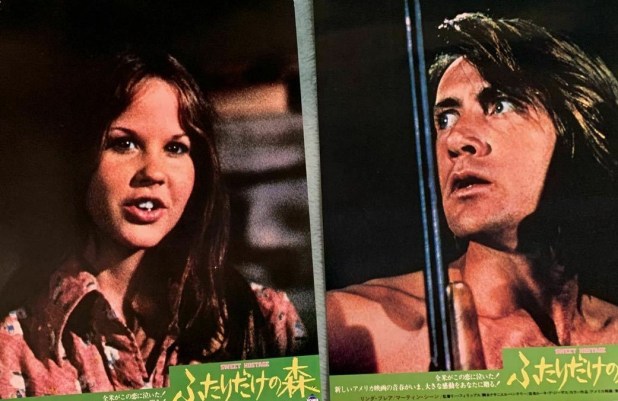
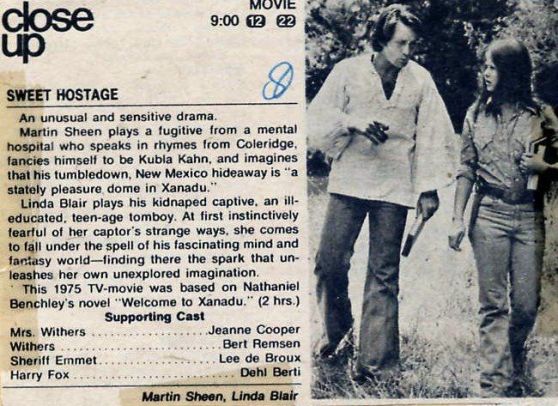
Based on Welcome to Xanadu by Nathaniel Benchley, this was the ABC Friday Night Movie on October 10, 1975 and two years later, it became the CBS Late Movie. It was directed by former actor Lee Phillips and written by Edward Hume.

It’s a tale that’s both simple and controversial. Leonard Hatch (Martin Sheen) kidnaps Doris Withers (Linda Blair) from the farm that she works on for her family. Despite being a mental patient, he treats her better than her family ever did, teaching her and respecting her boundaries. However, this is also a story of a thirty-one-year-old man kidnapping a teenage girl and her developing Stockholm syndrome. It’s a stark reminder that 1975 was a different time. After all, Linda Blair was only 16 when this was made.

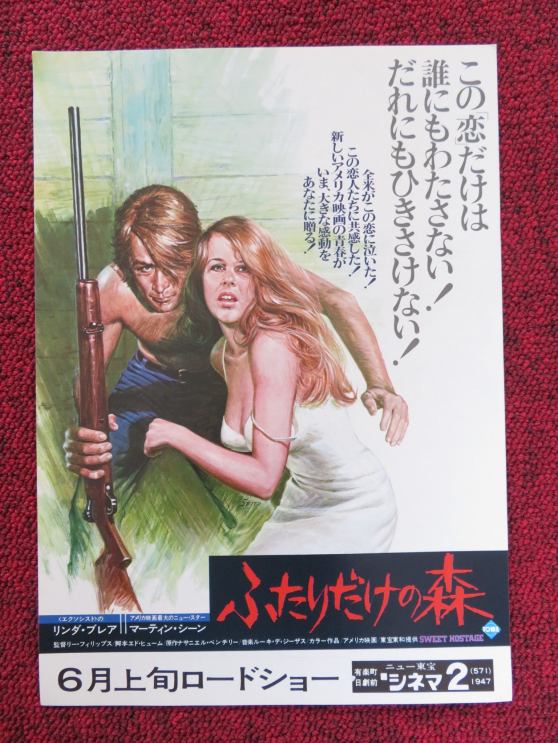
It was a big deal in Japan, where it played in theaters, and posters featured Blair in her nightgown. Although she didn’t want Sheen in the role and would have preferred her then-boyfriend Rick Springfield, she ended up “falling madly in love” with the twenty-one-years older Sheen, although they didn’t have a relationship.

As the story unfolds, these two characters find themselves in a surprising situation and fall in love. However, their budding romance is constantly interrupted by Doris’ parents and the police. The story concludes in a manner typical of a 1970s TV movie, leaving the audience with a sense of unexpectedness.

Junesploitation AND THE FILMS OF WILLIAM GIRDLER: Sheba, Baby (1975)

June 19: Junesploitation’s topic of the day — as suggested by F This Movie— is Blaxploitation! We’re excited to tackle a different genre every day, so check back and see what’s next.

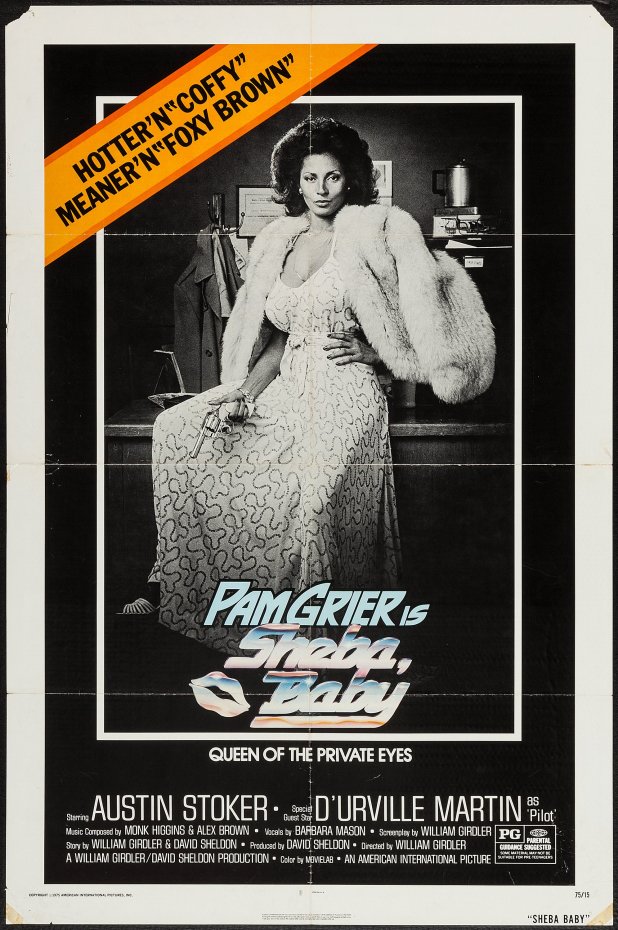
Private detective Sheba Shayne (Pam Grier) has come back home to Louisville from the big city of Chicago and she’s fighting back against the criminals out to ruin her father’s insurance business. Teaming up with her father’s partner — and her former lover — Brick Williams (Austin Stoker), she does exactly what she set out to do, even if the local cops warn her off and the thugs blow up her car.

They can kill her dad, they can drag her in a speedboat but they can’t make her give in. This is the kind of movie where Pam Grier effortlessly chases bad guys on a jet ski and dispenses them with a spear gun. In short, everything you want, including Pam kicking at least one of the bad guys directly in the balls.

David Sheldon and William Girdler sold this movie to Samuel Arkoff by telling him they already had a script done. Well, they didn’t. A day later, after selling the movie, they did.

This was also the last movie that Girdler would make in Kentucky, now ready to move onward.

As much as I like Girdler’s films, Jack Hill knew how to make Pam Grier movies. The Big Doll HouseThe Big Bird CageCoffy and Foxy Brown really are a high bar to achieve, if you think about it.

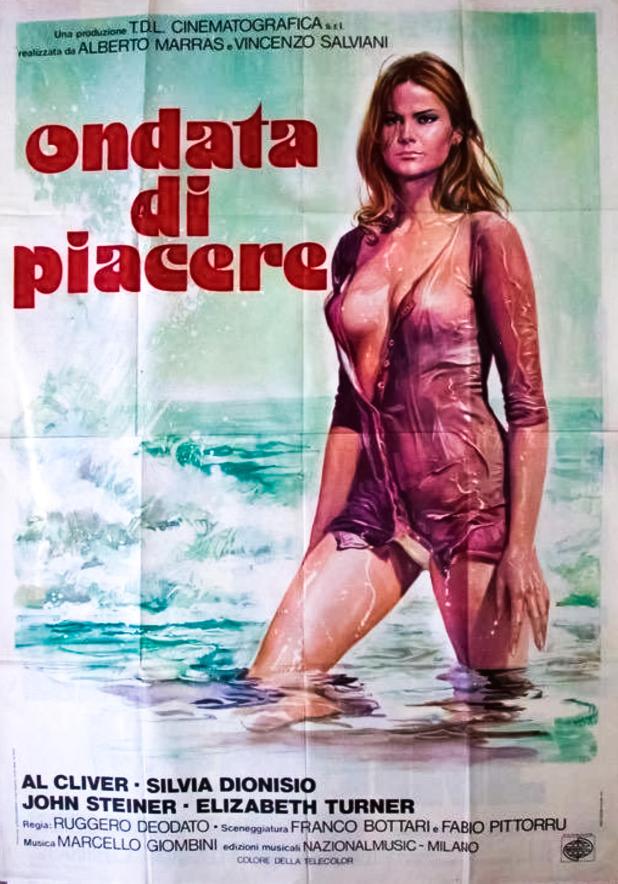
Ondata di piacere (1975)

If you’re planning a sleazy triple feature of giallo yacht-based films, go with InterrabangTop Sensation and this movie. Take liberal showers before, during and after all three movies and when your significant other walks in on these, you can blame me.

Waves of Lust has Ruggero Deodato at the wheel and he’s working from a script by Franco Bottari (Colt 38 Special Squad) and Fabio Pittorru (The Night Evelyn Came Out of Her Grave) from a story by Gianlorenzo Battaglia and Lamberto Bava.

We meet young and in love couple Irem (Al Cliver, Endgame) and Barbara (Silvia Dionisio, Murder Obsession) in the middle of their vacation in Sicily. An older and not-so-in-love couple named Giorgio (John Steiner, Shock) and Silvia (Elizabeth Turner, Beyond the Door) beckons them to join them on their yacht and that’s when things get cooking.

Somehow, this movie becomes an anti-capitalist one, as Giorgio is an industrialist who owns nearly everything, including his wife, and lords it over anyone he can. That said, in no way will the message get in the way of what this movie is really about, and that’s making a giallo that’s more on the erotic side than the thriller part of the erotic thriller. Both Irem and Barbara end up with Silvia and hardly anyone stays clothed for this movie’s running time.

John Steiner, who usually overacts in nearly everything, has found a role in this that’s perfect for him. He’s out of control and a lunatic and given to pouring J&B in women’s belly buttons instead of shot glasses. One night it all goes too far and he repeatedly stabs his wife with a trident — yes, really — and throws her overboard. Our young and free working class kids respond to this by getting him drunk and convincing him that Silvia in a wig is his dead wife back from her watery grave. They dress him up in a SCUBA suit and toss his ass overboard and finally enjoy the fruits of labor. This would only be a bigger proletariat victory if they burned the yacht down and walked away from the harbor in slow motion smoking cigarettes.

There’s also a strange skeletal drawing above Giorgio and Silvia’s bed that keeps changing as the movie twists and turns. It’s not so much giallo as, well, what else would you call it? Sex and murder on a boat? Let’s just be find with the giallo title and enjoy this movie for what it is. Deodato has some nice diving footage and shows he’s as adept at filming gorgeous women as he is people being eaten and turtles being killed (yes, this is a Deodato movie, so an eel is violently killed for real, fair warning).

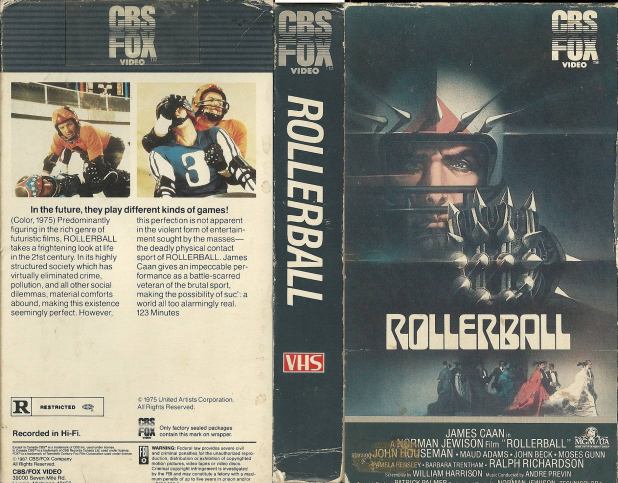
VIDEO ARCHIVES WEEK: Rollerball (1975)

VIDEO ARCHIVES NOTES: This movie was discussed on the May 30, 2023 episode of the Video Archives podcast and can be found on their site here.

The game of Rollerball was so realistic that the cast, extras and stunt personnel played it between takes on the set. On ABC’s Wide World of Sports, director Norman Jewison and star James Caan even explained the game to Howard Cossell. Audiences loved the game so much that Jewison was contacted by promoters for the rights to the game; he was enraged because the whole point of this movie is to show the “sickness and insanity of contact sports.”

In 2018, the world is pretty much as horrible as it is today in 2023, but at least they have Rollerball. The biggest star of the sport, Houston captain Jonathan E. (Caan) is made an offer by team sponsor and Energy Corporation boss Mr. Bartholomew (John Houseman). He can retire and live in luxury if he does it now — this is exactly what so many steel mill workers were going through in 1975 — but Jonathan refuses and demands to see his ex-wife Ella (Maud Adams), who was taken away from him and given to one of Bartholomew’s executives.

In this horrible future that we live in today, there are only six companies — Energy, Food, Transport, Communications, Housing and Luxury — that each control part of the world. This feels so familiar that what was once horrifying in 1975 seems like something I shrug about and think, “Well, yeah.”

To force him out, the league makes Rollerball more and more violent, killing many of the players as a result and putting Jonathan’s best friend Moonpie (John Beck) in a coma. Meanwhile, the aging star wonders why all the books are owned by corporations. In fact, all human knowledge is now corrupted. Ralph Richardson shows up in these scenes as The Librarian.

The Executive Committee decides that the next game will be played with no penalties, no substitutions and no time limit. They hope that Jonathan will be killed during the game, as his popularity and longevity as a player threaten their agenda, which is to show the world that there is no place for being an individual. They even send Ella to tell him that the game will be to the death and he erases the last movie he had of them, realizing that no one is on his side.

In the final match against New York, everyone on the Houston team is killed or crippled. Only Jonathan is left, battling a skater and a biker from New York. He kills the biker right in front of Mr. Bartholomew and takes the ball. He knocks the biker off his machine and decides to smash his face in. At the last minute, he refuses to kill the man, gets to his feet and scores the only point in the game. As he takes a victory lap, the crowd cheers his name, a lot like the end of Kansas City Bomber.

Jewison had an interesting career that contains everything from the 1962 The Judy Garland Special to In the Heat of the NightThe Thomas Crown AffairFiddler On the RoofJesus Christ SuperstarF.I.S.T.Moonstruck and so many more. The script for this movie was by William Harrison. He also wrote the story this is based on, “Roller Ball Murder,” which was first in Esquire.

Rollerball was one of the first movies to name its stunt people. One of them, Marc Rocco, would become “Rollerball” Rocco in pro wrestling and be one of Tiger Mask’s greatest foes. While there was never an actual Rollerball game, roller derby was adapted in the 90s to the point that RollerJam and Roller Games started to look more like this movie than what fans of the game in the 60s and 70s knew.

Also: I completely love that in this future, Pittsburgh has a team. Of course we do.

So many critics decried the violence in the film that it’s supposed to be against. When asked what the movie was about, Caan said, “It’s about ninety minutes.” It’s actually two hours and five minutes long.

VIDEO ARCHIVES WEEK: The Great Waldo Pepper (1975)

VIDEO ARCHIVES NOTES: This movie was discussed on the March 28, 2023 episode of the Video Archives podcast and can be found on their site here. There’s another take on this movie here.

Directed, produced and co-written — with William Goldman — by George Roy Hill (Butch Cassidy and the Sundance KidThe Sting, Thoroughly Modern Millie, Slaughterhouse-Five, Slap ShotThe World According to GarpFunny Farm — what a career!), The Great Waldo Pepper stars Robert Redford as Waldo Pepper, a pilot who spent World War I teaching other pilots instead of being in combat. He feels a sense of loss as he settles back into American life, a malaise that he takes out on his rival Axel Olsson (Bo Svenson) before they become friends. A stunt goes wrong, sending Waldo back home to his girlfriend Maude (Margot Kidder), who hates when he returns, because it’s always when he’s hurt. Her brother Ezra (Edward Herrmann), however, is excited because he thinks that his monoplane plans can make Waldo famous.

Until then, Waldo and Axel start working in Doc Dillhoefer’s (Phillip Bruns) air circus, which has an act where Mary Beth (Susan Sarandon) will wear a barely there dress, climb out on the wing and have the wind tear her clothes off. Well, that’s the idea. She ends up falling to her death, grounding everyone and bringing an investigation from Newt Potts (Geoffrey Lewis).

Ezra joins the circus and brings his monoplane, hoping to be the first person to an outside loop — an aerobatic maneuver where a vertical circle is entered from a straight and erect level flight with the canopy pointing out of the loop — before he crashes on his third attempt. As he lies in the wreckage, a member of the audience flicks a cigarette into the gasoline-soaked crash scene, burning Ezra alive. As he screams in abject pain, with no one helping him, Waldo kills him to stop his agony. He jumps in a plane, despite being grounded, and buzzes the crowd before crashing himself.

Waldo and Axel go to Hollywood, where they get a job shooting recreations of the air battles of the War to End All Wars alongside German air ace Ernst Kessler (Bo Brundin). During shooting, the two men — both bitter at the world — find something of their past in the sky and begin a dogfight without weapons, instead crashing into one another. Waldo wins their fight and the two men salute one another as Waldo learns that his plane has no landing gear, which means one more crash.

This was made without models. Those are real planes.

Hill flew as a U.S. Marine Corps cargo pilot in World War II and was a lifelong pilot, so this was a passion project for him. He had Svenson and Redford do each sequence with no parachutes or safety harnesses so they would experience the real feeling of flight. It’s amazing that this happened, that no one was hurt and that they agreed to it. In no way would that ever happen today. Well, unless we’re discussing Tom Cruise.

VIDEO ARCHIVES WEEK: My Nights With Susan, Sandra, Olga and Julie (1975)

VIDEO ARCHIVES NOTES: This movie was discussed on the January 31, 2023 episode of the Video Archives podcast and can be found on their site here.

Wim Verstappen and Pim de la Parra were the Wim and Pim of Scorpio Films. They made Blue Movie, which led to the end of the Dutch film rating system for adults. They also made Sylvia Kristel’s first movie, Frank en Eva.

Written by Pim along with Carel Donck, Charles Gormley (who directed the TV movie adaption of the comic book The Bogey Man), David Kaufman and Harry Kümel (the director of Daughters of Darkness), this is the story of the four women in the title. But the driving force — at first — is Susan (Willeke Van Ammelrooy), a model who has grown tired of the fast life and moved to the country. As the title tells you, she lives with Sandra (Marja de Heer), Olga (Franulka Heyermans) and Julie (Marieke van Leeuwen), who always seems to be asleep.

Then Anton (Hans van der Gragt) comes to lure Susan back and things get weird.

I mean, they were weird before. After all, Sandra and Olga just killed an American tourist and buried his body in a lake where it was found by the somehow even stranger Piet (Nelly Frijda) who has taken the body to her shack and started treating it as if it were alive.

Susan and Anton start to fall for one another while Sandra and Olga conspire to get between them and get with Anton.

Oh yeah. Albert (Serge-Henri Valcke) is living inside the walls watching everything.

Pim de la Parra made Obsessions, which was written by Martin Scorcese and scored by Bernard Hermann, so he knows how to do suspense. This is, well, Eurosleaze and I say that in the kindest of ways. It’s a movie about getting the actresses nude and then also having them conspire to commit all sorts of murder.

What I didn’t expect was the use of Stevie Wonder’s “Don’t You Worry ‘Bout a Thing.” Where did that come from?

This was also the final movie that Elisabeth Lutyens would score. She also worked on The SkullThe PsychopathDr. Terror’s House of Horror and Never Take Candy from a Stranger.

None of this makes sense and I wouldn’t have it any other way. How many movies are there were a bunch of worked up women live inside the twists and turns of a maze-like farmhouse and continually taunt the weird lady that lives in the woods while a guy watches them, Bad Ronald style? It is a genre of one.

VIDEO ARCHIVES WEEK: Hennessy (1975)

VIDEO ARCHIVES NOTES: This movie was discussed on the February 28, 2023 episode of the Video Archives podcast and can be found on their site here.

Niall Hennessy (Rod Steiger) watched his family die in a Belfast riot. There’s only one thing he can do now. Kill the Royal Family and all of Parliament. As he coldly enacts his plot, both the police and the IRA want to stop him. Steiger is great, as he plays a man who just wants to avoid “the Troubles” — even though his brother is in the IRA — but when he loses those that he loves, he loses his humanity.

John Guillermin was the original director, but he left to make The Towering Inferno. Don Sharp (Psychomania) came on and worked from a script by John Gay. Lee Remick agreed to play her supporting role as it reunited her with Steiger and Gay, as they had just worked on No Way to Treat a Lady.

This was based on a story by Richard Johnson — who played Inspector Hollis — and the movie was accused of making entertainment from terrorism. Samuel Z. Arkoff for American-International Pictures said, “We do not consider this a pro-IRA movie but we are very anxious to avoid public opinion in Britain. I think the film is brilliant. I realize the bombing campaign in Britain must have made people very bitter about the IRA. I ask people to see the film before they make up their minds.”

The British Board of Film Classification refused to classify the film as there was newsreel footage of the Queen altered to appear as if she was reacting to a bomb explosion. Arkoff added a disclaimer stating that the British Royal Family had not participated, but Odeon Cinemas refused to show it and EMI would not distribute it.

It’s wild that this movie came out during such a politically charged time and was either very brave or very exploitative.

VIDEO ARCHIVES WEEK: Innocents with Dirty Hands (1975)

VIDEO ARCHIVES NOTES: This movie was discussed on the August 30, 2022 episode of the Video Archives podcast and can be found on their site here.

Based on the novel The Damned Innocents by Richard Neely, this film was directed and written by Claude Chabrol, a member of the French New Wave (nouvelle vague) group of filmmakers. Chabrol claimed that he was “seized by the demon of cinema,” which led to him writing about film and championing directors like Alfred Hitchcock, who this film owes a debt to.

Chabrol was a massive fan of Hitchcock, even writing a book on the director with Eric Rohmer. On the set of To Catch a Thief, Chabrol and François Truffaut were so starstruck that they walked right into a water tank. Hitchcock would laugh at that for years, even saying years later that the dup were “ice cubes in a glass of whiskey.”

Chabrol’s first movie was the Hitchcock-influenced Le Beau Serge and throughout his career, he would return to the styles of the director and stories of the rich and powerful dealing with murder and scandal.

Louis Wormser (Rod Steiger) has a young wife — Julie (Romy Schneider) — a drinking problem, a bad heart and a case of impotence. He doesn’t even sleep in bed with his wife anymore, so it’s no wonder that she’s started having sex with a writer named Jeff Marle (Paolo Giusti). And even less of a narrative jump that they decide to kill Louis. She hits him with a heavy object, Jeff rolls him into the water and she decides to lay low. But then Jeff disappears with all the money, leaving Julie without a man, without cash and under the watchful gaze of the police.

So just imagine how she feels when Louis reappears, claiming to be cleaned up and in great health. Even stranger, he says that he got a confession out of Jeff and killed him. Now, he wants to be a good husband and they make love just in time for Jeff to come back for her.

Man, can one woman find worse men? Yes, when it’s in a Hitchcockian film like this. I almost claimed it’s a giallo, but the line between Hitchcock, krimi and giallo is so thin, right? Maybe neo noir is the right category? Do we need labels?

This was released in the U.S by New Line, which caused Vincent Canby of The New York Times to say, “I have no idea how much the English dubbing and editing have damaged the original, but the Dirty Hands that opened yesterday at the Forum and other theaters is a junk movie.”

RADIANCE FILMS BLU RAY RELEASE: The Sunday Woman (1975)

EDITOR’S NOTE: This was originally on the site on September 12, 2021 and has been reposted as Radiance Films has released it on blu ray. The limited special edition of 2,000 copies has a 2K restoration of the film from the original negative, presented in the original 1.33:1 and an alternate 1.85:1 widescreen presentation, as well as newly filmed interviews with academic and Italian cinema expert Richard Dyer and academic and screenwriter Giacomo Scarpelli;  archival interviews with cinematographer Luciano Tovoli and Jean-Louis Trintignant; a trailer; a reversible sleeve featuring designs based on original posters and a limited edition 24-page booklet featuring new writing on the film by Mariangela Sansone and a reprint of an archival piece on the film. You can get it from MVD.

Commissioner Santamaria (Garrone, an architect who was playing an intellectual game of murder within a series of letters to his friend Massimo Campi (Jean-Louis Trintignant). While investigating, Satanamaria falls for one of the suspects, Anna Carla Dosio. Can we blame him when she’s played by Jacqueline Bisset?

It seems that Garrone has been killed for his blackmailing, but now that Campi’s boyfriend Lello has also been killed — amongst others — the plot is thickening.

Luigi Comencini is usually the director of more high brow things than we cover here. But hey — there’s a Morricone soundtrack to tether us to the tenuous connections to the giallo genre that we hold so dear. I guess I shouldn’t say too high brow, as after all the main victim is murdered with a stone penis, so there’s that.