APRIL MOVIE THON 2: Scorpio (1973)

April 15: King Yourself! — Pick a movie released by Crown International Pictures. Here’s a list!

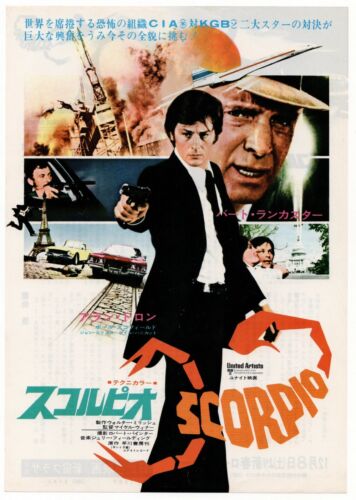
CIA killing machine Cross (Burt Lancaster) is retiring, but not before he trains his replacement, Jean Laurier (Alain Delon), alias Scorpio, to replace him. The CIA wants Scorpio to kill Cross for suspected treason and working with the enemy, but Cross pays him off and takes him back to America.

Cross’ Soviet counterpart Sergei Zharkov (Paul Scofield) helps him to get away from a trap and into Vienna, but Cross wants to rescue his wife Sarah *Joanne Linville) too. Unfortunately, the CIA gets to her first, which means that he decides to get revenge on the man who ordered the hit, McLeod (John Colicos). That makes the CIA throw even more money at Cross to pull off the job on his teacher.

It turns out that Cross has really been making money by playing every side against one another and even has Scorpio’s girlfriend on the payroll. The young agent kills her with no remorse and tracks down Cross, who tells him that he needs to always watch his back, because after he’s killed, they’ll be looking to clear up any loose ends. Spoiler warning. He’s right.

Scorpio was written by David W. Rintels and produced by Walter Mirisch, at least until director Michael Winner wanted to change the script and United Artists picked him over Rintels and Mirisch. What ended up on screen is a lot like another Winter movie, The Mechanic.

Even though the CIA are the bad guys in this movie, Winner was permitted to shoot in their headquarters in Langley, Virginia. It was the first movie ever shot there, even after Winter showed them the script. Even odder, Cross’ home is really CIA Director Richard Helms’s house. Perhaps they were allowed to do so because Lancaster asked Senator John V. Tunney if he could get them into the building.

You can watch this on Tubi.

APRIL MOVIE THON 2: Arnold (1973)

April 10: Nightmare USA — Celebrate Stephen Thrower’s book by picking a movie from it. Here’s all of them in a list.

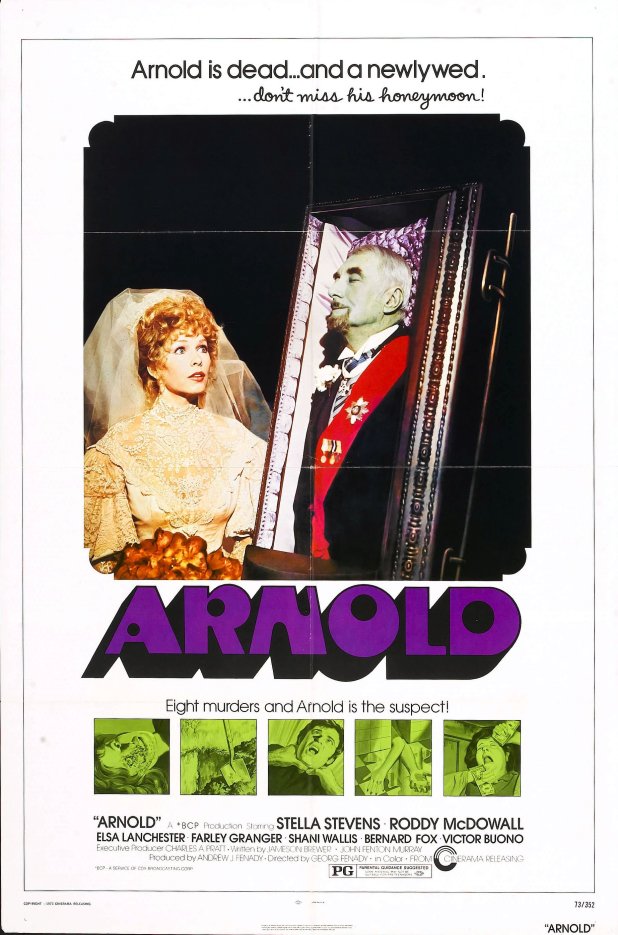
Lord Arnold Dwellyn (Norman Stuart) has just married Karen (Stella Stevens), which would not be all that strange except that, well, he’s dead. He’s not buried, as per his will, if Karen wants to inherit all that he owns, she must never leave his mansion and leave him in state. That doesn’t mean that she’s taking it easy, as she’s been having an affair with Arnold’s brother Robert (Roddy McDowall). And umm, how did Arnold get married when he has a widow, Lady Jocelyn (Shani Wallis)? I guess it really is until death do you part, right?

There’s money hidden in the walls, though, but whenever anyone gets close to it, Arnold has already planned for it, knowing how each person will react and coming up with a death trap created just for them, like some kind of Dr. Phibes without the years of medical school. Only Arnold’s sister Hester (Elsa Lanchester, once a Bride) seems to benefit from all of this, but her luck can’t last.

Shot at the same time as Terror in the Wax Museum with most of the same cast — Lanchester, Wallis, Steven Marlo, Patric Knowles, Shani Ben Wright and Leslie Thompson — this didn’t hit right with me at first. It felt like a long black out sketch from Night Gallery. Yet the more I think about it, well, I keep thinking about this movie. I mean, what other movie finds roles for Victor Buono, Bernard Fox, Farley Granger and Jamie Farr? How many fog machines did it take to make this? And wow, it was produced by Bing Crosby Productions?

Directed by Georg Fenady, who other than this and the aforementioned Terror in the Wax Museum mainly worked in TV and written by Jameson Brewer (who did write The Incredible Mr. Limpet) and John Fenton Murray (whose credits include Sid and Marty Krofft shows and Partridge Family 2200 AD), this feels like something made in between episodes of other shows. Yet it has some weird charm that keeps bringing me back to it. Maybe it’s the Shani Walls theme at the end?

NEW WORLD PICTURES WEEK: Amarcord (1973)

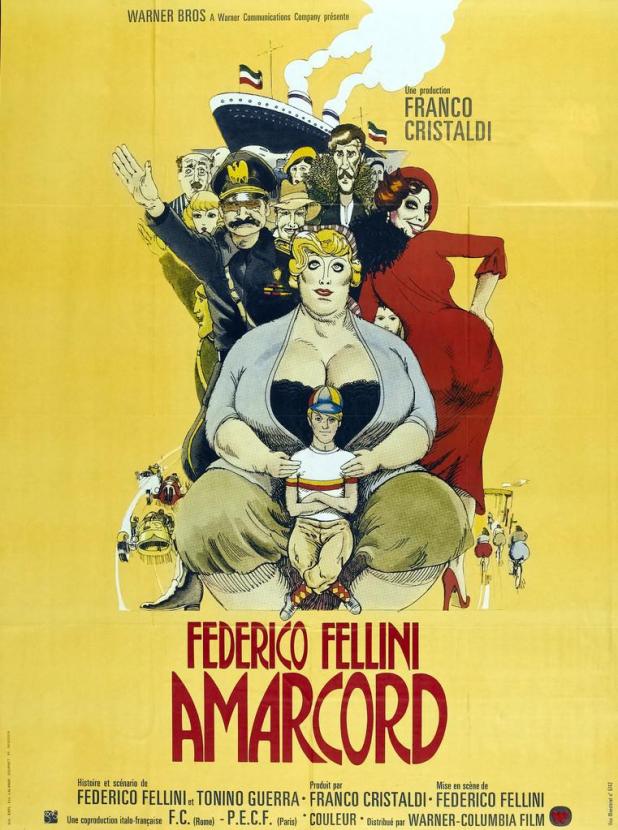
In Italian, a m’arcord means I remember and this is what Federico Fellini does in this film which recounts his childhood and the life of his childhood best friend, Luigi Titta Benzi, who is the inspiration for Titta, the main character. Fellini took efforts to say that this was not an autobiographical film, but thoughts of his past.

What’s amazing to me is this Oscar-winning film — Best Foreign Language Film and nominations for Best Director and Best Original Screenplay — was brought to the U.S. by Roger Corman.

Titta (Bruno Zanin) and his friends would rather be involved with pranks and attempt to lose their virginity than studying under fascism. This film has a scene where four of them masturbate in a car while discussing women like Bardot that may shock U.S. audiences, not because there’s any nudity, but the frankness and idea of boys exploring their sexuality in the same confined space is something that Americans would deny ever doing.

Many of Titta’s fantasies revolve around Gradisca (Magali Noël), the most beautiful woman in town who is due to be married to a fascist officer, as well as an encounter with a well-endowed tobacconist (Maria Antonietta Beluzzi) who nearly overwhelms him with her bosom.

This is an episodic film, filled with moments like Titta’s institutionalized uncle climbing a tree and screaming, “I want a woman!” as well as his father’s past as an anarchist, a winter family tragedy, the town coming together for a festival and an ocean liner passing by and everyone meeting it by boat. It’s charming and perhaps the most accessible of Fellini’s films, even if the Italian sexuality of it all may be too much for American puritanical eyes.

How important of a movie is this? It was the first film released in the letterboxed format when it came out on a RCA SelectaVision CED videodisc.

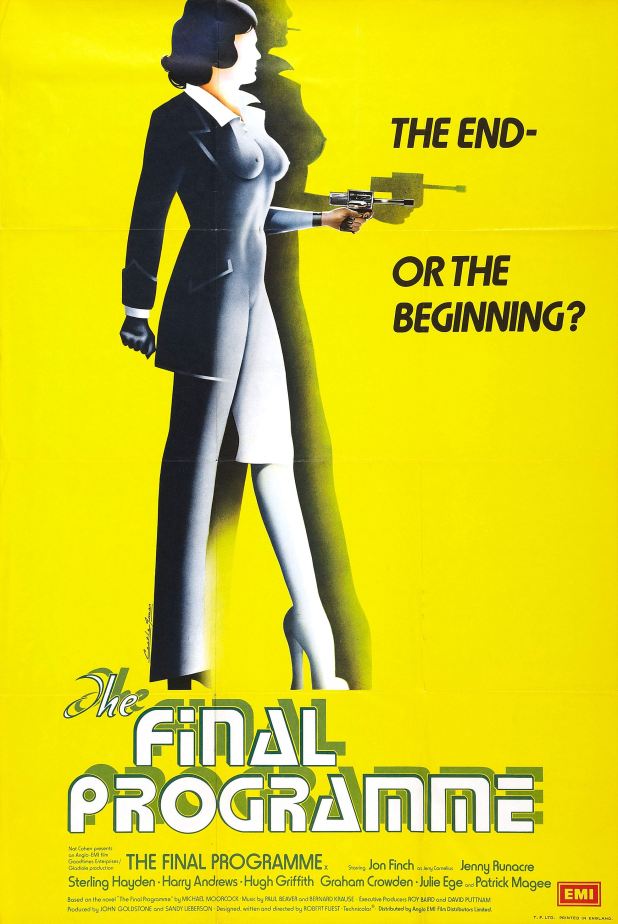
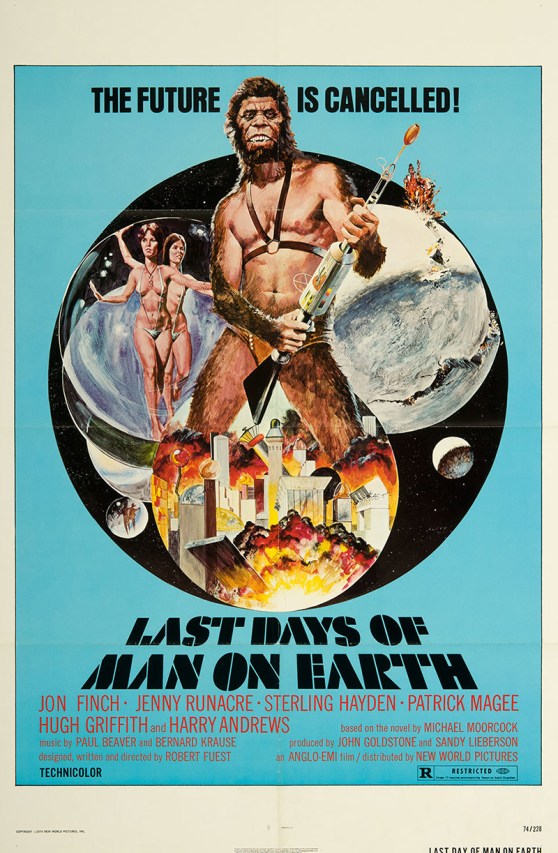
NEW WORLD PICTURES MONTH: The Final Programme (1973)

I have no idea what American audiences thought when confronted by the Robert Fuest directed and written The Final Programme, released here as The Last Days of Man on Earth.

Based on the novel of the same name by Michael Moorcock, this is the story of physicist, secret agent and dandy Jerry Cornelius (Jon Finch, Frenzy, who replaced Timothy Dalton at the last minute), who first attends the funeral burning of his father, a man who created the titular Final Programme, which will create the ultimate self-replicating immortal human. The world is ending, but a series of scientists and government types want this to come to pass while all Jerry wants to do is rescue his sister — and quite possibly lover — Catharine (Sarah Douglas) from his drugged-out brother Frank (Derrick O’Connor), all the while avoiding the man devouring secret agent Miss Brunner (Jenny Runacre, Jubilee).

Let me put this out there: this is a film that is all about its look more than caring if you understand the story. Either you’re going to love the ideas and Cornelius or you’re going to quit before its over. If you stick around, you’ll get a gigantic arcade filled with nuns playing slot machines for fruit (look for Moorcock and Hawkwind hanging out), needlegun battles, a hero addicted to drinking and biscuits, and an ending that really defies a conclusion, something that had to infuriate anyone not familiar with the source novel, which would be less than a handful, I believe.

Plus, you get Sterling Hayden as military man Major Wrongway Lindberg; Graham Crowden, Basil Henson and George Coulouris as the doctors; a Patrick Magee cameo; Fuest going wild creating sets and scenes that don’t always work (but who cares) and a strange feel that really makes this unlike any other movie I’ve seen.

It would be two years until Fuest got to make another movie — The Devil’s Rain! — and that didn’t work out so well either, sending him back to where he began, directing episodes of The New Avengers. He’d spend the rest of his career in TV, making ABC Afterschool Specials (Make-Believe MarriageA Movie Star’s DaughterA Family of Stranges and My Mother Was Never a Kid), The Big Stuffed DogRevenge of the Stepford Wives and episodes of Worlds BeyondC.A.T.S. Eyes and The Optimist. He also made Aphrodite, a film that had both softcore and hardcore cuts.

In a perfect world, Fuest would have had great success, but who knows? Maybe he was happy that after two Dr. Phibes movies he wasn’t typecast as a horror director. Perhaps he was even happier than the failure of The Devil’s Rain! put a nail in that coffin. His movies are challenges, with sets her decorated himself, films that never tell the audience all — or often any — of what’s happening, that are anything but wallpaper to have in the background.

NEW WORLD PICTURES MONTH: The Clones (1973)

Dr. Gerald Appleby (Michael Greene) finds himself in a perplexing situation and believes he’s been cloned. His conviction stems from a near-fatal escape from his lab’s explosion and the unsettling reports of his sightings in places he’s never been. This sets the stage for a gripping narrative as he goes on the run, pursued not only by the deranged scientist Carl Swafford (Stanley Adams, Cyrano Jones from the original Star Trek) but also by the ruthless thugs Sawyer (Otis Young, Blood Beach) and Nemo (Gregory Sierra, a stark contrast to his usual role as the virtuous Det. Sgt. Chano Amenguale on Barney Miller).

Directed by Paul Hunt (he also directed Twisted Nightmare and produced Demon Wind) and Lamar Card (who directed Supervan and Jukebox AKA Disco Fever, as well as the producer of Nashville GirlSavage Harvest and Project: Metalbeast), who co-wrote the film with Steve Fisher, who started writing movies back in 1938 with Nurse from Brooklyn. He also wrote the novel and screenplay for I Wake Up ScreamingHell’s Half AcreJohnny Angel and episodes of Peter GunnMcMillan & WifeCannon and Fantasy Island.

Most people will watch this movie and see a slow-moving film that goes nowhere, filled with fish-eye lens-addled drug scenes and an overwhelming sense of conspiracy doom. As for me, I read that sentence and only see the positives. Young and Sierra are having a blast; the ending is as cynical as it gets, and a lot of the ending takes place inside an amusement park that runs itself. It’s a movie that came out on VHS, has had no major DVD release and has never come out on Blu-ray.

You can watch this on Tubi.

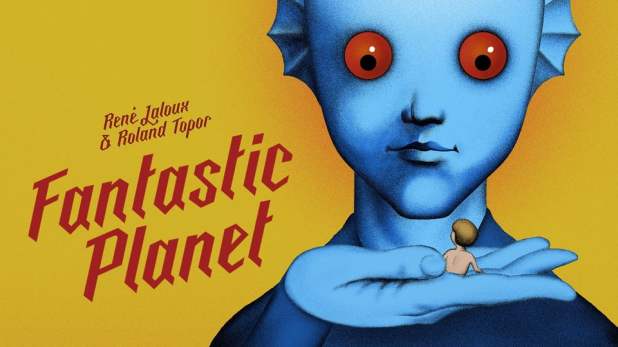
NEW WORLD PICTURES MONTH: Fantastic Planet (1973)

I’ve seen La Planète sauvage so many times, starting in the 80s thanks to Night Flight, and all the way up to now and honestly, I don’t have the slightest idea of what it’s all about and love it all the same.

An international co-production between France and Czechoslovakia based on Stefan Wul’s Oms en série, this movie is about the relationship between the gigantic blue Traags, who have kidnapped humans, renamed them as Oms and take them to their home planet of Ygam to help maintain their society, whether that means hard labor, serving as pets or being hunted.

Three Traag children torture a female human and kill her, orphaning her child Terr, who becomes the pet of Tiwa, who soon begins a symbiotic relationship of sorts with him, even taking her to meditation classes where Tiwa learns more about the Traag than any human before. By using these meditation techniques, Terr is able to learn how the Traag reproduce and of a moon that they call the Fantastic Planet, a place where they are able to finally find peace between the two races.

Fantastic Planet could be about that or it could be about whatever you want it to be, such as pets and humans, human rights or just something to trip out to, including the Pink Floyd-referencing soundtrack. It’s gorgeous — it took five years to animate — and still a movie I put on from time to time, even if — as I mentioned before — I have never decided what it’s all about.

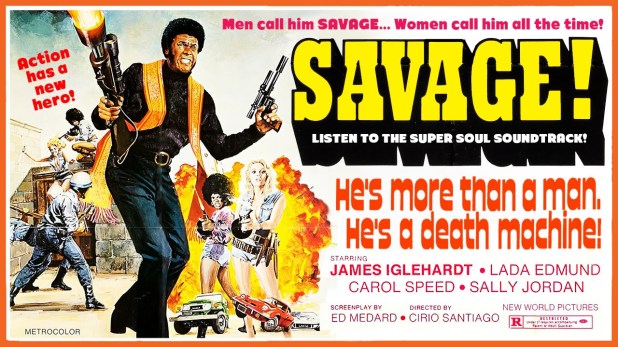
NEW WORLD PICTURES MONTH: Savage! (1973)

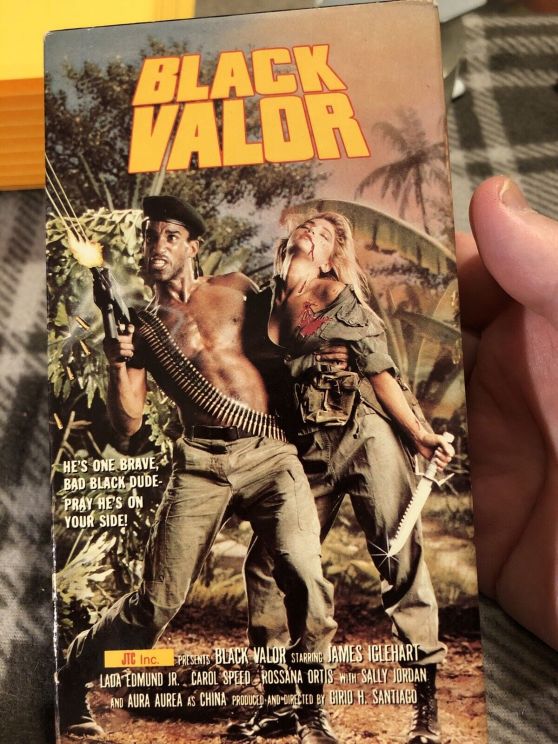
Between 1973 and 2008, Cirio H. Santiago partnered with Roger Corman on more than forty Philippines-filmed exploitation movies. The cost was low, the stuntmen willing to die, the locations gorgeous. And here’s Savage!, directed by Santiago and written by one time only screenwriter Ed Medard.

Savage (James Iglehart, Beyond the Valley of the Dolls) goes from a criminal evading the law to a leader overthrowing a dictatorship in just over eighty minutes. Working with Vicki (Lada St. Edmund, who went from go-go dancer on Hullabaloo to being the highest paid stunt woman in Hollywood) and Amanda (Carol Speed, always Abby), he goes from fighting the rebels to becoming one of them. I mean, Vicki is a knife thrower and Amanda is an acrobat and they know how to transform those circus skills into deadly arts.

As you can imagine, Vic Diaz is in this and maybe bamboo buildings blow up real good. It’s also called Black Valor, which really isn’t a better title than Savage! but is possibly a better blacksploitation movie name.

Iglehart is also in a much better film in this same genre, Fighting Mad. Aura Aurea, who plays China, was known as the Brigitte Bardot of the Philippines, which is a great name to be awarded, right?

NEW WORLD PICTURES MONTH: The Student Teachers (1973)

EDITOR’S NOTE: This was first on the site on October 17, 2018.

Man, these student teachers. They’re changing the old ways of high school and making it better — well, maybe more interesting — for the hip now generation. The sequel to Roger Corman’s The Student Nurses, this movie is all about the issues, man.

Directed and co-written by Jonathan Kaplan, who would go on to direct The Accused, this movie follows three student teachers: Rachel who wants to teach the good parts of sex education after school (that is, birth control and that sex isn’t this alien, frightening thing); Tracey dates an art teacher who cheats on her and Jody works with an inner-city education effort but also gets involved in selling drugs.

Chuck Norris made his debut in this film as a karate instructor. In his autobiography, he revealed that he knew nothing of the film other than the scene he was in. When the movie was released, Norris and his family went to see it and were shocked by the explicit sex and nudity. In fact, Norris almost changed his mind about becoming an actor!

To say this movie is dated is an understatement. That said, it’s packed with the earnestness of the end of the 1970s and the feeling that young people would change the world. They all ended up repeating the same cycle as their parents by the early 80s. But for now, they would be the student teachers.

NEW WORLD PICTURES MONTH: Stacey (1973)

EDITOR’S NOTE: Have I ever told you that I like Andy Sidaris? This was originally on the site on May 12, 2019.

Before he made Stacey, Andy Sidaris was known as a pioneer in the world of sports television, directing thousands of hours worth of football, basketball, Olympic games and special events for ABC’s Wide World of Sports. He eventually won seven Emmy Awards, but is perhaps best known for his invention of the “honey shot,” where he’d zoom in on the cleavage of female audience members and cheerleaders.

After helping make Monday Night Football into a ratings powerhouse and working on shows like Kojak and Gemini Man,  Sidaris moved into making his own movies by partnering with Roger Corman, raising half the funds for his debut film, Stacey. This is not truly his first film, as that would be The Racing Scene, a documentary about actor James Garner’s racing team.

Stacey Hanson (Anne Randall, May 1967 Playboy Playmate of the Month) has two jobs: private eye and race car driver. Wealthy older woman Florence Chambers hires her to determine whether or not her three family members are worthy of being in her will: the secretly gay John, his adulterous wife Tish (Anitra Ford from Messiah of Evil!) and Pamela (Cristina Raines from The Sentinel!), who is in a Manson-esque cult.

Meanwhile, houseboy Frank, who has been sleeping with and blackmailing everyone in the family, has been killed and no one is safe. This is the movie where I learned that none of Sidaris’ heroes and heroines knows how to shoot a gun, yet the villains are easily able to shoot everyone around them resulting in spectacular crimson geysers of gore.

If this all seems rather close to a later Sidaris film, Malibu Express, that’s because other than a few characters, they’re largely the same film. The sad fact that I can logically discuss Andy Sidaris films and know enough facts about them that I can drop at will either makes me feel like I’m doing the right thing or ponder where it all went wrong. There’s a thin line between madness and genius. The films of Andy Sidaris make me confront that head on.

Whereas the later films of Sidaris postulate a shared universe of L.E.T.H.A.L. Ladies and various drug dealing enemies that eventually become friends, this is a self-contained affair. But as he’d move on from doing TV — he was still working on shows like The Hardy Boys/Nancy Drew Mysteries and ABC’s Monday Night Football — Andy was ready to embrace the world of film completely. Yet one thing never changed: Sidaris loved showing off gorgeous women, but don’t write off his films as simple exploitation. His women are always capable, empowered and intelligent.

NEW WORLD PICTURES MONTH: Fly Me (1973)

Despite being directed by Cirio H. Santiago (so many movies to pick from, but today I’d mention Vampire Hookers and Wheels of Fire), Roger Corman didn’t want this movie to look like it was shot in the Philippines. That’s why it has that opening with Toby (Pat Anderson, Bonnie’s Kids) getting picked up by Dick Miller and taken to LAX. It was shot by Curtis Hanson. Some of the kung fu scenes were shot by Johnathan Demme, so man, three directors!

There’s also Sherry (Lyllah Torena) who juggles men at every destination and sneaks drugs everywhere she goes, which ends up getting her trapped in white slavery. Then there’s Andrea (Lenore Kasdorf), who is kung fu fighting through Hong Kong while Toby is hounded by her mom (Naomi Stevens) and pursued by a hunky doctor (Richard Young, who was the man who gave Indiana Jones his hat at the beginning of Indiana Jones and the Last Crusade).

In case you were wondering, yes, Vic Diaz shows up. As a cop, no less!

Yet another in the series of Roger Corman female occupation movies, this one is quite episodic and ends, as one imagines, with all the ladies meeting up to save one another’s days. I imagine most people were watching this through steamed up windows at a drive-in in 1973 and weren’t thinking of the story structure or multiple directors.