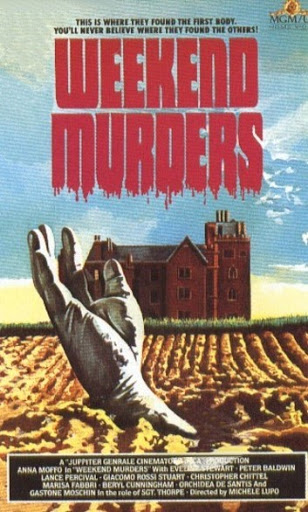
Known in Italy as Concerto per Pistola Solista (Concert for Solo Gun), this Michele Lupo (Arizona Colt) film takes place in England instead of the Italy we’ve come to depend on for our giallo adventures.
As a family comes to an estate for the reading of the will of Henry Carter, Second Earl of Vale, and get murdered one after the other. Is it because his niece Barbara got all of his money? Was the sniper who killed the butler trying to shoot her all along? Did the makers of Knives Out watch this and figure that everyone would think they were making an Agatha Christie film and not aping a giallo?
Inspector Grey, who takes the case, is played by Lance Percival, who was the voice of Paul and Ringo in Yellow Submarine. Beryl Cunningham (So Sweet, So Dead) and Marisa Fabbri (Rabid Dogs) also appear.
Chris Chittell plays George, who is pretty much the villain of this movie. You may remember him from The Wild Geese and They Call Him Cemetery. There’s a scene where he decides to sexually assault one of the maid, who tells him he could have just asked and she would have given in. They end up making love, but visions of his overbearing mother lead to more bloodshed. Ah 1970! What a time you were for things no one would try in a movie today.
This might not be my favorite giallo of all time, but it’s fine for what it is. It’s closer to a detective tale with some trapping of pre-Argento and much Christie influence. It’s not bad, but I just demand more weirdness from my murder movies.
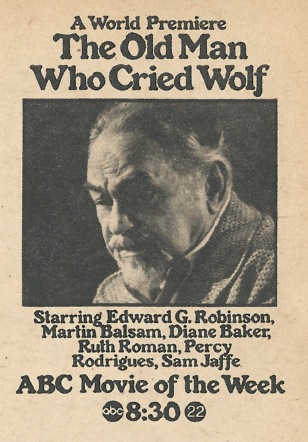
Luther Davis wrote Across 110th Street and this nihilistic TV movie, originally airing October 13, 1970. It’s directed by Walter Grauman, who was behind more than fifty episodes of Murder, She Wrote.
What a cast — from Jay C. Flippen (a former blackface vaudevillian known as “The Ham What Am”), Martin E. Brooks (Dr. Rudy Welles from The Six Million Dollar Man, the role originated by Martin Balsam, who is also in this), Ed Asner and Sam Jaffe to Percy Rodriguez (Genesis II, as well as the voiceover artist on the trailers for The Exorcist, Chopping Mall, House, The Great Outdoors and many more), Ruth Roman (The Baby), Diane Baker (Lorraine Warren in The Haunted), Balsam and Edward G. Robinson.
Robinson is an old man who watches his friend die and no one believes him. When he keeps telling anyone who will listen that they were attacked, his relatives try to get him psychiatric help. He decides to try to find the killers himself, but someone is watching his every step and the story grows darker and darker.
If you want to watch a real downer, the kind of rough ending that only the 1970’s can give you, this movie is on YouTube:
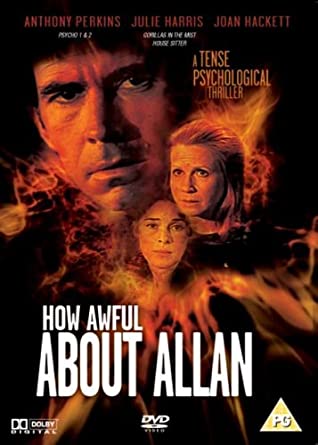
Along with What’s the Matter With Helen?, this movie is one of the two collaborations between writer Henry Farrell and director Curtis Harrington. It was the ABC Movie of the Week on September 22, 1970 and has stood the test of time as one of the better TV movies. And there’s some stiff competition for that.
Shot in just 12 days, it stars Anthony Perkins as Allan Colleigh, who has psychosomatic blindness after an accident — he left paint cans too close to a fire — that killed his abusive father and scarred his sister Katharine (Julie Harris from the 1963 version of The Haunting).
After Allan returns to their home after time in a mental hospital, he’s convinced that everyone is out to get him, including a new boarder with speaks in a hoarse whisper and one of his sister’s ex-boyfriends on the phone.
Joan Hackett — who was in two great TV movies, Dead of Night and The Possessed— appears as Allan’s former girlfriend. She gets caught up in his mania as rooms of the house explode into flames and he’s kidnapped by that mysterious ex.
How Awful About Allan has plenty of actors as comfortable on the stage as they were on the big or small screen. Perkins agreed to wear special contacts that completely made him blind so that his performance would be more realistic.
This didn’t get great reviews when it came out, but do the movie we love ever do?
Lucha libre is to American pro wrestling as a movie like Alucarda is to an American possession film. Sure, they’re in the same category, but they’ve gone off into their own strange world where reality — the things we know and see and believe every single day — no longer exists.
Lucha takes the Catholic morality of Mexico to the extreme, with los technicos (the good guys) battling valiantly against los rudos (the bad guys) in matches that are often about technical skill versus brute force. There’s also the idea of putting your manhood on the line, as often there are chop and strike battles to prove who is more macho. And then there are the outfits and masks and characters, with each person exemplifying a different heroic or villainous ideal. When a feud reaches its conclusion, it often costs a combattant their mask — honestly, their face — or their hair.
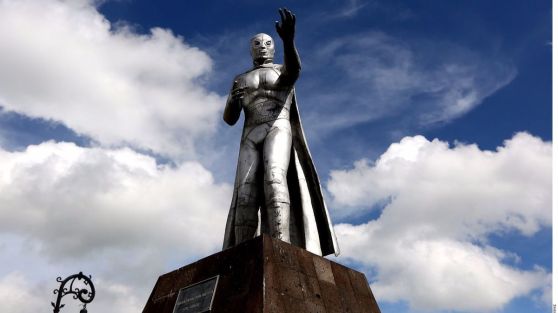
There has never been a luchador like El Santo. While he began as a rudo, once he achieved his fame, he became the kind of celebrity that Hulk Hogan could only dream of. Santo isn’t a big time pro wrestler; he’s a cultural icon on the level of someone like Elvis Presley. He starred in fifty-two movies between 1958 and 1982, along with winning thirty-eight matches where he put his famous silver mask up against the hair and masks of opponents like Perro Aguayo, Espanto I and II, Black Shadow, Bobby Bonales, La Momia and so many more.
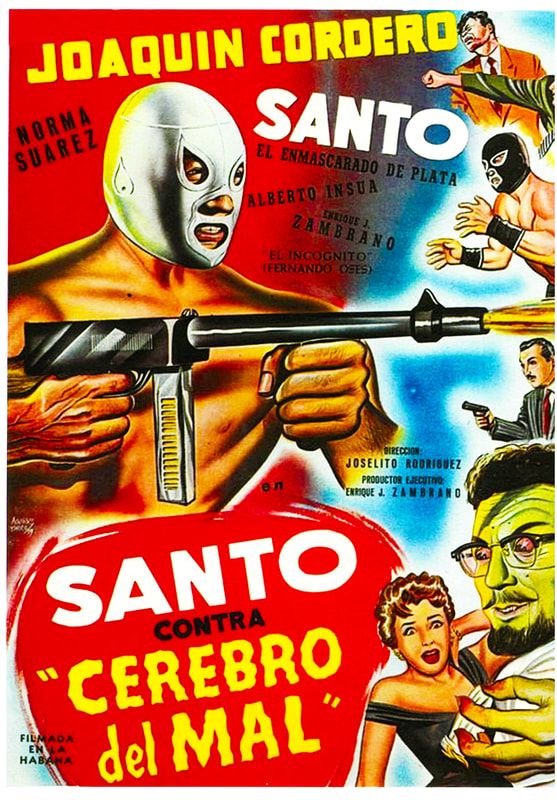
The first Santo comic was released in 1952 and after years of resisting appearing in the movies — the ring was his first love — Santo made his first two films, el Cerebro del Mal (The Evil Brain) and Hombres Infernales (The Infernal Men), in 1958. By 1961, Santo was just as big of a movie star as a wrestler.
El Santo was known to never remove his mask, even in private. When traveling, he made sure to take a different flight from film crews so they would never see his face as he went through customs. The only time Santo removed his hood in public was a week before he died from a heart attack, an action thought to be him realizing the death was near and he wanted to say goodbye.
Lucha libre owns a place in my heart that pro wrestling never will. It means so much more; it’s a passion play in the midst of the squared circle that still draws a huge crowd every Friday night in Arena Mexico.
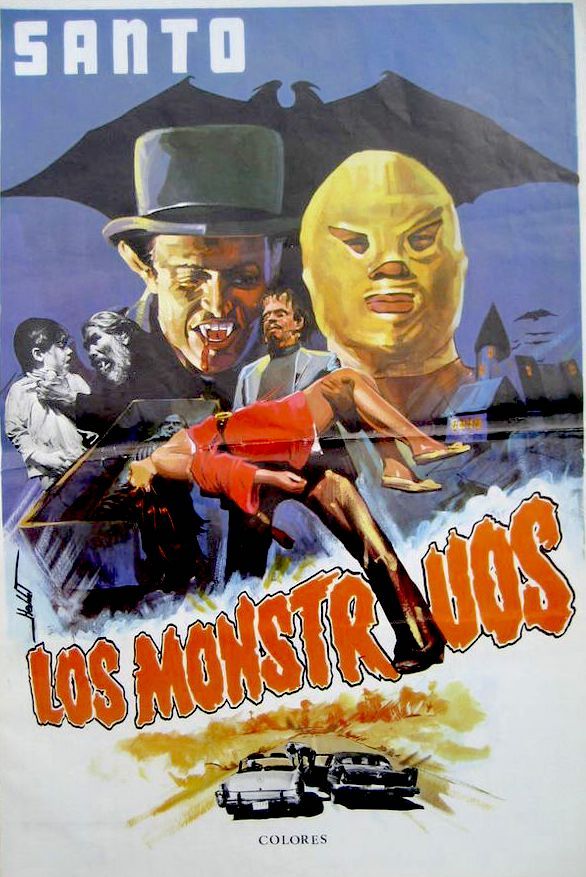
Santo and Blue Demon Against the Monsters is a piece of magic. Here, our silver masked hero and his sidekick Blue Demon don’t just battle one monster. They battle every single one of them, one after the other, for nearly ninety mind-destroying minutes.
Leading the mob is El Vampiro, a vampire with the temerity to challenge Santo to a mask versus mask match in the middle of the holiest of all holy places, Arena Mexico, and the rudo nature to allow his army of monsters to invade before he loses
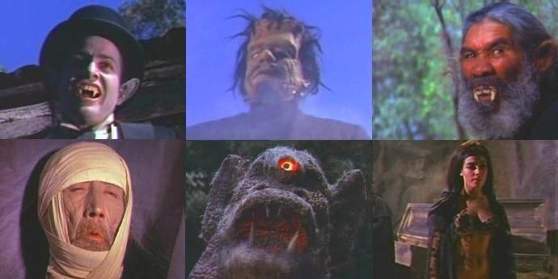
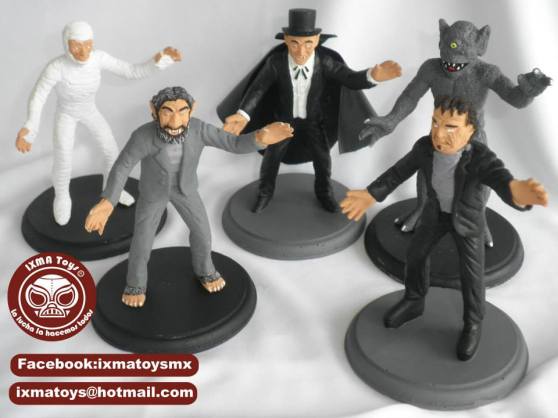
There’s also El Hombre Lobo, a werewolf that basically is just a hairy dude with fangs. La Momia, a skinny old man who looks like he could fold with one chop from Santo. Franquestain, who we can only assume is Frankenstein’s Monster with a van dyke! La Mujer Vampiro, who proves that ladies can be just as deadly as their male monster counterparts! El Ciclope, who takes over for the Creature from the Black Lagoon and looks like a beast straight out of Plaza Sésamo! Santo literally beats this dude with an ugly stick for twenty or more unanswered shots in a row while I yelled with madness and glee! There’s also a mad scientist named Bruno Halde and his dwarf sidekick Waldo, who struggle to keep these monsters in one piece. Oh man – I also forgot that there’s an evil clone of Blue Demon to deal with too!
This is the kind of movie that’s perfect for kids — think 60’s Batman mixed with some James Bond — except that there’s also a scene where a wolfman rips apart a kid’s parents in front of him, then does the same to the kid! In Mexican lucha films, rules don’t exist and life is cheap! And I haven’t even got to the scene where Franquestain stomps out a kid’s head. American History X has nothing on lucha monsters!
The end of this movie has Santo and Blue Demon — armed with torches and their pare fists, while wearing tight turtlenecks — murder nearly every monster thanks to the power of the cross and good old fashioned smashing everything. They also don’t even need hammers to stake vampires — our heroes do it with their bare hands.
As our heroes leave the vampires’ castle — leaving it ablaze after the staked vamps fade into nothing — the credits roll. In our overly CGI digital universe, a movie like this is a cool drink of aqua de fresa for what ails you. The best part is that this is just one of the many times Santo would go to war with the forces of evil. You can also watch him battle zombies, the king of crime, Satanic power, Martians, mafia killers, the Bermuda Triangle, karate experts and more.
Viva los luchadores! Viva la lucha! And most importantly, viva El Santo!
This article originally ran in Drive-In Asylum issue #18, which you can get right here.
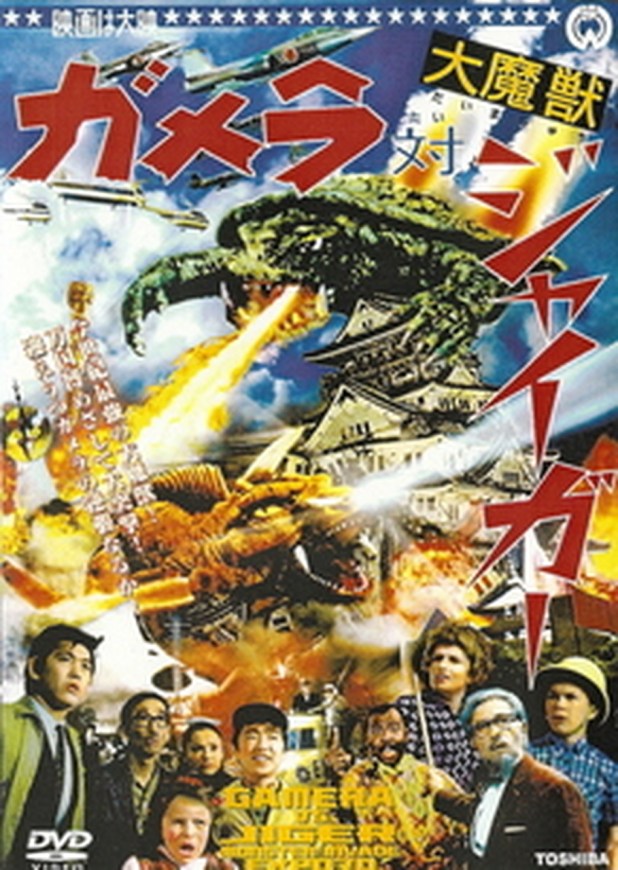
Known as Gamera tai Daimajū Jaigāin Japan, or Gamera vs. Giant Devil Beast Jiger, this is the sixth Gamera film. In the U.S., it was released straight to television under the name Gamera vs. Monster X.
The American version contains stock footage from Gamera vs. Guiron and Gamera vs. Barugon to extend the movie’s release time.
As Japan gets ready for Expo ’70 in Osaka, they decide to take a mysterious status called the Devil’s Whistle off an island. Gamera tries to stop them, but they take it anyway. It makes everyone sick and insane that goes near it.
The sound that the Devil’s Whistle makes Jiger go crazy too, so the beast comes down and starts taking out everyone in its way, as well as using its spiked tail to mess up Gamera. It also has a spiky bulbed tail that lays an egg — and eventually a baby Jiger — inside Gamera’s lungs.
That baby looks like a cute version of Jiger, but damn if those little Japanese kids don’t go inside Gamera and kill that infant with static from their walkie-talkies. The scientists then use big speakers to keep Jiger busy while the kids go back inside the giant turtle and jump-start his heart.
In their final battle, Gamera uses telephone poles like earplugs — man, these movies are inventive — and he smashes Juger’s tail, finally making her weak enough to destroy.
Despite the increasingly low budgets and bad effects, Gamera movies remain willing to embrace pure insanity. Isn’t that what we’re all looking for anyway?
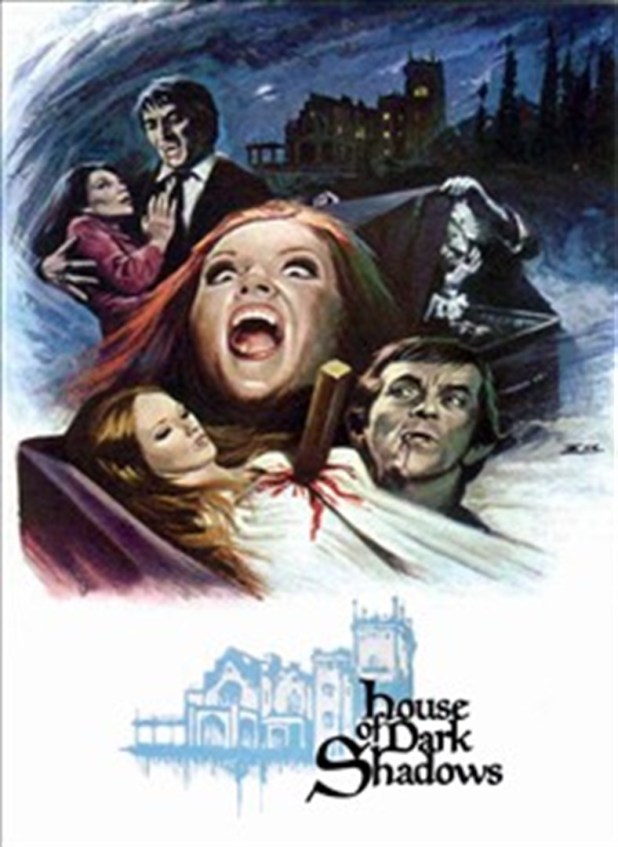
Dark Shadows was a phenomenon. As such, producer and creator Dan Curtis started pitching a feature-length TV movie from 1968 onwards, seeing it as a big cultural deal that needed to be capitalized on.
The original idea was to edit together old episodes of the show, but soon, the idea to tell the entire Barnabas Collins saga—complete with bloody bites and gore—took over. Several actors were written out while the TV series was still on the air. A writer trying to use the vampire for a biographical novel trapped Barnabas in a coffin for 28 episodes. Other characters were replaced in the 1970 parallel world story arc.
With a budget of $750,000 — that was probably enough for 750 episodes of the actual series — and on-location shooting at the Lyndhurst Estate in Tarrytown, New York and that town’s Sleepy Hollow Cemetery (as well as the Lockwood–Mathews Mansion in Norwalk, Connecticut), this movie looks gorgeous. And it’s a joy to see so much of the original cast come back and play modified versions of their roles.
However, what takes years on the soap opera now takes moments. It’s a bit disconcerting.
Like his entry on the show, Barnabas (Johnathan Frid) is found by handyman Willie Loomis (John Karlen) and, within moments, introduces himself as a long-lost European relative while taking bites out of almost every female cast member.
Daphne Budd? Bitten. Carolyn Stoddard? She gets a bite. Maggie Evans? Yep, her too.
Barnabas is also transformed into a human by Dr. Julia Hoffman, but she falls for him and jealously transforms him into his true age. No worries — actual bites from his chosen bride, Maggie, bring him back to vitality.
The only part you may not enjoy is Willie turning on Barnabas and the titular vampire succumbing to a crossbow to the back. That said, his bat flies away — Curtis was doing end-credit teases way before the Marvel movies — in a nod to a projected sequel that never happened, Curse of Dark Shadows.
There’s also a moment when Quentin Collins’ theme is heard, but he doesn’t show up. I’m sure many young ladies were crushed by this.
This is a fun movie if you haven’t watched the original episodes. If you have, you may be upset that they are glossed over. Regardless, I saw it at the drive-in, paired with its spiritual sequel, and I enjoyed it.
All good things must end. This is the final of the Blood Island films and the last movie that Eddie Romero would make for Hemisphere Pictures.
As Dr. Bill Foster (John Ashley), Sheila Willard, her father and Carlos Lopez escape from Blood Island, this movie’s Beast gets on board and goes buck wild, killing everyone he can and blowing up the ship. He survives and heads back to the jungle while Dr. Foster spends months recovering. Everyone he knew or loved is now dead.
Of course, he’s going back to Blood Island.
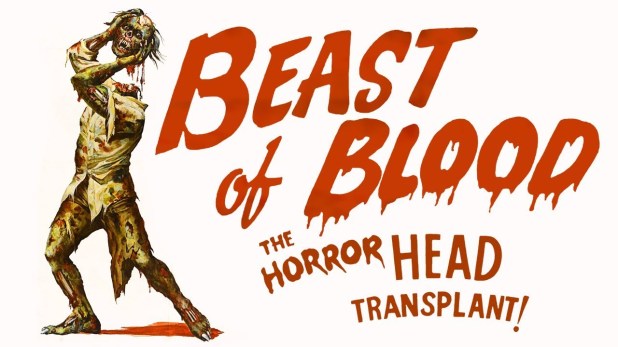
Dr. Lorca (Eddie Garcia), who apparently died at the end of the last movie, is still alive but horribly scarred. He controls the beast, which can live without its head and even talk and control its own body from afar.
This is less of a narrative movie for me and more a collection of magical images, as bodies squirt blood and beasts have swampy faces and make strange noises while their heads rot inside beakers and lab equipment.
To promote this one, which played a double bill with Curse of the Vampires, the producers printed counterfeit 10 bills that folded in half, with the other side revealing a poster for the film. Those fake sawbucks were scattered all around the neighborhoods where this movie played.
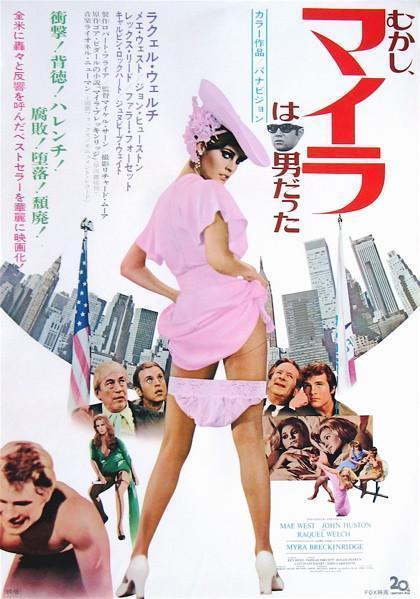
Gore Vidal’s 1968 novel Myra Breckinridge was a landmark novel, an attack on the traditional norms of gender and sexuality, while also a biting satire of Hollywood. It was also seen as incredibly pornographic, so the idea that a movie could be made from the book seemed pretty out there.
After all, two weeks into writing the book, Vidal decided to make his main character transgender — and if you think transpeople are an issue today, you can only imagine how the world felt about them fifty years ago. An interesting trivia note — the name Breckinridge was taken from Bunny Breckinridge, who played The Ruler in Plan 9 From Outer Space. He was an openly gay man in a time when it was dangerous to be homosexual and was even jailed several times as a result. His desire to become a woman was ruined by the legal system and even a car accident on the way to get an illegal transition surgery in Mexico. In his later years, he’d open his San Francisco Spanish bungalow-style home to hippies and regale them with the history of closeted Hollywood.
Somehow, this got made, with Vidal making $750,000 ($5 million in today’s money) for the rights and screenplay. Original director — and Pittsburgh native — Bud Yorkin was replaced by Michael Sarne, an auteur who had made all of one film, 1968’s tale of swinging London Joanna. Somehow, he got complete creative control over this project.
Sarne quickly went over budget. One reason is that he’d often lock himself in a room while union cast and crew made money outside, thinking of what he’d do next for up to seven hours as a time. He also famously spent several days filming close-ups of food instead of handing that task off to a second unit. He also was big on getting the cast members to fight amongst themselves.
A former singer — who had a novelty #1 hit with “Come Outside” in the UK, somehow Sarne was able to do whatever he wanted, at least until this movie flopped. He never directed a movie in the U.S. again, but has acted in several films since this movie bombed oh so badly. And his movie The Punk did well, but it took decades to revive his career.
I mean, Sarne trashed the entire cast long before the movie even came out. Welch was “useful only as a joke” and “an old raccoon.” Rex Reed was “faggy, prissy and unpleasant.” John Huston was “an old hack.”
When asked by The Independent about the film, Vidal minced no words. “One of the worst films ever made. A disaster. Myra was the most pre-publicized film since Gone with the Wind. It made the covers of Time and Newsweek. But you could tell it was going to be a disaster from reading Sarne’s script.”
So how bad is it? Well, somehow this 94-minute film feels like it takes 94 years to unspool. It ridicules old Hollywood for shock tactics, leading many of the Golden Era film actors who appeared in the movie to be angry that their old films were being used to punctuate puerile gags and a woman on man pegging assault. It got so bad that the White House asked for footage of Shirley Temple — now a U.S. ambassador — to be removed. Loretta Young successfully sued to have herself cut out of the film.
Yes, it’s a movie so bad that actors sued to get themselves on to the cutting room floor.
The film begins with Myron Breckinridge (critic Rex Reed, who also shows up in another megaflop, Inchon) has gone to Copenhagen to become the gorgeous Myra (Racquel Welch, who is, well, Racquel Welch and nearly melts the screen with each appearance). When he returns to the U.S., he heads off to his/her (Myra has no set gender pronoun) uncle Buck Loner’s (John Huston, who I would say deserves better, but he’s also in Tentacles, Bermuda Triangle and The Visitor, so he obviously would do anything; also all three of those movies are a billion times better than this) acting school, where he/she acts as his/her own widow to try and get half the school or a half a million bucks.
Somehow, Myra ends up becoming an etiquette teacher at the school, which means that he/she discusses mainly the Golden Age of Hollywood and female domination, all with the end goal of “the destruction of the last vestigial traces of traditional manhood in the race in order to realign the sexes, thus reducing population while increasing human happiness and preparing for its next stage.” Oh yeah — Myron also shows up as his/her conscience.
Myra has also grown obsessed with lovebirds Rusty and Mary Ann (Roger Herren, whose career was ruined after this lone role, and a very young Farrah Fawcett), who she sees as everything old fashioned, apple pie and America. To destroy them, she first pegs Rusty, who leaves his girl behind, then enters a lesbian relationship with Mary Ann, who wishes that Myra was really a woman so they could have a complete life. Ah, 1970.
Also — Mae West — pre-Sextette — is in here as a casting agent who is pretty much Mae West redoing all of her old routines. After auditioning plenty of men — look for a young Tom Selleck — she ends up getting the used up and presumably dilated Rusty as her next boy toy.
Buck is convinced that Myra is a liar and keeps trying to trip him/her up. These machinations end when Myra reveals that she hasn’t lost all of Myron, who then manifests himself and hits her with a car.
Myron awakens — in black and white thanks to a re-edit made to the DVD release to show us this was all a dream — and was never a woman at all.
All manner of people are utterly wasted in this movie, which I’ve come to respect in the same way that one looks up to rats for being able to get into social media eating pizza on a near-weekly basis. There’s Dan Heyada in a young role as a mental patient, Toni Basil more than a decade before her hit video “Mickey,” The Monkees’ actor Monte Landis, Helda Hopper’s son William, former pro wrestler Buck Kartalian, Kathleen Freeman (Microwave Marge from Gremlins 2), Grady Sutton (who was often in W.C. Fields movies and often played “sissy” roles), Andy Devine (who was Cookie, the sidekick of Roy Rogers), John Carradine (are you shocked?), Jim Backus, Calvin Lockart (The Beast Must Die), George Furth (Blazing Saddles) and Roger C. Carmel (Harry Mudd himself!).
Raquel Welch claimed that she was fascinated by Mae West, as she could never fully decide if West was a man or a woman. That seems like sour grapes, as West had a contract that allowed her to pick her costume colors above anyone else in the cast, leading to many of Welch’s outfits needing to be picked all over again.
And hey — Rex Reed refused to say the movie’s best — or worst — line, “Where are my tits? Where are my tits!?!” until he was told they’d just have someone impersonate his voice. He did it anyway.
As we’ve seen numerous times over Box Office Failures Week, many movies that were flops didn’t really flop. And some of the ones seen as poor films are actually pretty good. This is not the case. Not even a little bit.
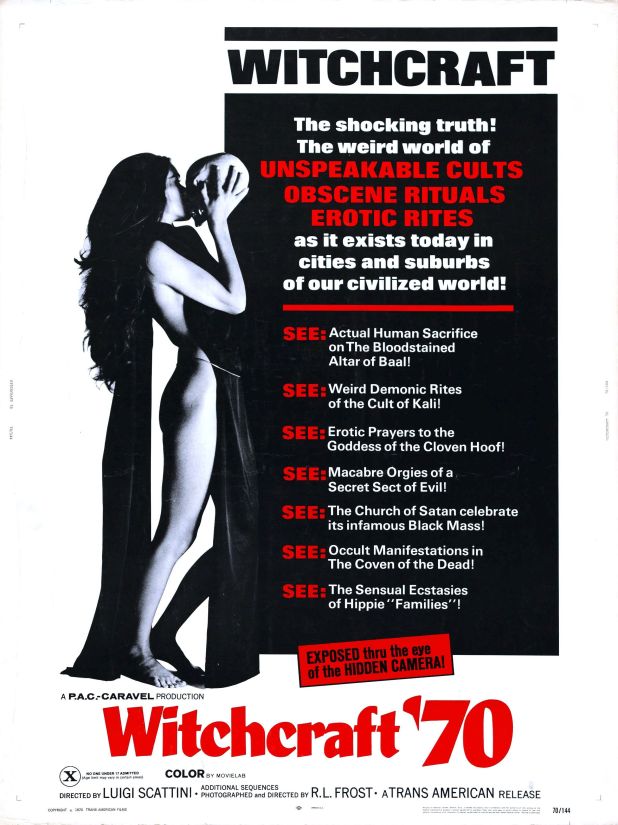
Lee Frost, who directed Love Camp 7, Hot Spur, Dixie Dynamite, A Climax of Blue Power, The Thing with Two Heads and The Black Gestapo, in addition to mondo films like Hollywood’s World of Flesh, Mondo Freudo, Mondo Bizarro and The Forbiddendirected the additional scenes in this revised version at the behest of TransAmerica Films.
Original director Luigi Scattini was behind lots of exploitation over in Italy like Sweden: Heaven and Hell and Blue Nude. He brought in Alberto Bevilacqua, who was a writer on films like Atom Age Vampire, Black Sabbath and Planet of the Vampires.
How can you not love a movie that promises dialogue like “A ballad of the ’60’s said, “I left my heart in San Francisco.: Now in the ’70’s, it is possible to leave one’s soul there as well?” Yes, the biggest problems in 1970 were weed and witchcraft. Is it any wonder that this movie has led to so many samples in the songs of Electric Wizard?
Keep in mind, the ideas in this film — and the sheer nudity on display — destroys minds and reaped souls back in 1970. But in 2019? It could almost be on regular television. This version is the one to watch — the Italian version, like I said, which we’ll get to tomorrow, is missing plenty of the rougher footage from Frost, as well as a warning from Lieutenant David Estee of the Capitola California Police Department
But hey — you do get to see a Satanic wedding officiated by Anton LaVey, so there’s that. And dialogue like “The night air carries the stench of flames, sex and an acrid unnatural sweat.”
I got this from the sadly gone Cult Action. I really wish that site was still around, if only to make me spend more money on movies that I can’t afford.
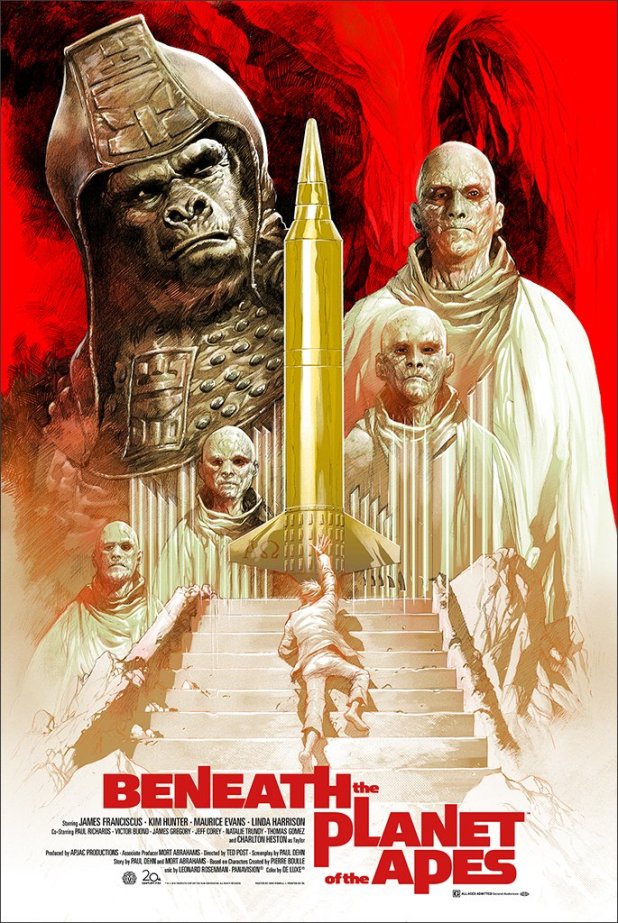
After Planet of the Apes, producers considered several treatments before finally hiring Paul Dehn to write the movie, making him the primary writer for the films.
They didn’t use the sequel suggested by Pierre Boulle, author of the original novel, whose Planet of the Men script had Taylor as a messiah leading humans against the apes.
However, he eventually agreed, only if his character died and all of his salary went to charity.
Dehn altered the script to center on a new character, Brent, played by James Franciscus. And with original director Franklin J. Schaffner unavailable, as he was making Patton, Ted Post was hired. He’d go on to make one of my favorite movies ever, The Baby.
Immediately after Planet of the Apes, Taylor (Heston) and Nova (Linda Harrison) ride through the Forbidden Zone. Suddenly, fire emerges from the ground and Taylor disappears into a mountain.
That’s when a second ship — looking for Taylor — emerges. It crash lands and only Brent (Franciscus) survives. He soon meets Nova and sees that she wears Taylor’s dog tags. She takes him to Ape City, where he watches General Ursus (James Gregory, who went on to play Inspector Luger on Barney Miller) rally his soldiers into conquering the Forbidden Zone. Brent is discovered and wounded, which brings him to the home of Cornelius (David Watson takes over for Roddy McDowall for this installment, as the star was in Scotland directing a movie) and Zira (Kim Hunter).
Orson Welles almost played Ursus. I wish that had happened. Plus, Gregory Sierra, who played Verger, was also on Barney Miller as Detective Sergeant Chano Amenguale. And for some real ape trivia, while Normann Burton played a human and an ape in the films (he was the Hunt Leader in Planet of the Apes and an Army Officer in Escape from the Planet of the Apes), only Natalie Trundy (who was the wife of producer Arthur P. Jacobs) played all three groups across four sequels. She’s the mutant Albina in this movie, then plays Dr. Stephanie Branton in Escape and then finally the ape Lisa in Conquest and Battle.
Soon, they’re back in the Forbidden Zone, where psychic voices tell Brent to kill Nova, voices that come from telepathic mutants who worship an atomic bomb. Either this is going to make you check out — as many critics did — or love this movie as much as I do.
In the ruins of St. Patrick’s Cathedral, these humans who survived the bomb and became mutants are ready to go to war with the apes, ready to use their Divine Bomb as a last resort. Then, you get to witness their religious ceremony where they remove their faces to reveal their true form — skinless faces praying to a nuclear god. This set is reused from Hello Dolly! if you can believe that.
Oh yeah — Victor Buono shows up too!
Brent is separated from Nova and taken to a cell where the mutant Ongaro (Don Pedro Colley, who would later play Sheriff Ed Little on The Dukes of Hazzard) forces him to battle the still-alive Taylor to the death. Nova utters Taylor’s name and the humans kill the mutant.
Just like Shakespeare, everyone dies. Seriously, most of the mutants commit suicide, Nova gets killed, Menedez is shot, Taylor gets gunned down and Brent gets murked, too. Luckily, Brent took out Ursus and Taylor says screw it and nukes everyone and everything. The end of this movie is amazing, so astounding that Electric Wizard used a sample from it on the song “Son of Nothing.”
“In one of the countless billions of galaxies in the universe lies a medium-sized star, and one of its satellites, a green and insignificant planet, is now dead”.
An alternate ending was written where Taylor, Brent and Nova escape and return to Ape City. With the help of Zira and Cornelius, they release the humans from the cages and a new order of peace begins. Hundreds of years later, the Lawgiver is teaching a group of ape and human children when a mutated gorilla appears and shoots a dove.
Before Richard Zanuck was fired as studio president during production, he is the one who gave the thumbs up to using the bomb to end this series. It was another Charlton Heston idea, who really didn’t want to be in these movies it seems. That said — this isn’t the end. Not at all.
How many movies keep going after the entire world gets blown up?

 B&S About Movies
You must be logged in to post a comment.