Man, Christopher Lee may rival Donald Pleasence for not being able to say no — I say this with full knowledge that the former turned from Halloween while the latter said yes to that series more than he should have — and here he played Sax Rohmer’s “yellow peril” character of Fu Manchu, who is joined by his just as sadistic daughter Lin Tang. She’s played by Tsai Chin, who was a Bond girl twice in You Only Live Twice and Casino Royale, topped the music charts with “The Ding Dong Song” and played Auntie Lindo in The Joy Luck Club.
Rosalba Neri is also in this and you know, as bad as this movie might be, Rosalba Neri is in it. You should be so lucky as to get to spend 92 minutes with her.
This is the fifth and final time that Sir Lee played Fu Manchu, if you can believe that. Also starring in this movie is plenty of pilfered footage, including the entire opening effects coming from A Night to Remember and the dam bursting being taken from Campbell’s Kingdom.
There’s lots of fog, which I appreciate, and a plot about freezing the oceans, which I am also totally down with. Man, is Fu Manchu the good guy?
A blind sculptor and his captive muse are at the center of this Edogawa Rampo adaption, directed by Yasuzō Masumura (Giants and Toys, Irezumi). This movie looks like the inside of a maniac’s dream after they’ve done days and days of psychedelics and I couldn’t be more excited to have watched this.
Aki works as an artist’s model, but she’s never been hired like this before. She’s been kidnapped and taken to a warehouse filled with gigantic female body parts like eyes, legs, lips and breasts as well as two huge male and female figures. There, Michio tells her that he plans on using her to sculpt his most perfect version of the female body.
At first, she wants to escape, but she slowly comes to obsess over her captor as much as he does her. However, his mother, who has helped him to this point, may keep their strange romance from achieving its perfect flower.
Make no mistake — this is a dark and strange movie for grownups. But if you’ve ready for the challenge, it will reward you with an eerie story and some incredible visual scenes.
The Arrow Video blu ray of Blind Beast has new commentary by Asian cinema scholar Earl Jackson, a new introduction by Japanese cinema expert Tony Rayns and Blind Beast: Masumura the Supersensualist, a brand new visual essay by Japanese literature and visual studies scholar Seth Jacobowitz. You can order it directly from Arrow.
Mil Máscaras means Thousand Masks and the man behind those multiple faces became one of the most recognizable wrestlers in the entire world as well as the star of twenty movies.
The character of Mil Mascaras was announced before he even wrestled in the ring, with the character created by “El Rey Midas de la Lucha Libre” Valente Perez. Perez was the publisher of Lucha Libre magazine and also came up with Tinieblas.
Mil is one of the first lucha stars to wrestle in the U.S. — he was the first masked wrestler to appear in Madison Square Garden after the ban on masked wrestlers was lifted — and Japan, where he became a major star in All Japan Pro Wrestling, often teaming with his brother Dos Caras.
Yet Mil Máscaras was created specifically to be a movie star. This suited producer Luis Enrique Vergara well, as Santo had argued for more money and Blue Demon was injured. The lucha movies were making money, so Vergara got a new star out of Mil.
Taking a page — many pages to be fair — out of Doc Savage, Mil gets an origin story that finds him as an infant found clutched in his dead mother’s arms at the end of World War II. Scientists adopt him and put him through a brutal series of physical trials and mental lessons to create a superhuman that can make the world a better place.
While this movie was shot in black and white and may seem pretty plain when compared to the wilder lucha stories to come, everything has to start somewhere. Mil has some really fun matches in this and there’s lots of great rock and roll for the kids to twist away the night to.
While there are many that decry Mil for being selfish in the ring, he remains a major star years after being named Pro Wrestling Illustrated’s most popular wrestler in 1975. No less of an expert than the original Tiger Mask, Satoru Sayama, said ” If it weren’t for Mil Máscaras, there would be no Jushin Liger, no Último Dragón or the Great Sasuke today.”
Note: Information for this article came from Luchawiki.
You know, Gaby (Regina Torne) is great. Across two movies — Las Luchadoras contra El Medico Asesinoand Las Luchadoras contra La Momia — we’ve watched Gloria Venus and Golden Rubi battle evil doctors and an Aztec mummy, but now we have an evil doctor kidnapping the world’s smartest scientists and also creating a trenchcoat wearing killer who looks like he’s made out of the finest rubber than Senor Benjamin Cooper makes.
Sure, we’ve seen it before as “Return of the Cybernauts” on The Avengers, but have we see it with wrestling women and a half-ape, half-zombie, half-man named Carfax? And then, how about if we put that monsters head into a female wrestler and change her named from Berthe to Black Electra?
As was the custom at the time, there are two cuts of this movie. There was another “sexy” version with nudity that was intended for the U.S. titled El Asesino Loco y el Sexo (Sex and the Mad Killer). The clean and filthy versions both went unreleased up here.
Director René Cardona was on a quest to make the perfect luchadora against scientists movie and damn if he didn’t succeed more than once. If you want the best realitization of his quixotic quest, I would recommend Night of the Bloody Apes, which features a heroine who dresses like a demon, a monkey/human killer that rips off faces and legitimate footage of an open heart surgery.
I never went to a real college per se — I went to art school and then got my degree as quickly as I could from a university in the city, so I have no idea what it’s like to have a campus quad or fellow students into the same things that I’m into. I just live through the movie students of Medfield College, as seen in everything from The Absent-Minded Professor and Son of Flubber to this movie and its sequels Now You See Him, Now You Don’t and The Strongest Man in the World. The Shaggy D.A. also takes place in the same town.
Medfield College is named after the town of Medfield, Massachusetts, a place that Walt Disney would visit from time to time, landing his place on a private airstrip. Their middle school has a quote from Disney written in its cornerstone: “Our greatest natural resource is in the minds of our children.”
I always wondered why people disagreed so much with John Carpenter about casting Kurt Russell as Snake Plissken. I always say that your cultural experience is based off when you first experience it and didn’t realize that in myself. If I’d only known Russell from these Disney movies, I’d never see him as grizzled.
Dexter Reilly (Russell) attends the aforementioned Medfield College, a college with such a limited endowment that they can’t even afford a computer. To be fair, an HP 3000 sold for $95,000 in 1972, which is about $567,000 in today’s money.
The students get a wealthy businessman — criminal — named A.J. Arno (Cesar Romero) to donate an old computer to the college. What they get is one of his old gambling computers, which leads to all manner of problems when it quickly breaks down.
As Dexter goes to get a new part during a thunderstorm, a shock transforms him into a human computer that can do math better than anyone else, read and remember any book and speak any language within seconds. This takes Dexter from kindly friend to all to a robot, but the school is happy because they’re finally making money.
Reilly goes on a roll, leads Medfield’s team in victories against other schools on a TV quiz show. However, the word applejack unlocks all of Arno’s gambling info, so the criminal and his gang — featuring Kurt’s real-life father Bing — kidnap him. As his friends rescue him, a blow to the head turns off his computer brain, but the other team members rally to win $100,000 for the school.
Director Robert Butler may have worked in TV — and Disney films — throughout his career, but he also directed Turbulence, Up the Creek and Night of the Juggler. Writer Joseph L. McEveety also scripted The Barefoot Executive, Superdad, the two Dexter sequels, Hot Lead and Cold Feet and No Deposit, No Return.
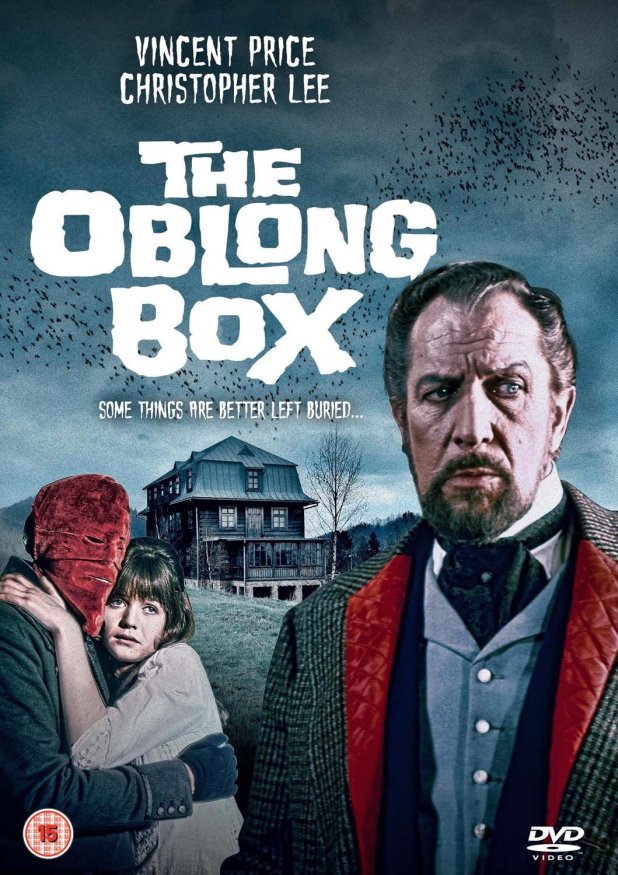
Based on the Edgar Allan Poe short story “The Oblong Box,” the script for this movie by Lawrence Huntington and Christopher Wicking also brings in plenty of other Poe themes like masked men, premature burial and, well, voodoo. Which has nothing to do with Poe, but hey — this is the first time Christopher Lee and Vincent Price were in a movie together, so let’s just ignore that.
While in Africa, Sir Edward Markham (Alister Williamson, who usually is in a supporting role) has his face ruined in a voodoo ceremony — shades of how The Great Kabuki (Japanese version) got his facepaint — and is kept locked up by his brother Julian (Vincent Price). The secret is that the crime that he was punished for — killing a child — was really the fault of his brother. Now, he wears the scars for the crime he did not commit.
He soon gets the family lawyer and a witchdoctor (Harry Baird, Cool It Carol) to help him fake his death, but his brother buries him — but first, a proxy as nobody wants to see what Sir Edward has become — before going off to marry his true love Elizabeth (Hilary Dwyer, which means that Matthew Hopkins finally got to have his way with Sara).
Meanwhile, Sir Edward is dug up — still alive — and given to Dr. Newhartt (Lee) to use as an experimental autopsy. The facially deformed madman blackmails the doctor and starts murdering nearly everyone he meets. By the end of this movie, numerous people have been horribly killed and both brothers are sentenced for their crimes, if not by the law, then by karma.
Sadly, this movie was to reteam Witchfinder General director Michael Reeves with Price. That film led to a renaissance of Poe films from AIP. However, Reeves fell ill while working on the film — he was also going to make an adaption of H.G. Welles’ When the Sleeper Wakes with AIP. He’d die a few months later of an accidental drug overdose. Instead, this was directed by Gordon Hessler, who also made Pray for Death and Kiss Meets the Phantom of the Park.
The pro-black scene of the slaves rising up against Sir Edward was enough to get this movie banned in Texas, which happened within several of our lifetimes. The world changes eventually, right?
Our three-day tribute to Bernard L. Kowalski continues!
Well, even after the abject failure of the intended, sweeping epic that wasn’t Krakatoa: East of Java (reviewed this week), Bernard L. Kowalski was still in the game with this AVCO Embassy-backed adaption of a Harold Robbins (a big deal novelist in the ’60s and ’70s) novel produced by Joseph E. Levine, who brought us the successful box office epics of Zulu and A Bridge Too Far.
The then A-List Alex Cord, Britt Ekland, and Patrick O’Neal, and an up-and-coming Roy Scheider, six years away from his huge, influential shark-based horror movie, star in this then de rigueur Bond-inspired flick. We also get the familiar character actor skills of M. Emmett Walsh and Charles Durning. Why, yes, that is Raul Julia (Eyes of Laura Mars and The Addams Family franchise) in his film debut. (For me: It’ll always be Frankenstein Unbound for my Raul fix.) And if you’re a fan of Danger: Diabolik (1968), and aren’t we all, Britt Ekland was a last minute replacement for that film’s Marisa Mell as Cord’s co-star. But that’s okay, since we got Marisa in Seven Blood-Stained Orchids.
Count Cesare Cardinali (Cord, of Genesis II fame) has the perfect cover for his secret life as a profession mob hitman-for-hire: he’s a famed jet-setting playboy. Of course, as with all of those hitmen before and after him, he decides it’s time to retire and enjoy the spoils — but when you know too much, you’ll have to be “eliminated” as well.
Courtesy of the Bondness-meets-The Godfatherness of it all, there’s lots of (stylized) scenes in casinos and on yachts with Cord and Elkand in Speedos and string bikinis in exotic places like Puerto Rico. Then the tux and dripping-with-jewels gowns are taken off the hangers for the usual New York penthouse sets. And while there’s an Italian connection in here, Puerto Rico doubles for Sicily — when it’s not being “Puerto Rico.”
Stiletto certainly isn’t awful, but the cops-chasing-robbers set-up is all very TV movie flat, which is why this received an early appearance on CBS-TV. And don’t forget: this all comes from the while successful, but cheesy, melodramatic pen of Harold Robbins. If you’ve never read one of his books or seen a movie based on his books (The Betsy, The Lonely Lady), then maybe you know Robbins as result of his being named-dropped by the English new-wave band Squeeze in the lyrics — “a Harold Robbins paperback” — in their song “Pulling Mussels (From The Shell).” Or, since we are all Roger Corman fans around here, you know Harold Robbins by way of Corman’s 1970 post-apocalyptic Gas! – Or- It Became Necessary to Destroy the World in Order to Save It, as a young couple uses a public library’s copies of the successful but critically-derided collected works of Jacqueline Susann (her books became the movies Valley of the Dolls, The Love Machine, and Once Is Not Enough) and Harold Robbins as kindling to keep warm.
Sadly, there’s no online streams to share, but DVDs are easily available, the best versions are from Kino Lorber, who also issued Stiletto on Blu-ray.
About the Author: You can learn more about the writings of R.D Francis on Facebook.He also writes for B&S About Movies.
This movie is quite literally the Justice League — more like the Legion of Doom — of scumbag film superstars.
It was written and produced by Harry Alan Towers, who went from syndicating radio and TV shows to being arrested along with his girlfriend Mariella Novotny — who was played by Britt Eklund in Scandal — for operating a vice ring. He jumped bail and ran to Europe while his lover revealed that Towers was a Soviet agent using his girls to get info for the Russians. And Novotny, a high-class call girl, had already been linked to both John and Robert Kennedy, as well as having experience working for MI5.
Once he settled down in Europe, Towers married actress Maria Rohm — she’s in this, as well as several other Jess Franco movies — and started writing and producing movies based on the novels of Agatha Christie, the Marquis de Sade and giallo father — one of many, but a father nonetheless — Edgar Wallace.
Plus, he worked extensively with the second member of our rogue’s gallery: Jesus “Jess” Franco. This may have been the first film that Jess and Towers worked on, but they would make The Girl from Rio, Venus in Furs, Justine, Eugenie… The Story of Her Journey into Perversion, The Bloody Judge, Count Dracula, The Blood of Fu Manchu and The Castle of Fu Manchu.
Franco made at least 173 movies and took a gradual slide from horror, Eurospy and softcore films into grimier and grimier films. He’s an acquired taste that I’ve grown to enjoy, yet for every well-made movie like Bloody Moon, you’ll find one where you wonder if Franco had even seen a film before, much less made one.
The reason for that is often the funds that Franco had at his disposal. He’s the kind of filmmaker who would make ten bad movies instead of one good one, providing that he was getting the chance to make a movie.
He reminds me a lot of the third member of our exploitation army of evil and that would be the man that edited this movie — and from all accounts directed the pornographic insert (pun intended) scenes — Bruno Mattei..
The French version of this movie features eight minutes of fully adult footage, shot with body doubles in similar settings, all to give the illusion that this movie is way more hardcore than it really is.
To be perfectly frank, this movie is an aberrant work of absolute indecency even without seeing gynecological footage of the old in and out.
New inmate Marie (Rohm, yes, the producer’s wife, yet she endures so much that you really get the idea that this is not an example of nepotism) has arrived at Castillo de la Muerte, an island prison where she’s given the number — she no longer has a name — 99.
She’s joined by Helga, now known as 97. She’s played by Elisa Montes, who had appeared in several peplum and westerns before this. And Natalie Mendoz — 98 — is played by Luciana Paluzzi, who was SPECTRE assassin Fiona Volpa in Thunderball, as well as showing up in everything from The Green Slime to A Black Veil for Lisa, The Man Who Came from Hate and The Klansman.
They’re suffering under the oppressive sapphic rule of Thelma Diaz, a tough warden who is, shockingly, played by Oscar-winner Mercedes McCambridge, who won that award for All the King’s Men, was nominated for Giant and was also the voice of Pazuzu. She’s berserk in this movie, laying it all on the line, unafraid to go over the top and then keep her upward trajectory.
“From now on you have no name, only a number. You have no future, only the past. No hope, only regrets. You have no friends, only me,” she barks at them before they even get into the prison.
Eventutally, Diaz takes things too far, but even the new warden Caroll (Maria Schell, who had an affair so memorable with Glenn Ford that she remembered it two decades later and gifted him with a dog named Bismarck who became his constant companion) can’t improve this hell on earth. So the women escape at the same time that several men break out from the similarly brutal rule of Governor Santos (Herbert Lom).
What happens when you have several damaged women on the run being followed by men who haven’t even seen a woman in decades? And what if that happens in a Jess Franco movie? Yeah, you can see where this is heading.
Rosalba Neri — Lady Frankenstein! — is also on hand to pretty much set the film on fire in every single frame that she shows up in.
Every Women In Prison movie that would follow in the slimy wake of this film would be based upon the path that it blazed, including Mattei’s own The Jail: Women’s Hell, which he waited nearly four decades to make and pretty much stuck pretty close to what Franco started. Well, he was also following the even more berserk template he’d established with Violence In a Women’s Prison and Women’s Prison Massacre. Man, if you want a WIP movie, call Bruno Mattei. Sadly, you can’t. He’s dead.
Or you could call Jess Franco, were he alive. He made nine WIP movies in his career, including Women In Cellblock 9, Tropical Inferno, Justine, The Lovers of Devil’s Island, Barbed Wire Dolls, Women Behind Bars, Love Camp, Sadomania and this movie.
This is one of the Franco films where he’s making not just a movie, but a good movie. The focus is soft, the feel is surreal and the interplay with the Bruno Nicolai score is fabulous. I could have done without the scumdog feel of the French cut, but hey, I’m doing an entire week of Bruno Mattei movies.
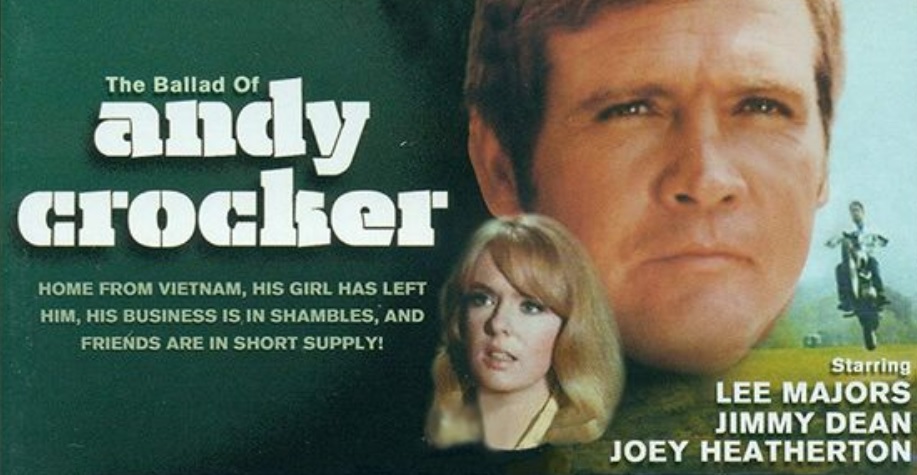
After his 112-episode, 4-year run as Heath Barkley on ABC-TV’s The Big Valley, it was time to see if Lee Majors could carry a feature film. And he did, with this, the screenwriting debut by familiar ’60s and ’70s TV actor Stuart Margolin (we know him best from his support role as Angel Martin, James Garner’s former cell mate, in The Rockford Files). And who’s the director on this? Well, hey, it’s George McCowan — the guy who brought us the nature-run-amuck classic, Frogs and the Canadian Star Wars dropping that is The Shape of Things to Come, as well as a few episodes of the pre-Star Wars venture The Starlost, and too many ’60s and ’70s U.S. TV series to mention.
One of the earliest films — long before the 1979 Oscar Winner, Coming Home — that dealt with the emotional trauma of returning Vietnam veterans, Lee stars as Andy Crocker. He’s a disaffected vet who returns to his Texas hometown to discover his girlfriend was forced into marrying another man, his once successful motorcycle shop is left in ruins, and those he once through were his friends, now turn their backs on him. The campaign against him is led by the town’s queen bee: the mother of his ex-girlfriend.
In addition to this serving as Majors’s film debut, be on the lookout for R&B musician Marvin Gaye (he finished his acting career with Chrome and Hot Leather starring William Smith), country musician and breakfast sausage king Jimmy Dean (who followed up with a role in Diamonds Are Forever), and Righteous Brother Bobby Hatfield, each in their acting debuts. Keen TV eyes and lovers off things character-actor will notice Joe Higgins (from TV’s The Big Valley and The Rifleman, but also Record City and Sixpack Annie!), ’60s six kitten Joey Heatherton (Cry-Baby), longtime Clint Eastwood sidekick and future Commission Gordon Pat Hingle (Rachel, Sweet Rachel), and Agnes Moorehead (TV’s Bewitched, but also of What’s the Matter with Helen? and The Bat!) rounding out the cast.
You can watch The Ballad of Andy Crocker — Stuart Margolin’s screenwriting debut — on You Tube, and watch his latest screenplay, What the Night Can Do, for free on IMDbTV (via your IMDb, Amazon, or Google accounts). We found the original, 1969 trailer to enjoy, as well.
About the Author: You can learn more about the writings of R.D Francis on Facebook.He also writes for B&S About Movies.
EDITOR’S NOTE: We watched this Barry Mahon children’s movie — yes, that is totally a thing with more than one example — on August 9, 2019.
Despite being born in Bakersfield, CA, Barry Mahon volunteered to be in Britain’s Royal Air Force in 1941, achieving a record of five confirmed kills, two probable and three damaged planes, which earned him the British Distinguished Flying Cross in 1985. He was shot down in August of 1942, captured and imprisoned at Stalag Luft III. He managed to escape and was recaptured twice before he was finally liberated by Patton’s 3rd Army in 1945. It’s been claimed that Steve McQueen’s role in The Great Escape is based on Mahon.
Upon returning to America, he became the personal pilot and manager of Errol Flynn. This led to producing films like 1957’s Crossed Swords and 1959’s Cuban Rebel Girls, both of which had Flynn in them. The rest of his films, like Rocket Attack U.S.A., Sex Killer and Fanny Hill Meets Dr. Erotico enter the world of exploitation and sexploitation. Further titles include Bunny Yeager’s Nude Camera, Hollywood Nudes Report, Confessions of a Bad Girl, P. P. S. (Prostitutes’ Protective Society), The Girl With the Magic Box and many, many more. And then there are his children’s films, like Santa’s Christmas Elf Named Calvin, Jack and the Beanstalk and Thumbelina, which is part of one of the oddest movies I’ve ever seen — imagine exactly how much that statement covers — Santa Claus and the Ice Cream Bunny.
An adaption of The Marvelous Land of Oz by L. Frank Baum, Mahon told The New York Times that he had hired Judy Garland to narrate this movie, which is the ultimate in carnie flim flam.
Mahon’s youngest son Channy, or Chandos Castle Mahon, plays our hero Tip. Yes, Dorothy doesn’t show up, but Glinda, the Tin Woodsman and the Scarecrow all do. However, they’re all embroiled in international intrigue and in-fighting between their kingdoms, I mean cardboard sets that wouldn’t be foreign in a late 60’s nudie-cutie.
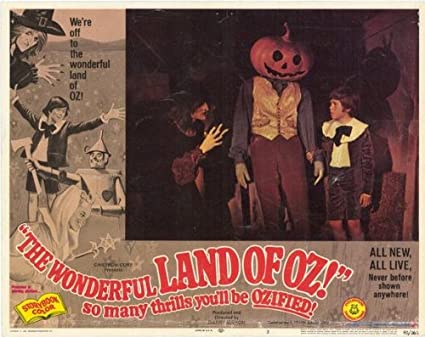
Speaking of softcore, all of Jinjur’s Army of Revolt are played by incredibly attractive young women in band uniforms and knee high boots. “Something for daddy,” as they say. Speaking of fathers, there’s also a man with a giant pumpkin for a head that is brought to life and calls Tip dad.
This movie is completely frightening. There’s a papier-mache purple cow, a bug faced man and a scarecrow that looks more like Imhotep than Ray Bolger. You may never get it out of your brain and for that, I am sorry.
You can watch the Rifftrax version on Amazon Prime.






 B&S About Movies
You must be logged in to post a comment.