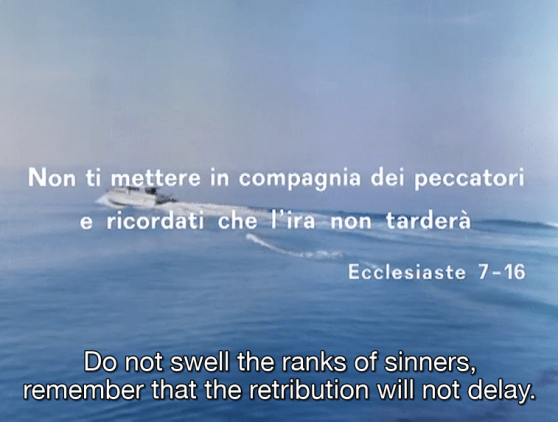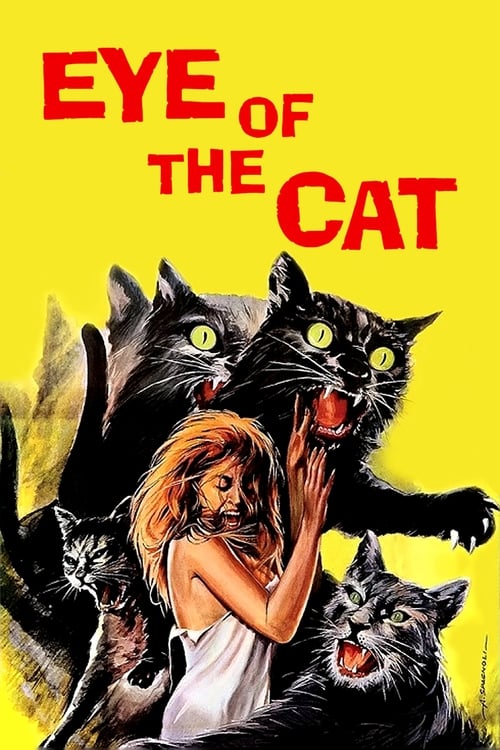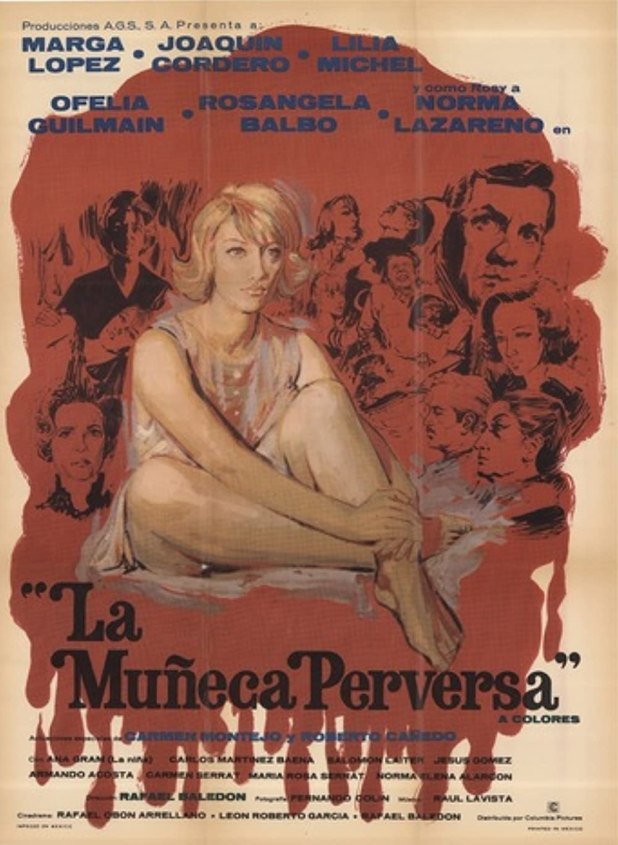
Vivi o preferibilmente morti (1969)

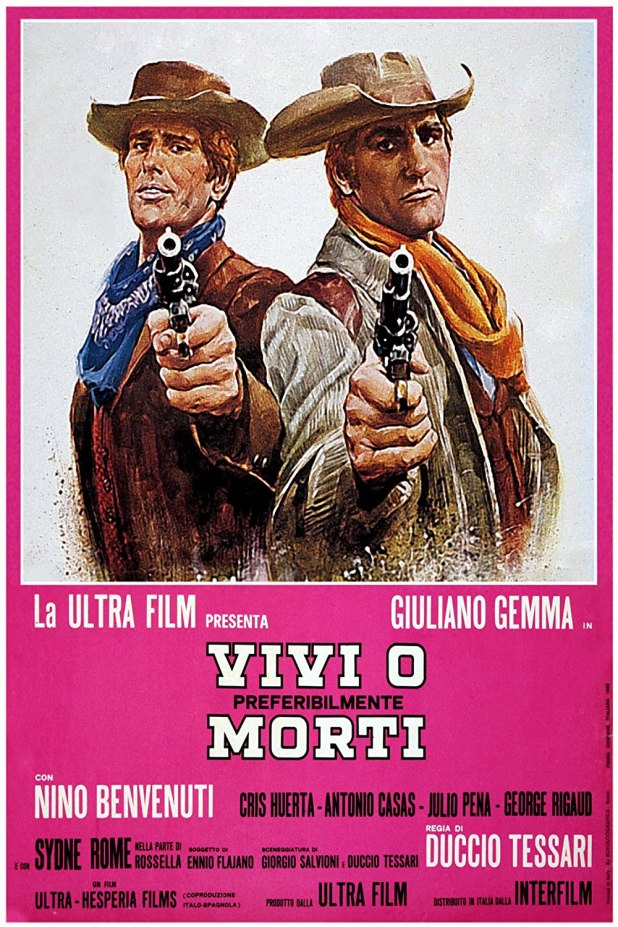
Alive or Preferably Dead is also known as Sundance and the Kid and Sundance Cassidy and Butch the Kid, an attempt to win the audience of Butch Cassidy and the Sundance Kid. It was directed by Duccio Tessari, who wrote A Fistful of Dollars and would go on to direct A Pistol for Ringo. Its story comes from Ennio Flaiano, who wrote ten movies with Fellini, and has a screenplay by Tessari and Giorgio Salvioni (The Tenth Victim).

In the U.S. version, everyone gets an American name: Giuliano Gemma is John Wade; Nino Benvenuti becomes Robert Neuman; Sydne Rome is Karen Blake and director Tessari is called Arthur Pitt.

Country mouse Ted Mulligan (Nino Benvenuti, a former boxer) and city mouse Monty (Giuliano Gemma) inherit $300,000 if they can live together for six months.As soon as Ted arrives, he insults local tough “Bad Jim” Williams (Robert Huerta) who responds by burning down his brother’s house. Soon, the two of them are doing odd jobs, including robbing banks and kidnapping Rossella (Sydne Rome, What?Some Girls Do) who they both fall for.

It’s all rather goofy and really a predecessor of the sillier Italian westerns that were soon to come riding into town.

La collina degli stivali (1969)

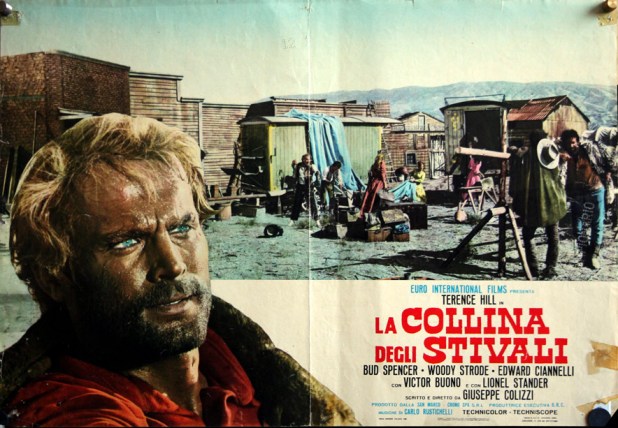
Boot Hill (the Italian title means The Hill Made of Boots) is the last movie in a trilogy that began with God Forgives…I Don’t and was followed by Ace High. Taking advantage of star Terence Hill’s fame, it was re-released as Trinity Rides Again.

It was directed and written by Giuseppe Colizzi, who also made the other films in this trilogy, as well as All the Way Boys with Hill and Bud Spencer; Run, Joe, Run and Switch.

Hill plays Cat Stevens and Spencer is Hutch Bessy, who along with George Eastman as the mute Baby Doll are all somewhat friends and partners by the end. But to get there, Cat is shot and left for dead by a gang and nursed back to health by the circus of Thomas (Woody Strode), which includes can can dancers, dwarves and Mami (Lionel Stander), the dress-wearing manager of all of them, which ain’t easy, because when they met, it was murder.

Beyond the bad guy having the name Honey Fisher, he’s played by Victor Buono, which is quite a treat. There’s a strange dual look to this film, with the circus sections filled with color and near surrealism — they were shot by the movie’s original director Romolo Guerrieri (Johnny YumaThe Sweet Body of Deborah, L’ Ultimo Guerriero) while most of the film’s look is quite dark and moody.

You can watch this on Tubi.

Junesploitation 2022: Il prezzo del potere (1969)

June 2: Junesploitation’s topic of the day — as suggested by F This Movie — is Westerns! We’re excited to tackle a different genre every day, so check back and see what’s next.

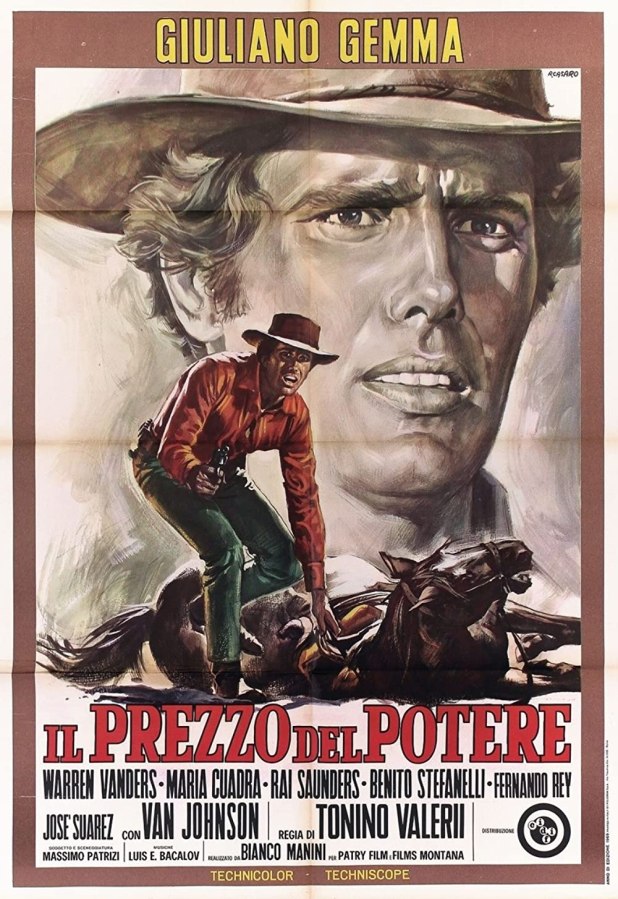
The Price of Power (AKA A Bullet for the President) is an absolutely deranged idea for a movie. It uses the attempted assassination of President James A. Garfield in 1881 to work out the feelings of the death of President John F. Kennedy just six years earlier.

Except that it’s a Western.

Made in Italy.

The idea came from commedia all’italiana director Luigi Comencini’s brother-in-law Massimo Patrizi, who wrote the script with director Tonino Valeri (Day of AngerMy Dear KillerMy Name Is Nobody) and Ernesto Gastaldi, whose writing credits include All the Colors of the DarkTorso and The Suspicious Death of a Minor.

Bill Willer (Giuliano Gemma, a true star of the Italian west thanks to turns as Ringo and Arizona Colt) is trying to get revenge for the death of his father while trying to save the life of Garfield from the Pinkerton agency.

The Pinkertons may be heroes elsewhere, but in Pittsburgh, you can drive past the two adjoining cemeteries of St. Mary’s and Homestead where remains of six of the seven Carnegie Steel Company workers killed are buried, the bloody aftermath of the Battle of Homestead on July 6, 1892, when Henry Frick tried to use the agency to break strikers with violence.

Van Johnson plays the idealistic Garfield, who is coming to Texas to speak to people who have no interest in hearing what he has to say, yet he believes in the goodness in everyone. Of course, he’s killed and the Lee Harvey Oswald figure is Jack Donovan (Ray Saunders), a black man, which adds even more of a connection to the way the world of 1969 was looking, what with Robert Kennedy and Martin Luther King being killed and the start of the Years of Lead in Italy. And I’m not certain that the scars in America’s psyche had yet healed, so I doubt anyone was ready for a movie they surely saw as escapism having María Cuadra play Jackie Kennedy and follow her exact movements in Dallas. She’s even given red roses, just like the President’s widow was.

The joy of the Italian west is in finding movies that explore not only the way that film depicts a time and place we can never go to — indeed, many of the filmmakers had not even been to America — and even find that an alternate version of history can tell us so many things about the world we live in today.

You can watch this on YouTube.

Fangs of the Living Dead (1969)

When this played a triple bill with Curse of the Living Dead (Kill, Baby, Kill!) and Revenge of the Living Dead (The Murder Clinic), anyone upset by these three films was offered free psychiatric care. Amando de Ossorio did more than just create the Blind Dead and direct The Loreley’s Grasp. He cared about your mental health.

Sylvia (Anita Ekberg, perfect) learns that she’s now a countess and has inherited a castle, even if the locals are horrified by the very mention of its name. Yet things get strange when she arrives, as both her uncle Count Walbrooke (Julián Ugarte) and the maid Blinka (Adriana Ambesi) claim to be vampires. There’s also some non-consensual whipping.

The entire family is cursed and Sylvia must remain at the castle — she’s the reincarnation of the witch Malenka — and she must stay unmarried or the curse will get worse. Her fiancee still comes to save her and stabs the count in the heart. If you saw it in Spain, it’s all a hoax but the bad guy dies anyway. In other countries, there’s an ending where he really was a vampire. I can hear Americans saying, “If I’m gonna come see Fangs of the Vampire, there better be vampires. Them Spaniards already fooled me with Frankenstein’s Bloody Terror, a movie that had no Frankensteins in it!”

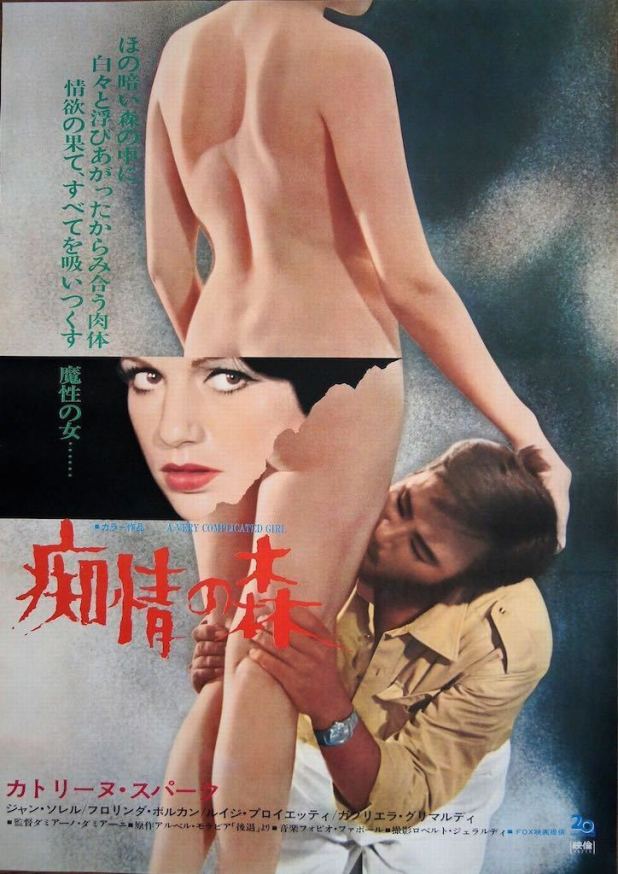
Una ragazza piuttosto complicata (1969)

A Rather Complicated Girl was directed by Damiano Damiani, the director who came to the U.S. to make the most Italian movie — sheer exploitation and a streak of pure meanness — ever made in America, Amityville II: The Possession.

Alberto (Jean Sorel) has heard two sapphic lovers speak on the telephone and his head is filled with fantasies. He decides that he has to meet one of them in person, so he tracks down Claudia (Catherine Spaak, The Cat o’ Nine Tails) and they soon find themselves making love non-stop in between acting as fake talent scouts so they can get involved with the innocent Viola (Gabriella Boccardo, A Quiet Place In the Country) and discussing the strange relationship between Claudia and the woman on the other line, her stepmother Greta (Florinda Bolkan, always the finest actor in any giallo).

I love that this movie tests what a giallo is a year before Argento would send everyone down the animal-named and switchblade holding path. Alberto is a rich man without a care, even making fun of the wife (María Cuadra) of his dying brother, asking her when she’ll find her next lover. As for Claudia, she already has one abusive and possessive boyfriend — Pietro (Gigi Proietti) — and the film goes near hyperbolic in showing she has no morals with an interlude where she tries to seduce a priest.

The two plays games with one another and if you’ve seen enough giallo, you understand that Alberto can’t outthink Claudia or her mental games, especially when she shows him the gun in her purse and wonders if he’d do anything for her. Perhaps they’ve found an equal match in one another, for a time, as the idea that they could make love in a room where someone hung themselves excites them both, as if they are above human concerns.

Interestingly, the interviewing of the young girl and Alberto’s constant questions about Claudia’s life and relationships makes this a proto-Sex, Lies and Videotape, as when he’s not probing mentally, he can’t probe physically. What’s the fun in being a rich and gorgeous playboy if you’re impotent? Maybe he really does need that gun.

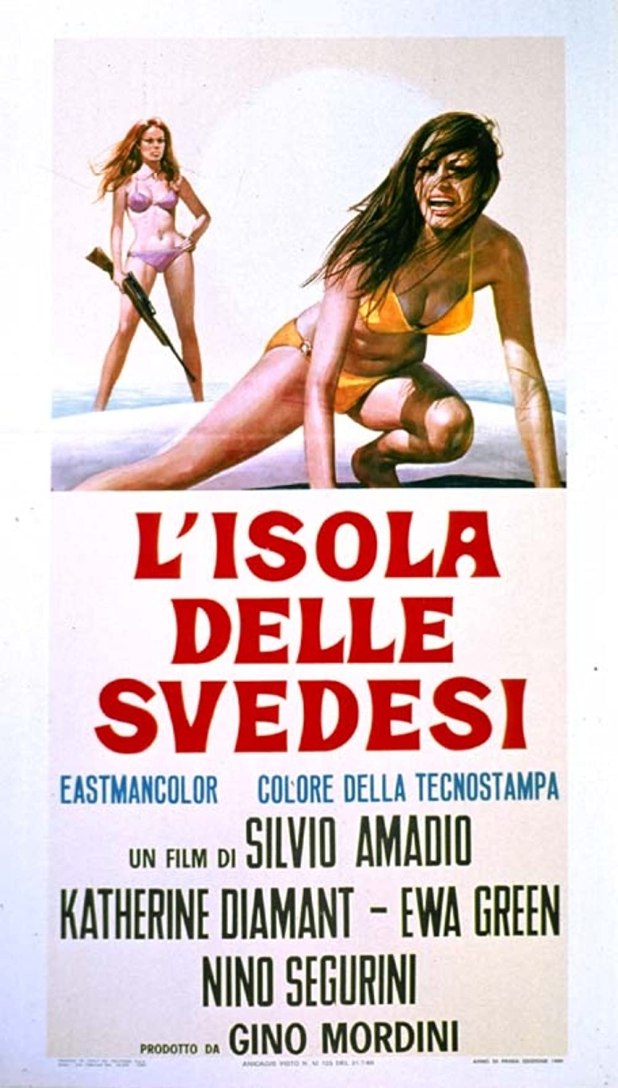
L’isola delle svedesi (1969)

After another in a series of fights with her lover Maurizio (Nino Segurini, Beyond the DoorAmuck), Manuela (Eva Green in her only movie) leaves him for the island where her friend Eleonora (Catherine Diamant, Devil In the Flesh) lives alone. Seeing as how this is a giallo, their friendship soon flowers into a relationship much deeper.

Maurizio follows her with the hope of winning her back. And when she chooses him, things get violent.

Directed by Silvio Amadio (AmuckSmile Before Death), who wrote the script with Gino Mordini (The Sinful Nuns of Saint Valentine) and Roberto Natale (Bloody Pit of Horror), this film makes the most of its location, its small cast and cinematography by Joe D’Amato.

Also known as Island of the SwedesTwisted GirlsNo Man’s Island and Island of the Swedish Girls, it has a great body painting scene and an ending that takes from The Most Dangerous Game just as much as Franco did for Countess Perverse, but it comes as a natural outgrowth over the frustrated passions within the characters.

Very few of Amadio’s films are available in great quality, which is distressing, and I’d love to see a box ray set of this, AmuckSo Young, So Lovely, So Vicious… and Smile Before Death.

APRIL MOVIE THON DAY 28: Death of a Gunfighter (1969)

Death of a Gunfighter was originally directed by Robert Totten, who directed the original The Quick and the Dead, as well as plenty of TV like Gunsmoke and Mystery In Dracula’s Castle. Despite a year of work, he couldn’t get along with star Richard Widmark and lost that battle, getting replaced by Don Siegel (Invasion of the Body SnatchersDirty Harry and John Wayne’s last movie, The Shootist).

Siegel had been the original choice to direct, but was overworked, according to the Chicago Tribune. However, in Siegel’s memoirs, he wrote that Widmark pushed from day one to get Totten kicked off the film and replaced by the unwilling Siegel. Finally, three and a half weeks into making the movie, Widmark got Universal boss Lew Wasserman to personally get involved.

When Siegel looked at Totten’s footage, he thought it was great and even made sure his own footage matched. In fact, he didn’t reshoot a single scene, only finishing off the film’s opening and closing sequences, as well as some pick-up shots. In the end, he didn’t think he had done enough work to take directing credit.

However, Totten wanted nothing to do with the film. Siegel didn’t want his name on the film, which upset Widmark even more. Finally, an agreement was made with the Directors Guild of America for the pseudonym Alan Smithee to be used.

In fact, this was the first Alan Smithee-directed film.

Here’s where it gets weird: critics loved the film and the new director. The New York Times claimed that it had sharp direction and that Smithee “has an adroit facility for scanning faces and extracting sharp background detail.” Roger Ebert said that it was “an extraordinary western by director Allen Smithee, a name I’m not familiar with, allows his story to unfold naturally.” I wonder if Ebert was aware what was going on and was having fun with his review. I’d like to think so.

Based on Death of a Gunfighter by Lewis B. Patten, this movie feels like Hollywood realizing that some of the better Westerns were coming from other countries, mostly Italy, at this point. Marshall Frank Patch (Widmark) is an Old West-style lawman in Cottonwood Springs, Texas, a town determined to be modern and, as such, conveniently forget its numerous sins and just whitewash the past.

“What would happen,” the mayor says, “if an Eastern businessman came to town and saw old Patch there, wearing that shirt he probably hasn’t washed in a week?”

Patch shoots a drunk in self-defense, which the town leaders use as a way to get him out. Knowing that the town is about to murder him with their own gunfighters — he knows too much — the old lawman settles his affairs, including marrying brothel owner Claire Quintana (Lena Horne), an interracial relationship that is a fact of life, something bold for 1969.

This is a film rich with character actors that I love — Carroll O’Connor, Royal Dano, John Saxon — and a town unlike many other Westerns, one made up of all races, a place where a lone car causes worry, where the trains must get ever closer, where the past — and Patch — must die to move progress ever forward, no matter what.

APRIL MOVIE THON DAY 11: Invocation of My Demon Brother (1969)

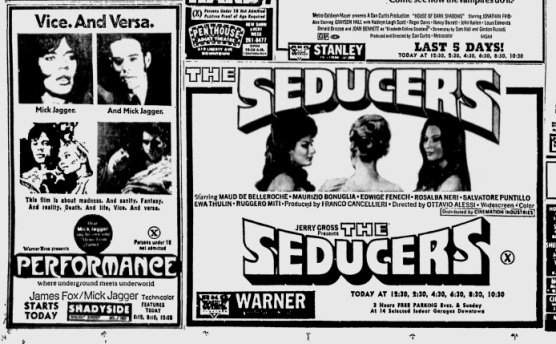
While you can say that this is but an 11-minute movie, this Kenneth Anger directed, edited and photographed work of art — complete with Moog soundtrack by Mick Jagger — is one of the films that started midnight movies.

Assembled from what remains of the first version of Lucifer Rising, this movie strobes your mind with an assemblage of Anton LaVey presiding over a public funeral for a cat, the cast smoking out of a human skull, Anger on stage leading a ritual, nude men, Vietnam footage, the Stones playing their ill-fated Altamount show and is itself a ritual that follows Crowley’s Holy Law of Thelema in that one must master this universe before achieving the mindset needed to become your own god.

You could also say that it’s a lot of noise over a collage of imagery. Or perhaps Anger’s theory of film as magickal weapon is true. If you follow the logic that this isn’t for everyone, then you believe in Crowley’s thought process and how he claimed the esoteric would become “that which is understood by the people I wish to instruct.”

Evolution will only come by shocking our senses and overloading them with tones, with colors, with images.

Obviously, Bobby Beausoleil is Lucifer and the connections between the occult and the loathsome Manson Family will always be cited.

APRIL MOVIE THON DAY 1: The April Fools (1969)

I think my new obsession is watching movies where Jack Lemmon is flummoxed by modern love. Here, he’s Howard Brubaker, a man married to Phyllis (Sally Kellerman), who cares more about money, real estate and status than love. The person he falls for is Catherine (Catherine Deneuve) whose uncaring and philandering mate is Howard’s boss, Ted Gunther (Peter Lawford). When they meet Grace and Andre Greenlaw (Myrna Loy and Charles Boyer), they start to believe that maybe they could be happily married, just like the Greenlaws, if they can only run away and start again.

Deneuve’s part was originally intended for Shirley MacLaine, which would have reunited the stars of The Apartment. Knowing that makes me realize that that casting would have truly improved this, as with as stunning as Deneuve is, it makes it seem as if the affair is simply over attraction and not the idea that the two could be life partners, not just attracted to each other — no insult to MacLaine, who is also quite fetching. I hope you understand my point.

Maybe after The Apartment I just see Lemmon and MacLaine as the perfect couple.

Director Stuart Rosenberg also made Cool Hand Luke and The Amityville Horror, while writer Hal Dresener wrote SssssssThe Eiger Sanction and Zorro: The Gay Blade. Dionne Warwick sang the title song, while one of her biggest hits, “I Say a Little Prayer,” is sung at a party in the film by Susan Barrett. The b-side of that single? “Theme from Valley of the Dolls.”

JESS FRANCO MONTH: Succubus (1969)

The German title for this movie, Necronomicon – Geträumte Sünden (Necronomicon – Dreamt Sins) is metal as fuck and when you get right down to it, isn’t Jess Franco the same way? I feel like him like I do about Venom. Most Venom songs sound the same, but man, they all sound pretty good and while they aren’t the best musicians, they lucked on to some really great riffs and really, isn’t that what we’re looking for?

Franco’s first movie outside of Spain, this was his hope that he’d escape all the rules and censorship by working in Germany. The script was three pages long, which feels like two and a half pages too long for a Jess Franco movie, and the funding didn’t come through, but producer Pier A. Caminnecci paid for the rest and had an affair with lead actress Janine Reynaud despite her husband Michel Lemoine being in the cast. And that’s how a Jess Franco movie gets made.

American-International Pictures released this movie in the United States under the title Succubus and when Roger Ebert reviewed it, he called it “a flat-out bomb. It left you stunned and reeling. There was literally nothing of worth in it. Even the girl was ugly.”

Reynaud, who was also in Franco’s Kiss Me Monster and The Case of the Scorpion’s Tail, plays Lorna Green works in an S&M club where members watch fake deaths from the whip, the cross and yes, sex. And as Lorna continues to dance, she takes on the role of the femme fatale not just on stage, but in reality. But what is reality, after all, in a Jess Franco movie, particularly in 1969 when he had something of a budget, was shooting on film and some youth?

That said, if he had one of his muses in this, like Soledad Miranda or Lina Romay, I fear it would have been even wilder.

At once a mannequin movie and a film about a woman that may have killed someone and can’t remember and it’s driving her insane — oh man, two of my favorite themes — and it gets wild, like you’re drunk at a party and end up at another party and talking in the kitchen to someone and then someone hands you some pills and you wind up standing in the cold in the middle of a major city and the snow and rain and wind are in your face and you close your eyes and open them to heat and the most gorgeous and demonic creature you’ve ever seen is dancing mere feet away from you and you’re just a mere mortal and you want to touch their garment and jazz is blaring and you’re sure you’re in your bed but you’re so fucking far from home.

All hail Jess Franco.