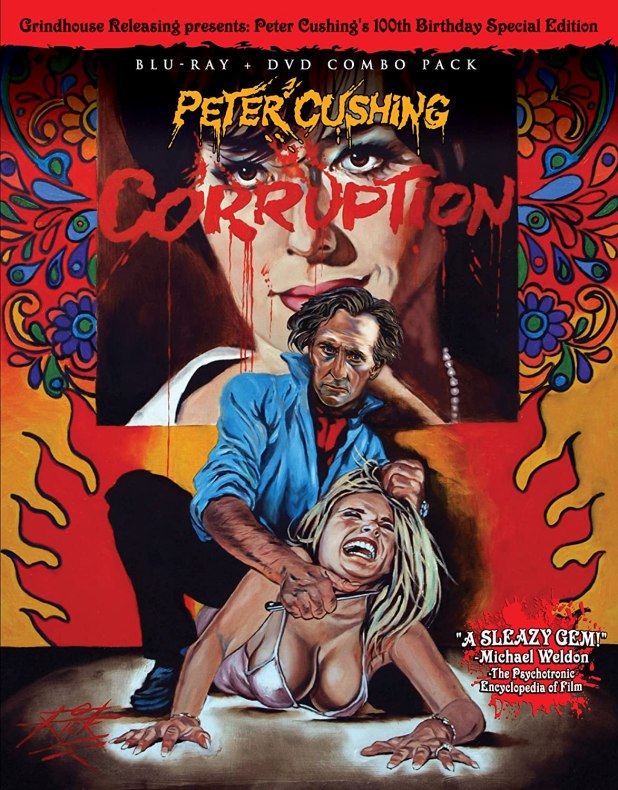
As the trailer will tell you, Corruption is not a women’s picture.
That’s debatable.
What is not is that Corruption is a ripoff of Eyes without a Face.
But hey — some of my favorite movies are total ripoffs.
Renowned plastic surgeon Sir John Rowan (Peter Cushing) starts the movie at a swinging 60s party with his beautiful fiancée Lynn (Sue Lloyd, Hysteria). Sir John isn’t dealing well with all this counterculture excess, so when a pervy photographer makes a pass at his girl, he attacks the man, sending a hot light into Lynn’s face. This party may seem like a parody when seen today, but this is a serious scene, with Cushing facing the Summer of Love and not dealing so well with all of it.
Rowan pledges to flix Lynn’s scarred face through a combination of laser technology and a pituitary gland transplant. Sound good? Well, it’s fueled by murder, giving the fluids of young women to his wife, to keep her face from scarring and it needs to be repeated again and again to stop the scars from coming back. Everything goes well — as well as repeatedly killing people and basically feeding their skin to your wife can go –until Sir John and Lynn try to seduce a new victim who ends up being part of a gang of robbers.
Those criminals break into the home of Sir John and they soon learn his secret. However, no one profits from this knowledge, as everyone end up getting killed by a surgical laser. And then, get this — it’s all a dream!
Cushing would say, “It was gratuitously violent, fearfully sick. But it was a good script, which just goes to show how important the presentation is.” You have to love a movie where Van Helsing flips out at a party that Austin Powers would say is way too mod. And wow, it’s pretty gory for a late sixties British movie!
Director Robert Hartford-Davis would also make Incense for the Damned, Gonks Go Beat and The Fiend.
Also, just to remind you one more time, Corruption is not a women’s picture.
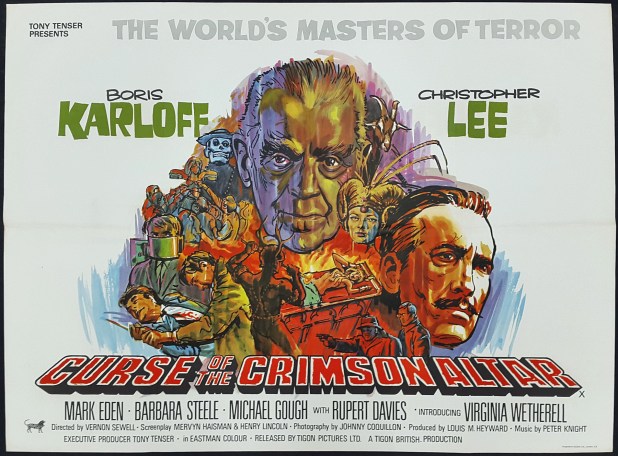
I’ll be perfectly honest. This could have been the worst movie ever made and you put Barbara Steele in green body paint and I’ll watch it anyway. Luckily, it’s a pretty great movie.
Director by Vernon Sewell (The Blood Beast Terror) and written by Mervyn Haisman (Dr. Who, Jane and the Lost City) and Henry Lincoln (who wrote The Holy Blood and the Holy Grail, which Dan Brown completely ripped off to make The DaVinci Code, as well as one of the main researchers into Rennes-le-Château and an honorary Militi Templi Scotia knight in recognition of his work in the fields of sacred geometry and Templar history), this movie piles on the occult and I couldn’t love it anymore for that fact. Or that it was based on “The Dreams in the Witch House” by H. P. Lovecraft.
Antiques dealer Robert Manning is looking for his brother, who has gone missing after visiting their family’s ancestral home in Graymarsh. He arrives in the middle of a party — people are painted like they are on Laugh-In and there’s a catfight tournament seemingly being held — and by the first evening’s rest, his dreams are filled with images of ritual sacrifice. That’s when he joins up with occult expert Professor Marsh (Boris Karloff!) to battle the forces of Satan himself.
Making this all the better, Morley, the owner of the Craxted Lodge*, is played by Christopher Lee.
Also — Michael Gough appears as a sinister butler!
When this was released by American-International Pictures in the U.S., all of the nudity in the virgin sacrifice scenes were, well, sacrificed.
Honestly, no one is going to blame you if you just watch the scenes with Steele leading wild orgies of death and psychedelic mayhem. They even distort her voice and toss all kinds of different colors all over these scenes, which make them more than worthy of the time it takes to watch this movie.
*It’s actually Grim’s Dyke, an allegedly haunted house that also was the setting for Zeta One, several episodes of the Avengers and Cry of the Banshee. It was also the home of W.S. Gilbert of Gilbert and Sullivan.
The feature debut of Norman J. Warren, Her Private Hell came about producer Bachoo Sen approached Richard Schulman, owner of London’s Paris Pullman Cinema, with the idea to make their own films. This is how the production company Piccadilly Pictures started.
Schuman was the owner of London’s Paris Pullman Cinema and was showing Warren’s short film Fragment, so they made an offer for him to film two movies for them. The director would later tell Rock Shock Pop!, “I had no idea what the film would be, but to be honest, I would have said yes to anything. I was 25 and desperate to direct a feature film.
The story was written y Glynn Christian, a New Zealand immigrant who based his screenplay on his own experiences as a foreigner living in the swinging London of the 60s.
Marisa (Lucia Modugno, LSD Flesh of the Devil, Danger: Diabolik) has come to London to be a model and the first magazine she works for decides to keep her in a fancy high rise apartment along with their top photographer, Bernie (Terry Skelton). They explain its for her protection and not to be the sole owner of her image, which she soon realizes as the magazine begins to control her every move.
While Marisa sleeps with Bernie, she also falls for Matt (Daniel Ollier, who beat Udo Keir for the role), a young photographer whose avant-garde nudes end up in Margaret — one of the magazine’s owners — possession and get sold to a foreign magazine. The film then becomes all about who Marisa will leave with — Bernie, Matt or alone. And perhaps Margaret and Bernie aren’t strangers to one another, as it turns out.
At once a naive girl done wrong film mixed with a movie about the literal swinging 60s morals, Her Private Hell isn’t the Norman J. Warren you may know and love. This is closer to French New Wave than anything else he’d make.
At one point, this Norman J. Warren’s was rated X. Today, it plays uncut on YouTube. Such is the changing of the tides.
Just listen to that song that opens this up! You know instantly it’s the end of the 60s and you’re about to watch something romantic. Or dirty. Probably both.
This is the story of Steve (Simon Brent, Love Is a Many Splendored Illusion) who can’t decide between all of the women who want to sleep with him or his wife Suzanne (Georgina Ward, The Man Who Finally Died), who now has a new lover in her life.
Of course, when all of the women are as attractive as the French model who is new in town (played by Françoise Pascal, who was also in There’s a Girl In My Soup and Incense for theDamned), that’s not going to be so simple.
Warren would move on to make Her Private Hell before discovering the horrors that he’d make his name on, stuff like Satan’s Slave, Prey and Terror — all great movies you should totally check out. For someone who started life stricken by polio and grew to adulthood with only one functioning arm, Warren ended up having one of the strongest careers a horror director can dream of.
This would be the last secular movie that Ron Ormond would ever make and what a movie to end that era of his career on. He also plays the mob boss Nemo, the man who rules the strip clubs of New Orleans — this movie is also known as The Monster and the Stripper — and decides to book a creature three men found in the marshes known only as Swamp Thing to be menacing next to his array of beehived go-go girls who are absolutely astounding in their inventiveness, twirling flaring tassels off their pasties.
The movie plays like a sketch comedy show, except that the Swamp Thing — played by Ormond’s next-door neighbor, a hulking rockabilly singer with the marvelous name of Sleepy LaBeef — is absolutely horrific, biting the necks off chickens to drink their blood and bearing men to death with their own arms. He’s like a Herschell Gordon Lewis movie character inserted into this wanna-be Russ Meyer film made by a Southern family who would soon almost die ina plane crash — and then Roger would have to nearly die again — and then find God and make movies with none of this sin.
This movie has something for everyone. You want a creature feature? It has that. How about some mob drama? Yes. And how about something for daddy? This movie is filled with dancing of the most prurient kind. The Swamp Thing falls for the new girl who is too shy to strip nude — someone needs to make a Letterboxd list of strippers in movies who never get unclothed — and when she’s attacked by the queen of the club, well, you’ve seen every monster movie ever made. Human beings are gonna pay.
This is the kind of movie that describes Bourbon Street as “sleepy by day, psychedelic by night,” which is pretty much the best thing ever written in a film. The world needs more movies that have 60s exotic dancing mixed with surprising torrents of gore.
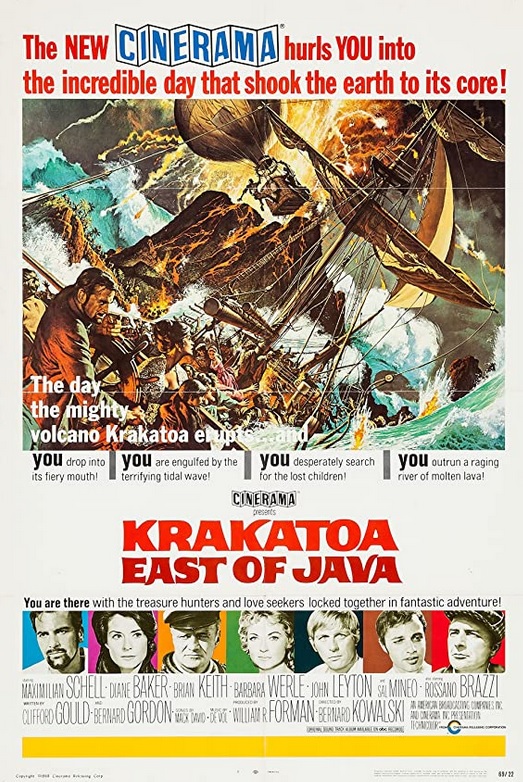
Editor’s Note: We hope you’re enjoying our tribute to the films of director Bernard L. Kowalski. Today, we’re reviewing his first major studio feature film. And in a twist that only a B&S About Movies reader can appreciate: the leads of Maximilian Schell and Brian Keith would later star in their own, respective Star Wars-boondoggles that were The Black Hole and Meteor. Now, if that doesn’t make you want to watch this proto-disaster drama, then we don’t know what will.
Lost somewhere between Arthur Hailey and Irwin Allen igniting the ’70s disaster genre with their respective Airport franchise and the one-two-punch that is The Poseidon Adventure and The Towering Inferno (and not forgetting Mark Robson’s Earthquake for Universal), there was ’50s blacklisted and ex-Poverty Row Monogram Pictures and King Brothers low-budget drive-in scribe Philip Yordan’s return to the Hollywood majors with his proposal of making a film about the 1883 eruption of the island of Krakatoa. Yordan’s “blacklisting” was actually a blackballing, due a script mix up that brought forth a contractual dispute between 20th Century Fox and Warner Bros. Unable to work in Hollywood, Yordan ended up in Spain working for Samuel Bronston, where Yordan incorporated Security Pictures. However, when it comes to “blacklisting”: he did, before his own ouster, front for ’50s blacklisted writers.
Now, back in 1965: Yordan began his “come back” with the man-screws-up-the-Earth disaster epic, Crack in the World. (Yeah, it was made on the cheap in Spain for Yordan’s Security Pictures, but Paramount gave it a U.S. release.) However, for the B&S crowd, Yordan pumps our VHS-lovin’ hearts with his final films, ones that we go on and on about: Cataclysm (1980), The Nightmare Never Ends (1980), Savage Journey (1983), Night Train to Terror (1985), Cry Wilderness (1987), Bloody Wednesday (1987; which we need to review), and the The Unholy (1988). Oh, and how can we forget Marilyn Alive and Behind Bars (1992), aka Scream Your Head Off (sometime in the ’80s).
I know . . . let’s move on from my Yordan geek-dom. Back to the mountains of Krakatoa, we shall go!
So, for dramatic effect — as if people running for their lives from an erupting volcano wasn’t enough drama — ‘ol Phil concocted a subplot about a band of unsavory characters aboard the decrepit steamer Batavia Queen attempting to salvage a sunken cargo of pearls deep in the island’s watery outskirts, with the bragging rights of a $3 million production budget. Initially, the film started out at Columbia Pictures with Rock Hudson (who eventually ended up in a disaster flick of his own with 1978’s Avalanche) as Captain Chris Hanson, the commander of the Batavia Queen. As with most “big” movie plans, the project fell into “development hell,” and came out on the other side under the Cinerama Releasing Corporation shingle, a studio-distributor that did pretty with the John Boorman-directed (Zardoz, The Exorcist II: The Heretic) World War II drama Hell in the Pacific (1968) starring Lee Marvin.
Then, the real disaster erupted.
The then in-camera effects and process shots required to make the volcanic disaster appear convincing on film proved to be difficult; Philip Yordan gave up on his dream project; a new producer, Clifford Newton Gould, commissioned a new script; the film’s runtime ballooned to 130 minutes (two hours and ten minutes); once conceived as a family-friendly adventure, it now had racier, adult-dramatic elements added; the weather, the seas, and animals on the location weren’t cooperating within the budget.
At the time, Bernard L. Kowalski was a young TV director who cut his teeth with Roger Corman on Hot Car Girl, Night of the Blood Beast, and Attack of the Giant Leeches, but he more than proved himself in the more commercial realms of network television directing episodes of westerns (Rawhide, The Wild Wild West, The Virginian, Gunsmoke) and law procedurals (Perry Mason, The Untouchables, Mission: Impossible). There’s no doubt Kowalski was more-than-ready for a major studio, million dollar-plus project. But the “what ifs” abound: If only Columbia had backed the project (with more money). And, no disrespect to our leads of Maximilian Schell and Brian Keith, both are fine actors — if only Rock Hudson had carried the picture. And you didn’t have bickering I-know-better-than-you-do producers revamping a locked script and adding superfluous, saucy adult drama that left us with a confusing plot rife with a constantly changing adventure-to drama-to romance-to-adventure tone augmented with beyond-the-budget, haphazard special effects.
And, of course . . . there’s that pesky Cinerama Releasing Corporation boondoggle with the title: not only did the producers misspell (insist) the island, known as Krakatau; the island is — while technical part of the Indonesian “Far East” — is actually west of the isle and sea of Java. But how many of us dumb ticket buyers back in 1968 knew that fact? Well, the film critics made sure we knew in their reviews. And besides, “East” is sexier, you know, with Japan and all. In the end, the cataclysmic event that killed 36,000 people referenced in the film isn’t a docudrama: it is merely a (wildly, historically in accurate) backdrop for its family adventure-cum-adult dramatic relationships storyline.
So . . . do we need to tell you the movie was a critical and box office bomb? Not every movie with an overture and intermission (as did Fiddler on the Roof and 2001: A Space Odyssey) can be a success. The 130-minute print that ran in theaters in 1969 was later edited-for-television — with scenes shorted or wholly deleted — into a 106-minute print. Vying for the epic sweep of David Lean’s Lawrence of Arabia (1962), which ran near four hours long and cleared $70 million against its $15 million budget to sweep The Golden Globes and Oscars, Philip Yordan’s dream project turned into a box office bomb.
Sadly, as with most directors-for-hire who have no control over the script they’re hired to shoot, nor a voice against those I-know-better-than-you-do producers, Bernard L. Kowalski shouldered the blame. After making two more major studio films for AVCO Embassy Pictures, Stiletto(1969), based on a Harold Robbins paperback best seller (starring Alex Cord and Britt Ekland), and the Civil War western Macho Callahan (1970; stars Gene Shane of The Velvet Vampire and Werewolves on Wheels alongside David Janssen), neither which set the box office on fire, Kowalski made his TV movie debut — and forged a successful TV movie career — with the airline disaster flick, Terror in the Sky(1971).
While Tubi carries the 106-minute TV print, we found the 130-minute theatrical cut on You Tube to enjoy. Moi? Even with its flaws, I stick to the epic — in more ways than one — theatrical print. You can enjoy the trailer on You Tube.
About the Author: You can learn more about the writings of R.D Francis on Facebook.He also writes for B&S About Movies.
Two films nullified the ’50s productions values of sci-fi films: 20th Century Fox’s Planet of the Apes and MGM’s 2001: A Space Odyssey, both released in April 1968, respectively. To a lesser extent: there was the Robert Altman-directed Warner Bros. production of Countdown, released a month later, in May. And to an even lesser extent: there was Hammer Films — in conjunction with Warners — with their failed “space western” Moon Zero Two, which made it to screens in October 1969. Then, in November 1969, Columbia threw their hat into the space race ring with Marooned, directed by — of all people — John Sturges of The Magnificent Seven (1960) and The Great Escape (1963) fame. (If you haven’t seen them: Countdown and Marooned, while accurate, realistic space race dramas, are bone-dry; Moon Zero Two is best described as a goofy, swingin’-mod version of 2001.)
An ’80s VHS reissue.
But no one told television director Nicholas Webster that the sci-fi times had changed (and a couple other directors, as you’ll soon see). Then there’s Webster’s less-prestigious pedigree: his first forays into theatrical features was with the crazed Christmastime movie (and his third film) Santa Claus Conquers the Martians (we love this 1964 movie so much, we’ve reviewed it, not once, but twice).
Also released the same year in the U.S. was Italian pirate and western purveyor Primo Zeglio’s woefully already-behind-the-times sci-fi’er Mission Stardust — a film that is closer-in-style to Antonio Margheriti’s early ’60s “mods in space” romps Assignment: Outer Space and Battle of the Worlds, along with Margheriti’s four mid-’60s “Italian Space Movies” produced for direct syndication on American UHF television stations: Known as the Gamma One series, the films included Wild, Wild Planet, War of the Planets, War Between the Planets, and Snow Devils in America (each carry alternate titles). A fifth film in the Gamma series — backed by MGM (!?) with Margheriti co-directing with revered Japanese director Kinji Fukasaku (Tora! Tora! Tora!) — was another woefully out-of-date space flick in 1968: The Green Slime. Each of these films are pure fantasy and lack in any realism triggered by 2001 and the Apes. Can we mention the weirder-to-worse, celluloid cousin to Mission Stardust, 2+5 Mission Hydra, which bounced around the world marketplace from 1966 to 1968? Sure, why not.
If you are familiar with 2+5 Mission Hydra, wrap your head around this for a moment: While Stanley Kubrick was in production on 2001, Pietro Francisci was making his space epic — which itself had Planet of the Apes-inspired apes — in production at the same time. Crazy, right?
However, despite 2001’s ability to transcend its spiritual-and-psychological-confusing themes about a man’s journey through his “inner space” and find box-office success, the major studios held steadfast to their belief: science fiction was a low-budget genre lacking an analogues audience appeal to the westerns and war movies churned out by the majors (which is why Countdown and Marooned are bogged down with more “western” style drama-bickering instead of amazing sci-fi imagery). And it’s true: There was the more inept Missile to the Moon (1958) and Mission Mars (1968) flicks produced than there were Forbidden Planet (1956) and It! The Terror from Beyond Space (1958) styled flicks on the big screen in the ’50s and ’60s. Then there were the Earth-bound ones, such as Beginning of the End(1957) — starring a giant, back-projected grasshopper invasion over photographs of Chicago. So goes sci-fi in the ’50s and ’60s.
The plot-similar Countdown (both with Cold War-era space race, fretting wives, bickering military and astronaut drama), which was adapted from Hank Searls’s best-selling 1964 novel The Pilgrim Project, benefited from Searls’s reputation as a respected military and aviation-themed novelist and screenwriter, as well as realism afforded by NASA renting out their facilities in Cocoa Beach, Florida. And from having a score composed by Leonard Rosenman (the Apes and Star Trek film franchises).
Meanwhile: Mission Mars had a Decca Records-tie in with a theme song (that had nothing to do with the film) “No More Tears” by the Queens, New York, garage-psych group, The Forum Quroum (Discogs / Rockasteria). It is truly the ultimate of end credit theme songs (well, at least until Star Crystal was released). Just why? Well, there’s a subplot about the astronaut’s wives having foreshadowing-nightmares about their hubbies not coming back, so there’s the “tears,” we guess, to warrant the songs. And you may get “tears” from the “futuristic” ’60s-style jazzy electric keyboard noodling heard throughout the film: I’m picking up “bad vibrations, indeed.
Webster’s film was produced by Sagittarius Productions as the first film produced at Studio City, a scrappy facility cobbled together in Miami, in a failed, hodgepodge effort by Florida to become the “Hollywood of the South.” (One of Trump’s failed pre-President ’90s deals was to build a film studio in Homestead, Florida, back before the state rescinded its film production tax incentives program later in the decade.) And instead of being based on a best-selling novel, like its three celluloid brethren, Mission Mars was co-penned by Micheal St. Clair and Aubrey Wisberg, who collectively gave us The Body Stealers (1969) and The Man from Planet X (1951) — two films so obscure, the B&S team never encountered either film on UHF-TV, VHS home video, or a Mill Creek box set. (The second and final film produced at Studio City in Miami was William Grefe’s The Wild Rebels. Gus Pardalis from The Forum Quorum also composed the soundtrack — the band also provided songs from their lone album to the film — on Sagittarius’ third feature, 1969’s The Candy Man.)
Do you see where this is going?
Mattel’s Major Matt Mason ’60s toy set courtesy of SyFy Wire. Robert Zemeckis and Tom Hanks have been trying for years to get a feature film madebased on the toys.
While the films Nicolas Webster (who returned to television, never to make another feature film — and, in addition, stayed away from science fiction) was attempting to copy benefited from location shoots, along with sets and costumes made from scratch — Webster heavily relied on clumsy NASA stock footage. And Webster”reversed” his space footage — two effects for the price of one effects shot — for the Mars launching/landings. And he built his first “Mars” outside: then a tornado ripped through the Liberty City neighborhood and destroyed it. Then shooting was delayed when a dump trunk delivering sand to recreate the Martian set indoors, fell through the sound stage floor. The crew’s spacesuits were a hodgepodge of motorcycle helmets and white-rubber scuba suits. (It seems Sagittarius was unable to rent out authentic Air Force pressure suits and helmets, unlike its more inept cheapie-brethren, 1960’s 12 to the Moon.) Their blue, red-and-white shoulder-striped astronaut mission tee-shirts were actually popular off-the-rack ’60s wares that lasted into the ’70s (Bobby Brady even wore one!) — only with name tags and American flags sewn on the chest and sleeves. (There’s a great, 2011 anecdote from Lance Webster, the director’s son, then 24 and just out of college, threaded on the IMDb regarding the production.)
Do you see where this is going: Mission Mars is more Primo Zeglio and Antonio Margheriti — who coped Roger Vadim’s “mods in space” romp Barbarella — than Arthur P. Jacobs and Stanley Kurbrick. And with a lesser budget.
As with The Green Smile: of course we get goofy aliens. But in Webster’s verse: they’re spindly, one-red-eyed Martians (that look like — and are — dolls shot in close up and inspired by the far superior War of the Worlds aliens) firing up their red eye to either brainwash or fry the Earthlings to a cinder. And there’s the big, rocky-silver orb that splits open to suck in the astronauts. But there are a few nice touches: Mission Commander Darren McGavin (Yep, Kolchak, The Night Stalkler and Old Man Parker from A Christmas Story) and soon-to-die third wheel George De Vries (Deathdream) drop yellow pills and a shot of water into metal steamers to make eggs. And their elevator-platformed capsule is pretty convincing. And the frozen cosmonaut they find — and defrost — is a decent enough effect. The launching of “marker” balloons to find their way back to the ship, is smart. And the alien orb, while a clumsy, in-camera effect, brings a nice what-the-hell-is-that alien mystery to the proceedings that reminds of director Sidney W. Pink and writer Ib Melchoir’s (superior) Journey to the Seventh Planet (1962), with its mystero aliens illusion-duping the stupid Earthmen with fake women and lush landscapes on Uranus.
While watching Mission Mars all these years later, it certainly stirs the ol’ UHF ventricles and VHS cockles, but there’s no denying the cheesiness and low-tech tomfoolery of it of it all, with its same old space ship interiors of Bulova clocks and reel-to-reel tape players on the walls. Yes, this is a film of Motorcycle helmets and wet suits as astronauts strap in to massage tables instead of Lap-Z-Boy recliners like other films of its low-budgeted, ’50s ilk. In fact, if Mission Mars was shot in black and white, instead of color, you’d have a ’50s-era film that ranks right up there with Project Moonbase (1953), King Dinosaur (1955), Destination Space (1959) and Space Probe Taurus (1965). And, if there was a woman on the ship, we could have had another well-intention but Bechdel test failure like The Angry Red Planet (1959) (a personal favorite, courtesy of Ib Melchoir), but me thinks that film’s funky red-filtering and film tinting photo-trickery was beyond Mission Mars’ budget — more so after having to build Mars, twice, and crane a dump truck out of a hole in a sound stage floor.
Okay, well, maybe Mission Mars isn’t as bad as King Dinosaur (at least they didn’t nuke Mars). However, while the always likable McGavin keeps us watching (he returned to Mars twelve years later in NBC-TV’s The Martian Chronicles), it’s easy to see why Nick Adams (in his last-released film before his death) was never able to consolidate his “Best Supporting Actor” Oscar nod for Twilight of Honor (1963) to reach the career hires of his old roommate, James Dean, and close friend, Elvis Presley, only to ended up doing low-rent sci-fi for Toho Studios (Frankenstein Conquers the World, Monster Zero) to pay off his divorce and child custody bills. (It’s said that Presley’s manager, Col. Tom Parker, concerned of Nick’s friendship with Elvis, was behind the undermining/bad mouthing of Nick’s career as a troubled “bad boy” and homosexual.)
You can watch Mission Mars — unripped by MST3K — with a very clean DVD rip on You Tube. If you’re a kid of the ’80s and remember your Saturday afternoons with Commander USA’s Groovy Movies, that version — complete with commercial and Commander vignettes, is also on You Tube. Of course, if you just want the “sci-fi Mars” parts, then you can burn through the movie in eleven-minutes, with the highlights reel, embedded above. Oh, and here’s “No More Tears” as a standalone track on You Tube.
About the Author: You can learn more about the writings of R.D Francis on Facebook. He also writes for B&S About Movies.
EDITOR’S NOTE: There really needs to be an Arrow box set of these movies, which are all wonderful. The best of them all is this one, which I encourage everyone to watch. This originally was on our site on January 5, 2021.
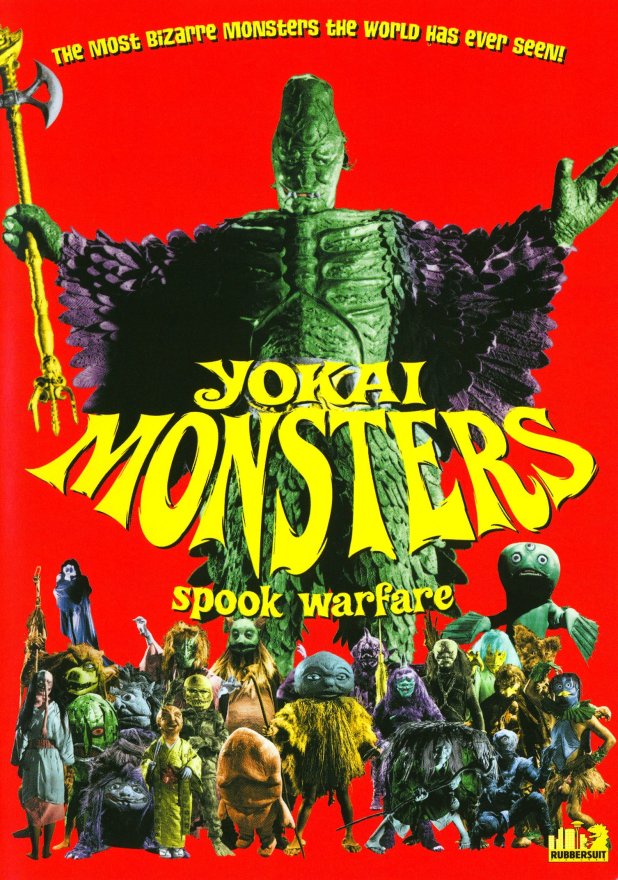
1968 saw the release of Yokai Monsters: 100 Monsters, but just seven months later, director Kuroda Yoshiyuki (Daimajin, several Zatoichi films) made this sequel, which takes the main ideas of presenting Japan’s native monsters, perhaps finds some inspiration from the manga GeGeGe no Kitaro and the story of Momotaro, take a strong shot of national Japanese pride and remembers that no one cares about the humans in the story. We’re here to see monsters. And oh man, are we gonna get them!
In the Babylonian city of Ur, the body of the great monster Daimon lies amongst the ruins. That is, until some treasure hunters rouse him from his dark sleep, which leads to him flying to Japan, vampirically taking over the body of samurai Lord Hyogo Isobe.
As Isobe, Daimon goes wild, burning all the religious altars, killing the family dog and even rousing a kappa — a “river child” turtle creature who loves to wrestle — from his slumber in the river. Hurt in combat with the much stronger Daimon, the kappa begins his quest to unite the yokai and stop the foul beast.
Soon, the kappa meets Kasa-obake (a one-legged umbrella with eyes), Futakuchi-onna (a two-mouthed cursed woman), Rokurokubi (a long-necked woman who often appears in the more adult kaiden stories), Nuppeppo (a clay creature who resembles a blob of meat) and Abura-sumashi (a wise ghost of a human who once stole oil). They tell him that according to coloring books and field guides, no such yokai exists.
Meanwhile, Daimon has stopped his attempted exorcism and responded by killing the parents of several children. As his men hunt for the surviving kids, they hide in the yokai shrine. Soon, the monsters realize the kappa was telling the truth and join him in battle, which ends up involving nearly every single monster from across Japan.
Takashi Miike remade this movie in 2005 as The Great Yokai War, which also features Kitaro creator Mizuki in a cameo.
Seriously, this movie took a bad day and made anything seem possible. This is pure joy on film.
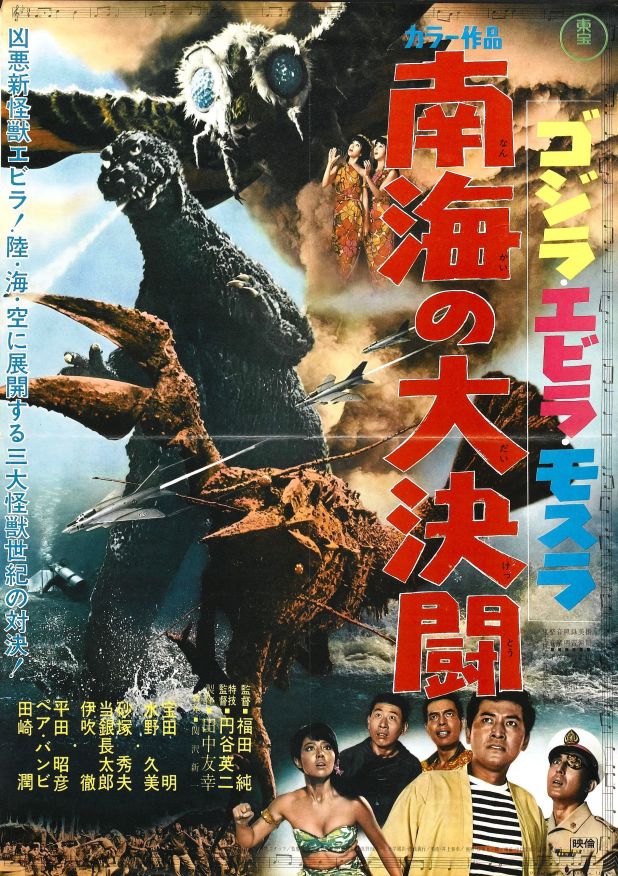
This movie started as a vehicle for the Japanese version of King Kong, with the title Operation Robinson Crusoe: King Kong vs. Ebirah. It was rejected by Rankin/Bass Productions, the folks who created all your favorite holiday specials and who had the rights to Kong, producing a licensed TV show — The King Kong Show — which was amongst the first original cartoons to be produced in Japan for Americans.
King Kong’s role was replaced with Godzilla under the title Ebirah, Horror of the Deep*. It’s the first of two Godzilla films — Son of Godzilla is the other — set on a South Pacific island instead of Japan.
What most filmmakers have never realized is that no one cares at all about the humans in these stories. As a child and an adult, I do not care if people find their brothers that have been lost or if the Red Bamboo terrorist group sells heavy water weapons. I only care to see the monster crab named Ebirah and our friend Godzilla fight.
Yet as an old man, I also feel for Godzilla, who just wants to hide in a cave and sleep after defeating the menace of Ghidorah. Instead, these kids make a lightning rod** and zap him to awareness before he has to kill a giant condo (which is totally a Rodan costume), knock down some jets and then set that big crustacean*** straight by ripping his claws off.
Bonus points to Godzilla to remembering that just because Mothra**** is the friend of humanity, she and he are not on speaking terms. The movie ends with another big battle, an island getting blown up real good and Godzilla going back into the murky depths. Soon, he would meet his son, but that’s a story for another day.
This one has a really lower budget and reused the Daisenso-Goji suit. At some point during filming, the head of this suit was combined with the Mosu-Goji suit for episode ten of Ultraman to create the monster Jirass. That head was replaced with a different head that shows up after Godzilla fights the Red Bamboo and is noticeable for the bug eyes and raised eyebrows.
A lizard with eyebrows. This is why I love Godzilla.
*It’s known by so many names around the world, but my favorites are Germany’s Frankenstein and the Monster from the Ocean, Poland’s Ebirah: The Monster of Magic and Holland’s Mothra the Flying Dracula Monster.
**Godzilla being powered by electricity is totally because the script was written for the Japanese King Kong, who is powered that way. It’s also why he’s so protective of Dayo, as falling for human females is a Kong characteristic.
***Ebirah’s name comes from the Japanese word ebi. That means shrimp, so he’s really one of those and not a crab, but he has crab claws, so…
****This is the last Showa-era Godzilla film where Mothra’s twin helpers the Shobijin, appear. They’re played by the same actress, Pair Bambi, instead of The Peanuts (Emi and Yumi Itô).
EDITOR’S NOTE: This article originally ran in the original first articles on this site on May 7, 2018. Today for our 24-hour celebration of Godzilla vs. Kong, we’ve gone back to retell the story of one of Sam’s favorite movies of all time.
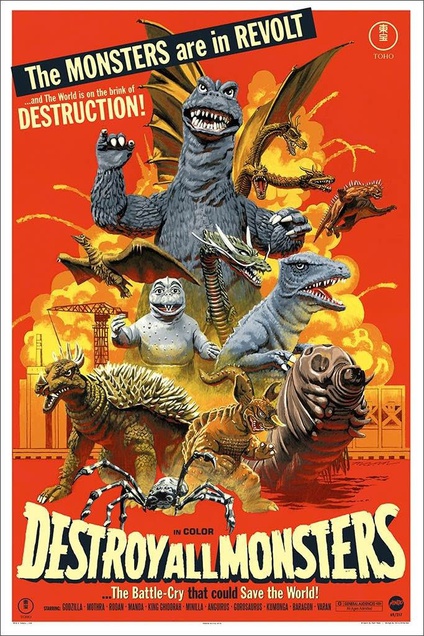
Has there ever been a better movie than Destroy All Monsters? It is everything that is magical about film: giant monsters smashing cities and fighting one another while people run and scream in terror. It is cinematic junk food, a treat for the mind that returns me to watching Action Movie on Youngstown’s WKBN 27 as a little kid, jumping around the room in pure glee.
Every giant monster on Earth has been captured and sent to Monster Island, where they are kept secure and studied — until all communication is mysteriously cut off.
Turns out that the scientists on the island are being mind-controlled by the Kilaaks, who demand the human race surrender or face total destruction. They control the monsters to attack famous cities all over the world: Godzilla decimates New York City, Rodan smashes Moscow, Mothra takes out Beijing, Gorosaurus crushes Paris and Manda, a giant Japanese dragon, goes shithouse on London. All of these attacks are to keep the UNSC forces from finding out that Tokyo is the real target.
Luckily, the humans are able to take out the control signals and the good guy monsters take on King Ghidorah, who is overcome and killed (Minilla, Varan, Anguirus and Kumonga show up, too). The Kilaaks also have a Fire Dragon, a monster that starts setting cities on fire. Godzilla takes out their base and the forces of good triumph.
This was meant to be the final Godzilla film, as the popularity of the series was waning. However, the success of Destroy All Monsters led to even more Godzilla films.
When I was a kid, I was impatient for the human scenes to end and for the monsters to show up. I’ve never changed. All I want to do is watch giant monsters destroy cities and fight one another. This movie delivers all of that and more. It’s not high art, but does it have to be?




 B&S About Movies
You must be logged in to post a comment.