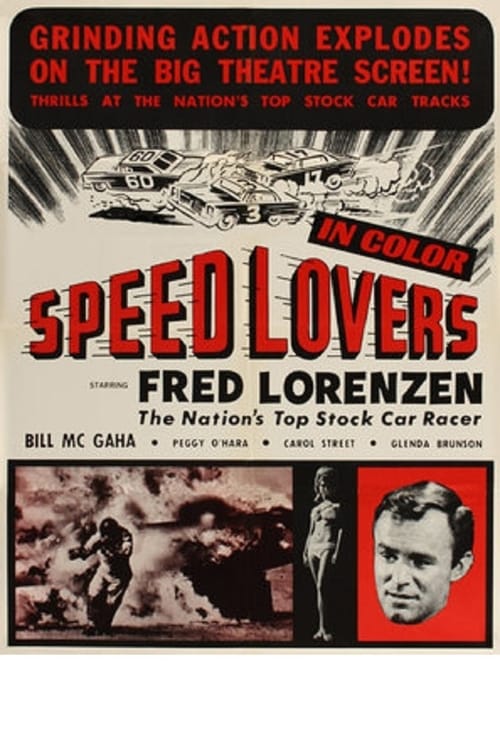
APRIL MOVIE THON 2: The Speed Lovers (1968)

April 18: Vroom — A movie mostly about cars.

William F. McGaha, co-wrote, directed,  produced, and stars in this as Scott, a young car racer who will remind you that he deserves to be on the track to the point that you will absolutely hate him. So yeah, he can do anything except make you love him in this movie.

What this movie does have is a great theme song, “Speed Lovers” by Billy Lee Riley, and also an appearance by the band Randy Little and the Holidays, who rock out two numbers, “You Love Everybody” and “A Living Doll.”

Scott Clayton, the character that McGaha plays, is the son of a famous mechanic and being asked to fix a big race by Atlanta organized crime figure Pinkerton Bentley (David Marcus), who plies him with sodas and go go dancers.

Fred Lorenzen — The Golden Boy, Fast Freddie, The Elmhurst Express and Fearless Freddy — plays himself and at the time, he was a majorstar in NASCAR, winning the following races from 1962 to 1967: the Atlanta 500, the World 600; the Volunteer 500, the Western North Carolina 500; the Mountaineer 300 and the Old Dominion 500 in 1963; the Southeastern 500 at Bristol; the Atlanta 500; the Gwyn Staley 400 at North Wilkesboro; the Virginia 500 at Martinsville; the Rebel 300 at Darlington; the Volunteer 500; the Old Dominion 500 and the Charlotte Motor Speedway National 400 in 1964; the Daytona 500; the Virginia 500; the World 600 and the National 400 in 1965; and the Old Dominion 500 and the American 500 in 1966 and Daytona 500 Qualifier in 1967. In 1963 alone, he made $122,000 in winner’s prizes, a figure which would be $1.2 million dollars in 2023 money. That’s kind of like having Michael Jordan show up in your regional Florida movie.

McGaha would go on to make Bad Girls for the BoysThe Shrink and one of the oddest biker movies ever, J.C., which yes, is about a motorcycle riding Jesus. He wrote this with Fred Tuch, who went on to be an art director for the shows Manimal and Galactica 80 as well as the art director for Pennies from Heaven, the storyboard artist for Mannequin and an illustrator on Blue Thunder.
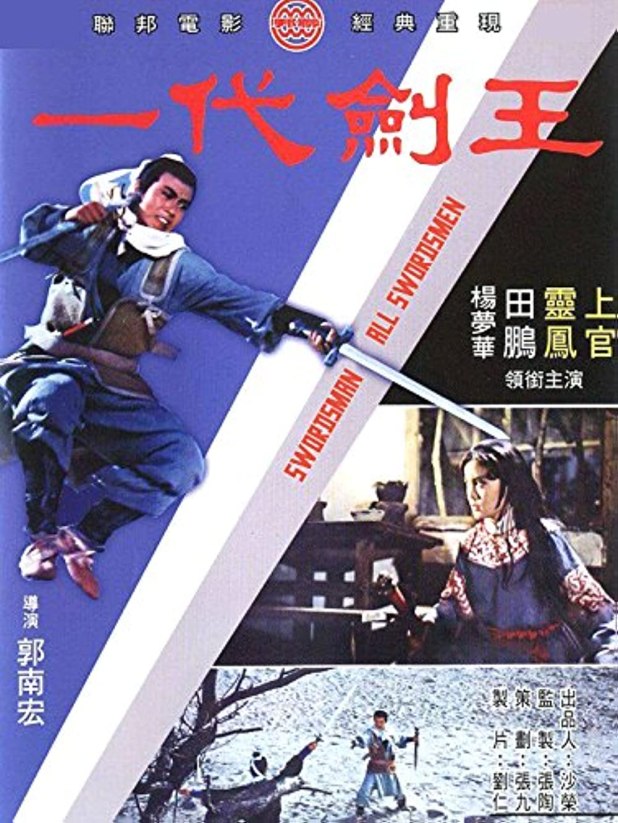
10TH OLD SCHOOL KUNG FU FEST: The Swordsman Of All Swordsmen (1968)

Directed by Joseph Kuo, who wrote it with Shui-Han Chiang and Tien-Yung Hsu, Yi dai jian wang tells the tale of Tsai Lai-Chieh (Peng Tien, Return of the 18 Bronzemen), who as a child had his entire family — nearly sixty members in all, killed by five martial arts masters. He has trained his entire life to destroy them, which is a plot that could be any other martial arts or wuxia movie, but this transcends the form with the last target of his vengeance — symbolized by the wooden names he keeps on his belt and breaks with each step toward killing them all — being a blind and broken old man that realizes that he deserves death.

La-Chieh is joined by two equally incredible fighters, Flying Swallow (Polly Kuan, Shi er sheng xiao) and Black Dragon (Chiang Nan, The Magic Blade), a swordsman dedicated to being the best of the best, even if that means that he must wait and help Lai-Chieh pay his blood debt to his family before they inevitably fight to the death. I loved how La-Chieh is willing to admit that Black Dragon is a better fighter than him, but his tenuous friend can only know through a duel which will destroy one of them. They save him for an attack with arrows and poison darts, giving him time to heal and get back on the bloody road of retribution.

This movie gets a lot of jaw-dropping scenery, bloody swordplay and even laughs in the midst of all the pathos and blood being spilled, adding up to a movie that inspires one to seek out more from everyone involved in its creation.

Want to see it for yourself?

You can watch The Swordsman of All Swordsmen next Saturday, April 22 at 3:30 PM in Theater 2 and Sunday, April 23 at 1 PM in Theater 2  at Metrograph and Subway Cinema in New York City. It’s part of the 10th Old School Kung Fu Fest: Sword Fighting Heroes Edition from April 21-30, 2023!

Tickets are on sale right here!

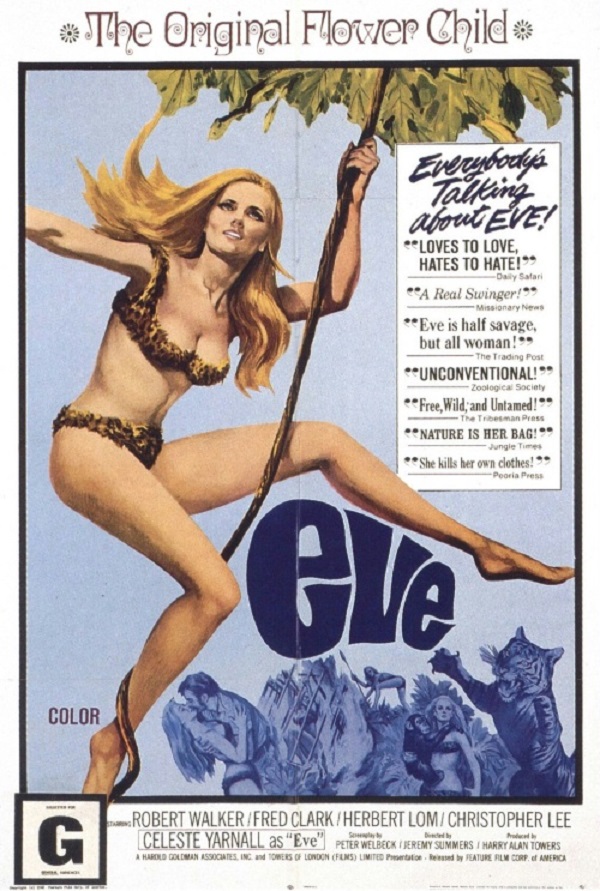
JESS FRANCO MONTH: Eve (1968)

This is not the 1968 film Eva, la Venere selvaggia, also known as Kong Island, which was directed by Roberto Mauri. This is either Eve, Eva en la Selva, The Face of Eve, Eve in the Jungle or Diana, Daughter of the Wilderness. It was first directed by Jeremy Summers, who did plenty of work for British TV and written by Peter Welbeck, which explains how Jess Franco — along with Robert Lynn (the assistant director of Revenge of Frankenstein and Dracula A.D. 1972) — came to finish directing this, as Peter Welbeck is really Harry Alan Towers.

Celeste Yarnall, who plays Eve, was discovered by Ozzie and Ricky Nelson before being discovered by Towers at the Cannes Film Festival. She was also in Beast of Blood and “The Apple” episode of the original Star Trek but is best known as The Velvet Vampire.

Eve’s grandfather Colonel Stewart (Christopher Lee) has been looking for her and his business partner Diego (Herbert Lom) is working with a girl named Conchita (Rosenda Monteros, The Magnificent Seven) in a scam where she pretends to be Eve. There’s also a plane crash and a heroic pilot named Mike Yates (Robert Walker Jr., who is also famous for a Star Trek role, playing Charlie X in, well, the episode “Charlie X”) is coming in for the rescue.

There are cannibals, there is a jungle, there is an Incan treasure, there is a cabaret scene where Maria Rohm keeps on singing even though there’s a gigantic fight. It’s not great but you know, Celeste Yarnall in a bikini with a parrot and monkey as her pals. I can watch that.

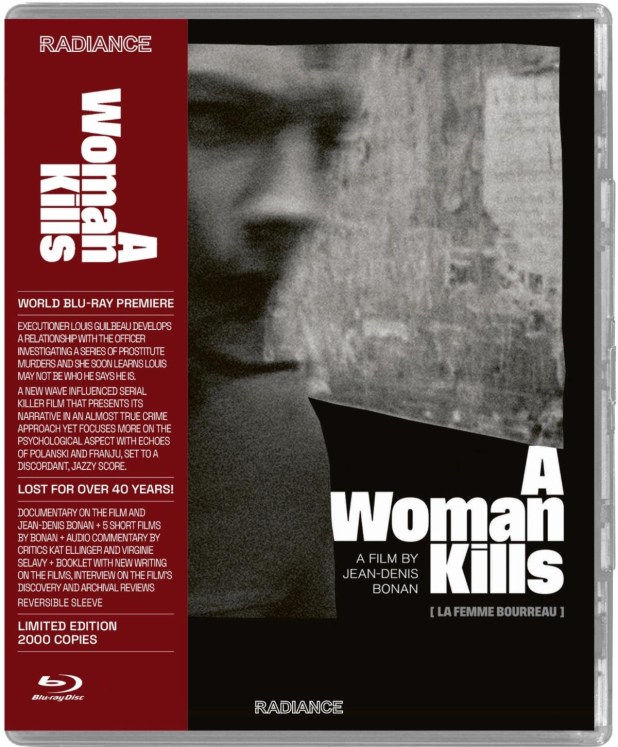
RADIANCE FILMS BLU RAY RELEASE: A Woman Kills (1968)

Several sex workers have been killed and the populace is in a panic as a serial killer is on the loose. Then, a woman named Hélène Picard is executed for the crimes, yet within a few weeks, they start all over again as a mysterious woman is seen with the victims moments before they are killed. Meanwhile, the man who executed Hélène, Louis Guilbeau (Claude Merlin) begins a relationship with the woman who arrested her, Solange (Solange Pradel), yet he may not be who he claims to be.

A Woman Kills was directed by Jean-Denis Bonan, who was dealing with censors being enraged by his first short film, A Season for Mankind, which meant that producer Anatole Dauman was unable to find distribution for the film for 45 years until Luna Park Films brought it back to life in a new restoration.


What emerges is a film at the center of arthouse and grindhouse, yet leaning to the former. It has the POV shots of a slasher, yet the look and feel of the French New Wave mixed with German expressionism all with a short running time and a soundtrack that makes the whole thing feel ill at ease. In short, I loved it, a film that presents how the thriller or krimi may have become a genre of its own — in an alternate timeline — in France instead of Italy.

Look for a Jean Rollin in a small role!

The Radiance Films blu ray release of A Woman Kills — the worldwide blu ray debut that features a 2K restoration of the film from the original 16mm elements — comes with a number of exclusive newly-commissioned and archival bonus features such as audio commentary by critics Kat Ellinger and Virginie Sélavy; an introduction by Virginie Sélavy; On the Margin: The Cursed Films of Jean-Denis Bonan, a newly updated documentary program featuring director Jean-Denis Bonan, cinematographer Gérard de Battista, editor Mireille Abramovici, musician Daniel Lalou and actress Jackie Rynal; several films by Jean-Denis Bonan: La vie brève de Monsieur Meucieu, Un crime d’amour, the incomplete Tristesses des anthropophages, Mathieu-fou and Une saison chez les hommes; the trailer; a reversible sleeve featuring original and newly commissioned artwork by maarko phntm and a limited edition booklet featuring new writing on the film by author and scholar Catherine Wheatley, writer and broadcaster Richard Thomas on the short films, writing on gender identity tropes in A Woman Kills and the horror film, an interview with Francis Lecomte, the French distributor who rescued the film, newly translated archival reviews and film credits. You can get it from MVD.

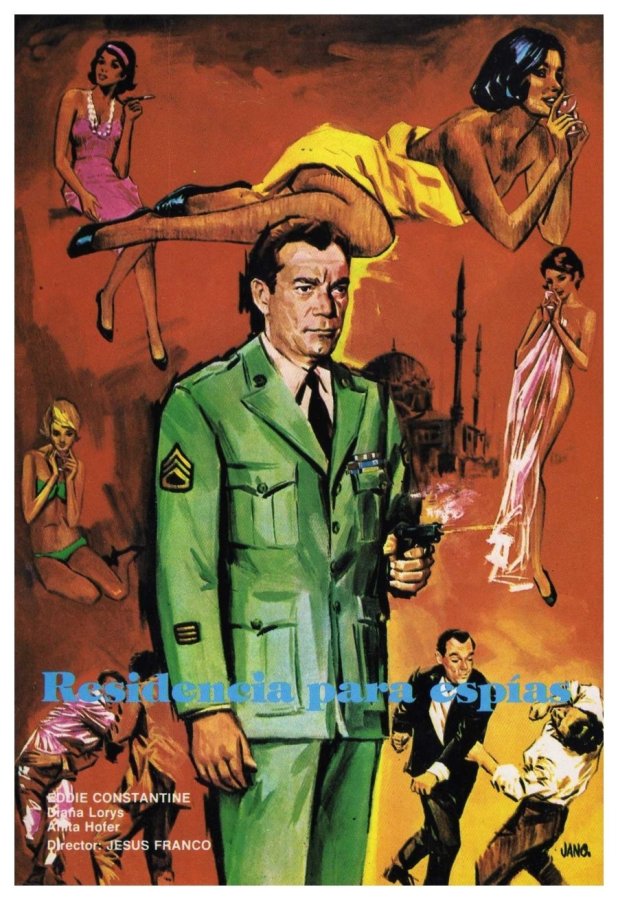
JESS FRANCO MONTH: Residencia para espías (1968)

Based on the Michael Loggan novel Leyton et les Chatelaines, Jess Franco directed and wrote this movie about American secret agent Dan Leyton (Eddie Constantine) being sent to Istanbul to investigate a spy ring operating out of a boardinghouse for women. His girlfriend Marion (Anita Hoffer) is also there working undercover, which complicates things when Janet Spokane (Diana Lorys), the wife of the man in charge of all of this evil spy planning, tries to seduce him.

It fits squarely into the Eurospy world but at least has some of Franco’s love of jazz in there, even if none of the astoundingly strange things he would soon bring to cinema. That said, Lorys is, as always, gorgeous. She’d also appear in Franco’s The Bloody Judge as well as the oddball Westerns Get Mean and Blindman, as well as Blue Eyes of the Broken Doll.

I love looking at reviews of this: Eurospy fans say its boring and Franco fans are excited by how good of a setting Turkey could be for the film.

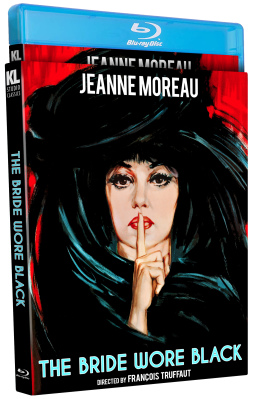
KINO LORBER BLU RAY RELEASE: The Bride Wore Black (1968)

Cornell Woodrich wrote a ton of stories that got turned into movies, like Black Alibi, which was made as The Leopard ManThe Mark of the WhistlerNight has a Thousand Eyes; The Death Stone, which was made as The Earring by Leon Klimovsky; Rear Window; Rendezvous in Black, which was made as Seven Bloodstained Orchids; The Boy Who Cried Murder, which was made as Cloak and Dagger and I’m Dangerous Tonight.

The fact that he made one of Alfred Hitchcock’s best-known movies is no accident, as director and co-writer — with Jean-Louis Richard — François Truffaut was trying to combine Hollywood with the French New Wave. He wasn’t happy with how it came out, as critics savaged it. In truth, he had daily arguments with cinematographer Raoul Coutard over how the movie would be filmed. They fought so much that many scenes ended up being directed by the star of this film, Jeanne Moreau. At the premiere, Truffaut was said to be “tormented by the contrast between the emotional notes he had intended to give the actors and the finished film.” He never called out or named Coutard as the reason why.

Julie Kohler (Moreau) tries to jump out of a window before her mother stops her. She instead goes on a long trip, but in truth, she boards a train and steps right off. She has stripped herself of her funeral black and is clad in all white when she appears again, arousing the ardor of soon-to-be married Bliss (Claude Rich) at a party on the evening before his wedding. He maneuvers her onto the balcony. She maneuvers her way into shoving him off the building.

She follows that by poisoning a lonely bachelor named Coral (Michel Bouquet) and as he dies, she reveals her identity, explaining how the love of her life was shot on the steps of the church on their wedding day. Then, she becomes a teacher, sending away the wife of the politician Morane (Michel Lonsdale), putting his son to bed and locking the man inside a hidden closet. She seals the door and he runs out of oxygen.

All of these men were members of a hunting party drunkenly playing with a rifle in a hotel room when Fergus (Charles Denner) fires it, killing her husband, an event we learn of in flashback. After posing as an artist’s model, she allows him to paint her before killing him. The last of the party is arrested and out of her reach, so she allows herself to be jailed for her crimes, only to use her wiles to find her way into his side of the prison and, yes, getting her revenge.

How Hitchcock is this? Well, in addition to the Woolrich novel, Truffaut had recently finished Hitchcock/Truffaut,  a book of interviews with the master of thrillers and even used Bernard Herrmann to write the score.

The French New Wave argued that American film lovers missed the real heroes of cinema. For example, Truffaut dedicated his first film, Breathless, not to anyone famous or well-considered. He named Monogram Pictures, the b-movie studio.

Therefore, what emerges may not be art, but it is gorgeous and it is suspenseful. And to me, it’s a successful movie.

A lot of people remark how much Kill Bill is like this, as a bride has a list that she crosses off one by one as she hunts those who killed her husband on her wedding day. Tarantino claims he never saw it before he made his movie, which could be hyperbole, but he definitely saw She Killed In Ecstasy, the Jess Franco movie that takes a lot from this.

The Bride Wore Black has been released on blu ray by Kino Lorber. It has commentary by film historians Julie Kirgo, Steven C. Smith and Nick Redman and a trailer. You can buy it from Kino Lorber.

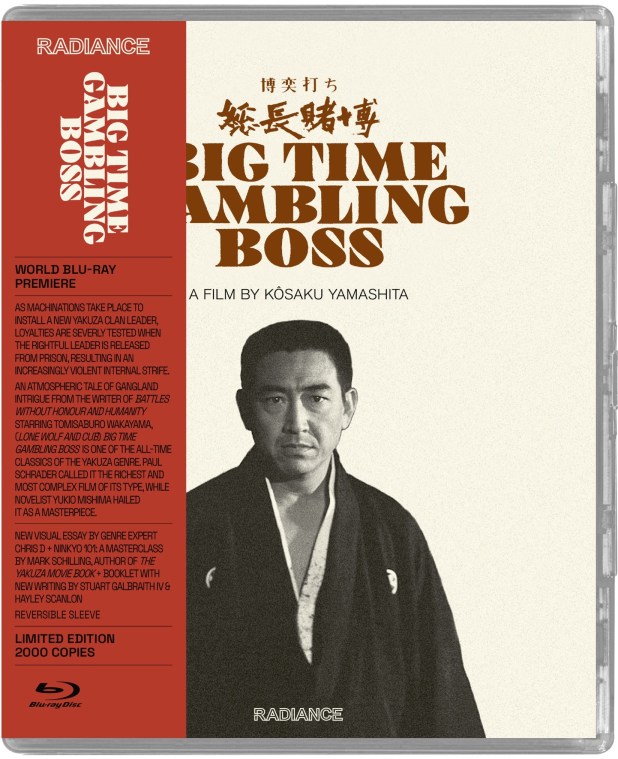
RADIANCE FILMS BLU RAY RELEASE: Big Time Gambling Boss (1968)

This is the first film I’ve got from Radiance Films. The packaging is amazing and it’s so cool to have that movie be one that has never been released on blu ray before.

Gang boss Arakawa has fallen ill and the new leader must be named. Nakai is an outsider, Matsuda is in jail and only Ishido is suitable. Yet when Matsuda is released from prison, you can only imagine that the internal conflicts will soon grow out of control.

Directed by Kôsaku Yamashita and written by Kazuo Kasahara (Battles Without Honor and Humanity), this is a film about the loyalties and codes of the Yakuza and how when those are tested, friendships are thrown away and bloody vengeance can be the only answer. By the end, Nakai can only say, “Loyalty? To hell with it, I’m just a mean murderer. Nothing more.”

This is actually the fourth film in Toei’s Bakuchi uchi (Gambling Den) series of Yakuza films. You don’t need to see the others to watch this. Yamashita has a resume filled with more violent crime dramas that I can’t wait to dig into after this. And if Matsuda looks familiar, that’s because Tomisaburo Wakayama also played Ogami Ittō in the six Lone Wolf and Cub films and their American remix, Shogun Assassin.

The limited edition Radiance Films release of Big Time Gambling Boss has a high definition digital transfer of the film Serial Gambling, a video essay by Chris D., author of Gun and Sword: An Encyclopedia of Japanese Gangster Films 1955-1980 on Big Time Gambling Boss‘s origins in the Toei studio’s serialized yakuza movie production and what sets the film apart; Ninkyo 101, a video essay that has Mark Schilling, author of The Yakuza Movie Book, talking about the history and impact of the classical style of yakuza film, the ninkyo eiga or “chivalry films;” a stills gallery, a trailer, a reversible sleeve featuring original and newly commissioned artwork by maarko phntm and a limited edition booklet featuring new writing on the film by author Stuart Galbraith IV and critic Hayley Scanlon. This limited edition of 2,000 copies has full-height Scanavo packaging with a removable OBI strip leaving the packaging free of certificates and markings. You can get it from MVD.

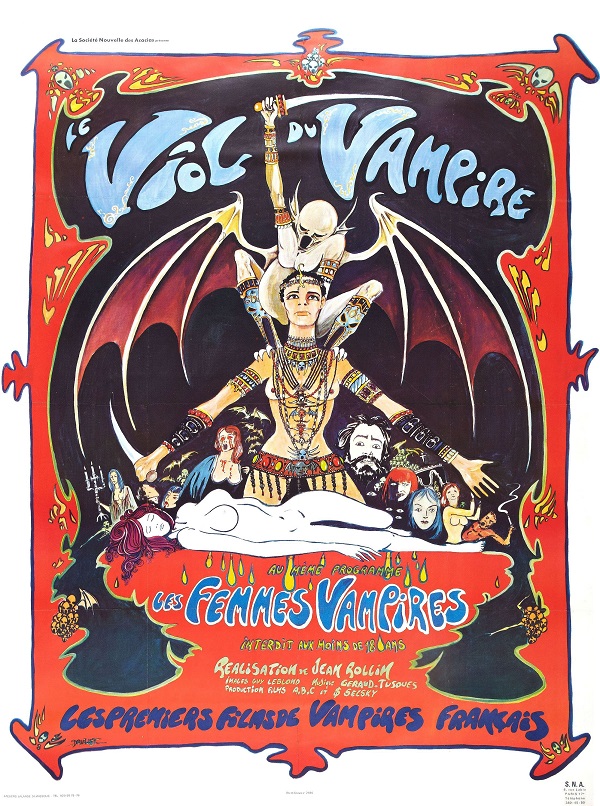
JEAN ROLLIN-UARY: Le Viol du Vampire (1968)

Le Viol du Vampire was the first film directed by Jean Rollin and is a short film with added footage to make it a complete feature. It’s two parts are The Rape of the Vampire and The Queen of the Vampires.  It was commissioned by French retailer Jean Lavie, owner of a network of small theatres who needed a short vampire film to play before the 1940 American film Dead Men Walk, which he had bought the rights to and was planning to rebroadcast.

Rollin had only worked on short films and documentaries, but he was excited to work on this film/. With a budget of 200,000 francs, he started making his fantasy film which would be influenced by American adventure serials. The filming, other than the beach scene, was all at an abandoned Paris house called Château de Gressy.

Debuting on May 27, 1968, the film was lucky — maybe — to play to big audiences who were in the midst of strikes and riots and needed entertainment. Lavie’s theaters had it and as they sat through his dream-like film, they weren’t happy.

Rollin told KinoEye, “Le Viol was a terrible scandal here in Paris. People were really mad when they saw it. In Pigalle, they threw things at the screen. The principal reason was that nobody could understand the story.” It would go unreleased on video until 2000.

Four sisters — including model Ursule Pauly and exotic dancer Nicole Romain — believe that they are vampires, making them all fear the daylight and the crucifix, as well as be very suggestable to the old man who orders them to kill and also likes to casually grope them and also be slaves to the idol in the forest who speaks directly to them.

Three people from the big city — Thomas, Brigitte and Marc — have come to cure them of this insanity, believing the villagers have driven them mad. The old man, sure that he will lose his power over them, orders them to kill the outsiders and then unleashes the village on everyone. Thomas begs one of the sisters to prove that she is a vampire and is stunned to learn that she really is, just in time for Marc to kill everyone as he has been driven mad by the death of Brigitte.

The second part of the story involves the queen of th vampires as she attempts to escape her curse and Thomas and Brigitte coming back to life after drinking the blood of the old man. Of course, this being a Rollin movie, a woman is whipped on the beach and everyone ends up dying rather than giving in to their thirst for blood.

Rollin improvised most of the story because he lost the script on the third day of production. Just imagine how wild this man gets when he has no plan if his planned films seem so odd. He’d continue his obsession with vampires, lesbians, old cemeteries and eroticism. This is the DNA that runs through so many of his films with several moments recaptured and reshot later.

Cinematic Void January Giallo 2023: Death Laid an Egg (1968)

EDITOR’S NOTE: Cinematic Void will be playing this film on Monday, Jan. 23 at 7:00 PM PT at the Los Feliz 3 in Los Angeles (tickets here). For more information, visit Cinematic Void.

Let me put it out there right now: This movie is completely insane.

Let me see if I can summarize it.

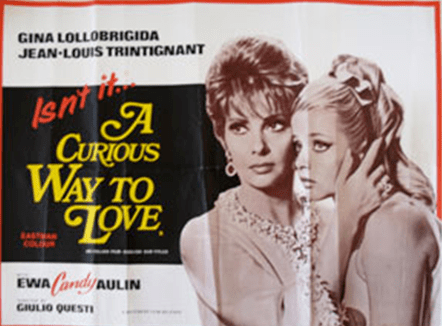
A high tech chicken farm is trying to create birds that have no heads or bones. A love triangle develops between the three people who run it: Anna (international sex symbol and the photojournalist who was one of the first to interview Fidel Castro, Gina Lollobrigida), her prostitute killing husband Marco and their secretary Gabriella (Ewa Aulin, the near goddess who appeared in films like Candy and Death Smiles on a Murderer).

Yes. Headless and boneless chickens, all inside a fashionable proto giallo filled with sex and murder. You better believe I’m all over this movie.

Director Giulio Questi was also behind Django Kill… If You Live, Shoot! and Arcana. I’ve seen this movie explained as a “socio-politically sophisticated avant-garde giallo,” which is pretty much the best way I can think of telling you what it’s all about. It’s also around 40 years ahead of its time yet blissfully stuck in 1968.

Despite being Anna’s cousin, Gabri hooks up with her husband and they debate running away together. However, Gabri is already married to Mondaini and their plan is to kill Anna and frame  Marco. There’s also the issue of Anna wanting to have something special and strange with Marco, which instead of being a child, ends up being these Eraserhead-ish chicken balls that scream and bleed worms when he kills them.

When Marco discovers his wife’s body in a hotel room, he cleans the scene up and brings her body to the farm to turn it into chicken feed. That’s when we learn his big secret: he doesn’t really kill prostitutes, but instead role plays the murder and sends them away with plenty of cash. But then, as he tries to feed his wife into the machine, he falls in just as the police arrive to catch him disposing of the body. Gabri and Mondaini are eventually caught as we watch the chickens chow down on human food. Nothing good is gonna come out of that. I mean, poultry that feeds on human flesh seems like way worse than any steroids or hormones.

I’ve never seen a movie that straddles being an art film, a drug film, a murder mystery story and science fiction examination of man trying to change nature along with psychedelic film techniques and non-linear editing techniques. It’s also a satire of the highest order. I have no idea why people aren’t constantly discussing this movie and I’m going to do my best to drive people nuts talking about it over and over again.

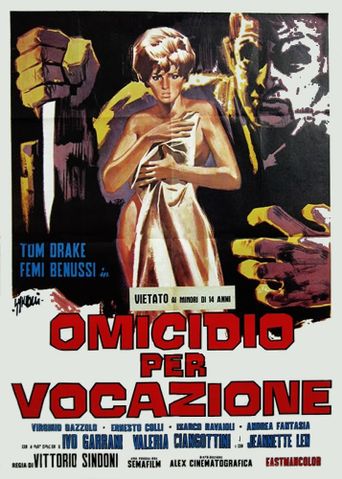
Deadly Inheritance (1968)

A pre-Argento giallo, Omicidio per vocazione is about a railroad worker killed by a train and the deaths of his heirs as they attempt to claim his fortune. Directed by Vittorio Sindoni, who wrote the script with Aldo Bruno and Romano Migliorini, this has Inspector Greville (Tom Drake) trying to figure out who is killing off all these people.

The cast also includes Femi Benussi (Hatchet for the HoneymoonStrip Nude for Your Killer…indeed, her nude scene caused this film to not pass censors originally), Valeria Ciangottini (La Dolce Vita) and Jeannette Len (Crimes of the Black Cat).

Give it points for giallo originality. It takes place in a small village in France and steals more from Agatha Christie than Edgar Wallace. That said, it’s very by the numbers until the end reveal, but at least the bad people are beyond bad and it has a great alternate title: L’assassino ha le mani pulite (The Killer Has Clean Hands). It also has more than one — maybe — deaths by train. Also: death by golf club.