EDITOR’S NOTE: Gorgo was on Chiller Theater eleven times! The first airing was Saturday, April 17, 1965 at 11:20 p.m. It was part of an all night show on October 30, 1965, then aired on April 29, 1967; February 22, 1969; December 4, 1971; April 13, 1974; June 14, 1975; December 18, 1976; November 28, 1978; December 15, 1979 and September 18, 1982.
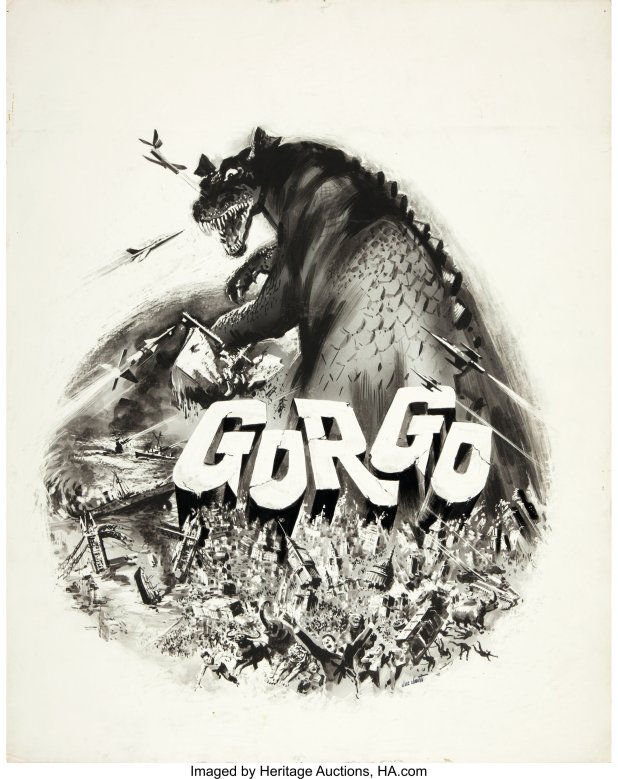
A co-production of the United Kingdom, the United States and Ireland — all united to rip off a film from Japan — Gorgo is all about a pearl diving crew taking a little monster to London and being gobsmacked when its mother comes to tear up Big Ben.
Originally, this was going to be set in Japan, then France and even Australia, but the filmmakers decided that — and I’m not making this up — no one cared about Australia.
Director Eugène Lourié already had some kaiju experience, making The Beast from 20,000 Fathoms and The Giant Behemoth.
This film also sets up that perhaps kaiju have been with us since the beginning of time and thought of as monsters, as a Viking relic shows an image of a beast called Ogra the sea spirit.
Monarch Books, who seemed ready to release a book for any giant monster movie*, put out a novel version that had way more sex than the movie. Way more meaning any at all.
Charlton Comics also published 23 issues of a comic book with pencils by Steve Ditko. They also did a three issue sequel miniseries called The Return of Gorgo and Ditko included Gorgo and Konga in a Captain Universe backup story in Web of Spider-Man Annual #6.
EDITOR’S NOTE: Mothra was first on Chiller Theater on Saturday, October 16, 1965 at 11:20 PM. It also was on September 30, 1967.
Godzilla may be the most popular kaiju there is, but at least when it comes to Toho’s stable, Mothra is number two, appearing in thirteen of Godzilla’s movies and her own trilogy in the Heisei era.
She got her start when producer Tomoyuki Tanaka hired author Shin’ichirō Nakamura to write an original kaiju story. Working with Takehiko Fukunaga and Zenei Hotta, their story The Glowing Fairies and Mothra was serialized in Weekly Asahi Extra magazine. To play the fairies, the idol singing group The Peanuts were hired, bringing a new audience to kaiju movies.
They are just two of the many odd inhabitants of Infant Island, a place whose juice can heal radiation sickness, vampire plants nearly eat trespassers and gigantic lavra can grow into fantastic moth creatures.
Let me say this again. One of the main plot points of this movie involves singing miniature women called the Shobijin who can speak directly to giant monsters.
Much like so many kaiju films, a shady businessman kidnaps them and attempts to make money off them. That plan has failed every time it’s been tried, dating all the way back toKing Kong. So they call out to be rescued, singing to the egg god of their island which hatches to become a gigantic silk-spinning worm that cocoons itself until it becomes a gigantic butterfly, saving the women and taking them home.
Columbia Pictures had the rights to this movie in America and they went full William Castle selling it. They came up with a press book that told theater owners to put up signs on construction sites saying “Mothra was here” and to hire cute girls and make them walk around with signs that read “Mothra, the world’s most fantastic love story!”
They even wanted theaters to have radioactive material and geiger counters for audiences to play with. Anything to sell a monster movie, I guess.
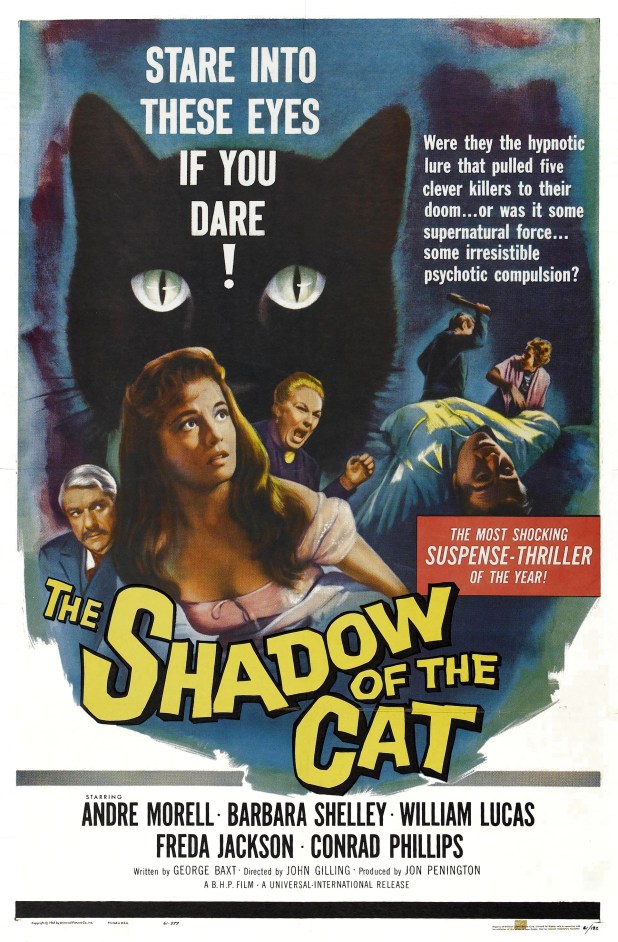
Ella Venable (Catherine Lacey) has been murdered by Andrew the butler (Andrew Crawford) and her body buried on her estate, a plot concocted by him, Ella’s husband Walter (André Morell) and Clara the maid (Freda Jackson).
They didn’t count on Tabitha, Ella’s cat.
The only witness to the crime, she instinctively knows that Walter had her master killed. So this gang decides that they have to kill the cat and find the old will, the one that said that her husband would get none of her money.
Even after Tabitha gives Walter a heart attack, he brings in his family to find and kill the cat. Let me tell you, as the owner of a tabby, you have no idea what a cat can do once it sets its mind to doing it.
Directed by John Gilling (The Plague of the Zombies) and written by George Baxt (Burn, Witch, Burn), this is a Hammer movie that doesn’t have classic monsters in it. Well, it’s credited to BHP Productions, but it’s a Hammer, right? Cue people leaving comments telling me how wrong I am. But anyways, Barbara Shelley is quite cute in this and she and the cat are the only good people in a plot full of people willing to kill one another.
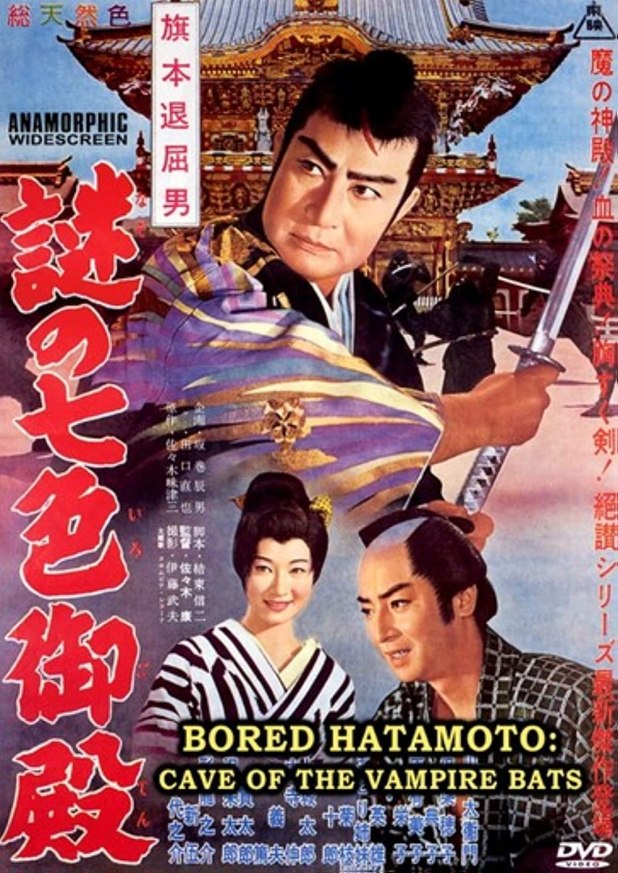
The most popular samurai in Edo, Saotome Mondonosuke is also known as Bored Hatamoto. Utaemon Ichikawa first started playing this role all the way back in 1930, making this the longest running Japanese film series starring a single actor — thanks Japanonfilm — even if Shintaro Katsu played Zatoichmore more times if you count the TV series.
But imagine this: Utaemon Ichikawa played the same role in the same continuing series of films from Japan’s silent era all the way up until 1963, through World War II — which cost many of the films, as they simply no longer exist — and due to the restrictions of the end of the war, period samurai dramas were restricted until the late 1950s. At that point, Ichikawa was in his fifties but still making movies.
Bored Hatamoto is marked with a crescent scar and is a near-ronin, masterless to all other samurai other than the Tokugawa shogun. He’s a virtuous character who solves crimes, like Sherlock Holmes, but if Holmes could fight a hundred other swordsmen at the same time.
The women who live near a shrine keep getting killed by bats, except they’re not bats. They’re flying ninja that live inside a gigantic cave above the holy place. Our hero also has four sidekicks, which seems like a ton, but hey, when you have a film series that lasts this long and then continues as a TV series with your son taking over the role, you have a good formula.
This also reminds me of American Westerns of this time, as this is basically a variety show. There’s fighting, there’s comedy, there’s song and dance from a variety of acts. When you went to the movies back in the early 60s — or the 50s in America with our singing cowboys — you got a full buffet and not just a main course.
Also: Ninja are seen in America as an 80s trend. As in so many other pop culture ways, Japan was ahead of us.
April 25: Bava Forever — Bava died on this day 43 years ago. Let’s watch his movies.
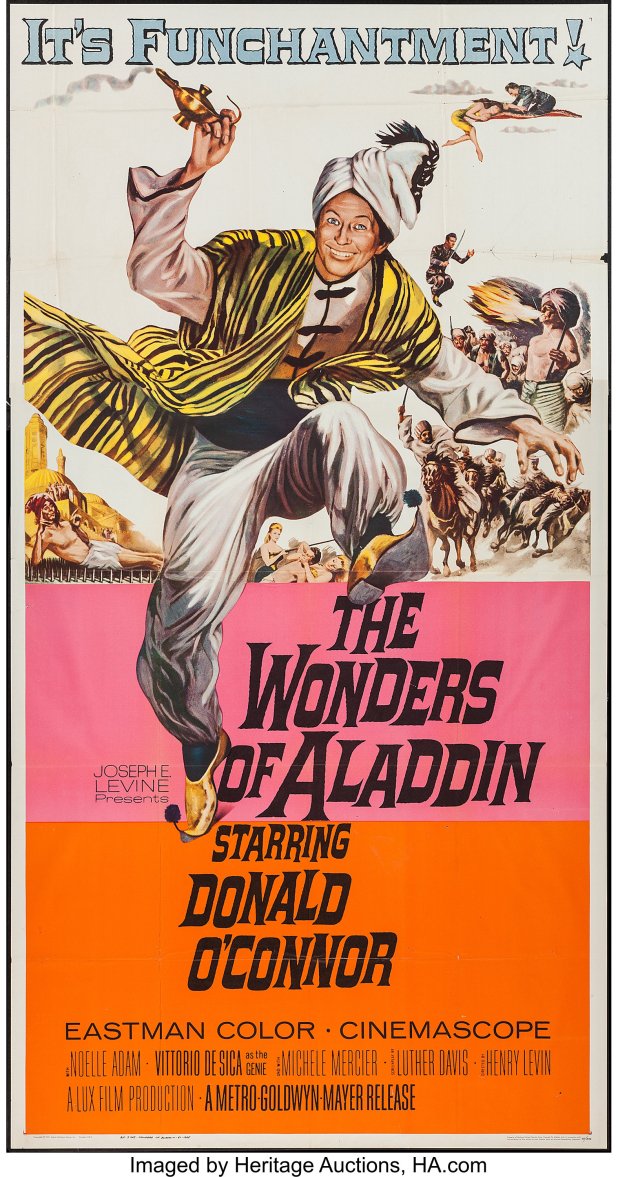
According to camera operator Marcello Gatti, Henry Levin (That Man Bolt, Kiss the Girls and Make Them Die) directed 80% of this movie, while Mario Bava did the second unit direction and supervised the special effects. Because Bava was also in charge of post-production and dubbing in Italy, Italian and French prints have the credit “A film by Henry Levin, directed by Mario Bava” while English language prints only credit Levin with direction.
The making of this movie was not without incident.
Star Donald O’Connor suffered a blood hemorrhage on his throat and had to be rushed to hospital at one point. He also was joined by director Levin and writer Henry Motofsky in crossing the Tunisian border into Algeria while scouting locations and being arrested for three hours. But the worst incident — according to the commentary track from Tim Lucas on the Kino Lorber blu ray — was that the use of a mosque as a shooting location caused a violent revolt which led to five deaths and the killing of a security guard at the American embassy that was cleared the location. Bava had literally spears pointed at his head and said that it was the most frightening moment of his life.
In the middle of all that insanity, this movie was made at the same time as two Steve Reeves films: Morgan, the Pirate and The Thief of Baghdad. The same crew — producer Joseph E. Levine, set designer Flavio Mogherini, cinematographer Tonino Delli Colli and Bava on effects — worked on all of the movies one after another.
The script is credited to Luther Davis (The Old Man Who Cried Wolf) from a story by Stefano Strucchi and Duccio Tessari, who was three years away from writing A Fistful of Dollars. The adaptation is credited to Silvano Reina, Pierre Véry and Franco Prosperi, who one day would make The Last House on the Beach, The Throne of Fire, The Green Inferno and White Cannibal Queen. He also wrote another film for Bava, Hercules In the Haunted World. He also did second unit directing for that movie, as well as Bava’s Erik the Conquerer and The Girl Who Knew Too Much.
Based on Antoine Galland’s adapted version of Aladdin and the Magic Lamp, this film combines the feel of peplum with the tales of Arabian adventure. Aladdin must go up against the Grand Vizier (Fausto Tozzi) with the help of a genie (Vittorio De Sica, who would go on to direct films of his own such as Marriage Italian Style, Woman Times Seven, a sex comedy anthology starring Shirley MacLaine, and a segment in Le streghe). There’s also Prince Moluk in this, played by Mario Girotti. Six years later, you’d start to know him much better by his Americanized stage name, Terrence Hill.
While the actual movie is pretty simple and not all that exciting, the effects and ability to stretch the budget that Bava always showed are reasons enough to see this movie.
April 2: Forgotten Heroes — Share a superhero movie that no one knows but you.
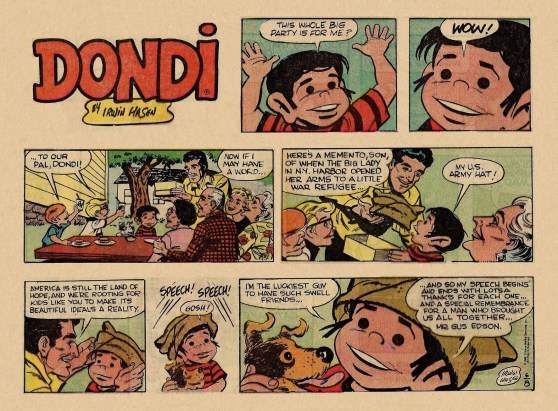
OK, I’m cheating. This is a comic strip not a comic book, but Dondi was created by Gus Edson and Irwin Hasen and at the height of its fame, it ran in more than a hundred newspapers from September 25, 1955, to June 8, 1986. When I was obsessed by the comic pages in the Sunday paper — and, as always, the movie section with huge drive-in listings — Dondi was one of the strips I hated. I had no interest and I always wondered who did.
Dondi started as a five-year-old World War II orphan from Italy who didn’t know his name or family who was brought to America by soldiers Ted Wills and Whitey McGowan. By the early 1960s, he was a Korean War orphan and by the 70s, he was a Vietnamese kid. If there’s a tragedy or a war, Dondi is like Tom Joad and he will be there.
In 1961, Dondi was such a big thing that there was this movie, which stars David Kory in the title role and David Janssen as Dealey. Amazingly, Whitey died in the comic, so for some reason, they avoided all of that. Patti Page plays Liz and the creators of the comic show up, with Edson as a cop and Hansen as a sketch artist.
Director and producer Albert Zugsmith** said that Allied Artists made the film to prove that they could make movies for kids and then “arbitrarily cut the wrong twenty minutes out of it.”
How bad is it? Arnold Stang, who is in some horrible movies — Skidoo, Hercules In New York — is not the worst thing in it. The whole soundtrack is on one instrument, the most annoying of all musical implements, the harmonica. And David Kory was just seven years old and can’t be blamed for how bad he is in this movie. He’s like…there’s never been a bad this bad. He was the son of Diane Kory, who was once a Rockette and was supposedly spotted on a New York City sidewalk because yes, he looks a lot like Dondi. I guess, knowing how much I hated the daily adventures of this kid, I should hate his movie just as much, so mission accomplished.
*Come back on April 20 for more of me against the Medveds.
**Zugsmith also produced Russ Meyer’s Fanny Hill, Captive Women and Touch of Evil and directed one of the weirdest movies I’ve seen, The Chinese Room. He also made Mamie Van Doren a star with High School Confidential!, The Beat Generation, The Big Operator, Girls Townand The Private Lives of Adam and Eve, so I can forgive him this movie.
The second of the 1960s CCC Films Dr. Mabuse film series, this movie follows up Fritz Lang’s The Thousand Eyes of Dr. Mabuse. Gert Fröbe, who plays Inspector Lohmann, was the selling point in the U.S., as he had become known as Goldfinger.
The lawman is called away from his vacation to investigate a series of murders, including an Interpol agent with proof that American organized crime is working with a European crime syndicate, as well as the wife of one of that group’s members, who is killed by a flamethrower in a scene that’s pretty intense seeing as how this was made in 1961.
That woman was carrying Lohmann’s book, The Devil’s Anatomy, written by a Reverend Briefenstein of St. Thomas Church. That book has a theory: Satan is a spirit that can take the form of a werewolf, vampire or Dr. Mabuse. Yet, isn’t Dr. Mabuse dead? A priest informs Lohmann that even though the body can die, a soul can infest the bodies of other men. At that very point, Dr. Mabuse’s voice crackles from the church’s speaker system, demanding that the investigation stop now.
Mabuse (Wolfgang Preiss) now has an army of zombie criminals that he will use to take anything he wants, including giving these zombies orders to every prisoner in a jail and then sending them to destroy a nuclear power plant.
This movie would be followed by three more: The Testament of Dr. Mabuse, Scotland Yard Hunts Dr. Mabuse and The Secret of Dr. Mabuse. In 1990, Claude Chabrol would bring the character back for his movie Dr. M.
Something Weird has made out lives so much richer, saving the strange, the smutty, the scary and everything in between. Working with the American Genre Film Archives, they created this mixtape of sheer lunacy which adds up the scare films of the past. You’ll never do drugs again until the next time to do drugs.
This blu ray has the following movies, all uncut and in 2K:
Beyond LSD (1967): This movie astounded me because instead of telling parents that their kids are maniacs, it tells them to listen to them because they’re going through some things. How is this even real?
Director Paul Burnford mainly made shorts and documentary films, like 1944’s Nostradamus IV and the 1943 blood transfusion ten-minute epic Brothers in Blood. He also directed the first movie in the Rusty series and an entry in the A Crime Does Not Pay series, Dark Shadows, which is about a psychiatrist matching wits with a killer.
In short — it’s less about drugs and more about how to treat your kids. It’s still relevant today.
The Bottle and the Throttle (1961, 1968): Narrated by Timothy Farrell, who was one of the two narrators and the psychiatrist in Glen or Glenda, as well Girl Gang,Pin-Down Girl, Dance Hall Racket, Test Tube Babies, The Violent Years, Jail Bait and many more. He was also a bailiff for the Los Angeles Marshal’s Department when he was acting in movies like Paris AfterMidnight, which was raided by the Los Angeles Vice Squad during filming.
A bunch of kids a drinking beach beers — Budweiser, Schlitz and Hamm’s — and Bill has had one too many. He ends up driving home and killing a child and breaking the back of her mother. Was it worth it?
Do you remember that wheel of how many drinks you had and how long until you sober up back in driver’s ed or health class? Man, I used to think of that all the time and here I am, now trying to gauge edibles which are magical and unpredictable lunacy when compared to whiskey.
The major difference between the 1961 and 1968 films is that the former is made with the help of the Culver City Police Department and the Culver City Unified School District while the latter is made with the West Covina Police Department. I’d like to think these organizations were scammed and paid twice for one movie.
“The little girl died on the way to the hospital and the mother will probably never walk again. No matter how your trial comes out, you’ll always have to live with those facts, won’t you Bill. A child dead. A mother crippled. Not a pleasant future to face at the age of 18.”
Pure nihilism.
Sidney Davis Productions also made The Dropout, Boys Beware (an anti-homosexual scare movie), the Ib Melchior-directed — yes, the guy who wrote Death Race 2000 and directed The Angry Red Planet — Keep Off the Grass, Skateboard Sense and LSD: Trip or Trap!
Curious Alice (1971): Dave Dixon, the Culture Czar, was the lead DJ of the legendary “Air Aces” on Detroit’s rock station WABX and the first person to play Sabbath, The Doors, Led Zeppelin and The Doors in the Motor City. Beyond co-writing Peter, Paul and Mary’s “I Dig Rock & Roll Music,” he co-wrote this animated film that explains drugs through Alice In Wonderland which is totally right on with the kids and four years after Jefferson Airplane did the same thing in “White Rabbit.”
The art in this movie is mind-boggling, however, and you’ll be entranced as Alice learns about LSD from the Mad Hatter, speed from the March Hare, heroin from the King of Hearts and barbituates from the Dormouse.
Made by the National Institute of Mental Health in 1971 and meant for use with ten-year-old students, if I had seen this before my teen years I would have done all the drugs in high school. The National Coordinating Council on Drug Education agreed, writing that viewers “may be intrigued by the fantasy world of drugs” after watching it.
The Distant Drummer (1970): A short-lived series of four 22-minute American documentary films that warned the kids about drugs, these were all directed by William Templeton (The Fallen Idol) and written by Don Peterson.
The first two movies in this series, A Movable Scene and A Movable Feast, were narrated by Robert Mitchum, who served 43 days at a California prison farm for possession of marijuana in 1948, a conviction that was overturned in 1951.
Here’s just a sample of Mitchum’s speech: “Thousands of snapshots on police station walls remain the only link between many of America’s most affluent families and the children who embodied their great expectations. Nearly everyone in the hippie community smokes marijuana — whether they call it pot, grass, hemp, gage, joint or mary jane — the marijuana is the basic background for the shared drug experience. The experience is shared to such an extent that roach pipes are always in demand — a roach is a marijuana butt and it requires some form of holder for those last few drags. The new generation, whether they are runaways or rebels-in-residence, use marijuana as a symbol of discontent with the basic values of the establishment. For some, there exists a social imperative beyond flaunting society’s rules — for these adventurers the mind-expanding drugs open a window on a whole new frontier…”
The other two parts, Bridge from No Place and Flowers ofDarkness, were narrated by Rod Steiger and Paul Newman.
Drugs, Drinking and Driving (1971): Herbert Moskowitz is now here to explain why you should never mix the three things in the title. I love that this movie has no issues with using the Mission: Impossible theme over and over and over, flaunting copyright law with each successive refrain.
This also seems pre-Jackass with a stunt where two drivers are each given drugs, one amphetamine and one barbituates, and then told to drive for 36 hours straight until they either pass out or wreck their cars.
LSD: Insight or Insanity (1967): “Now, everybody who takes it admits that there’s always the risk of a bad trip, a bummer, a freak-out, even a flip-out. But, why be lame, baby? Give yourself a real kick. Yes, a kick in the head!”
That’s Sal Mineo talking in this Max Miller-directed (the same dude who made the Sonny Bono anti-drug movie Marijuana) film which explains what LSD is, how it’s made and when people take it they jump in front of cars and take leaps off cliffs like Diane Linkletter out of the windows of the Shoreham Towers, blamed on LSD even if the last person who saw her alive — Edward Dunston — may have also was the last person to see actress Carol Wayne alive. Then again, both Dunstons could be different people and for some other reason, people seem to confuse them with David E. Durston, the man who taught us that Satan was an acidhead in I Drink Your Blood.
See, I may make some detours, but I always get you back on the road.
This ends with a Russian Roulette freakout and Mineo singing over the closing credits, which inform us that everyone in this movie was not an actor. You won’t be surprised.
LSD 25 (1967): Directed by David Parker and written by Hank Harrison — the father of Courtney Love — this movie is narrated by an LSD tab which proves that the creators of this may very well be getting high on their own supply.
“Today, you’re high. Tomorrow, you’re dead.”
Yes, LSD starts all happy explaining all the good things it does and by the end, your fingerprints can’t get out of any police database.
So go ahead and take that sugar cube. You’ll learn all the secrets of the infinite and then, you know, you won’t be able to tell anyone.
Because you’ll be dead.
Narcotics the Decision: Goofballs and Tea (1958): Written by Pittsburgh native Roger Emerson Garris, who was the story editor for the Sherlock Holmes TV series, this police training film is all about barbituates and marijuana. Yes, people once called drugs these words.
Narrated by Art Gilmore, who was on Dragnet and voiced the radio announcer on The Waltons, this movie lets kids know that it starts with sneaking their parent’s booze and ends up with you in jail, dead or worse. Avoid weed, avoid malt shops, avoid everything.
None for the Road (1957): Margaret Travis wrote 83 shorts that we know of, movies like The Other Fellow’s Feelings, Health: Your Clothing and Rowan and Martin on the Driveway One Fine Day, an industrial film for Phillips 66 Petroleum where the future Laugh-In stars run a gas station. This movie, too.
But the director? That’s Herk Harvey, who made around four hundred or more industrial films like Shake Hands with Danger. And one very important movie, Carnival of Souls.
Three men all use alcohol in different ways: not at all, a little and too much. They’re like the lab rats that we later see injected with alcohol, which sounds like a good way to spend a weekend. But wow, we’ve been warning people about drunk driving for 65 years and not everyone listens.
The Trip Back (1970): It’s no accident that an episode of Strangers With Candy was titled “The Trip Back.” Jerri Blank on that show is literally the star of this movie, Florrie Fisher, played for comic effect.
Fisher was married four times by the time she filmed this speech, first an arranged marriage, then to a pimp, then another drug addict and finally to a man she met via the mail. She credited her recovery to Synanon, which was originally established as a drug rehabilitation program and became one of the most dangerous and violent cults America had ever seen.
Wait, what?
Founded by Charles E. “Chuck” Dederich Sr., Synanon — a mix of togetherness (“syn”) with the unknown (“anon”) — was an alternative community centered on group truth-telling sessions called the “Synanon Game”, a form of attack therapy during which participants humiliated one another and exposed each other’s innermost weaknesses. There are theories that Dedereich was given LSD by Dr. Keith S. Dittman and Dr. Sidney Cohen, as well as encouraged to start Synanon as part of the CIA MK Ultra program.
Headquarted in a former beachfront hotel in Santa Monica called the Club Casa del Mar, women who joined Synanon had to shave their heads. Men were given forced vasectomies. Pregnant women were forced to abort their babies. Married couples were broken up and had to take new partners as the group became the Church of Synanon.
After Synanon’s transition into an alternate society in 1968, the game became a 72-hour ordeal for most members. The program of rehabilitation went from two years to a lifetime rehabilitation program, as they now preached that addicts would never truly be well enough to return to society.
Throughout this period, San Francisco area media covered the adult and child abuse caused by the church, but were often sued for libel by Synanon’s lawyers. If all of this sounds like Scientology, well…there was a group within the group called the Imperial Marines authorized to beat members into oblivion.
When NBC started reporting on the church in the late 70s, executives received hundreds of threats and Paul Morantz, a lawyer who had helped members escape, had a de-rattled rattlesnake placed in his mailbox. It bit him and put him in the hospital. A police search found a tape of Dederich speaking about Morantz, saying: “We’re not going to mess with the old-time, turn-the-other-cheek religious postures. Our religious posture is: Don’t mess with us. You can get killed dead, literally dead/ These are real threats. They are draining life’s blood from us, and expecting us to play by their silly rules. We will make the rules. I see nothing frightening about it. I am quite willing to break some lawyer’s legs, and next break his wife’s legs, and threaten to cut their child’s arm off. That is the end of that lawyer. That is a very satisfactory, humane way of transmitting information. I really do want an ear in a glass of alcohol on my desk.”
The teachings of Synanon influenced groups like CEDU, Daytop Village (the very place Nancy Reagan visited and became aware of the drug problem, which led to Just Say No), Phoenix House and those boot camps that always show up on daytime talk shows.
Back to Florrie Fisher.
An interview with David Susskind led to her appearing on The Mike Douglas Show, speaking at schools and an autobiography, The Lonely Trip Back. This film captures her speaking at a New York City high school, barraging the audience with a rambling dissertation on turning tricks, six of her marijuana friends all dying in the chair, jailhouse sapphic antics and shouting things like “I now know that I can’t smoke one stick of pot! I can’t take one snort of horse! I can’t take one needle of cocaine because I am an addictive personality! And that’s all I need is one of anything. Ya know I need one dress. If I happen to like this dress in tan, I buy the same dress in green and black and pink. This is the type of personality I am!”
Despite how horrible Synanon was for some, it worked for Florrie. Sadly, she died during the lecture tour she’s on in this movie due to liver cancer and kidney failure.
This movie is totally worth the price of this entire blu ray.
Users Are Losers (1971): Think drugs are for teens? This kid is saving up his milk money to pay for his habit, doing odd jobs and being incredibly thrifty just to get some marijuana. It made me think, parents are always on kids for throwing their money away, but this kid knows what he wants, works hard for it and then is selfless and shares what he gets with his friends.
Some kids also find one of their friends dead on a mattress and some young narc says, “If you blow pot, you’re blowing your future.” Get off my TV, kid.
Plus, you also get DRUG STORIES! NARCOTIC NIGHTMARES AND HALLUCINOGENIC HELLRIDES, a full-length mixtape from the AGFA team.
Now if you’ll excuse me, I must go blow some pot. Get toasty toast. Go clambaking. Fly Mexican Airlines. Run within an endless field. Walk the green ducks. Roll into the Backwoods. Be a ninja. Do some chiefing at the Rooney statue.
EDITOR’S NOTE: Originally running on our site on April 4, 2019, this is a movie that has obsessed me in the same way Marjorie Cameron, the occult, Crowley and Jack Parsons have for many years. Remember the words of Ms. Cameron, who said, “I shall plunge down into the abysmal horror of madness and death—or I shall walk upon the dawn.” Here’s hoping you find a new obsession.
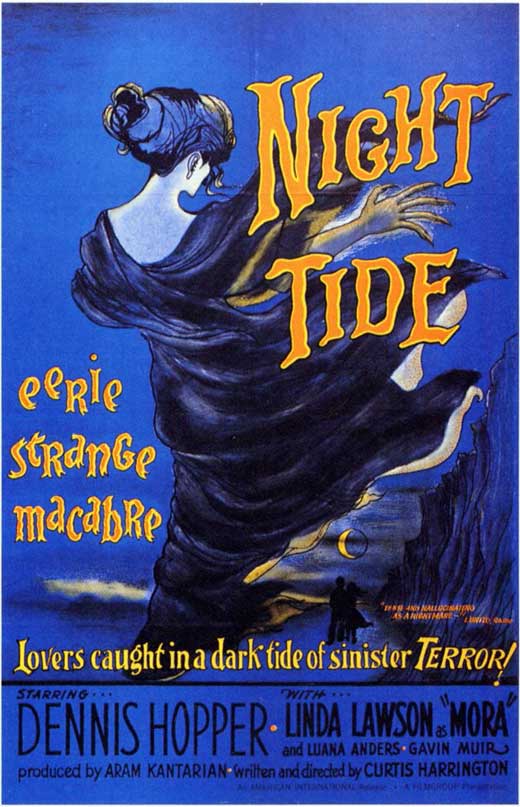
Written and directed by Curtis Harrington — one of the leaders of New Queer Cinema and also the director of Queen of Blood, What’s the Matter with Helen?, Who Slew Auntie Roo?, Ruby and so many more — this film was always one I wanted to see as it features Marjorie Cameron in a small role.
Harrington had also shot a documentary about her — The Wormwood Star — and I’ll forgive you if you have no idea who she is. Cameron was many things — an artist, poet, actress, and probably most essentially, an occultist. A follower of Crowley’s Thelema, she was married to rocket pioneer and nexus point of all things 20th century occult, Jack Parsons. In fact, Parsons believed that he had conjured Cameron to be the Whore of Babylon/Thelemite goddess Babalon as part of his Babalon Working rite, which he conducted alongside L. Rod Hubbard. No, really. It may have also opened our world to the aliens that have obsessed us since Kenneth Arnold reported a UFO in 1947.
After a suicide attempt and being institutionalized, Cameron gathered a group of magic practitioners around herself that she called The Children, whose sex magic rituals were to create a moonchild. She was now pregnant with what she referred to as the Wormwood Star, but that ended in miscarriage. Many of The Children soon left, as her proclamations of the future had grown increasingly apocalyptic.
Cameron’s orbit — much like her husband’s — unites both the worlds of art and the occult, straddling appearing in the films of Kenneth Anger, working with UFO expert and contactee George Van Tassel and appearing in Wallace Berman’s art journal Semina.
Why did I tell you all this? Because it fascinates me that she’s in Night Tide.
Johnny Drake (Dennis Hopper!) is a young sailor on shore leave who meets Mora (Linda Lawson, who is also in William Castle’s Let’s Kill Uncle), a woman who makes her living appearing in a sideshow. They fall in love before he learns that her past boyfriends have drowned under mysterious circumstances. That may — or may not — be because Mora is a siren, a legendary creature who exists to lure men to their deaths. Adding to her suspicions is the mystery woman (Cameron) who calls to her and demands that she follow her destiny.
One evening, under a full moon, she invites him deep sea swimming, but cuts his hose, forcing him to surface so that she isn’t tempted to kill him. She then swims into the depths of the ocean, fulfilling the call of the mystery woman. And when he returns to the boardwalk, her dead body is still in the mermaid sideshow, now there for visitors to gawk at her dead eyes.
Despite a police confession as to who the killer is, the strange woman in black and her call to the sea is never explained.
Anton LaVey discussed this film in Blanche Barton’s The Secret Life of a Satanist: The Authorized Biography of Anton Szandor LaVey. “There’s a whole genre of films that are just little evocative low-budget gems that I certainly wouldn’t call schlock but that are also being revived as a consequence of more attention in those directions. Director Curtis Hanington’s first movie, Night Tide filmed around the Santa Monica Pier and Venice. California in the late ’50’s, is a psychologically intricate story about a young sailor (Dennis Hopper) who falls in love with a mermaid It’s just wonderful to see these precious works of art being finally given the attention they merit.” This also appears on the Church of Satan film list.
According to Spencer Kansa’s Wormwood Star: The Magickal Life of Marjorie Cameron, Anger introduced Cameron and LaVey, who was delighted to meet the actress, having been a fan of the film.
You can download this movie from the Internet Archive or buy the Kino Loberblu ray. Or check out the gorgeous restored version at Nicholas Winding Refn’s ByNWR site. Refn also owns the film’s original print.
About the Author: Shannon Briggs has been a passionate fan of cinema ever since his grandmother recorded The Monster Squadon VHS through cable and gave it to him. You can see more of his musings on Twitter @MisterShannonB and read more his reviews at https://letterboxd.com/MisterShannonB/
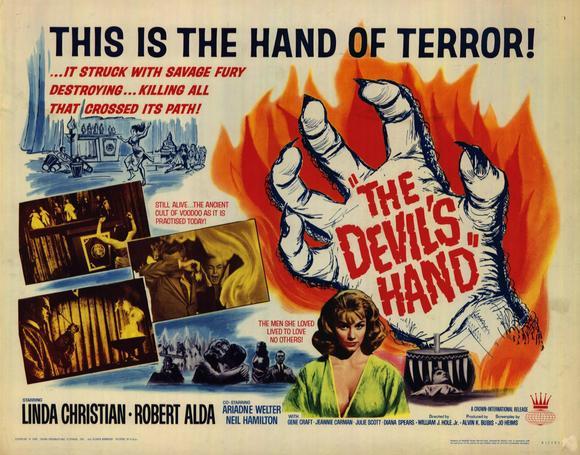
Just a few seconds into the opening titles of “The Devil’s Hand”, the viewer isn’t greeted with the ominous score you expect from a horror film about a deadly cult. No, Baker Knight’s theme for the film is instead a surf-rock medley that would be a comfortable fit for a fun beach comedy with Frankie Avalon and Annette Funicello. It’s a head-scratching choice. This is indicative of the film’s overall out of touch nature with tone and how incredibly goofy it is when tackling the subject of cults.
The plot of The Devil’s Hands consists of Rick (played by character actor Robert Alda, probably best known for his guest roles in a plethora of 1960s and 1970s television shows and was Alan Alda’s father.) haunted/mesmerized by vivid visions of a beautiful woman (Linda Christian, from the 1954 television adaptation of Casino Royale) and is shocked when he passes by a doll shop and sees a doll identical to this mystery woman. He brings his fiancé, Donna, (Ariadna Welter) to the shop and not only does the shop owner, Francis Lamont (Neil Hamilton, Commissioner Gordon from the 1960s Batman) recognize him, but states that it is of Bianca Milan and also declares that Rick ordered the doll. Rick has no memory of this, and things get even weirder when a doll that looks like Donna is discovered by the couple as well, but Francis refuses to sell it because it already belongs to someone else.
As soon as Rick and Donna leave, Lamont walks into a secret room in his shop and stabs the doll that looks like Donna with a pin. Donna collapses and is taken to a hospital for heart spasms. Rick has another vision of Bianca and tells Donna he wants to deliver the doll to Bianca but pledges his loyalty to Donna. However, minutes after meeting Bianca, Rick folds like a poker hand and is immediately DTF for Bianca. Turns out Bianca was using thought projections to appear to Rick and convinces him to join a cult meeting of the devil god, Gamba, led by Lamont. The meetings consist of bongo playing and interpretive dance around a statue of Buddha for some reason. Oh, and the occasional human sacrifice as well. Can Rick withstand Bianca’s charms enough to realize that joining a death cult probably wasn’t probably the best idea?
The Devil’s Hand attituded towards cults seems to mix fear of otherness pertaining to African/Asian iconography and huge smattering of voodoo. In fact, the most notable scene is when the worst undercover reporter is discovered, and Lamont stabs a pin through the head of the like-like doll of said reporter. The reporter is seen immediately clutching his forehead in pain and the car comically goes off the road and falls down a cliff where it immediately explodes. The voodoo stuff, while obviously ignorant, at least makes sense in the plot. When the film is trying to convey the evils of Eastern religion through bongos and sensual dancing, it’s just embarrassing.
As far as the cast, Christian’s Bianca is really the main focus as the story focuses on her allure and sensuality. However, the film cannot seem to make its mind on if she is a femme fatale or a more sympathetic character. Her scenes with Lamont seem to hint at a seething animosity but nothing really comes of it, and she mostly comes off as a loyal second in command. Alda’s Rick is the most frustrating because it never really confirms whether his initiation into the cult is due to brainwashing or lust. At times he seems to be under some sort of spell. For example, after joining the cult, it is revealed that Rick has done substantially well financially and has newfound luck. You think something may come of this revelation but…shrug. Most of the time, he seems to have all of his senses and eventually reconciles with Donna after basically gaslighting her for the second act of the film (our hero). Hamilton’s Lamont is by far the best performance even if saddled with some of the silliest dialogue in the film. Weltner’s Donna isn’t given much to do outside of advancing the finale and being a link to Rick’s humanity when the film decides to make him a loyal fiancé again.
Directed by William J. Hole Jr., The Devil’s Hand (a.k.a. Witchcraft, The Naked Goddess, Devil’s Doll and Live to Love) was completed in 1959 but wasn’t distributed until 1961, when Crown International Pictures acquired it. Surprisingly, while mostly filmed in Los Angeles, some production was done in Mexico City, Mexico. Hence, the use of Mexican actresses Christian and Welter (whose stilted English is noticeable). Not surprisingly, the film seemed to made on cheap and quick and most of the cast wasn’t fond of it, specifically Christina and Alda. Screenwriter Jo Heims would go on to write the Elvis as twins’ vehicle, Double Trouble, and Clint Eastwood’s directorial debut, Play Misty for Me. Hole Jr., primarily a television director, would do a few more B-movies throughout the 1960s but finish out his career directing episodes of The Bionic Woman.
The Devil’s Hand is a more of a curiosity than an enjoyable movie. It’s 50’s viewpoint of cults and primarily Satanism is so quaint that it would make 1975’s The Devil’s Rain chuckle. Like I said at the beginning, having a surf rock score for your Satanic horror film was a choice.





 B&S About Movies
You must be logged in to post a comment.