12 to the Moon (1960)

“I am now switching over to my helmet microphone. Now I am tuning on my invisible electromatic ray screen, which forms a protective shield our faces, and I will continue my commentary through my mirco-tape recorder.”
— Dr. David Ruskin, with some expositional technobabble

Image courtesy of Chunky Vintage & Antiques/eBay

Okay, so the good doctor Ruskin explained away the lack of face shields on the ISO crews’ helmets. But how to explain away the astronauts strapping themselves down onto vinyl cushion tube-webbed folding-chaise lounge lawn chairs C-clamped to the walls? Or a world where they can invent visorless helmets (did Glen Larson see this for BSG’s Egyptian-helmets) and, as the plot unfolds, magnetic-deflecting meteor technology, but uses backyard lawn chairs for G-Force space flight?

It’s true: the crew cockpit is dressed with a lawn chairs. And the rocket’s flames are a piece of cellophane fluttering against a fan. But what did you expect from David Bradley, the writer/director who gave us the Mill Creek public domain ditty that is The Madmen of Mandoras (1963), aka They Saved Hitler’s Brain (1968)? And to think Bradley started his career with adaptions of Ibsen’s Peer Gynt (1941) and Shakespeare’s Julius Caesar (1950), both starring his high school chum, Charlton Heston (later of Planet of the Apes!).

Yep. From Heston to spaceship lawn chairs: only in the B&S-verse.

Now, you’re probably wondering: A major studio project from Columbia Pictures propped-out with lawn chairs and visorless helmets? And hey . . . why are some of the sets and props familiar?

Watch the trailer — and the hair brushing — on You Tube.

Well, that’s because 12 to the Moon was an independent production by Bradley at California Studios, later known as Producers Studios, Inc., on Melrose Avenue in Los Angeles — the same studio where another forgotten sci-fi cheapy, Mutiny in Outer Space (1965; look for our review, this week), was filmed. (The studio has since reincorporated as Raleigh Studios; learn more about the studio and other backlots and ranches at Retroweb.tv.) In need of a B-flick to double-bill with their recently-acquired Ishiro Honda-directed (1954’s Godzilla and 1965’s Rodan) Battle in Outer Space (1959) for Toho Studios, Columbia slapped their title card on Bradley’s film. After coming and going relatively quickly from Drive-Ins, Bradley’s lone star-romp received its widest exposure as result of Columbia, via its TV-arm, Screen Gems, distributing the film as part of their “X” syndication horror/sci-fi package that ran until the mid-‘70s on U.S. UHF stations.

Yeah, there’s nothing quite like the Soviets launching Sputnik in October 1957 to inspire quickie-junk sci-fi features—fully equipped with lawn chairs and faux-future plastic-swivel chairs at the control panels.

However, even with the lawn chairs and added-after-the-fact exposition to explain away the helmet snafu, the special effects—once the film hits the moon—with its “heat vents” peppering the weird lunarscape, is pretty good. And the production had the sense to rent (or could afford) official air force pressure suits and helmets (the visors removed because the actors couldn’t breathe and it distorted their photographic images). Sadly, there wasn’t enough money to shoot in color, which succeeds in making 12 to the Moon look ten years older than it is, when screened alongside Toho’s shot-in-color space flick (which is a loose sequel to 1957’s The Mysterians). In addition, we’re given an intelligent script from the scribe behind Val Lewton’s classics Cat People (1942) and (okay, a lesser not-so-classic) The Seventh Victim (1943): DeWitt Bodeen, who’s backed by producer Fred Gebhardt; he’s responsible for The Phantom Planet (which starred Delores Faith from Mutiny in Outer Space) (and there’s your déjà vu sets, thanks, Fred).

The ISO, the International Space Order, is formed for the purpose of the internationalization of the moon and comes to send its first manned mission (commanded by Ken Clark of Attack of the Giant Leeches fame and manned by Francis X. Bushman and Anthony Dexter from Gebhardt’s The Phantom Planet). The international crew of Lunar Eagle 1 comprises of 12 scientific specialists from around the world: 10 men and two women (and we’re introduced to the entire crew through a lengthy expositional voiceover as they board the rocket). Are the woman (Norwegian and Japanese) matriarchal-strong? Eh, a little. Could you imagine Ripley sitting in front of a mirror brushing her hair? Or Lambert, during a course correction, losing her balance and falling into—and to the pleasure of—Kane’s arms? Or Parker walking in on a showering-undressed Ripley or Lambert—and making a “This ain’t the Waldorf” joke? Well, that all happens here. It has to: for this isn’t Space: 1999, this is Space: 1950.

Those Bechdel test fails aside, we get a bit of insightful, sociopolitical tensions among a crew that still feels the sting of the Holocaust and Earth’s racist and warring past, with the good Dr. Oroloff bragging about mother Russia’s scientific wonders getting them into space in the first place, and the Polish Dr. Ruskin coming to the defense of Israel and the rights of Jews. Meanwhile, the German Dr. Heinrich hides his own dark past: his father was a Nazi death camp commander. Oh, and the French dude is an underground communist sympathizer out to sabotage the trip. (See? Pretty heavy, cold war plot fodder for a cheapy.)

Once on the Moon, it’s time to disengage the ol’ magnetic ray screens on the helmets and partake of the conveniently “air-filled caves.” Hey, Norway’s Dr. Ingrid Bomark and Turkey’s Dr. Hamid need to have that deep, passionate kiss, right? Why? Again: Space: 1950. Of course, the Moon, according to the hopeful—and greedy “science” of the day—is encrusted with diamonds, gold, and other sparkly minerals. But they also discover the moon is filled with flesh-eating, lava-like liquids that discourage excavations. And there are pockets of “lunar quicksand” at every turn!

Then the dastardly “Great Coordinator of the Moon” taps into the ship’s computers and prints out a message warning the crew to leave the moon at once. But first, the Moonites must study the Bomark-Hamid hook up to learn what love is . . . and please leave the two cats from the lab behind, because they’ve grown fascinated with Earth felines. Do the Moonites have cans of Sheba and bags of Meow Mix with Vitaburst Tender Centers? Don’t know: for this is a plot-holed world of invisible face shields, Zero-G lawnchairs, and feline-loving, invisible Moon people.

So, do the Earthlings head the warnings by leaving the Moonites in peace and all is moon lava under the ice cave bridge?

Nope.

The Moonies send a giant, freezing cloud to encase the North American continent in ice. So a plan is devised—that the French Communist dude tries to thwart—to drop atomic matter into a Mexican volcano, so as to trigger a massive, atmospheric heat surge that will thaw the U.S. (See? Sots of plot-twists for a cheapy.)

Alas! Impressed by the crew’s valiant efforts to save the human race (it was all a test, after all), the Moonites will spare Earth and will allow them to return with open arms (or whatever appendages disembodied, cat-loving moon aliens have). (I feel bad for the cats. How will the Moonites pet the cats? Cats need human—or humanoid—contact, after all.)

See? And you thought the plots of The Asylum’s recent Earth-faces-extinction flicks Astreroid-a-Geddon, Collision Moon, and Meteor Moon were far-fetched. For the more flights we make to the Moon or Mars, the more those trips stay the same. And you can take the trip with the 12 to the Moon on You Tube.

About the Author: You can learn more about the writings of R.D Francis on Facebook. He also writes for B&S About Movies.

First Spaceship on Venus (1960)

Also known as Planet of the Dead and Spaceship Venus Does Not Reply, this is really the East German/Polish film Milcząca Gwiazda / Der Schweigende Stern, which would mean The Silent Star in English. It’s based on Stanislaw Lew’s 1951 novel The Astronauts. The author — who also was the man behind Solaris — was critical of the final film, saying, “It practically delivered speeches about the struggle for peace. Trashy screenplay was painted; tar was bubbling, which would not scare even a child.”

So how did it make it to America? Out old friends at Crown International Pictures, who In 1962 released a cut-down and American-friendly dub of the movie — along with two other cuts under the aforementioned Planet of the Dead and Spaceship Venus Does Not Reply titles. Domestic audiences wouldn’t see the original, uncut version of the film until it was re-released by the DEFA Film Library of the University of Massachusetts Amherst as The Silent Star.

Scientists discover that the Tunguska explosion of 1908 was caused by an alien craft and not a meteor, which sends them to Venus, where they discover that the inhabitants of that planet want to irradiate the Earth and take it over. More precisely, they would have, had they not nuked themselves into oblivion.

If you watched this and thought, “Have I seen this movie somewhere else?” that would be because it’s the movie within a movie in Galaxina. If you listened to it and felt the same way, that’s because it liberally borrows — steals — music from Destination MoonThis Island Earth and The Wolf Man.

You can watch the Mystery Science Theater 3000 version of this movie on Tubi or the original on YouTube:

Teenage Conflict (1960)

Donna and Joe are two clean-cut American white kids who love science. In fact, dangerously so, as their love of the rational explanation for why things are is starting to get in the way of their love for God.

Joe is pretty smart. How smart? The dude made a satellite tracker in his bedroom, which seems advanced for 2020, much less sixty years ago when Family Films made this movie.

It seems like Donna and Joe want to apply the scientific method to their study of God, an act which offends nearly everyone in their youth group. But what will Dr. George Cooper, a science geek made good, think? Even better, he’s such a big start that when he comes to town, he’s going to be sleeping in their house, which suggests to me that being a big star in science is much like being in a well-known doom metal band or an indy pro wrestler. You might get recognized at Dollar General, but you’re still going to have to find a couch to crash on.

Guess what? The doctor turns out to be a Christian and he easily explains away the fact that he can believe in something that can’t be seen or quantified by saying, “Well then, just because science can’t measure things like love, faith and hope doesn’t mean they aren’t real.”

The funny thing is science has totally shown that they can measure emotions and their impact on the human mind, but let’s not be rude right now. Let’s get back to discussing this film.

Obviously, the geek in charge of the science club, a doubter named Sid, is going to pay tomorrow when he thinks Dr. George is on his side. Keep in mind that Sid has been pretty even-handed throughout this film. He’s going to burn in hell.

For some reason, there’s also a subplot when the kids’ mom might have cancer and it’s never resolved. Nothing is, other than the fact the kids feel bad for potentially believing that science has all the answers.

I love these movies more than I can explain. Every time I watch them, my wife comes into the room and just stares at me, wondering what message I am getting from them. I don’t know the answer myself.

You can watch this on YouTube. It’s also on the Internet Archive.

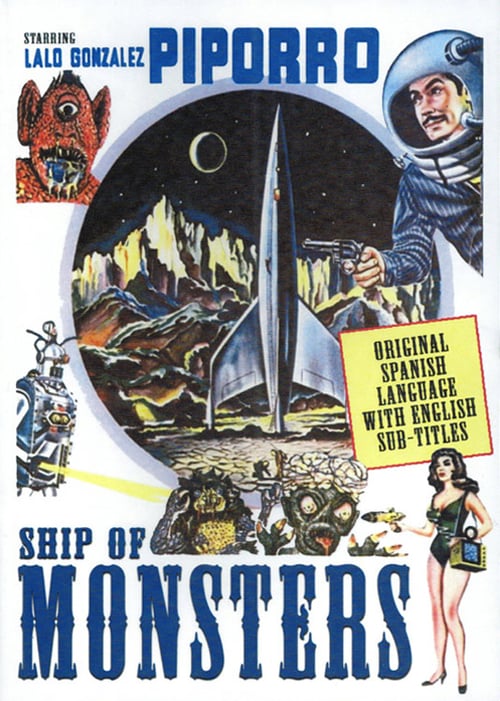
REPOST: La Nave de los Monstruos (1960)

EDITOR’S NOTE: This Mexican senoritas in charge movie originally was on our site on June 23, 2020. It’s a fine example of how the trope of dominant matriarchal societies has reached so many countries beyond our own.

Rogelio A. Gonzalez made more than 70 movies, but I wonder if he ever made anything near as good as this movie, which is perhaps one of the strangest films I’ve ever had the delight to witness.

I was wondering how to even describe this movie. Basically, Gamma (Ana Bertha Lepe, Miss Mexico 1953 and a third-runner up for Miss Universe) and Beta (Lorena Velazquez, Miss Mexico 1960 and also Zorina queen of the vampires in Santo vs. Las Mujeres Vampiro) have come from Venus to find men to repopulate their planet. Of course, they can’t resist biting people or falling in love with Lauriano (Eulalio “Piporro” Gonzalez, one of the kings of golden age of Mexico comedy and the literal embodiment of Northern Mexican culture), a singing cowboy.

Sure, that would set up a great movie, but this is Mexico. Which means that the ship has a robot named Tor who is collecting a whole bunch of monsters — why, the title translates as Ship of Monsters, surprise! — and those monsters are about to go crazy. There’s Uk the cyclops, the many armed Carasus, Prince of Mars Tagual, Utirr the spider and the dinosaur skeleton named Zok. Also, Tor falls for a jukebox. And some of the special effects were ripped off from the Russian movie Road to the Stars.

Imagine if Ed Wood lived in Mexico, had a better budget, lucked out and had magnificent actresses willing to wear swimsuits and high heels, as well as a singing cowboy. Then we’d cut open slice open a peyote cactus and make him sit in a cave until he made this and it still might not this charming and odd.

You can watch this on YouTube.

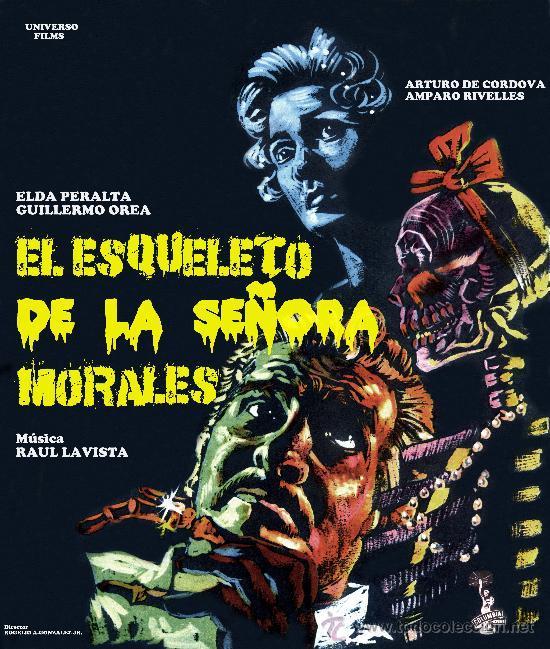
El Esqueleto de La Señora Morales (1960)

Based on Arthur Machen’s 1927 short story “The Islington Mystery,” this Rogelio A. González-directed (ChanocDr. Satán y La Magia Negra) film is considered by many to be a classic of Mexican film, not just Mexican horror.

It’s the story of taxidermist Dr. Pablo Morales (Arturo de Córdova, For Whom the Bell Tolls) who is stuck in a dead marriage to the hypochondriacal and ultra-religious Gloria (Amparo Rivelles, The Nail). He’s dreamed of having children or even a moment of affection from his wife, who tells him that he smells of the dead.

Pablo finds another dream. He saves for a camera, but he gives the money to the church, so he must save up again. Despite his wife convincing the community that he’s an abuser and a drunk, he somehow finally gets his camera.

Mrs. Morales responds by breaking it.

That’s when too much is too much, so the kindly man kills his wife, dissects her and displays her skeleton in his storefront.

The priest is convinced that our protagonist is guilty, as is nearly everyone else in town, after Mrs. Morales has painted him as a drunk, a wife-beater and a general ne’er do well. That’s when this movie shifts into a courtroom film.

Well, Mr. Morales escapes the law. But he can’t escape God.

Screenwriter Luis Alcoriza was very influenced by Bunuel, which comes through in this. I love that Mexican cinema of the 1950’s — or at least my experience of it — is monsters and luchadors on one side and mind-bending art films on the other.

089859906923-300x437

You can buy this on blu ray from VCI.

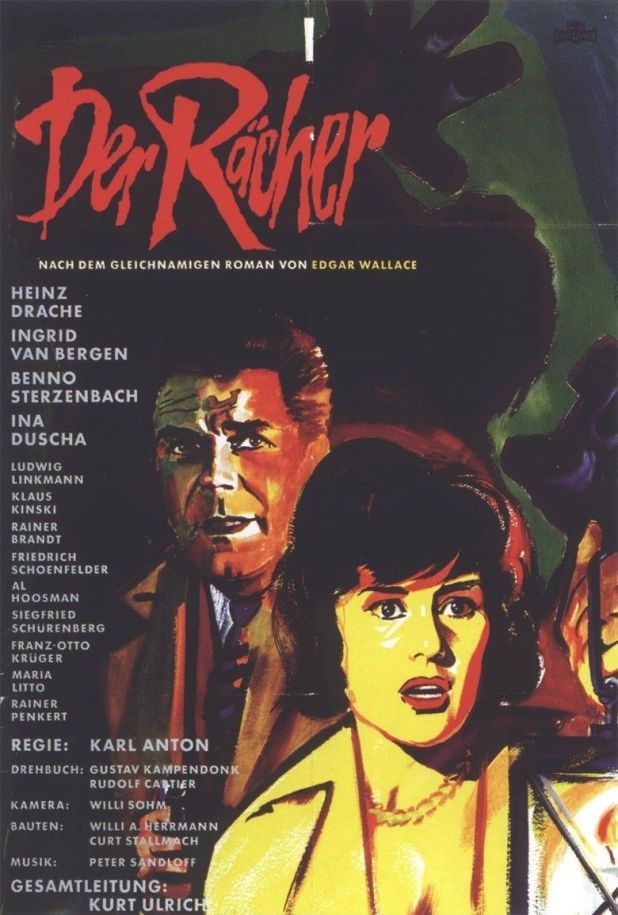
Der Rächer (1960)

In The Avenger, a killer is slicing the heads off of his or her victims, then sending them right to Scotland Yard, which seems pretty ballsy.

This pre-giallo was directed by Karl Anton, who made the 1957 German remake of Viktor and Viktoria and based on the 1926 Edgar Wallace novel of the same name.

The Executioner, the killer of this story, has been sending packages of those disembodied heads from different locations, along with letters taunting the police. When a Scotland Yard employee is one of the victims — who all seem unrelated — Detective Mike Brixan of Special Branch is called in.

There are just a few clues, like the black sedan seen at the scene of the crime and that two letters are offset in every letter The Executioner writes. Those letters match a script being written for a movie, which means that the murderer just might be one of the cast or crew.

Ingrid van Bergen, who plays the niece of one of the victims, has a giallo-like real life, as she shot her lover, money broker Klaus Knaths, dead and served five years of jail time, being released for good behavior, at which point she went back to acting.

You should also keep an eye out for a very young Klaus Kinski!

You can watch this on YouTube.

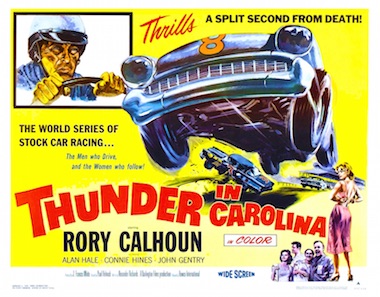
Thunder in Carolina (1960)

Filmed at small dirt ovals throughout the Southern U.S. and set at the 1959 NASCAR Southern 500 at Darlington Raceway — with footage shot at the event itself with star Rory Calhoun actually racing some actual laps — this stock car racing movie is a favorite of Quentin Tarantino. He said of the film, “There are some fun Southern ones too. Rory Calhoun did a movie called Thunder in Carolina where a driver teaches his mechanic how to race.”

If you love early TV, then this movie is perfect for you, because the Skipper (Alan Hale Jr.) and Connie Post from Mr. Ed (Connie Hines) are both in it.

Anyways, Calhoun plays Mitch Cooper, who teaches his mechanic Les (John Gentry) how to race cars but falls for his protege’s wife (Hines), which ends up an injured Mitch racing the big one against his former friend, who now is on the team of an unfeeling rich guy.

Paul Helmick only directed this film and Teenage Thunder, but was the assistant director on everything from Hello, Dolly! and Rio Bravo to MartyGentlemen Prefer Blondes and To Have and Have Not.

You can watch this on Amazon Prime.

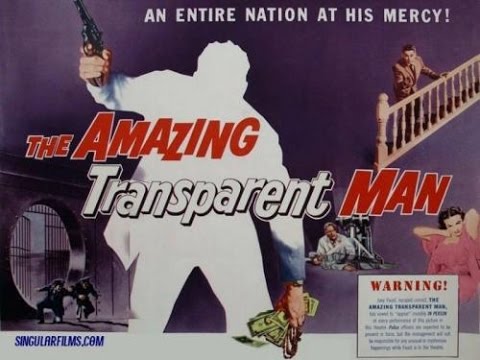
Mill Creek Sci-Fi Invasion: The Amazing Transparent Man (1960)

Editor’s Note: The review previous ran on November 4, 2019, as part of our Mill Creek Pure Terror month-long tribute.

ABOUT THE AUTHOR: Craig Edwards is an award-winning blogger as well as a self-proclaimed Media Guy and a consumer of pop culture for a lot of years. He also writes a great blog called Let’s Get Out of Here

Famed low budget director Edgar G. Ulmer helms this science fiction flick which has apparently fallen into the public domain, which resulted in it being available on countless bargain VHS tapes and now in untold numbers of cheapie DVD sets, much like the very one we’re shining the spotlight on.

Former Army guy Krenner (James Griffith), plans to conquer the world with his soon-to-be army of invisible thugs and he is willing to do anything to make that happen. Krenner forces Dr. Ulof (Ivan Trisault) to work to perfect the invisibility machine Ulof invented. He keeps Ulof’s daughter, Maria (Carmel Daniel) as a hostage with the help of his henchman, Julian (Red Morgan). Ulof needs radioactive elements to improve the invisibility machine which are understandably rare and kept under guard in government facilities. Krenner busts Joey Faust (Douglas Kennedy) out of prison to steal the materials he needs. Faust pulls the robberies using the invisibility power – but chaffs working for the dictatorial Krenner. Soon everyone in the house, including Krenner’s girlfriend Laura (Marguerite Chapman) is working some kind of double cross or secret agenda; and it’s readily apparent that no one is particularly likable – so who’s going to be the treacherous victor?

While it’s obviously a very low budget talkfest, there’s just SOMETHING about Edgar G. Ulmer’s movies that interest me. Consequently, I like this little dud which is usually touted as one of the worst of all time. Ulmer only made two more movies before retiring; but his touch is still evident all over this. Sure, it’s low-budget; it’s static; it’s talky – but I’ve seen it now like three times, and I still enjoy it.

I can’t defend the movie – but to me this works – it’s not an epic of production values and amazing effects – though there are a few sprinkled in – but it works as the little sci-fi talkfest it is. If it sounds at all interesting it is worth a look and it’s certainly not hard to find.

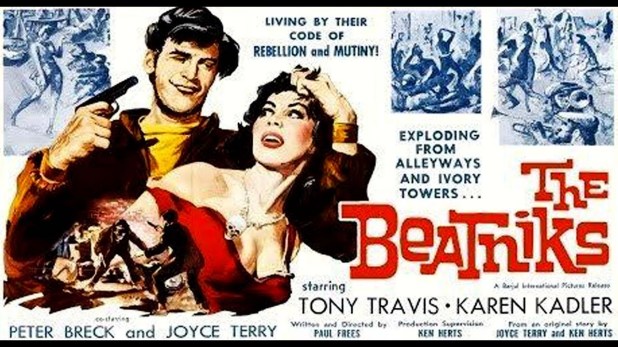
The Beatniks (1960)

Paul Frees really did it all. Actor, voice actor, comedian, impressionist, screenwriter and even writer and director, at least for this one movie. He’s even the “Ghost Host” in the Haunted Mansion at Disneyland and Disneyworld.

Originally intended to be called Sideburns and Sympathy, this movie is all about Eddy Crane, a small-time crook who gets discovered by a music exec. However, his old gang can’t give up their ways. Then there’s the worry of his old girl, Iris, who is getting left behind for the music exec’s secretary. Things won’t end well.

So yeah. The movie is really bad. But let’s judge Paul Frees, who did so many other cool things, like the films of George Pal (the voice over for the rings in The Time Machine, the reporter in War of the Worlds, the narration that starts Doc Savage), the voices of John Lennon and George Harrison in The Beatles cartoon, the voice of The Millionaire, as well as the vocal chords behind Colossus: The Forbin Project. He’s also the man behind the narration that apocalyptically ends Beneath the Planet of the Apes: “In one of the countless billions of galaxies in the universe lies a medium-sized star, and one of its satellites, a green and insignificant planet, is now dead”.

You can watch this on YouTube. You can also download it on the Internet Archive.

And Die of Pleasure (1960)

You have to hand it to French director and screenwriter Roger Vadim: he had a way with the ladies. Unfortunately, he always cast those wives and girlfriends in his movies. His wife Marie-Christine Barrault starred in four of his French TV movies, Bridget Bardot starred in And God Created Woman, and Jane Fonda in Barbarella. And when he opted for a longtime affair in lieu of marrying Catherine Deneuve (Fréquence Meurtre, aka Frequency Death), she starred in Vice and Virtue. And Annette Stroyberg (credited here as Vadim) starred in this “art house” lesbian vampire romp.

Watch the trailer.

If you’ve never experienced Vadim’s work, one must take into consideration that he got his start in the visual arts as a fashion photographer; for his films he employed famous French cinematographer Claude Renoir. So Vadim’s version (French title: Et Mourir de Plaisir; aka And Die of Pleasure; Americanized titles: Blood and Roses/To Die With Pleasure) of Sheridan Le Fanu’s influential short story “Carmilla” (part of his 1872 collection In a Glass Darkly) forgoes the adaptation conventionality of Hammer Studios’ early ‘70s “fleshy” trilogy variations of (the highly-suggested watches) The Vampire Lovers, Lust for a Vampire, and Twins of Evil, aka “The Karnstein Trilogy” (and Hammer’s other effective vamper, Captain Kronos: Vampire Hunter, acts as sidequel). Others lurking in the La Fanu catacombs are the more straightforward, third adaptation, Terror in the Crypt starring Christopher Lee (1964); the first was Carl Theodor Dreyer’s equally-dreamy Vampyr (1932). The creepiest and most atmospheric of them all (unofficially) is Mario Bava’s looser-read of Black Sunday (1964) (which also pinches from Nikolai Gogol’s 1835 Russian vampire tale “Viy” contained in his collection Mirgorod) that stars the heart-weeping Barbara Steele as a vampire-witch hybrid (one of the film’s alternate-titles was, in fact, Revenge of the Vampire).

If you’re raised on cinema’s modernized, CGI-blood suckers—ones that blatantly swish through screenwriter-guru Syd Field’s Paradigm, coughing and wheezing under a rising sun on the run to the medi-script offices of Golden, Towne & Truby—then Vadim’s vamps aren’t your goblet of corpuscles. For this ain’t no fanged fiend of the Al Adamson Blood on Dracula’s Castle variety. This is a vampire of class and style: a Nantucket vampire; not a Bowery bloodsucker.

Vadim is all about impressions. He gives you rich set designs and stunning cinematography awash in colors enveloping dreamy visuals; he fills your eyes with pleasure (a singular drop of blood across flesh of breast; a dreamscape view through a set of French Doors of Carmilla swimming a water-filled room); he fills your cortex with the psychological and the ambiguous.

Is it real? Is it a dream? Is a stunning female vampire thou art loose on the lush Euro-estate of young Carmilla’s family? Or is she experiencing a mental breakdown as result of suppressing her homosexuality for her bisexual girlfriend Georgia (Elsa Martinella of Elio Petri’s “art house” take on Richard Cornell’s The Most Dangerous Game: The 10th Victim) who’s rejected her for marriage to a young squire? As Carmilla ran off to wallow in self-pity, did she stumble into the tomb of vampire? And is that vampire in control and causing Carmilla to commit acts of murder?

Two “Thumb Up,” right Sam? So, have we decided: Am I the “Siskel” here?

About the Author: You can learn more about the writings of R.D Francis on Facebook. He also writes for B&S About Movies.