Aug 4-10 Stoner Comedy Week: I don’t gas reefer anymore, but I love it when people in movies do!
This is a movie with many audiences.
People who love Daft Punk and want to hear the songs from Discovery along with visuals, including songs like “One More Time,” “Harder, Better, Faster, Stronger” and “Something About Us.”
Those who love anime and want to see a new film by Leiji Matsumoto (Space Battleship Yamato, Space Pirate Captain Harlock, Galaxy Express 999) and don’t need dialogue to guide them through the anime archetypes and story.
Stoners who are super high.
All of the above.
Hi, that’s me, number four.
Keyboardist Octave, guitarist Arpegius, drummer Baryl and bass player Stella have been kidnapped by Earl de Darkwood, a music producer who takes bands from other planets and brings them to Earth as his slaves. Now known as The Crescendolls, three of them are saved by space pilot Shep, who gives his life to free them from their programming.
As The Crescendolls win the Gold Record Award, Stella — still mind-controlled — is saved by the band, who free her and head to Darkwood Manor, where they learn that Darkwood has a plan called the Veridis Quo, which has him getting 5,555 Gold Records and ruling the universe. Their record is the last and Stella is nearly sacrificed before Darkwood and his followers are cast into a pit.
The entire planet of Earth sends the band back home, where Shep is remembered. Or maybe it was all a dream of a child, listening to a Daft Punk album.
Daft Punk said, “The music we have been making must have been influenced at some point by the shows we were watching when we were little kids.” I love that when they started to become famous, they went all in on their influences. I got to see this in a theater at earsplitting volume, and it was perfect; yes, maybe what we had in the parking lot made it even better.
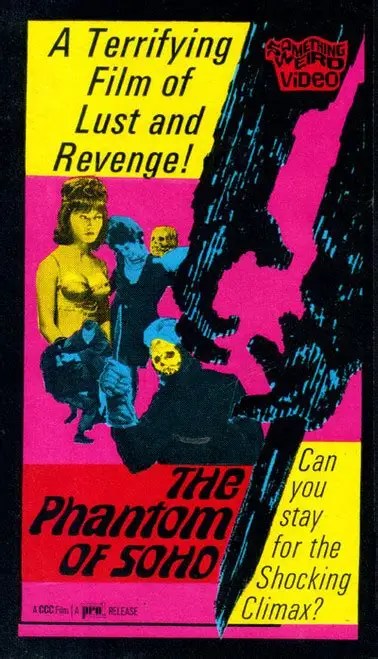
Based on a novel by Bryan Edgar Wallace, this Franz Josef Gottlieb-directed and Ladislas Fodor-written movie takes place in a sex den in Soho, the Sanisbar, which is ruled over by wheelchair — and not just for respect — bound crime domme Joanna Filiati (Elisabeth Flickenschildt). There are a bunch of murders by someone in glittery gold gloves — this isn’t a Giallo! — and a skull mask, so Joanna is trying to hush it up and keep Scotland Yard off the case, as it will bring people running to arrest her.
Chief Inspector Hugh Patton (Dieter Borsche) and would-be Jessica Fletcher Clarinda Smith (Barbara Rütting) are on the case. This has film noir, jazzy clubs, plenty of fog and feels like London twenty years earlier more than Germany. There’s also a great camera move as the viewer is forced to spin along with the girl on a knife thower’s wheel. It might make you throw up your spätzle! This is what happens when a yacht called the Yolanda sinks and the survivors think they get away! Even better, this played in the U.S.!
This is part of the Terror In the Fog box set and has extras including a new introduction by genre film expert and Video Watchdog founder Tim Lucas and audio commentary by Kim Newman and Barry Forshaw. You can get it from MVD.
Based on White Carpet by Bryan Edgar Wallace, The Mad Executioners has fog — so much fog — and a serial killer who loves to cut the heads off of beautiful women. A mob is organized by a secret court — The Mad Executioners, anyone — forms and starts to hang anyone they think could be the killer. The rope they use comes from Scotland Yard’s crime museum.
John Hiller (Hansjörg Felmy) is assigned to these cases, and it’s personal because his sister was one of the victims. How bad does he want to solve this? His fiancée, Ann Barry (Maria Perschy), is used as bait for the killer, but gets kidnapped, and Hiller has to beat the mad executioners to the killer so he can save her. Plus, there are mad scientist moments and a horse-drawn carriage that brings criminals to be tried by the mystery court.
This combines krimi, Gothic horror and Giallo all in one delicious dish. Dig in!
This is part of the Terror of the Fog box set and has extras, including a new introduction by genre film expert and Video Watchdog founder Tim Lucas and audio commentary by Kevin Lyons and Jonathan Rigby. You can get it from MVD.
Directed by Harald Reinl, Der Würger von Schloß Blackmoor is a Bryan Edgar Wallace adaptation. Not Edgar Wallace, but his son. He wrote books of his own, adapted his father’s stories for movies and even had some of his stories turned into films like this and The Phantom of Soho and The Dead Are Alive. There’s also a rumor that he was an uncredited contributor to the script of The Cat o’ Nine Tails.
The killer in this is strangling people on a British estate. However, not only does he do that, he then brands an M into the foreheads of those he murders and then decapitates them. Well, maybe he likes to make sure that they’re dead.
The masked killer shows up after a party during which Lucius Clark (Rudolf Fernau) announces that he will be knighted. The hooded strangler accuses him of stealing diamonds and killing Charles Manning, then claims that he will kill until he gets what he wants. He may also only have nine fingers, and the police, Lucius, and his niece Claridge (Karin Dor, who would play Helga Brandt in You Only Live Twice and is also in The Torture Chamber of Dr. Sadism and Los Monstruos del Terror) must solve the case before more are killed.
This is part of the Terror In the Fog box set and has extras including a new introduction by genre film expert and Video Watchdog founder Tim Lucas and audio commentary by Kevin Lyons and Jonathan Rigby. You can get it from MVD.
Aug 4-10 Stoner Comedy Week: I don’t gas reefer anymore, but I love it when people in movies do!
Lawrence Kasanoff executive produced movies like Party Camp, Blood Diner, The Underachievers, Dream a Little Dream, Blue Steel, Class of 1999, A Gnome Named Gnorm and Ghoulies III: Ghoulies Go to College before finding success with the Mortal Kombatmovies. He also founded the Vestron Pictures genre subsidiary Lightning Pictures in 1986, Lightstorm Entertainment with James Cameron in 1990 and Threshold Entertainment in 1993, which is where this movie came from. Threshold claims to have done the first morphing in a film for Terminator 2, as well as tons of 3D and 4D work on theme park attractions.
Kasanoff and Threshold Entertainment employee Joshua Wexler created the concept that would become Foodfight! in 1997. They entered into a $25 million joint investment with Korean investment company Natural Image, thinking that foreign pre-sales and loans against the sales would cover the budget. Kasanoff also decided to produce and direct the film, despite having no prior experience in animation.
If this was a success, the movies Arcade and Mascots would be next. As those movies never came out, you can assume that Foodfight! was anything but successful.
In fact, it was a mess.
After raising tens of millions of dollars in funding, the film was initially scheduled for a Christmas 2003 theatrical release. It was also said to come out in 2005 and 2007. Then, when a loan was defaulted on, creditors auctioned off the film’s assets and all associated rights to Fireman’s Fund Insurance Company.
In an article in Animation Magazine, “The Long, Strange Odyssey of Foodfight!,” Kasanoff was beyond gung ho on the project, saying, In terms of coming to have an independent digital animation studio making a digitally animated movie right now, I think we’re pretty much it. We’ve got the movie, we’ve got the property, the place, the equipment, the talent, we’re there. Do we believe our next film, Foodfight!, is going to be a huge hit? Of course we do! We think it’s great. We’ve gotten a fantastic response to it. I’ve told people all over the world, and we’re getting a uniform reaction to it. We’re betting a ton that it’s going to be a great movie. We’re risking more on this movie than any other venture I’ve ever been involved in in my life. Every studio but one offered us a deal on the movie, but for us as producers, not for us as the animation studio. We’re never going to be the next Pixar, being for-hire producers with some other shop.”
Before the rights were sold, the hard drives holding this movie disappeared. Industrial espionage was claimed. In 2012, it was released on DVD and on demand in Europe.
So those are the facts. Here’s another one: this movie is weird.
Weird because none of the corporate mascots paid to be in this. They allowed the film to use them, but no one made money. And yet this feels like a sell-out film. And they’re barely in the movie, despite being all over the poster. Somehow, some execs got worried and pulled their characters, like Cheetos’ Chester Cheetah, the Coca-Cola Polar Bears, Count Chocula, the M&Ms (the animators had “mistakenly rendered the Green M&M, a female mascot, as male within the footage shown to company representative”) and cereal mascots like Sugar Bear, Lucky the Leprechaun, the Trix Rabbit, Cap’n Cruch, Sonny from Cocoa Puffs and the Honey Nut Cheerios Bee.
It all takes place in Marketopolis, a grocery store that when the lights go down turns into a neo-noir film where Dex Dogtective (Charlie Sheen) and his partner Daredevil Dan (Wayne Brady) protect other foods from criminals — and run a nightclub called the Copabanana, don’t fall in love — when Dex isn’t pining for his lost love Sunshine Goodness (Hilary Duff). There’s also the new Brand X, led by General X (Jerry Stiller) and Lady X (Eva Longoria), taking over the store, which is populated by the Energizer Bunny, Kid Cuisine and K.C. Penguin, Punchy from Hawaiian Punch, Mr. Clean, Twinkie the Kid, Mrs. Butterworth (Edie McClurg), the Vlasic Stork, Charlie the Tuna (Jeff Bergman), The California Raisins, Tootsie the Owl and Mr. Bubble. These characters are Ikes, or icons, and when they die, their brands die. Someone is killing Ikes — this is a kid’s movie, but has a cartoon cat played by Harvey Fierstein be Harvey Fierstein and a joke from Midnight Cowboy, not to mention the “La Marseillaise” sequence from Jean Renoir’s La Grande Illusion being parodied (thanks as always to my guiding light when it comes to writing things like this, Nathan Rubin) — and there’s a secret plot that’s not all so secret.
This is a movie with Larry Miller playing Vlad Chocool, a chocolate cereal vampire bat who has a forbidden love for Daredevil Dan (this is them getting back at General Mills for not allowed Count Chocula out to play); Chris Kattan as Polar Penguin; Ed Asner as the old guy who runs the grocery store; Cloris Leachman as the Brand X Lunch Lady and Christopher Lloyd as the voice of Brand X.
According to comments made by animators, Kasanoff didn’t seem to realize the difference between live-action and animation, often demanding retakes and notes like “make this more awesome.” He also insisted on bringing his dogs to the studio, one of which was said to be a nightmare. He also reportedly asked for a personal nude 3D render of Lady X, which he would keep and admire.
Either the animation was unfinished in this or that’s how bad it is, a movie that wants to be a tough gumshoe film yet is a movie for kids but filled with outright unpaid product placement and sold off to Europe, who didn’t have most of these characters — or may outright hate them, like Chef Boyaredee — where no one wanted to watch it.
How did this get made?
Why did this get made?
It’s still better than Sausage Party.
You can watch this on YouTube.
To learn even more, watch ROTTEN: Behind the Foodfight!
July 28 – Aug 3 Screwball Comedy: Just imagine, the Great Depression is raging and you’re getting less than a fin a week at the rubber boiling factory, but it only costs two bits to go to the movies all day, so let’s watch some quick-talking dames match wits with some dopey joes!
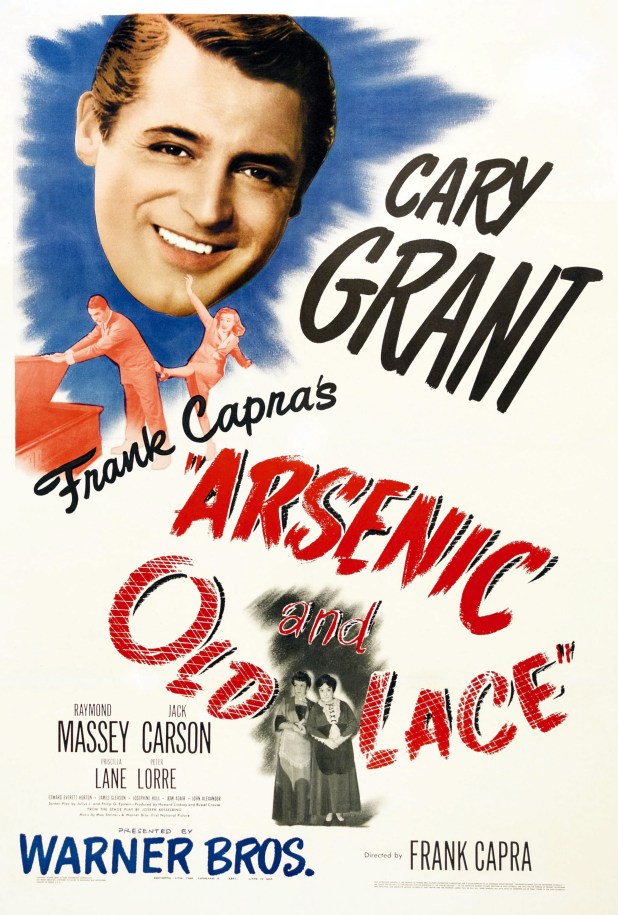
Based on Joseph Kesselring’s play, this movie was completed in 1941 but delayed until 1944, as the producers agreed to not show it in theaters until the Broadway run ended.
On Halloween, Mortimer Brewster (Cary Grant), a theater critic and author who is anti-marriage and a minister’s daughter, Elaine Harper (Priscilla Lane), get married. On the way to their honeymoon, she goes to tell her father, and he visits the aunts who raised him, Abby (Josephine Hull) and Martha (Jean Adair), who still live with his insane brother Teddy (John Alexander). While there, he finds a dead man; he learns that his aunts have been killing old single men — twelve so far — with elderberry wine that has arsenic, strychnine and cyanide. What a mixed drink.
Then, his evil older brother Jonathan (Raymond Massey) arrives, also a killer of twelve people, with his plastic surgeon, Dr. Herman Einstein (Peter Lorre). Jonathan is said to look like Boris Karloff, who originated the role on Broadway and stayed so that the entire cast didn’t leave to make the movie. Or, as some suggest, the producers forced him to stay, and he was not allowed to participate. He did get to play the part in the 1962 TV movie.
Indeed, in Dear Boris, Cynthia Lindsay wrote that “Josephine Hull and Jean Adair went to their graves believing that Boris Karloff had been so saintly as to agree to let them go to Hollywood to make this film while he stayed on Broadway doing the play. Nothing could have been further from the truth: Karloff was furious and disappointed that he was the only cast member not allowed out of his contract to do the film.”
Warner Bros. even offered Humphrey Bogart to the play’s producers; they kept Karloff.
In The Capra Touch: A Study of the Director’s Hollywood Classics and War Documentaries, 1934–1945, Matthew C. Gunter argues that the theme of both the play and film — directed by Capra — “is the United States’ difficulty in coming to grips with both the positive and negative consequences of the liberty it professes to uphold, and which the Brewsters demand. Although their house is the nicest in the street, there are 12 bodies in the basement. That inconsistency is a metaphor for the country’s struggle to reconcile the violence of much of its past with the pervasive myths about its role as a beacon of freedom.”
Elliot Kintner (Paul Rudd) and his teenage daughter, Ridley (Jenna Ortega), are driving through Canada toward his boss, Odell Leopold’s (Richard E. Grant) house when they hit a unicorn.
That’s the start of this film, which also finds Ridley having cosmic visions through the fairy tale creature’s horn before her dad bludgeons it to death. The blood removes her acne and improves her father’s allergies. The Leopolds — mother Belinda (Téa Leoni) and son Shepherd (Will Pouter) — experiment with the body they find in Elliot’s car and cure Odell’s cancer.
Meanwhile, the unicorn’s parents come for it, killing everyone in their path.
I liked how the unicorns are basically velociraptors. This wears its influences proudly and isn’t afraid to be a dumb monster movie, and I say that with peace and love. This has a lot of Aliens in it, too, which is unexpected. I mean, the family has alien eggs in the kitchen! This is weird in the best of places, and I applaud that.
The special edition Blu-Ray release of Death of a Unicorn has a commentary track with director and writer Alex Scharfman, deleted scenes, a “How to Kill a Unicorn” featurette and six collectible postcards. You can order it from Deep Discount.
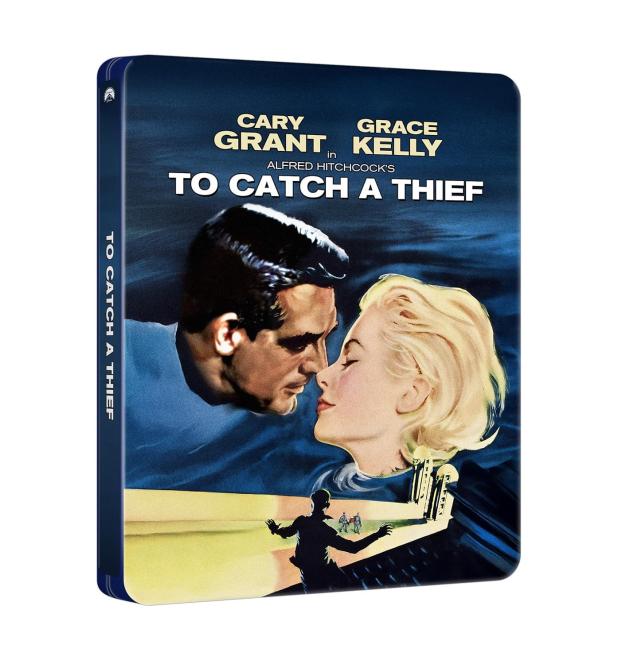
John “The Cat” Robie (Cary Grant) is a retired jewel thief who is suspected of crimes all over the French Riviera. His old gang has gone straight, and maybe he has, too. The only way to prove himself is to catch whoever is pulling off these thefts, working with insurance agent H. H. Hughson (John Williams).
His way of proving his innocence is like casing the joint, starting with Frances Stevens (Grace Kelly) and her mother Jessie (Jessie Royce Landis), who have just come into money. Whenever he’s in trouble, it seems that his old partner’s daughter, Danielle Foussard (Brigitte Auber), is there to save him. But is there just one burglar? Or several? And will Robie be able to pull off stealing Frances away from her mother?
Hitchcock’s first film in VistaVision and last with Grace Kelly, it wasn’t well-received by critics when it came out, as they expected Hitchcock’s suspense. Instead, they got an adventure movie with romance, including a gorgeous scene as Grant and Kelly watch fireworks.
Hitchcock got Grant out of retirement for this movie. With the rise of Method actors like Marlon Brando, he thought no one wanted to see him, and he was upset with how the McCarthy era had treated Charlie Chaplin. After this, he acted for more than a decade.
The Paramount Steelbox of this movie — it’s the only movie Hitchcock made for Paramount that he didn’t get the rights to — has the film on 4K UHD, Blu-ray and a digital code. Extras include commentary by Dr. Drew Casper, a Leonard Maltin feature on To Catch a Thief, featurettes on the Hitchcocks, the writing and casting of the film, censorship, the making of the film and Grant and Grace. Plus, it looks gorgeous and I’m so happy to have it on my shelf.
July 28 – Aug 3 Screwball Comedy: Just imagine, the Great Depression is raging and you’re getting less than a fin a week at the rubber boiling factory, but it only costs two bits to go to the movies all day, so let’s watch some quick-talking dames match wits with some dopey joes!
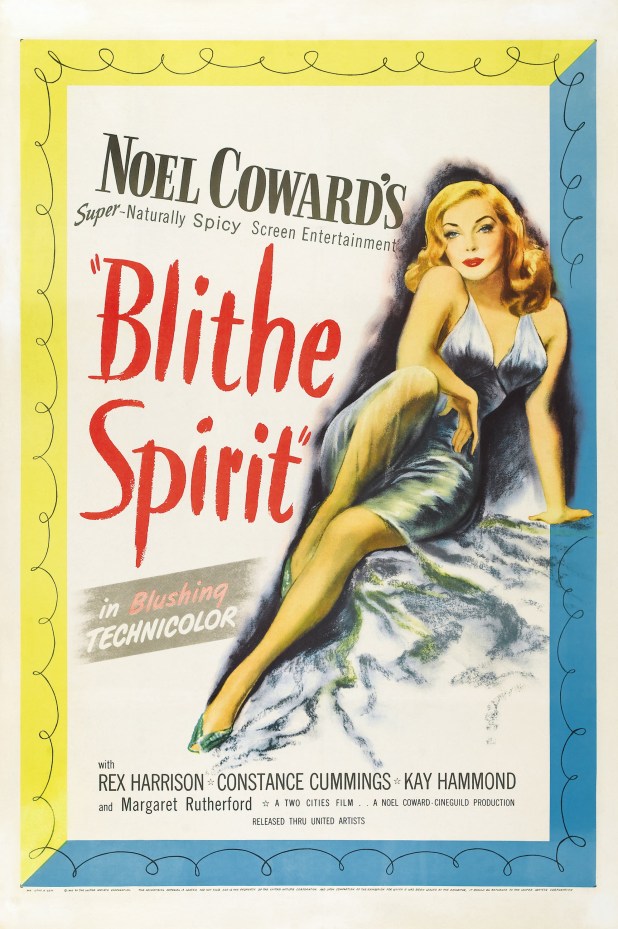
Based on the Noel Coward play, this movie has socialite and novelist Charles Condomine (Rex Harrison) looking for material for his next book. He decides to have Madame Arcati (Margaret Rutherford) come to his home and conduct a séance. As an unbeliever, he’s shocked when it brings the spirit of his first wife, Elvira (Kay Hammond), into his life, as she tries to ruin his marriage to Ruth (Constance Cummings), who can’t see or hear the ghostly form of his first bride.
Coward wanted this cast and screenwriter Anthony Havelock-Allen saw this as one of the reasons why this movie failed, saying “The point of the play is a middle-aged man well into his second marriage, having long ago put away the follies of his youth with his sexy first wife, and suddenly being woken up by her reappearance as a ghost. Rex Harrison was not middle-aged, and Kay Hammond, though a brilliant stage actress, didn’t photograph well and also had a very slow delivery, which was difficult in films. When we started shooting scenes with Kay and Rex, it became obvious that Constance Cummings (the second wife) looked more attractive to the average man in the street than Kay. This upset the whole play.”
In his book, A Serious Business, Harrison didn’t seem to enjoy it either: “Blithe Spirit was not a play I liked, and I certainly didn’t think much of the film we made of it. David Lean directed it, but the shooting was unimaginative and flat, a filmed stage play. He didn’t direct me too well, either – he hasn’t a great sense of humour … By that time, it had been over three years since I’d done any acting. I can remember feeling a bit shaky about it, and almost, but not quite, as strange as when I’d first started, but Lean did something to me on that film which I shall never forget, and which was unforgivable in any circumstances. I was trying to make one of those difficult Noel Coward scenes work … when David said, “I don’t think that’s very funny.” And he turned round to the cameraman, Ronnie Neame, and said: “Did you think that was funny, Ronnie?” Ronnie said, “Oh, no, I didn’t think it was funny.” So what do you do next, if it isn’t funny?”
Coward hated the ending that was added, as it has Charles dying — perhaps due to his wives’ spirits — and joining them as ghosts. He claimed that it ruined the best play he ever wrote.
A classic today, it was a box office disappointment for director David Lean in 1945. It did win Tom Howard the Academy Award for Best Visual Effects.
A prequel to 2003’s The Texas Chainsaw Massacre, this movie reminds me that when a franchise has run out of ideas, they always go backward. Back to the well or, in this instance, back in time for a prequel.
Back in 1939, a woman gave birth in a slaughterhouse and died, at which point the manager threw her infant into a dumpster, where it was rescued by Luda Mae Hewitt, who raised the baby as her son Thomas.
Fast forward to 1969,, and Thomas works in the same slaughterhouseunderr the exact manage. When the plants are shut down by the health department, he refuses to leave. So when the manager pushes him, he gets killed by a chainsaw and his adopted brother Charlie (R. Lee Ermey) kills the arresting officer that comes to their home — Sheriff Hoyt — and takes on his identity.
Thomas eventually becomes Leatherface — are you surprised? — but not before wiping out an entirely different set of teens years before the original movie, including Jordana Brewster from The Fast and the Furious series.
This comes from the days when Platinum Dunes were the Blumhouse of the 2000s, reinventing horror film series like The Amityville Horror, The Hitcher,Friday the 13th and A Nightmare on Elm Street to varying degrees of box office success. Director Jonathan Liebesman was also behind their reboot of Teenage Mutant Ninja Turtles.
At this point, even a fan of the character like me — I dressed as Leatherface for more Halloweens than I can count on a severed hand — checked out.
The Arrow Video release of this film has a 4K (2160p) Ultra HD Blu-ray presentation in Dolby Vision (HDR10 compatible) of both the Theatrical Version and the Uncut Version. Extras include a new audio commentary on the Uncut Version with Dread Central co-founder Steve “Uncle Creepy” Barton and co-host of The Spooky Picture Show podcast Chris MacGibbon and an audio commentary on the Uncut Version with director Jonathan Liebesman and producers Andrew Form and Brad Fuller; interviews with Lew Temple; special effects makeup artist Jake Garber and special effects makeup technician Kevin Wasner and director of photography Lukas Ettlin; a making-of doc; deleted and extended scenes with optional commentary from director Jonathan Liebesman and producers Andrew Form and Brad Fuller and a trailer, all inside a reversible sleeve featuring original and newly commissioned artwork by Aaron Lea with a double-sided foldout poster featuring original and newly commissioned artwork by Aaron Lea and an illustrated collector’s booklet featuring new writing on the film by Michael Gingold.







 B&S About Movies
You must be logged in to post a comment.