“Michael, you are a dirty boy. You are just a giant, sad, dirty man-baby.” — Sebastian, producer and agent from L.A.’s underbelly
To this day I still get the business for making my friends watch Adam Rifkin’s The Dark Backward. I’ll never live down the “movie with the arm coming out of Judd Nelson’s back.” I’m the guy who walks out of a movie theatre after a showing of David Cronenberg’s Videodrome, only to have my date tell me, “you pick the shittiest movies.” Chicks.
So I can imagine your reaction when I show you this teaser that opens with bananas falling on a man’s head . . . alongside images of cats . . . and a voiceover about a naked duck lady with duck boobs . . .
. . . and there’s a cat carrier in flames . . . and 1976-era John Travolta from The Boy in the Plastic Bubble keeps showing up, with musical backing by the obscure, late ’70s teen-pop duo sounds of Donnie and Joe Emerson and the new wave synth-pop drone of Cowboys International. And the fact that I can’t recall any other film that, through ambient sounds and jerky-visual collages, reaches out of the screen like a J-Horror yūrei and induces an uneasy queasiness.
Yeah, this is going to be one weird movie.
Like David Lynch experimental and Andy Warhol avant-garde (bananas?). Like Jim Jarmusch ’80s indie-expressionistic. Like a John Waters Pink Flamingos joint. Like MTV Liquid Television-retro crossed with a USA Night Flight analog bong-hit and a snort of Takashi Miike’s scent for the bizarre (The Happiness of the Katakuris or Visitor Q, anyone?). And that means music video director Michael Reich’s (Ryan Adams, Bad Religion, and My Chemical Romance) feature film debut will be an intelligent cult classic that only a film freak like me will love—and mainstream flick lubbers who pine for Judd Nelson in The Breakfast Club, will hate.
I’m all in, kittie cat.
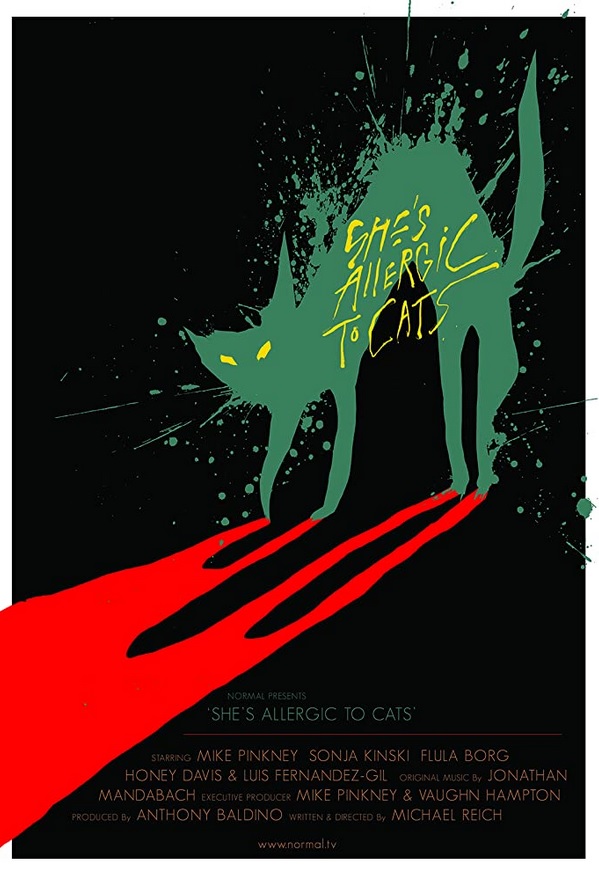
For we are in a land-world somewhere Under the Silver Lake, a movie that, like Sam, the boss at B&S says, “. . . unlike the vast majority of the world,” we loved. And like that Andrew Garfield starrer, She’s Allergic to Cats is impossible to spoil and difficult to explain. But I’ll sure as hell try—and my critical attempt to make sense of it won’t spoil one frame of it for you.
Mike Pinkney (played by meta-Mike Pinkney, who’s Michael Reich 2.0) is another one of those aspiring, emo-nerdy filmmakers who arrives in Tinseltown—and is rejected by the industry. Yeah, pitching an all-talking cat version of Stephen King’s Carrie . . . and embracing ‘80s analog technology in your work . . . has a way of stymieing a career. So he has to settle for a job as animal groomer—but not of cats, but of dogs. And he sucks at his job because, well, he hates his job. And cats.
And he hates his dick of a German agent, Sebastian (the funny-as-hell Flula Borg; he’ll appear as “Javelin” in James Gunn’s upcoming Suicide Squad). And he hates the down-and-out club musician landlord of his rat-infested rental home. But Mike loves his endless tapes of retro ‘80s video art that nobody wants to watch. Yeah, videos of falling bananas and dancing cats have that effect on people.
And by way of his dog-grooming gig, he meets his femme fatale, Cora. And she looks like Nastassja Kinski—because she the real-life daughter (Sonja Kinski) of Nastassja—who starred in Paul Schrader’s Cat People (1982). And Cora hates cats. And she takes Mike on a quasi-horror, acid-trip rom-com that goes meta-film noir—if there is such a genre. If not, Michael Reich just created it.
Giant Pictures debuts this surrealist dark comedy across all VOD platforms on April 7. You can learn more about Michael Reich’s feature film writing and directing debut by visiting sheallergictocats.com and NormalTV. As of December 2020, can now watch it as free-with-ads stream on Tubi.
About the Author: You can read the music and film reviews of R.D Francis on Medium and learn more about his work on Facebook. He also writes for B&S About Movies.
Disclaimer: This movie was sent to us by its PR company and, as you know, that has no bearing on our review. However, based on the teaser and the trailer, we would have rented the VOD anyway.
For Kurt Cobain: February 20, 1967 – April 5, 1994
Before Nirvana, the Spin Doctors, the Red Hot Chilli Peppers and Pearl Jam, no one knew the meaning of grunge, or even cared where Seattle was: flannel was a fashion no-no. Do you remember the days of post-modern and cutting-edge rock, when everyone wore black and they were always depressed? Remember the days when Gen-X’ers were confused, unable to decide if they were “alternative” or “progressive,” so they stumbled through the X-decade, trying to be both?
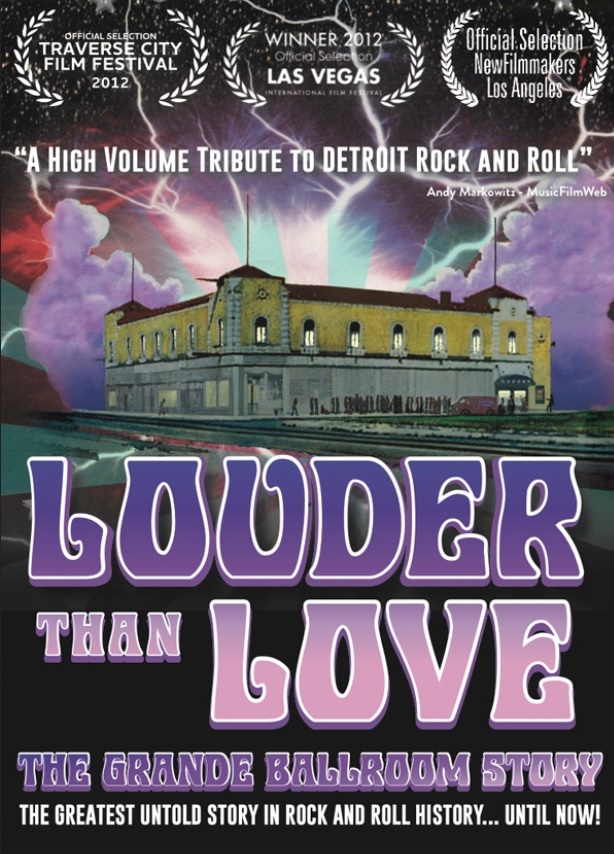
Well before those incoherent flannel days of Seattle, when a muddy, grunge wave swept across America—and while the West Coast was frolicking in the Fillmore to the sounds of the Summer of Love in 1967—Detroit was rippin’ out a hard-driving, gritty and raw sound from the four walls of the scene’s epicenter: The Grande Ballroom.
The Grande is where the likes of the MC5, Iggy & the Stooges, and Ted Nugent & the Amboy Dukes got their start. The Grande also served as the main-Midwest concert stop for legendary acts such as B.B King, Cream, Janis Joplin, Led Zeppelin, Pink Floyd, and the Who. Then there’s the local Detroit bands that made it to the biggest stage in town—some signing record deals, that you may have never heard of—such Dick Wagner’s the Frost, Frigid Pink, Dave Gilbert’s of the Rockets precursor Shakey Jake, SRC, and Arthur Pendragon’s Walpurgis (aka Phantom’s Divine Comedy).
The Grande is the dance hall that started it all. Some of the world’s best bands came from Detroit from 1967 to 1980 and Louder Than Love is the story of those times—of The Grande—as told through the artists who graced her stage.
Filmmaker and music historian Tony D’Annunzio is currently offering a free stream of the U.S. PBS-TV broadcast version of the film (60-minute running time) on his You Tube page. While there’s no online streams of the feature-length version (80-minutes/1 hour and twenty minutes), you can purchase DVDs of that theatrical/direct-to-video version—released in 2016—at various brick-and-mortar and online retailers such as Walmart, Target, and Amazon.
And since this is Kurt’s special day . . . take a moment to remember him with the Seattle documents 1991: The Year Punk Broke on Daily Motion and Hype! on TubiTv. And, while you may not know him, could you take a moment to remember the unsung career of Detroit’s Arthur Pendragon with his lone album.
About the Author: You can read the music and film reviews of R.D Francis on Medium and learn more about his work on Facebook.
In tribute to Kurt Cobain: February 20, 1967 – April 5, 1994
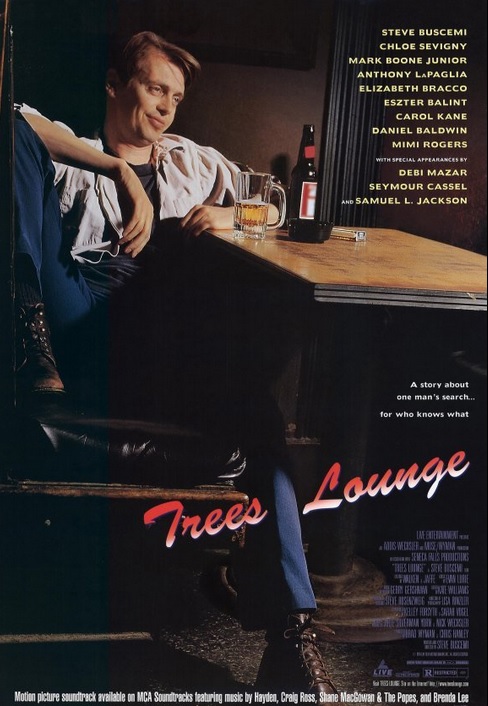
There are two reasons (of many) why I love Trees Lounge: First: It serves as the screenwriting and directing debut by one of my favorite actors: Steve Buscemi. He’s the type of actor who appears in huge, major studio tent poles—like Armageddon and Con Air—and he leaves you clamoring for another film that centers on his character’s backstories. Second: Trees Lounge has an incredible (nostalgic for me), ‘90s college rock radio gem with a theme song from Hayden. If you love Chris Whitley (who? here, listen to this), if you love the alt-country of Uncle Tupelo (who? listen here), or the indie-sounds of California’s Pavement (listen here), Britain’s Placebo (listen here), or the crowded-kings of college rock, Dinosaur, Jr. (listen here), you’ll love Hayden.
Yep. I love Hayden and the college rock era . . .
And Steve Buscemi also loves his rock ‘n’ roll.
“The Stealer” from Paul Rogers and Free (you know, the “All Right Now” guys) receiving a well-deserved soundtrack position? And we’re not hatin’ on Argent’s “Hold Your Head Up,” John Mayall’s “Light the Fuse,” Bachman Turner Overdrive’s “You Ain’t Seen Nuthin’ Yet” and “Roll On Down the Highway,” and Earl Hooker’s blues chops with “Off the Hook,” either. And tunes from The Ink Spots? Just wow.
It’s an incredible soundtrack replicating just what you’d expect in the jukebox at a decrepit, little bar in small-town America. And we have Evan Lurie, who, with his brother John Lurie (John consulted-scored John Travolta’s Get Shorty), founded the ‘80s jazz collective, the Lounge Lizards, to thank. You know Evan though his music consulting and scoring on a wide array of films, such as the Oscar winners Silver Linings Playbook and American Hustle, along with the rest of Steve Buscemi’s writing and directing credits: Animal Factory (2000), Lonesome Jim (2005), and Interview (2007).
Check out the rock video single of “Trees Lounge” . . . featuring Seymour Cassel on drums and Rockets Redglare on guitar?
As for Trees Lounge, the movie . . .
It’s of a time and place. It’s of the ‘90s when indie record labels, such as Homestead, Dutch East, SST, and Caroline, cultivated the college rock scene. Meanwhile, on the big screen, studio imprints, such as Miramax (shameless plug: check out our “8 Films of Quentin Tarantino’s Rolling Thunder Pictures”) and Orion Classics (which distributed Trees Lounge), filled the rising alt-nation’s screens with all manner of indie art-house and foreign films. It was the era that entertained us non-mainstream swimmers with the likes of Greg Araki’s The Doom Generation, Eric Bogosians’s SurbUria, Larry Clark’s Kids, Tom DiCillo’s Living in Oblivion, Richard Linklater’s Slacker and Dazed and Confused, Kevin Smith’s Clerks and Mallrats, Gus Van Sant’s Drugstore Cowboy, Hal Hartley’s Simple Men and Amateur, and Wayne Wang’s Smoke, along with the films Bandwagon, Floundering, Gas Food Lodging, The Low Life, Roadside Prophets, and S.F.W.
Yeah, the ‘90s were my music and film heaven.
I know, I know. “Geeze, Marie, enough with the trip down memory lane. When are you going to review the movie?”
Well, that’s just the point: Trees Lounge is Steve Buscemi’s trip down memory lane.
Long before he became an actor, Buscemi served as a New York firefighter in the early ‘80s at Engine Company 55 in Manhattan’s Little Italy. So, if you’re from the five Burroughs, keep your eyes open: you’ll see your old streets of The Bronx, Brooklyn, Queens, and Long Island.
Rob’s Body Shop doubled as “Nick’s Service Center” (where Steve’s character is fired from). Scenes were shot at Stobierksi’s Lucas Gardenview Funeral Home and Firemen’s Memorial Field (where Steve’s character is attacked-by-baseball bat). The Assembly Bar on Cooper Avenue, in Glendale, Queens, doubles as “Trees Lounge” (where Steve’s character drinks away his troubles). And Trees Lounge was a real place: after the original bar shut down, Steve purchased the sign and restored it for the movie, but he was ultimately not allowed to use it. (So he gifted it to his friend: a waitress-bartender who worked at Trees Lounge for over forty years.) Another autobiographical element of the film: before becoming a fireman, Steve, as his character, drove an ice cream truck on the movie’s same streets.
Influenced by the buck-the-studio system indie flicks of John Cassavetes (1958’s Shadows, 1968’s Faces, 1970’s Husbands, and 1974’s A Woman Under the Influence), by the writings of poet-author Charles Bukowski (whose work was translated as the 1987 Mickey Rourke-starring Barfly), and Jack Kerouac’s novels On the Road (1957) and The Dharma Bums, Buscemi brings his tales of the lonely, lost denizens of Trees Lounge.
It’s the story of Tommy Basilio, an unemployed car mechanic who, even when he was employed, spent most of his time drinking his life away at a blue collar watering hole where he lives alone in an apartment above. And, as with the tragic-heroes of Cassavetes and Bukowksi: Tommy is a self-destructive, Type D personality who blames everyone but himself for his troubles. (In fact, if you salt Tommy with more violent tendencies, you’d get Buscemi’s Carl Showalter in Fargo.)
In quick succession: Tommy loses his job after borrowing money (i.e. he stole it and got caught) from the auto repair shop where he worked; in turn, he loses Theresa (Lorraine “Goodfellas” Bracco’s sister, Elizabeth), his girlfriend of eight years to his boss, Rob (Anthony LaPaglia)—and now she’s pregnant. And Tommy believes he’s the father. To make ends meet, Tommy reluctantly takes over his late Uncle Al’s (Seymour Cassel) ice cream truck route.
Tommy’s logical response to his ever mounting problems: making them worse. And he accomplishes that goal by having an affair with Theresa’s flirtatious seventeen-year-old niece, Debbie (Chloe Sevigny). Then Jerry (Daniel Baldwin), the husband of Patty (Mimi Rogers), Theresa’s sister, takes him to task with a baseball bat and trashes the ice cream truck.
Yeah, it’s only a matter of time before Tommy takes over the stool of longtime barfly, Bill (Bronson Dudley; the “bass player” in the Hayden video) . . . and stares down into the errs of his ways . . . in the bottom of a glass on the bar at Trees Lounge.
The bottom line: Steve Buscemi’s debut as a screenwriter and director is pure magic in a bottle. Not a bad for a film shot for just over a million dollars in 24 days.
And the rest of the supporting cast of Trees Lounge’s outcasts: wow. Rockets Redglare (an actor in over 30 films, he roadied for Billy Joel’s The Hassels and was the Sex Pistol’s Sid Vicious’s drug dealer), Carol Kane (Fred Walton’s When a Stranger Calls), Mark Boone Junior (American Satan), Kevin Corrigan (Ray Liotta’s little brother in Goodfellas; also of the aforementioned Bandwagon), and Michael Imperioli (TV’s Law and Order, The Sopranos; got his start in A Matter of Degrees) are each excellent in their roles. Co-stars Anthony LaPaglia and Debi Mazar (Ray Liotta’s coke-snorting hussy in Goodfellas) also starred in Empire Records. And watch out for Samuel L. Jackson.
So spend a day in Trees Lounge—with movie and the soundtrack. You’ll be drunk-in-amazement on how awesome it all is. You can enjoy this soundtrack re-creation (below) that I cooked up on You Tube. And you can watch the movie for free—with limited commercials—on TubiTv.
In tribute to Kurt Cobain: February 20, 1967 – April 5, 1994
First, there was Rick Van Ryan, the malcontent, social injustice warrior VJ of Incident at Channel Q. Then, when the metal ’80s buckled to the grungy ’90s, the Catcher In the Rye-styled, disenfranchised Generation X’ers of America needed a new hero: they got Cliff Spab.
If Cliff Spab had been a pirate radio DJ, he would have been “Hard Harry” in Pump Up the Volume. If Cliff had gone to college, became enchanted with the campus radio station, and took the course titles “Interdisciplinary Approaches to Ethnicity,” he would have been Maxwell Glass in A Matter of Degrees. A well-read, apathetic convenience store clerk: he’d be Dante Hicks (well, maybe more Randal Graves) in Clerks. If Dustin Hoffman’s Ben Braddock from The Graduate had been a hippie: he’d be Spab. A filmmaker: he’d be Alan Shapiro in duBeat-eo—each expounding the same Holden Caulfield nihilism-cum-Abbie Hoffman anarchism. And, is it just me, but is Ethan Hawke’s Troy Dyer from 1994’s Reality Bitesjust a little too close-for-comfort-Spab coincidental?
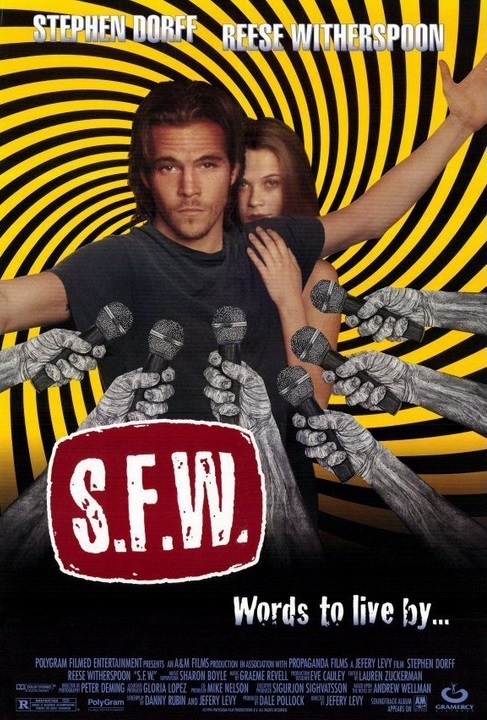
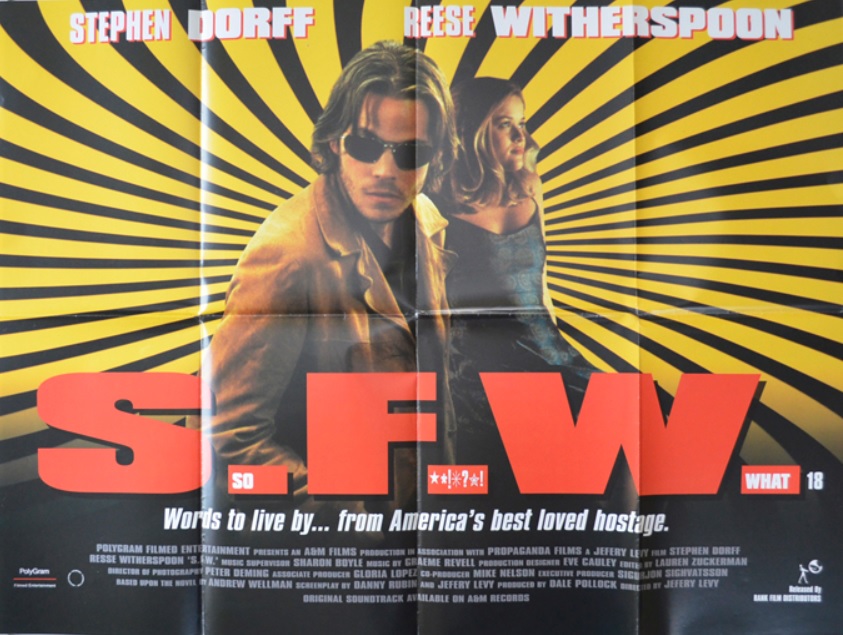
R.E.M’s Michael Stipe produced (Welcome to the Dollhouse, Velvet Goldmine), along with noted rock video producer Sigurjon Sighvatsson (Hard Rock Zombies, American Drive-In), this loose adaptation of Andrew Wellman’s satiric Generation X novel that explores the price of fame colliding with reckless tabloid journalism. Stephen Dorff (while he played the role younger, he made his big screen debut in 1987 at the age of 14 in the “No False Metal” classic The Gate; he recently wrapped the first season of FOX-TV’s Deputy) is the apathetic-reluctant hero, Cliff Spab, whose “catch phases”—his stock answer to everything is “So Fucking What?”—during his captivity of a televised hostage crisis, transforms him into a media sensation—and his unwanted, new found fame serves as a bigger prison than his previous apathetic fast-food worker lifestyle (apparent in the novel; lost in the movie).
In this tale of youth alienation, Oliver Stone’s Natural Born Killers goes grunge as Spab becomes a nation anti-hero after surviving for 36 days as one of five hostages in a non-descript, suburban Detroit convenience store by a gang of armed, camera-wielding terrorists—complete in white janitor-jumpsuits and stocking masks—who force the networks to carry the crisis in its entirety on the air. When Spab and his childhood friend, Joe Dice, kill the terrorists (and Dice dies in the process), Spab becomes a media sensation, alongside fellow hostage Wendy, an upper-class girl (Reese Witherspoon), splashed across the covers of magazines and reported on TV ad nauseam.
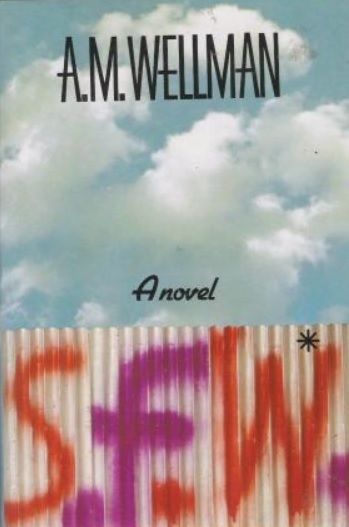
The novel’s writer, Andrew Wellman, at the age of 21, won the 1989 Playboy College Fiction Award and was quickly signed by Random House. The publisher then took the “unfinished” award-winning manuscript “The Madison Heights Syndrome,” (at a breezy 147 pages, the book is more novella than as the novel it is marketed), and chose a truncated version of the Spab character’s oft-repeated dismissive as the new title. And, because of the book’s timely correlation to the grunge ethos sweeping America, the book was marketed for a movie deal. If you read the now out-of-print book (my local library still has a copy), you’ll discover Wellman’s social commentary analogous to the voice of Bret Easton Ellis, whose (awesome) novels of disenfranchised malcontents—Less Than Zero (1985), The Rules of Attraction (1987), and, to a lesser extent, American Psycho (1991)—were adapted into films (that were more successful than S.F.W.).
Sadly, as is the case with cinematic adaptations of books-to-screenplays, an author’s flights-of-fancy narratives must be compressed, with events and characters composited and sanitized to the Hollywood screenwriting standard of 90 to 110 pages. As result, the film loses Wellman’s effective analogy regarding the sensationalistic tendencies of film by having Spab hiding out inside an abandoned movie theatre—where the character relates his story in flashbacks (just a like a movie).
Luckily, the film retained the book’s character of Morrow Streeter (an excellent Jake Busey; the jarhead “Ace Levy” in Starship Troopers), Spab’s shady-violent friend who’s prone to gay-bashing and pulling guns on and urinating on girlfriends (toned down for the film, natch). Another film highlight alongside Busey’s is Richard Portnow’s (Howard Stern’s dad in Private Parts) FBI agent who’s utterly convinced the store siege was an elaborate ruse perpetrated by Spab.
Another creative, celluloid choice that stifled the power of Wellman’s book is the film’s awkward “message” on consumerism—by stocking the non-descript convenience store with similarly non-descript, white-packaged generic item (e.g., cans of soup say “soup,” paper towels, say “paper towels” with no brand names). The “artistic” images and its related “message” flat lines on the screen.
And what’s the deal with Gary Coleman from TV’s Diff’rent Strokes being cast (it’s not in the book) alongside the clumsy-uncomfortable Tori Spelling-clone (aka, the sexually-degradingly named “Dori Smelling”) in the “TV movie version” of the hostage crisis? And there’s Levy’s “in-joke” with one of his previous film’s characters from Inside Monkey Zetterland (played by Steve Antin) appearing. What’s the point? What’s the message? The self-deprecation—especially Coleman’s—falls flat. (As a kid actor, Dorff starred in an episode of Diff’rent Strokes; were they still friends and did he bring Coleman onto film?)
Then there’s the . . . well, I can best describe it as the “Eddie Murphy Coming to America gag”—via the casting of John Roarke (lots of network TV series, but I remember him best from the truly awful sci-fi comedy rental, 1989’s Mutant on the Bounty) as the thinly-disguised clones of popular, real-life celebrity journalists Alan Dershowitz, Phil Donahue, Sam Donaldson, Ted Koppel, and Larry King. True, Roarke is a very talented impressionist-mimic, but unlike Eddie Murphy’s work (also in The Nutty Professor), it’s obvious to the viewer it’s the same actor in each of the rolls. We’re not fooled. And telling us that the “distortion” of the celebrity reporters are being filtered through “Spab’s point of view” doesn’t sell it either. Why would he “distort” reporters in his mind to look like Phil Donahue? The gag induces groans and any intentions at contemporary hipness are a total loss; the film would have been better served by playing it straight via casting an array of actors as faux-celebrity news hacks.
In the end the Coleman and Roarke celluloid subterfuges negate the film’s goal: the irony of the media complex transforming tragedies (e.g. 9-11) into television “programming” and then dipping in their hands in the tills a second time with their post-adaptations of those misfortunes with biographical and fictional films (World Trade Center, United 93).
S.F.W. was written by Danny Rubin (Bill Murray’s Groundhog Day) and directed by Jefrey Levy. Levy’s career began with the multiple award-winning, 1991 independent feature Drive (starring David Warner, of From Beyond the Grave and Ice Cream Man, as an acidic, middle-aged Brit reduced to chauffeuring the rich, liberal elite). During your mid-‘90s HBO excursions, you may have come across Levy’s feature film debut proper, Inside Monkey Zetterland (1992), a semi-autobiographical tale about an out-of-work gay screenwriter in Hollywood. That film starred Steve Antin (“Jessie” of Rick Springfield’s video hit single, the teen comedy The Last American Virgin, Don Coscarelli’s post-Phantasm flick Survival Quest, and three seasons on TV’s NYPD Blue; he wrote and directed the 2010 Christina Aguilera and Cher-starring bomb, Burlesque).
After the failure of S.F.W., Levy rebounded with a successful directing career on U.S network television and self-produced a couple of never-heard-of-them, low-budget indie flicks. Rubin, after writing the Marlee Matlin and Martin Sheen-starring Hear No Evil (1993), vanished from the business.
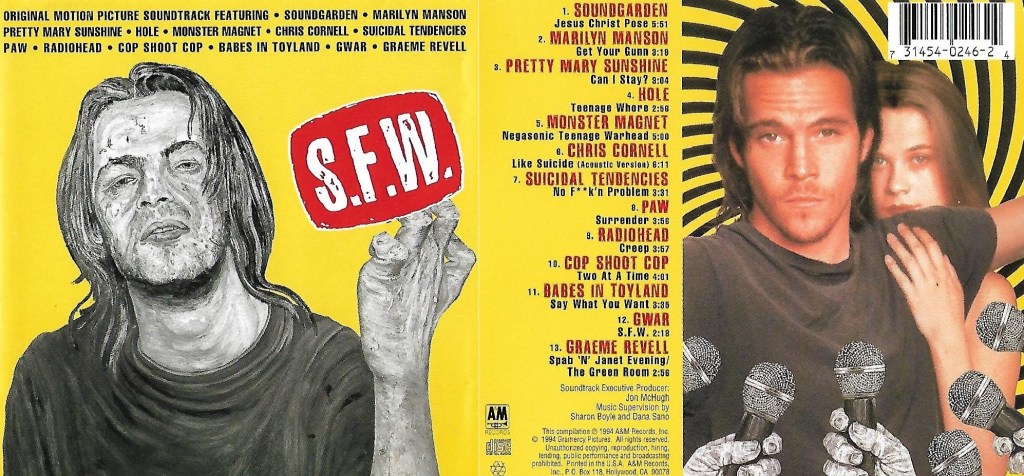
At the time of S.F.W.’s release, grunge was all the rage and the major label record companies and film studios couldn’t sit back and allow the indie label network (Homestead! Dutch East! SST! Caroline!) and college radio stations (staffed with guys like me) that birthed the alt-rock ‘90s in the first place, rake in all the dough. So began a corporate synergy to create a plethora of soundtrack-film hybrids with the likes of the aforementioned A Matter of Degrees, along with Kevin Smith’s Clerks (the soundtrack clearances cost more than the film itself), and Ben Stiller’s Reality Bites. The only problem: the soundtracks for most of these films featuring the then college radio and MTV 120 Minutes and IRS: The Cutting Edge darlings—especially in the case of A Matter of Degrees—were more successful than the box office bomb movies they promoted. And the S.F.W. soundtrack is no exception.
“Jesus Christ Pose” — Soundgarden “Get Your Gunn” — Marilyn Manson “Can I Stay?” — Pretty Mary Sunshine “Teenage Whore” — Hole “Negasonic Teenage Warhead” — Monster Magnet “Like Suicide (Acoustic Version)” — Chris Cornell “No Fuck’n Problem” — Suicidal Tendencies “Surrender” — Paw “Creep” — Radiohead “Two at a Time” — Cop Shoot Cop “Say What You Want” — Babes in Toyland “S.F.W.” — GWAR
Three songs appearing in the film but not on the soundtrack (clearance issues) are the Ronnie James Dio-era of Ritchie Blackmore’s Rainbow with “A Light in the Black” (featured in the trailer), Australia’s Mantissa with “Mary, Mary” (they appear via their rock video on TV), and Ireland’s Therapy? with “Speedball.” And while they make an appearance via a “Spab Tribute Concert” and spew some dialog, Babes in Toyland do not perform their soundtrack contribution. (Personally, we could have done without the Coleman bit and had Babes in Toyland “live” on stage; the Cheap Trick original of “Surrender” (which could have been a nice homage to the similarly themed, juvenile delinquent flick Over the Edge (a Kurt Cobain favorite) on the soundtrack, and had Paw represented by their then popular tunes of “The Bridge” or “Jessie.”)
And there was one more song that was planned to be included in the film. And if this chain-of-events sounds a lot like Cameron Crowe wanting to include “Smells Like Teen Spirit” in his 1992 grunge-flick entry Singles. . . then it probably is.
In the pages of a June 1994 issue of Entertainment Weekly (yes, the studio put their full marketing gauntlet behind the film), director Jefrey Levy spoke of the Cliff Spab-to-Kurt Cobain parallels, as both were just regular kids with extraordinary sensitivity thrust into extraordinary circumstances. So, to that end, Levy wanted to include Nirvana’s then hit single, “All Apologies,” from the band’s third album, In Utero.
Levy stated that while Cobain responded positively to the movie, he failed to acquire formal permission to include the song due to Cobain’s suicide (on April 5, 1994) shortly after. Levy did, however, as a consolation prize, was able to include the song “Teenage Whore” from Kurt’s widow, Courtney Love and her band Hole (for the scuzzy-love scene between Spab and Joey Lauren Adams’s Monica Dice). Cobain’s peripheral attachment to the film took on an eerie quality when Love, during the televised park vigil reading of Cobain’s suicide note, kept chastising Cobain with the term “So fucking what?” over and over.
And did that Cobain connection, in conjunction with the soundtrack that our favorite college radio DJs spun ‘n plugged (as with A Matter of Degrees and Clerks) make us rent the VHS copy, then search out Andrew Wellman’s book? Yep!
What’s that? You need more grunge? Then check out our tribute to ’90s Gen-X films with “Exploring: 50 Gen-X Grunge Films of the Alt-Rock ‘90s,” which we also touch on, in part, with our tribute to radio stations on film: “Exploring: Radio Stations on Film.” And, speaking of box office failures (S.F.W.‘s total box office take was less than $65,000 against an unknown eight-digit budget), we explored a week of those films with our recent “Box Office Failures Week.”
And, with that, we’ll catch you on the “flippity flop,” Kurt.
About the Author: You can read the music and film reviews of R.D Francis on Medium and learn more about his work on Facebook.
In the late ‘90s, Robert Altman (M.A.S.H, Nashville, Quintet) transitioned into television with an innovative approach to the anthology-narrative format: Gun, which aired on the ABC-TV network. Each unrelated episode—with new plots and characters for each story—followed a .45 semi-automatic pistol on its travels from person to person.
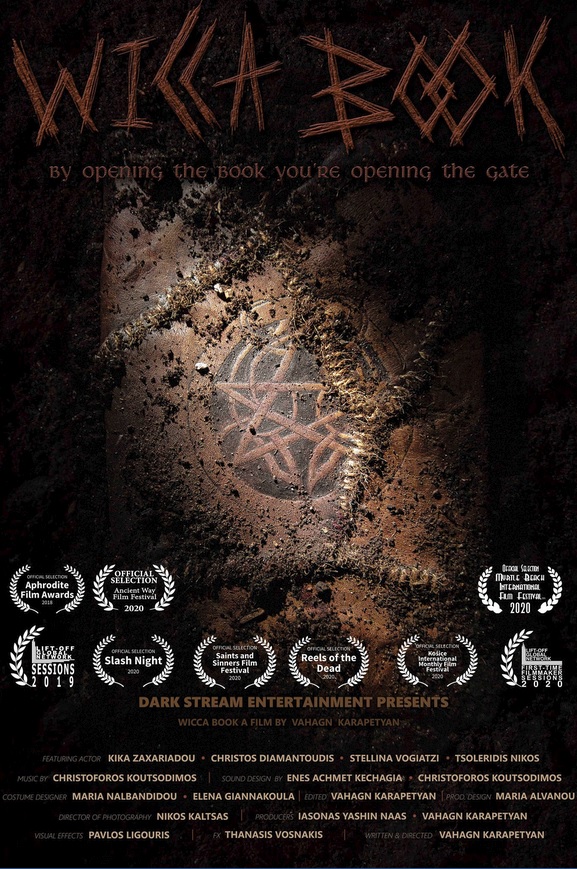
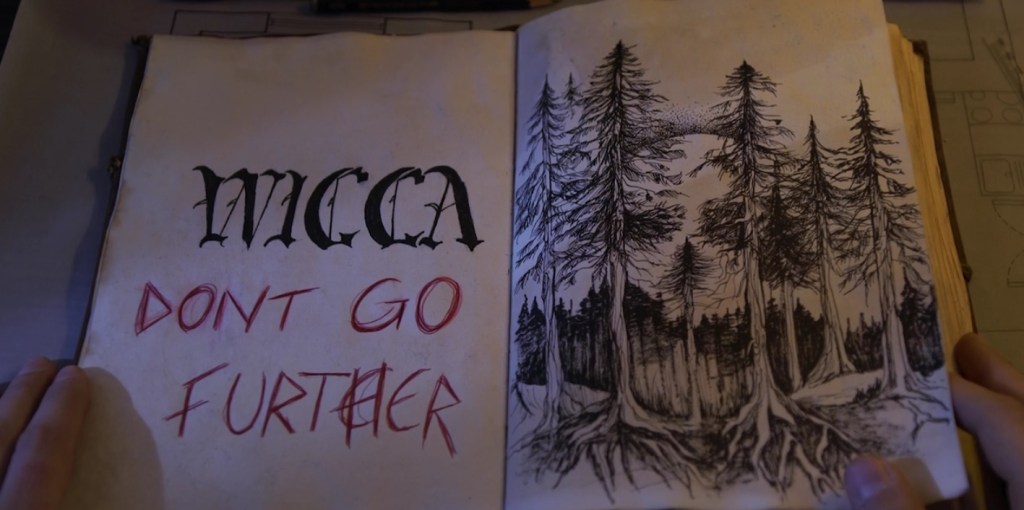
In Wicca Book, writer-director Vahagn Karapetyan’s seventh short film, we have an intelligent amalgamation of the Altman concept plopped into the Sam Raimi universe—unfolding as a Hieronymus Bosch, medieval triptych: a garden of Greek horror centered on an ancient grimoire (convincing-beautifully crafted by artist Maria Alvanou) that passes from owner to owner. However, while there’s a Raimi connection via an ancient text (that Raimi pinched wholesale from 1970’s Equinox; sans the Dave Allen and Jim Danforth creatures), make no mistake: There’s no Bruce Campbell hammy buffoonery: a Rob Zombie-styled, Dario Argento homage snared in Karapetyan’s fisheye lens.
Film, at its core, is a visual medium. It’s an art form based in “showing” and not “telling”; for film is 90% visual and 10% dialog (and the stage is the reverse). Images tell the story though props, an actor’s body language and, most importantly: that your actors are not skilled in the craft of acting—but “being.” This is an art at which Karapetyan and his actors excel: there’s no dialog across his film’s 22-minute run time. While, at first glance, Wicca Book may be a bit longer than a short film should be, in this case, there’s not one superfluous frame on screen: every minute is artistically warranted. It’s masterfully edited.
In addition to a film’s dialog-barren image, music can also induce emotion in those frames. And all of the film disciplines are at their finest in Wicca Book as Karapetyan formulated a solid, celluloid-symbiotic relationship between cinematography Nick Kaltsas, Foley artist Enes Achmet Kechargia, and musician Christoforos Koutsodimos. He proves you do not need any title card preambles or voiceover prologues—or any dialog—to bring on the fear and dread.
And the terror unfolds in the triptych’s first panel: A frantic knock and doorbell ring at the apartment door of a young architectural student (Christos Diamantoudis) reveals the ancient text stuffed in a plastic garbage bag with a note saying, “It’s yours.” And as he turns the pages, it seems the book was written especially for him. And, it seems, the cries of children rise from its pages. He tries to destroy it; the pages won’t tear or burn. Then something presses at the front door; it wants in . . . . And he becomes one of book’s ink-scratched pages.
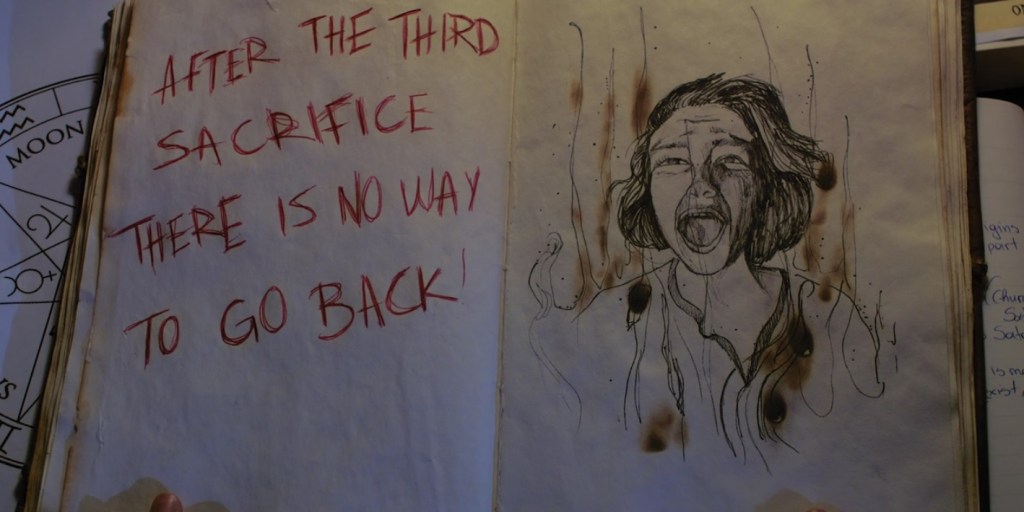
In the longer, second panel: The now unbound demon comes to the dreams of Mia, a young archeological student (Kika Zachariadou), and inspires her to discover the book while spelunking. Upon opening the book, her name appears in blood on her bathroom mirror and, the book instructs her to “give it away.” Then we learn the truth: Mia was the frantic knock and doorbell ring opening the film; she passed the book onto the architectural student. But it was a trick: By giving the book away, not only will she sacrifice the receiver: she’ll transform into a witch. So, to save them both, she breaks into his apartment, steals the book, and tries to return the book from where it came. As she runs from the apartment, she runs into her neighbor: the book’s instructed third sacrifice is complete. Mia will become a witch, after all.
The Bosch garden rots in the third panel of this supernatural triptych, as Mia returns to the cave (with an inspired POV shovel-in-the-dirt shot) for a final knife-wielding showdown with The Devil. . . .
Wicca Book is a horror film of old, not of the modern film world that wobbles on the crutches of shock-scares and motion-captured, CGI-grafted gore. This is a film that reminds of Gloria Katz and Willard Huyck’s feature film debut, 1973’s Messiah of Evil (a movie so good, we reviewed it three times: HERE, HERE, and HERE), L.Q Jones’s Brotherhood of Satan, and Burt I. Gordon’s Necromancy. Wicca Book is a classic, shot-in-camera ‘70s-styled suspense-horror flick, like those Dan Curtis ‘70s U.S TV movies of old (shameless plug: check out our Exploring: Dan Curtis featurette). (Also, please note that there’s neither reference of nor an appearance of Hieronymus Bosch’s medieval triptych in the film: that is my personal interpretation of the film’s narrative structure.)
While attending Aristotle University, Karapetyan, an Armenian director and writer based in Greece, wrote a thesis paper: “How a Traditional Myth Becomes a Horror Film,” so he knows his material. While I haven’t seen Karapetyan’s six previous horror shorts, based on what I’ve seen with Wicca Book, I wait in anticipation for his first international English language feature film, Go Dark, currently in its pre-production stages. I also believe all of the parts are there for Wicca Book to be expanded into a feature film as well.
Referring to my comment regarding the runtime: 30-minute programs are actually 17 to 22-minutes in length. Once you add commercials, you have a half-hour program; so again, the length works in that regard and Wicca Book could become a television series. Another goal is to turn Wicca Book into a web-series, using elements of time travel to explore the book’s birth in 16th century New England and how the book came to be in the cave explored by Mia. The concept—in any form—is exciting and worth following its development.
It may take some time, but Vahagn Karapetyan is on his way to becoming a voice in Euro-horror. And all good things take time. Wicca Book is currently under the wing of Film Freeway, so let’s hope it comes to a U.S film festival sometime soon near you. It’s worth the price of admission. You can learn more about the film at Darkstream Entertainment on Facebook and Vahagn Films on Facebook.
About the Author: You can read the music and film reviews of R.D Francis on Medium and learn more about his work on Facebook. He also writes for B&S About Movies.
Disclaimer: This movie was sent to us by its PR company and, as you know, that has no bearing on our review.
What a happy, accidental discovery—considering B&S About Movies is in the midst of its “James Bond Month” extravaganza.
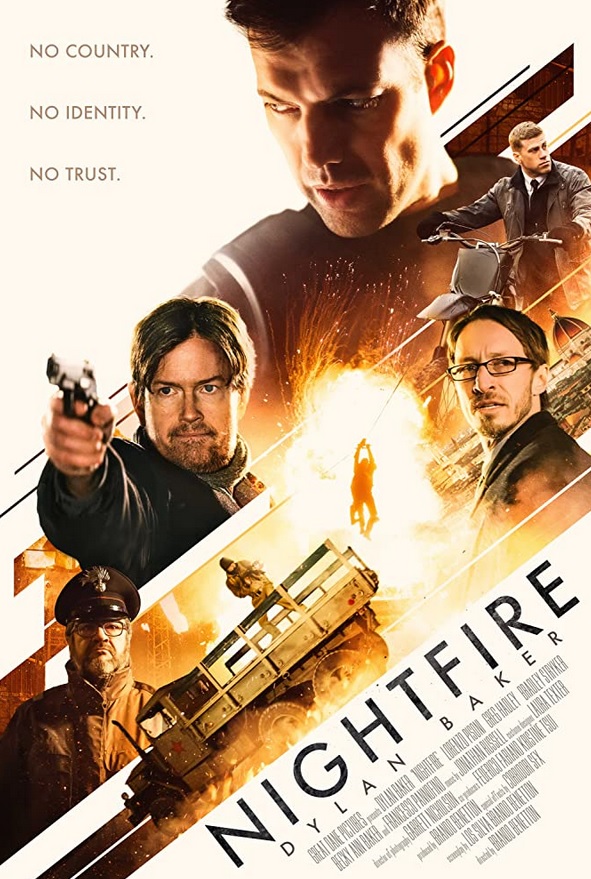
Filmed in the popular cinematic location of Verona, Italy, one of the locations for the 2008 James Bond entry, Quantum of Solace, Nightfire is a timely story about the plight of the Ukrainian people and the United States’ involvement in that country’s conflict.
At the Sokov Military Base, located 32 miles from the Ukrainian border of the country of Belarus, the mission of CIA operatives Carter (Lorenzo Pisoni; guest star on U.S TV’s The Good Wife, Law & Order: SVU, and Elementary) and Ross (Greg Hadley; new to the scene and very good here) to retrieve two military chips containing top-secret content goes awry when they compromise their mission objective to rescue Olivetti, an international political prisoner. And Carter comes to discover it’s never about the freedom of a country and its citizens: it’s always about greed. And no one is who they say they are.
The marquee name here is the-you-watch-anything-he’s-in Dylan Baker, as Olivetti. Dating back to his support role in Steve Martin’s Planes, Trains & Automobiles, you’ve come to know Baker as he delivered the goods countless times on U.S television series, such as Law & Order: TOS and the Chicago P.D./Fire franchise, along with his starring roles on Blindspot, The Good Wife, and Homeland—and his role as Dr. Curt Conners in Sam Raimi’s Spider-Man franchise. The cast is rounded out by Bradley Stryker (guest roles on TV’s Arrow, Cold Case, and CSI:NY) and Becky Ann Baker (star of HBO’s Girls, as well as The Blacklist and Hunters).
Nightfire is the fifth student-short production by French-born writer-director Brando Benetton and, considering this is a college thesis project shot on a low budget in 14 days—the quality is of an astounding, major studio quality. That quality comes courtesy of the production’s use of Red Epic Dragon cameras and the implementation of non-CGI practical effects. The car chases and real explosions are masterfully executed by the Corridori Brothers—you know their work; nothing too exciting: just films like the The Italian Job, Mission: Impossible III, and Spectre (the team also worked on maestro Dario Argento’s Do You Like Hitchock? and Giallo). Considering the 45-minute runtime, the spy action-thriller adventures of Lorenzo Pisoni’s Agent Carter can easily be picked up by a major U.S television or grittier cable network and expanded into an hour-long drama. If not, there’s definitely a feature film in its experimental, truncated frames.
Benetton is currently working as a Second Assistant Director on a very intriguing feature film—his first feature—currently in post-production. Voodoo MacBeth concerns the young and arrogant Orson Welles staging the first all-black production of Shakespeare’s Macbeth in 1936 Harlem.
You can learn more about Nightfire and the career of Brando Benetton courtesy of a three-minute behind the scenes vignette on the Vimeo page of Great Dane Productions. You can watch Nightfire as an Amazon Prime and Hulu stream beginning May 1. It has since become available on the free-with-ads steam service, Tubi. Benetton has since worked as a first assistant director on the indie drama Voodoo Macbeth and thriller, The Summond (both 2021).
Disclaimer: This movie was sent to us by its PR company and, as you know, that has no bearing on our review.
About the Author: You can read the music and film reviews of R.D Francis on Medium and learn more about his work on Facebook.He also writes forB&S About Movies.
I’ve long since surpassed my Hollywood-mainstream film attendances with my affection for the new breed cultivated in film festivals: I love going to film festivals, seeing short films, and acting in short films: the camaraderie of the indie environs is pure electric. It’s oxygen. It’s life.
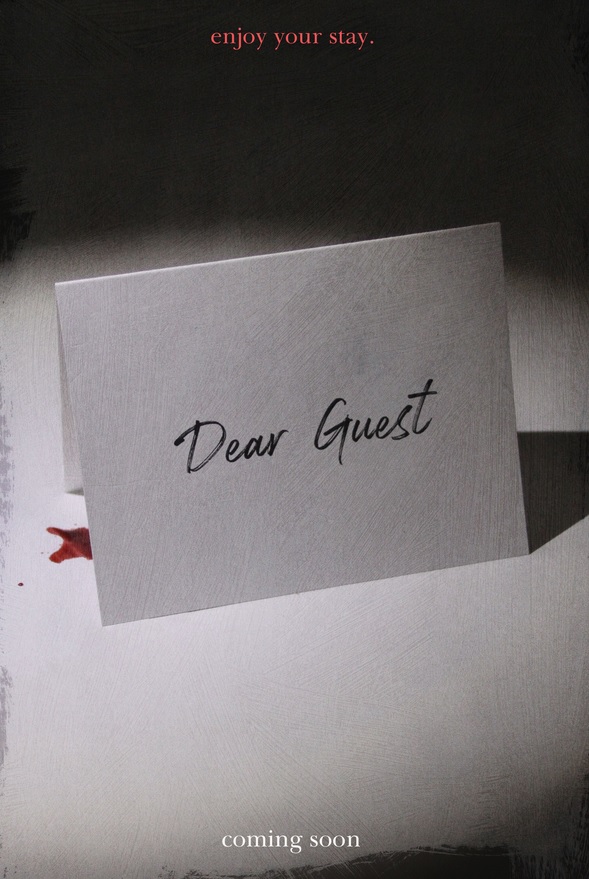
I got my start in the entertainment industry by way of radio broadcasting, where I was able to support indie-labeled bands and unsigned local musicians. And that affection for the independent spirit carried over as I started acting in indie shorts (I even supplied props, wardrobes, and “roadied” them). And watching a film like Dear Guest makes me jealous, and nostalgic at the same time, as none of my writer-directors possessed the skills of Megan Freels Johnson.
I appreciate that Johnson understands the concept of a short film. Short films should be just that: short. Dear Guest is well-written and edited, and gives us full-character arcs and development in the space of 10 minutes: exactly as a short film should. No, this won’t turn into a college thesis on the craft of screenwriting, and act structure, and etc., but take my word for it: Megan Freels Johnson knows her stuff—and a bag o’ chips.
Currently making the rounds at a film festival near you, Dear Guest is a psychological noir-thriller of the Alfred Hitchcock-cum-Twilight Zone variety—with a twist of Polanksi (and one more of our favorite writer-directors)—where nothing is at it seems.
The “dear guests” are Maria and Jules (Ashley Bell of The Last Exorcism and Noureen DeWulf of NBC-TV’s currently-airing Good Girls), a couple who checks into a beautifully furnished rental for a long-awaited vacation, only to discover they’ve walked into an elaborate mouse-trap tended by its anonymous host.
“I’m so happy I made you take time off work,” kisses Maria.
“You didn’t make me,” scowls Jules.
Uh, oh. Maria needs a rethink . . . in more ways than one. This vaycay is going off the rails, one way or another.
Then, as Jules goes off to check out the bedroom and put away their bags—she vanishes. Then the front door to the house is locked—from the outside. And a plain white “Dear Guest” place card appears in the empty bedroom—with a riddle held within its crease.
Jules discovers she’s a game piece and she needs to follow the clues: such as that theatrical one-sheet for Ann-Margret’s The Swinger . . . and that Hot Wheels car on the floor. . . . Maria’s been kidnapped, bound and gagged in the garage, inside a car . . . and the card is rigged to go up in flames.
As the couple tries to escape, another card appears on the rear kitchen door—with bullet-soundproof glass, and the house is covered in it. What will happen during the next three days, discloses the place card.
When the camera slowly zooms—in conjunction with the ambient tinkles of a xylophone backed by ominous strings—on that stoic, poolside griffin through the prison-like wrought iron fence . . . wow. That’s a pure—and welcomed—Dan Curtis vibe, he the master of ‘70s psychological and supernatural thriller TV movies. And we should know: we waxed nostalgic for a whole week over his resume (shamless plug: check out our last month’s Exploring: Dan Curtis featurette roundup).
Here’s to hoping the plans to expand this chiller into a feature film come to fruition, as we want more. And that is exactly what a short film should do: leave you wanting more. . . .
You’ll also remember Ashley Bell from her guest appearance on a rerun of CSI: Crime Scene Investigations (I’m currently binging on it) and Showtime’s United States of Tara. You’ll also recognize Noureen DeWulf from her role as “Lacey” on Fox-TV’s Anger Management and her support roles in the theatricals Ghosts of Girlfriends Past and The Backup Plan. The point: you know the acting in Dear Guest is top-notch.
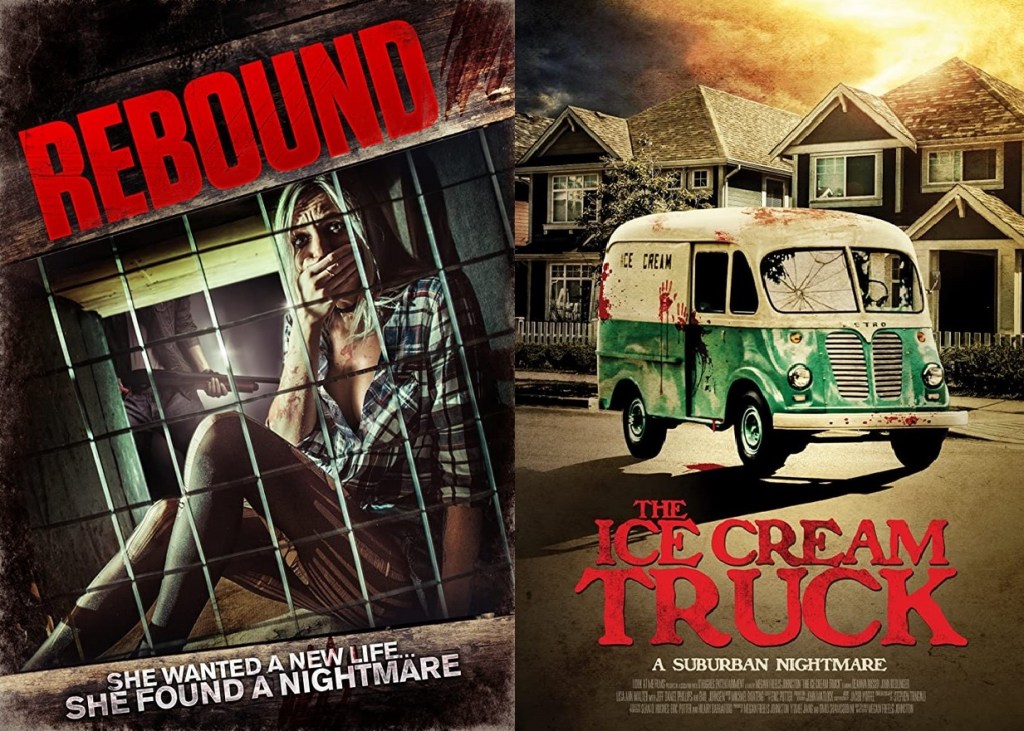
You can watch Megan Freels Johnson’s feature film writing and directing debut, 2014’s Rebound, for free—via a legal stream with limited commercials—on TubiTv and Vudu, or via your Amazon Prime, iTunes, and Google Play accounts. Her follow up to Rebound, 2017’s The Ice Cream Truck, is also available on the TubiTv and Vudu platforms, as well as Amazon Prime, iTunes, Google Play, and You Tube Movies.
Johnson’s third and fourth feature films in her horror oeuvre, Hunting Season and Asking for It, are currently in pre-production. And Hunting Season sounds really good, as any movie with Bruce Davison, from the horror classic Willard, usually is (and we get Meadow Soprano, aka Jamie-Lynn Sigler, in the bargain): Deanna Russo of The Ice Cream Truck stars as a young woman on a weekend getaway with her new boyfriend, only to discover “hunting season” is all year round. Who’s the cat and who’s the mouse? Who’s the hunter and who’s the prey?
I have to admit: I wasn’t aware of Johnson’s work until writing this review for Dear Guest, so I’m going to let you go. It looks like I’ve got some movies to watch.
Oh wait! Sorry, but we have to click bait you with another shameless plug before you go. (Send your complaints to Megan: she’s the one making movies about ice cream.) So, when you get a chance, check our B&S reviews for one of my favorite films, Clint Howard’s Ice Cream Man, and Sam’s, Santa and the Ice Cream Bunny.
Okay. Now class is dismissed. See you on Monday. Beware the Ice Cream Man, kids.
About the Author: You can read the music and film reviews of R.D Francis on Medium and learn more about his work on Facebook. He also writes for B&S About Movies.
Disclaimer: This movie was sent to us by its PR company and, as you know, that has no bearing on our review.
“You’d be directing a god damn student film on a fucking iPhone!” — Bob Moseby, producer of (the film within the film) The Sleep Experiment
As the diabolical Moseby dug his Norma Desmondesque claws into Jack Archer, the desperate, struggling director chosen as his murderous pasty, I was reminded of poor Jack’s entertainment industry neo-brethren in screenwriter Joe Gillis from Sunset Boulevard (1950), Michelangelo Antonioni’s neo-trapped photographer in Blowup (1966), and Brian DePalma’s Hitchcockian-twisting sound effects technician in Blow Out (1981).
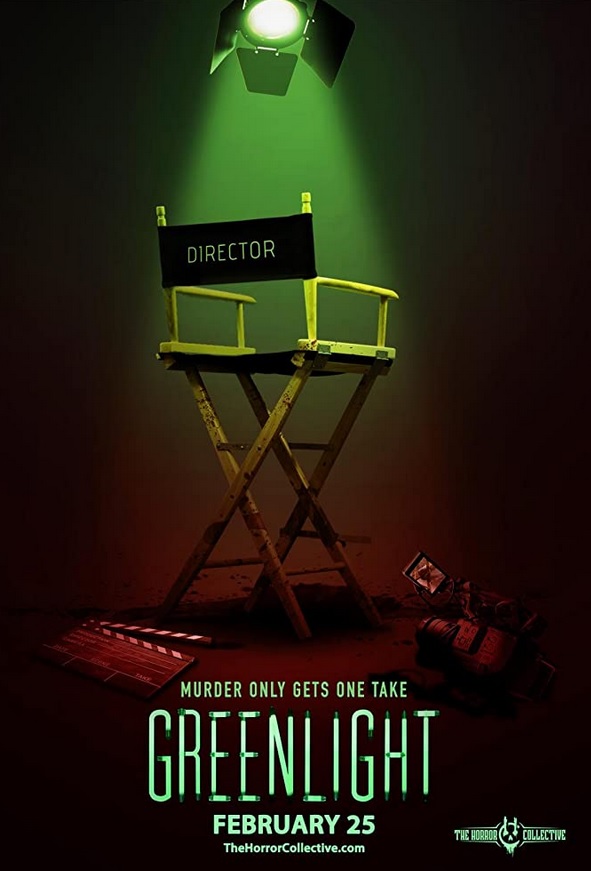
Yes. Although this noir low-budget film from is from a first time director and an unknown screenwriter, Greenlight illuminated with the same excitement I felt when I watched the ‘90s neo-noir trifecta from the genre’s master, John Dahl, with Kill Me Again (1989), Red Rock West (1993), and the crowned jewel, The Last Seduction (1994).
“Horror films don’t win awards, but psychological thrillers do.” — Bob Moseby
Let slip the red herrings and neo-dogs of noir. Get ready for your close up, Mr. Archer.
And so begins Jack Archer’s maddening descent as his Hollywood dreams smudge n’ smear into an ouroboros nightmare when, instead of a Ms. Dietrichson dangling an anklet, our neophyte director is Walter Neff’d by a femme fatale in the form of an attractive, complement-showering actress dangling the old “I know a producer looking for a director” carrot. Oh, Jack. You can’t be that neo-naïve. . . .
And there’s Moseby’s wife, the “star” of the film. And what McGuffin is she hiding?
Then, once the once-great Moseby has his mook on hook, he blackmails Jack into pulling a “Brandon Lee” on one of the actors—as a “marketing gimmick” for the film. Yep, the dead body is already set up. And so is the DNA. But it’s never just about the “gimmick,” is it, Bob?
Screenwriter Patrick Robert Young earned his Final Draft stripes with a pair of damsel in distress flicks for Lifetime: My Teacher, My Obsession (2018, aka Dad Crush)* and Pretty Little Stalker (2019)*. Now we all know that Lifetime’s female demo-skewing thrillers and psycho-chick romps are hit-and-miss, but after watching Young’s superb turn of a phase and multilayered psychological plotting in Greenlight, it seems seeking out those two Lifetime flicks are in order.
Young’s screenplay is wicked smart, rife with fun filmmaking references and horror film nods that, even if you’re not in the industry and just a movie goer (well, streamer these days), you won’t feel left out. He scribed great dialog that displays a bard’s skills for balancing darkness and humor—and that realistic dialog is brought across the finish line by Chase Williamson as Jack Archer and, especially, Chris Browning as the egotistical Bob Moseby: both are absolutely stellar. And lead actors are only as good as their supporting cast—and they deliver as well.
Pulling together the great script and solid cast is Graham Denman, an actor who’s obviously learned his craft across an array of shorts and web series and directing four shorts before being given his Jack Archer-shot at the big time—and Denman nails it. It is my sincere belief that there’s a major studio development team out there watching a copy of Greenlight right now—and they’ve placed Denman on their shortlist as a director to greenlight.
And kudos on the casting, as Denman could have easily gone the put-a-star-name-on-the-box route to put bodies in the seats. He could have easily cast Eric Roberts—who excels at diabolical, ulterior motive characters like the smarmy Bob Moseby (as his work in the radio station-set neo-noir Power 98 and the political-noir Lone Star Deception proves). But Denman opted to give unknown, under-the-radar actors a shot. And it was the right choice.
While under-the-radar, you’ve seen the cast of Greenlight via their starring roles on network TV series and support roles in feature films: Chris Browning appeared as “Gogo” in Sons of Anarchy, along with Will Smith’s Bright, Cowboys & Aliens, Let Me In, and Steven King’s Mercy. Shane Coffey was in Pretty Little Liars, Craig Stark appeared in Quentin Tarantino’s The Hateful Eight, Victor Turpin in Ma, and Chase Williamson made his leading man debut in Don Coscarelli’s John Dies at the End. And you’ve seen Nicole Alexandra Shipley in Guardians of the Galaxy, Caroline Williams in The Texas Chainsaw Massacre 2, and Brian Cousins goes back to our Charles Band VHS rental favorites Mandroid and Invisible: The Chronicles of Benjamin Knight.
A rousing success on the festival circuit, Greenlight was acquired for distribution by The Horror Collective specialty imprint after the film’s world premiere at the Los Angeles Shriekfest Horror Film Festival, where it won a deserving “Best Thriller Feature Film” award and a “Best Male Performance in a Feature Film” win for Chase Williamson. Rolled out on all VOD and digital platforms this past February, you can find Greenlight on Amazon, Google Play, Vudu, and You Tube Movies.
* You can stream Patrick Robert Young’s My Teacher, My Stalker on Amazon, Netflix and Vudu, while Pretty Little Stalker is available on Amazon and Vudu.
You can sample both films with their trailers, below.
Disclaimer: We didn’t receive a screener copy of Greenlight from the PA firm for the film’s distribution company. We discovered this movie all on our own and genuinely loved it.
About the Author: You can read the music and film reviews of R.D Francis on Medium and learn more about his work on Facebook. He also writes for B&S About Movies.
At first glance, it’s easy to slag this meta-horror homage to ’80s SOV horror (we discuss that analog genre of VHS-taped films with our review of John Howard’s Spine) as an “amateur film school project.” And, in fact, there are reviews for this inventive amalgamation of the ’80s SOV and ’90s mockumentary and found footage genres that say just that, for this, the writing and directing debut from Jody Barton.
It’s a family affair! The gang’s all here!
Jody Barton is a man of reinvention: he was a civil rights attorney with a burning to desire to work as an actor. So, with the wanderlust of a beat poet, he moved to Los Angeles to work as an actor and filmmaker. And across 30 shorts and indie features (since 2009; including a role in 2019’s Beyond the Law with Steven Seagal), Barton worked his way up to a leading role in Hunting Alice, a currently in-development streaming series.
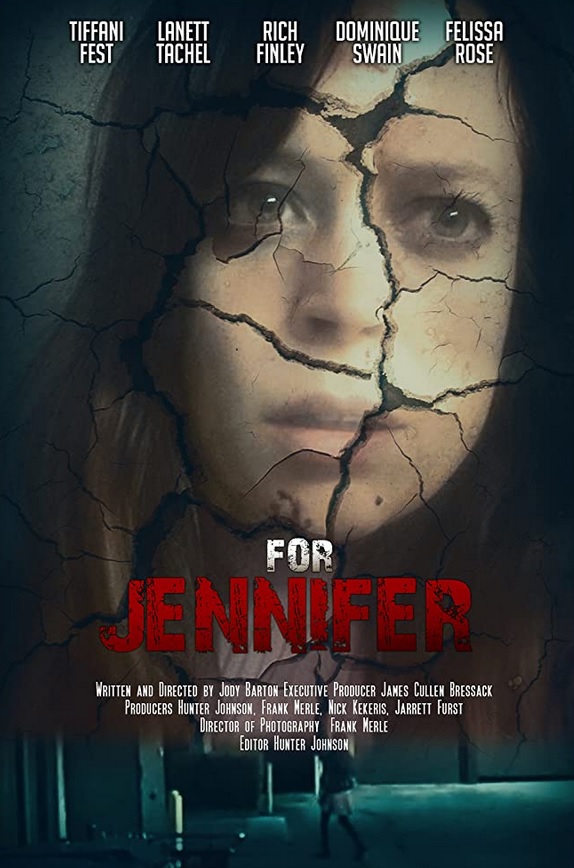
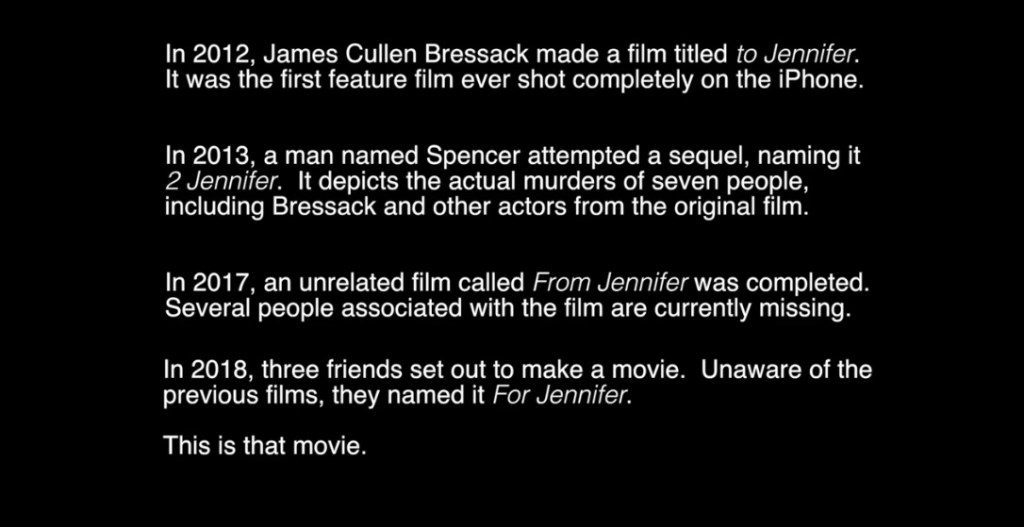
Now Barton’s written and directed his debut feature film, For Jennifer, the fourth film in the SOP series (films in which he also starred) that includes James Cullen Bressack’s (directed Beyond the Law) to Jennifer, Hunter Johnson’s 2Jennifer, and Frank Merle’s standalone film, #From Jennifer.
Bressack initiated the series with the groundbreaking to Jennifer (2013), which he shot entirely on an iPhone 5. The first commercially-released SOP film, it documents the story of a scorned boyfriend who sets out to find and confront Jennifer, his cheating girlfriend—which leads to a bloody climax.
The Felissa Rose (A Nun’s Curse*) starring 2Jennifer takes a film-with-a-film approach: Spencer (the excellent Hunter Johnson), a horror blogger and aspiring filmmaker makes his own film about the Jennifer mystery set forth in to Jennifer—and it becomes a pseudo snuff film (that reminds of Michael Powell’s 1960 classic, Peeping Tom) courtesy of its mentally unstable filmmaker: Bressack and his actors from to Jennifer are the victims.
The standalone—and Tony Todd (Candyman) starring—#For Jennifer concerns an Internet-fame obsessed actress who will achieve fame at any costs and her blood, and of others, spills: the “curse” of Jennifer resulted in the disappearance of those filmmakers.
For Barton’s entry in the franchise, Felissa Rose returns from 2Jennifer as one of the “Jennifers,” and introduces two new characters: Randi, played by Dominque Swain (The 6th Friend, A Husband for Christmas), and another “Jennifer,” Tiffani Fest (Rootwood*; itself a meta-horror).
As a surprise horror-themed birthday celebration for Fest’s horror movie fan and blogger unfolds, one of her gifts—revealed to be from a stalker—is a copy of scenes from the series’ second installment, 2Jennifer—and it leads to her having a car accident. To lift her spirits—and to satiate her curiosity as to who and what happened to Jennifer and where the first two Jennifer films came from—she and her friends decide to shoot their own movie. At that point the meta-venture goes off the rails, with film fantasy blurring with bloody reality, as her life, and of her friends, will suffer the fates depicted in the previous films. And the red herrings are a-flopping: who’s the stalker? The masked guy at the party no one knew? The guy Jennifer hit with her car? Her boyfriend’s creepy buddy Gene? The clerk at the video store?
A Blair Witch vibe? I ain’t hatin’ that vibe.
For Jennifer isn’t a film for those who prefer traditionally-shot films; you’ll critique the cinematography and acting as “bad.” And that’s the point: the movie is shot by horror-blogging aficionados who love horror film—with zero filmmaking skills. And the actors are supposed to “look” like they’re acting: because they’re not “actors.”
In referring back to the ‘80s SOV/Spine analogy: For Jennifer is clearly the better film—and the gold standard (if there is one) for SOP horror—across the disciplines of screenwriting, cinematography, lighting, and acting. Especially screenwriting, courtesy of Barton’s self-deprecation of not only his own film, but the low-budget horror genre in general, when the cackling killer (intentionally overplayed to prove a point) chastises Jennifer for making a boring film with too much talking and that you “need kills” in a horror movie. That’s when For Jennifer film blazes through its third act: everybody dies—via their blood soaked POVs.
To get on board the For Jennifer sequels-narrative, one needs no explanations—as with all of the Halloween remake-reboots on how “this movie connects to that movie via this timeline,” etc. If you didn’t see the first three Jennifers: not a problem. Barton’s smart script pays homage to the predecessor trio while it creates its own standalone narrative—like James Cameron did with the sequel gold standard: Aliens vs. Alien.
If you’re intrigued by metacinema, films that break the fourth wall, and faux-urban legends driven by a “video diary” format colliding with the SOV and found footage genres, you’ll enjoy Jody’s Barton’s debut film that “solves” the Jennifer mystery. For his first time effort—using phones and handicams—it’s a commendable work; he learned the craft well, due to his association with James Cullen Bressack. I look forward to Barton’s accomplishments in a conventional narrative and technical format.
Also equally exciting: Bressack’s follow up to Seagal’s Beyond the Law, Alone, stars Bruce Davison of the ‘70s horror classic, Willard. Currently in post-production, the film concerns a woman’s fight for survival against sex traffickers. And the acting performance of Hunter Johnson, in his brief return here as Spenser, is stellar. His extensive resume is mostly shorts, web series, and indie films—but he’s ready for the mainstream. Somebody book this guy with a guest role on a network series: book him on a Law and Order: SVU (my favorite TV series). And this friggin’ rockabilly rippin’ end credits tune from the Cold Blue Rebels, rules. Hell yeah!
On a release rollout since November 2018, For Jennifer made its online streaming debut on Amazon via JB Films.
* My reviews for Tiffani Fest’s Rootwoodand Felissa Rose’s A Nun’s Curseare coming to B&S About Movies on April 7 and May 5, respectively.
About the Author: You can read the music and film reviews of R.D Francis on Medium and learn more about his work on Facebook. He also writes for B&S About Movies.
Disclaimer: This movie was sent to us by its PR company and, as you know, that has no bearing on our review.
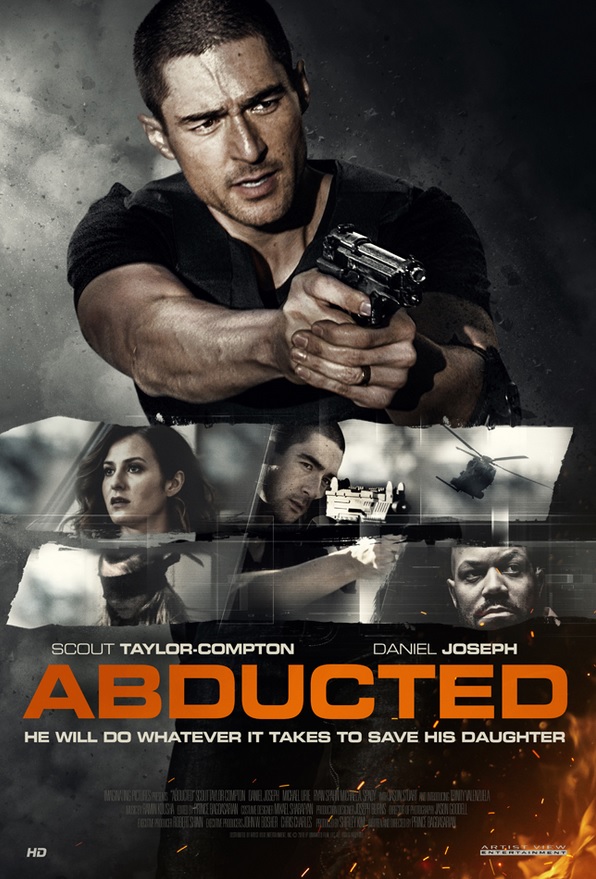
There’s nothing like a free week of Showtime to expose you to a new flick. And having the reliable Scout Taylor-Compton (Rob Zombie’s Halloweenreboots, 2019’s Eternal Code, 2020’s upcoming Getawaystarring Lane Caudell)—if you haven’t figured out by the title—in this abduction thriller, is an added bonus.
I first assumed this was the latest in the long line of writer-director Steven C. Miller’s serviceable action-thrillers packed with morally-screwed characters, such as the Bruce Willis-starringFirst Kill (2017), the Nicolas Cage-starring Arsenal (2018), and the Aaron Eckhart-starringLine of Duty (2019).
Abducted is actually the work—the second film—of a new director on the scene, Prince Bagdasarian, who’s amassed an extensive list of credits as an editor (one of his films is the 2009 Werner Herzog-directed Bad Lieutenant: Port of Call New Orleans starring Nicolas Cage). In 2013, Bagdasarian completed his first feature film, Abstraction, a crime drama revolving around the heist of a million dollar painting, starring Eric Roberts (who just released his own action-thriller, Lone Star Deception).
Still dealing with the death of his wife, U.S. military veteran Dane Hunte (Daniel Joseph) now works as a truck driver to support his young daughter, Eden (the film’s original title was Diverted Eden), while his gay brother-in-law, Todd (LGBT actor Michael Urie from TV’s Ugly Betty), looks after the child.
A violent home invasion—that seems to be connected to Hunte’s military past—at Todd’s house leaves his partner in a coma and Eden kidnapped. In steps the resourceful Detective Fini (Scout Taylor-Compton) assigned to the case. But as is the case with these action-thrillers, the law is useless, so the ex-solider works his shady contacts and stocks his arsenal for a “scorched earth” solution that takes him into the city’s criminal underbelly.
While Taylor-Compton’s name is on the box, this is clearly Daniel Joseph’s show—and he excels in his feature film debut. Taylor-Compton’s casting in the film as its selling point (it made me watch), instead of Bruce Willis or Nicolas Cage, as is the case with most of these direct-to-video potboilers, is appreciated—especially when her ass-kicking, neon-lit club scene unfolds. In addition to having Hunte’s immediate family as a gay couple, kudos also applies to Bagdasarian creating a deaf character in the film for Hunte’s war buddy (who’s involved in the invasion-kidnapping), played by real-life deaf actor Michael Anthony Spady.
While IMDb user-reviews haven’t been kind, I found Abduction to be a wonderful, accidental discovery and a great example that Prince Bagdasarian is a writer and director worth following for his future works: he works his tight budgets with skill. In addition to watching Abduction as a Showtime exclusive (it premiered March 1) on their cable TV platforms, you can watch it on their Showtime Anytime online platform and stream it on Hulu. You can also watch Bagdasarian’s debut, Abstraction, as a free-with-ads stream on TubiTV and watch the trailer on You Tube.
The film’s award wins to date, are:
The People’s Choice Award for “Best Director” at the Hollywood Reel Independent Film Festival.
“Excellence In Film,” “Best Editing Feature,” and “Best Cinematography Feature” at the Action on Film International Film Festival.
“Audience Award” at the ARPA International Film Festival.
“Best Editing” at the Hollywood Reel Independent Film Festival.
Prince Bagdasarian recently announced his third and fourth features have gone into production: Bluebird and Uncontrolled. In his press release, he revealed the plot for Bluebird: Trapped during a bank robbery, a young girl with telekinetic powers evades capture and unleashes havoc against the secret government agency that has seized control of her isolated, small town.
You can learn more about those two films, and more, courtesy of Prince’s interview with Voyage LA Magazine. He previously spoke on the digital pages of Pop Horror. You can follow Prince’s work — with lots of great behind-the-scenes production stills — at PIB Productions Facebook.
Disclaimer: We didn’t receive a screener copy of this film. We discovered it on Showtime all on our own and enjoyed the movie.
About the Author: You can read the music and film reviews of R.D Francis on Medium and learn more about his work on Facebook.He also writes forB&S About Movies.



 B&S About Movies
You must be logged in to post a comment.