SHUDDER ORIGINAL: Nocebo (2022)

Christine (Eva Green) designs clothing for children and one day, at work, she has a breakdown after receiving a phone call. Then, a ghostly dog appears and shakes ticks and fleas all over her with one lodging at the nape of her neck. Her life is destroyed, her work suffers and she must take multiple drugs and sleep with a mask on just to keep some semblance of health. That’s when her new caregiver Diana (Chai Fonacier) — who she doesn’t remember hiring — comes to save her. Then again, as we’re in the realm of folk horror, much less Filipino folk horror and more specifically Bisaya/Cebuano folk horror, a lot can and will happen.

Her husband Felix (Mark Strong) distrusts Diane yet she’s able to return the spirit and health that Christine lost while being able to find a way to bond with Bobs (Billie Gadsdon), their unreachable daughter. Of course, that’s because she’s an ongo, a sorcerer of sorts who was given her powers when she watched an old woman die and her powers — in the form of a bird — flew into her mouth. While her power allowed her to heal the people around her, they also feared her and stayed away.

Felix finds Christine’s drugs, which have been hidden away, as well as an altar in Diane’s room. They make her leave the house but by then, the spell has been cast. The illness inside Christine is directly related to her destroying — man, spoilers on, obviously — Diane’s life when she demanded that the sweatshop that makes her clothes — the same place Diane made her living — increase production and be locked so that people can’t leave with her product. A fire soon destroys everything and because the door was locked, everyone dies, including Diane’s daughter while she watches helplessly outside, clutching the coconut water that her daughter had asked for.

Sadly, that tragedy in the factory is based on reality. The film’s credits have the Filipino song “Pugon” by The General Strike, a song all about the 2015 Kentex slipper factory fire that killed 74 people. The lyrics state:

They died at work This box caught fire Imprisoned and buried They were burned there In the factory that became a furnace

The credits feature the words “Justice for all Kentex fire victims.”

Sadly, it will have to be in this movie.

Directed by Lorcan Finnegan and written by Garret Shanley, the surprises may be easy to see, but to see capitalism destroyed in such a final way by someone that has been forgotten makes this a film worth watching.


What’s On Shudder: March and April 2023

Here’s what’s playing on Shudder this month and next. Click on any title with a hyperlink to see our review.

March 1: Gretyl and Hansel

March 2: Spoonful of Sugar

March 9: The Company of Wolves

March 13: Holidays

March 17: Leave

March 20: Jack Be Nimble

March 27: After Blue and Ultra Pulpe

March 31: The UnheardThe FogThe Blair Witch Project and Book of Shadows: Blair Witch 2

April 3: The Slumber Party MassacreMagic

April 4: Don’t Panic

April 6: Slasher: Ripper season premiere

April 10: Bog

April 14: Kids vs. Aliens

April 17: Final ExamPrimal RageDarklands

April 25: The Boulet Brothers’ Halfway to Halloween TV Special

April 28: From Black

Most importantly…

Don’t have Shudder? Plans start at under $5 a month and you can get the first week free when you visit Shudder.

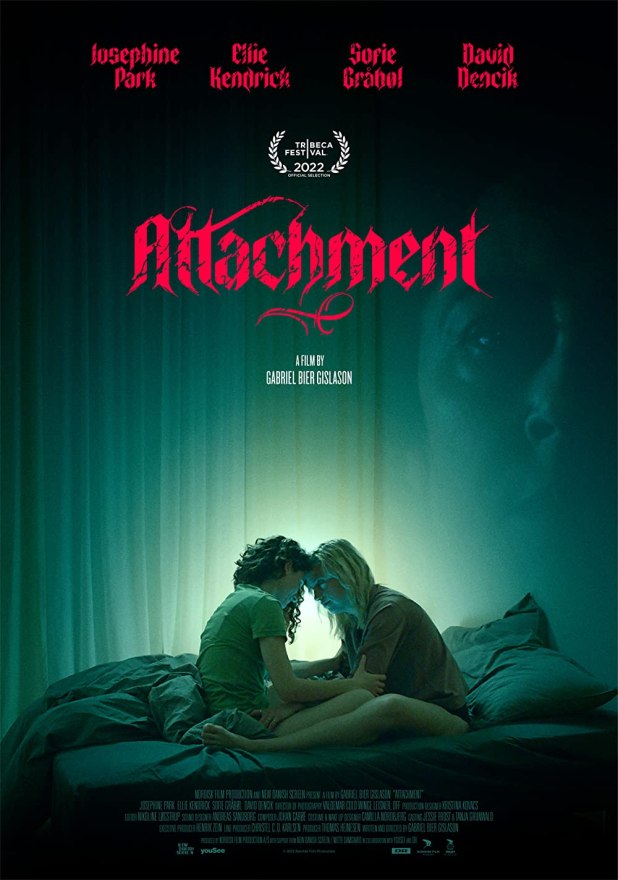
SHUDDER ORIGINAL: Attachment (2022)

If anything, this movie has a relationship that you want to see make it. Maja (Josephine Park) and Leah (Ellie Kendrick) meet cute in a library and accidentally switch books. As they meet up again to trade, the two go for tea, which turns into wine, which turns into the kind of relationship that shuts out of the rest of the world. Everything is perfect until a night when Leah has a seizure that breaks her leg. That’s when all the missed calls from her mother and avoidance of her past life all make more sense.

Maja goes with Leah back to her home in London, in the same building as her mother Chana (Sofie Gråbøl), a woman who seems to believe that only she can take care of her daughter. As you can imagine, there are the worries of a new relationship, much less what could be a forbidden one within the orthodox Jewish community where Chana and Leah live.

It might seem strange for anyone. But then throw in all those symbols, talk of demons and meetings with bookstore owner Lev (David Dencik) who reveals that there’s even more going on — he’s also Leah’s uncle and gets pulled into this drama — and you have quite the predicament for young love.

Director and writer Gabriel Bier Gislason allows the leads time to win you over while also building the tension with Jewish mysticism and mentions of golem and dybbuk. It’s intriguing to see a side of possession film outside of Catholic religion and Lev makes both great comic relief, source of exposition and someone who is amazed when what he has only read of in books because horrifyingly real.

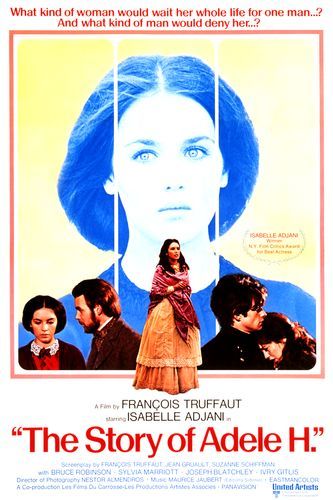
NEW WORLD PICTURES MONTH: The Story of Adele H. (1975)

Distributed by United Artists in director and co-writer François Truffaut’s native France, this was put out by New World in the U.S. It’s a love story about Adèle Hugo (Isabelle Adjani), the second daughter of Victor Hugo, and also was a love story for Truffaut, who fell for his twenty-year-old leading lady. She turned him down; dude, I saw Possession and yeah, I get it. I totally get it.

Also, by love story, I mean that Adèle spends the entire movie pining for Lieutenant Albert Pinson (Bruce Robinson), first in innocuous ways and then in ways that ruin his life and then in ways that grasp at straws, such as trying to have him hypnotized into loving her and attempting to connect with her dead by drowning sister from beyond the grave to aid her in winning over the military man.

She says at one point that she will walk across the ocean to be with her lover. She has built him up into near mythic levels of nobility and romantic power. Surely, were their relationship to ever be consummated, he could never live up to the man that he is inside her head. Again, I totally get it. While never consumed with the mania that she displays — the film ends with her wandering the streets of a foreign country, unable to even recognize Pinson but still in love with the man she conjured years before — I am guilty of falling in love with the people I have believed people to be, want them to be, need them to be and unfairly wondering why they can never live up to my near-impossible romantic notions. It’s a horrible thing to be in love with someone who does not exist as the person you know them as.orrible thing to be in love with someone who does not exist as the person you know them as.

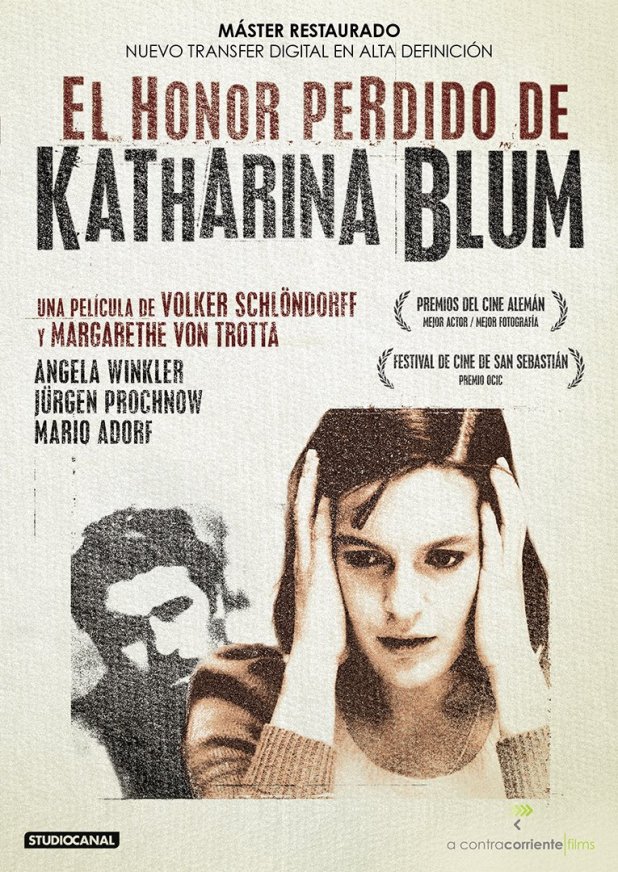
NEW WORLD PICTURES MONTH: The Lost Honour of Katharina Blum (1975)

It’s pretty amazing seeing how many movies from New World or distributed by Roger Corman are in the Criterion Collection: The Harder They ComeCries and WhispersFantastic PlanetAmarcord and this movie. While Corman’s produced films may be about car crashes and half-nude nurses (in jail), he could certainly pick movies to champion.

The Lost Honour of Katharina Blum, or: How violence develops and where it can lead is based on the novel of the same name by Heinrich Böll and is an indictment of how society and the media can demonize women, which is a heady subject for a movie, again, distributed by Corman.

Katharina Blum (Angelina Winkler) is a housekeeper whose lawyer boss refers to as “The Nun” because of what a prude she is. Yet when she gets involved with Ludwig Götten (Jürgen Prochnow), an anarchist and bank robber, she gets her name hung out to dry in the tabloids and accused of aiding and abetting the would-be terrorist. That newspaper goes so far that it ruins all of Katharina’s relationships and even causes her mother to die in the hospital, misinterpreting her last words to make it appear like she hated her daughter.

Unable to get her own story out, she finally kills a reporter and his photographer. That reporter is buried as a hero, seen as someone using his ability to tell the real story. His coffin gives the film an opportunity to call out the yellow journalism of German tabloid Bild-Zeitung.

When this was made, West German tabloid newspapers worked hand in hand with the police to publish pretty much anything they wanted about anyone they wanted. The reporter makes up stories about Katharina for the entire film and then expects her to sleep with him because he gave her what so many people want. He made her famous.

NEW WORLD PICTURES MONTH: Lucky Girls (1975)

Lucky Girls is the name New World Pictures gave to Qui comincia l’avventura or the even better title Blonde In Black Leather. It was directed by Carlo Di Palma, who is probably better known for his cinematography on movies like Mighty AphroditeShadows and FogHannah and Her Sisters, and, under the name Charles Brown, Terror-Creatures from the Grave. He also directed Teresa the Thief and was a focus puller all the way back in 1948 on Bicycle Thieves.

He co-wrote this film with Barbara Alberti, who also worked on one of my favorite films, Hotel Fear, and Amedeo Pagani, who had collaborated with Alberti on that film and The Night Porter.

What emerges is a charming romp in which the leather-clad Miele (Monica Vitti, dubbed by Carolyn De Fonseca) takes her friend Claudia (Claudia Cardinale, The Butterfly Affair) on an episodic adventure driven by the sheer force of the personality of its leads. Miele spends one moment having her leather suit hand polished while she’s wearing it; if you were Claudia, slaving in a laundrette for a horrible husband, wouldn’t you leave behind your mediocre life and jump on the back of Miele’s motorcycle?

There’s also an incredible moment where Miele and Claudia outfight every man in a casino and the scene almost takes on a filmstrip feeling where with each click, we’re seeing her knock out another man. As if that isn’t enough, the score by Riz Ortolani makes it all work even better.

By the end, maybe Miele is more of a tall tale teller than we originally believe, but she’s given agency and escape to Claudia. Consider this Thelma and Louise but with a happier close.

New World released this on a double feature with Candy Stripe Nurses, which is what I call a dream night at the drive-in.

The fabulous Temple of Schlock shared this image of it playing under the Blonde In Black Leather title.

STAY UP LATE AND GET SCARED WITH THE DIA LATE NITE MOVIE!

This Saturday at 11 PM EST, join Bill and me for one frightening flick on the Groovy Doom Facebook and YouTube channel.

We’re watching Deathdream which you can find on YouTube and Tubi.

Every week, we watch movies with you, but we also share information about the film, discuss its ad campaign and share a drink recipe. Here’s the one for this week.

Joanne’s Letters

  • 1 oz. high proof rum
  • 1/2 oz. tequila
  • 1/2 oz. Midori
  • 1/2 oz. Chambord
  • 1/2 oz. passion fruit syrup
  • 1 1/2 oz. orange juice
  • 1 1/2 oz. pineapple juice
  • Dash, grenadine
  1. Combine all ingredients in a shaker with ice except rum. Shake, then pour into a glass.
  2. Top with rum and enjoy.

See you on Saturday!

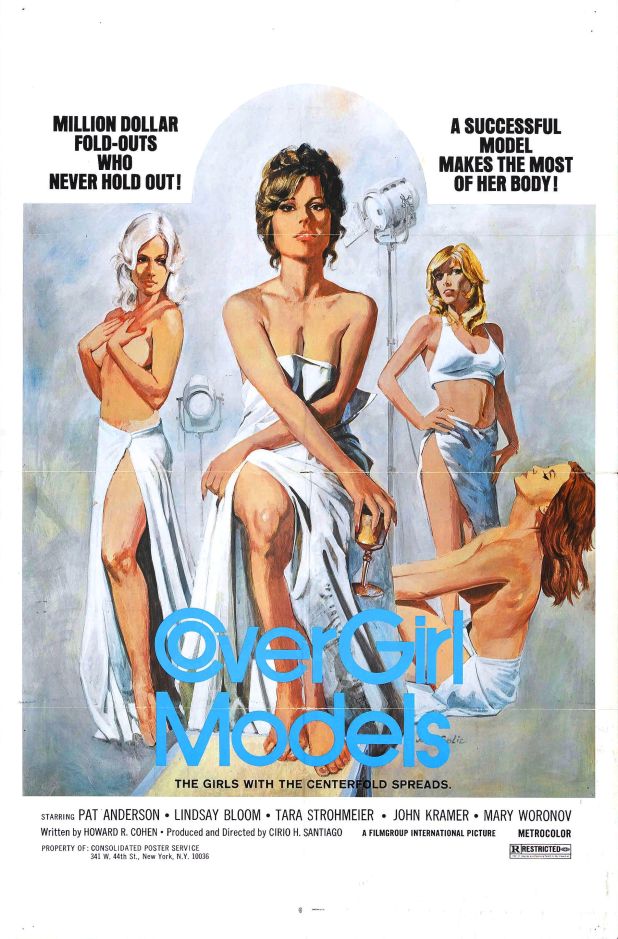
NEW WORLD PICTURES MONTH: Cover Girl Models (1975)

One of the last movies New World Pictures made in the Philippines — due to rising costs — this was directed by Cirio H. Santiago and written by Howard R. Cohen. Outside of Hollywood Boulevard, it’s also the last of the New World occupation movies.

Barbara (Pat Anderson, Summer School Teachers), Claire (Lindsay Bloom, The Happy Hooker Goes Hollywood) and Mandy (Tara Strohmeier, Van Nuys Blvd.) are, well, cover girl models flying from Los Angeles to Hong Kong for a photo shoot. As always, the three girls each get an adventure: Barbara finds a microfilm that several spies are looking for, Claire wants to be in a movie and Mandy falls for a photographer.

If you know me, you know that I wish this movie had been about fashion editor Diane (Mary Woronov), who only makes an appearance in the first few minutes. But hey! Vic Diaz shows up as a bad guy. This didn’t really get a big release in 1975, but a year later — and a time when Charlie’s Angels was big deal — it came back out.

NEW WORLD PICTURES MONTH: Dersu Uzala (1975)

The difference between New World and, let’s say, Cannon, is that New World has more movies that are in the Criterion Collection or considered high art, because Roger Corman distributed a lot of films from high end directors while staying hands-off on the final product.

Directed and co-written by Akira Kurosawa, this was both his only non-Japanese-language film and his only 70mm film. Based on the 1923 memoir of the same name by Russian explorer Vladimir Arsenyev, Dersu Uzala won the Academy Award for Best Foreign Language Film and was a big hit in the USSR, Europe and even the U.S.

This is a story told by Captain Arsenyev (Yury Solomin), who years ago hired a named Dersu Uzala (Maxim Munzuk) and was amazed by the way the man may have been uneducated, yet could deduce nearly anything and knew instinctively how to survive in the harsh world of winter that he lived in. Yet he was also capable of great kindness, as at one point he builds a hut and stocks it not for himself but for those who will come after him.

In 1971, Kurosawa attempted suicide, questioning his creative ability after the commercial failure of Dodes’ka-den and his inability to get another film funded. He had to have seen himself in Uzala, a man growing older whose once incredible powers are reduced to having to live in normal society and afraid when he can no longer see enough to hunt for himself.

He had wanted to make this movie since the 50s, but couldn’t figure out how to make it in Japan. Imagine his surprise when a member of the Russian embassy reached out. He asked him to make a Russian film for Russians. They needed him as their country lacked the talent to make a quality film. It was as if two different dreams could come true and reason to remain alive. The Russians were shocked when he asked if he could film Vladimir Arsenev’s book, because at that time it was little known outside their country.

NEW WORLD PICTURES MONTH: Crazy Mama (1975)

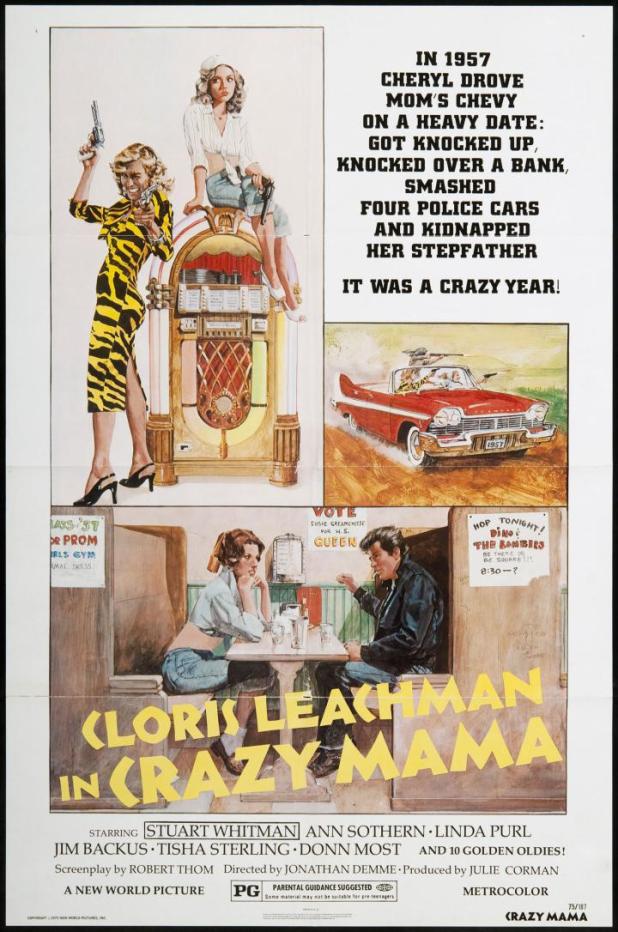
Directed by Jonathan Demme and written by Robert Thom, Crazy Mama was the kind of movie you used to stay up late to watch on cable when your parents went to sleep.

Melba Stokes (Cloris Leachman) owns a beauty parlor and lives with her mother Sheba (Ann Sothern) and daughter Cheryl (Linda Purl, who has a career of playing relatives, as she was Matlock‘s daughter and Pam’s mom on The Office; she’s also in Visiting Hours). When their landlord Albertson (Jim Backus)  kicks them out and takes their belongings, they go on the run and decide to start a crime spree, eventually joined by former Texas sheriff Jim Bob Trotter (Stuart Whitman) and pursued by Cheryl’s would-be baby daddy (Donny Most).

This was to be originally directed by Shirley Clarke. I have no idea how her dance and art background would have worked and we’ll never find out, because she was fired ten days prior to filming. Demme changed the ending to the movie, which was to have everyone die, which he just thought was too much.

Hey — it’s also Bill Paxton and Dennis Quaid’s debut! And John Milius is a cop!