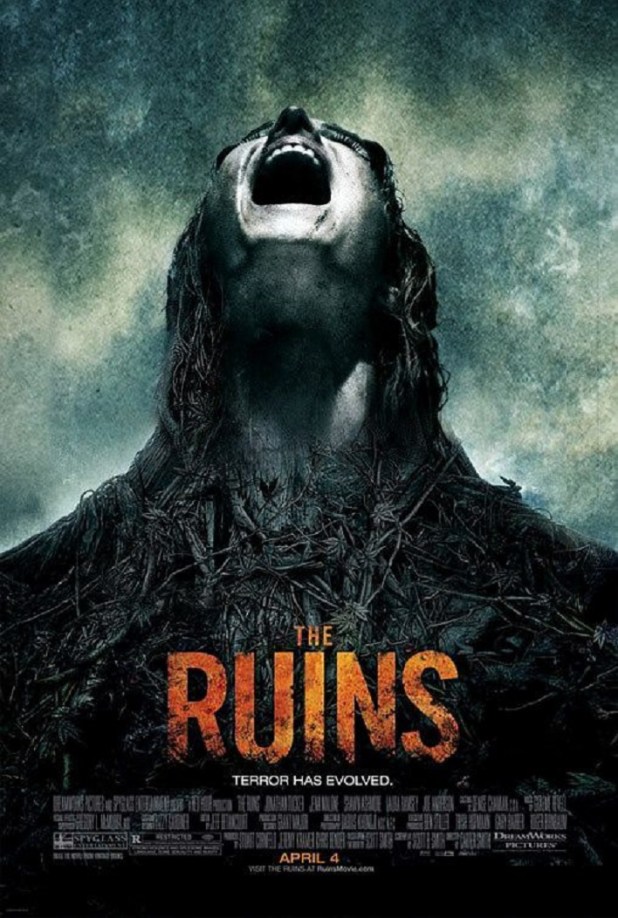
APRIL MOVIE THON DAY 13: The Ruins (2008)

Based on The Ruins by Scott Smith, who also wrote the screenplay and is not related to the director, Carter Smith.

Jeff (Jonathan Tucker), Amy (Jena Malone) Eric (Shawn Ashmore) and Stacy (Laura Ramsey) are on vacation in Mexico when they meet Mathias (Joe Anderson) who last saw his brither Heinrich at a Mayan temple dig. As they follow him and his friend Dmitri, they end up accidentally stepping on some vines that cause the locals to grow insane at come at them with knives and guns, killing Dmitri.

It turns out that those vines, when touched, cause the natives to leave them alone. Those same vines also start to grow within their bodies, taking them over and consuming them. The vine FX are great, the scene where Stacy tries to slice herself apart to free her body of them is good but as for the rest of the movie, it’s just fine. They shot a ton of endings to this and seemingly picked the safest one. Oh well.

APRIL MOVIE THON DAY 13

It’s day thirteen of the B&S About Movies April Movie Thon and it’s time to get horny.

April 13: (Evil) Plant Appreciation Day — It ain’t easy being green. Pay tribute to all the plants with a movie starring one of them.

All April long, we’ll have thirty themes as writing prompts. If you’d like to be part of it, you can just send us an article for that day to bandsaboutmovies@gmail.com or post it on your site and share it out with the hashtag #BSAprilMovieThon.

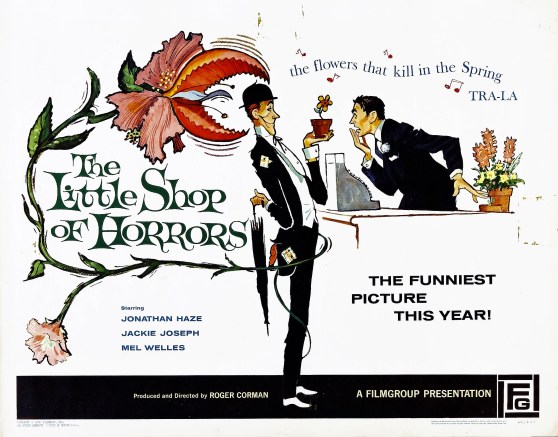
Little Shop of Horrors (1963): This Roger Corman film led to a musical and a much larger budget remake. Not bad for a film made in just a few days.

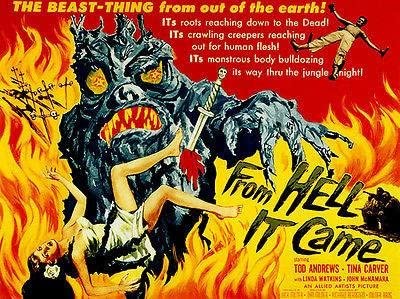
From Hell It Came (1957): Tabonga is the star of this movie, an angry tree stump that demands blood.

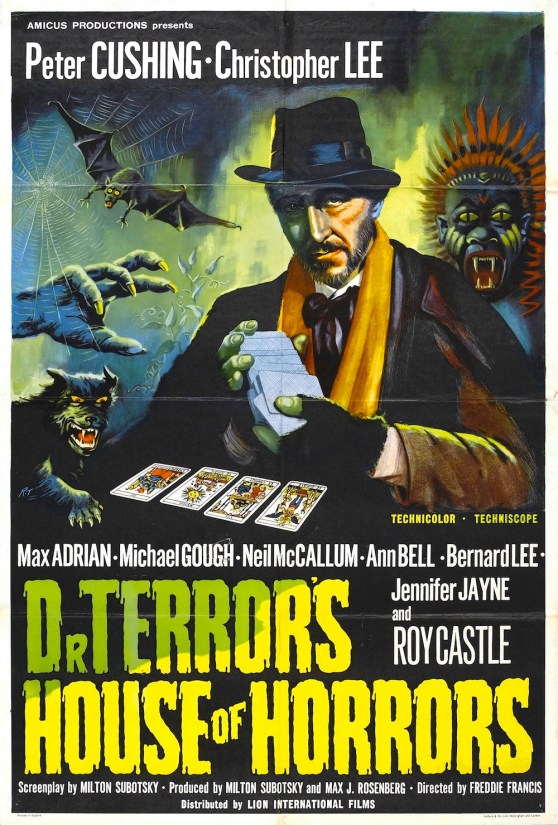
Dr. Terror’s House of Horrors (1967): Killer plants just work so well for Amicus movies.

What are you watching?

APRIL MOVIE THON DAY 12: My Uncle John Is a Zombie! (2016)

After being drafted into the army for a two year tour, John Russo came back to Pittsburgh and started working with The Latent Image, making commercial films but always planning a feature someday. Russo crafted a rough idea about a young man stumbling upon a host of ghouls feeding off human corpses, then George Romero wrote forty pages of a story based on that rough concept.

When Russo and George A. Romero parted ways after the movie that ensured — Night of the Living Dead — Russo retained the rights to any titles featuring Living Dead while Romero was free to create his own series of sequels. Russo’s book Return of the Living Dead became the movie. And before that he was already making his own films like MidnightThe Booby HatchHeartstopper and The Majorettes, which was directed by Bill Hinzman, the Cemetery Zombie in Night who also directed FleshEater.

Directed by Russo and co-written with Robert Lucas, this film can at least claim that while Russo may not be the father of the modern American flesheater movie, he’s definitely at least an uncle. Or Uncle John, the somewhat still-human undead main character of the film, a zombie who becomes a celebrity in a world that now treats the undead like a different ethnic group.

Shot in the same Evans City cemetery as Night, as well as locations in Clairton, West Mifflin and Braddock, this takes place a half-decade after the canon real events of the first film and now, Uncle John is a horny old man protected by his niece Cy-Fi (using her real name, she’s also in Crucifvixen and the documentary Pola in she plays herself as a rave DJ) and nephew Oscar (Gary Lee Vincent, the 2020 remake of Midnight). Meanwhile, zombie hunter Reverend Hotchkiss (Russell Streiner, the man who once said, “Barbara, they’re coming to get you.”) is hunting him down and a cop named Jane Smart (Sarah French, Art of the Dead) wants to know how he stays alive if he isn’t eating people.

There’s also a right wing hunting camp that wants to protect the Second Amendment and also kill as many zombies as possible. Also, if you love commercial breaks within the film, this has them. It also has Debbie Rochon, Tiffany Shepis, Felissa Rose and Lloyd Kaufman with the Toxic Avenger and Sgt. Kabukiman, which was enough to make me want to shut this off but I got through it.

Jizmak the Gusha from Gwar is in this, out of makeup, as is George Kosana, who played Sheriff McClelland in Night and who is finally called to task for shooting more black zombies than white ghouls. I mean, this film has John Russo in zombie makeup on a sex swing somewhere at a rave party in Braddock along with social commentary and if you’re willing to take that ride, it’s here.

You can watch this on Tubi.

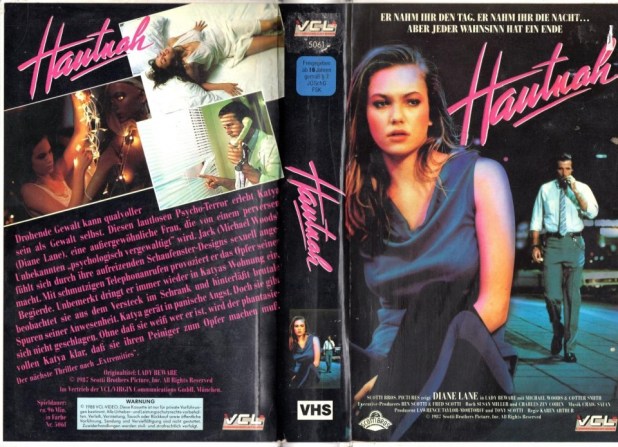
APRIL MOVIE THON DAY 12: Lady Beware (1987)

ABOUT THE AUTHOR: A.C. Nicholas, who has a sketchy background and hails from parts unknown in Western Pennsylvania, was once a drive-in theater projectionist and disk jockey, Currently, in addition to being a writer, editor, podcaster, and voice-over artist, he contributes to Drive-In Asylum. His first article, “Grindhouse Memories Across the U.S.A.,” was published in issue #23. He’s also written “I Was a Teenage Drive-in Projectionist” and “Emanuelle in Disney World and Other Weird Tales of a Trash Film Lover” for upcoming issues.

The explosion of the horror genre in the 80s gave us lots of slasher films and films loaded to the brim with gore. Every once and a while though, there was something different, something special, a small gem. Lady Beware (1987) sports a title that sounds like a Lifetime movie of the week and a visual aesthetic that sometimes looks good, but mostly looks like a TV movie. But it’s an endlessly fascinating film that straddles the line between art film and exploitation film. It’s not your typical woman-in-peril film. Director Karen Arthur with this, her passion project, is much too intelligent and sophisticated to make a simple young woman vs. stalker thriller. Instead, she gives us a smart, though flawed, film with a nice feminist slant that doesn’t beat you over the head with its gender politics, like so many current arthouse horror films.

Katya, played by a young Diane Lane, rides the bus from boondocks Pennsylvania to the big city–Pittsburgh, that is–to seek a career as a window dresser at Joseph Horne’s, one of Pittsburgh’s once-iconic department stores (the other was Kaufmann’s). She’s ambitious and aggressively convinces the store manager to hire her. Then she makes friends with co-workers, including dated 80s movie token gay guy and black woman, and designs some windows with lots of sexual content. (Arthur’s a good director, so you suspend your disbelief about these store windows that feature partially clad mannequins posed in “interesting” positions—and then there’s that use of aerosol-can whipped cream to top things off.) Soon, she’s attracted not only the attention of Cotter Smith, a Pittsburgh magazine reporter, but also a radiology technician from a building across the street, who has a family and is a closet stalker. He’s played by Michael Woods in a low-keyed, creepy performance.

Soon the expected stalking starts. Woods makes obscene phone calls, leaves messages, steals Lane’s mail, and even rappels down the side of her locked building in broad daylight to break into her apartment. (More suspension of disbelief on that scene.) Once inside, he does as many awful things as you can imagine from taking a bath in her tub, to writhing around naked on her bed, to using her toothbrush (Yuck!). This unhinges Lane to the point of a near nervous breakdown, but in the end. she finds her inner feminist strength, plays mind games with Woods, and eventually turns the tables on him. This leads to a memorable final shot, where the stalker symbolically becomes trapped in his own perverted fantasy. 

Unfortunately, the Scotti Brothers, successful record producers who had recently moved into movie production, took the final cut away from director Arthur and drastically reduced the film’s running time. Viveca Lindfors’ part as Lane’s mother was eliminated, and Smith’s ineffectual boyfriend was watered down even more. (I’m not sure either of those decisions was a bad thing; they strengthen Lane’s lone stand against her stalker.) Also, to make the movie more exploitable, the producers added repeated shots of a naked, nubile Lane, defeating the point of the film by objectifying its lead character. Arthur was unhappy and thought about taking her name off the film. She didn’t, and I’m glad she didn’t. Even in its bastardized form, it’s a film to be proud of. In addition to being a solid thriller with good ideas, it’s a beautiful travelogue of Pittsburgh in the late 80s. And those of us from the area who grew up during that era will enjoy spotting local actors in small parts, such as Don Brockett from Mister Rogers’ Neighborhood; Bingo O’Malley, who was in just about everything filmed in the city from Dominick and Eugene to Creepshow, Two Evil Eyes and Bob Roberts; and even Ray Laine, the star of George Romero’s There’s Always Vanilla.

Lady Beware was clearly made on a low budget with an eye on home video. It didn’t have much theatrical play but became a staple of pay-cable in the late 80s. Then after a VHS release, it disappeared. It has never had an official DVD release in the U.S., and you can find a soft-looking rip of the VHS tape on the Internet Archive, where the poster noted that the film is in the public domain. I don’t know about that, but I do know that this film doesn’t deserve its obscurity. It’s striking in tone with an atypical handling of some fairly pat material. I liked it a lot. And I think you will too.

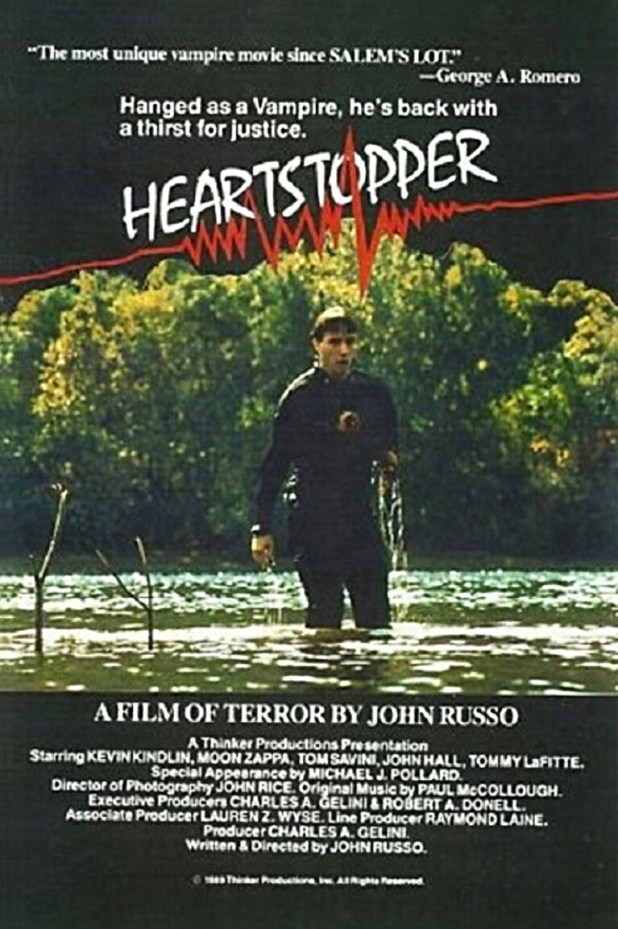
APRIL MOVIE THON DAY 12: Heartstopper (1989)

Back in my Fangoria fanboy mania, I kept seeing the Pittsburgh-made Heartstopper get listed and it supposedly had tons of Savini gore, as well as a role for him as a police detective. Every con Savini was at, I asked, “Is Heartstopper coming out yet?” And he’d laugh and say, “I hope so.”

It took me 33 years to see it.

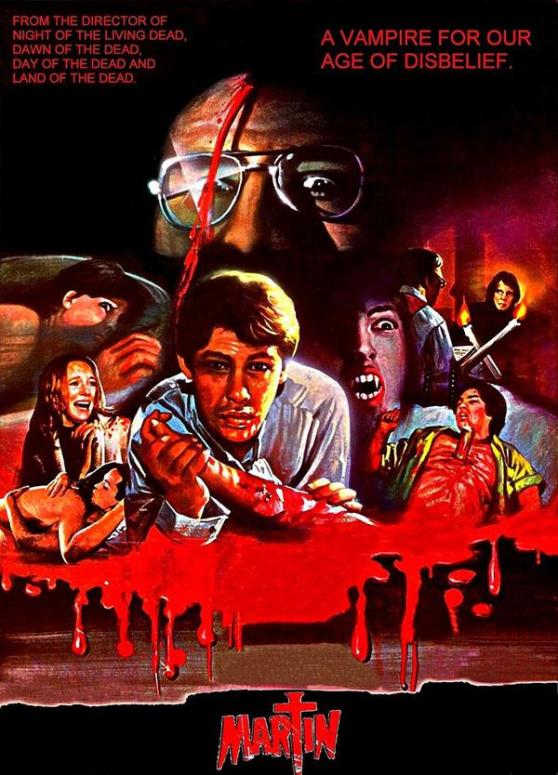
Pittsburgh has seen more than one vampire movie get made here, from the lo-fi Fist of the Vampire to the big budget Innocent Blood and perhaps one of the best vampire movies ever made, Martin.

And oh yeah, Heartstopper.

Benjamin Latham (Kevin Kindlin, The Majorettes) was a doctor back around the Revolutionary War who was experimenting with blood when his sister-in-law and brother proclaim him a vampire. He’s hung and not just lynched, but held down by her, his heart has a stake put through it and he’s covered with garlic. And two hundred years later, he rises in Pittsburgh’s Point State Park. Unlike your run of the mill vampire, he lives by day and has poisonous saliva that either kills or brings people to his side, such as his lover Lenora Clayton (Moon Unit Zappa!?!), who introduces him to our modern world while having a tie to the past, as she’s a museum curator.

Meanwhile, one of Benjamin’s descendants has become a serial killer himself and he’s conflicted over saving him or destroying him. There’s also the matter of Lt. Ron Vargo (Savini), whose daughter was killed by someone who had a very vampiric MO, so all he does is talk about it and refuses knocking up his wife again because he’d rather work out down in the basement, so if you want to watch Savini grunt it out and do sets, trust me, this is your movie.

It also has a tremendous metal soundtrack and by that, the kind that will earworm you. The band N.M.E. (metal is not always clever) is a power/thrash band from the City of Bridges made up of David Paul Snyder on drums, C.E. Robinson on bass, Brian Keruskin and Michael Weldon on guitars and Jirus on vocals. They had two songs in the movie, “The  Gates of Hell” (“Walk On”) and “Heartstopper” (“Eat Me Alive”) and they’re pretty decent, along with a solo Jirus song called “Killer In the Park” and two songs by The Sound Castle, “What Kind of Love Is This?” and “In Principio,” which sound like progressive metal by way of Meat Loaf and I’m all for that, too.

“Heartstopper” (“Eat Me Alive”) was released on the VHS Horror Rock, which also has Hurricane’s “Over the Edge,” Wrath’s “Children of the Wicked,” The Pandoras’ “Run Down Love Battery,” The Dickies’ ” Booby Trap,” Elvis Hitler’s “Hot Rod to Hell” and The Del-Lords’ “Judas Kiss” all playing over clips of Night of the Living DeadThe MajorettesMidnight and Heartstopper, which as you may have put together are all movies owned by this film’s writer and director John Russo  (or public domain, as is the case with Night).

Heartstopper is an interesting film at the level of The Majorettes in quality. It tries to be a different take on the vampire story and for that, it succeeds, while also being a great time capsule of 1989 downtown Pittsburgh. And of Tom Savini’s workout. Seriously, the dude made gains while making this.

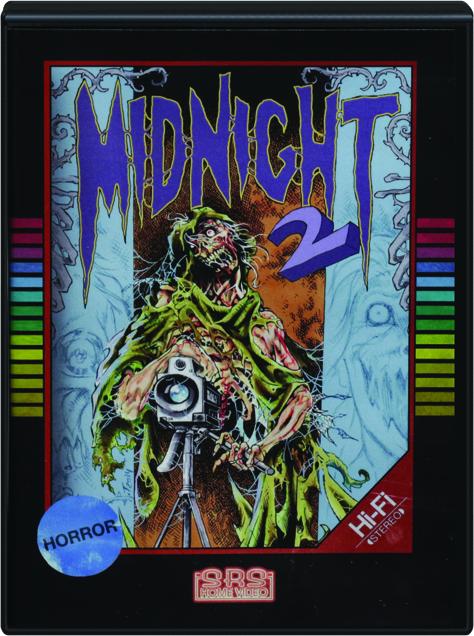
APRIL MOVIE THON DAY 12: Midnight 2: Sex, Death and Videotape (1993)

I’m so on record for my love of John Russo’s Midnight that my words appear on the back cover of Severin’s new blu ray release of the film. So imagine my surprise that there’s a sequel to it and even better, it’s a lo-fi video exploration of the only survivor of the cult from the first film, Abraham Barnes (not John Amplas, but instead Matthew Jason Walsh, who has gone on to write 45 of his own movies at the time of this review).

The SRS DVD of this film (available on their site) has two versions, the released version and the unrated “first cut” of the film, and they complement each other well.

Taking place ten years after the events of the first film — don’t worry, a good portion of the running time of this film has clips of that movie, which juxtaposes the film and video media, which is strange but for some reason, I was totally fine with. I think if these movies were made anywhere other than Pittsburgh — and Akron, but we’ll get to that in a minute — I wouldn’t treat them with the love that I do.

What works for me is that Abraham stalks his prey in places I’ve been, mainly Point State Park (did he cross paths with Santa Claws in Market Square?) and PPG Plaza. He wanders the city with his video camera — at a time when such a thing was a huge burden and not the cinema-ready iPhone you carry now — and interviews subjects, looking for both victims and a mate so he can settle down and stop killing.

The first of those victims — in the released cut — is Jane (Lori Scarlett, a Cleveland-born actress who was Jane in Killer Nerd and Return of the Killer Nerd). She has the kind of haircut that bedeviled me in 1993, that asymmetrical blonde wave with shaved sides, which is what passes for punk rock in the Three Rivers (and Burning River, too). Abraham mentions that he can feel it deep inside his, well, member if a woman is true or not. She isn’t, she’s choked into oblivion and he moves on to stalking her roommate Rebecca (Jo Norcia, Zombie Cop).

Rebecca is caught between two men — or at least the movie asks us to believe this — Abraham and L.T. David Morgan (Chuck Pierce Jr., who is, you guessed it, the son of Charles B. Pierce), the cop who is trying to solve the disappearance of Jane.

This is one talky movie, but I kind of liked that about it. It realizes that it’s a low, low, low budget remake of an already low budget movie and therefore leans into it. Everyone was beyond excited in town when Silence of the Lambs was made here, so I don’t even mind that it’s referenced as the end all, be all of serial killer cinema. The only real issue I have is that the action moves from dahntahn to Akron without informing the viewer, but just about everyone who wants to see this lives in the area, so they’re going to cry foul. Then again, it originally came out from J.R. Bookwalter’s Tempe Video and that’s where the Ohio comes in.

The chair from the original comes back. This is more than just ninety minutes of trash, it’s ninety minutes of good trash because it’s nihilistic and mean spirited and has a scene where the female lead gets a biggie soft drink from Wendy’s, which I assume came from the one down on Liberty and she walked herself to get it and I’m a fan of slasher/giallo movies with Wendy’s food in them, which is all of this movie and Nothing Underneath, a movie in which Donald Pleasence takes full advantage of Dave Thomas’ salad bar offerings.

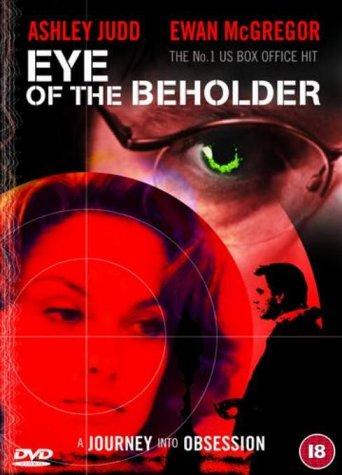
APRIL MOVIE THON DAY 12: Eye of the Beholder (1999)

Based on Marc Behm’s novel and a remake of Claude Miller’s 1983 French thriller Deadly Circuit, this Stephan Elliot-directed (The Adventures of Priscilla, Queen of the Desert) was originally optioned by producer Philip Yordan (yes, I can get a Night Train to Terror mention in for every movie) for Charlton Heston, but it took decades to be made in America.

Stephen Wilson (Ewan McGregor) is known as The Eye, a surveillance expert called in to track down the son of his wealthy boss. However, that man is killed by serial killer Joanna Eris (Ashley Judd) as Stephen watches. Years ago, his daughter disappeared and he sees her as the grown version of her, so he keeps trying to rescue her.

Going rogue, Stephen keeps following Eris, even after she is due to be married to a rich blind man named Alexander Leonard (Patrick Bergin) and gives up killing men. So why does he shoot her tires out and cause his death? Why does he save her from Gary (Jason Priestley), who has beaten Eris into oblivion and is preparing to assault her? Why does he follow her all over the country?

How muchy of what Stephen sees is even real? Does Hildary (k.d. lang) even exist? Is this a cyberpunk movie (yes, it has dystopian tech, British accents and a rock star in it)? And how about the scenes shot in Pittsburgh?

What a mess. I kind of want to watch it a third time to see if I can make any more sense of it.

You can watch this on Tubi.


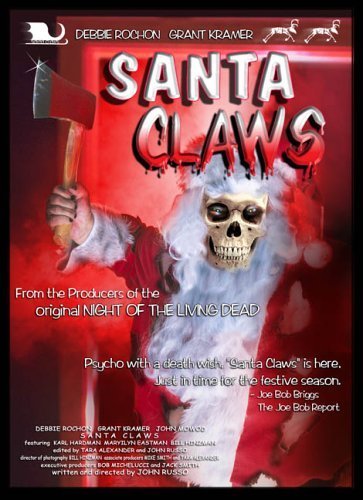
APRIL MOVIE THON DAY 12: Santa Claws (1996)

John Russo lives in Glassport, which I can see from my house, and he wrote the idea that became Night of the Living Dead, which would probably be enough, but he also helped make Return of the Living Dead happen. And he also made Midnight and The Majorettes, two movies that fall into that strange genre that can only come from Pittsburgh, the yinzer giallo. He also was the publisher and managing editor of Scream Queens Illustrated, which figures into this movie.

Raven Quinn (Debbie Rochon) used to be a scream queen but ever since she had two children with a scream queen magazine publisher who would rather take nude photos of models than work on his marriage. Luckily, she has Wayne (Grant Cramer), a neighbor who once watched his mommy do more than kiss Santa Claus, lost his mind and killed them both. So perhaps she is not quite so fortunate.

Beyond getting to see Night stars like Marilyn Eastman, who played Helen Cooper, Karl Hardman, who played her husband Harry, and first zombie — and the director of The Majorettes and FleshEater — S. William Hinzman, you can pretty much see this as an American Night Killer. They’re both set at Christmas, they both deal with broken marriages and they’re both absolutely berserk movies seemingly made by maniacs.

Waste not, want not, as Russo edited this into Scream Queens Naked Christmas.

Yinzer bonus: Numerous scenes of characters wandering Market Square before anyone went there, back when George Aiken was still making the best-fried chicken ever, when National Record Mart still had that huge store and G.W. Murphy’s was still open. I mean, the killer runs into the Oyster House for a second and I was awash with 90s dahntahn memories, like Honus Wagner, the smell of Hare Krishna’s t-shirts, Candyrama and so much more.

In short, a killer that uses a garden cultivator as a weapon, like a total South Hills Blood and Black Lace, all with softcore dancing that makes me wistful for dollar pizza at Anthony’s and the old sign that was painted on the wall at the Cricket and hey, John Russo wrote two songs for this, “Christmas by Myself” and “Brand New Christmas.”

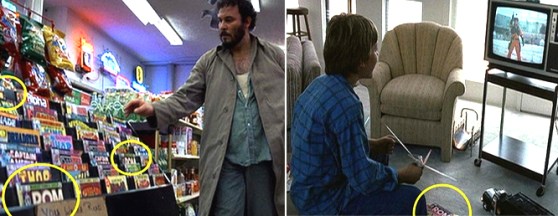
If you remember that old store Novelties in Market Square that never seemed to sell anything and was put out of business for a Dunkin’ Donuts, well, I want you to know that this movie has the killer buy his Santa Claus suit in that very store.

Welcome to the yinzer giallo list, Santa Claws. Meet us under the Kaufmann’s clock for your framed certificate.

APRIL MOVIE THON DAY 12

Day twelve of the B&S About Movies April Movie Thon is about 4-1-2. Pittsburgh-made movies!

April 12: 412 Day — A movie about Pittsburgh (if you’re not from here that’s our area code). Or maybe one made here. Heck, just write about Striking Distance if you want.

All April long, we’ll have thirty themes as writing prompts. If you’d like to be part of it, you can just send us an article for that day to bandsaboutmovies@gmail.com or post it on your site and share it out with the hashtag #BSAprilMovieThon.

Here are some films that we can recommend to watch today:

Martin (1978): This movie is the best version of Pittsburgh, the truest, that has even been filmed. It’s also George Romero’s best movie.

Effects (1981): While not seen much when it was released, this is one of the most imaginative horror movies ever, not just one of the best movies made in Pittsburgh.

Sudden Death (1995): JCVD fought our hockey mascot, Iceberg. That’s all you need to know about this movie.

What are you watching?


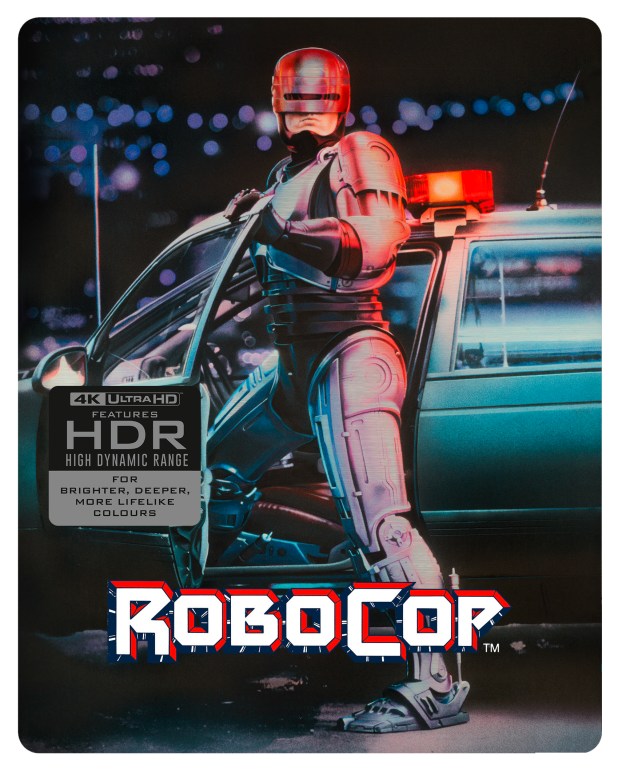
ARROW UHD RELEASE: RoboCop (1987)

EDITOR’S NOTE: RoboCop is one of my all-time most loved films. I’m so excited to have the Arrow UHD! This originally was on the site on January 12, 2020 and has been updated for the new release.

RoboCop was written by Edward Neumeier and Michael Miner, inspired by a poster for the Blade Runner. Neumeier asked a friend what the film was about and was told, “It’s about a cop hunting robots.”

Neumeier was stranded at an airport with a high-ranking film exec and was able to sell him on the project, which took half a decade or more to reach the screen. The first draft, in 1981, was about a robot cop who slowly became human. That script got rejected.

In 1984, Neumeier and Miner met. Miner had been working on a script that he called SuperCop, about a police officer who has been seriously injured and becomes a donor for an experiment to create a cybernetic police officer.

Paul Verhoeven had already made his first American movie, Flesh & Blood, in 1985. The first time he read the script, he threw it away. His wife saved it from the garbage and told him it could be so much more. Other directors who showed interest included Repo Man director Alex Cox and Kenneth Johnson, creator of the television series V.

The character of RoboCop itself was inspired by — let’s try and not say directly lifted from —  British comic book hero Judge Dredd, as well as the Japanese series Space Sheriff Gavan and the Marvel Comics toy-based superhero Rom the Spaceknight, whose comic shows up throughout the film.

UPDATE: Shout out to Ed Piskor, who reminded me just how much this movie is influenced by Howard Chaykin’s American Flagg!

Honestly, this film is a great mix of individuals who all needed to come together to create something that could only exist by the combination of their strengths. In anyone else’s hands other than Verhoeven, it could have been just an action film. With any other actor other than Peter Weller playing the lead, it wouldn’t have the drama that it evokes. With any other artists than Rob Bottin, The Chiodo Brothers, Craig Hayes and Phil Tippett, the look of the film would be basic.

Its a perfect action movie, though one that’s also an indictment on fascism and the growing disparity between the rich and the lower castes in the United States. In fact, much like Starship Troopers, it’s satire is often lost on some audiences, who believe that it has to be absolutely serious.

RoboCop was rated X eleven different times. That’s how brutal the original versions were. Keep that in mind — the movie remains one of the most anarchic of 1987 and hell, I couldn’t see half this stuff being shown in a movie in 2020.

Detroit is worse in the future than it was in the past, if that’s possible. The cops want to strike. Omni Consumer Products (OCP) runs Detroit’s police department in exchange for letting the company rebuild run-down sections of the city into a high-end utopia. Now, they want to replace flesh and blood cops with robotic peace operatives, like ED-209, which ends up killing nearly everyone in the board room in his initial test.

That’s when the RoboCop plan comes in. It’s going to take a real cop’s brain and put it in a near-indestructible body to protect the city. That cop ends up being Alex Murphy (Weller), who gets killed on pretty much his first few days on the job by Clarence Boddicker (Kurtwood Smith) and his gang, leaving his partner Anne Lewis (Nancy Allen) alone again.

Soon, Murphy’s brains have been retrofitted into a sleek mechanical shell ready to dispense justice by any means necessary, including shooting muggers right in the meat. Before long, he’s recovered his humanity and realizes that OCP, the company that saved him, may have more in common with the criminals that he busts than the public he’s programmed to protect.

It’s a pretty basic tale, enlivened by the way and style in which it is told. Plus, you get some great actors — beyond Weller, Allen and Smith, who are all at the top of their game here. There’s Dan O’Herlihy as the OCP chairman known as only “The Old Man;” Miguel Ferrer as Bob Morton, the exec who gets RoboCop funded before Boddicker offs him during a coke binge (perhaps the most quoted scene in the film); and a gang of baddies that include Ray Wise (Leland Palmer from Twin Peaks), Paul McCrane (Guard Trout from The Shawshank Redemption) and Jesse Goins (Up the Creek). And wow, as always, Ronny Cox plays the best of bad guys, here as OCP exec Dick Jones.

Perhaps the best parts of this movie are the video screens and fake commercials that break it all up. Leeza Gibbons and Mario Machado appear as anchorpeople who take us through the news of the day, allowing for fast exposition and recaps. This technique feels right out of Frank Miller’s 1986 graphic novel The Dark Knight Returns. Plus, the “I’d but that for a dollar” guy is perfect.

In 2013, Neumeier reflected on the fact that his script was quite prophetic, saying “We are now living in the world that I was proposing in RoboCop…how big corporations will take care of us and…how they won’t.”

For what it’s worth, Verhoeven and Bottin fought throughout the production over harsh light revealing too much of the makeup on screen. Once Verhoeven won the argument, the two didn’t speak until the premiere, where they were so impressed by how the film turned out that they forgave one another. Despite vowing to never again work with the director, Bottin worked on the very next film Verhoeven made, Total Recall.

My favorite story about the film is that when he was in full costume, Weller would remain in character between takes, only responding to Verhoeven’s instructions when properly addressed as “Robo.” Verhoeven never took this seriously and refused to do so after just a few weeks. That’s second only to the fact that the producers paid President Richard Nixon $25,000 to promote the VHS release of RoboCop.

Arrow Video’s new UHD steel book release of RoboCop is packed with so many features. It starts with a 4K restoration of the film from the original camera negative by MGM, transferred in 2013 and approved by director Paul Verhoeven. There’s also the Director’s Cut and Theatrical Cut of the film on two 4K UHD Blu-ray discs with Dolby Vision. And you also get a 44-page limited edition collector’s booklet featuring new writing on the film by Omar Ahmed, Christopher Griffiths and Henry Blyth.

The director’s cut disk has archive commentary by director Paul Verhoeven, executive producer Jon Davison and co-writer Ed Neumeier (originally recorded for the Theatrical Cut and re-edited in 2014 for the Director’s Cut). Plus, you get two new commentary tracks, one by film historian Paul M. Sammon and the other by fans Christopher Griffiths, Gary Smart and Eastwood Allen.

Like all Arrow releases, this set is packed with documentaries, like The Future of Law Enforcement: Creating RoboCop, a newly filmed interview with co-writer Michael Miner and RoboTalk, a newly filmed conversation between co-writer Ed Neumeier and filmmakers David Birke (writer of Elle) and Nick McCarthy (director of Orion Pictures’ The Prodigy), as well as interviews with Nancy Allen — in which she glowingly refers to the town we live in with a very profanity-laced comment that made me laught out loud, casting director Julie Selzer and second unit director Mark Goldblatt. Plus, there’s also a tribute to composer Basil Poledouris featuring film music experts Jeff Bond, Lukas Kendall, Daniel Schweiger and Robert Townson, a tour of Julien Dumont’s collection of original props and memorabilia, three archive features from the 2007 release and a 2012 Q&A with the cast and crew. Plus there’s even more — four deleted scenes, trailers, TV spots, Director’s Cut production footage and raw dailies, and even an Easter Egg!

Is there more? Yes, this is Arrow! There’s an edited-for-television version of the film, featuring alternate dubs, takes and edits of several scenes, a compilation of these alternate scenes and a split-screen comparison of the Theatrical and Director’s Cuts.

You can get this from MVD.