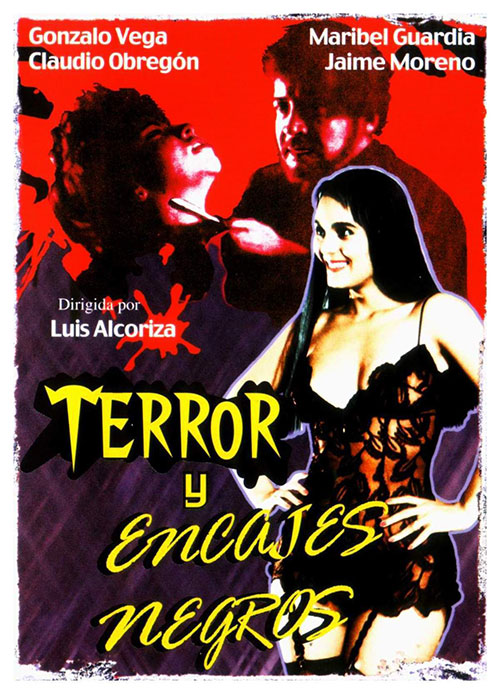
Why did I watch this? Is it my OCD-fuelled need to get overwhelmed by any film genre the more I study it? Or is it because its title — translated in English as Terror and Black Lace — references one of my favorite films of all time, Mario Bava’s seminal Blood and Black Lace?
The answer is ambas, mi amigos.
Isabel is a good wife, one who stays at home and patiently waits for her abusive husband to come home and knock her around. She thinks that the next door neighbor is the polite and kind man of her dreams, but this being a Mexican exploitation movie from 1985, we all know that he’s going to be a maniac as well.
As she sits and waits for hubby — clad in black lingerie, so there’s the reason for the title — she watches said neighbor dispose of a body in a kind of La Ventana Trasera situation. The neighbor is played by Claudio Obregon, who is no relation to noted Andy Sidaris villain Rodrigo Obregon.
Actually, I was too rough by lumping this film into the exploitation world. It’s lead actress Maribel Guardia was nominated for an Ariel Award for this movie. So maybe if you come in expecting a giallo, instead you’re getting drama. Which probably isn’t what you want with a title like this, hmm?
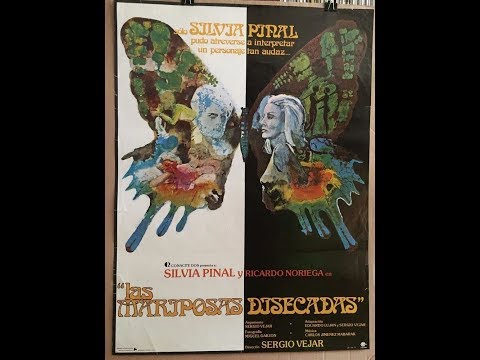
Julia (Silvia Pinal, who was a star in the Golden Age of Mexican Cinema yet completely unafraid to go for it in this absolutely insane film, but she was in three Bunuel films, so that adds up) is a writer who uses the pen name Cassandra Fuller.
She’s keeping to herself, not leaving her home, obsessed with writing. I relate. What I can’t relate to is her obsession with beauty and youth, as well as how it informs her next book The Dried Butterflies.
She begins to connect with the outside world once several children enter her yard, looking for the dead body of a bird. She brings them into her home to show off her canary and begins to obsess over one of the boys named Olak. Every afternoon, he comes back to see the bird while Julia remembers an obsessive love with another boy named Jorge that was ended by his parents. Unable to give him up, she murdered him and kept his body parts inside a closet near her room, but the smell is too much for her. She’s forced to bury him in her back yard while trying to decide how she will keep Olak with her forever.
If you watched Butcher, Baker, Nightmare Maker and said, “This movie didn’t get crazy enough,” Mexico realizes this and has you, mi amigo. Necrophilia and pedophilia in the same film, but treated with nuance and skill? This isn’t for everyone, but for those that want a movie that creates an allegory between this story and religion, well, here it is.
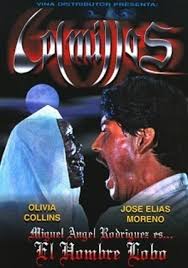
Rene Cardona III just wants to entertain you. His Vacaciones de Terroris well worth grabbing, as is this werewolf film that somehow combines a Paul Naschy-style wolfman style film with political commentary on the rich people of Mexico, mostly told through their obsession with horse racing.
Our hero Cristobal works at that horse racing track and after he gets attacked by a white-clad sorceress named Tara — cue the Naschy werewolf origins! — he steals a statue filled with expensive stones that he sells to win over rich girl Susana, who wears shoulder pads and power suits 14 years after Dynasty went off the air.
Some animal attacks are happening while all this romance is in the air and, of course, it’s our friend Cristobal doing the killing. This movie keeps on moving, is filled with fog and cave hideouts for evil female ghosts and has just enough bloodletting for the gorehounds out there.
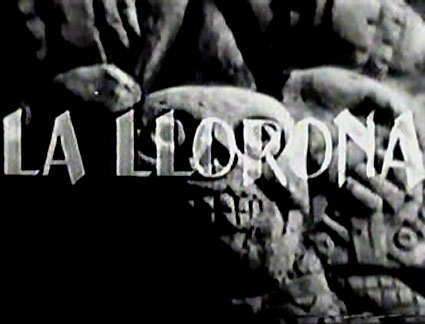
The first Mexican horror film, this movie is all about the legend of “The Crying Woman.” There’s been a film made about this story every few years and few of them are good. This one at least has some interesting atmosphere and is historically important.
Maria is a woman who has two children and is quite poor, but finds a wealthy man to marry. However, he cares more about the kids than her, so in a jealous rage she drowns them both and kills herself. Now, she’s trapped between life and death, unable to ever stop crying. She can never move to the next plane of existence until she finds her sons.
The film also relates other tales of women who took the lives of their children, all reduced to being crying women as well. Obviously, this movie is very influenced by Universal’s horror movies, yet it isn’t the same level of quality. That said, it’s still worth a view.
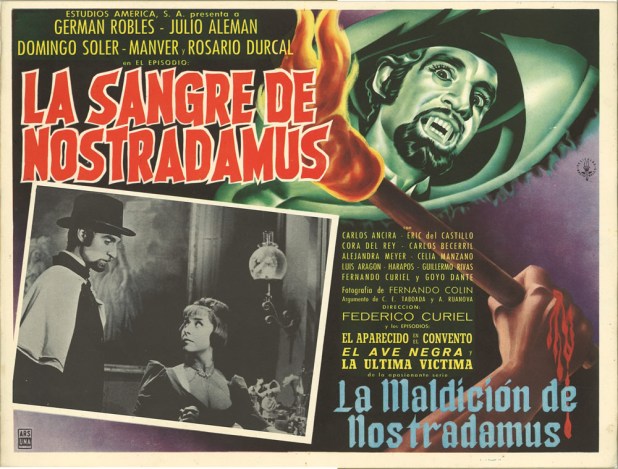
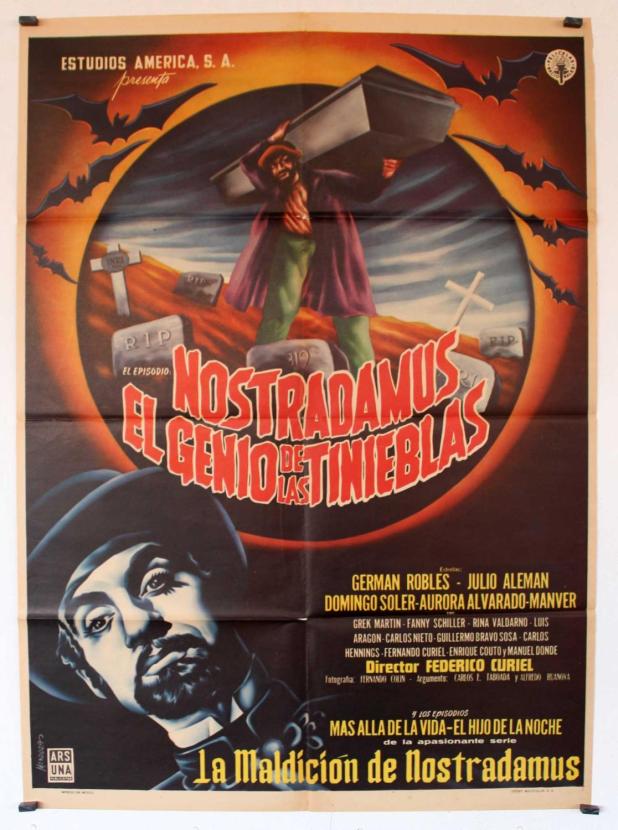
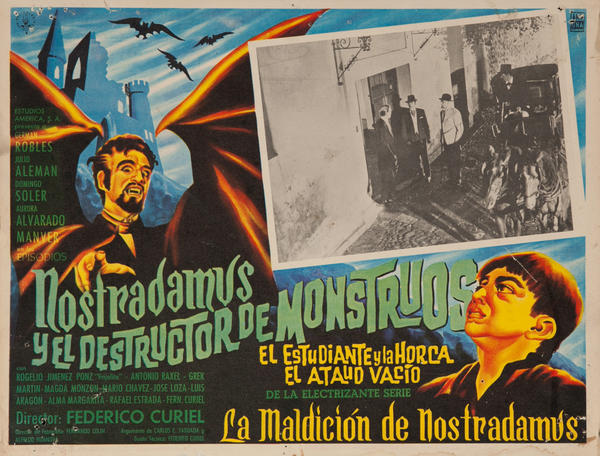
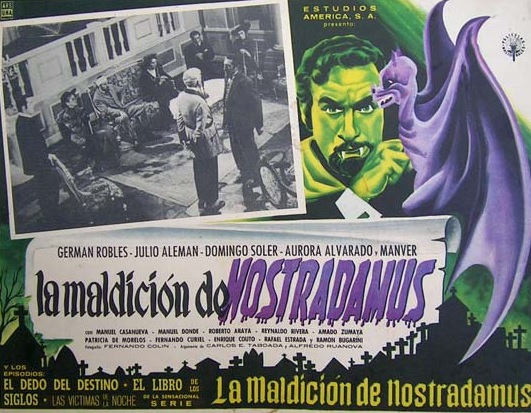
After three films — The Curse of Nostradamus, The Monsters Demolisher and The Genie of Darkness — we have arrived at the end of our tale, where the society to eliminate superstition must rise up against what we’re to assume is the son of the seer Nostradamus (although this is disputed in this series, depending on where you come in).
The good guys are about as intelligent and effective as a bunch of cops in a giallo film, as they think that by removing the ashes of Nostradamus’ ancestors from his coffin that he will die at sunrise. He just laughs and tells them that are the ashes of someone else he killed. Yes, he sleeps surrounded by the sooty remains of those he has killed before. You go, Nostadamus. You go.
Somehow, the good morons manage to kill off the hunchback and get their hands on a sonic weapon, which does some damage to the vampire before the sword cane of Igor — remember that dude who died and it was kind of a shock? — poetically is used to stake Nostradamus while in bat form.
I don’t know if you should watch all four of these movies in one day, but then again, I’ve also watched around fifty Mexican horror movies in the last few weeks, so I may be muy macho when it comes to watching peliculas de terror.
The real trouble with the villagers and professor who are supposed to be the heroes of the Nostradamus film series is that they’re boring as all get out. The only interesting one, Igor the vampire hunter, is unceremoniously dispatched early in this film. The rest just sit around and yammer away at what they should do instead of doing anything.
Meanwhile, the nattily dressed Nostradamus and his hunchback pal Leo are living it up. Well, maybe not so much Leo, whose witch mother Rebeca dares to question the villainous vampiro and gets set on fire for her troubles.
Director Federico Curiel would go on to work with Santo several times, as well as write one of the most out there of all early Mexican horror films — and trust me, that’s saying something — El Baron del Terror.
In the second film of this series — originally as 12-part movie serial — the professor finds that he must admit that the undead walk the Earth. He joins with a vampire hunter to stop Nostradamus, who is the son of one of the most powerful bloodsuckers of all time.
Nostradamus takes his evil even further by basically explaining to both of them how if they don’t stop him, he’ll make the world an even worse place. To prove his heart is in the wrong place, he also kidnaps several children and repeatedly places them in danger.
The vampire hunter Igor is played by Jack Taylor, whose career may have started in American television, but would take him all over the world. Of course, most of his roles have been in the kind of movies that only I would care about, like Mexican vampire movies, Jess Franco sleaze (Eugenie, Succubus, Count Dracula), Spanish horror (Dr. Jekyll vs. The Werewolf, The Killer Is One of 13, The Ghost Galleon, The Vampires Night Orgy) and appearances as a priest in Conan the Barbarian, as Professor Arthur Brown in Pieces and as book collector Victor Fargas in The Ninth Gate.
Perhaps most famously in the United States, this movie ran out of sequence as an April Fool’s Selection on the USA Network’s Commander USA’s Groovie Movies. Seeing as how that episode aired on April 4th, I find it even more amusing.
Nostradamus is not the fortune-telling mystic that scared you so badly in 1981’s The Man Who Saw Tomorrow. No, he’s an aristocratic vampire played by German Robles, who also played Count Karol de Lavud in the two El Vampiro films.
Murray’s nickname was Kagey and he led a pretty amazing life. The son of an Irish-American funeral home director, he grew up in Bloomington, Illinois, which is right next to the town of Normal. That’s where many of the carnie folk spent the off-season and Murray grew up around them. Instead of going into the family business, the teenager started a “corn game”, which is sort of what we’d call bingo today, in one of his father’s cemetery tents. Imagine — people were so starved for entertainment that they’d go play games of chance surrounded by the dead.
Regardless, that game got him on the road with the World Wonder Shows Carnival. After becoming the manager, Murray used his circus and carnie contacts to help cast the Munchkins in The Wizard of Oz. While he was doing that, he was also getting rich from a series of not-so-legal slot machines all over the Midwest.
After a move to Hollywood, Cecil B. DeMille hired him to help promote The Greatest Show on Earth. This led to a career in film, which of course brought him into the orbit of Kroger Babb, where he learned to take movies and make them more emotional. He did that with redubs of Mexican films, as well as becoming the King of the Kiddie Matinee.
We’ve discussed at length how Murray brought the brain-melting opus that is Rene Cardonna’s Santa Claus to America, a movie that seasonally played in theaters for thirty years. In all, he’d release sixty movies in fifteen years. The only thing that stopped him was the IRS, who seized his beloved films to get some back taxes, and the heart attack that the stress of the court battles caused.
Notable Murray imports include The Robot vs. the Aztec Mummy, The Brainiac (El Baron del Terror), The Wrestling Women vs. the Aztec Mummy (Las Luchadoras contra la Momia Azteca), Shanty Tramp (which he also wrote), The Swamp Of The Lost Monsters(El Pantano de las Animas) and Curse of the Doll People (Munecos Infernales), The Living Coffin (El Grito de la Muerte) and a series of Little Red Riding Hood movies where he played Stinky the Skunk (even dressing as the character when the films played live). He would also bring El Santo to America, re-releasing Santo Contra Las Mujeres Vampiros as Samson vs. the Vampire Women and Santo en el Museo de Cera as Samson In the Wax Museum.
Anyways, let’s get to this movie, which starts with a professor who has been re-elected to lead a society dedicated to the destruction of superstition, all so he can prove that werewolves and vampires aren’t real. However, he’s soon visited by a 400-year-old vampire, the son of Nostradamus the Alchemist.
He wants to begin his father’s cult again and to do so, he’s killing thirteen of his greatest enemies. Like some Medico Phibes, he’s writing to each of them — who says the art of letter writing and politeness is dead? — starting with burying a man alive. The professor replies to this by shooting Nostradamus Jr. six times center mass and the vampire laughs and flies away as a bat.
Still, the professor refuses to let the world know that vampires are real,, other than telling Antonio, his daughter’s fiancee. Nostradamus, besides having a wonderful top hat and reminding me of Coffin Joe, has a hunchback assistant, which is how you know you’ve made it in the supermonster business.
A James M. Cain-menagerie of spiritually flawed characters learn that reaching for the stars and realizing one’s dreams can have Faustian consequences in this twisty, paranoid crime-noir spiced with supernatural overtones.
Harry Frick, a nebbish, hypochondriac homicide detective right out of the ’70s giallo playbook (Danny Donnelly, reminding one of “’80s” Jeffrey Combs in terms of looks and jittery-acting style) is mismatched with Jessica Alvarez (Jennifer M. Kay), an eager, newly-promoted detective, to the case of a stockbroker who plunged to her death at the stroke of midnight—clutching a mysterious photograph. In the photo: the owner of an adult film studio, who later turns up dead—at midnight. Why would such a successful woman and a porn bottom feeder be photographed together? And was it murder or suicide? Has a serial killer with a “midnight” modus operandi from several years before returned for a new batch of six victims?
The sinister force behind the evil emulsion is The Pitchman (our favorite journeyman actor, Eric Roberts), a self-help shaman who offers the Garden of Eden to the greedy and the weak. As the photograph morphs to include new faces and the bodies pile up, the already emotionally fragile Frick begins to unravel once he realizes the woman of his dreams (the physically and emotional scarred Melissa) may soon become the next person to fall victim to The Pitchman.
The Arrangement is a family affair-inspired labor of love: a film that proves reaching for the stars and realizing one’s dreams doesn’t need a pitchman offering devilish contracts to achieve the desired result.
It began in 1983 when writer-producer-actor Andrew Hunsicker was accepted into the American Academy of the Dramatic Arts summer program (which is a nothing-to-sneeze-at accomplishment). He didn’t go and came to regret the decision; he returned to acting in 2013 and logged over a hundred projects in indie films, web series, and shorts, as well as writing several scripts.
It’s Hunsicker’s commitment to the “dream” that makes The Arrangement—like our recently reviewed, under-the-radar thriller indies of Prince Bagdasarian’s Abducted, Nick Leisure’s A Clear Shot, and Don Okolo’s Lone Star Deception (also starring Eric Roberts)—the debut film by the first-time father and son filmmaking team of writer-producer-actor Andrew Hunsicker (here as Captain Murray) and writer-director Jake Hunsicker worthy of hitting that big red streaming button.
Andrew wrote the script in 2000 when the project’s destined director, his son Jake, was only six years old. During the script’s twenty-year journey, Andrew experienced the frustration of selling the screenplay—only to see the option run out, twice: once with director Joel Zwick (My Big Fat Greek Wedding), then once again with Steve Bing (Stallone’s Get Carter). The script received a third chance courtesy of Jake, who grew into an award-winning filmmaker in his own right with Nod, a 2017 indie-short that received industry allocades across twenty film festivals.
In addition to Andrew stepping in front of the lens for The Arrangement, his daughters, Jessica and Melissa, and his other son, Nick, also have roles in a film that serves as Jake’s feature film debut (he’s directed four other shorts). Principal photography began in January 2019 and wrapped in three months—shooting over the weekends during the course of seventeen days in and around Philadelphia, Pennsylvania. If shot as a major studio film with an eight-figure budget and A-List actors, one would be left with the vibe of David Fincher’s noir-influenced horror-thriller Se7en crossed with Taylor Hackford’s Faustian-influenced The Devil’s Advocate. A little bit more blood, mixed with graphic sex and more elaborate kills, and you’d have an Americanized, neo-giallo*.
In the world of low-budget indie film, casting is the key. And as is the case with most of his films of late in his ever-expanding 570-plus resume, Roberts’s role is a small, albeit, pivotal role. Keen eyes will also recognize the always welcomed presence of Brian Anthony Wilson (Detective Vernon Holley on HBO’s The Wire) as a corrupt senator with his own set of noirish skeletons to hide. The affable supporting cast of adult film and social media star Britney Amber, Deborah Twiss (Kick-Ass, TV’s Blue Bloods), noted sports journalist and Philadelphia radio personality (WIP 610) Glen Macnow, Mike McFadden (TV’s Bull, Blindspot, Gotham), and Aaralyn Anderson (Netflix’s Maniac)—especially standout Dax Richardson, as a morally-corrupt detective (get this guy on a Blue Bloods or Law & Order, stat)—more than make up for the slight screen time of Roberts and Wilson.
While there is the occasional awkward moment that comes with an ambitions-over-budget indie production, and the proceedings could have benefited with a shorter, more palpable running time, neither point is a distraction. Considering its budgetary and scheduling restraints, the Hunsicker’s feature film debut is professionally consistent across all the disciplines; a well-shot film that knows its suspense-noir cues to hold one’s interest.
I particular enjoyed the subplot concerned with the concepts of reincarnation (that I interpreted). When one dies and is reborn, they forget their past life, only to remember all of their previous lives when they reach the afterlife; once reborn, all is forgotten once again. And The Pitchman preys upon that spiritual memory loss, only to relish man repeating his sins once again: for he is Hell’s Geppetto and knows what a man sees in the world is what he carries in his heart.
You’ll be able watch The Arrangement, which already won its first set of leaves as an “Official Selection” at the 2020 Golden State Film Festival, via Gravitas Ventures on VOD, DVD, and Blu-ray on July 7. You can keep abreast of the film’s developments on their official Facebook page.
* Be sure to join us for our recent “Exploring Giallo” featurette wrap-up of our weeklong, June 14 to June 20 blowout featuring classic gialli from the ’70s and the newer crop of neo-giallo films of today. We love our giallo and noir around this neck of the Allegheny County wilds, so there’s lots of links to our film reviews (along with streaming links to films) to enjoy.
You need more Pennsylvania-shot film? Then check out our recent review of Jon YonKondy and Mike Rutkoski’s Baby Frankenstein, shot in Wilkes-Barre.
Disclaimer: We were provided a screener by the film’s PR company. That has no bearing on our review.
About the Author: You can learn more about the writings of R.D Francis on Facebook. He also writes for B&S About Movies.
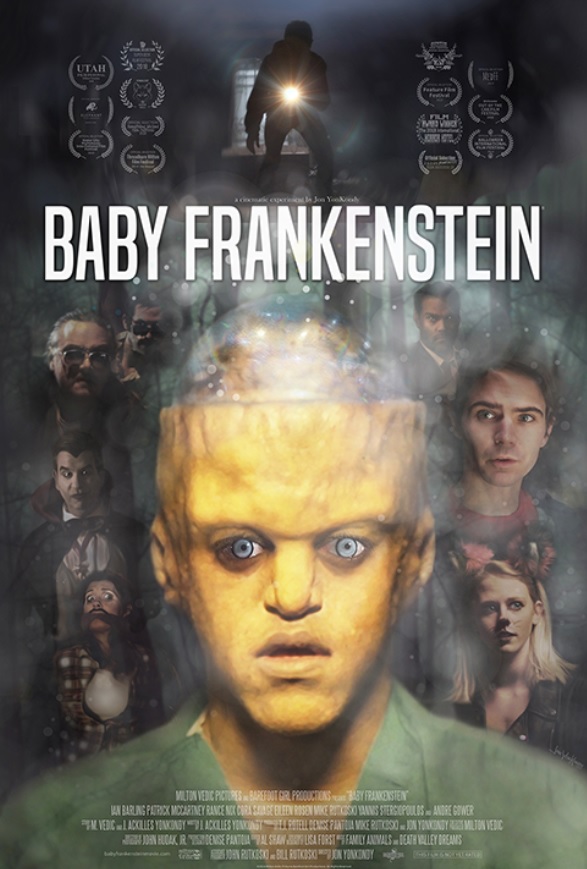
One read of the title. One look at the poster featuring the baby with a plexiglass skull cap. One watch of the trailer. . . .
I’m spider-sensing pure exploitation attitude of the ’80s home video variety: here comes the neon-wireframed VHS tape spinning on another Prism Video production (You Tube). I’ve just got Doc Brown’d to the wacked out worlds of Stuart Gordon’s Re-Animator, the Shapiro-Glickenhaus universe with the twist-fest thats are Ed Hunt’s The Brain and Frank Henenlotter’s Brain Damage and Frankenhooker (the final release from SG), and Fangoria Magazine’s “big studio move” with Severed Ties.
But wait . . . this is a Spielbergian family-friendly comedy-drama monster romp that reminds of Fred Dekker’s 1987 cult classic The Monster Squad (and Fred gave us the “required viewing” wack-fest that is Night of the Creeps) . . . and you know how we love the Dek around these B&S parts in the wilds of Allegheny County, PA.
Bottom line: Baby Frankenstein is pure ’80s VHS nostalgia. So let’s load that tape, the VCR won’t load itself.
Lance, a scruffy teen, develops an unlikely friendship with a pint-sized automated “robot monster” hiding in the attic of his family’s new duplex home. Helping Lance protect “Little Dude” from bounty hunters—including his mom’s sleazy boyfriend clamoring for that $50,000 reward—and Dauvin Lundquist, the evil scientist who created Lil’ Frank, is John (a fine job by screenwriter Mike Rutkoski), his socially awkward landlord and neighbor—who has a crush on Lance’s mom, Kim—and the sassy girl next door, Truth. It all leads to a final showdown where Lance must decide between the safety of his family and friends and the freedom of Baby Frankenstein.
While Baby Frankenstein brings on the analog-memories, this is a film born in the digital world: In the summer of 2015, actor-screenwriter Mike Rutkoski was searching for a director to bring his retro-unconventional script to the big screen (well, in today’s digital epoch: streaming platforms). So he reached out to director Jon YonKondy (the family-adventure Don Quixote and the Pennsylvania-shot Susquehanna) via Facebook. Fourteen months later, the duo finished a film that blazed through its principal photography in seven days in the Wyoming Valley area of Northeastern, Pennsylvania, around the cities of Wilkes-Barre and West Pittston (YonKondy is a West Pittston native; Rutkoski hails from Plains Township; actress Cora Savage is a native of Shickshinny).
Actor Rance Nix as Baby Frankenstein on set at Boscov’s Department Store in Wilkes-Barre, courtesy of Clark Van Orden/Times Leader Wilkes-Barre.
As with the recently reviewed “mature actor” comedy Nana’s Secret Recipe penned by first-time screenwriter Yolanda Avery, Baby Frankenstein is a stellar writing debut for Mike Rutkoski who, like Yolanda Avery, is buoyed by an excellent, under-the-radar cast—headed by Ian Barling (Lance) and Cora Savage (Truth), along with Patrick McCartney (Ken, the boyfriend), Eileen Rosen (Kim, the mom), and Rance Nix, who brings compassion and depth on equal with cinema’s original “big green dude,” Boris Karloff—in a stellar showcase for their talents. And it’s great to see child-teen actor Andre Gower—Sean from The Monster Squad (!)—return to the screen (he left in the late ’80s; returned in 2006) showing his adult thespin’ chops as the evil Dauvin Lundquist. (Channel Surfing Alert: Wading by Antenna TV for “Catch a Falling Star,” a 1984 episode of NBC-TV’s Highway to Heaven . . . there was a pre-Monster Squad Gower as tempermental child actor Tom Barney. Very cool.)
On top of being an enjoyable horror-comedy, Baby Frankenstein—like the new indie-horror favs we’ve recently reviewed, Evil River and The Invisible Mother, and the introspective-drama The In-Between—exposes us to a great alt-rock soundtrack by Family Animals (Facebook) and Death Valley Dreams (Facebook). And being ol’ band and radio dogs here at B&S, we’re always up for discovering new tuneage. I don’t know about you, but the Animals’ “Metal in the Microwave” and DVD’s “Turn out Those Eyes” are as good as any tunes airing on today’s alternative rock stations.
Making the festival rounds and racking up over a dozen awards, the fine folks at Wild Eye Releasing have made this Summer Hill Entertainment and Tomcat Films co-production available on all the usual VOD streaming platforms starting June 30. You can “pick your platform” by visiting the official Baby Frankenstein website and learn more about the film at their official Instragram, You Tube, and Facebook pages.
You need more Pennsylvania-shot film? Check out our recent review of Jake and Andrew Hunsicker’s The Arrangement, shot outside of Philadelphia.
Disclaimer: We were provided a screener by the film’s PR company. That has no bearing on our review.
About the Author: You can learn more about the writings of R.D Francis on Facebook. He also writes for B&S About Movies.


 B&S About Movies
You must be logged in to post a comment.